Innovative
methodologies
for ESL teachersCFPI
08-10-2016
Ruby Vurdien
White Rose Language School
Summary of ELT Methods
 1800 – Grammar Translation Method
 1900 – Direct Method
 1945 – Audio-Lingual Method
 1950 – Silent Way
 1960 – Community Language Learning
 1970 – Suggestopedia
 1970 – Total Physical Response
 1970 - Cognitive Approach
 1980 – Communicative Approach
 1985 – Humanistic Approach
 1987 – Task-Based Language Learning
Grammar Translation Method
 Language theory – learning to translate language for
understanding literature and for writing
 Teacher – strict authority. Students – passive receivers
of new information
 Techniques include:
 Translation of literary passages
 Reading comprehension
 Memorisation
 Composition
Direct Method
 Language theory - Language is for oral use. L1 is
forbidden. Speech in L2 is important
 Teacher – partner and guide. Students – active
participants
 Techniques include:
 Conversation
 Role plays
 Fill in the blanks
 Learn every day vocabulary
Audio-Lingual Method
 Language theory – Language is based on
descriptive linguistics primarily for oral
communication
 Teacher – model, director & controller of
students’ language. Students – imitators
 Techniques include:
 Minimal pairs (pronunciation)
 Grammar games
 Substitution drills
Silent Way
 Language theory – requires visuals for learning
(pronunciation or grammar components)
 Teacher – silent facilitator of learning. Student-student
learning (students assume responsibility for their
learning and collaborate with each other in solving
language problems)
 Techniques include:
 Teaching pronunciation with ‘sound colour charts’
 Peer correction
 Word charts for vocabulary
Community Language Learning
 Language theory - communication, creative
thinking and sharing culture, thereby fostering an
atmosphere of trust in the classroom. L1 can be
used.
 Teacher – counsellor removing threatening factors
from the classroom. Students dependent on
teacher in initial stage
 Techniques include:
 Reflection on experience
 Small group tasks
Suggestopedia
 Language theory – communication is a two-plane
process. Language and psychological/physical
factors influence linguistic message. Errors are
allowed. Confidence is built
 Teacher – authority. Students trust teacher
 Techniques include:
 Classroom set-up for comfort
 Drama
 Music
Total Physical Response
 Language theory – Language is primarily oral.
Use of commands – similar to native language
acquisition. L1 is used at the beginning.
 Teacher – director of students’ behaviour, followed
by students acting as self-director
 Techniques include:
 Commands
 Role reversal
 Action sequence
Cognitive Approach
 Language theory – concepts behind language –
grammar and sets of communicative functions
 Teacher – supplies students with ‘meaningful’ and
‘meaningless’ pattern drills. Students experience
new learning from practising drills
 Techniques include:
 Exchange of information
 Substitution drills
 Collocation
Communicative Approach
 Language theory – language is for development of
communicative competence (meaning & function)
 Teacher – facilitator and monitor. Students –
communicators and active negotiators of meaning
 Techniques include:
 Authentic materials
 Language games
 Fill in the gaps
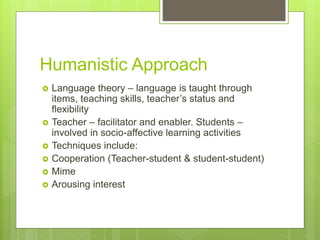
Humanistic Approach
 Language theory – language is taught through
items, teaching skills, teacher’s status and
flexibility
 Teacher – facilitator and enabler. Students –
involved in socio-affective learning activities
 Techniques include:
 Cooperation (Teacher-student & student-student)
 Mime
 Arousing interest
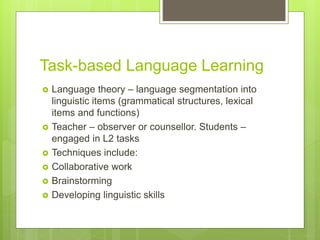
Task-based Language Learning
 Language theory – language segmentation into
linguistic items (grammatical structures, lexical
items and functions)
 Teacher – observer or counsellor. Students –
engaged in L2 tasks
 Techniques include:
 Collaborative work
 Brainstorming
 Developing linguistic skills
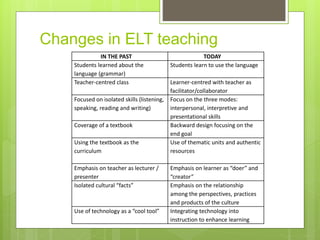
Changes in ELT teaching
IN THE PAST TODAY
Students learned about the
language (grammar)
Students learn to use the language
Teacher-centred class Learner-centred with teacher as
facilitator/collaborator
Focused on isolated skills (listening,
speaking, reading and writing)
Focus on the three modes:
interpersonal, interpretive and
presentational skills
Coverage of a textbook Backward design focusing on the
end goal
Using the textbook as the
curriculum
Use of thematic units and authentic
resources
Emphasis on teacher as lecturer /
presenter
Emphasis on learner as “doer” and
“creator”
Isolated cultural “facts” Emphasis on the relationship
among the perspectives, practices
and products of the culture
Use of technology as a “cool tool” Integrating technology into
instruction to enhance learning
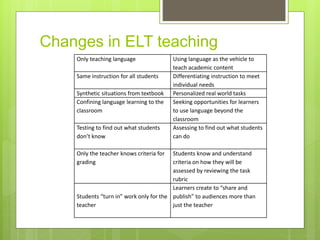
Changes in ELT teaching
Only teaching language Using language as the vehicle to
teach academic content
Same instruction for all students Differentiating instruction to meet
individual needs
Synthetic situations from textbook Personalized real world tasks
Confining language learning to the
classroom
Seeking opportunities for learners
to use language beyond the
classroom
Testing to find out what students
don’t know
Assessing to find out what students
can do
Only the teacher knows criteria for
grading
Students know and understand
criteria on how they will be
assessed by reviewing the task
rubric
Students “turn in” work only for the
teacher
Learners create to “share and
publish” to audiences more than
just the teacher
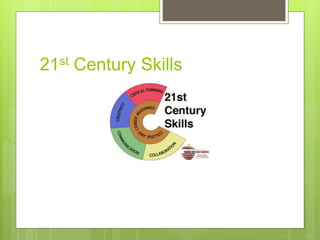
21st Century Skills
Do today’s learners need to learn
special skills?
 ‘Today because of rapid economic and social change,
schools have to prepare students for jobs that have not
yet been created, technologies that have not yet been
invented and problems we don’t yet know will arise’.
Andreas Schleircher, OECD Director of Directorate of
Education and Skills
(Schleircher, A. (2015) The case for 21st century learning)
http://www.oecd.org/general/thecasefor21st-
centurylearning.htm
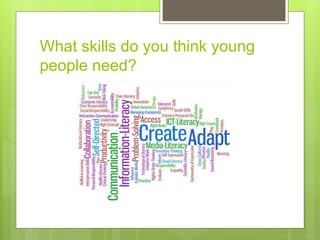
What skills do you think young
people need?
21st Century Education Video
 https://www.youtube.com/watch?v=nA1Aqp0s
PQo
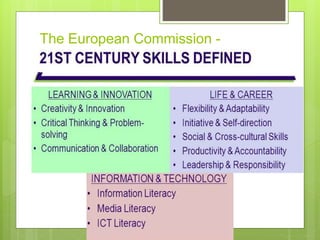
The European Commission -
century skills
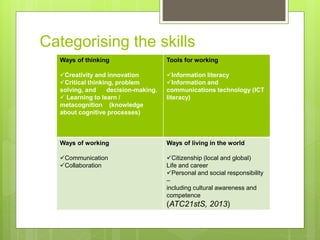
Categorising the skills
Ways of thinking
Creativity and innovation
Critical thinking, problem
solving, and decision-making.
 Learning to learn /
metacognition (knowledge
about cognitive processes)
Tools for working
Information literacy
Information and
communications technology (ICT
literacy)
Ways of working
Communication
Collaboration
Ways of living in the world
Citizenship (local and global)
Life and career
Personal and social responsibility
–
including cultural awareness and
competence
(ATC21stS, 2013)
What is Critical Thinking?
 Reflecting on and judging the assumptions we have
 Exercising sound reasoning in understanding (asking whether
reasons for our beliefs and decisions are any good)
 Understanding the interconnections among systems
Problem-solving
 Identifying and asking significant questions that clarify various
points of view and lead to better solutions
 Framing, analysing and synthesising information in order to solve
and answer questions
Interpreting information
 Being able to paraphrase, summarise, infer, classify, compare
and explain information effectively and accurately
Collaborative Skills
 Articulating thoughts and ideas clearly and effectively
through speaking and writing
 Demonstrating the ability to work effectively with diverse
groups
 Exercising willingness and flexibility to be helpful in making
necessary compromises to achieve a common goal
 Assuming shared responsibility for collaborative work
Communicative Skills
 Articulating thoughts and ideas effectively using oral,
written and non-verbal communication skills in a variety
of forms and contexts
 Using communication for a range of purposes (e.g. to
inform, instruct, motivate and persuade)
 Communicating effectively in diverse multi-lingual
environments
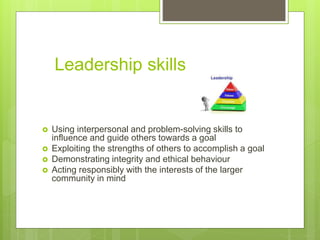
Leadership skills
 Using interpersonal and problem-solving skills to
influence and guide others towards a goal
 Exploiting the strengths of others to accomplish a goal
 Demonstrating integrity and ethical behaviour
 Acting responsibly with the interests of the larger
community in mind
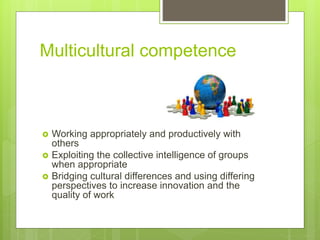
Multicultural competence
 Working appropriately and productively with
others
 Exploiting the collective intelligence of groups
when appropriate
 Bridging cultural differences and using differing
perspectives to increase innovation and the
quality of work
Digital Literacy
 Using digital technology communication tools and/or
networks appropriately to access, manage, integrate,
evaluate and create information in order to function in a
knowledge economy
 Using technology as a tool to research, organise,
evaluate, and communicate information and
understanding of ethical / legal issues surrounding the
access and use of information
THANK YOU!
Whiterose_va@yahoo.es

Innovative methodologies for_esl_teachers_-_ruby

  • 1.
  • 2.
    Summary of ELTMethods  1800 – Grammar Translation Method  1900 – Direct Method  1945 – Audio-Lingual Method  1950 – Silent Way  1960 – Community Language Learning  1970 – Suggestopedia  1970 – Total Physical Response  1970 - Cognitive Approach  1980 – Communicative Approach  1985 – Humanistic Approach  1987 – Task-Based Language Learning
  • 3.
    Grammar Translation Method Language theory – learning to translate language for understanding literature and for writing  Teacher – strict authority. Students – passive receivers of new information  Techniques include:  Translation of literary passages  Reading comprehension  Memorisation  Composition
  • 4.
    Direct Method  Languagetheory - Language is for oral use. L1 is forbidden. Speech in L2 is important  Teacher – partner and guide. Students – active participants  Techniques include:  Conversation  Role plays  Fill in the blanks  Learn every day vocabulary
  • 5.
    Audio-Lingual Method  Languagetheory – Language is based on descriptive linguistics primarily for oral communication  Teacher – model, director & controller of students’ language. Students – imitators  Techniques include:  Minimal pairs (pronunciation)  Grammar games  Substitution drills
  • 6.
    Silent Way  Languagetheory – requires visuals for learning (pronunciation or grammar components)  Teacher – silent facilitator of learning. Student-student learning (students assume responsibility for their learning and collaborate with each other in solving language problems)  Techniques include:  Teaching pronunciation with ‘sound colour charts’  Peer correction  Word charts for vocabulary
  • 7.
    Community Language Learning Language theory - communication, creative thinking and sharing culture, thereby fostering an atmosphere of trust in the classroom. L1 can be used.  Teacher – counsellor removing threatening factors from the classroom. Students dependent on teacher in initial stage  Techniques include:  Reflection on experience  Small group tasks
  • 8.
    Suggestopedia  Language theory– communication is a two-plane process. Language and psychological/physical factors influence linguistic message. Errors are allowed. Confidence is built  Teacher – authority. Students trust teacher  Techniques include:  Classroom set-up for comfort  Drama  Music
  • 9.
    Total Physical Response Language theory – Language is primarily oral. Use of commands – similar to native language acquisition. L1 is used at the beginning.  Teacher – director of students’ behaviour, followed by students acting as self-director  Techniques include:  Commands  Role reversal  Action sequence
  • 10.
    Cognitive Approach  Languagetheory – concepts behind language – grammar and sets of communicative functions  Teacher – supplies students with ‘meaningful’ and ‘meaningless’ pattern drills. Students experience new learning from practising drills  Techniques include:  Exchange of information  Substitution drills  Collocation
  • 11.
    Communicative Approach  Languagetheory – language is for development of communicative competence (meaning & function)  Teacher – facilitator and monitor. Students – communicators and active negotiators of meaning  Techniques include:  Authentic materials  Language games  Fill in the gaps
  • 12.
    Humanistic Approach  Languagetheory – language is taught through items, teaching skills, teacher’s status and flexibility  Teacher – facilitator and enabler. Students – involved in socio-affective learning activities  Techniques include:  Cooperation (Teacher-student & student-student)  Mime  Arousing interest
  • 13.
    Task-based Language Learning Language theory – language segmentation into linguistic items (grammatical structures, lexical items and functions)  Teacher – observer or counsellor. Students – engaged in L2 tasks  Techniques include:  Collaborative work  Brainstorming  Developing linguistic skills
  • 14.
    Changes in ELTteaching IN THE PAST TODAY Students learned about the language (grammar) Students learn to use the language Teacher-centred class Learner-centred with teacher as facilitator/collaborator Focused on isolated skills (listening, speaking, reading and writing) Focus on the three modes: interpersonal, interpretive and presentational skills Coverage of a textbook Backward design focusing on the end goal Using the textbook as the curriculum Use of thematic units and authentic resources Emphasis on teacher as lecturer / presenter Emphasis on learner as “doer” and “creator” Isolated cultural “facts” Emphasis on the relationship among the perspectives, practices and products of the culture Use of technology as a “cool tool” Integrating technology into instruction to enhance learning
  • 15.
    Changes in ELTteaching Only teaching language Using language as the vehicle to teach academic content Same instruction for all students Differentiating instruction to meet individual needs Synthetic situations from textbook Personalized real world tasks Confining language learning to the classroom Seeking opportunities for learners to use language beyond the classroom Testing to find out what students don’t know Assessing to find out what students can do Only the teacher knows criteria for grading Students know and understand criteria on how they will be assessed by reviewing the task rubric Students “turn in” work only for the teacher Learners create to “share and publish” to audiences more than just the teacher
  • 16.
  • 17.
    Do today’s learnersneed to learn special skills?  ‘Today because of rapid economic and social change, schools have to prepare students for jobs that have not yet been created, technologies that have not yet been invented and problems we don’t yet know will arise’. Andreas Schleircher, OECD Director of Directorate of Education and Skills (Schleircher, A. (2015) The case for 21st century learning) http://www.oecd.org/general/thecasefor21st- centurylearning.htm
  • 18.
    What skills doyou think young people need?
  • 19.
    21st Century EducationVideo  https://www.youtube.com/watch?v=nA1Aqp0s PQo
  • 20.
    The European Commission- century skills
  • 21.
    Categorising the skills Waysof thinking Creativity and innovation Critical thinking, problem solving, and decision-making.  Learning to learn / metacognition (knowledge about cognitive processes) Tools for working Information literacy Information and communications technology (ICT literacy) Ways of working Communication Collaboration Ways of living in the world Citizenship (local and global) Life and career Personal and social responsibility – including cultural awareness and competence (ATC21stS, 2013)
  • 22.
    What is CriticalThinking?  Reflecting on and judging the assumptions we have  Exercising sound reasoning in understanding (asking whether reasons for our beliefs and decisions are any good)  Understanding the interconnections among systems
  • 23.
    Problem-solving  Identifying andasking significant questions that clarify various points of view and lead to better solutions  Framing, analysing and synthesising information in order to solve and answer questions
  • 24.
    Interpreting information  Beingable to paraphrase, summarise, infer, classify, compare and explain information effectively and accurately
  • 25.
    Collaborative Skills  Articulatingthoughts and ideas clearly and effectively through speaking and writing  Demonstrating the ability to work effectively with diverse groups  Exercising willingness and flexibility to be helpful in making necessary compromises to achieve a common goal  Assuming shared responsibility for collaborative work
  • 26.
    Communicative Skills  Articulatingthoughts and ideas effectively using oral, written and non-verbal communication skills in a variety of forms and contexts  Using communication for a range of purposes (e.g. to inform, instruct, motivate and persuade)  Communicating effectively in diverse multi-lingual environments
  • 27.
    Leadership skills  Usinginterpersonal and problem-solving skills to influence and guide others towards a goal  Exploiting the strengths of others to accomplish a goal  Demonstrating integrity and ethical behaviour  Acting responsibly with the interests of the larger community in mind
  • 28.
    Multicultural competence  Workingappropriately and productively with others  Exploiting the collective intelligence of groups when appropriate  Bridging cultural differences and using differing perspectives to increase innovation and the quality of work
  • 29.
    Digital Literacy  Usingdigital technology communication tools and/or networks appropriately to access, manage, integrate, evaluate and create information in order to function in a knowledge economy  Using technology as a tool to research, organise, evaluate, and communicate information and understanding of ethical / legal issues surrounding the access and use of information
  • 30.