 In simpler terms, it is the FUNCTIONAL/USABLE
language.
 Reading, writing, speaking and listening are all necessary
parts of communicative competence. (e.g. reading a
menu, ordering the food, or filling in an application form
to work at the restaurant)
 Language learning is also dependent upon the ability of
people to interact purposefully with others in a variety of
cultural and social contexts
The communicative style of language
teaching began in the 1970s and developed in
response to a growing dissatisfaction with
prevailing methodologies, and in recognition
of theoretical advances. It is not the direct
result of any one way of looking at language
and language learning, but is effectively the
outcome of contributions given by the
various different approaches.
It started with Chomsky’s Cognitive
Approach, paying particular attention to his
distinction between performance and
linguistic competence, and was developed by
the socio-linguist, Hymes, and then
subsequently by countless others.
 Its origins are many, insofar as one teaching
methodology tends to influence the next. The
communicative approach could be said to be
the product of educators and linguists who
had grown dissatisfied with the audio-lingual
and grammar-translation methods of foreign
language instruction.
 They felt that students were not learning enough
realistic, whole language. They did not know how to
communicate using appropriate social language,
gestures, or expressions; in brief, they were at a loss
to communicate in the culture of the language
studied. Interest in and development of
communicative-style teaching mushroomed in the
1970s; authentic language use and classroom
exchanges where students engaged in real
communication with one another became quite
popular.
 In the 70s, grammar was even completely abandoned by some
who assumed students would naturally pick it up via
communicative learning, but due to a sharp decline in learner
accuracy and the realization that grammatical accuracy is a
necessary part of linguistic competence and communication, the
communicative teaching of grammar was integrated into the
overall approach. Grammar was “necessary, but not sufficient”
(McDonough and Shaw 1993:25) and the language learner has a
whole bunch of other things to keep in mind too, such as:
 1. The social and cultural rules which apply to the context or
situation.
 2. The relationship between the interactants.
 3. The purpose of the communication.
 4. The topic.
 5. How to use the channel of communication (spoken or written)
for a specific purpose
 Communicative language teaching makes use
of real-life situations that necessitate
communication. The teacher sets up a situation
that students are likely to encounter in real life.
 Communicative approach seeks to
personalize and localize language and
adapt it to interests of pupils. Meaningful
language is always more easily retained by
learners.
 Communicative approach is not just limited to
oral skills. Reading and writing skills need to be
developed to promote pupils' confidence in all
four skill areas. By using elements encountered
in variety of ways (reading/ summarizing/
translating/ discussion/ debates) - makes
language more fluid and pupils' manipulation of
language more fluent.
 Communicative approach seeks to use
authentic resources. More interesting and
motivating..
Authentic texts that can serve as partial
substitute for community of native speaker:
•Newspaper and magazine articles,
•poems,
• manuals,
• recipes,
• telephone directories,
• videos,
• news bulletins,
• discussion programs
1. Focuses on language as a medium of
communication. Recognizes that all
communication has a social purpose - learner
has something to say or find out.
2. Classroom activities maximize opportunities for
learners to use target language in a communicative
way for meaningful activities. Emphasis on meaning
(messages they are creating or task they are
completing) rather than form (correctness of
language and language structure) - as in first
language acquisition.
3. Use of target language as normal medium for
classroom management and instruction.
4. More emphasis on active modes of learning, including
pair work and group-work.
5. Primacy of oral work. Emphasis on oral and listening
skills in the classroom.
6. Errors are a natural part of learning language.
Learners trying their best to use the language creatively
and spontaneously are bound to make errors. Constant
correction is unnecessary and even counter-productive.
Correction should be discreet / noted by teacher - let
them talk and express themselves - form of language
becomes secondary.
7. Use of idiomatic/ everyday language. This is kind of language used in
communication between people - not a 'medium'/ grammatical/ exam-
orientated/ formal language!
8. Activities are based on real-life communication because that is what
we learn languages for, e.g. “This is my friend, Keiko. She’s from
Japan”, raher than “This is a pen. That is a pencil”.
9. Activities are task-based in which language is used for a purpose,
often based on an information gap and/or the sharing of information
to achieve such a communicative purpose, e.g. selling fruit, making an
appointment, a class survey or debating the pros and cons of school
uniform.
10. Use of pair-work and group-work activities is common as well as
individual and also teacher-led activities. Varied types of interaction
are encouraged and nurtured. Learners hear more types of language
from different sources, interact with more people, use language in
context, hear it repeated, rephrased and clarified, ask and answer
questions, build confidence and don’t have to speak in front of the
entire class.
11. Avoid age-old texts - materials must relate to
pupils' own lives / must be fresh and real
Changing texts and materials regularly keeps teacher
on toes and pupils interested.
12. Use of visual stimuli - OHP/ flashcards, etc -
important to provoke practical communicative
language. (3 stages presentation / assimilation/
reproducing language in creative and spontaneous
way).
13. Visual resources can be exploited at whatever
level one wishes - help to motivate and focus
pupils' attention.
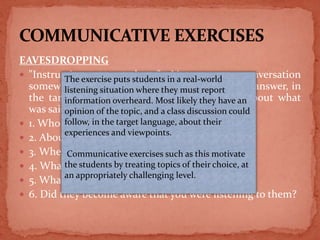
EAVESDROPPING
 "Instructions to students" Listen to a conversation
somewhere in a public place and be prepared to answer, in
the target language, some general questions about what
was said.
 1. Who was talking?
 2. About how old were they?
 3. Where were they when you eavesdropped?
 4. What were they talking about?
 5. What did they say?
 6. Did they become aware that you were listening to them?
The exercise puts students in a real-world
listening situation where they must report
information overheard. Most likely they have an
opinion of the topic, and a class discussion could
follow, in the target language, about their
experiences and viewpoints.
Communicative exercises such as this motivate
the students by treating topics of their choice, at
an appropriately challenging level.
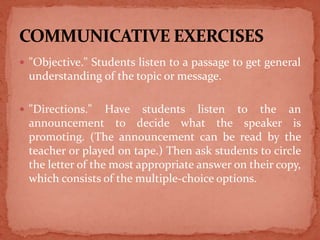
 "Objective." Students listen to a passage to get general
understanding of the topic or message.
 "Directions." Have students listen to the an
announcement to decide what the speaker is
promoting. (The announcement can be read by the
teacher or played on tape.) Then ask students to circle
the letter of the most appropriate answer on their copy,
which consists of the multiple-choice options.
 A classroom during a communicative activity is far from
quiet
 and frequently the scene of a classroom during a
communicative exercise is active, with students leaving their
seats to complete a task.
 Classroom should provide opportunities for rehearsal of
real-life situations and provide opportunity for real
communication. Emphasis on creative role-plays/
simulations/ surveys/ projects/ playlets - all produce
spontaneity and improvisation - not just repetition and
drills.
 Teachers in communicative classrooms will find
themselves talking less and listening more—
 becoming active facilitators of their students' learning
(Larsen-Freeman, 1986).
 The teacher sets up the exercise, but because the
students' performance is the goal, the teacher must
step back and observe, sometimes acting as referee or
monitor.
 Students are more responsible managers of their own
learning.
 The students do most of the speaking
 practicing sounds themselves, permutating sentence
patterns and getting chance to make mistakes and
learn from doing so.
 The real-life simulations change from day to day.
 Students' motivation to learn comes from their desire
to communicate in meaningful ways about meaningful
topics .
 Because of the increased responsibility to participate,
students may find they gain confidence in using the
target language in general .
 No environment of ESL
 Difficulty in evaluating students’ performance
 Ignore the training of reading and writing

Communicative language approach

  • 2.
     In simplerterms, it is the FUNCTIONAL/USABLE language.  Reading, writing, speaking and listening are all necessary parts of communicative competence. (e.g. reading a menu, ordering the food, or filling in an application form to work at the restaurant)  Language learning is also dependent upon the ability of people to interact purposefully with others in a variety of cultural and social contexts
  • 4.
    The communicative styleof language teaching began in the 1970s and developed in response to a growing dissatisfaction with prevailing methodologies, and in recognition of theoretical advances. It is not the direct result of any one way of looking at language and language learning, but is effectively the outcome of contributions given by the various different approaches.
  • 5.
    It started withChomsky’s Cognitive Approach, paying particular attention to his distinction between performance and linguistic competence, and was developed by the socio-linguist, Hymes, and then subsequently by countless others.
  • 6.
     Its originsare many, insofar as one teaching methodology tends to influence the next. The communicative approach could be said to be the product of educators and linguists who had grown dissatisfied with the audio-lingual and grammar-translation methods of foreign language instruction.
  • 7.
     They feltthat students were not learning enough realistic, whole language. They did not know how to communicate using appropriate social language, gestures, or expressions; in brief, they were at a loss to communicate in the culture of the language studied. Interest in and development of communicative-style teaching mushroomed in the 1970s; authentic language use and classroom exchanges where students engaged in real communication with one another became quite popular.
  • 8.
     In the70s, grammar was even completely abandoned by some who assumed students would naturally pick it up via communicative learning, but due to a sharp decline in learner accuracy and the realization that grammatical accuracy is a necessary part of linguistic competence and communication, the communicative teaching of grammar was integrated into the overall approach. Grammar was “necessary, but not sufficient” (McDonough and Shaw 1993:25) and the language learner has a whole bunch of other things to keep in mind too, such as:  1. The social and cultural rules which apply to the context or situation.  2. The relationship between the interactants.  3. The purpose of the communication.  4. The topic.  5. How to use the channel of communication (spoken or written) for a specific purpose
  • 10.
     Communicative languageteaching makes use of real-life situations that necessitate communication. The teacher sets up a situation that students are likely to encounter in real life.  Communicative approach seeks to personalize and localize language and adapt it to interests of pupils. Meaningful language is always more easily retained by learners.
  • 11.
     Communicative approachis not just limited to oral skills. Reading and writing skills need to be developed to promote pupils' confidence in all four skill areas. By using elements encountered in variety of ways (reading/ summarizing/ translating/ discussion/ debates) - makes language more fluid and pupils' manipulation of language more fluent.
  • 12.
     Communicative approachseeks to use authentic resources. More interesting and motivating.. Authentic texts that can serve as partial substitute for community of native speaker: •Newspaper and magazine articles, •poems, • manuals, • recipes, • telephone directories, • videos, • news bulletins, • discussion programs
  • 14.
    1. Focuses onlanguage as a medium of communication. Recognizes that all communication has a social purpose - learner has something to say or find out. 2. Classroom activities maximize opportunities for learners to use target language in a communicative way for meaningful activities. Emphasis on meaning (messages they are creating or task they are completing) rather than form (correctness of language and language structure) - as in first language acquisition.
  • 15.
    3. Use oftarget language as normal medium for classroom management and instruction. 4. More emphasis on active modes of learning, including pair work and group-work. 5. Primacy of oral work. Emphasis on oral and listening skills in the classroom. 6. Errors are a natural part of learning language. Learners trying their best to use the language creatively and spontaneously are bound to make errors. Constant correction is unnecessary and even counter-productive. Correction should be discreet / noted by teacher - let them talk and express themselves - form of language becomes secondary.
  • 16.
    7. Use ofidiomatic/ everyday language. This is kind of language used in communication between people - not a 'medium'/ grammatical/ exam- orientated/ formal language! 8. Activities are based on real-life communication because that is what we learn languages for, e.g. “This is my friend, Keiko. She’s from Japan”, raher than “This is a pen. That is a pencil”. 9. Activities are task-based in which language is used for a purpose, often based on an information gap and/or the sharing of information to achieve such a communicative purpose, e.g. selling fruit, making an appointment, a class survey or debating the pros and cons of school uniform. 10. Use of pair-work and group-work activities is common as well as individual and also teacher-led activities. Varied types of interaction are encouraged and nurtured. Learners hear more types of language from different sources, interact with more people, use language in context, hear it repeated, rephrased and clarified, ask and answer questions, build confidence and don’t have to speak in front of the entire class.
  • 17.
    11. Avoid age-oldtexts - materials must relate to pupils' own lives / must be fresh and real Changing texts and materials regularly keeps teacher on toes and pupils interested. 12. Use of visual stimuli - OHP/ flashcards, etc - important to provoke practical communicative language. (3 stages presentation / assimilation/ reproducing language in creative and spontaneous way). 13. Visual resources can be exploited at whatever level one wishes - help to motivate and focus pupils' attention.
  • 19.
    EAVESDROPPING  "Instructions tostudents" Listen to a conversation somewhere in a public place and be prepared to answer, in the target language, some general questions about what was said.  1. Who was talking?  2. About how old were they?  3. Where were they when you eavesdropped?  4. What were they talking about?  5. What did they say?  6. Did they become aware that you were listening to them? The exercise puts students in a real-world listening situation where they must report information overheard. Most likely they have an opinion of the topic, and a class discussion could follow, in the target language, about their experiences and viewpoints. Communicative exercises such as this motivate the students by treating topics of their choice, at an appropriately challenging level.
  • 20.
     "Objective." Studentslisten to a passage to get general understanding of the topic or message.  "Directions." Have students listen to the an announcement to decide what the speaker is promoting. (The announcement can be read by the teacher or played on tape.) Then ask students to circle the letter of the most appropriate answer on their copy, which consists of the multiple-choice options.
  • 22.
     A classroomduring a communicative activity is far from quiet  and frequently the scene of a classroom during a communicative exercise is active, with students leaving their seats to complete a task.  Classroom should provide opportunities for rehearsal of real-life situations and provide opportunity for real communication. Emphasis on creative role-plays/ simulations/ surveys/ projects/ playlets - all produce spontaneity and improvisation - not just repetition and drills.
  • 23.
     Teachers incommunicative classrooms will find themselves talking less and listening more—  becoming active facilitators of their students' learning (Larsen-Freeman, 1986).  The teacher sets up the exercise, but because the students' performance is the goal, the teacher must step back and observe, sometimes acting as referee or monitor.
  • 24.
     Students aremore responsible managers of their own learning.  The students do most of the speaking  practicing sounds themselves, permutating sentence patterns and getting chance to make mistakes and learn from doing so.
  • 25.
     The real-lifesimulations change from day to day.  Students' motivation to learn comes from their desire to communicate in meaningful ways about meaningful topics .  Because of the increased responsibility to participate, students may find they gain confidence in using the target language in general .
  • 26.
     No environmentof ESL  Difficulty in evaluating students’ performance  Ignore the training of reading and writing

Editor's Notes

  • #16 -4 reflects naturalistic language acquisition. 5 often not exploited enough by teachers fearful of noisy class.