SOFT PALATE for MBBS
13-May-17 Muhammed Asif 1
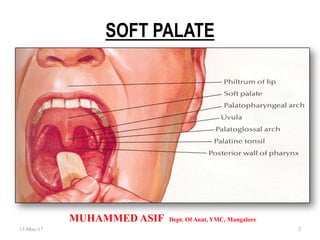
SOFT PALATE
13-May-17 2
MUHAMMED ASIF Dept. Of Anat, YMC, Mangalore
• Soft palate (5marks)
– Introduction
– Muscles
– Development
– Clinical anatomy
13-May-17 3Muhammed Asif
 Mucous covered fibro-musculo-glandular curtain.
 Present at the posterior margin of hard palate.
 Extends backwards & downwards between the nasal & oral
parts of the pharynx. It has
1. Anterior third is fibrous.
2. Middle third is muscular.
3. Posterior third is glandular.
13-May-17 4Muhammed Asif
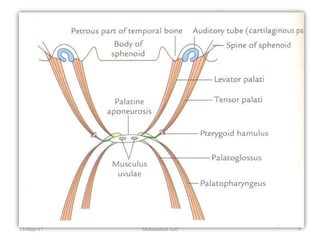
• Soft palate encloses following
 Palatine aponeusosis
 Muscles:
1) Tensor veli palatini.
2) Levator veli palatini.
3) Musculus uvulae.
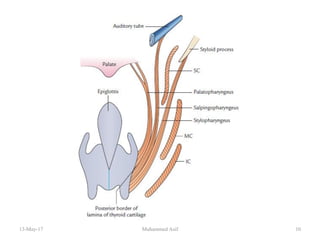
4) Palatoglossus.
5) Palatopharyngeus.
13-May-17 5Muhammed Asif
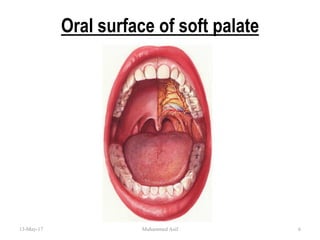
Oral surface of soft palate
13-May-17 6Muhammed Asif
 External feature :
• Two borders : Superior and Inferior .
• Two surfaces : Anterior and Posterior.
– Superior border
• is attached to the posterior border of the hard palate.
– Inferior border is free ,
• a conical tongue like small projection called uvula.
• Each side of uvula : two mucous membrane folds
1) palatoglossus fold.
2) palatopharyngeal fold.
• Anterior (oral) surface : concave and marked by a median raphe.
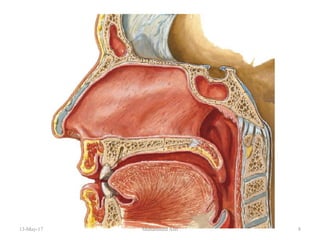
• Posterior surface : convex and continuous with nasal cavity.
13-May-17 7Muhammed Asif
13-May-17 8Muhammed Asif
13-May-17 9Muhammed Asif
13-May-17 10Muhammed Asif
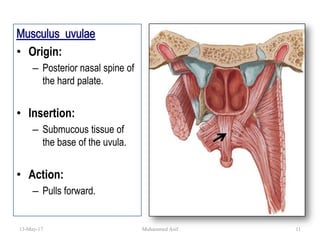
• Origin:
– Posterior nasal spine of
the hard palate.
• Insertion:
– Submucous tissue of
the base of the uvula.
• Action:
– Pulls forward.
13-May-17 11Muhammed Asif
• Arterial supply:
– Greater palatine branch of maxillary artery.
– Ascending palatine branch of facial artery.
– Palatine branch of ascending pharyngeal artery.
• Veins:
– Drain into pharyngeal venous plexus.via para-tonsillar veins.
• Lymphatic drainage:
- Drains into retropharyngeal, upper group of deep cervical
lymph nodes.
13-May-17 12Muhammed Asif
 Nerve supply :
• Motor :
1) All the muscles are supplied by cranial root of spinal accessory via
vagus nerve .
2) Except the tensor veli palatini supplied by medial pterygoid , a branch of
mandibular nerve.
• Sensory:
– General supply :
1. lesser palatine nerve (maxillary nerve) through pterygopalatine
ganglion.
2. Glossopharyngeal nerve.
– secretomotor nerves : lesser palatine nerve.
13-May-17 13Muhammed Asif
Clinical aspects
• Paralysis of the soft palate
– Nasal regurgitation of fluids
– Disturbance of the voice
– Flattening of the palatal arch
13-May-17 14Muhammed Asif
1. Plays an important role in chewing swallowing, speech,
coughing, sneezing etc.
2. Isolates the mouth from the oropharynx during chewing so that
breathing is unaffected.
3. Separates the oropharynx from the nasopharynx during the 2nd
stage of the swallowing so that food does not enter the nose.
4. By varying the degree of closure of the pharyngeal isthmus, the
quality of voice can be modified.
Movements and functions of the soft palate:
13-May-17 15Muhammed Asif
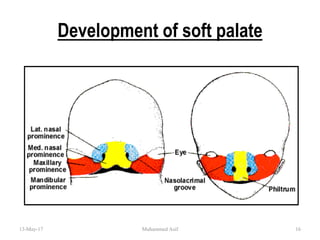
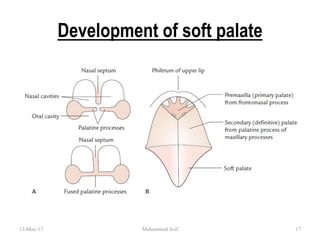
Development of soft palate
13-May-17 16Muhammed Asif
Development of soft palate
13-May-17 17Muhammed Asif
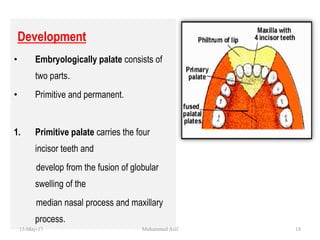
Development
• Embryologically palate consists of
two parts.
• Primitive and permanent.
1. Primitive palate carries the four
incisor teeth and
develop from the fusion of globular
swelling of the
median nasal process and maxillary
process.
13-May-17 18Muhammed Asif
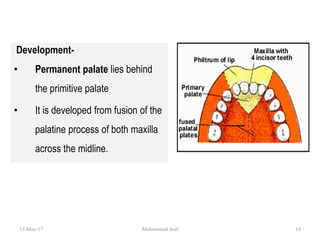
Development-
• Permanent palate lies behind
the primitive palate
• It is developed from fusion of the
palatine process of both maxilla
across the midline.
13-May-17 19Muhammed Asif
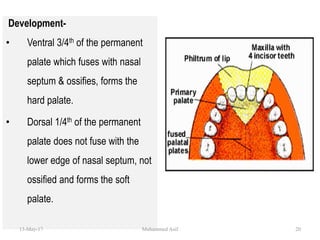
Development-
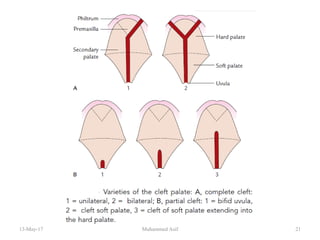
• Ventral 3/4th of the permanent
palate which fuses with nasal
septum & ossifies, forms the
hard palate.
• Dorsal 1/4th of the permanent
palate does not fuse with the
lower edge of nasal septum, not
ossified and forms the soft
palate.
13-May-17 20Muhammed Asif
13-May-17 21Muhammed Asif

Soft palate for MBBS

  • 1.
    SOFT PALATE forMBBS 13-May-17 Muhammed Asif 1
  • 2.
    SOFT PALATE 13-May-17 2 MUHAMMEDASIF Dept. Of Anat, YMC, Mangalore
  • 3.
    • Soft palate(5marks) – Introduction – Muscles – Development – Clinical anatomy 13-May-17 3Muhammed Asif
  • 4.
     Mucous coveredfibro-musculo-glandular curtain.  Present at the posterior margin of hard palate.  Extends backwards & downwards between the nasal & oral parts of the pharynx. It has 1. Anterior third is fibrous. 2. Middle third is muscular. 3. Posterior third is glandular. 13-May-17 4Muhammed Asif
  • 5.
    • Soft palateencloses following  Palatine aponeusosis  Muscles: 1) Tensor veli palatini. 2) Levator veli palatini. 3) Musculus uvulae. 4) Palatoglossus. 5) Palatopharyngeus. 13-May-17 5Muhammed Asif
  • 6.
    Oral surface ofsoft palate 13-May-17 6Muhammed Asif
  • 7.
     External feature: • Two borders : Superior and Inferior . • Two surfaces : Anterior and Posterior. – Superior border • is attached to the posterior border of the hard palate. – Inferior border is free , • a conical tongue like small projection called uvula. • Each side of uvula : two mucous membrane folds 1) palatoglossus fold. 2) palatopharyngeal fold. • Anterior (oral) surface : concave and marked by a median raphe. • Posterior surface : convex and continuous with nasal cavity. 13-May-17 7Muhammed Asif
  • 8.
  • 9.
  • 10.
  • 11.
    • Origin: – Posteriornasal spine of the hard palate. • Insertion: – Submucous tissue of the base of the uvula. • Action: – Pulls forward. 13-May-17 11Muhammed Asif
  • 12.
    • Arterial supply: –Greater palatine branch of maxillary artery. – Ascending palatine branch of facial artery. – Palatine branch of ascending pharyngeal artery. • Veins: – Drain into pharyngeal venous plexus.via para-tonsillar veins. • Lymphatic drainage: - Drains into retropharyngeal, upper group of deep cervical lymph nodes. 13-May-17 12Muhammed Asif
  • 13.
     Nerve supply: • Motor : 1) All the muscles are supplied by cranial root of spinal accessory via vagus nerve . 2) Except the tensor veli palatini supplied by medial pterygoid , a branch of mandibular nerve. • Sensory: – General supply : 1. lesser palatine nerve (maxillary nerve) through pterygopalatine ganglion. 2. Glossopharyngeal nerve. – secretomotor nerves : lesser palatine nerve. 13-May-17 13Muhammed Asif
  • 14.
    Clinical aspects • Paralysisof the soft palate – Nasal regurgitation of fluids – Disturbance of the voice – Flattening of the palatal arch 13-May-17 14Muhammed Asif
  • 15.
    1. Plays animportant role in chewing swallowing, speech, coughing, sneezing etc. 2. Isolates the mouth from the oropharynx during chewing so that breathing is unaffected. 3. Separates the oropharynx from the nasopharynx during the 2nd stage of the swallowing so that food does not enter the nose. 4. By varying the degree of closure of the pharyngeal isthmus, the quality of voice can be modified. Movements and functions of the soft palate: 13-May-17 15Muhammed Asif
  • 16.
    Development of softpalate 13-May-17 16Muhammed Asif
  • 17.
    Development of softpalate 13-May-17 17Muhammed Asif
  • 18.
    Development • Embryologically palateconsists of two parts. • Primitive and permanent. 1. Primitive palate carries the four incisor teeth and develop from the fusion of globular swelling of the median nasal process and maxillary process. 13-May-17 18Muhammed Asif
  • 19.
    Development- • Permanent palatelies behind the primitive palate • It is developed from fusion of the palatine process of both maxilla across the midline. 13-May-17 19Muhammed Asif
  • 20.
    Development- • Ventral 3/4thof the permanent palate which fuses with nasal septum & ossifies, forms the hard palate. • Dorsal 1/4th of the permanent palate does not fuse with the lower edge of nasal septum, not ossified and forms the soft palate. 13-May-17 20Muhammed Asif
  • 21.