The Nature of Memory
& Schema Theory
Today’s Goals
 I can explain what memory is and begin to explain how it
works.
 C5- Evaluate schema theory with reference to research
studies.
Warm Up
 Listen to the following story. Do not take notes.
Memory Quotations Warm-Up
Read the quotations on memory with your group
and make a list of the three which you think are
most effective at describing the nature of memory.
Be prepared to share and defend your choices.
What is Memory?
The capacity to retain and retrieve
information, and also the mental structures
that account for this capacity.
Explicit Memory  Declarative Memory
Implicit Memory  Procedural Memory
Explicit Memories
Explicit Memory – Conscious, intentional
recollection of an event or an item of
information.
Declarative Memory – Memories that can be
consciously recalled such as facts and details.
 Recall- Retrieve and reproduce memory from previously
encountered material.
 Recognition – The ability to identify previously encountered
material.
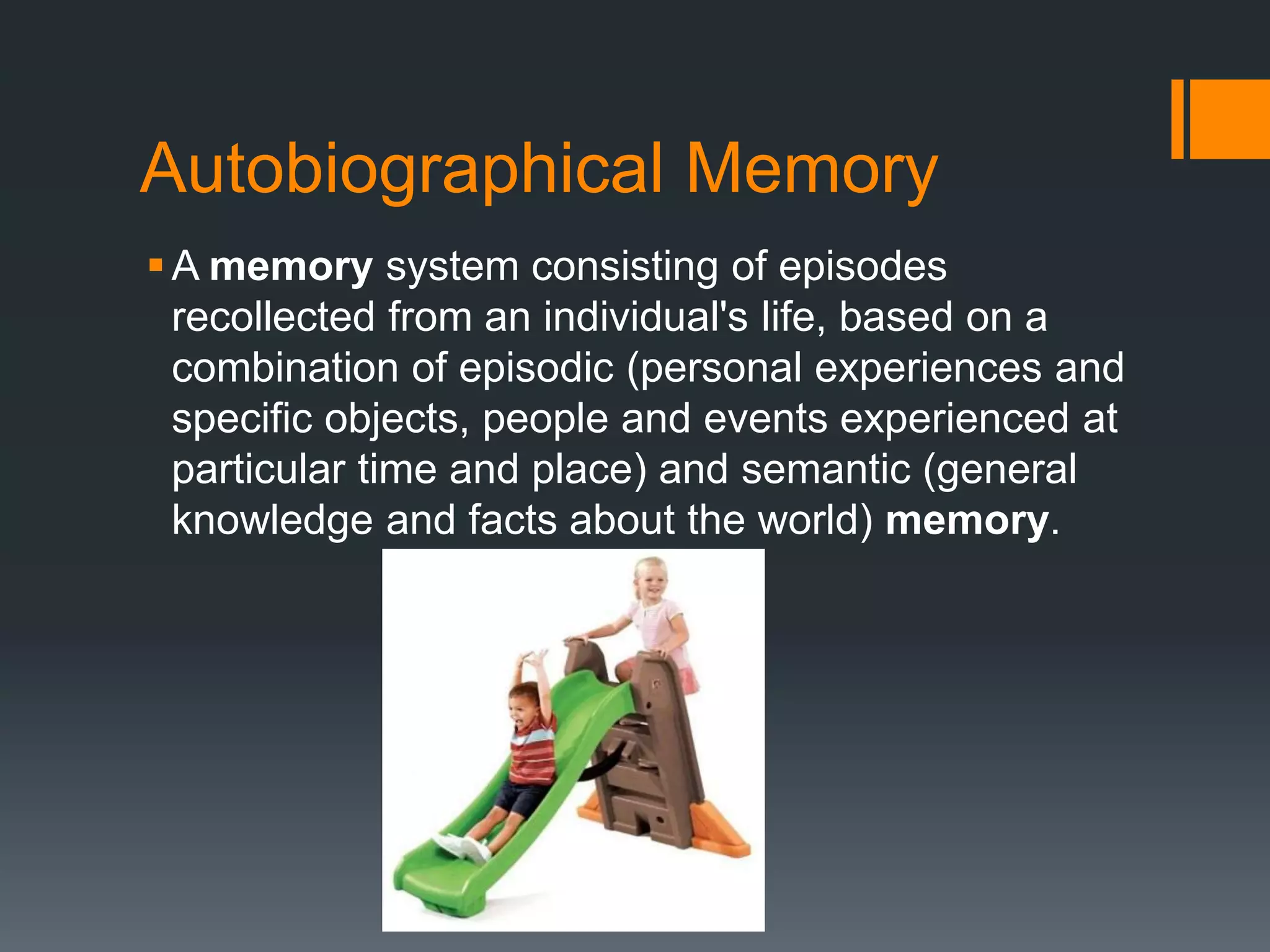
Autobiographical Memory
A memory system consisting of episodes
recollected from an individual's life, based on a
combination of episodic (personal experiences and
specific objects, people and events experienced at
particular time and place) and semantic (general
knowledge and facts about the world) memory.
Challenge
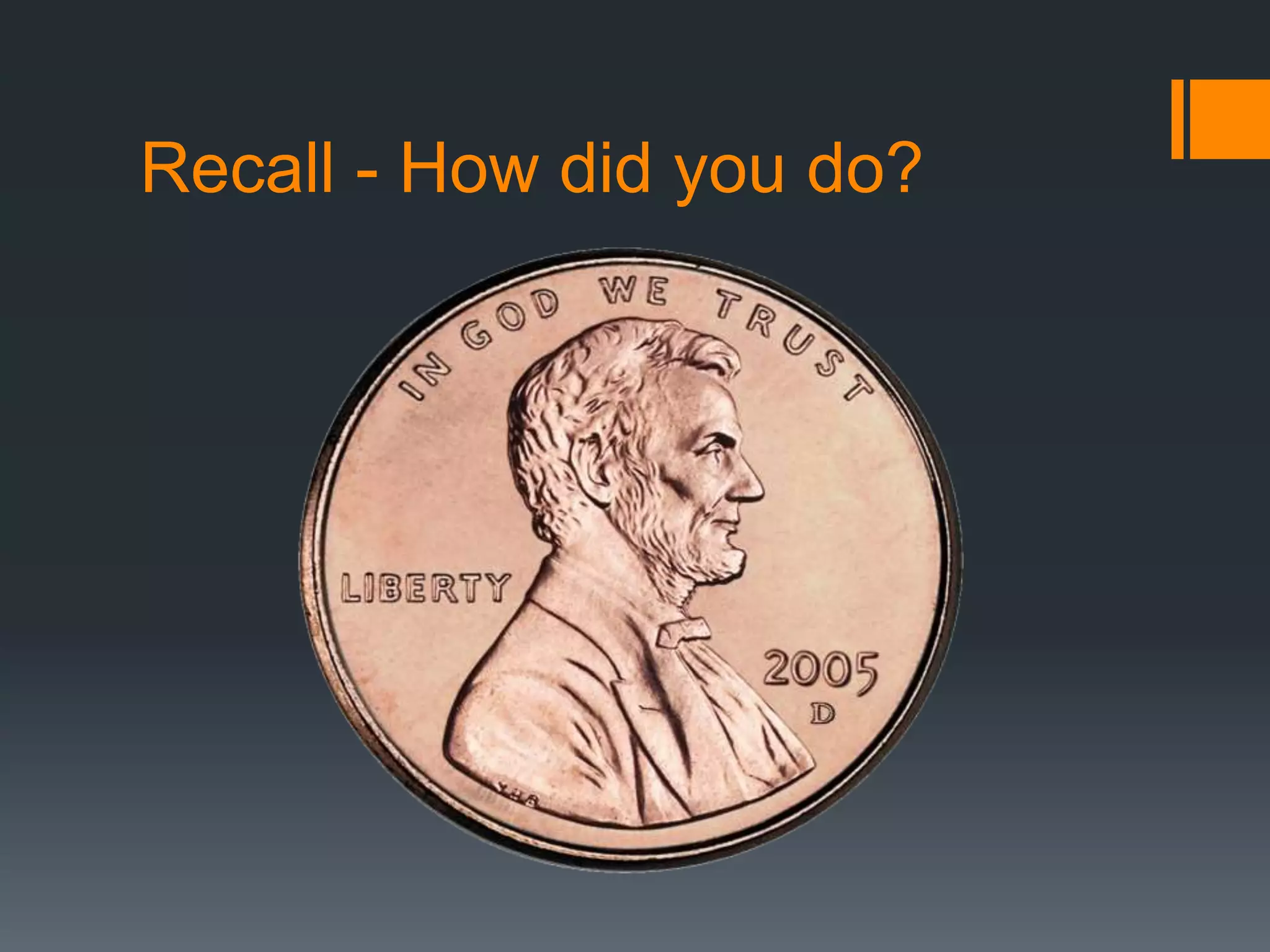
Draw the heads side of a penny.
Recall - How did you do?
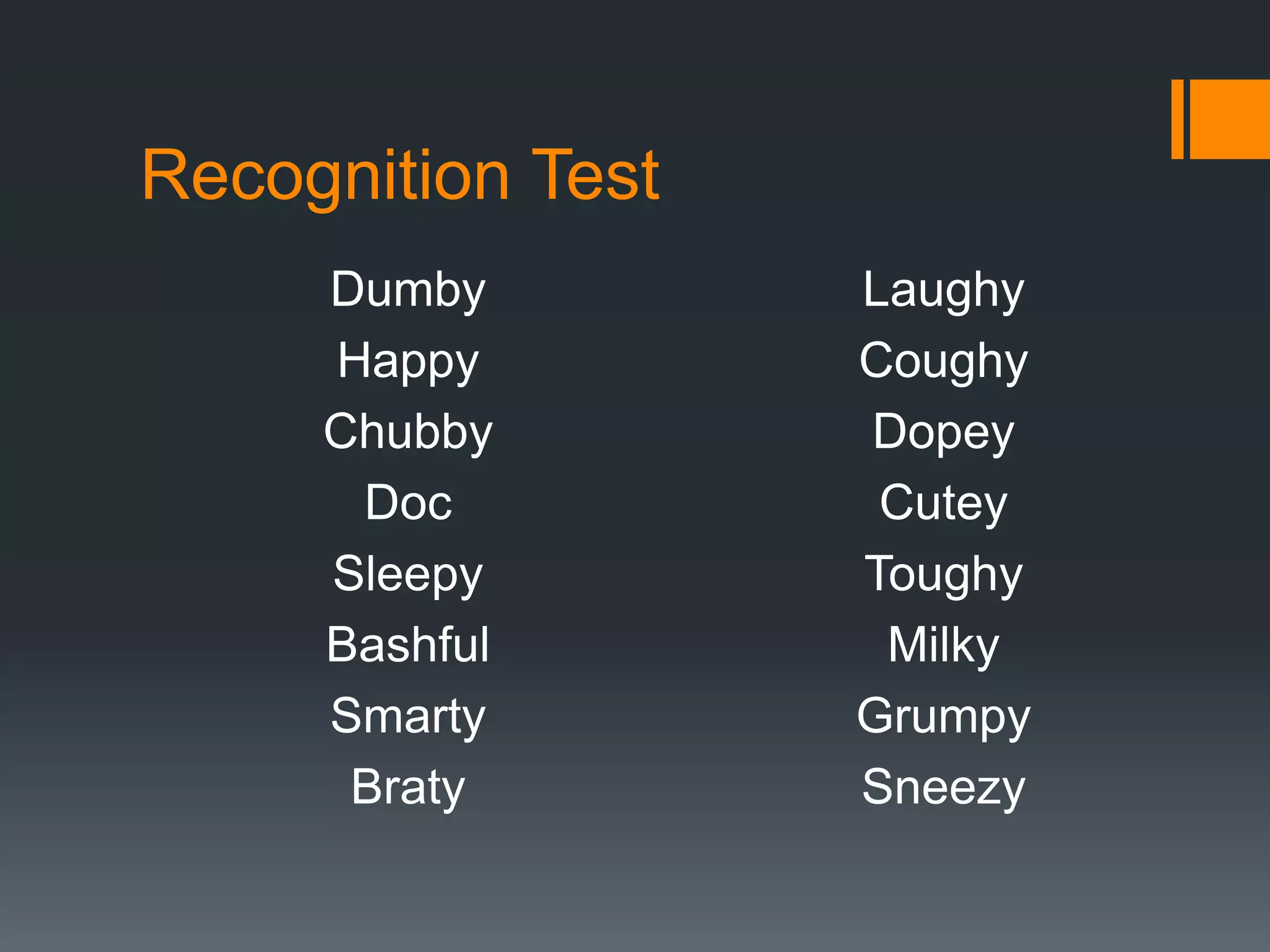
Recognition Test
Dumby
Happy
Chubby
Doc
Sleepy
Bashful
Smarty
Braty
Laughy
Coughy
Dopey
Cutey
Toughy
Milky
Grumpy
Sneezy
Implicit Memory
• Implicit Memory - The unconscious retention of
previous experiences that creep into our current
thoughts/actions.
• Procedural Memories- Memories that help you
perform certain procedures and tasks.
Early Research into Memory
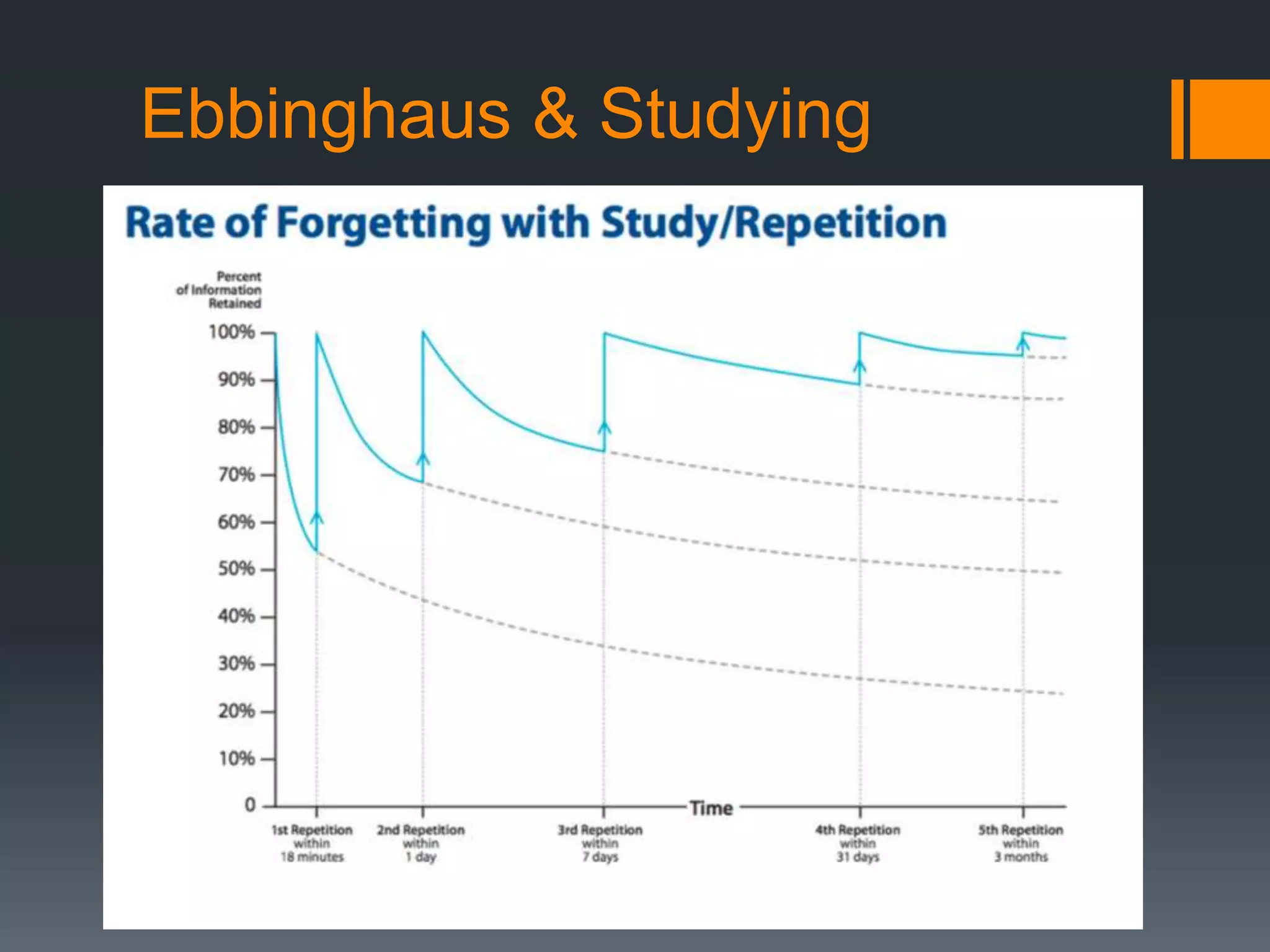
Ebbinghaus – 1885
Used self as subject
Tested his memory using lists of 3-letter
nonsense syllables (like KAF, PEB, LEV)
Nonsense because he didn’t want his existing
knowledge to be able to help out his memory
Method: Relearning Task – Learned a list,
set it aside for a period of time, then later
relearned the material to the same level.
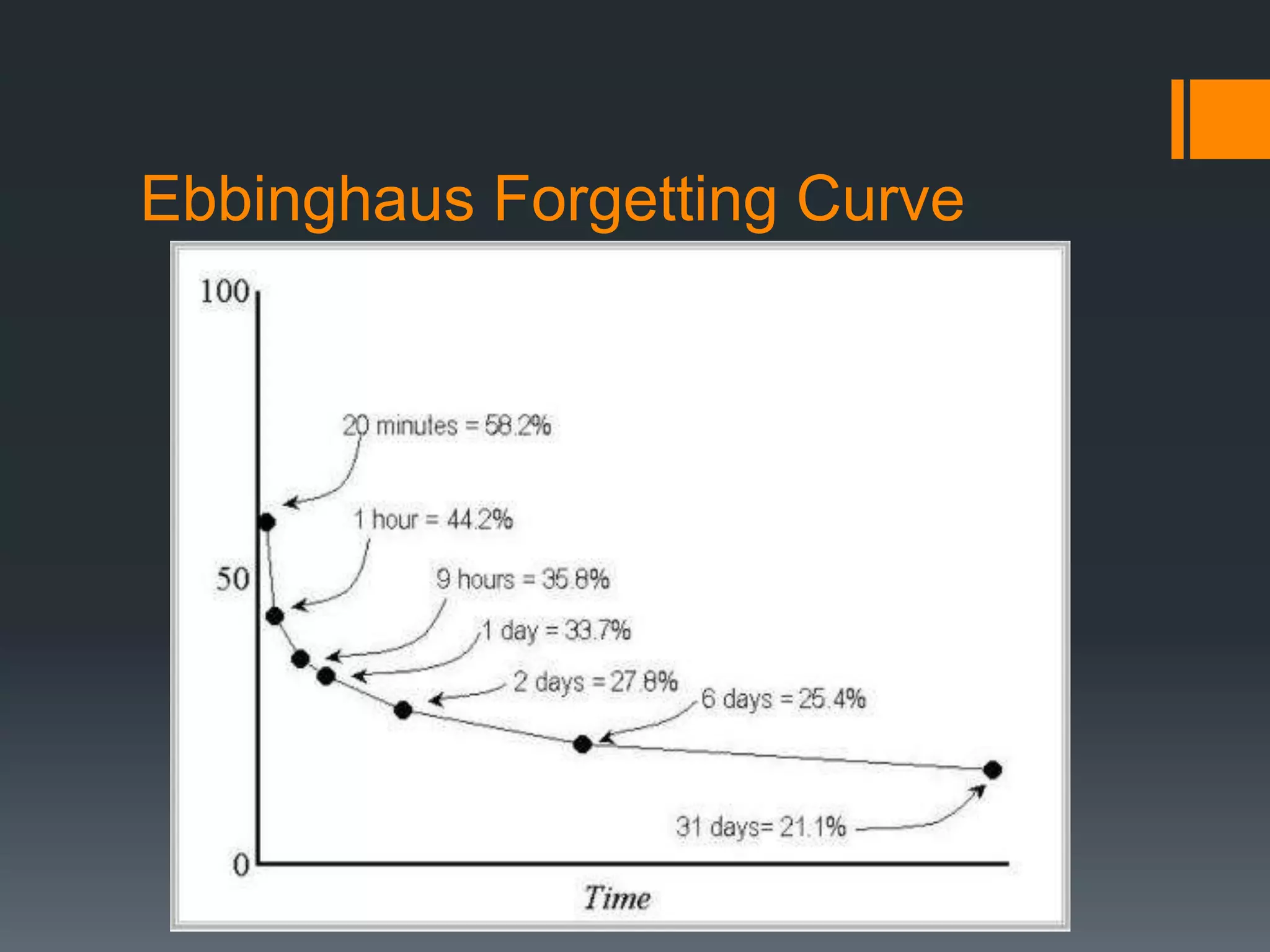
Ebbinghaus Forgetting Curve
Ebbinghaus & Studying
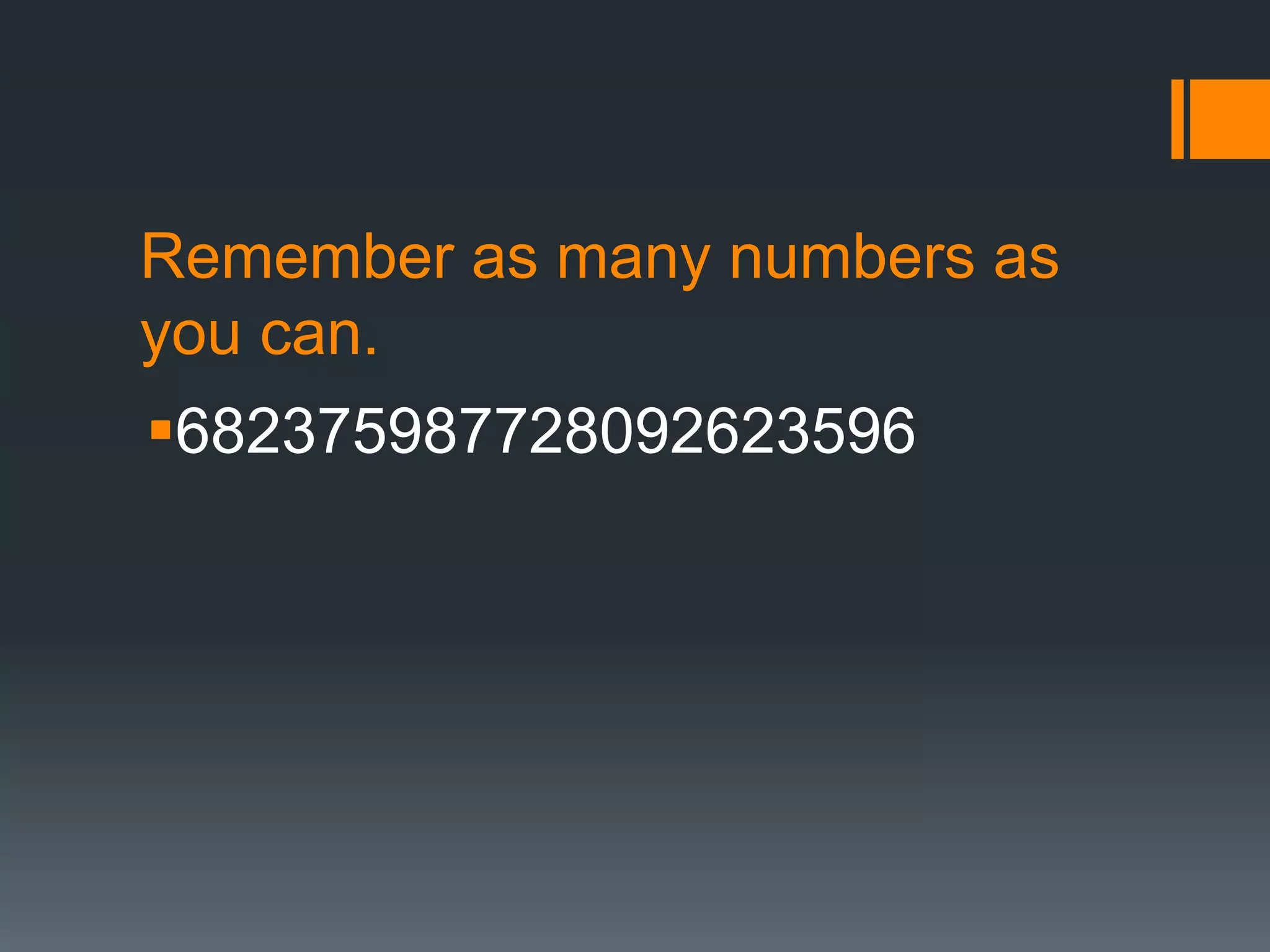
Remember as many numbers as
you can.
682375987728092623596
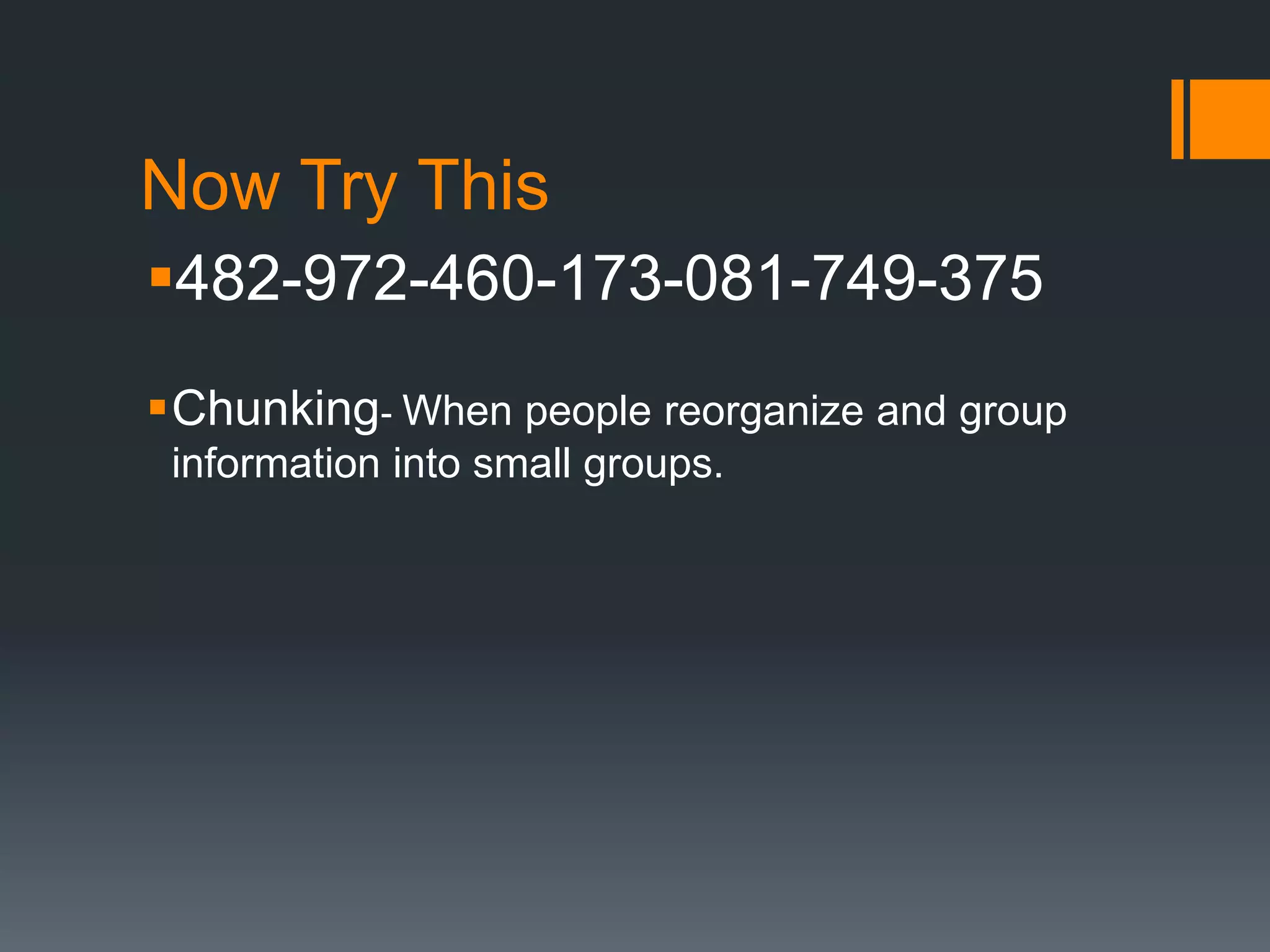
Now Try This
482-972-460-173-081-749-375
Chunking- When people reorganize and group
information into small groups.
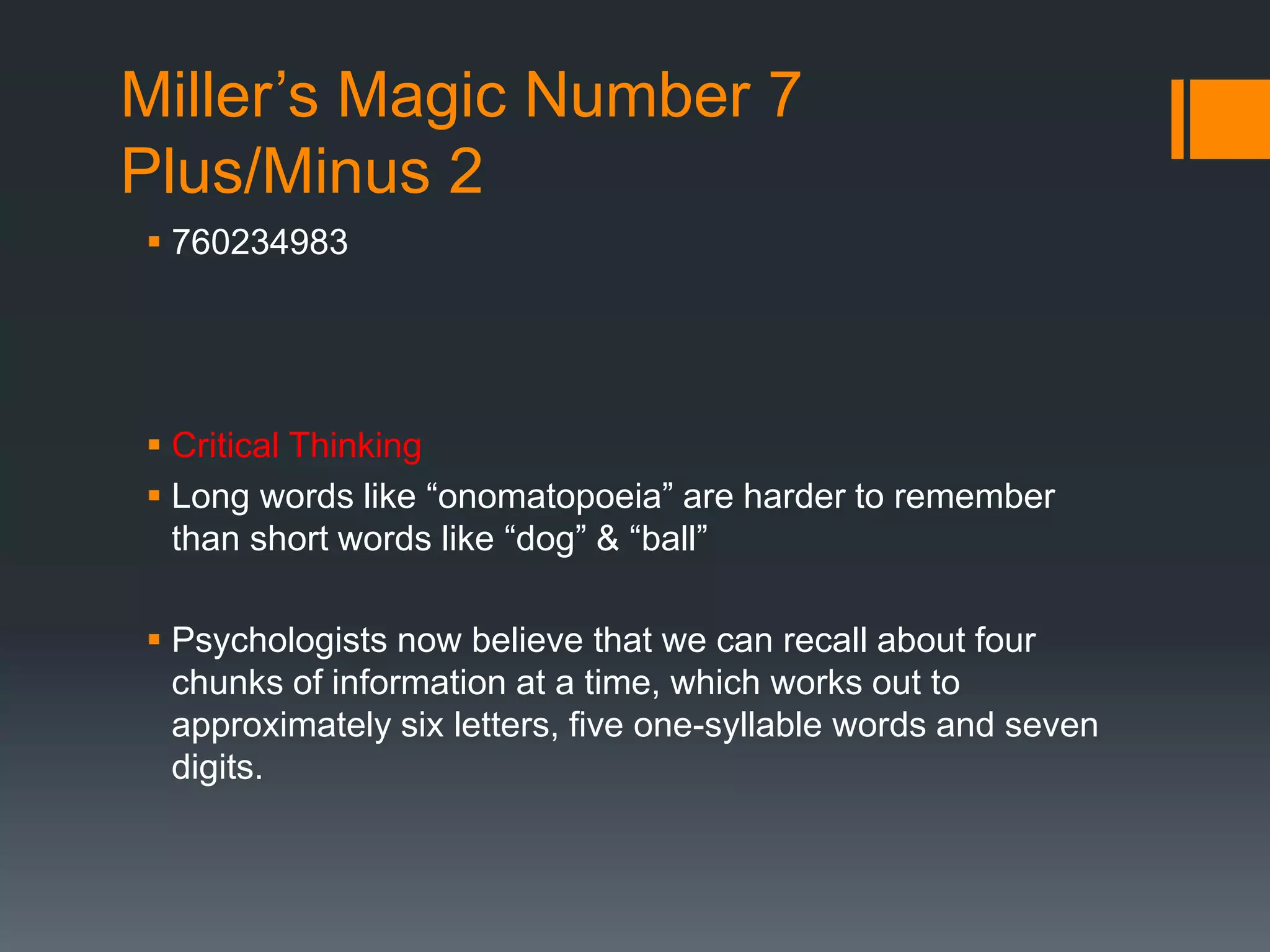
Miller’s Magic Number 7
Plus/Minus 2
 760234983
 Critical Thinking
 Long words like “onomatopoeia” are harder to remember
than short words like “dog” & “ball”
 Psychologists now believe that we can recall about four
chunks of information at a time, which works out to
approximately six letters, five one-syllable words and seven
digits.
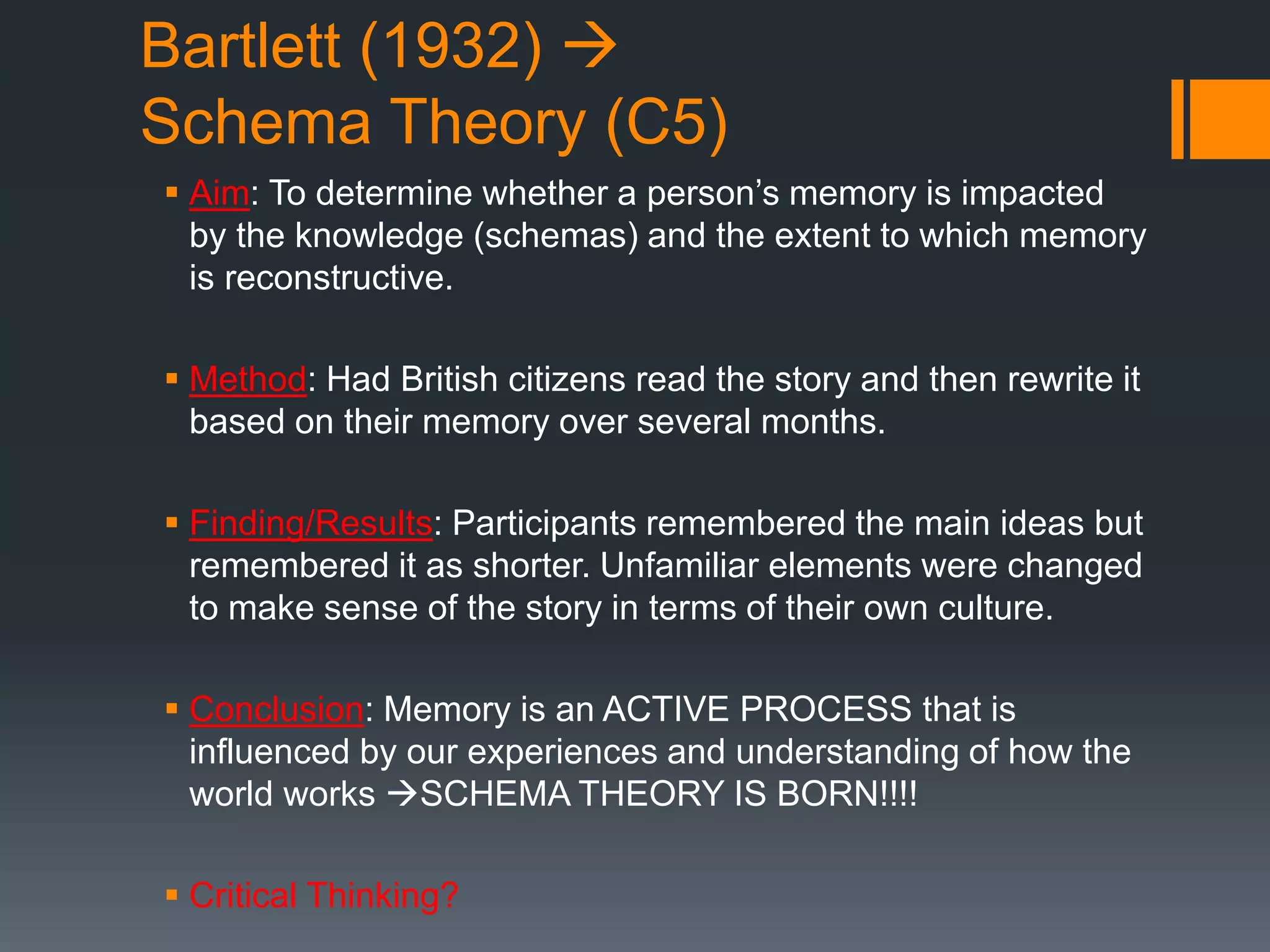
The War of the Ghosts
The War of the Ghosts
What similarities/accurate recollections are
there?
What differences/errors did you make?
What might this show about your memory?
Bartlett (1932) 
Schema Theory (C5)
 Aim: To determine whether a person’s memory is impacted
by the knowledge (schemas) and the extent to which memory
is reconstructive.
 Method: Had British citizens read the story and then rewrite it
based on their memory over several months.
 Finding/Results: Participants remembered the main ideas but
remembered it as shorter. Unfamiliar elements were changed
to make sense of the story in terms of their own culture.
 Conclusion: Memory is an ACTIVE PROCESS that is
influenced by our experiences and understanding of how the
world works SCHEMA THEORY IS BORN!!!!
 Critical Thinking?
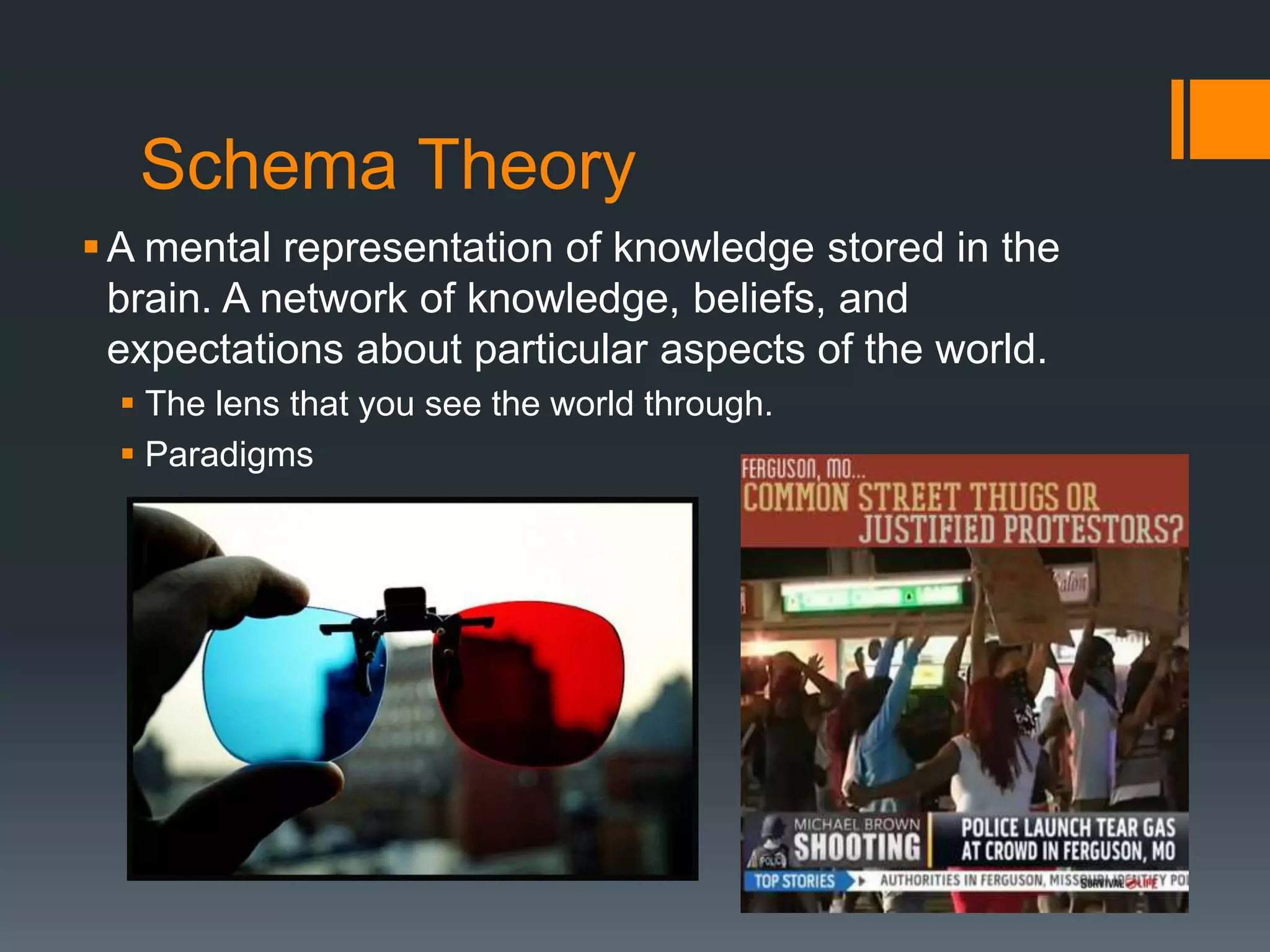
Schema Theory
A mental representation of knowledge stored in the
brain. A network of knowledge, beliefs, and
expectations about particular aspects of the world.
 The lens that you see the world through.
 Paradigms
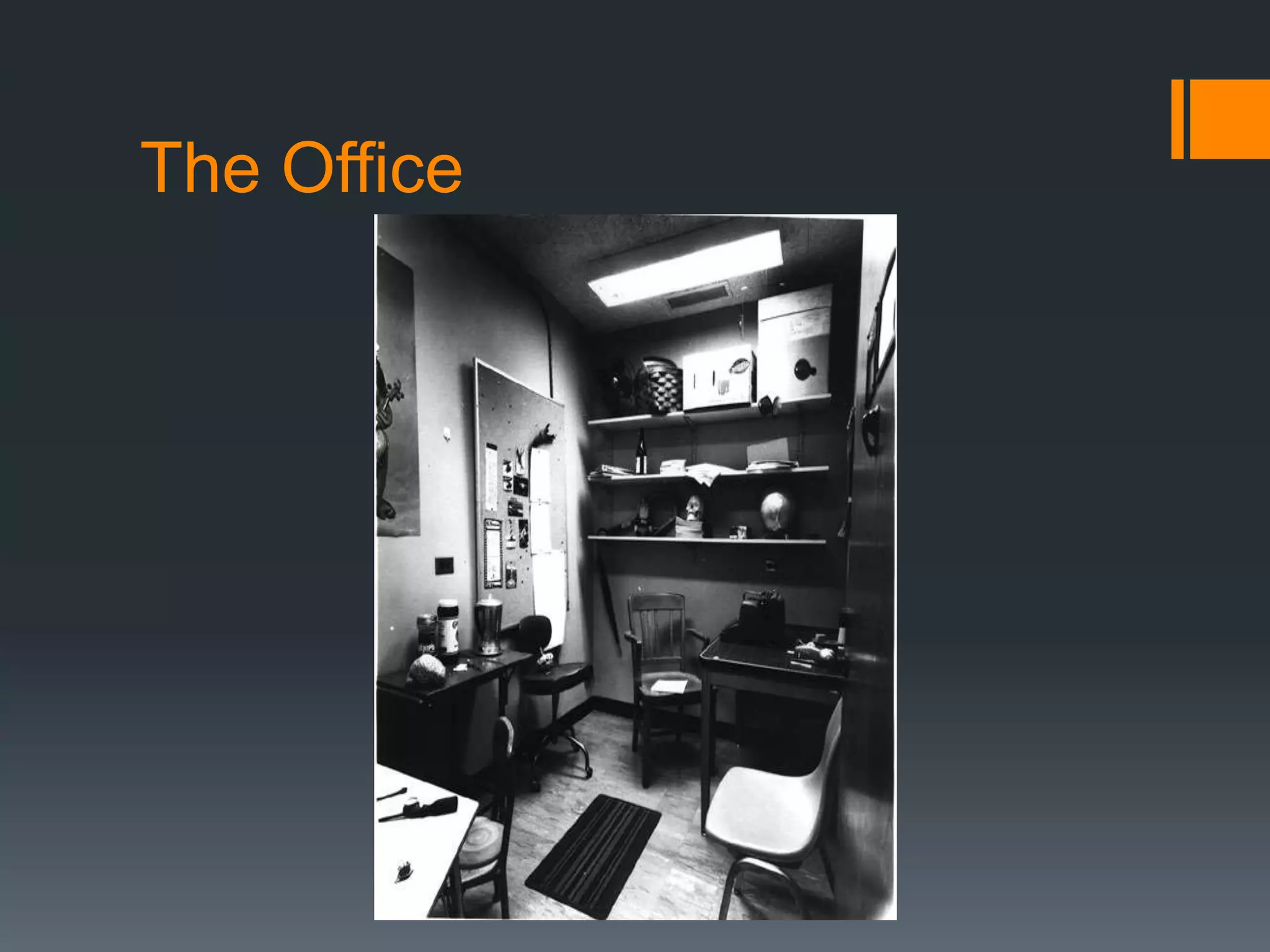
The Office
Brewer and Treyens (1981)
Aim: To investigate whether people’s
memory for objects in a room is influenced
by their existing schemas.
Method:
30 university students were asked to wait in
an office before being called into a research
study.
Participants were taken out of the office and
asked to write down everything they could
remember from the room.
Brewer and Treyens (1981)
Findings:
 Most participants recalled the schematic objects (desk,
typewriter).
 Some participants reported things that would be expected
but were not present (books, telephone, etc.)
 Many participants recalled non schematic items such as
the skull…Unusual items resulted in better memory than
schema theory predicted.
Conclusions: Schemas do impact memory, but
only to a certain extent.
Evaluate Schema Theory
What are the strengths of schema theory?
What are the limitations of schema theory?
What applications are there for schema
theory beyond memory?
Do you trust the research done on schema
theory? Why or why not?
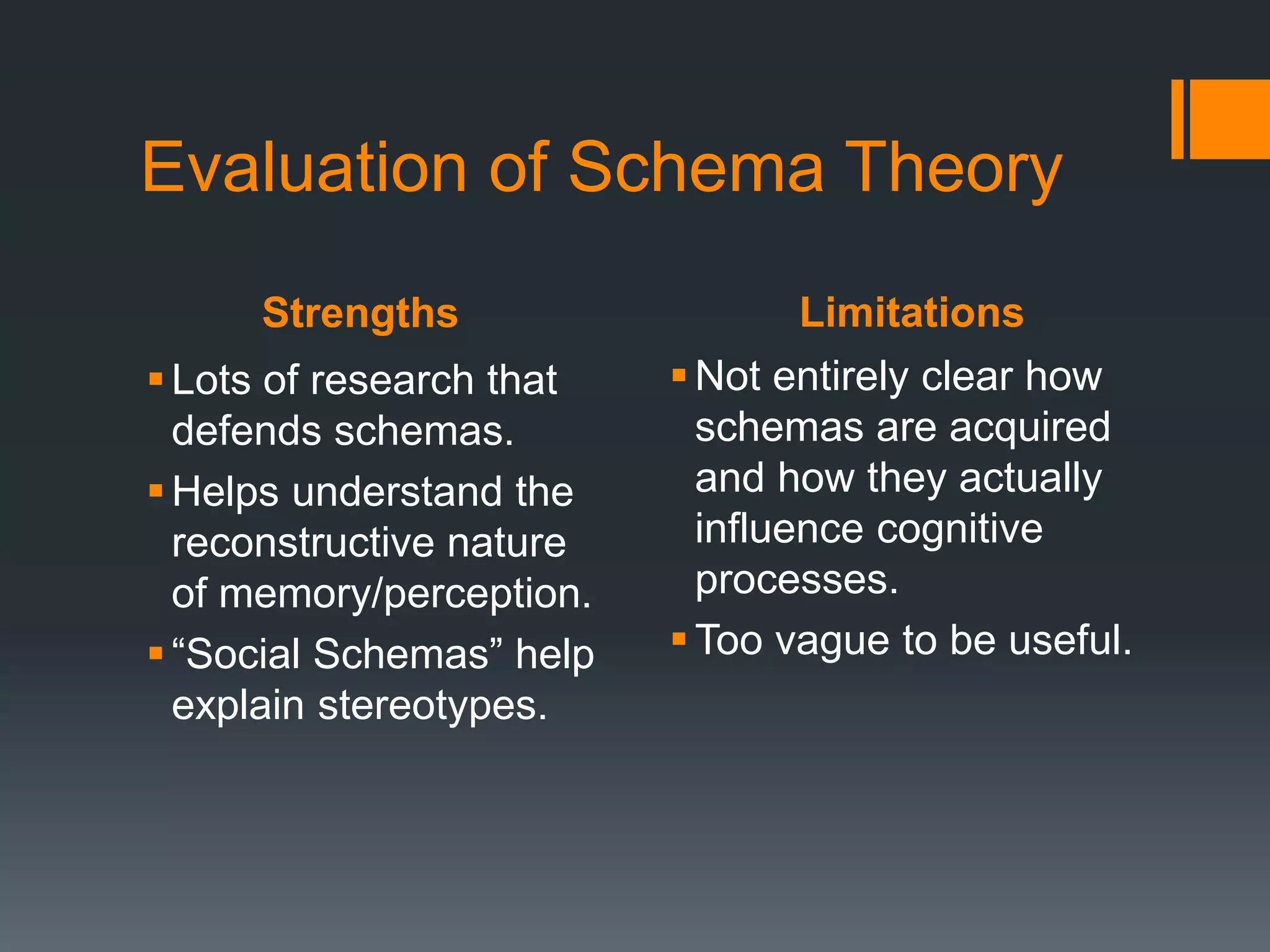
Strengths Limitations
Evaluation of Schema Theory
Lots of research that
defends schemas.
Helps understand the
reconstructive nature
of memory/perception.
“Social Schemas” help
explain stereotypes.
Not entirely clear how
schemas are acquired
and how they actually
influence cognitive
processes.
Too vague to be useful.
The Case of Clive Wearing
(C7 Biological Impact on Memory)
Clive Wearing Video (Sorry for the blurry
picture)
How does Clive Wearing’s story relate to
what we already know about memory?
What memories does Clive still have and
what ones does he not have?
How does Clive Wearing’s Memory
problems relate to the models of memory?
Tonight’s Homework
Watch the Prezi on the two Models of
Memory and record information for each
model of memory in your notes. We will
discuss them next time.
Warm Up
1. Remember back to your first day of high
school. Describe how each model would
describe this memory.
a. Which model best explains your
memories?
2. Create an analogy for each of the models.
Include each component and explain why
your analogy represents these models.

The Nature of Memory

  • 1.
    The Nature ofMemory & Schema Theory
  • 2.
    Today’s Goals  Ican explain what memory is and begin to explain how it works.  C5- Evaluate schema theory with reference to research studies.
  • 3.
    Warm Up  Listento the following story. Do not take notes.
  • 4.
    Memory Quotations Warm-Up Readthe quotations on memory with your group and make a list of the three which you think are most effective at describing the nature of memory. Be prepared to share and defend your choices.
  • 5.
    What is Memory? Thecapacity to retain and retrieve information, and also the mental structures that account for this capacity. Explicit Memory  Declarative Memory Implicit Memory  Procedural Memory
  • 6.
    Explicit Memories Explicit Memory– Conscious, intentional recollection of an event or an item of information. Declarative Memory – Memories that can be consciously recalled such as facts and details.  Recall- Retrieve and reproduce memory from previously encountered material.  Recognition – The ability to identify previously encountered material.
  • 7.
    Autobiographical Memory A memorysystem consisting of episodes recollected from an individual's life, based on a combination of episodic (personal experiences and specific objects, people and events experienced at particular time and place) and semantic (general knowledge and facts about the world) memory.
  • 8.
  • 9.
    Recall - Howdid you do?
  • 10.
  • 11.
    Implicit Memory • ImplicitMemory - The unconscious retention of previous experiences that creep into our current thoughts/actions. • Procedural Memories- Memories that help you perform certain procedures and tasks.
  • 12.
    Early Research intoMemory Ebbinghaus – 1885 Used self as subject Tested his memory using lists of 3-letter nonsense syllables (like KAF, PEB, LEV) Nonsense because he didn’t want his existing knowledge to be able to help out his memory Method: Relearning Task – Learned a list, set it aside for a period of time, then later relearned the material to the same level.
  • 13.
  • 14.
  • 15.
    Remember as manynumbers as you can. 682375987728092623596
  • 16.
    Now Try This 482-972-460-173-081-749-375 Chunking-When people reorganize and group information into small groups.
  • 17.
    Miller’s Magic Number7 Plus/Minus 2  760234983  Critical Thinking  Long words like “onomatopoeia” are harder to remember than short words like “dog” & “ball”  Psychologists now believe that we can recall about four chunks of information at a time, which works out to approximately six letters, five one-syllable words and seven digits.
  • 18.
    The War ofthe Ghosts The War of the Ghosts What similarities/accurate recollections are there? What differences/errors did you make? What might this show about your memory?
  • 19.
    Bartlett (1932)  SchemaTheory (C5)  Aim: To determine whether a person’s memory is impacted by the knowledge (schemas) and the extent to which memory is reconstructive.  Method: Had British citizens read the story and then rewrite it based on their memory over several months.  Finding/Results: Participants remembered the main ideas but remembered it as shorter. Unfamiliar elements were changed to make sense of the story in terms of their own culture.  Conclusion: Memory is an ACTIVE PROCESS that is influenced by our experiences and understanding of how the world works SCHEMA THEORY IS BORN!!!!  Critical Thinking?
  • 20.
    Schema Theory A mentalrepresentation of knowledge stored in the brain. A network of knowledge, beliefs, and expectations about particular aspects of the world.  The lens that you see the world through.  Paradigms
  • 21.
  • 22.
    Brewer and Treyens(1981) Aim: To investigate whether people’s memory for objects in a room is influenced by their existing schemas. Method: 30 university students were asked to wait in an office before being called into a research study. Participants were taken out of the office and asked to write down everything they could remember from the room.
  • 23.
    Brewer and Treyens(1981) Findings:  Most participants recalled the schematic objects (desk, typewriter).  Some participants reported things that would be expected but were not present (books, telephone, etc.)  Many participants recalled non schematic items such as the skull…Unusual items resulted in better memory than schema theory predicted. Conclusions: Schemas do impact memory, but only to a certain extent.
  • 24.
    Evaluate Schema Theory Whatare the strengths of schema theory? What are the limitations of schema theory? What applications are there for schema theory beyond memory? Do you trust the research done on schema theory? Why or why not?
  • 25.
    Strengths Limitations Evaluation ofSchema Theory Lots of research that defends schemas. Helps understand the reconstructive nature of memory/perception. “Social Schemas” help explain stereotypes. Not entirely clear how schemas are acquired and how they actually influence cognitive processes. Too vague to be useful.
  • 26.
    The Case ofClive Wearing (C7 Biological Impact on Memory) Clive Wearing Video (Sorry for the blurry picture) How does Clive Wearing’s story relate to what we already know about memory? What memories does Clive still have and what ones does he not have? How does Clive Wearing’s Memory problems relate to the models of memory?
  • 27.
    Tonight’s Homework Watch thePrezi on the two Models of Memory and record information for each model of memory in your notes. We will discuss them next time.
  • 28.
    Warm Up 1. Rememberback to your first day of high school. Describe how each model would describe this memory. a. Which model best explains your memories? 2. Create an analogy for each of the models. Include each component and explain why your analogy represents these models.