Flashbulb Memories
Learning Outcomes
 C12- Evaluate one theory of how emotion may affect one
cognitive function.
 C10- Evaluate the extent to which a cognitive process is
reliable.
The Psychology of Donald Trump
 Donald Trump: “There were people that were cheering on the
other side of New Jersey, where you have large Arab
populations. They were cheering as the World Trade Center
came down…I watched when the World Trade Center came
tumbling down. And I watched in Jersey City, New Jersey, where
thousands and thousands of people were cheering as that
building was coming down. Thousands of people were
cheering.”
 How does this example relate to the reliability of memory?
 What does this example reveal about Trump’s schema theory
regarding Arab Americans and how it impacted his memory?
 What does this show about flashbulb memories?
 Should cognitive psychology be an excuse for Trump’s
behavior? Impact his presidential bid?
Warm-Up
Answer the following questions for when you
heard about the terrorist attacks in Paris.
 Where were you?
 What were you doing?
 Who told you?
 How did you feel?
 How did they feel?
 How confident are you in your memory?
Brown and Kulik (1977)
Flashbulb Memories
Highly accurate and exceptionally vivid memories
when learning about a shocking event.
 Episodic Memories (explicit memories) that are highly
resistant to forgetting because of the emotional arousal at
the moment of encoding.
 “Flashbulb”  Memory registers like a photograph
 Importance and arousal lead to rehearsal
Elements of a Flashbulb Memory
Place (where they were when the incident
happened)
Ongoing Activity (what they were doing)
Informant (who broke the news)
Own affect (how they felt)
Others’ affect (how others felt)
Aftermath (importance of the event)
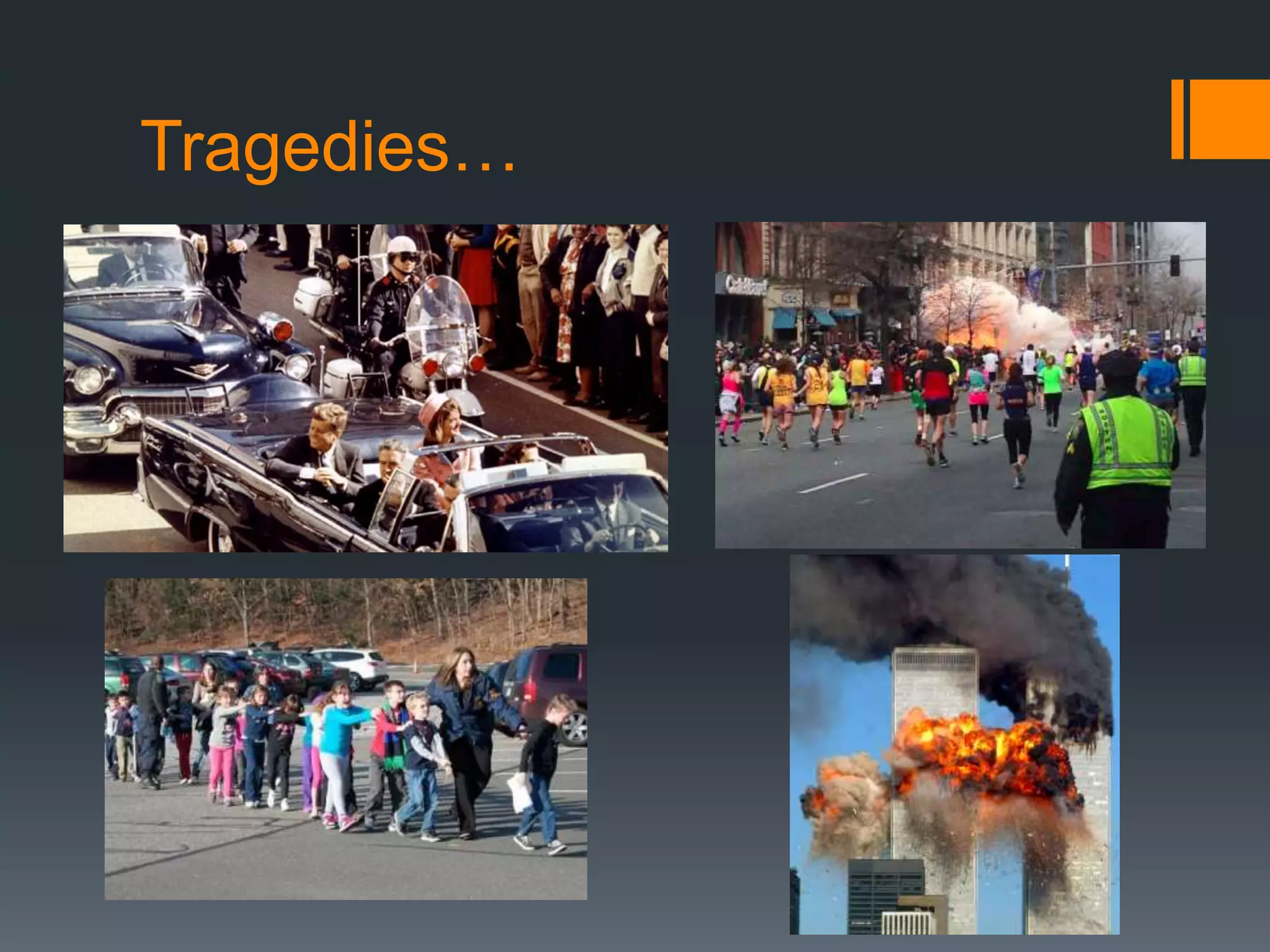
Tragedies…
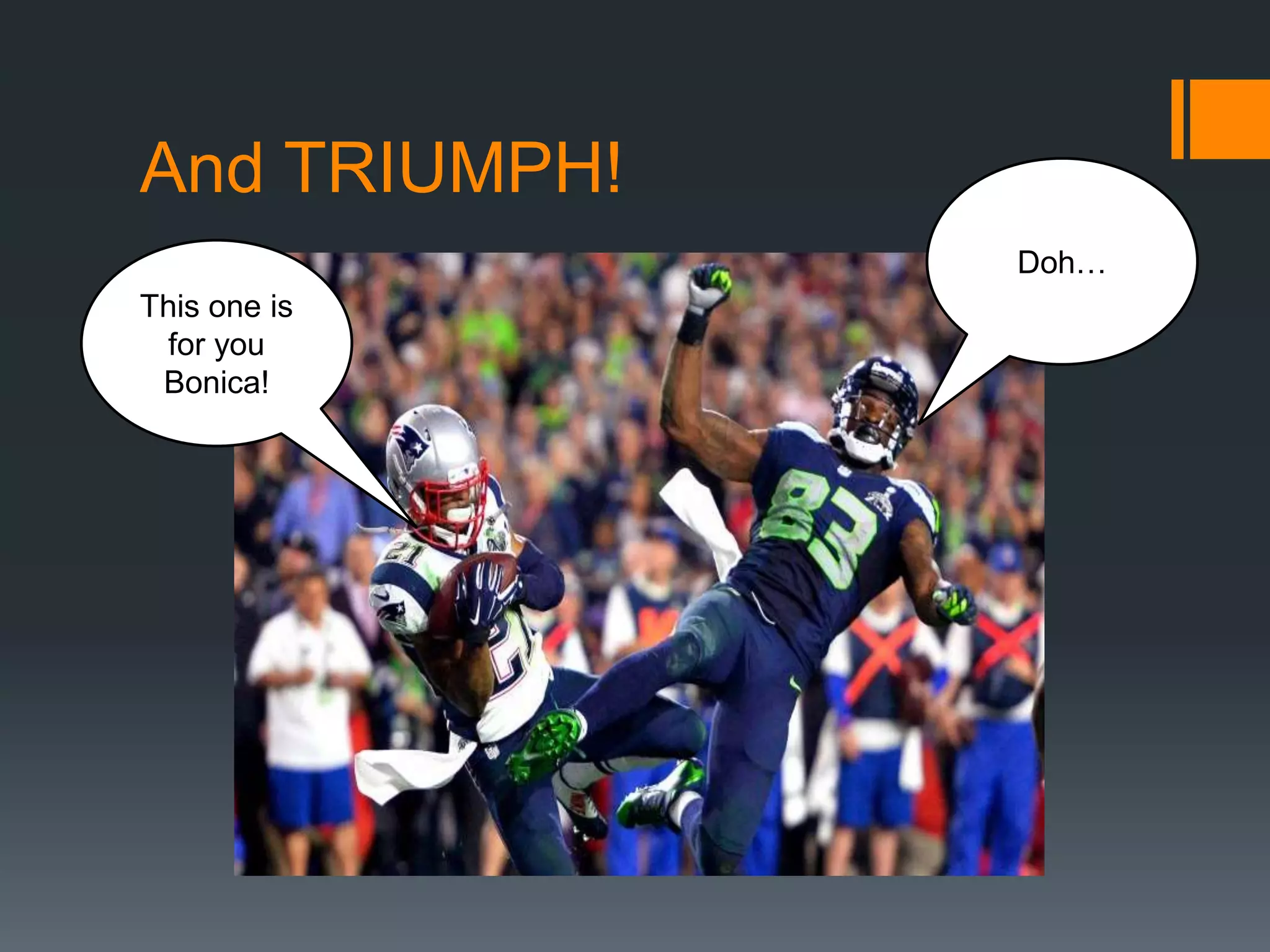
And TRIUMPH!
This one is
for you
Bonica!
Doh…
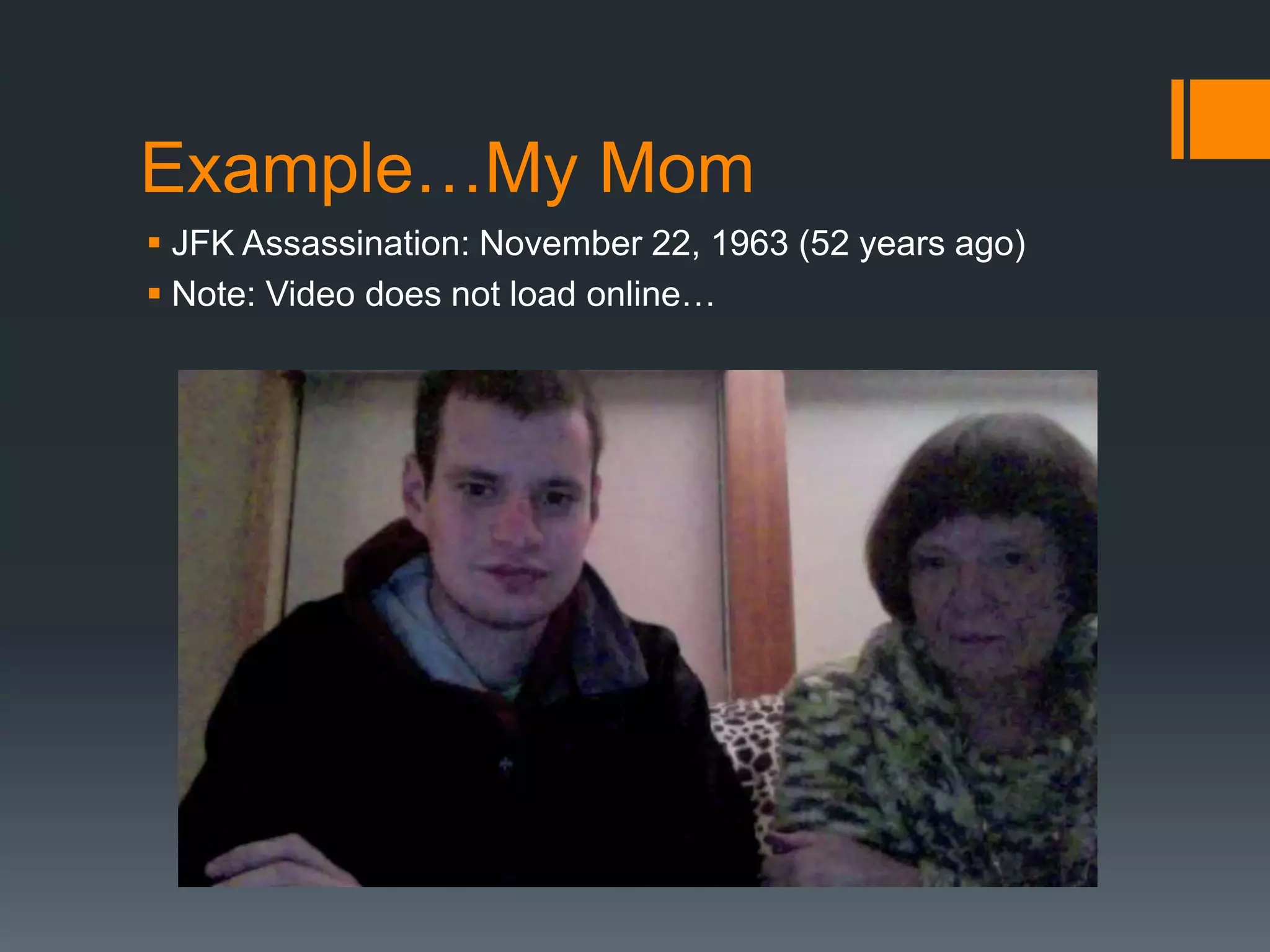
Example…My Mom
 JFK Assassination: November 22, 1963 (52 years ago)
 Note: Video does not load online…
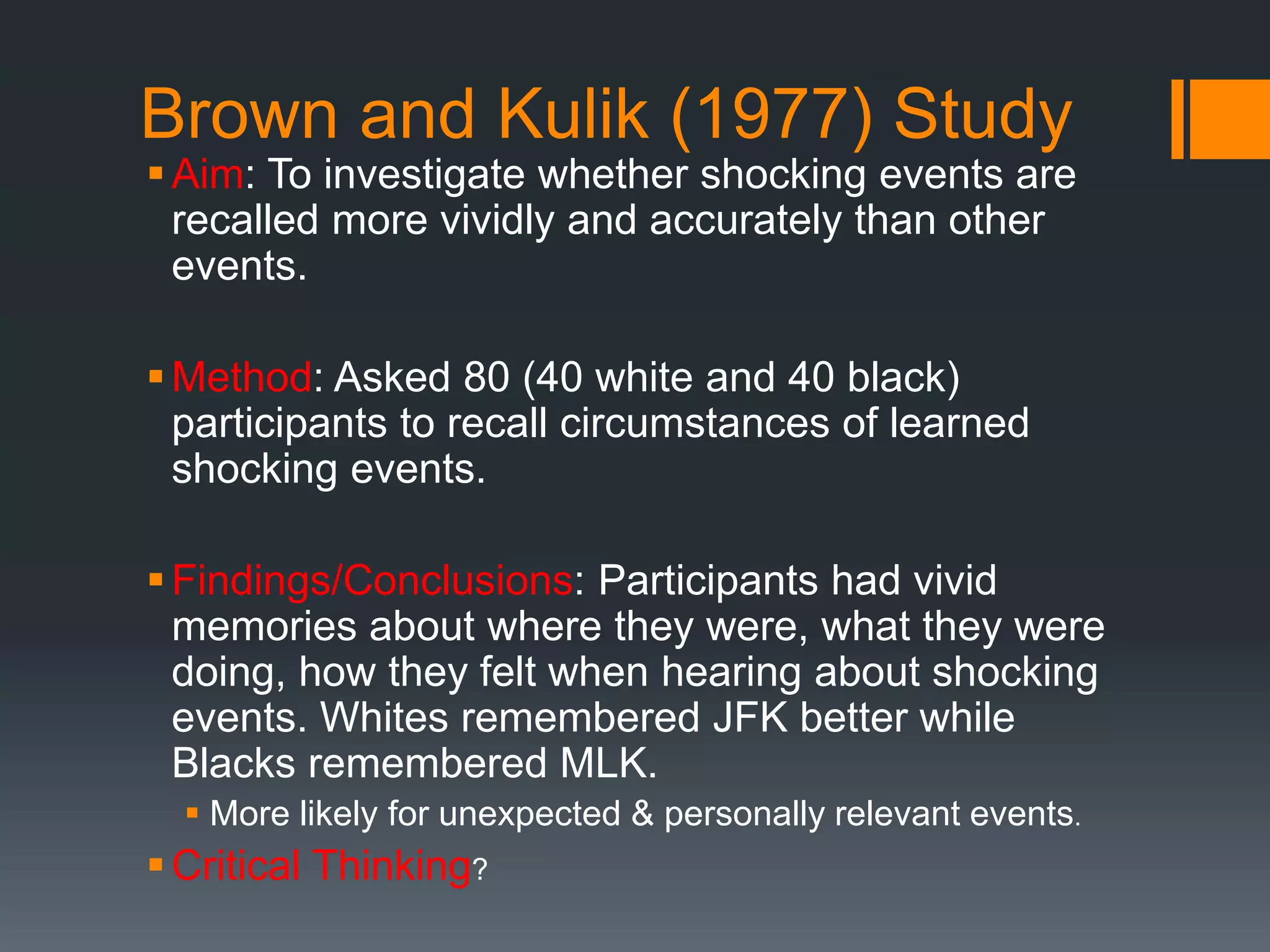
Brown and Kulik (1977) Study
Aim: To investigate whether shocking events are
recalled more vividly and accurately than other
events.
Method: Asked 80 (40 white and 40 black)
participants to recall circumstances of learned
shocking events.
Findings/Conclusions: Participants had vivid
memories about where they were, what they were
doing, how they felt when hearing about shocking
events. Whites remembered JFK better while
Blacks remembered MLK.
 More likely for unexpected & personally relevant events.
Critical Thinking?
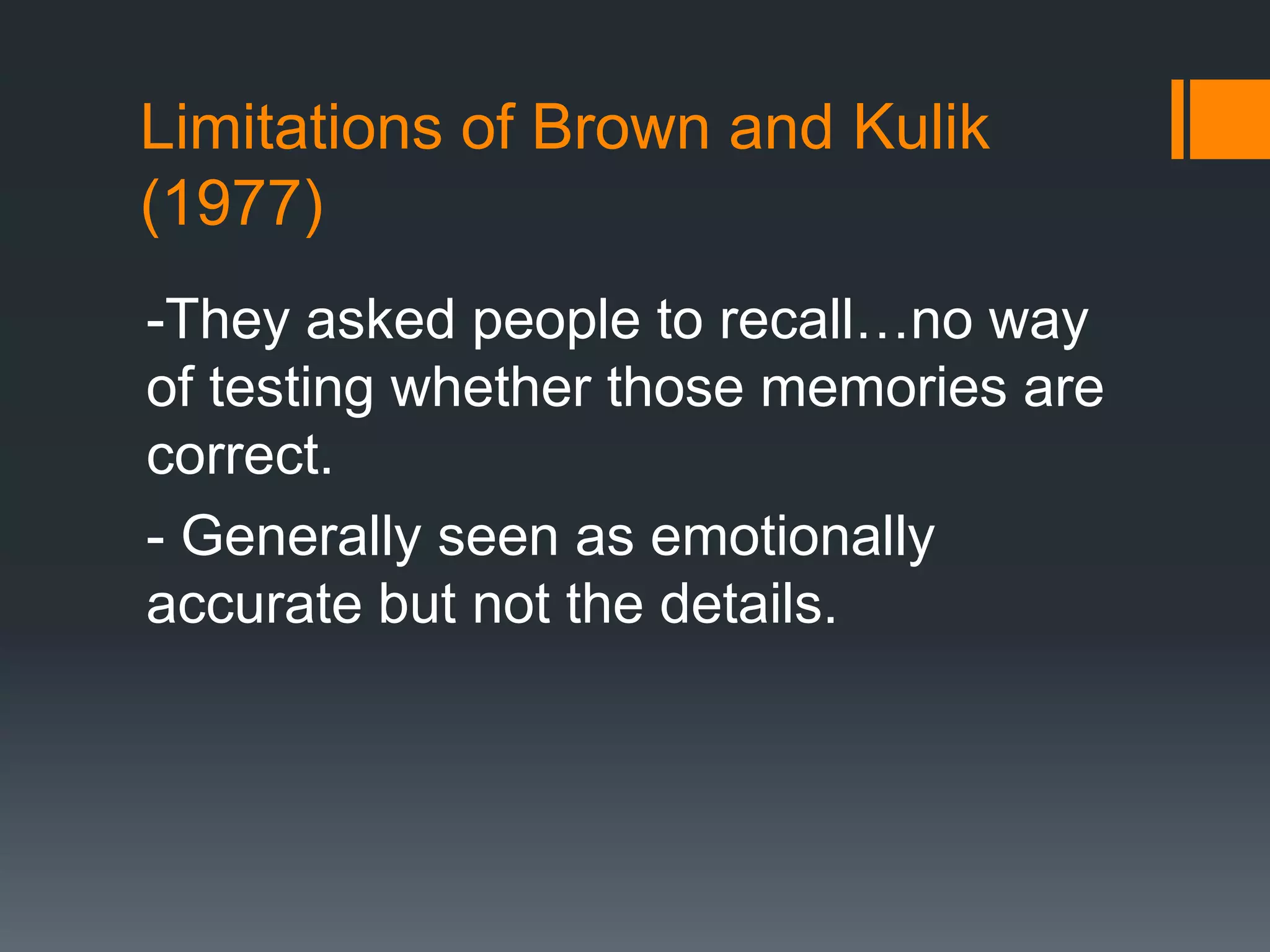
Limitations of Brown and Kulik
(1977)
-They asked people to recall…no way
of testing whether those memories are
correct.
- Generally seen as emotionally
accurate but not the details.
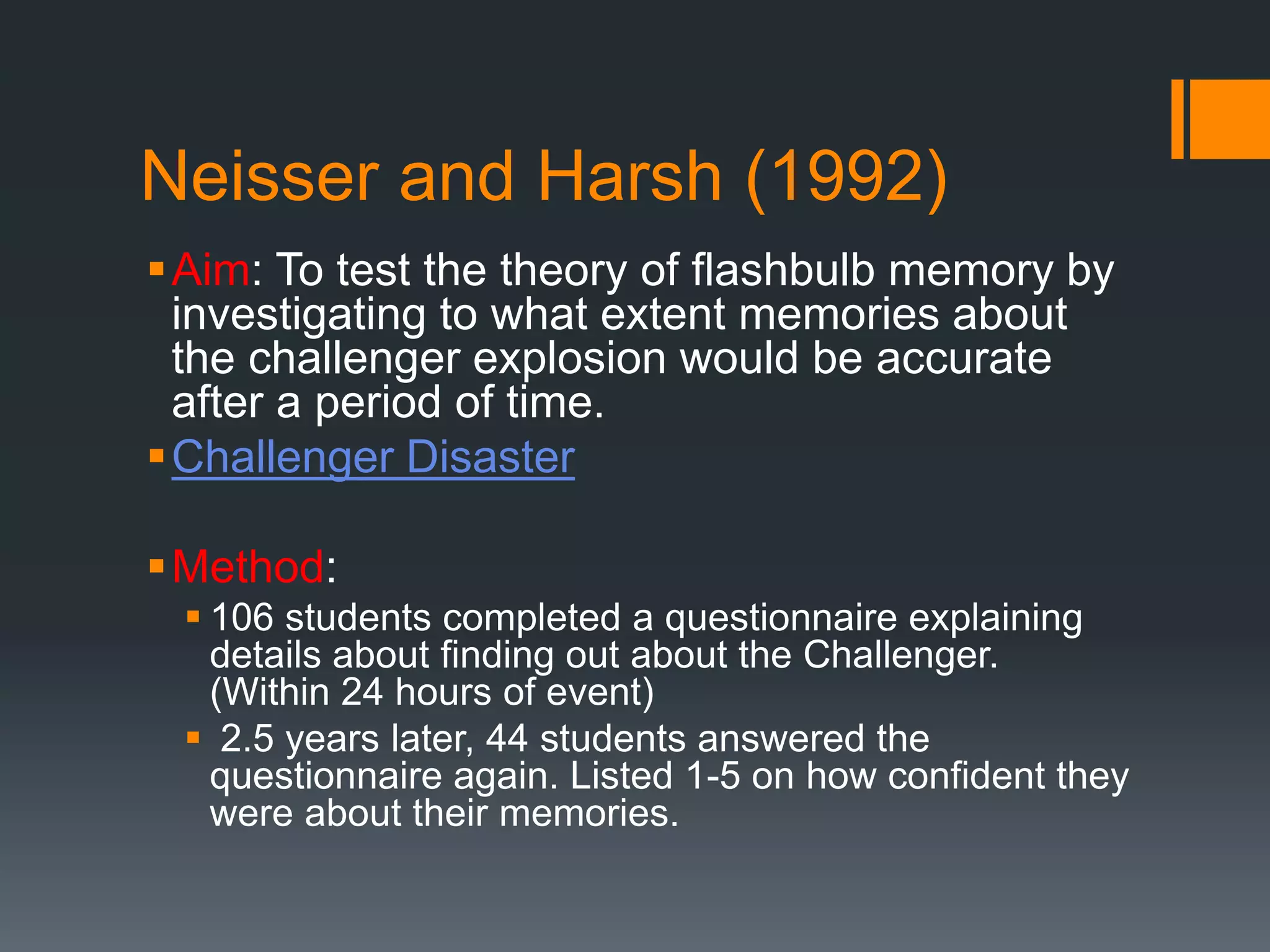
Neisser and Harsh (1992)
Aim: To test the theory of flashbulb memory by
investigating to what extent memories about
the challenger explosion would be accurate
after a period of time.
Challenger Disaster
Method:
 106 students completed a questionnaire explaining
details about finding out about the Challenger.
(Within 24 hours of event)
 2.5 years later, 44 students answered the
questionnaire again. Listed 1-5 on how confident they
were about their memories.
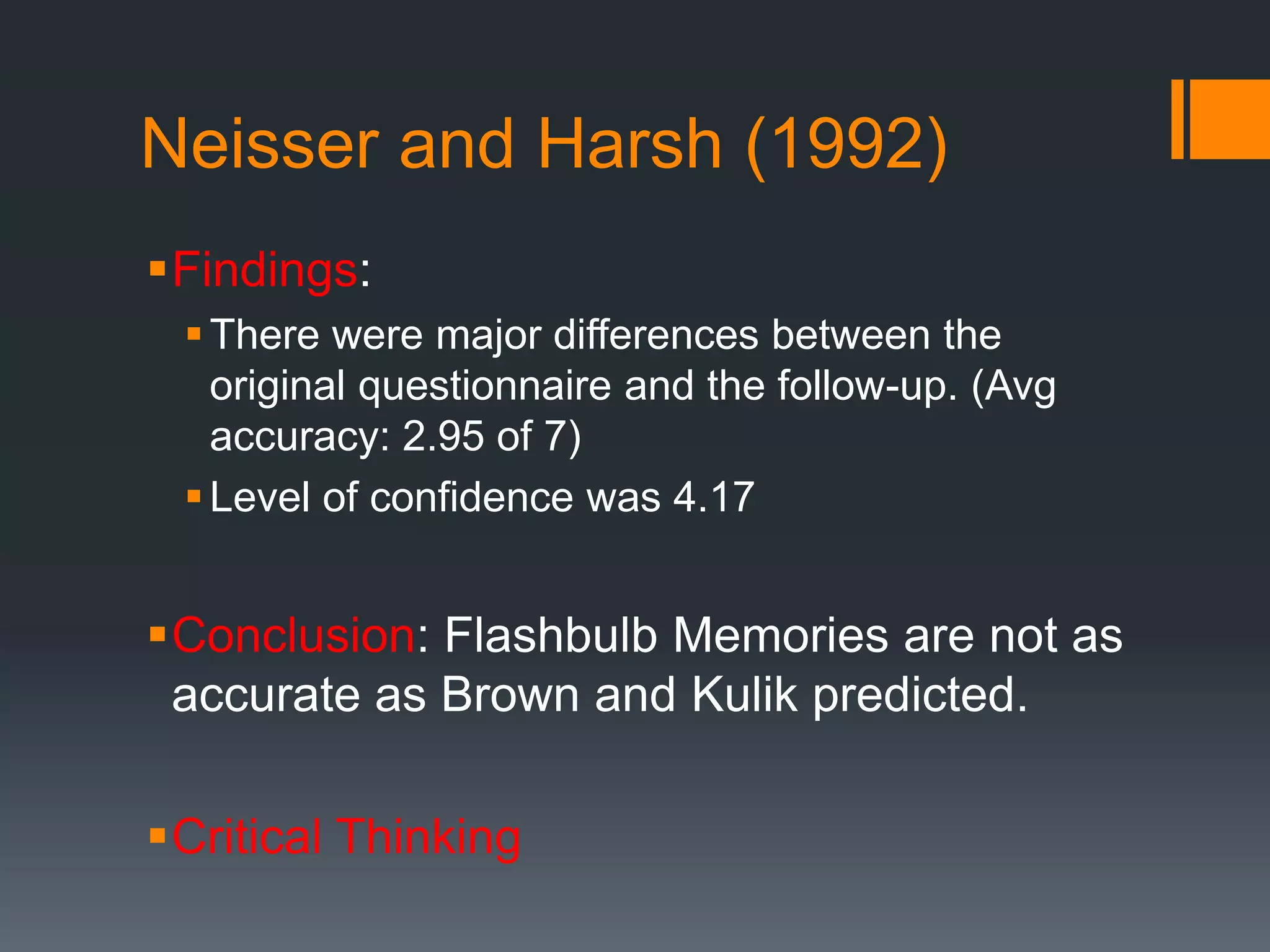
Neisser and Harsh (1992)
Findings:
There were major differences between the
original questionnaire and the follow-up. (Avg
accuracy: 2.95 of 7)
Level of confidence was 4.17
Conclusion: Flashbulb Memories are not as
accurate as Brown and Kulik predicted.
Critical Thinking
Evaluation
+ Natural environment
- Importance of the event could have
been different for different people.
C10 - Phelps et al. (2006)
Aim: To investigate the neurological activity
while recalling a flashbulb memory.
Method:
Three years following the 9/11 attacks, used
fMRI to measure brain activity when recalling an
autobiographical memory and the memory of the
9/11 attacks.
Two groups:
 Downtown (near the attack)
 Midtown (5 miles away from the attack)
Phelps et al. (2006)
Findings:
Downtown group remembered more information
about the attacks.
Those near the attack experienced activity in
their amygdala when recalling the event while
those who were not as near did not show any
difference between 9/11 and their other
memories.
Conclusions: The witnessing of an event bring
more emotional memories and thus create
lasting memories of shocking events.
Critical Thinking?
Hirst et al. (2015)
Aim: To investigate the consistency and confidence
of flashbulb memories over a long period.
Method
 Had participants from around the nation take surveys on
9/11 within a week of the attack.
 Had participants take the same survey three more times.
 1 year, 3 years, 10 years.
 Compared the results for consistency and confidence of
memories.
 Examined how engagement with Media, Conversations,
residency, personal impact, and emotional intensity
impacted remembering.
Hirst et al. (2015)
Findings:
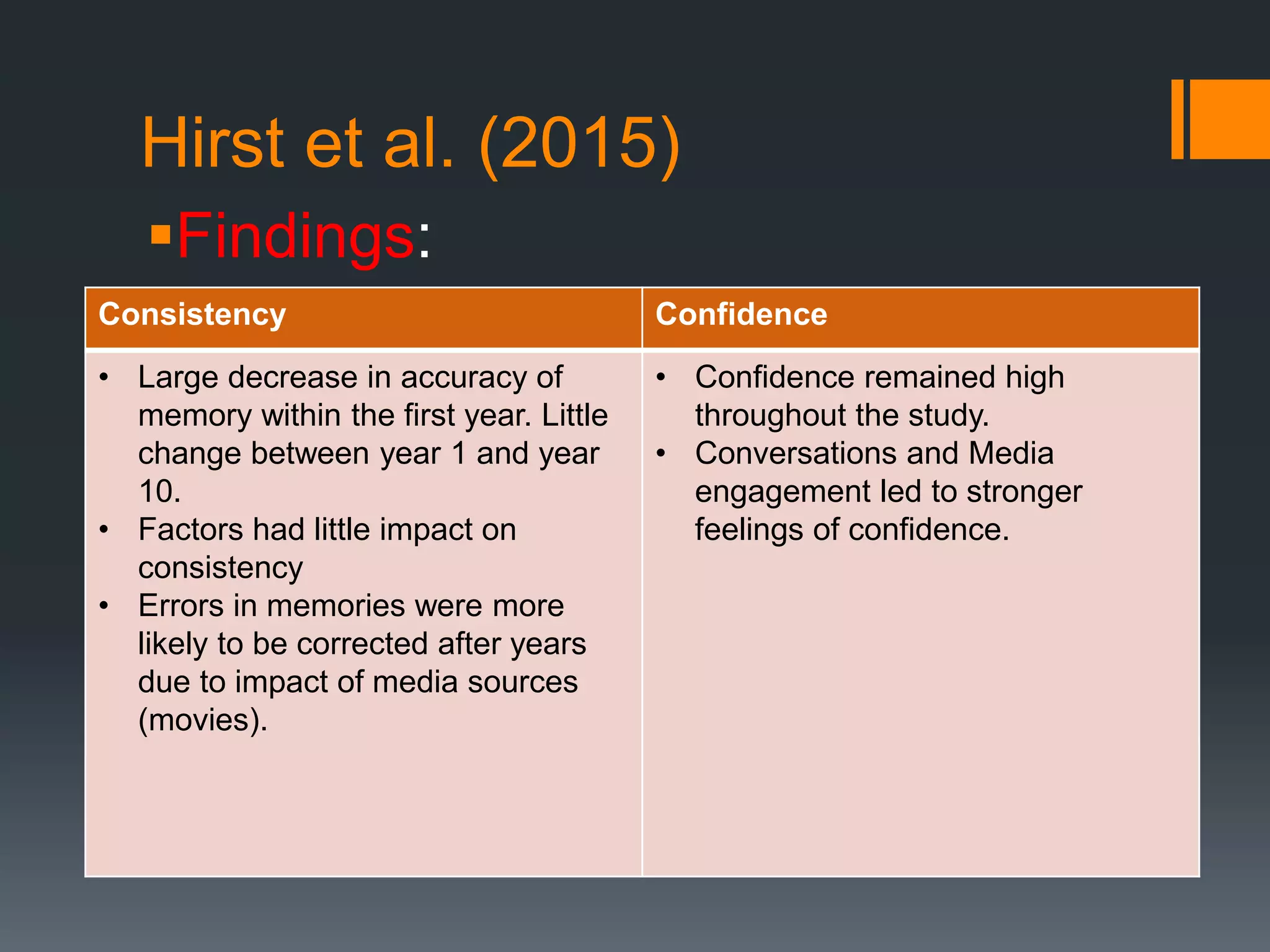
Consistency Confidence
• Large decrease in accuracy of
memory within the first year. Little
change between year 1 and year
10.
• Factors had little impact on
consistency
• Errors in memories were more
likely to be corrected after years
due to impact of media sources
(movies).
• Confidence remained high
throughout the study.
• Conversations and Media
engagement led to stronger
feelings of confidence.
Hirst et al. (2015)
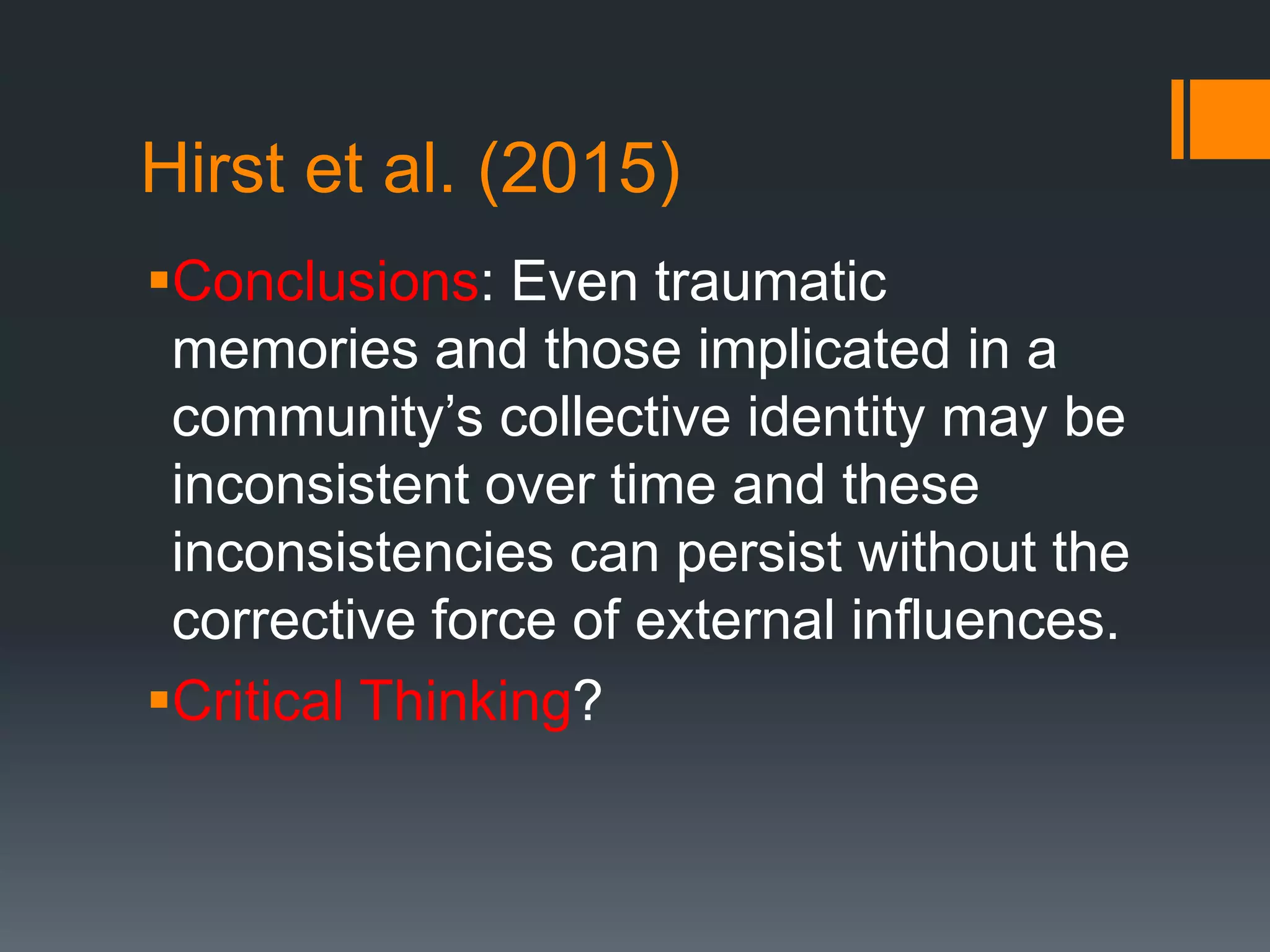
Conclusions: Even traumatic
memories and those implicated in a
community’s collective identity may be
inconsistent over time and these
inconsistencies can persist without the
corrective force of external influences.
Critical Thinking?
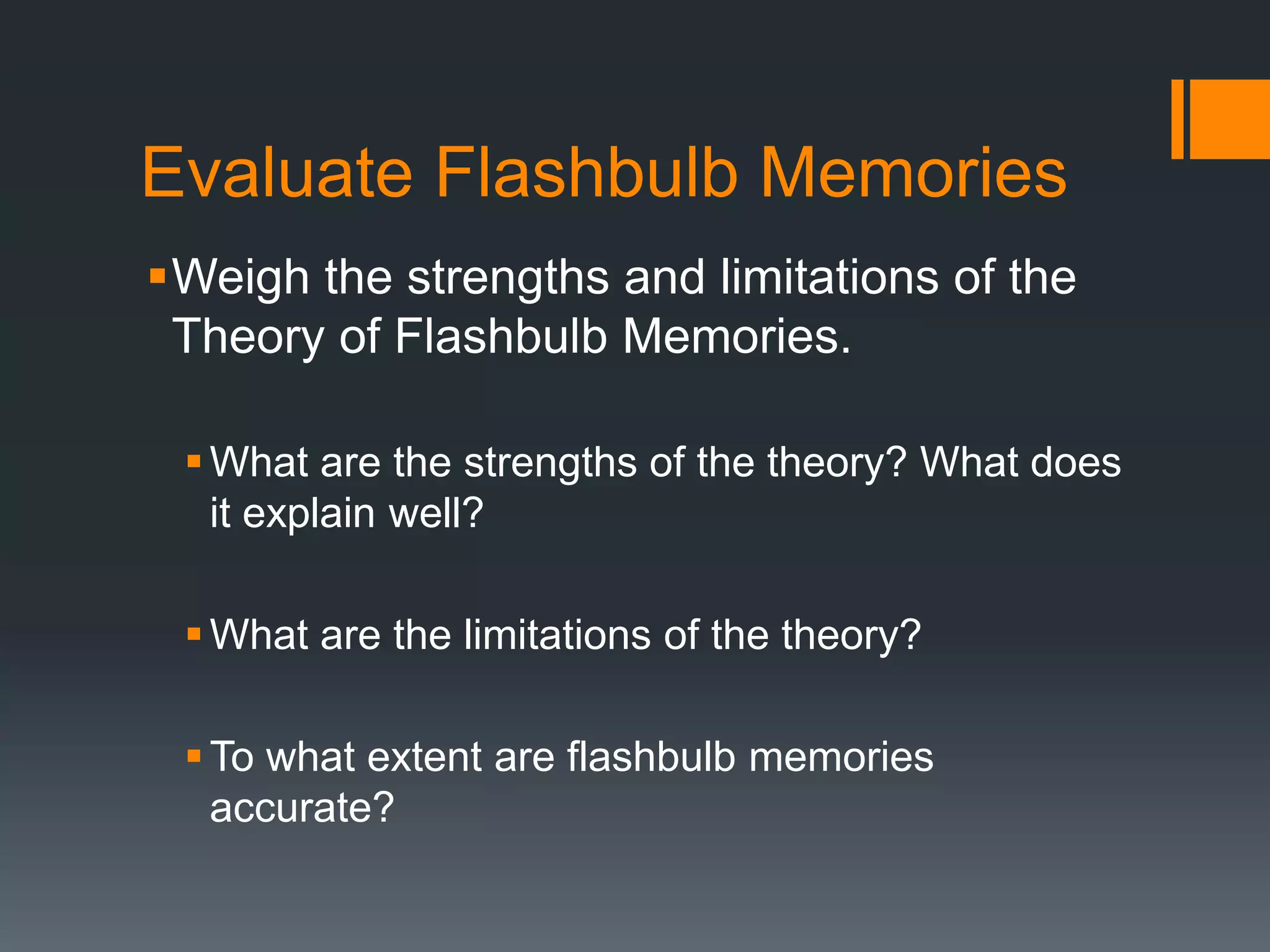
Evaluate Flashbulb Memories
Weigh the strengths and limitations of the
Theory of Flashbulb Memories.
What are the strengths of the theory? What does
it explain well?
What are the limitations of the theory?
To what extent are flashbulb memories
accurate?
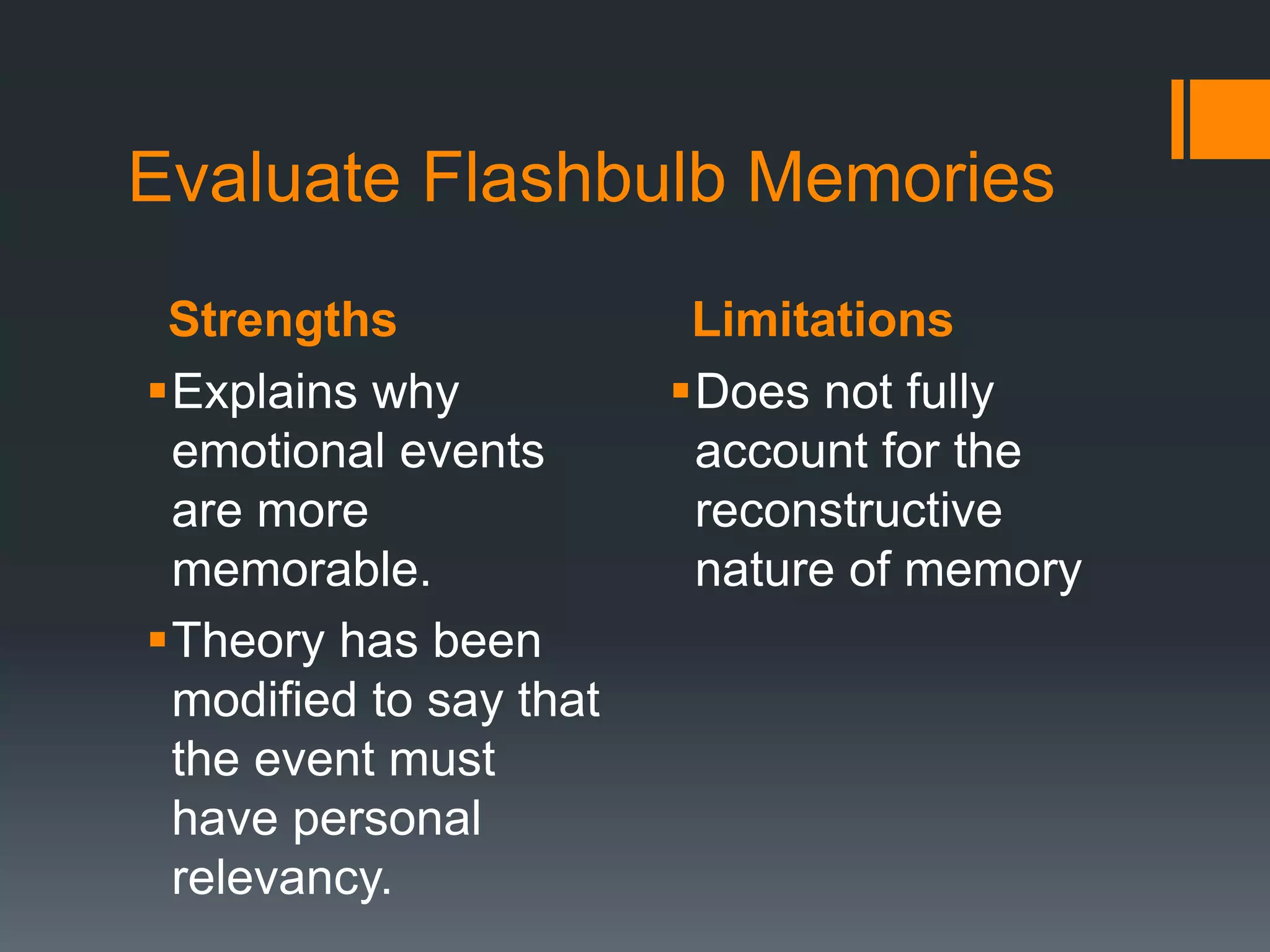
Strengths Limitations
Evaluate Flashbulb Memories
Explains why
emotional events
are more
memorable.
Theory has been
modified to say that
the event must
have personal
relevancy.
Does not fully
account for the
reconstructive
nature of memory

Flashbulb memories pp

  • 1.
  • 2.
    Learning Outcomes  C12-Evaluate one theory of how emotion may affect one cognitive function.  C10- Evaluate the extent to which a cognitive process is reliable.
  • 3.
    The Psychology ofDonald Trump  Donald Trump: “There were people that were cheering on the other side of New Jersey, where you have large Arab populations. They were cheering as the World Trade Center came down…I watched when the World Trade Center came tumbling down. And I watched in Jersey City, New Jersey, where thousands and thousands of people were cheering as that building was coming down. Thousands of people were cheering.”  How does this example relate to the reliability of memory?  What does this example reveal about Trump’s schema theory regarding Arab Americans and how it impacted his memory?  What does this show about flashbulb memories?  Should cognitive psychology be an excuse for Trump’s behavior? Impact his presidential bid?
  • 4.
    Warm-Up Answer the followingquestions for when you heard about the terrorist attacks in Paris.  Where were you?  What were you doing?  Who told you?  How did you feel?  How did they feel?  How confident are you in your memory?
  • 5.
    Brown and Kulik(1977) Flashbulb Memories Highly accurate and exceptionally vivid memories when learning about a shocking event.  Episodic Memories (explicit memories) that are highly resistant to forgetting because of the emotional arousal at the moment of encoding.  “Flashbulb”  Memory registers like a photograph  Importance and arousal lead to rehearsal
  • 6.
    Elements of aFlashbulb Memory Place (where they were when the incident happened) Ongoing Activity (what they were doing) Informant (who broke the news) Own affect (how they felt) Others’ affect (how others felt) Aftermath (importance of the event)
  • 7.
  • 8.
    And TRIUMPH! This oneis for you Bonica! Doh…
  • 9.
    Example…My Mom  JFKAssassination: November 22, 1963 (52 years ago)  Note: Video does not load online…
  • 10.
    Brown and Kulik(1977) Study Aim: To investigate whether shocking events are recalled more vividly and accurately than other events. Method: Asked 80 (40 white and 40 black) participants to recall circumstances of learned shocking events. Findings/Conclusions: Participants had vivid memories about where they were, what they were doing, how they felt when hearing about shocking events. Whites remembered JFK better while Blacks remembered MLK.  More likely for unexpected & personally relevant events. Critical Thinking?
  • 11.
    Limitations of Brownand Kulik (1977) -They asked people to recall…no way of testing whether those memories are correct. - Generally seen as emotionally accurate but not the details.
  • 12.
    Neisser and Harsh(1992) Aim: To test the theory of flashbulb memory by investigating to what extent memories about the challenger explosion would be accurate after a period of time. Challenger Disaster Method:  106 students completed a questionnaire explaining details about finding out about the Challenger. (Within 24 hours of event)  2.5 years later, 44 students answered the questionnaire again. Listed 1-5 on how confident they were about their memories.
  • 13.
    Neisser and Harsh(1992) Findings: There were major differences between the original questionnaire and the follow-up. (Avg accuracy: 2.95 of 7) Level of confidence was 4.17 Conclusion: Flashbulb Memories are not as accurate as Brown and Kulik predicted. Critical Thinking
  • 14.
    Evaluation + Natural environment -Importance of the event could have been different for different people.
  • 15.
    C10 - Phelpset al. (2006) Aim: To investigate the neurological activity while recalling a flashbulb memory. Method: Three years following the 9/11 attacks, used fMRI to measure brain activity when recalling an autobiographical memory and the memory of the 9/11 attacks. Two groups:  Downtown (near the attack)  Midtown (5 miles away from the attack)
  • 16.
    Phelps et al.(2006) Findings: Downtown group remembered more information about the attacks. Those near the attack experienced activity in their amygdala when recalling the event while those who were not as near did not show any difference between 9/11 and their other memories. Conclusions: The witnessing of an event bring more emotional memories and thus create lasting memories of shocking events. Critical Thinking?
  • 17.
    Hirst et al.(2015) Aim: To investigate the consistency and confidence of flashbulb memories over a long period. Method  Had participants from around the nation take surveys on 9/11 within a week of the attack.  Had participants take the same survey three more times.  1 year, 3 years, 10 years.  Compared the results for consistency and confidence of memories.  Examined how engagement with Media, Conversations, residency, personal impact, and emotional intensity impacted remembering.
  • 18.
    Hirst et al.(2015) Findings: Consistency Confidence • Large decrease in accuracy of memory within the first year. Little change between year 1 and year 10. • Factors had little impact on consistency • Errors in memories were more likely to be corrected after years due to impact of media sources (movies). • Confidence remained high throughout the study. • Conversations and Media engagement led to stronger feelings of confidence.
  • 19.
    Hirst et al.(2015) Conclusions: Even traumatic memories and those implicated in a community’s collective identity may be inconsistent over time and these inconsistencies can persist without the corrective force of external influences. Critical Thinking?
  • 20.
    Evaluate Flashbulb Memories Weighthe strengths and limitations of the Theory of Flashbulb Memories. What are the strengths of the theory? What does it explain well? What are the limitations of the theory? To what extent are flashbulb memories accurate?
  • 21.
    Strengths Limitations Evaluate FlashbulbMemories Explains why emotional events are more memorable. Theory has been modified to say that the event must have personal relevancy. Does not fully account for the reconstructive nature of memory