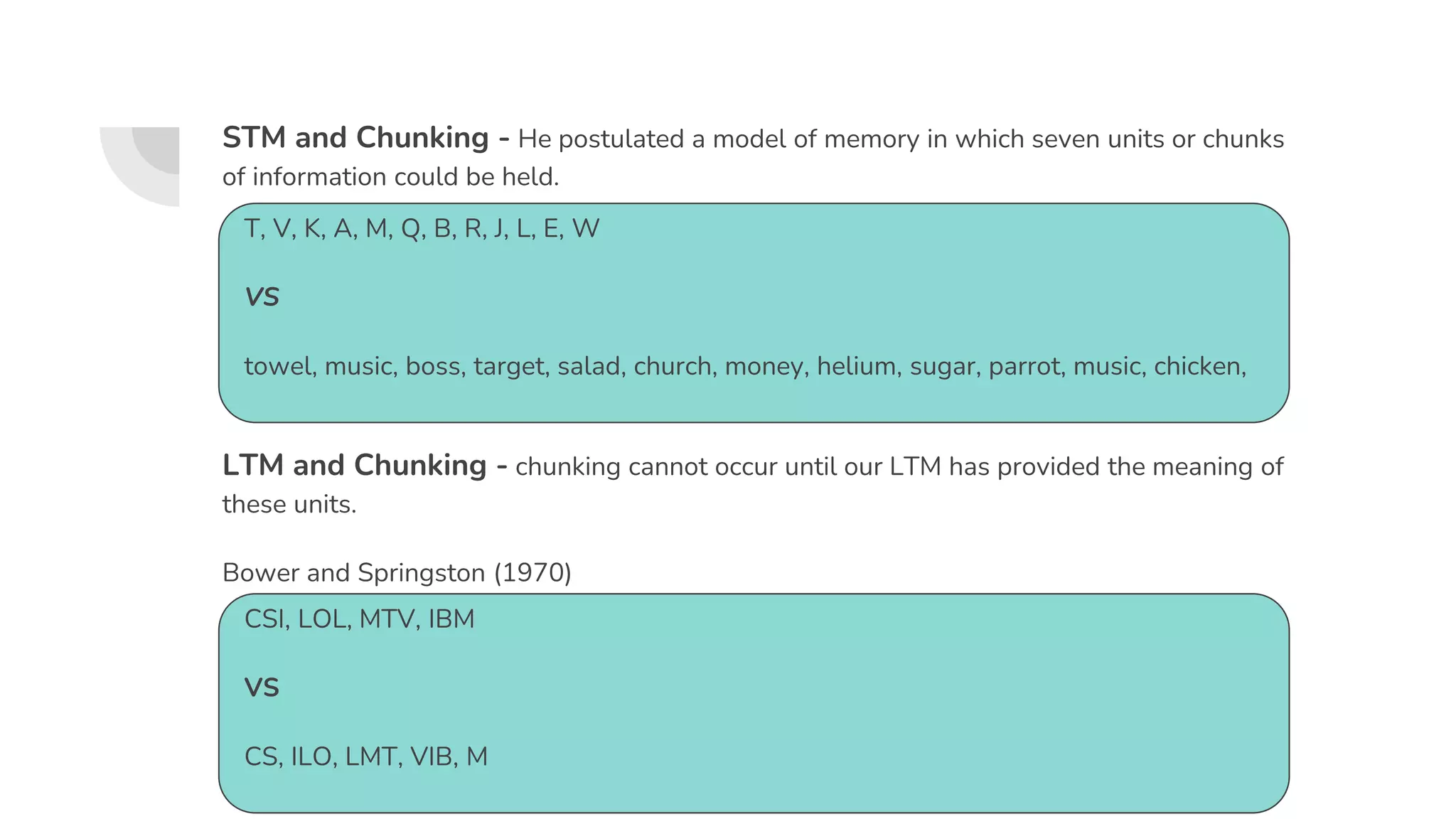
Memory involves encoding, storing, and retrieving information over time. Early models proposed separate short-term and long-term memory systems. Working memory models expanded on short-term memory to include additional components like the phonological loop and visuospatial sketchpad. Capacity limits in short-term memory are around 7 items on average. Information is retrieved from short-term memory through either parallel or serial search mechanisms. Long-term memory involves different codes like visual and semantic codes. Deeper levels of processing lead to stronger long-term memories according to levels of processing models. Memory is reconstructive in nature and influenced by schemas from long-term memory. False memories can also be constructed through suggestive questioning techniques.





![Norms[1]](https://cdn.slidesharecdn.com/ss_thumbnails/norms1-110821093015-phpapp01-thumbnail.jpg?width=640&height=640&fit=bounds)


