
Causal mechanisms
from causal models
     Federica Russo
    Center Leo Apostel, VUB
   Centre for Reasoning, Kent
Overview
Causal models: a baseline view

Causal vs Systemic
   The role of Exogeneity and Covariate Sufficiency
Multi-level
   A statistical expression of social hierarchies
Mixed Mechanism
   Theoretical plausibility of role-functions
Social Regularities
   Invariance of the ‘arrangement’

                                                      2
CAUSAL MODELS


                3
A tradition of scientific enquiry
Quetelet, Durkheim, Wright, …,
Blalock, Duncan, Simon, …,
Haavelmo, Koopmans, Wold, …,
SGS, Pearl, Woodward, …


To explain a (social) phenomenon
we have to model mechanisms


                                         4
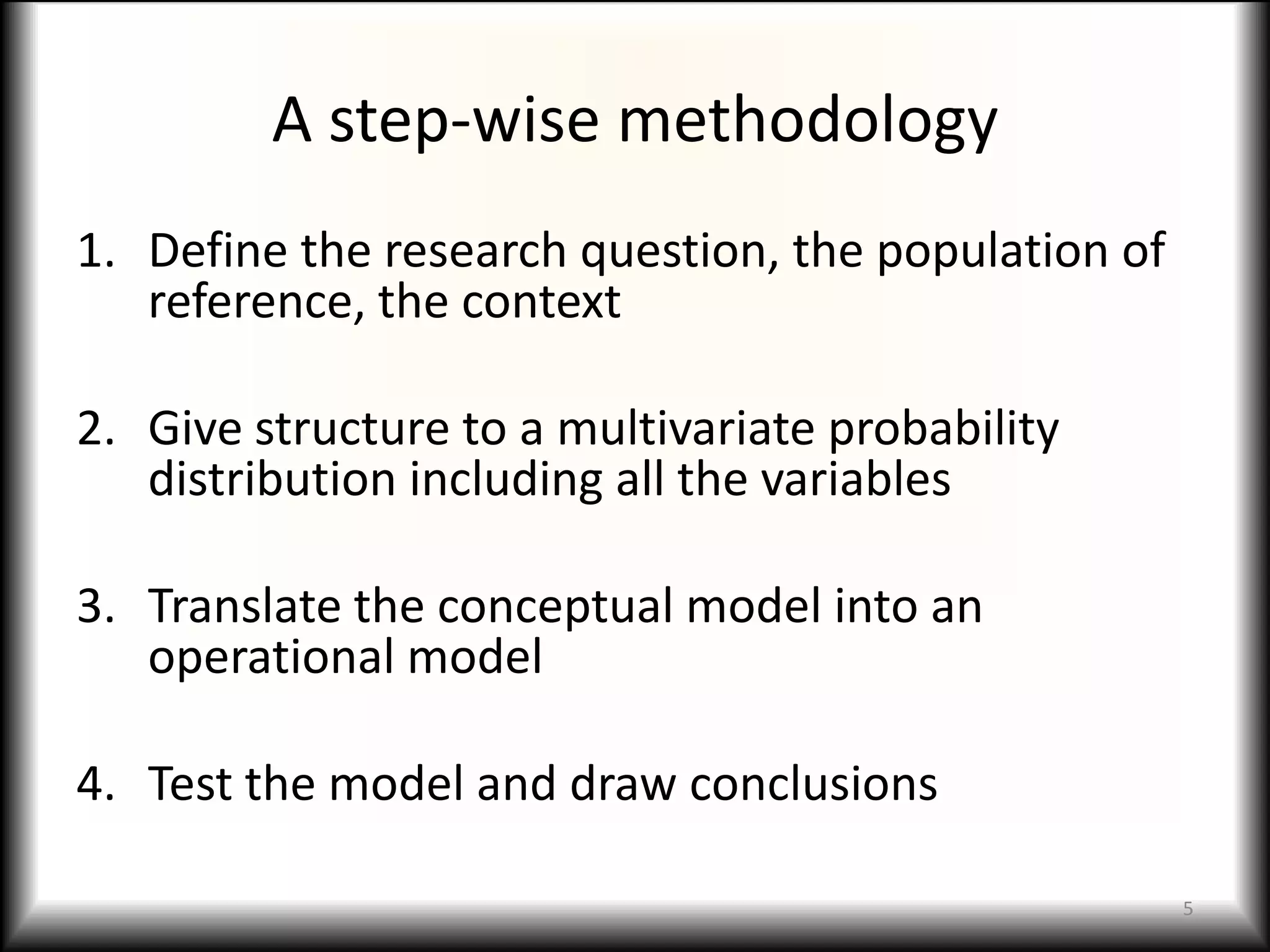
A step-wise methodology
1. Define the research question, the population of
   reference, the context

2. Give structure to a multivariate probability
   distribution including all the variables

3. Translate the conceptual model into an
   operational model

4. Test the model and draw conclusions

                                                     5
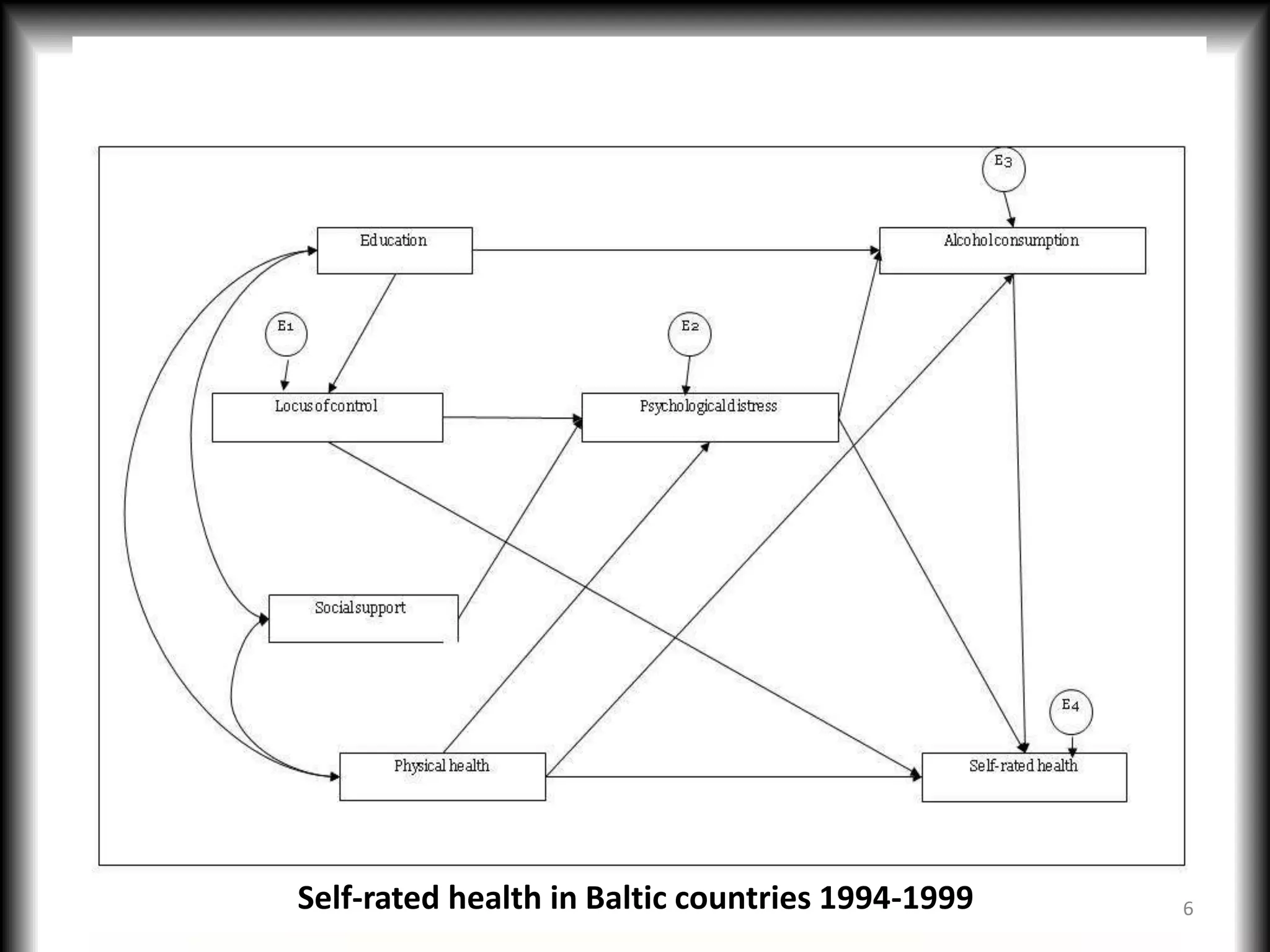
Self-rated health in Baltic countries 1994-1999   6
CAUSAL VS SYSTEMIC


                     7
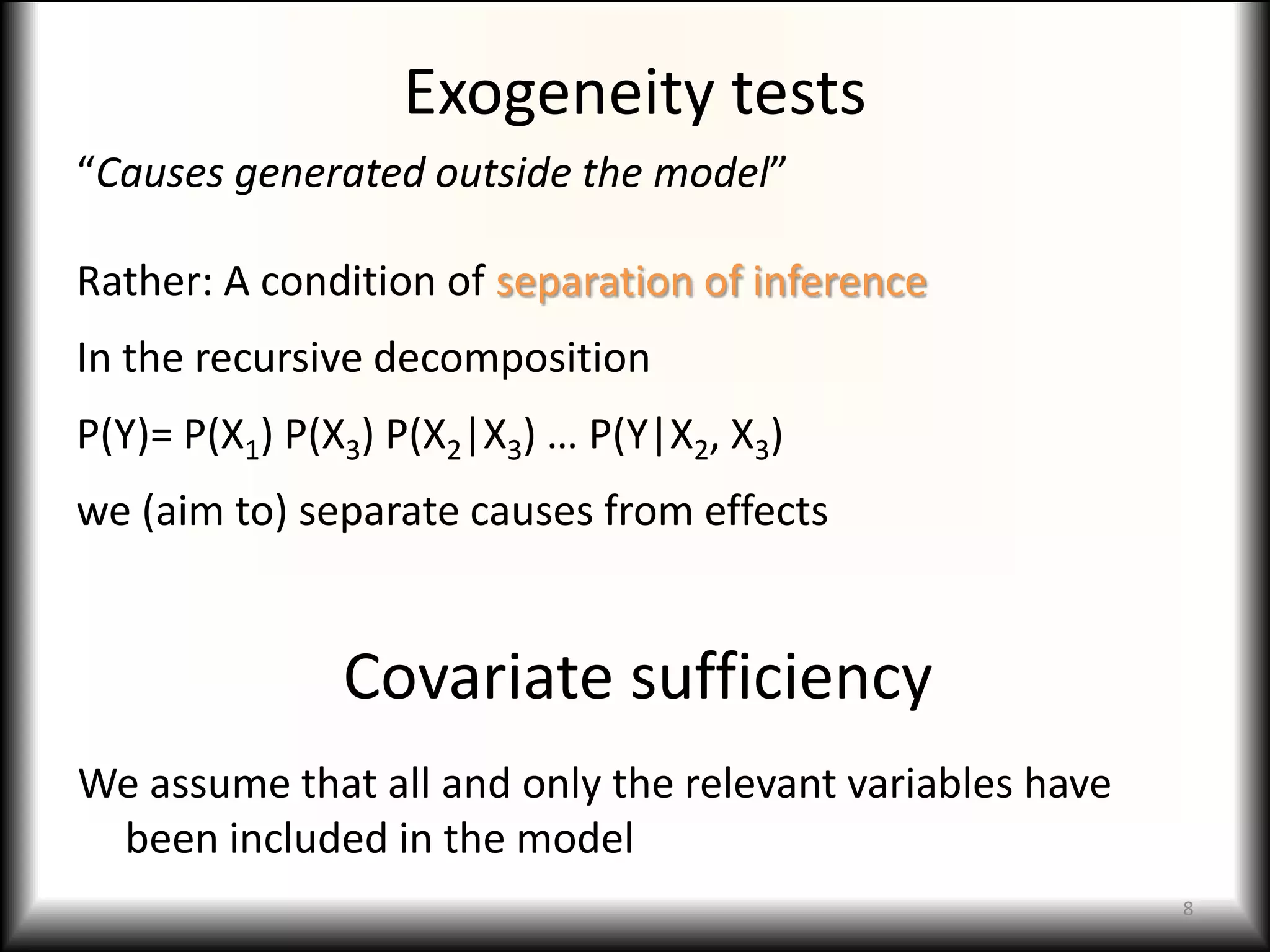
Exogeneity tests
“Causes generated outside the model”

Rather: A condition of separation of inference
In the recursive decomposition
P(Y)= P(X1) P(X3) P(X2|X3) … P(Y|X2, X3)
we (aim to) separate causes from effects


               Covariate sufficiency
We assume that all and only the relevant variables have
 been included in the model
                                                          8
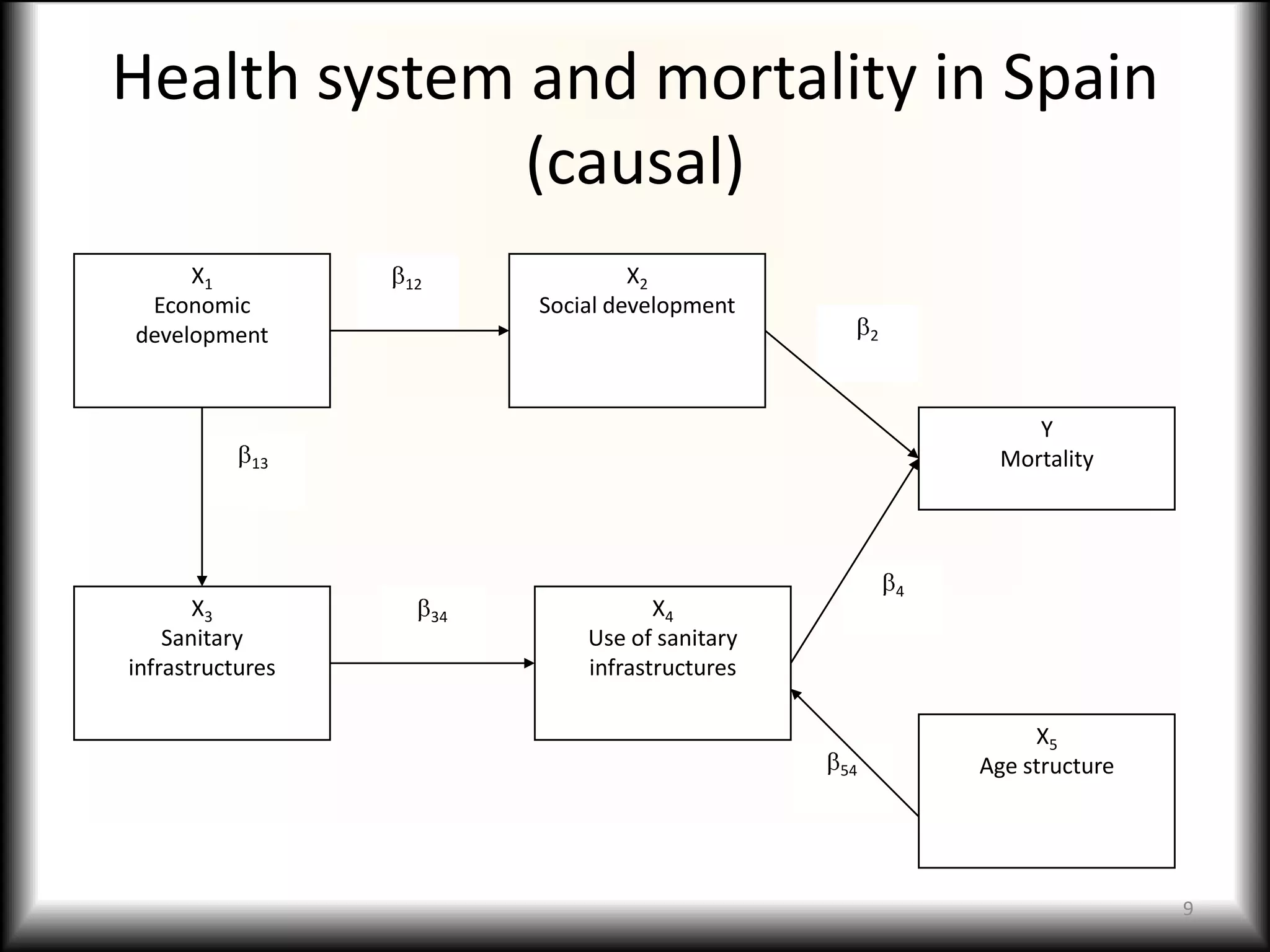
Health system and mortality in Spain
              (causal)
     X1           12                 X2
 Economic                   Social development
development                                            2


                                                                   Y
            13                                                  Mortality


                                                           4
       X3              34              X4
    Sanitary                    Use of sanitary
infrastructures                 infrastructures

                                                                    X5
                                                  54           Age structure


                                                                               9
Health systems
and mortality
in Spain
(systemic)


                 10
MULTI-LEVEL


              11
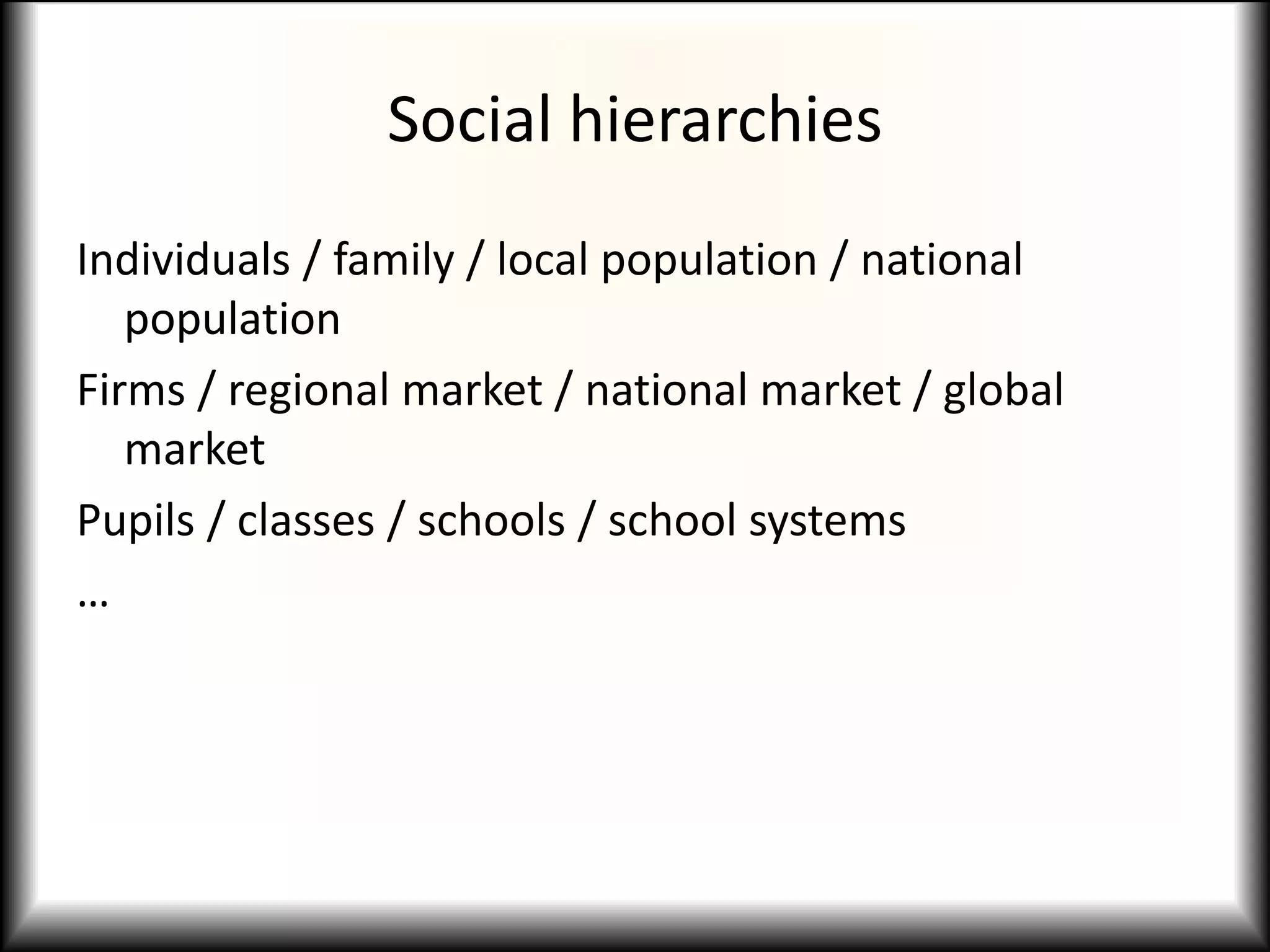
Social hierarchies
Individuals / family / local population / national
   population
Firms / regional market / national market / global
   market
Pupils / classes / schools / school systems
…
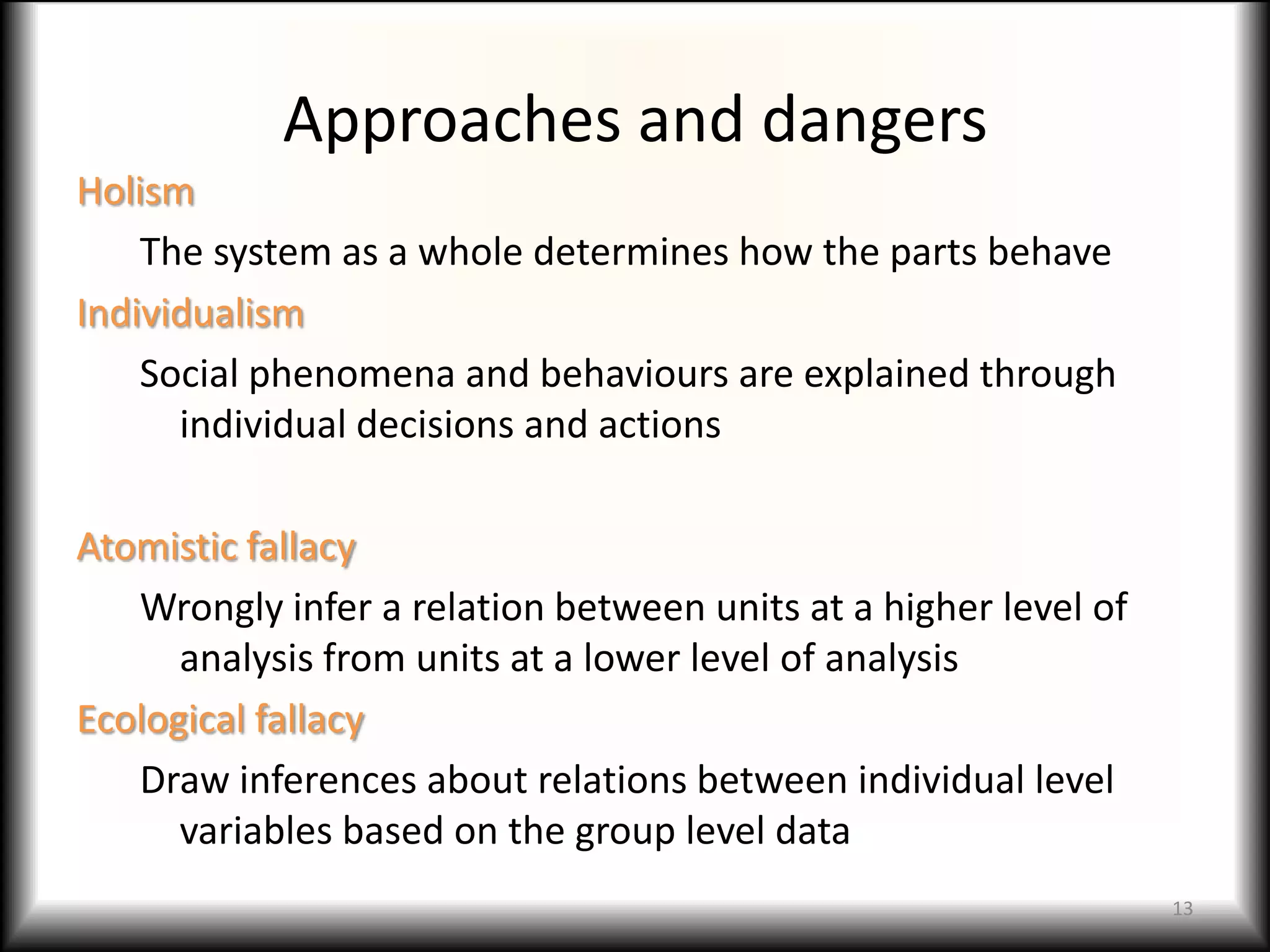
Approaches and dangers
Holism
    The system as a whole determines how the parts behave
Individualism
    Social phenomena and behaviours are explained through
      individual decisions and actions

Atomistic fallacy
   Wrongly infer a relation between units at a higher level of
      analysis from units at a lower level of analysis
Ecological fallacy
   Draw inferences about relations between individual level
      variables based on the group level data
                                                                 13
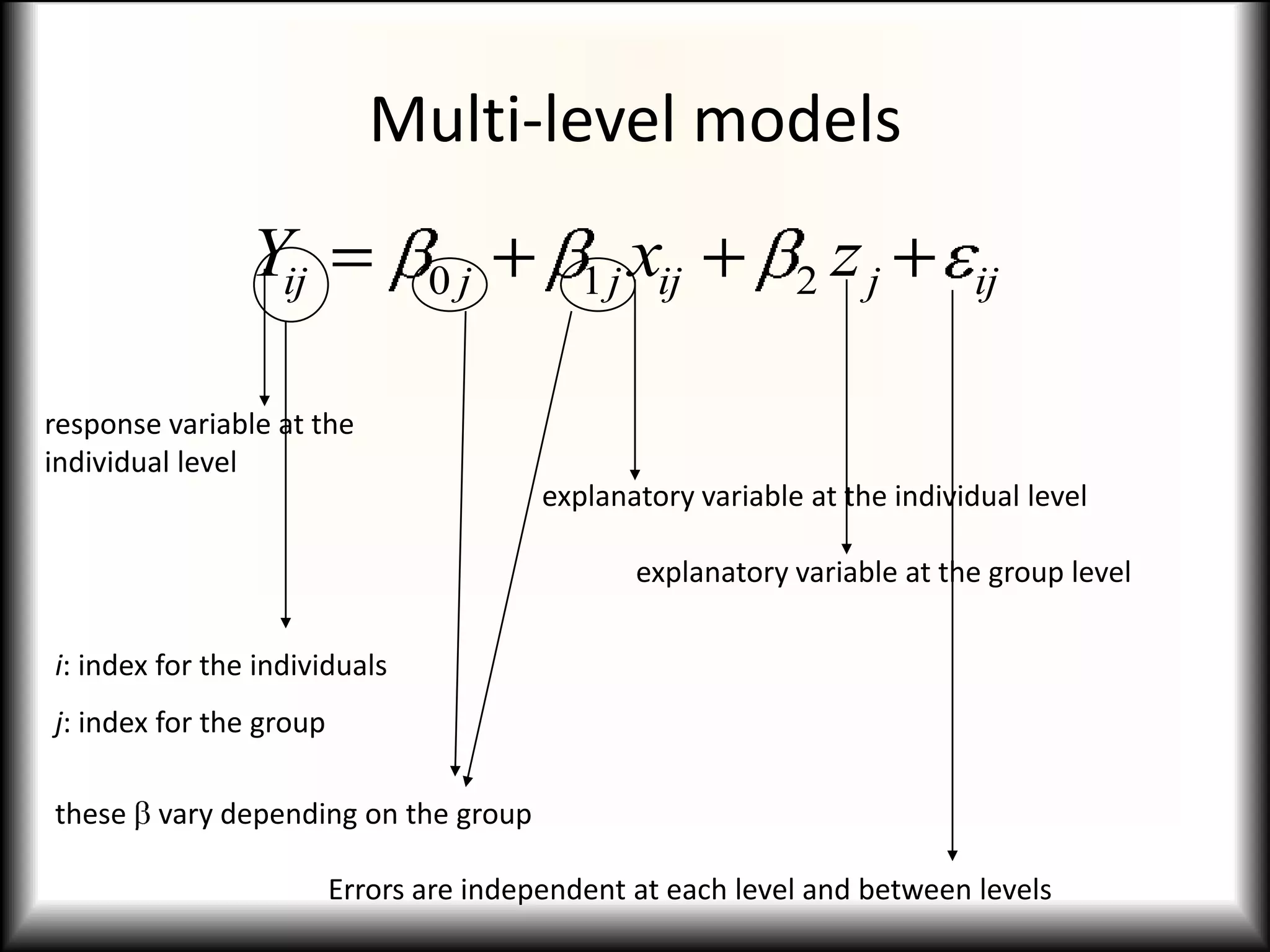
Multi-level models
                Yij             0j              x
                                            1 j ij           2   zj        ij


response variable at the
individual level
                                         explanatory variable at the individual level

                                                explanatory variable at the group level

i: index for the individuals
j: index for the group

these   vary depending on the group

                         Errors are independent at each level and between levels
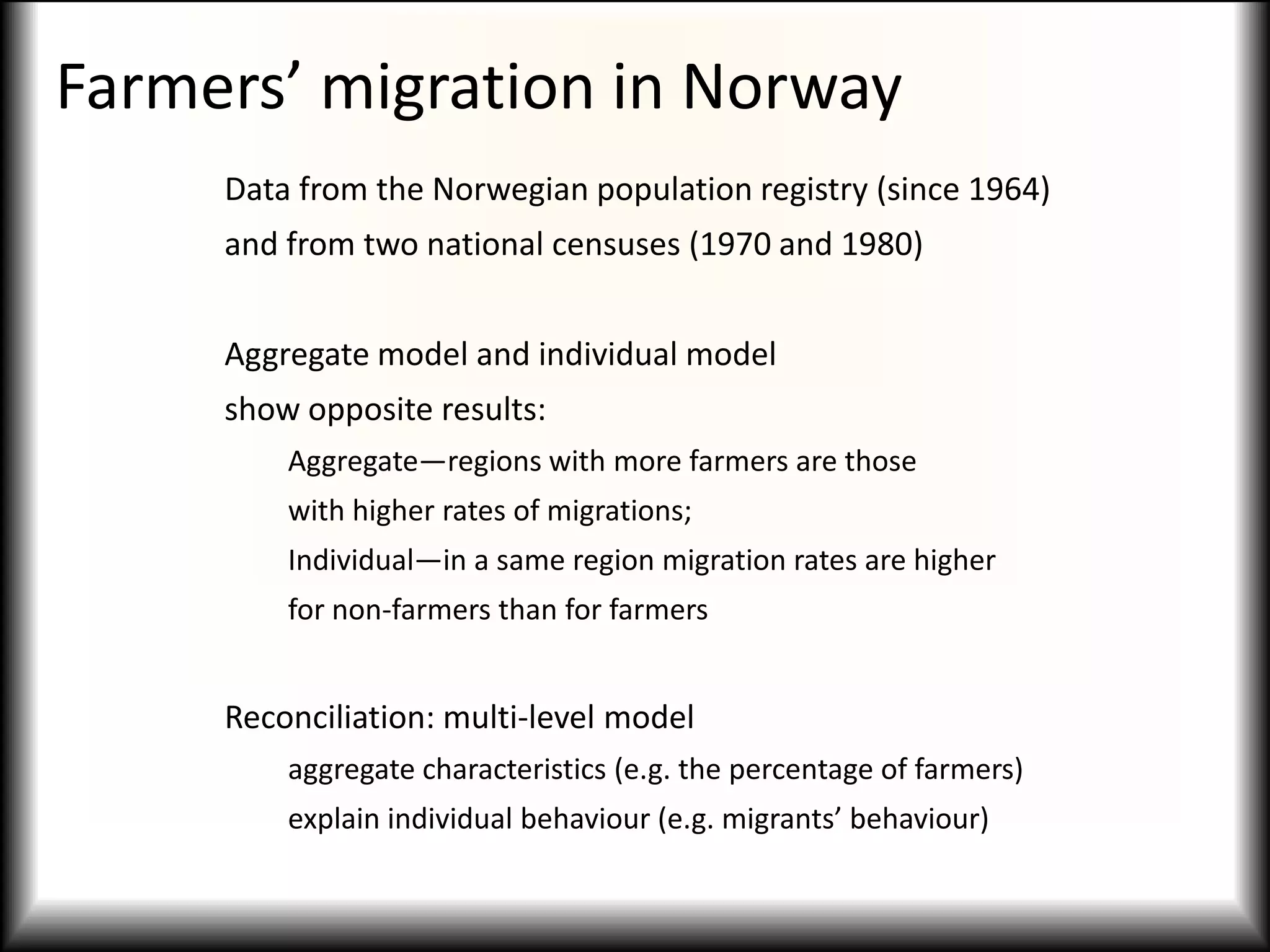
Farmers’ migration in Norway
     Data from the Norwegian population registry (since 1964)
     and from two national censuses (1970 and 1980)


     Aggregate model and individual model
     show opposite results:
         Aggregate—regions with more farmers are those
         with higher rates of migrations;
         Individual—in a same region migration rates are higher
         for non-farmers than for farmers


     Reconciliation: multi-level model
         aggregate characteristics (e.g. the percentage of farmers)
         explain individual behaviour (e.g. migrants’ behaviour)
MIXED MECHANISMS


                   16
Not just ‘social’
Socio-economic, health, psychological factors may act
  in a same mechanism

   Mother’s education and child survival in developing
    countries

   Child obesity and socio-psychological development


                                                         17
Not just ‘statistical’
We can add any variable we like in a causal model
But we must justify the role-function of each factor in
  the mechanism
   Even more in mixed-mechanisms


Theoretical plausibility backs up statistical modelling


                                                          18
SOCIAL REGULARITIES


                      19
Regularities in causal models
Humean regularities? (constant conjunction)


Rather:
  Repetitions of the same causal structure, either in
    time or given the same causally relevant factors
  Tested through invariance properties
     Change-relating relations that have a stable
      parametrisation in chosen sub-populations

                                                        20
A problem of testing
Testwhether relations are regular (in the
  invariance sense)
Information needed to establish generic causal
  relations
‘Generic’ comes into degrees:
  Relative to the population of reference
  Open question about external validity

                                                 21
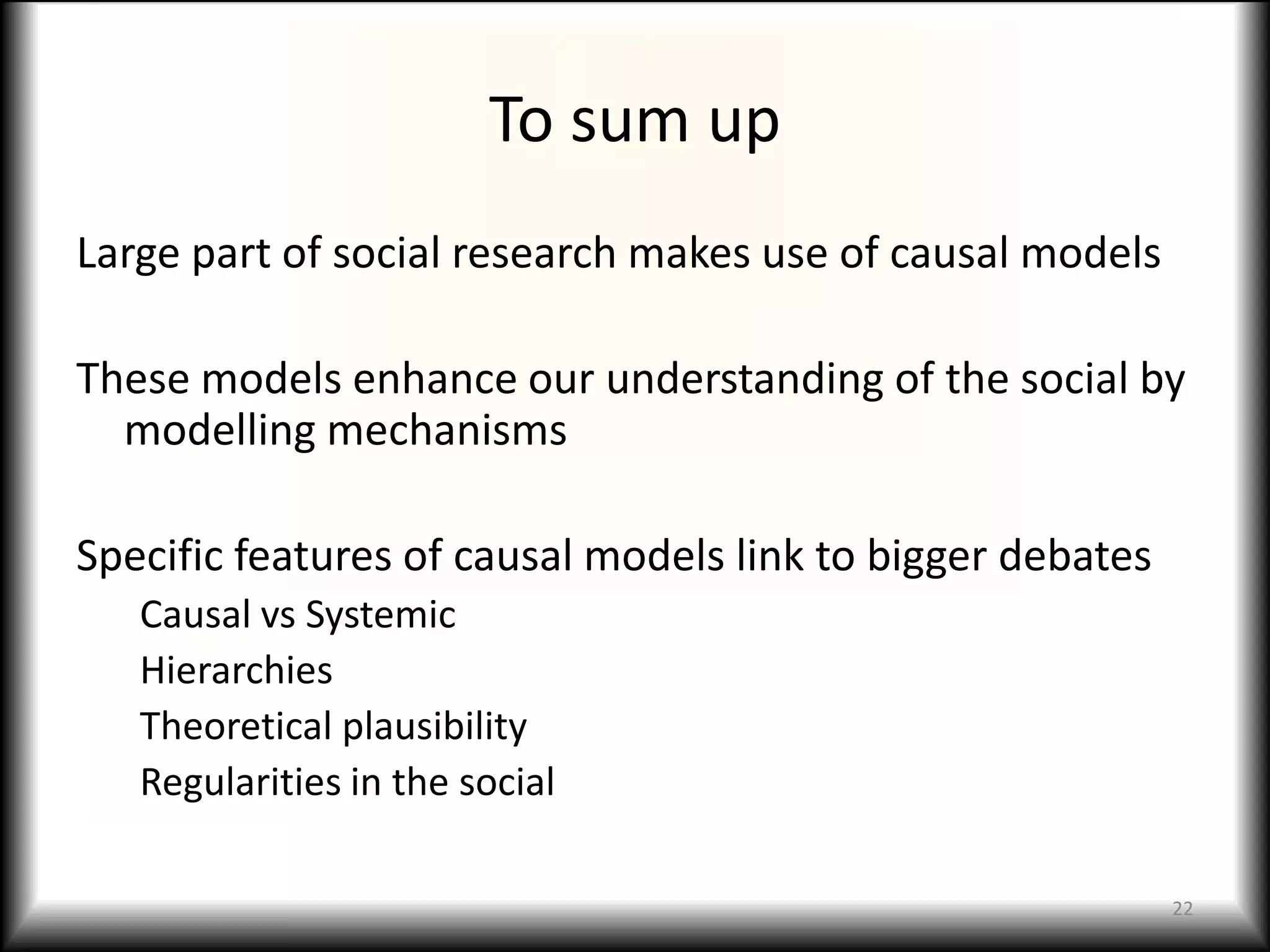
To sum up
Large part of social research makes use of causal models

These models enhance our understanding of the social by
  modelling mechanisms

Specific features of causal models link to bigger debates
   Causal vs Systemic
   Hierarchies
   Theoretical plausibility
   Regularities in the social

                                                            22
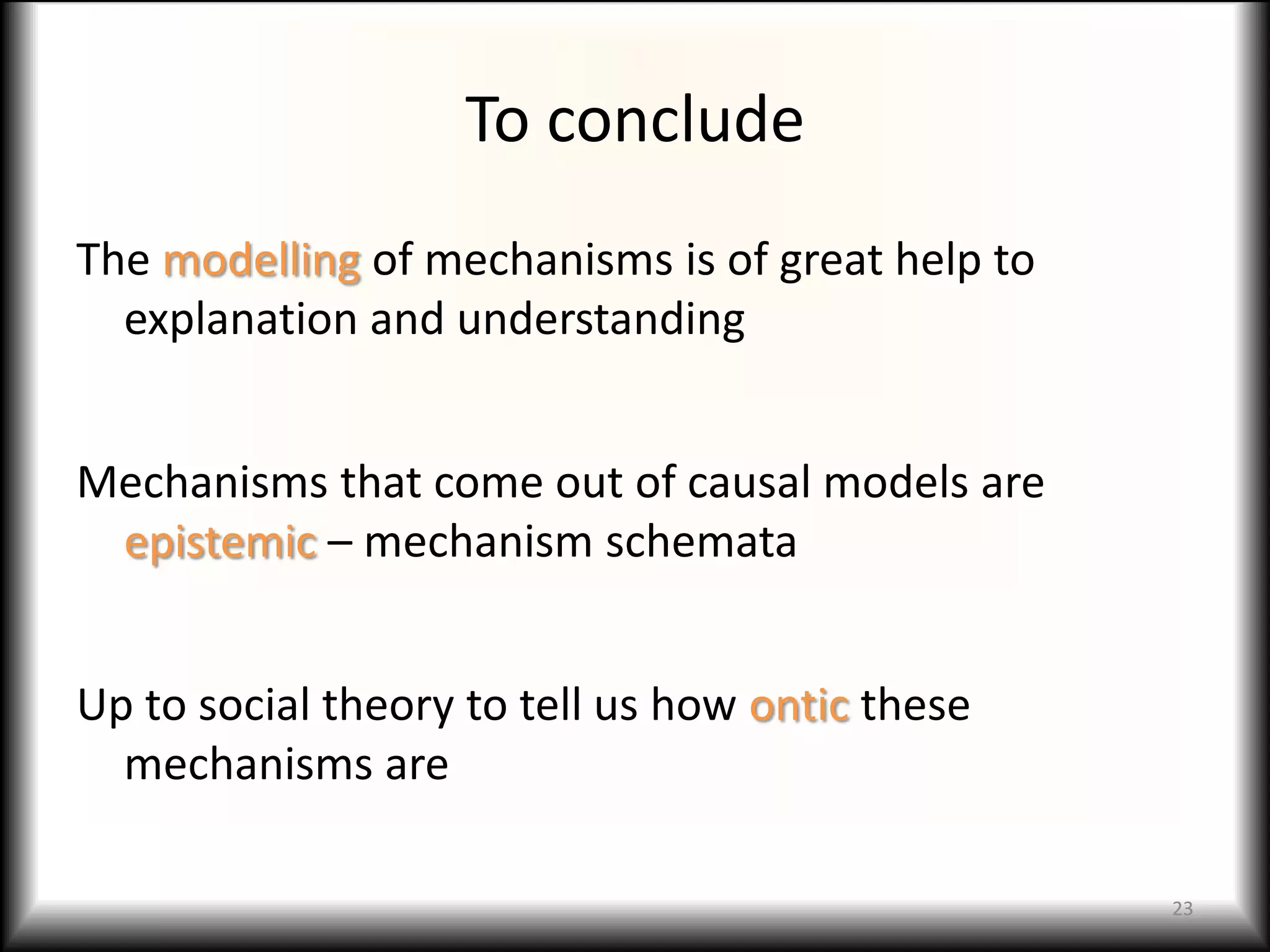
To conclude
The modelling of mechanisms is of great help to
  explanation and understanding


Mechanisms that come out of causal models are
 epistemic – mechanism schemata


Up to social theory to tell us how ontic these
  mechanisms are

                                                  23
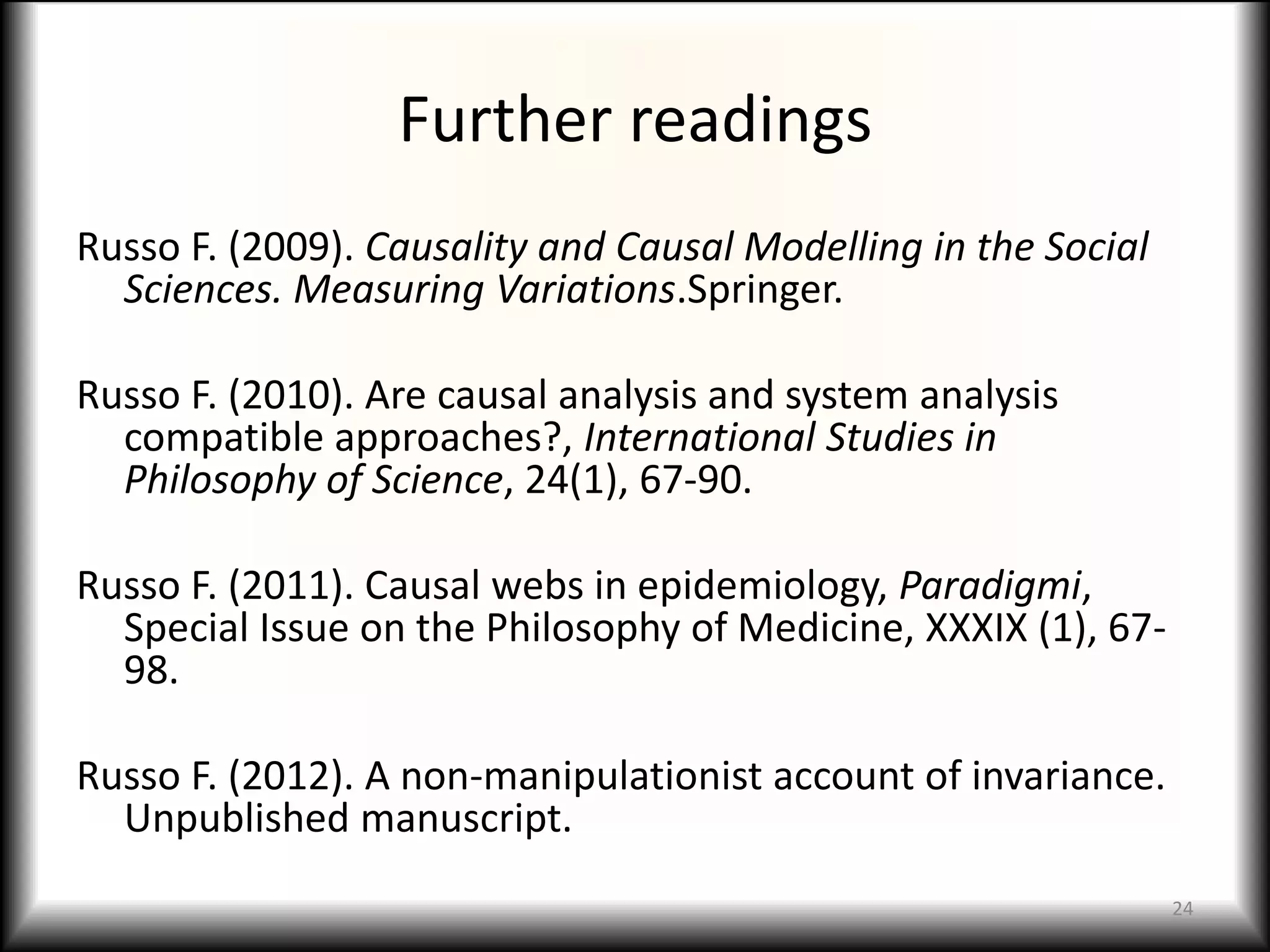
Further readings
Russo F. (2009). Causality and Causal Modelling in the Social
  Sciences. Measuring Variations.Springer.

Russo F. (2010). Are causal analysis and system analysis
  compatible approaches?, International Studies in
  Philosophy of Science, 24(1), 67-90.

Russo F. (2011). Causal webs in epidemiology, Paradigmi,
  Special Issue on the Philosophy of Medicine, XXXIX (1), 67-
  98.

Russo F. (2012). A non-manipulationist account of invariance.
  Unpublished manuscript.
                                                                24

Russo rotterdam2012

  • 1.
    Causal mechanisms from causalmodels Federica Russo Center Leo Apostel, VUB Centre for Reasoning, Kent
  • 2.
    Overview Causal models: abaseline view Causal vs Systemic The role of Exogeneity and Covariate Sufficiency Multi-level A statistical expression of social hierarchies Mixed Mechanism Theoretical plausibility of role-functions Social Regularities Invariance of the ‘arrangement’ 2
  • 3.
  • 4.
    A tradition ofscientific enquiry Quetelet, Durkheim, Wright, …, Blalock, Duncan, Simon, …, Haavelmo, Koopmans, Wold, …, SGS, Pearl, Woodward, … To explain a (social) phenomenon we have to model mechanisms 4
  • 5.
    A step-wise methodology 1.Define the research question, the population of reference, the context 2. Give structure to a multivariate probability distribution including all the variables 3. Translate the conceptual model into an operational model 4. Test the model and draw conclusions 5
  • 6.
    Self-rated health inBaltic countries 1994-1999 6
  • 7.
  • 8.
    Exogeneity tests “Causes generatedoutside the model” Rather: A condition of separation of inference In the recursive decomposition P(Y)= P(X1) P(X3) P(X2|X3) … P(Y|X2, X3) we (aim to) separate causes from effects Covariate sufficiency We assume that all and only the relevant variables have been included in the model 8
  • 9.
    Health system andmortality in Spain (causal) X1 12 X2 Economic Social development development 2 Y 13 Mortality 4 X3 34 X4 Sanitary Use of sanitary infrastructures infrastructures X5 54 Age structure 9
  • 10.
  • 11.
  • 12.
    Social hierarchies Individuals /family / local population / national population Firms / regional market / national market / global market Pupils / classes / schools / school systems …
  • 13.
    Approaches and dangers Holism The system as a whole determines how the parts behave Individualism Social phenomena and behaviours are explained through individual decisions and actions Atomistic fallacy Wrongly infer a relation between units at a higher level of analysis from units at a lower level of analysis Ecological fallacy Draw inferences about relations between individual level variables based on the group level data 13
  • 14.
    Multi-level models Yij 0j x 1 j ij 2 zj ij response variable at the individual level explanatory variable at the individual level explanatory variable at the group level i: index for the individuals j: index for the group these vary depending on the group Errors are independent at each level and between levels
  • 15.
    Farmers’ migration inNorway Data from the Norwegian population registry (since 1964) and from two national censuses (1970 and 1980) Aggregate model and individual model show opposite results: Aggregate—regions with more farmers are those with higher rates of migrations; Individual—in a same region migration rates are higher for non-farmers than for farmers Reconciliation: multi-level model aggregate characteristics (e.g. the percentage of farmers) explain individual behaviour (e.g. migrants’ behaviour)
  • 16.
  • 17.
    Not just ‘social’ Socio-economic,health, psychological factors may act in a same mechanism Mother’s education and child survival in developing countries Child obesity and socio-psychological development 17
  • 18.
    Not just ‘statistical’ Wecan add any variable we like in a causal model But we must justify the role-function of each factor in the mechanism Even more in mixed-mechanisms Theoretical plausibility backs up statistical modelling 18
  • 19.
  • 20.
    Regularities in causalmodels Humean regularities? (constant conjunction) Rather: Repetitions of the same causal structure, either in time or given the same causally relevant factors Tested through invariance properties Change-relating relations that have a stable parametrisation in chosen sub-populations 20
  • 21.
    A problem oftesting Testwhether relations are regular (in the invariance sense) Information needed to establish generic causal relations ‘Generic’ comes into degrees: Relative to the population of reference Open question about external validity 21
  • 22.
    To sum up Largepart of social research makes use of causal models These models enhance our understanding of the social by modelling mechanisms Specific features of causal models link to bigger debates Causal vs Systemic Hierarchies Theoretical plausibility Regularities in the social 22
  • 23.
    To conclude The modellingof mechanisms is of great help to explanation and understanding Mechanisms that come out of causal models are epistemic – mechanism schemata Up to social theory to tell us how ontic these mechanisms are 23
  • 24.
    Further readings Russo F.(2009). Causality and Causal Modelling in the Social Sciences. Measuring Variations.Springer. Russo F. (2010). Are causal analysis and system analysis compatible approaches?, International Studies in Philosophy of Science, 24(1), 67-90. Russo F. (2011). Causal webs in epidemiology, Paradigmi, Special Issue on the Philosophy of Medicine, XXXIX (1), 67- 98. Russo F. (2012). A non-manipulationist account of invariance. Unpublished manuscript. 24