Teaching Philosophy of
Science and Technology:
Some reflections on how to make it
inclusive and diverse
Federica Russo
Philosophy & ILLC | University of Amsterdam
russofederica.wordpress.com |@federicarusso
Levels of reflections
 Why reflecting about
 Teaching?
 How to teaching philsci / phil tech, and to non-phil students?
 Diversity and inclusion?
 In this talk, I navigate these dimensions, hopefully making clear which one I
address, at any given moment
 Disclaimer:
 I am ‘amateur’, for professional contributions, keep an eye on
https://philsci.eu/TeachingPoS
2
My eye-openers
 Constructive alignment approach of Biggs and Tang
 Their pedagogical approach to aligning learning goals – assignments – assessment is closely
related to philosophical thinking about the nature of knowledge
 Approaches to feedback, e.g. Boud and Molloy
 Students as the drivers of feedback, what feedback really consists in, how it can be helpful
rather than judgmental
 Project-based and problem-based learning
 Quite hard to adapt and implement in philosophy programmes, but capturing my research.
Whence the question: how to turn this into a phil module?
 The slow professor by Seeber and Berg
 Especially for the idea to literally make time for the students to think, wander in the
literature, and even to fail
3
Transforming modules
 How to turn old-fashioned courses into brand new ones?
 More inclusive, more interdisciplinary, more aligned, more project-based, more student-
centred, …
 Constraints
 Time availability
 Place of individual modules into the programme
 Culture clashes with other modules / whole programme / teachers
 Budget
 My current strategy
 Very gradual transformations; learning while teaching; seek and respond to students’
feedback, …
4
My core PhilSci / PhilTech
teaching portfolio
 BA > 3rd year Philosophical Approaches to the Sciences
 MA > Philosophy of the Social Sciences
 MA > Philosophy of Techno-Science
5
Who sits in my class? (Zoom!)
 BA-Phil Approaches to the Sciences
 Philosophy students; natural sci /medicine students
 MA-Phil Social Sciences
 Philosophy students; social science, art (history), law, history students
 MA-Phil Techno-Science
 Philosophy students, social science, logic, engineering, art, cultural analysis
students
6
The general challenge
 Offering a philosophical perspective to students that
 Have very different backgrounds and motivations
 Often have not been exposed to Phil Sci before
 Have been exposed only to critical approaches to science
 Know close to nothing about scientific practice
 …
7
The specific challenges
 BA-Phil Approaches to the Sciences
 A course in preparation to write the BA thesis …
 … but not everyone will be writing one
 MA-Phil Social Science
 Most students come from a specific discipline and will need a course that is
methodologically- and practice-oriented …
 … but some will be in need of higher-up philosophical reflection
 MA-Phil Techno-Science
 Establishing the need for a Phil of Techno-Science requires quite some time, before any
other topic can be fruitfully addressed
8
Revisiting the general challenge
 Heterogeneity of student population is part of the challenge, but not only
 Questions about canon and philosophical methodology are also at stake
 Ultimately, a big question for me is what I want students get from the course
 Upon reflection: over time, and looking at how my own research in Phil Sci/Tech
developed, this has changed a lot
9
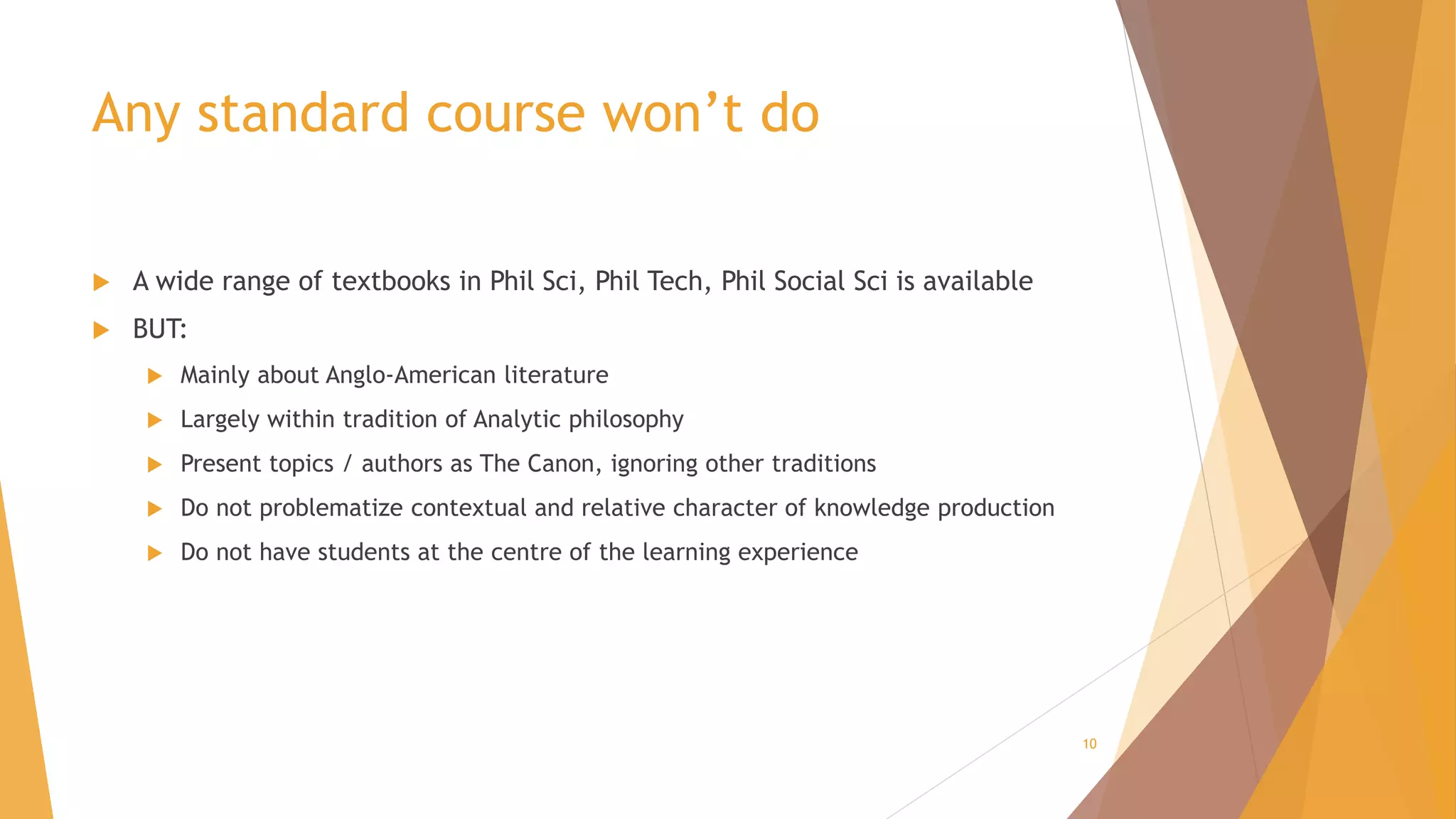
Any standard course won’t do
 A wide range of textbooks in Phil Sci, Phil Tech, Phil Social Sci is available
 BUT:
 Mainly about Anglo-American literature
 Largely within tradition of Analytic philosophy
 Present topics / authors as The Canon, ignoring other traditions
 Do not problematize contextual and relative character of knowledge production
 Do not have students at the centre of the learning experience
10
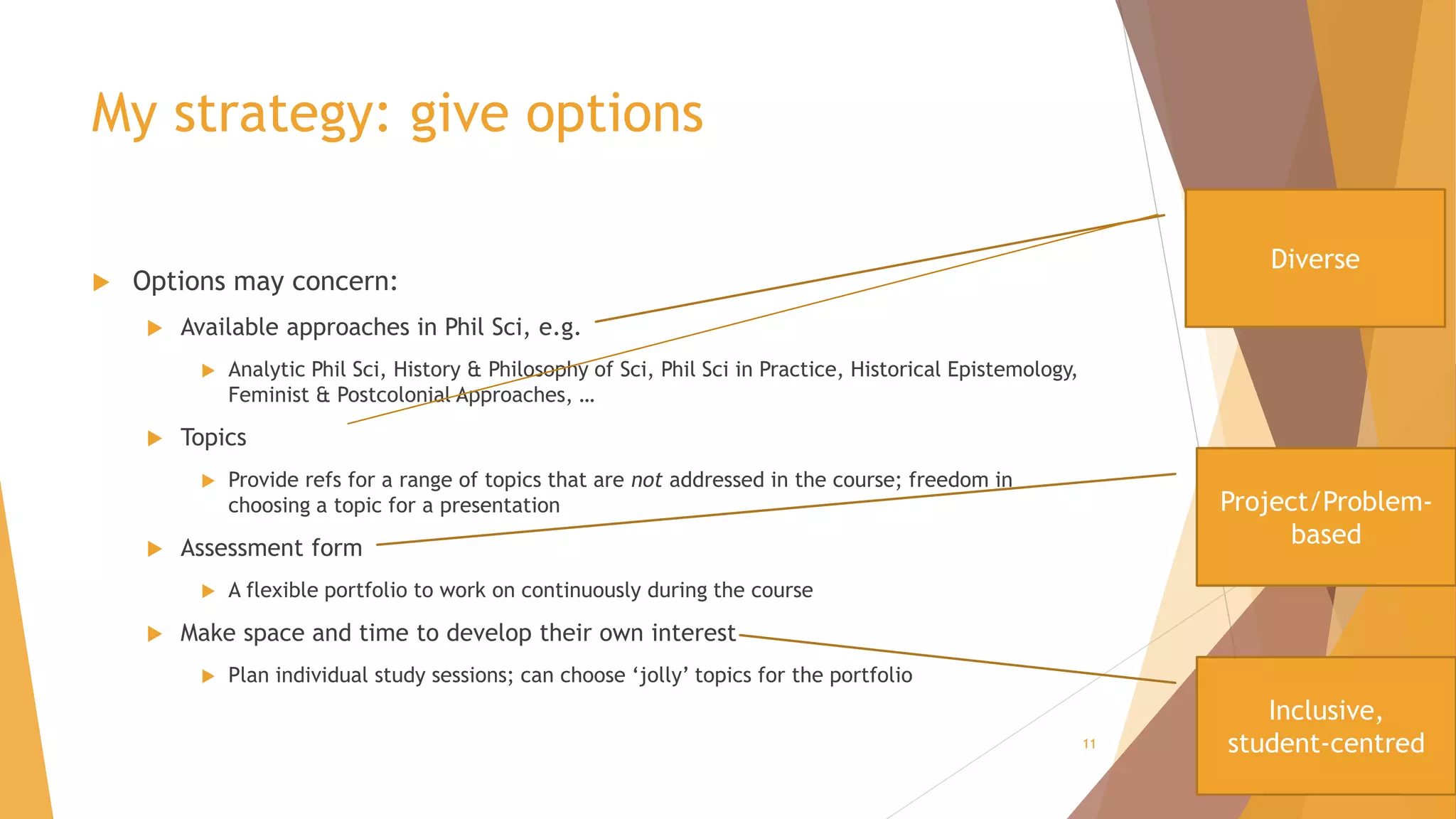
My strategy: give options
 Options may concern:
 Available approaches in Phil Sci, e.g.
 Analytic Phil Sci, History & Philosophy of Sci, Phil Sci in Practice, Historical Epistemology,
Feminist & Postcolonial Approaches, …
 Topics
 Provide refs for a range of topics that are not addressed in the course; freedom in
choosing a topic for a presentation
 Assessment form
 A flexible portfolio to work on continuously during the course
 Make space and time to develop their own interest
 Plan individual study sessions; can choose ‘jolly’ topics for the portfolio
11
Diverse
Project/Problem-
based
Inclusive,
student-centred
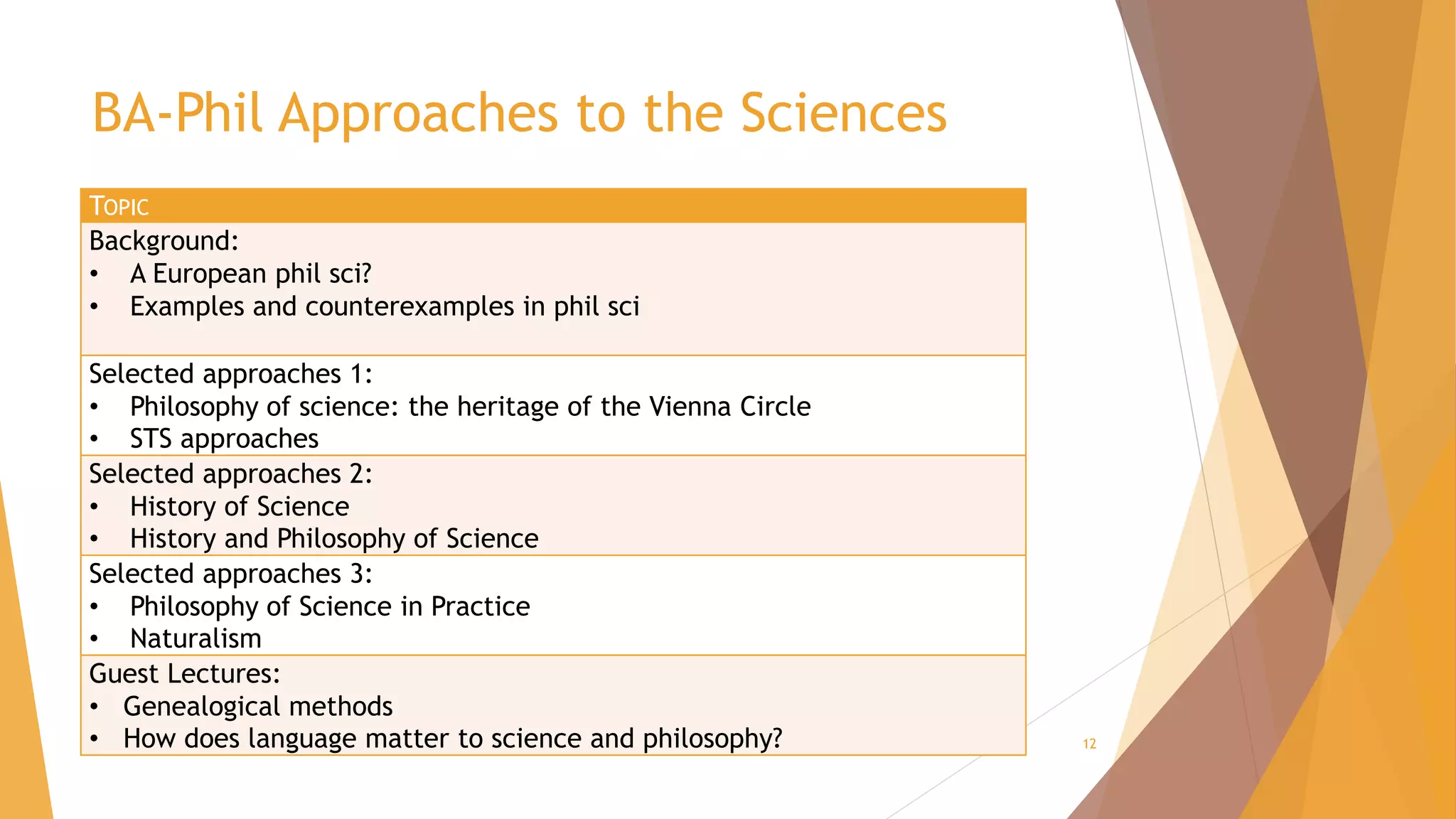
BA-Phil Approaches to the Sciences
12
TOPIC
Background:
• A European phil sci?
• Examples and counterexamples in phil sci
Selected approaches 1:
• Philosophy of science: the heritage of the Vienna Circle
• STS approaches
Selected approaches 2:
• History of Science
• History and Philosophy of Science
Selected approaches 3:
• Philosophy of Science in Practice
• Naturalism
Guest Lectures:
• Genealogical methods
• How does language matter to science and philosophy?
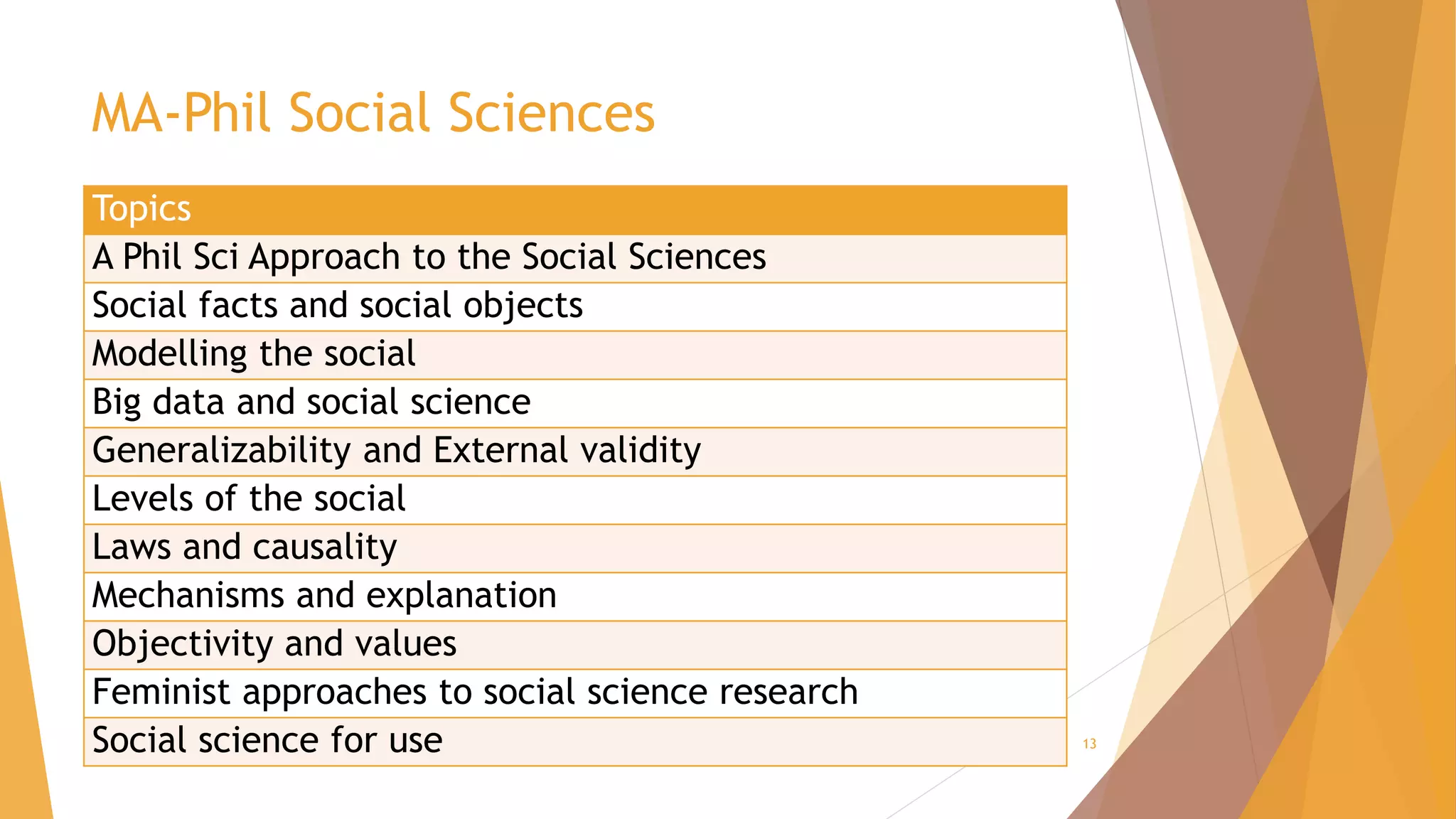
MA-Phil Social Sciences
13
Topics
A Phil Sci Approach to the Social Sciences
Social facts and social objects
Modelling the social
Big data and social science
Generalizability and External validity
Levels of the social
Laws and causality
Mechanisms and explanation
Objectivity and values
Feminist approaches to social science research
Social science for use
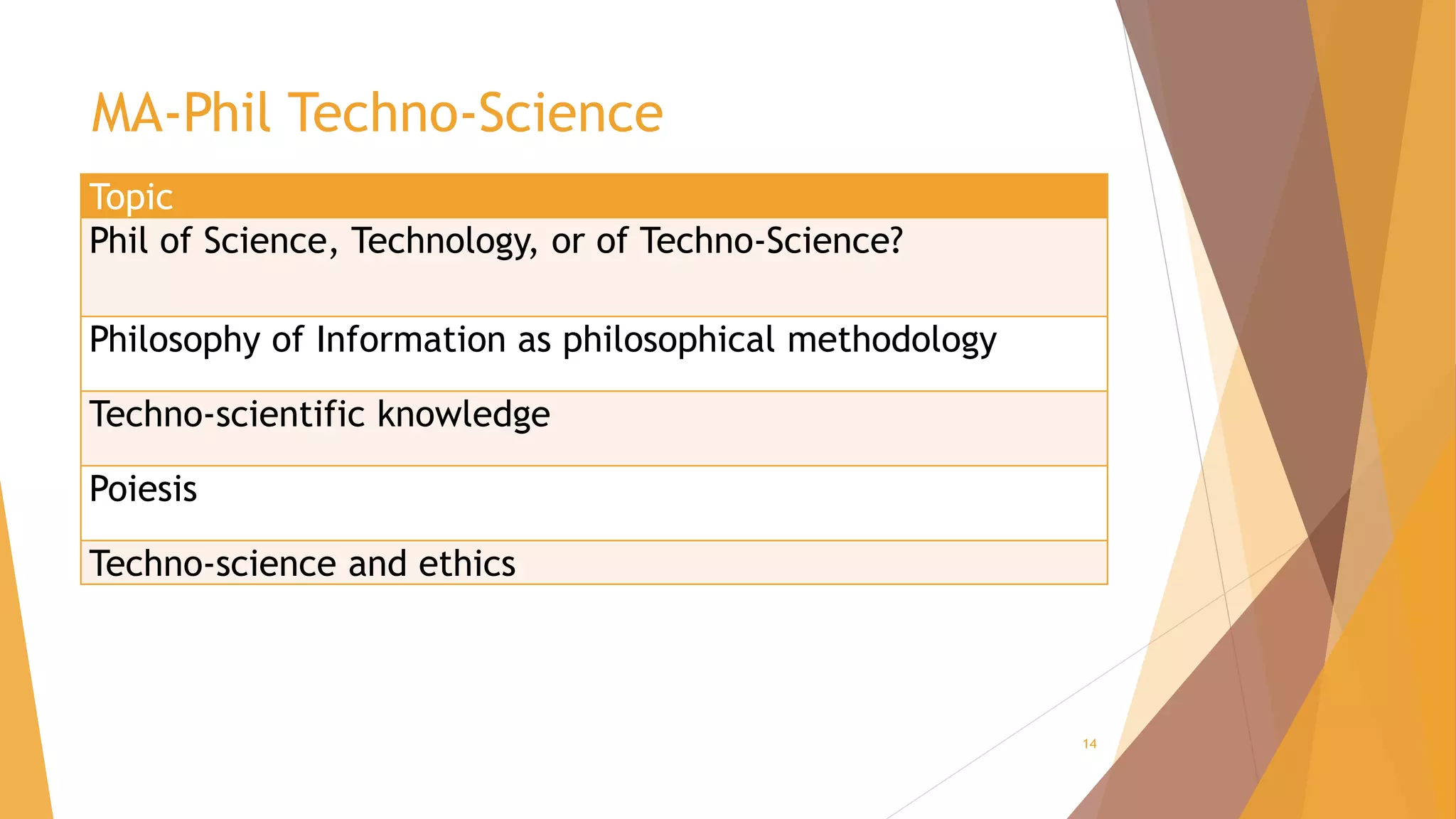
MA-Phil Techno-Science
14
Topic
Phil of Science, Technology, or of Techno-Science?
Philosophy of Information as philosophical methodology
Techno-scientific knowledge
Poiesis
Techno-science and ethics
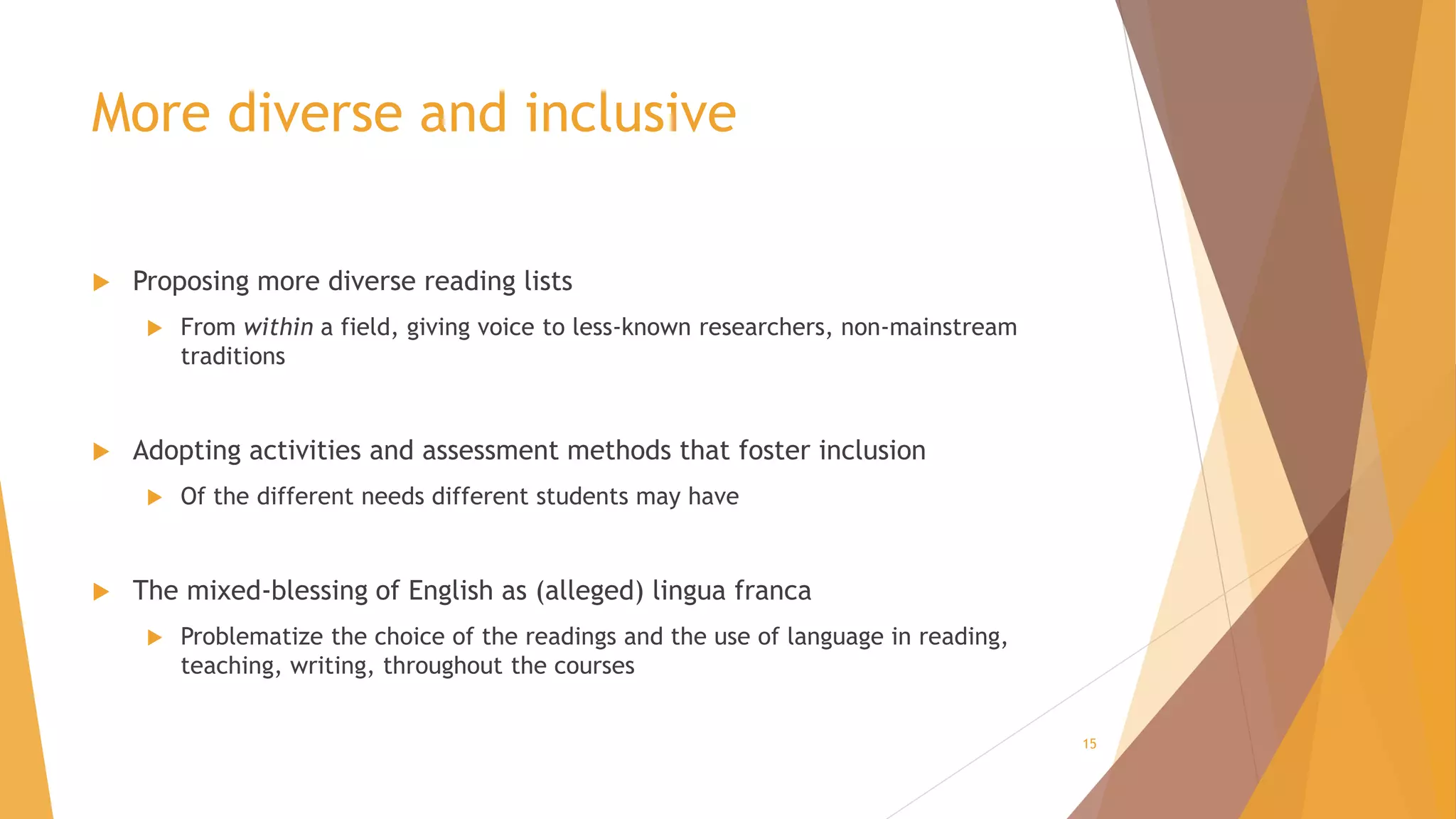
More diverse and inclusive
 Proposing more diverse reading lists
 From within a field, giving voice to less-known researchers, non-mainstream
traditions
 Adopting activities and assessment methods that foster inclusion
 Of the different needs different students may have
 The mixed-blessing of English as (alleged) lingua franca
 Problematize the choice of the readings and the use of language in reading,
teaching, writing, throughout the courses
15
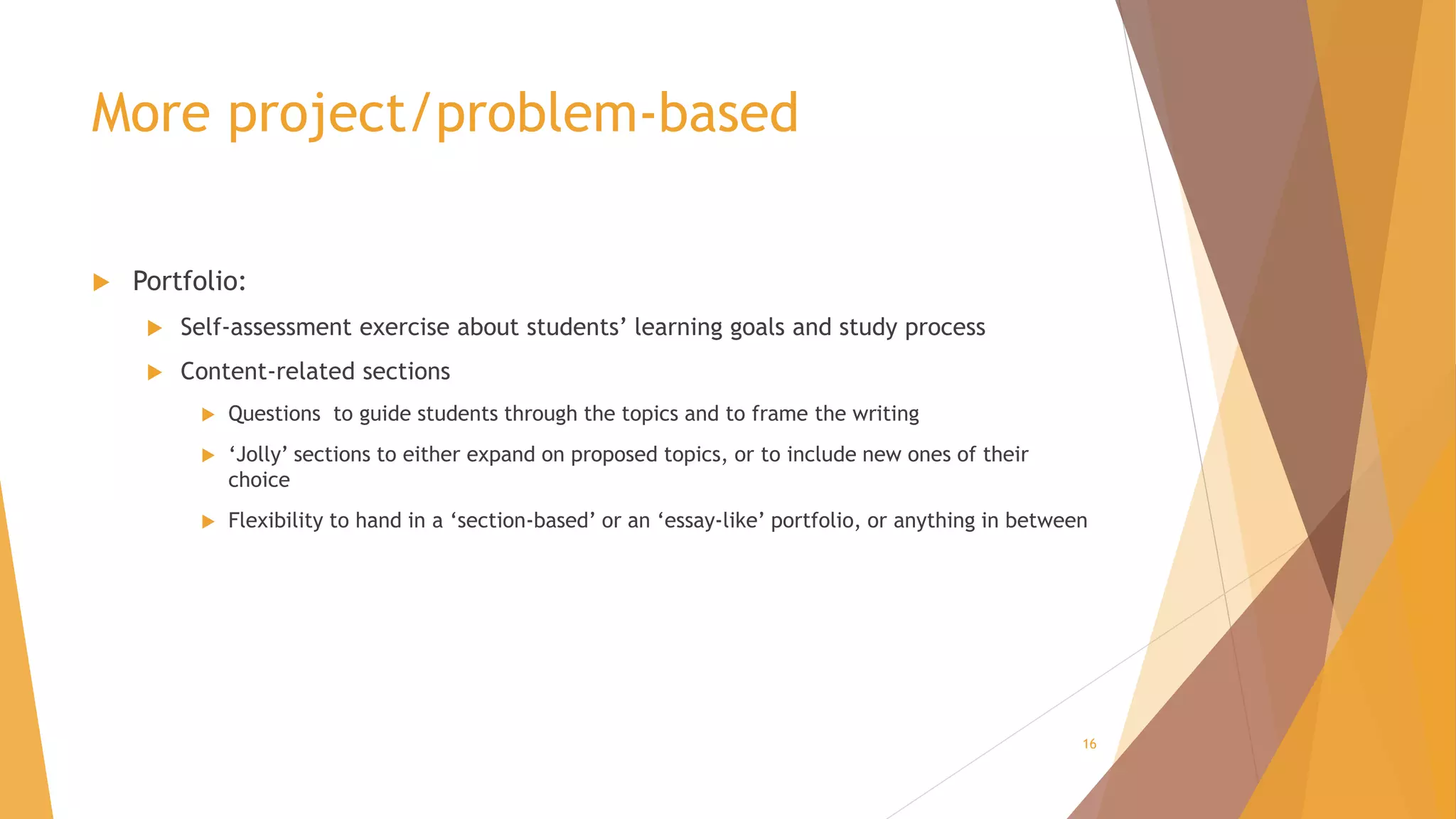
More project/problem-based
 Portfolio:
 Self-assessment exercise about students’ learning goals and study process
 Content-related sections
 Questions to guide students through the topics and to frame the writing
 ‘Jolly’ sections to either expand on proposed topics, or to include new ones of their
choice
 Flexibility to hand in a ‘section-based’ or an ‘essay-like’ portfolio, or anything in between
16
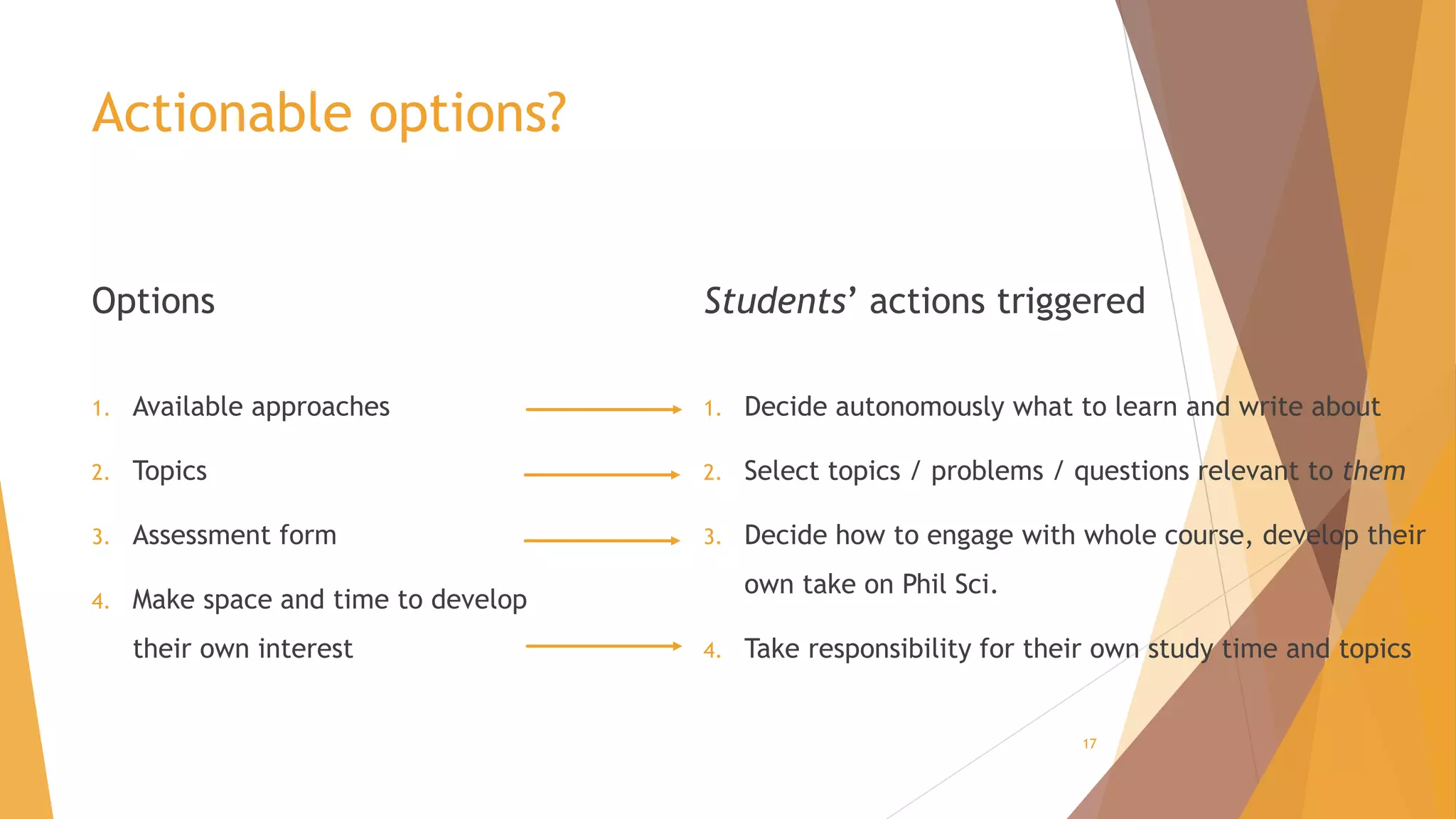
Actionable options?
Options
1. Available approaches
2. Topics
3. Assessment form
4. Make space and time to develop
their own interest
Students’ actions triggered
1. Decide autonomously what to learn and write about
2. Select topics / problems / questions relevant to them
3. Decide how to engage with whole course, develop their
own take on Phil Sci.
4. Take responsibility for their own study time and topics
17
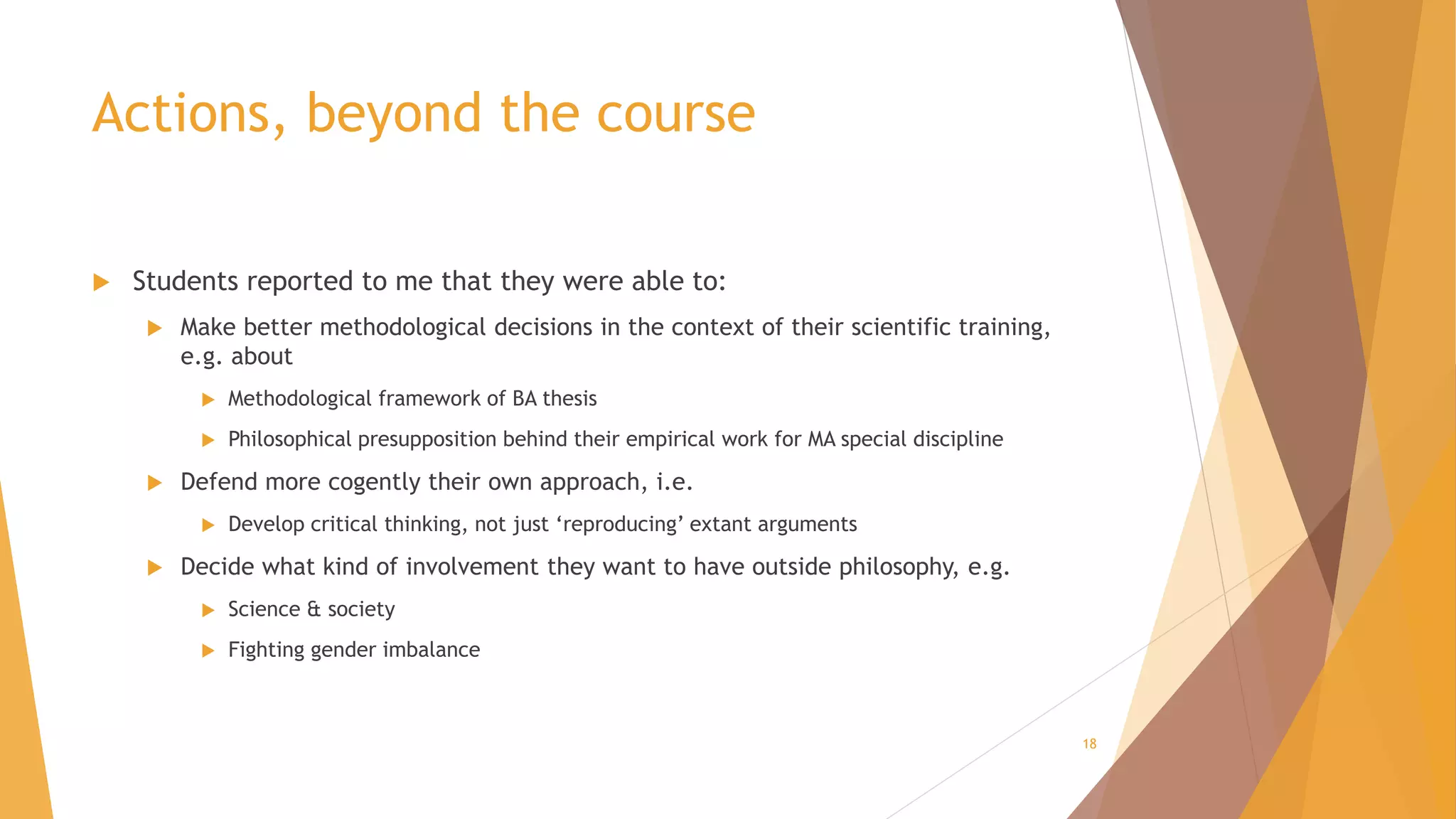
Actions, beyond the course
 Students reported to me that they were able to:
 Make better methodological decisions in the context of their scientific training,
e.g. about
 Methodological framework of BA thesis
 Philosophical presupposition behind their empirical work for MA special discipline
 Defend more cogently their own approach, i.e.
 Develop critical thinking, not just ‘reproducing’ extant arguments
 Decide what kind of involvement they want to have outside philosophy, e.g.
 Science & society
 Fighting gender imbalance
18
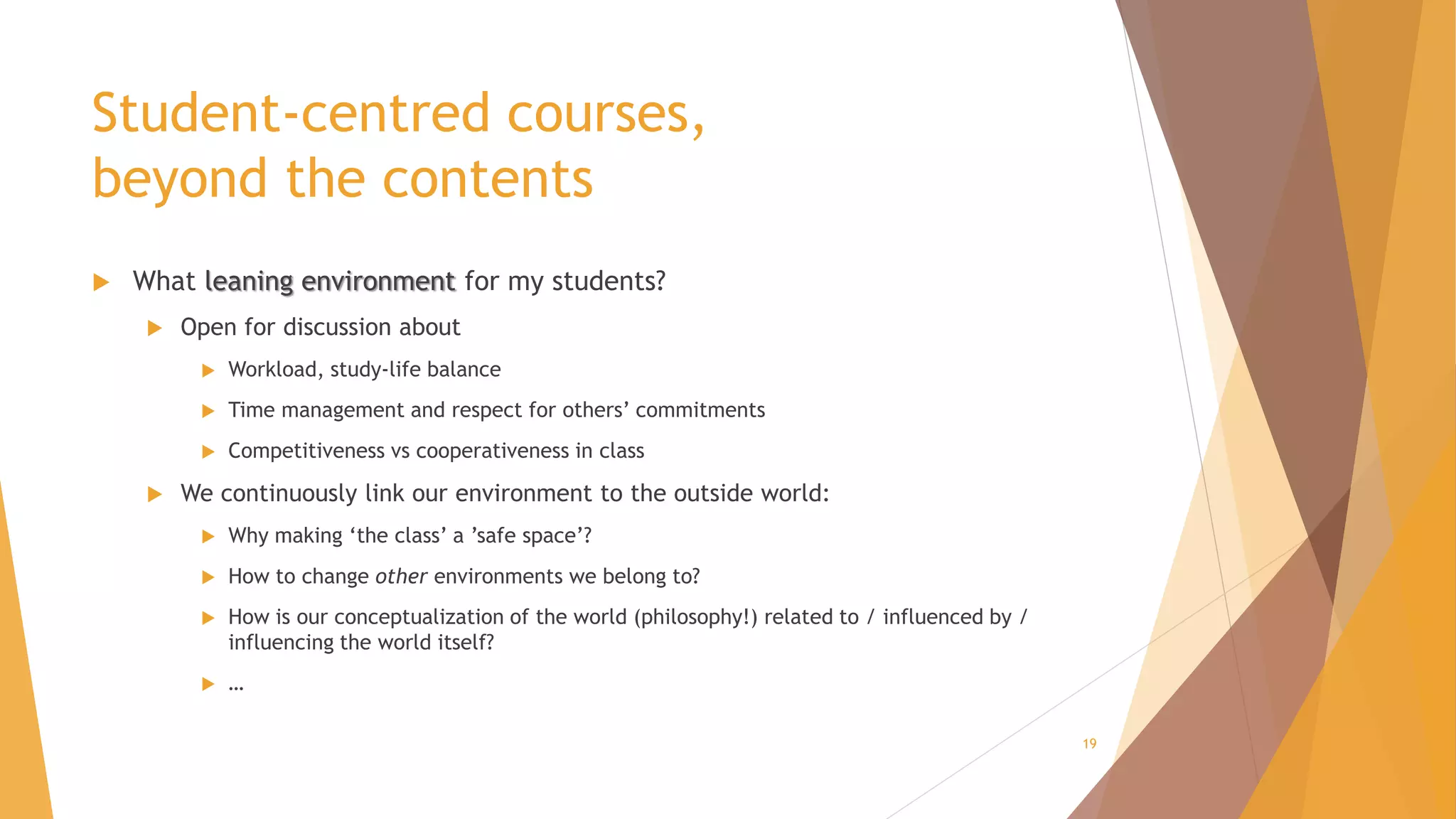
Student-centred courses,
beyond the contents
 What leaning environment for my students?
 Open for discussion about
 Workload, study-life balance
 Time management and respect for others’ commitments
 Competitiveness vs cooperativeness in class
 We continuously link our environment to the outside world:
 Why making ‘the class’ a ’safe space’?
 How to change other environments we belong to?
 How is our conceptualization of the world (philosophy!) related to / influenced by /
influencing the world itself?
 …
19
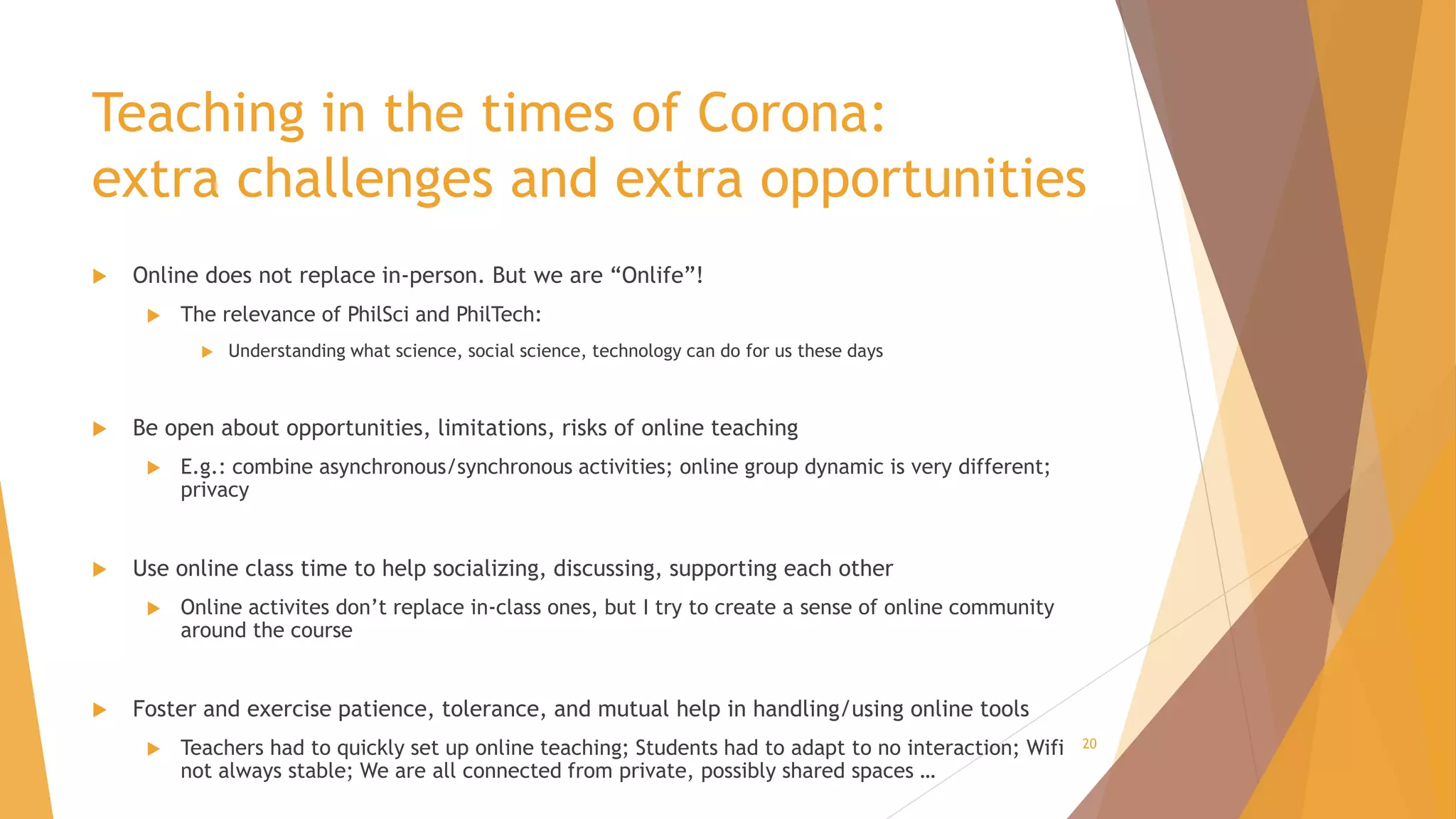
Teaching in the times of Corona:
extra challenges and extra opportunities
 Online does not replace in-person. But we are “Onlife”!
 The relevance of PhilSci and PhilTech:
 Understanding what science, social science, technology can do for us these days
 Be open about opportunities, limitations, risks of online teaching
 E.g.: combine asynchronous/synchronous activities; online group dynamic is very different;
privacy
 Use online class time to help socializing, discussing, supporting each other
 Online activites don’t replace in-class ones, but I try to create a sense of online community
around the course
 Foster and exercise patience, tolerance, and mutual help in handling/using online tools
 Teachers had to quickly set up online teaching; Students had to adapt to no interaction; Wifi
not always stable; We are all connected from private, possibly shared spaces …
20
Teaching Philosophy of
Science and Technology:
Some reflections on how to make it
inclusive and diverse
Federica Russo
Philosophy & ILLC | University of Amsterdam
russofederica.wordpress.com |@federicarusso

Teaching Philosophy of Science and Technology. Some reflections on how to make it inclusive and diverse

  • 1.
    Teaching Philosophy of Scienceand Technology: Some reflections on how to make it inclusive and diverse Federica Russo Philosophy & ILLC | University of Amsterdam russofederica.wordpress.com |@federicarusso
  • 2.
    Levels of reflections Why reflecting about  Teaching?  How to teaching philsci / phil tech, and to non-phil students?  Diversity and inclusion?  In this talk, I navigate these dimensions, hopefully making clear which one I address, at any given moment  Disclaimer:  I am ‘amateur’, for professional contributions, keep an eye on https://philsci.eu/TeachingPoS 2
  • 3.
    My eye-openers  Constructivealignment approach of Biggs and Tang  Their pedagogical approach to aligning learning goals – assignments – assessment is closely related to philosophical thinking about the nature of knowledge  Approaches to feedback, e.g. Boud and Molloy  Students as the drivers of feedback, what feedback really consists in, how it can be helpful rather than judgmental  Project-based and problem-based learning  Quite hard to adapt and implement in philosophy programmes, but capturing my research. Whence the question: how to turn this into a phil module?  The slow professor by Seeber and Berg  Especially for the idea to literally make time for the students to think, wander in the literature, and even to fail 3
  • 4.
    Transforming modules  Howto turn old-fashioned courses into brand new ones?  More inclusive, more interdisciplinary, more aligned, more project-based, more student- centred, …  Constraints  Time availability  Place of individual modules into the programme  Culture clashes with other modules / whole programme / teachers  Budget  My current strategy  Very gradual transformations; learning while teaching; seek and respond to students’ feedback, … 4
  • 5.
    My core PhilSci/ PhilTech teaching portfolio  BA > 3rd year Philosophical Approaches to the Sciences  MA > Philosophy of the Social Sciences  MA > Philosophy of Techno-Science 5
  • 6.
    Who sits inmy class? (Zoom!)  BA-Phil Approaches to the Sciences  Philosophy students; natural sci /medicine students  MA-Phil Social Sciences  Philosophy students; social science, art (history), law, history students  MA-Phil Techno-Science  Philosophy students, social science, logic, engineering, art, cultural analysis students 6
  • 7.
    The general challenge Offering a philosophical perspective to students that  Have very different backgrounds and motivations  Often have not been exposed to Phil Sci before  Have been exposed only to critical approaches to science  Know close to nothing about scientific practice  … 7
  • 8.
    The specific challenges BA-Phil Approaches to the Sciences  A course in preparation to write the BA thesis …  … but not everyone will be writing one  MA-Phil Social Science  Most students come from a specific discipline and will need a course that is methodologically- and practice-oriented …  … but some will be in need of higher-up philosophical reflection  MA-Phil Techno-Science  Establishing the need for a Phil of Techno-Science requires quite some time, before any other topic can be fruitfully addressed 8
  • 9.
    Revisiting the generalchallenge  Heterogeneity of student population is part of the challenge, but not only  Questions about canon and philosophical methodology are also at stake  Ultimately, a big question for me is what I want students get from the course  Upon reflection: over time, and looking at how my own research in Phil Sci/Tech developed, this has changed a lot 9
  • 10.
    Any standard coursewon’t do  A wide range of textbooks in Phil Sci, Phil Tech, Phil Social Sci is available  BUT:  Mainly about Anglo-American literature  Largely within tradition of Analytic philosophy  Present topics / authors as The Canon, ignoring other traditions  Do not problematize contextual and relative character of knowledge production  Do not have students at the centre of the learning experience 10
  • 11.
    My strategy: giveoptions  Options may concern:  Available approaches in Phil Sci, e.g.  Analytic Phil Sci, History & Philosophy of Sci, Phil Sci in Practice, Historical Epistemology, Feminist & Postcolonial Approaches, …  Topics  Provide refs for a range of topics that are not addressed in the course; freedom in choosing a topic for a presentation  Assessment form  A flexible portfolio to work on continuously during the course  Make space and time to develop their own interest  Plan individual study sessions; can choose ‘jolly’ topics for the portfolio 11 Diverse Project/Problem- based Inclusive, student-centred
  • 12.
    BA-Phil Approaches tothe Sciences 12 TOPIC Background: • A European phil sci? • Examples and counterexamples in phil sci Selected approaches 1: • Philosophy of science: the heritage of the Vienna Circle • STS approaches Selected approaches 2: • History of Science • History and Philosophy of Science Selected approaches 3: • Philosophy of Science in Practice • Naturalism Guest Lectures: • Genealogical methods • How does language matter to science and philosophy?
  • 13.
    MA-Phil Social Sciences 13 Topics APhil Sci Approach to the Social Sciences Social facts and social objects Modelling the social Big data and social science Generalizability and External validity Levels of the social Laws and causality Mechanisms and explanation Objectivity and values Feminist approaches to social science research Social science for use
  • 14.
    MA-Phil Techno-Science 14 Topic Phil ofScience, Technology, or of Techno-Science? Philosophy of Information as philosophical methodology Techno-scientific knowledge Poiesis Techno-science and ethics
  • 15.
    More diverse andinclusive  Proposing more diverse reading lists  From within a field, giving voice to less-known researchers, non-mainstream traditions  Adopting activities and assessment methods that foster inclusion  Of the different needs different students may have  The mixed-blessing of English as (alleged) lingua franca  Problematize the choice of the readings and the use of language in reading, teaching, writing, throughout the courses 15
  • 16.
    More project/problem-based  Portfolio: Self-assessment exercise about students’ learning goals and study process  Content-related sections  Questions to guide students through the topics and to frame the writing  ‘Jolly’ sections to either expand on proposed topics, or to include new ones of their choice  Flexibility to hand in a ‘section-based’ or an ‘essay-like’ portfolio, or anything in between 16
  • 17.
    Actionable options? Options 1. Availableapproaches 2. Topics 3. Assessment form 4. Make space and time to develop their own interest Students’ actions triggered 1. Decide autonomously what to learn and write about 2. Select topics / problems / questions relevant to them 3. Decide how to engage with whole course, develop their own take on Phil Sci. 4. Take responsibility for their own study time and topics 17
  • 18.
    Actions, beyond thecourse  Students reported to me that they were able to:  Make better methodological decisions in the context of their scientific training, e.g. about  Methodological framework of BA thesis  Philosophical presupposition behind their empirical work for MA special discipline  Defend more cogently their own approach, i.e.  Develop critical thinking, not just ‘reproducing’ extant arguments  Decide what kind of involvement they want to have outside philosophy, e.g.  Science & society  Fighting gender imbalance 18
  • 19.
    Student-centred courses, beyond thecontents  What leaning environment for my students?  Open for discussion about  Workload, study-life balance  Time management and respect for others’ commitments  Competitiveness vs cooperativeness in class  We continuously link our environment to the outside world:  Why making ‘the class’ a ’safe space’?  How to change other environments we belong to?  How is our conceptualization of the world (philosophy!) related to / influenced by / influencing the world itself?  … 19
  • 20.
    Teaching in thetimes of Corona: extra challenges and extra opportunities  Online does not replace in-person. But we are “Onlife”!  The relevance of PhilSci and PhilTech:  Understanding what science, social science, technology can do for us these days  Be open about opportunities, limitations, risks of online teaching  E.g.: combine asynchronous/synchronous activities; online group dynamic is very different; privacy  Use online class time to help socializing, discussing, supporting each other  Online activites don’t replace in-class ones, but I try to create a sense of online community around the course  Foster and exercise patience, tolerance, and mutual help in handling/using online tools  Teachers had to quickly set up online teaching; Students had to adapt to no interaction; Wifi not always stable; We are all connected from private, possibly shared spaces … 20
  • 21.
    Teaching Philosophy of Scienceand Technology: Some reflections on how to make it inclusive and diverse Federica Russo Philosophy & ILLC | University of Amsterdam russofederica.wordpress.com |@federicarusso