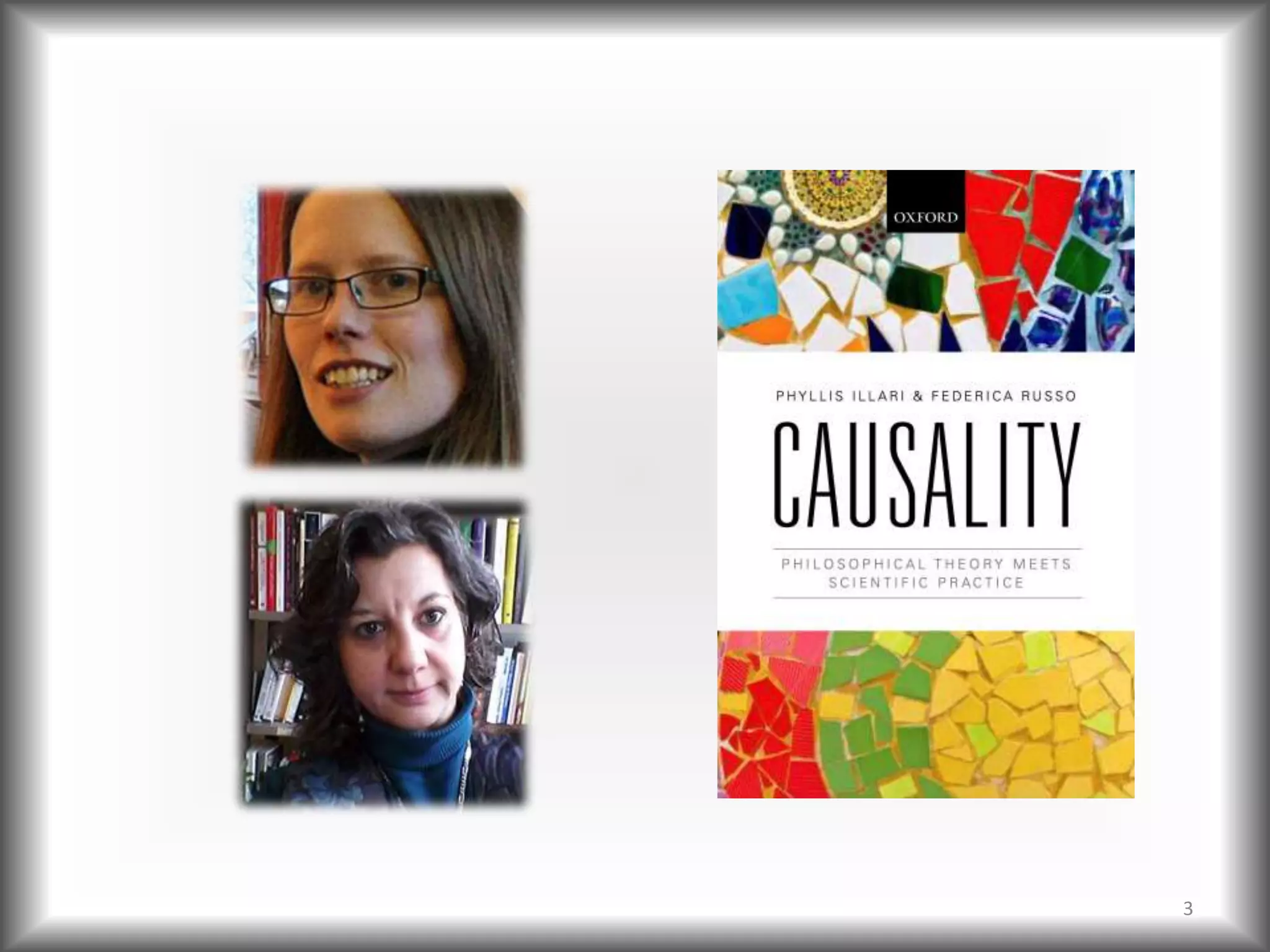

Scientific problems and philosophical questions
about causality:
Why we need a pluralistic approach
Federica Russo
Philosophy | Humanities | Amsterdam
russofederica.wordpress.com | @federicarusso
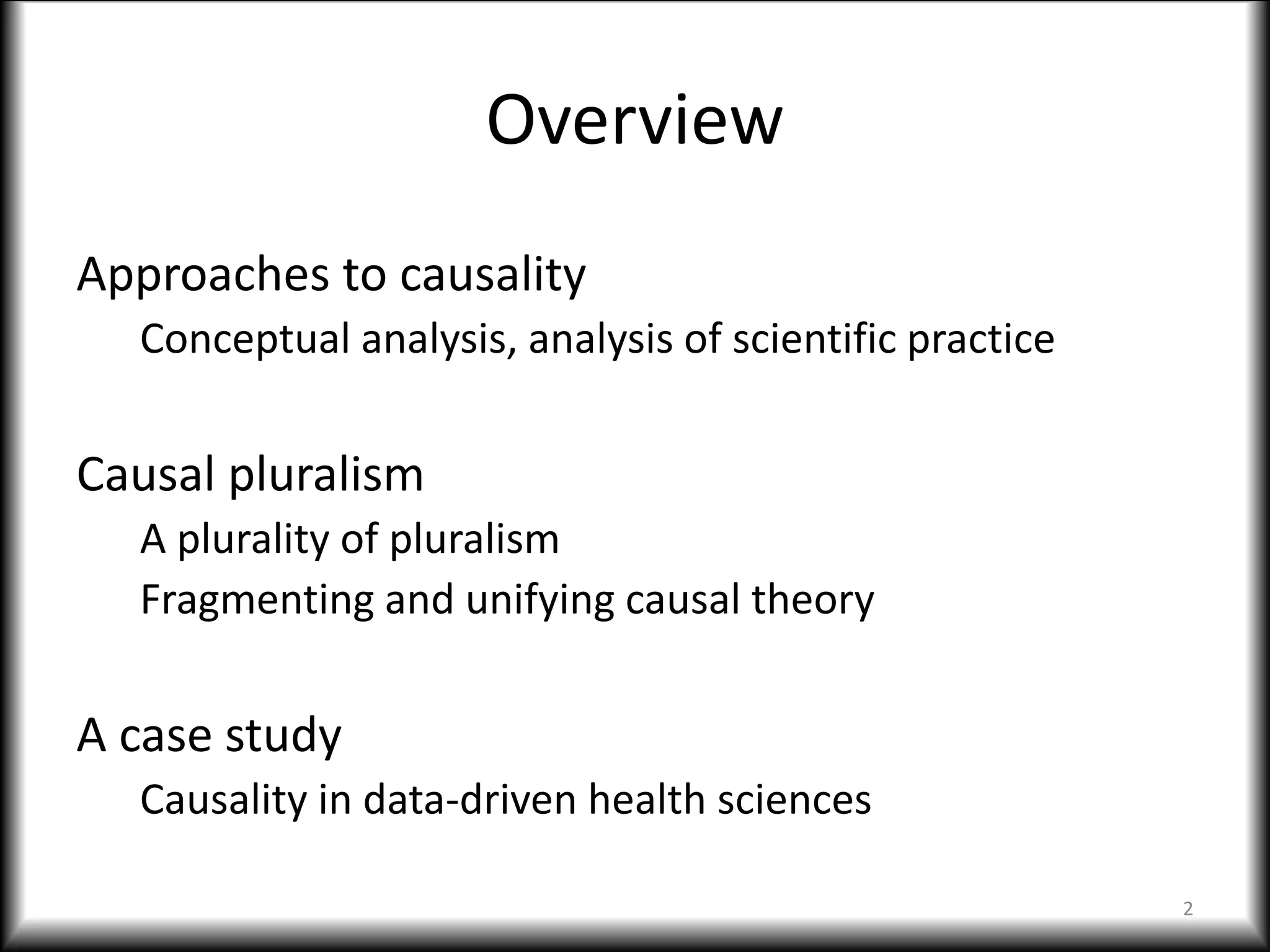
Overview
Approaches to causality
Conceptual analysis, analysis of scientific practice
Causal pluralism
A plurality of pluralism
Fragmenting and unifying causal theory
A case study
Causality in data-driven health sciences
2
3
APPROACHES TO CAUSALITY
4
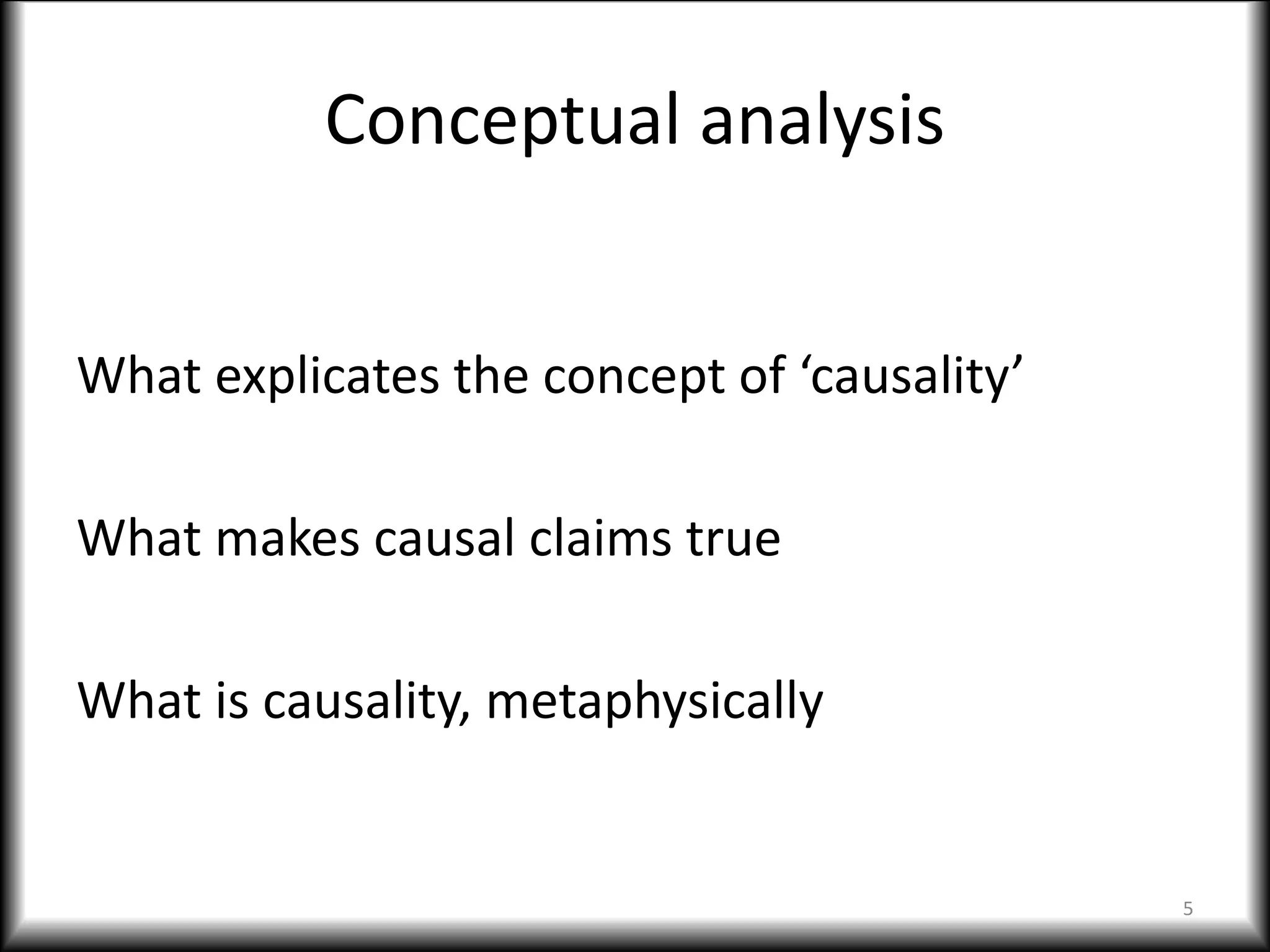
Conceptual analysis
What explicates the concept of ‘causality’
What makes causal claims true
What is causality, metaphysically
5
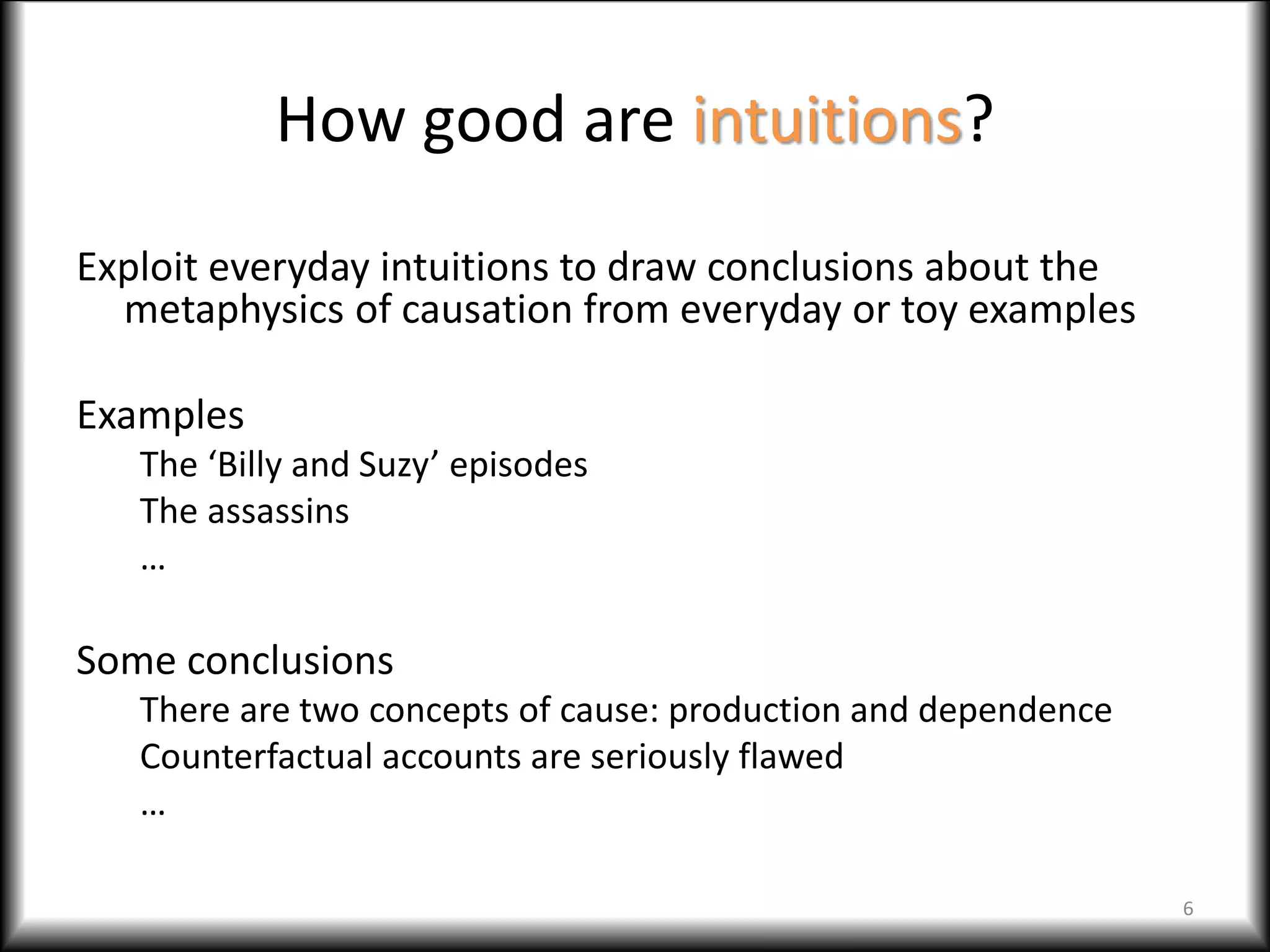
How good are intuitions?
Exploit everyday intuitions to draw conclusions about the
metaphysics of causation from everyday or toy examples
Examples
The ‘Billy and Suzy’ episodes
The assassins
…
Some conclusions
There are two concepts of cause: production and dependence
Counterfactual accounts are seriously flawed
…
6
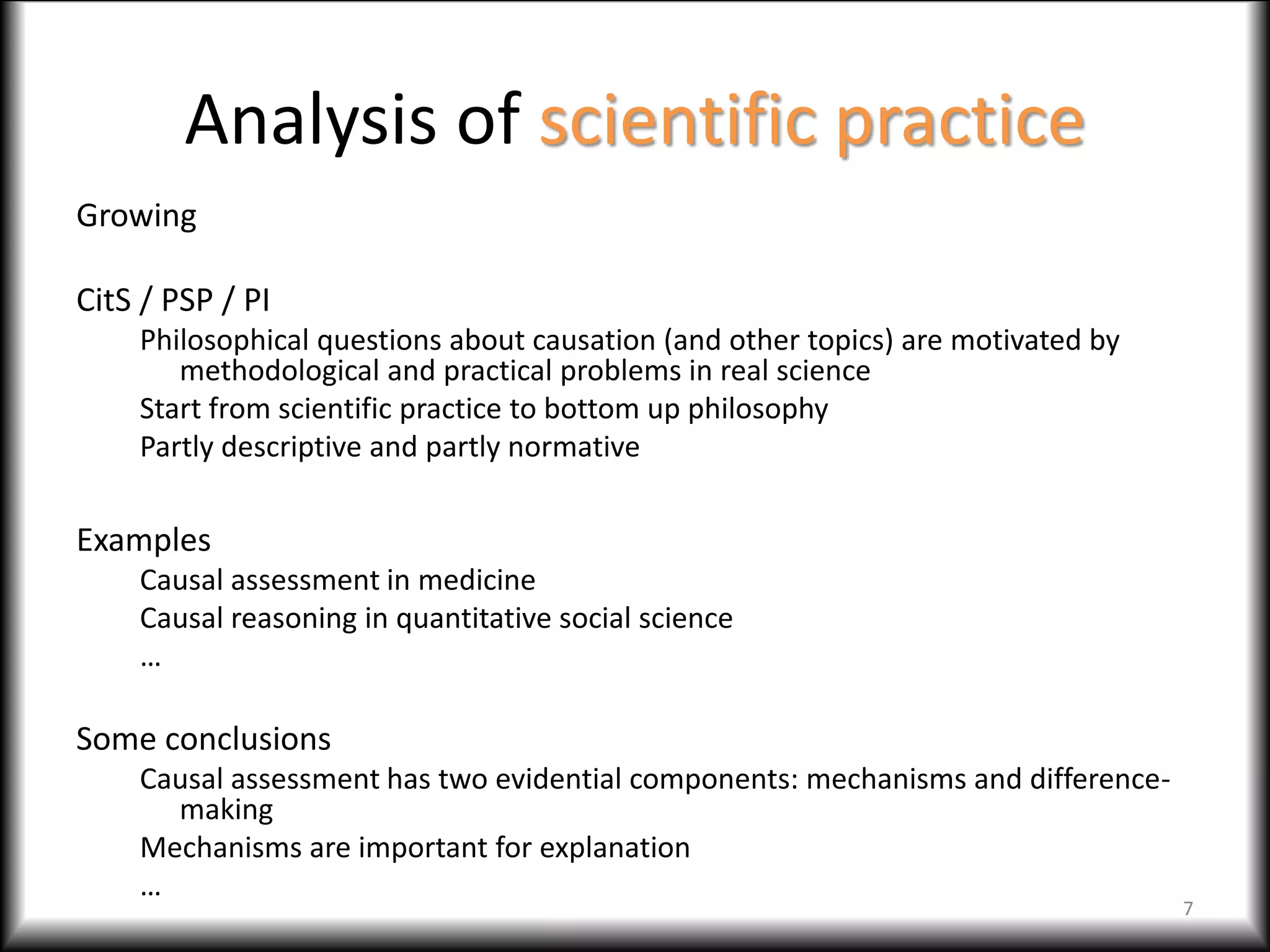
Analysis of scientific practice
Growing
CitS / PSP / PI
Philosophical questions about causation (and other topics) are motivated by
methodological and practical problems in real science
Start from scientific practice to bottom up philosophy
Partly descriptive and partly normative
Examples
Causal assessment in medicine
Causal reasoning in quantitative social science
…
Some conclusions
Causal assessment has two evidential components: mechanisms and difference-
making
Mechanisms are important for explanation
…
7
CAUSAL PLURALISM
8
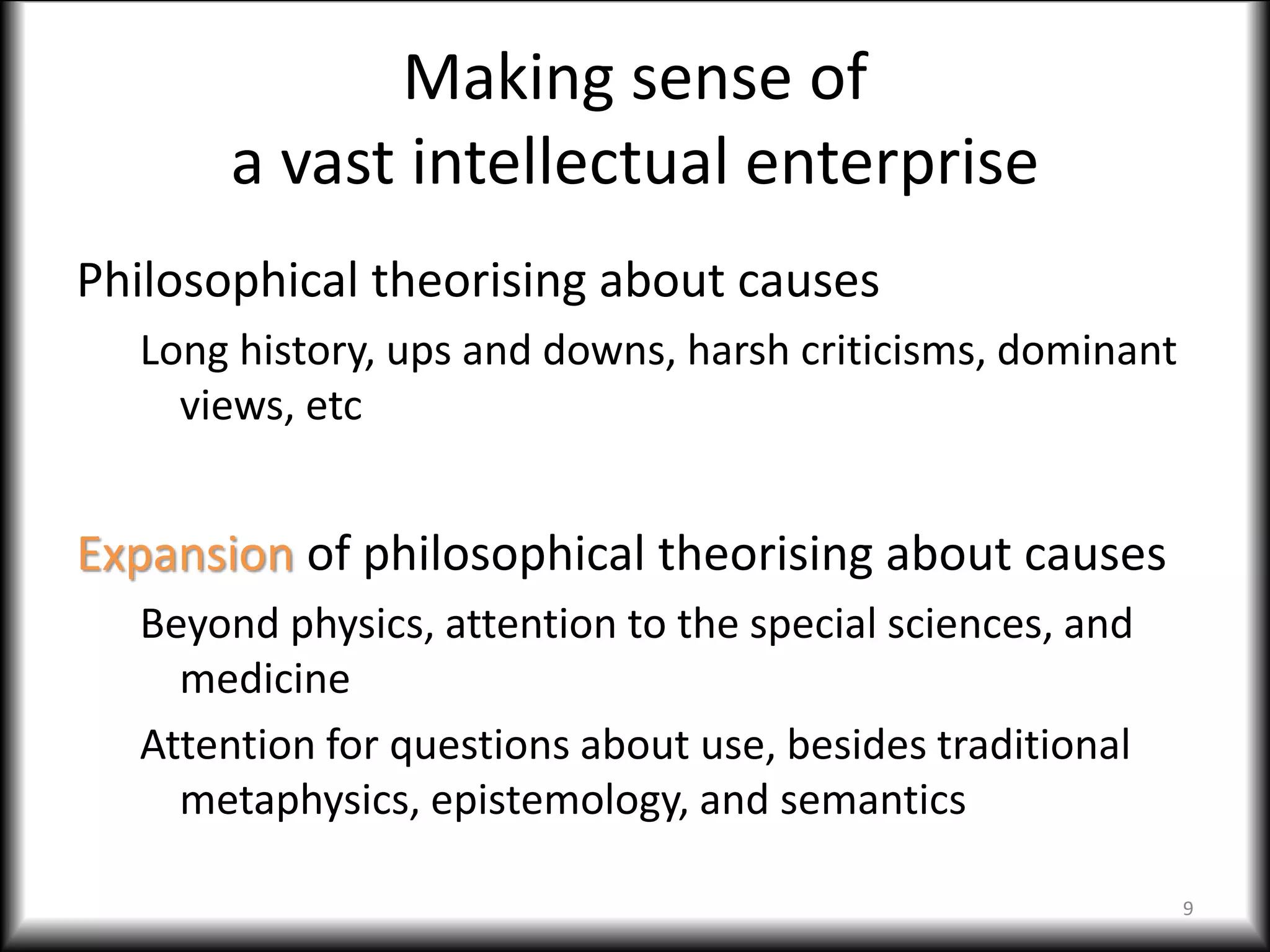
Making sense of
a vast intellectual enterprise
Philosophical theorising about causes
Long history, ups and downs, harsh criticisms, dominant
views, etc
Expansion of philosophical theorising about causes
Beyond physics, attention to the special sciences, and
medicine
Attention for questions about use, besides traditional
metaphysics, epistemology, and semantics
9
10
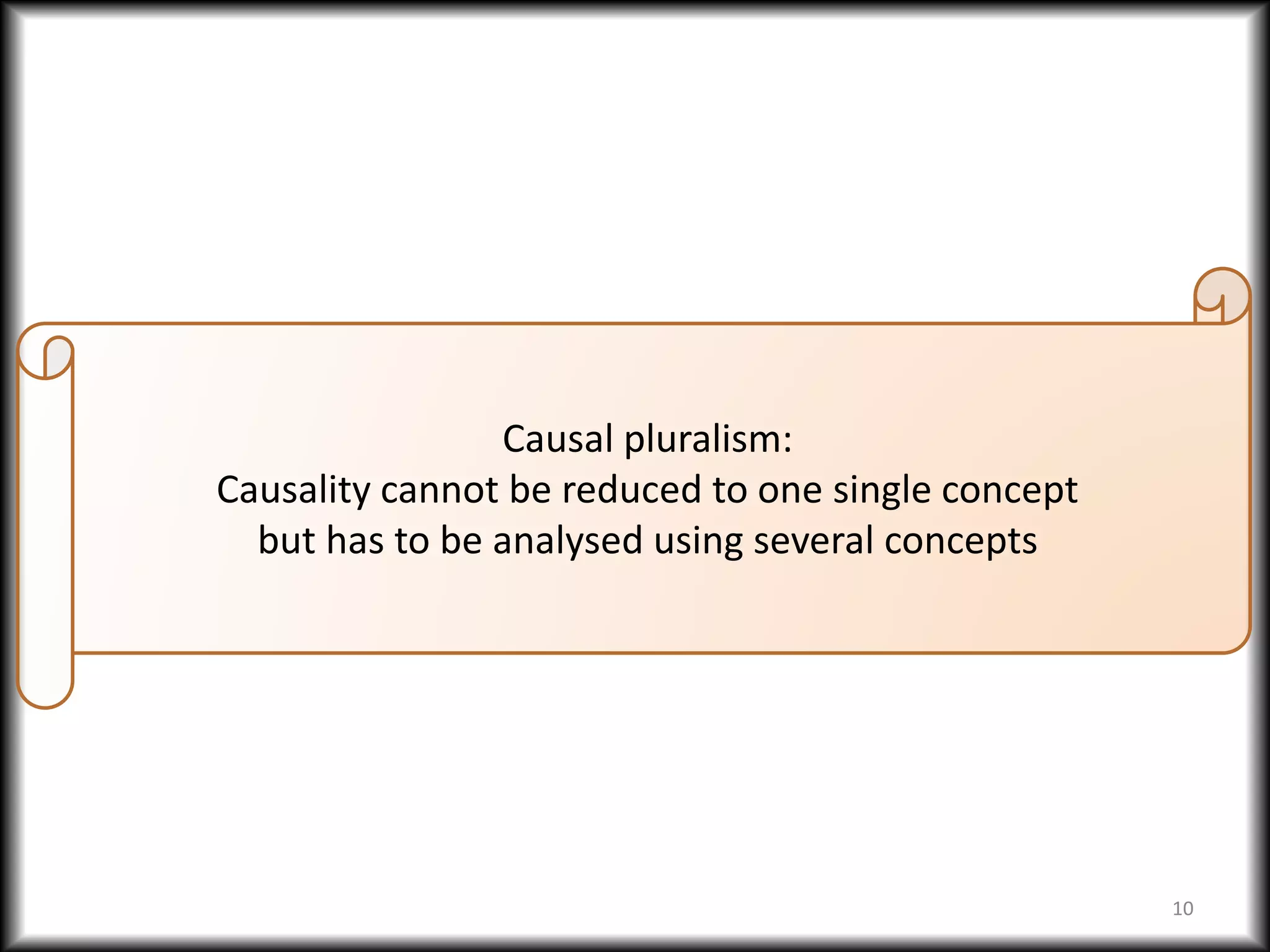
Causal pluralism:
Causality cannot be reduced to one single concept
but has to be analysed using several concepts
PLURALITY OF PLURALISMS
11
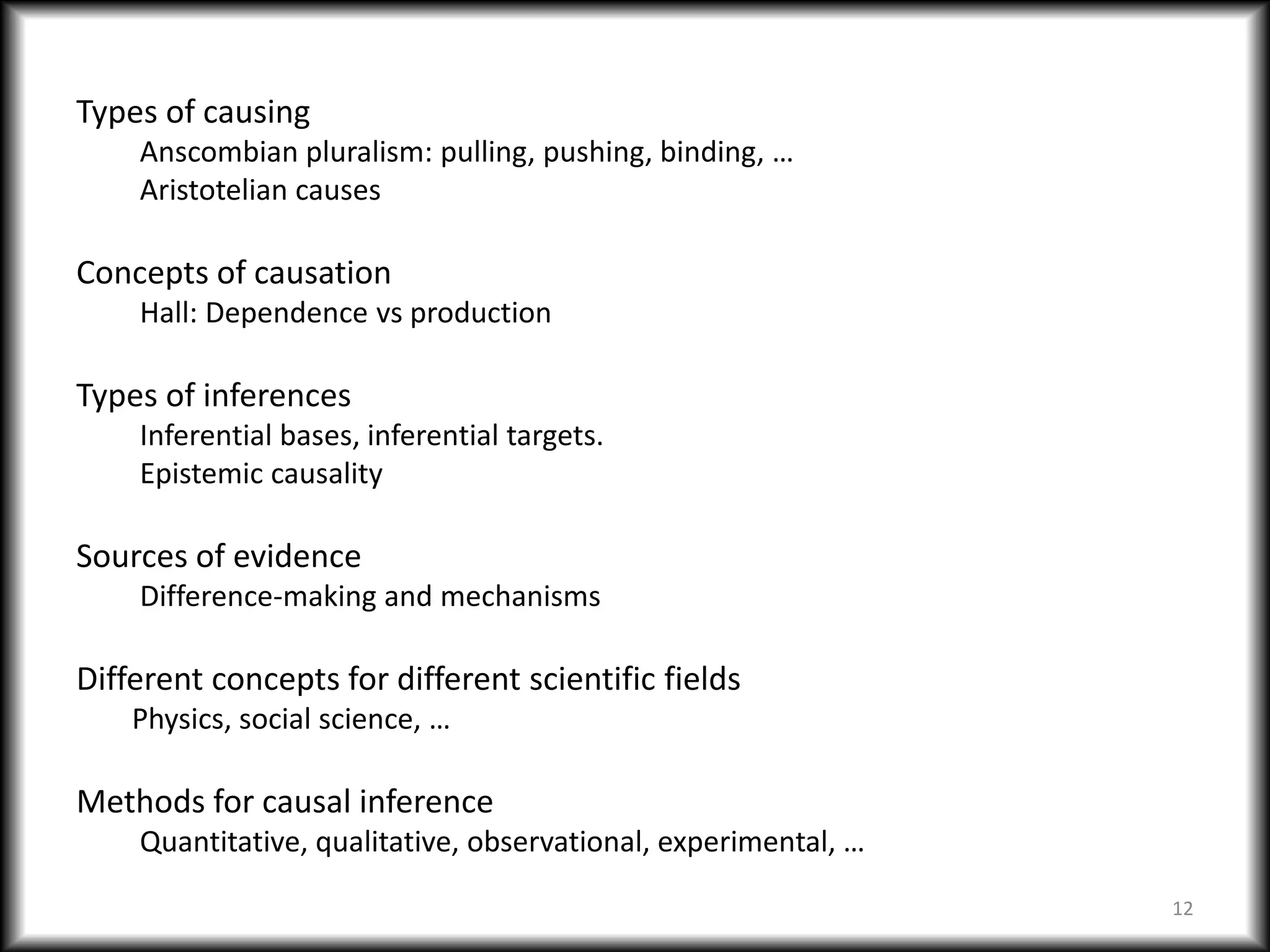
Types of causing
Anscombian pluralism: pulling, pushing, binding, …
Aristotelian causes
Concepts of causation
Hall: Dependence vs production
Types of inferences
Inferential bases, inferential targets.
Epistemic causality
Sources of evidence
Difference-making and mechanisms
Different concepts for different scientific fields
Physics, social science, …
Methods for causal inference
Quantitative, qualitative, observational, experimental, …
12
FRAGMENTING CAUSAL THEORY
13
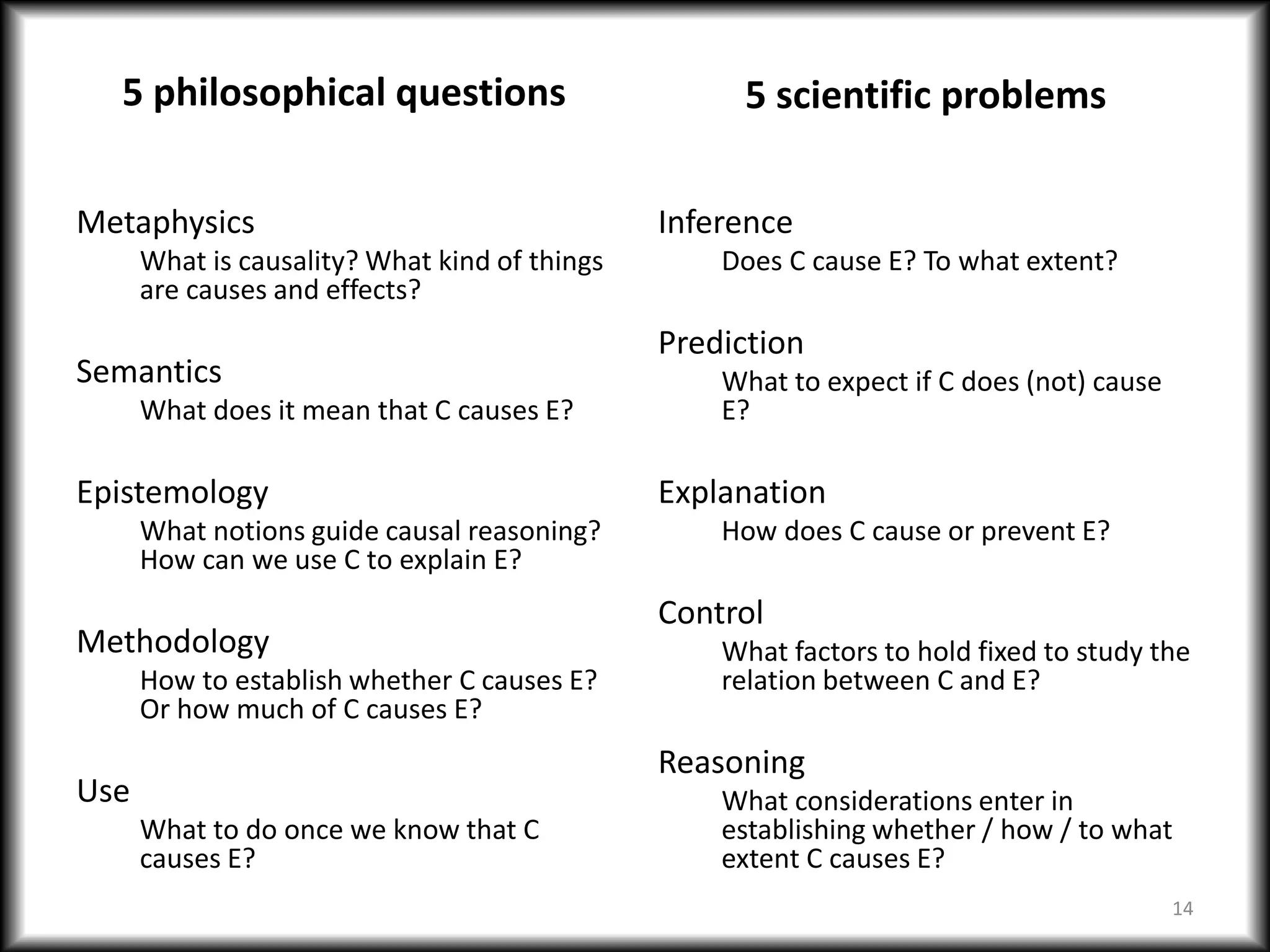
5 philosophical questions
Metaphysics
What is causality? What kind of things
are causes and effects?
Semantics
What does it mean that C causes E?
Epistemology
What notions guide causal reasoning?
How can we use C to explain E?
Methodology
How to establish whether C causes E?
Or how much of C causes E?
Use
What to do once we know that C
causes E?
5 scientific problems
Inference
Does C cause E? To what extent?
Prediction
What to expect if C does (not) cause
E?
Explanation
How does C cause or prevent E?
Control
What factors to hold fixed to study the
relation between C and E?
Reasoning
What considerations enter in
establishing whether / how / to what
extent C causes E?
14
THE CAUSAL MOSAIC
15
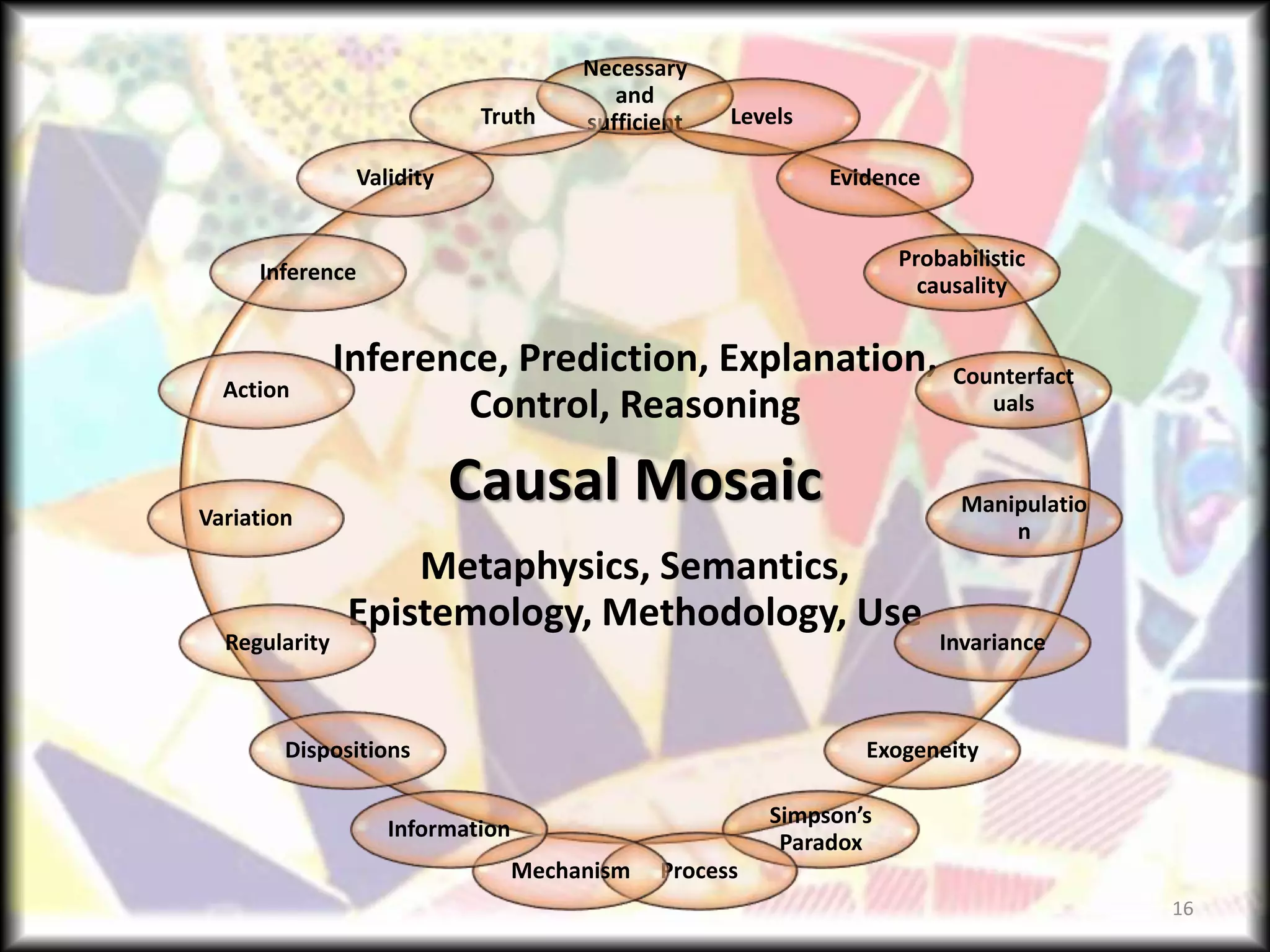
Inference, Prediction, Explanation,
Control, Reasoning
Causal Mosaic
Metaphysics, Semantics,
Epistemology, Methodology, Use
Necessary
and
sufficient Levels
Evidence
Probabilistic
causality
Counterfact
uals
Manipulatio
n
Invariance
Exogeneity
Simpson’s
Paradox
Process
Mechanism
Information
Dispositions
Regularity
Variation
Action
Inference
Validity
Truth
16
Unifying the fragments
into the ‘causal mosaic’
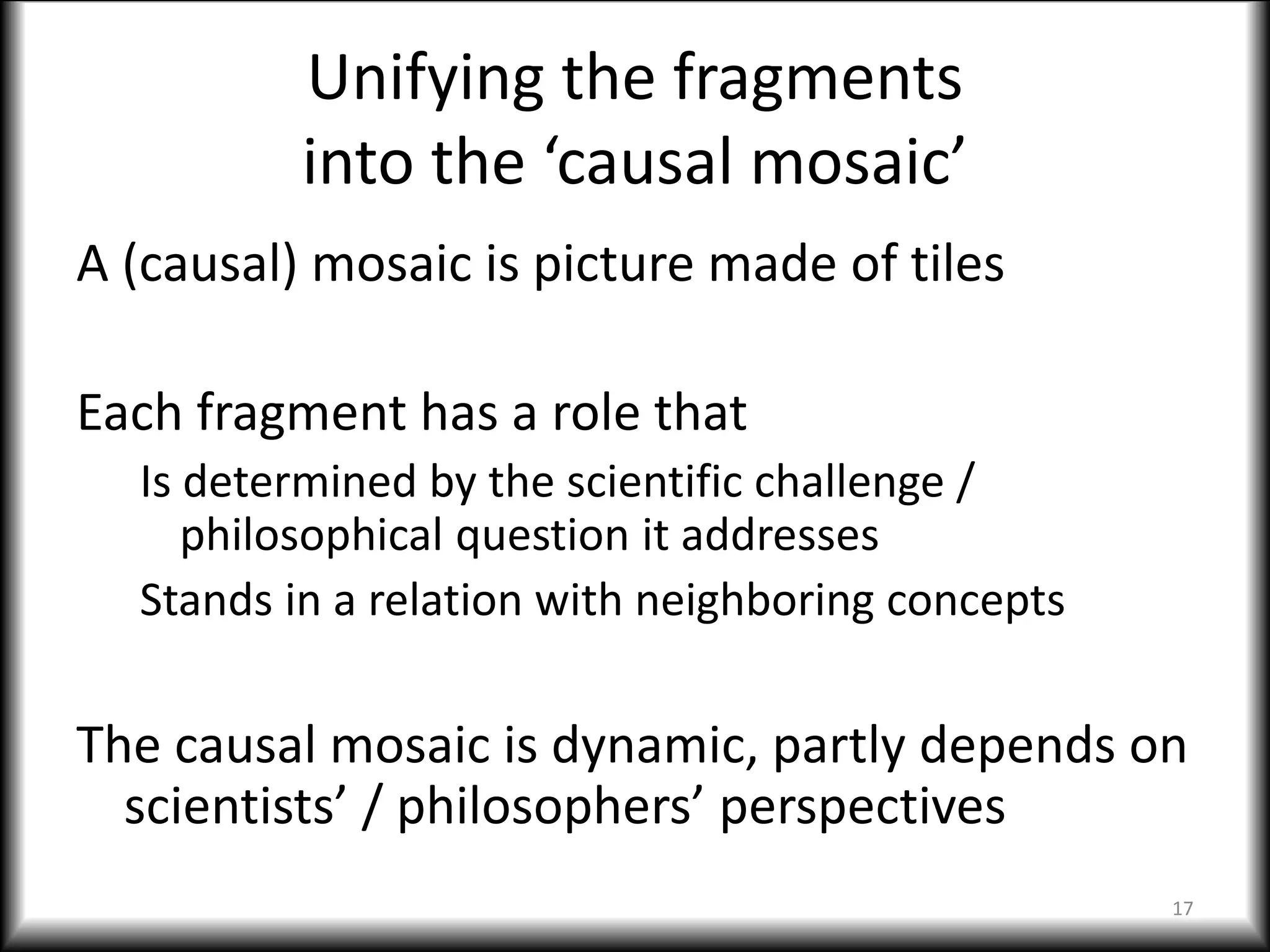
A (causal) mosaic is picture made of tiles
Each fragment has a role that
Is determined by the scientific challenge /
philosophical question it addresses
Stands in a relation with neighboring concepts
The causal mosaic is dynamic, partly depends on
scientists’ / philosophers’ perspectives
17
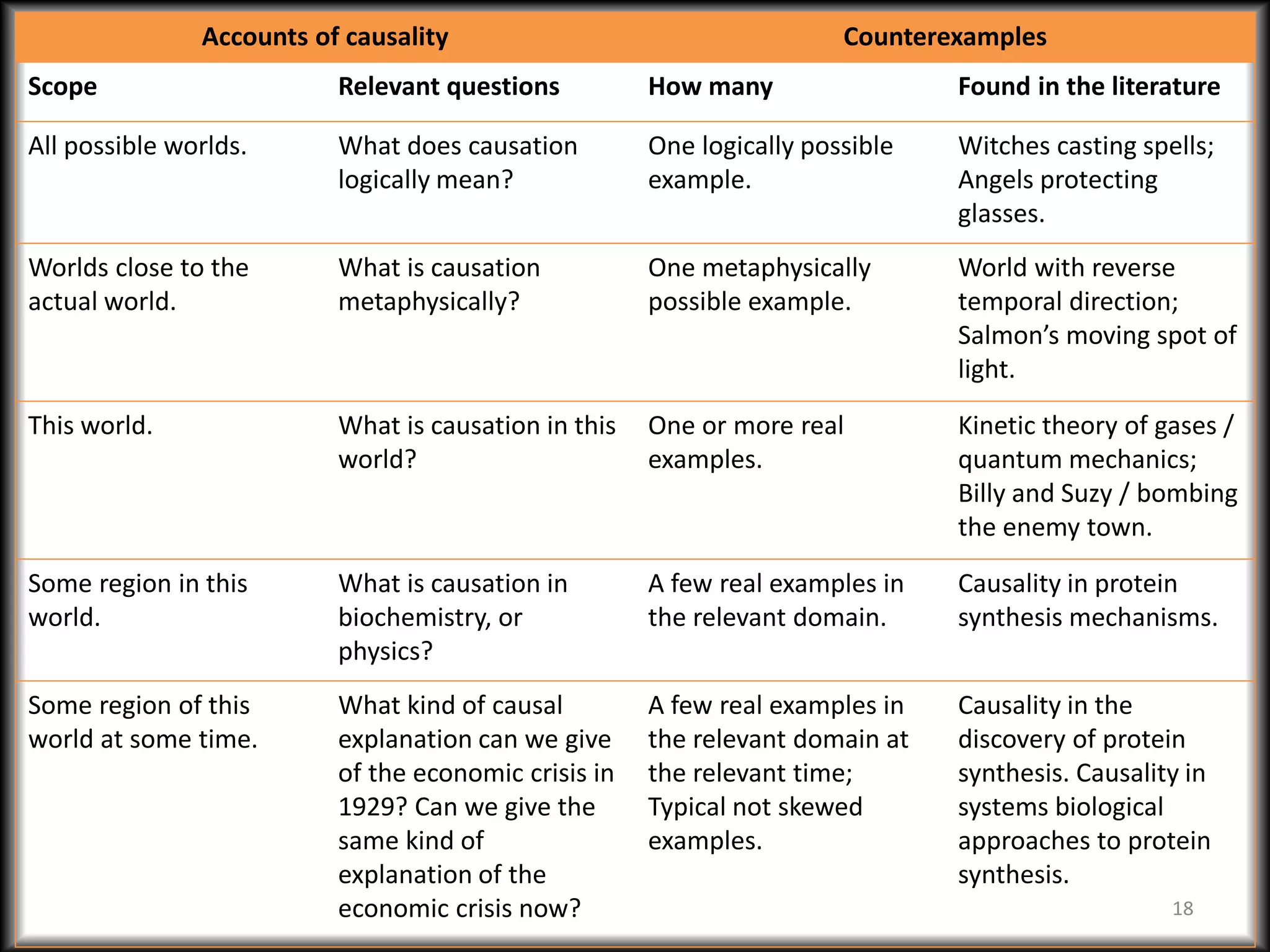
Accounts of causality Counterexamples
Scope Relevant questions How many Found in the literature
All possible worlds. What does causation
logically mean?
One logically possible
example.
Witches casting spells;
Angels protecting
glasses.
Worlds close to the
actual world.
What is causation
metaphysically?
One metaphysically
possible example.
World with reverse
temporal direction;
Salmon’s moving spot of
light.
This world. What is causation in this
world?
One or more real
examples.
Kinetic theory of gases /
quantum mechanics;
Billy and Suzy / bombing
the enemy town.
Some region in this
world.
What is causation in
biochemistry, or
physics?
A few real examples in
the relevant domain.
Causality in protein
synthesis mechanisms.
Some region of this
world at some time.
What kind of causal
explanation can we give
of the economic crisis in
1929? Can we give the
same kind of
explanation of the
economic crisis now?
A few real examples in
the relevant domain at
the relevant time;
Typical not skewed
examples.
Causality in the
discovery of protein
synthesis. Causality in
systems biological
approaches to protein
synthesis.
18
EXAMPLES OF
WELL-PLACED TILES
19
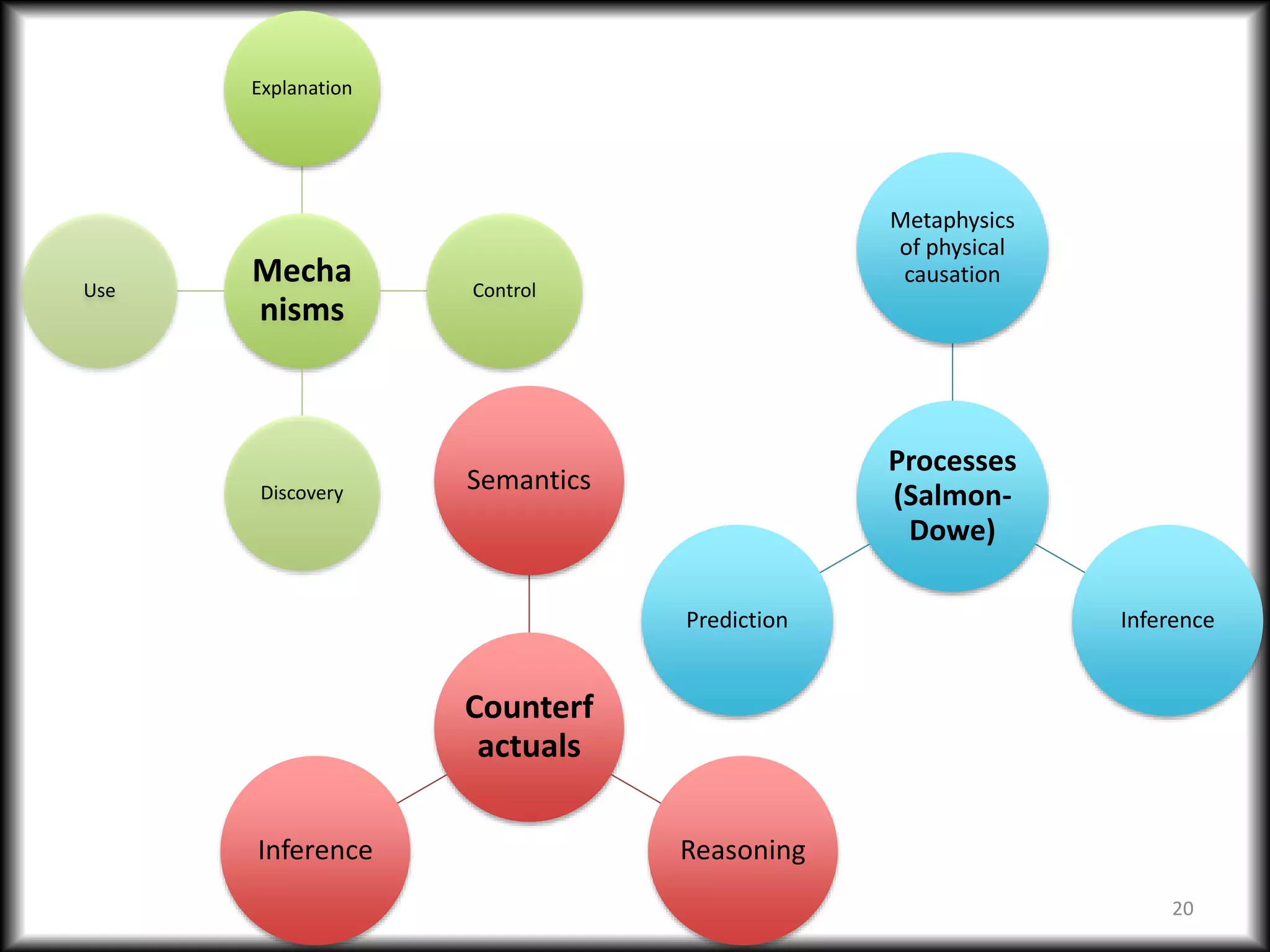
Mecha
nisms
Explanation
Control
Discovery
Use
Processes
(Salmon-
Dowe)
Metaphysics
of physical
causation
Inference
Prediction
Counterf
actuals
Semantics
Reasoning
Inference
20
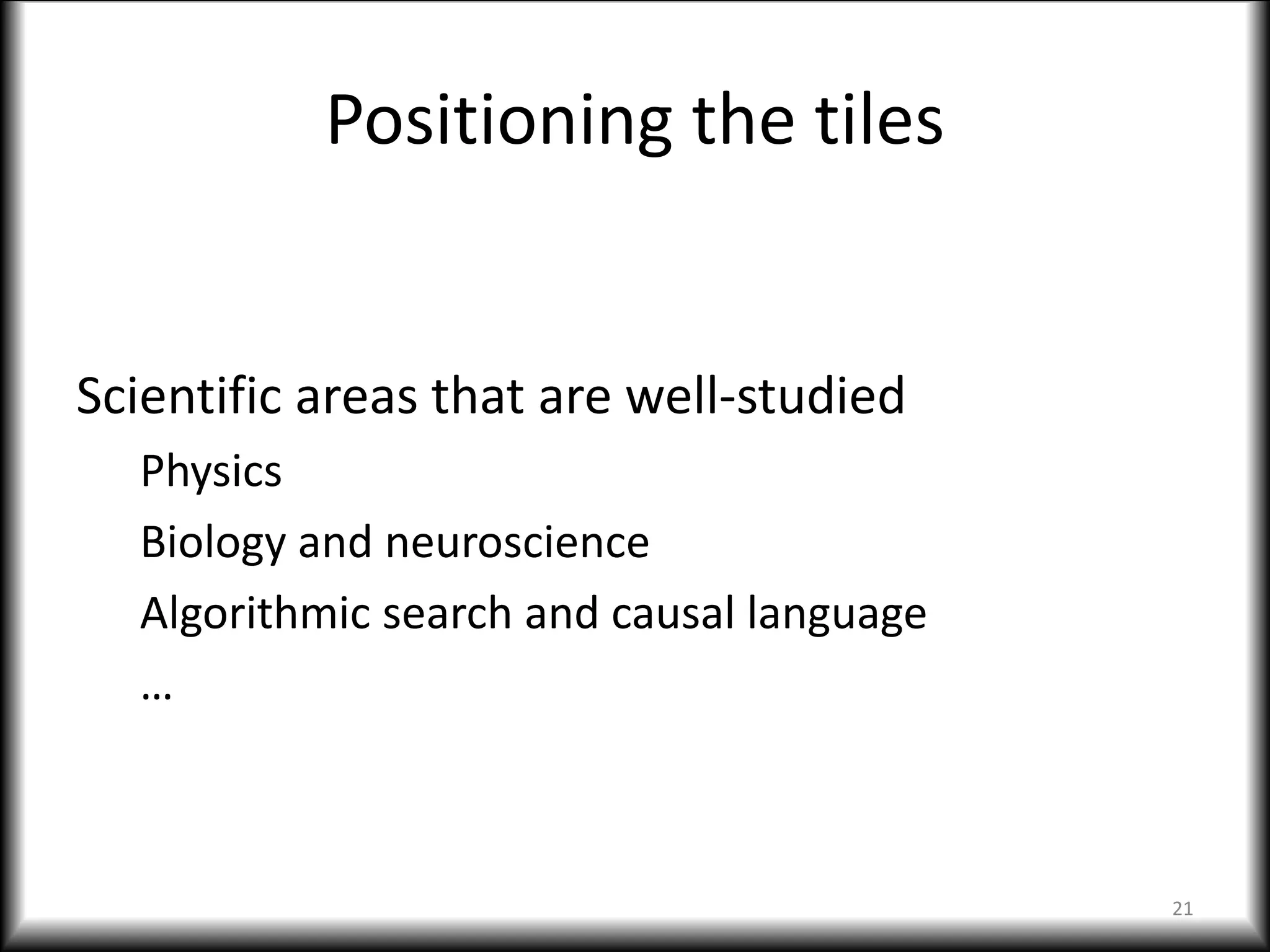
Positioning the tiles
Scientific areas that are well-studied
Physics
Biology and neuroscience
Algorithmic search and causal language
…
21
What about new areas?
Which tiles? How to place them?
DATA-DRIVEN HEALTH SCIENCES
23
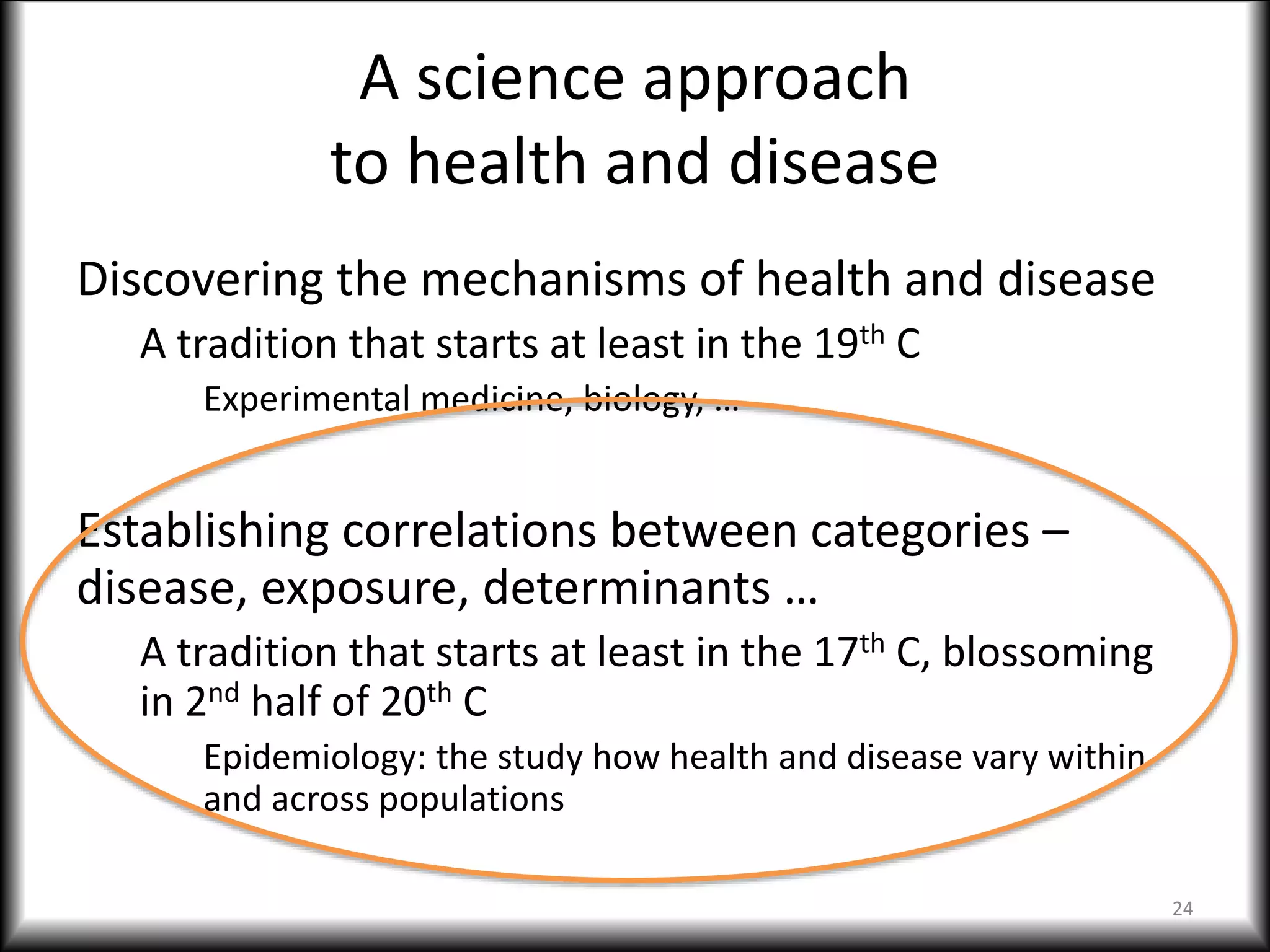
A science approach
to health and disease
Discovering the mechanisms of health and disease
A tradition that starts at least in the 19th C
Experimental medicine, biology, …
Establishing correlations between categories –
disease, exposure, determinants …
A tradition that starts at least in the 17th C, blossoming
in 2nd half of 20th C
Epidemiology: the study how health and disease vary within
and across populations
24
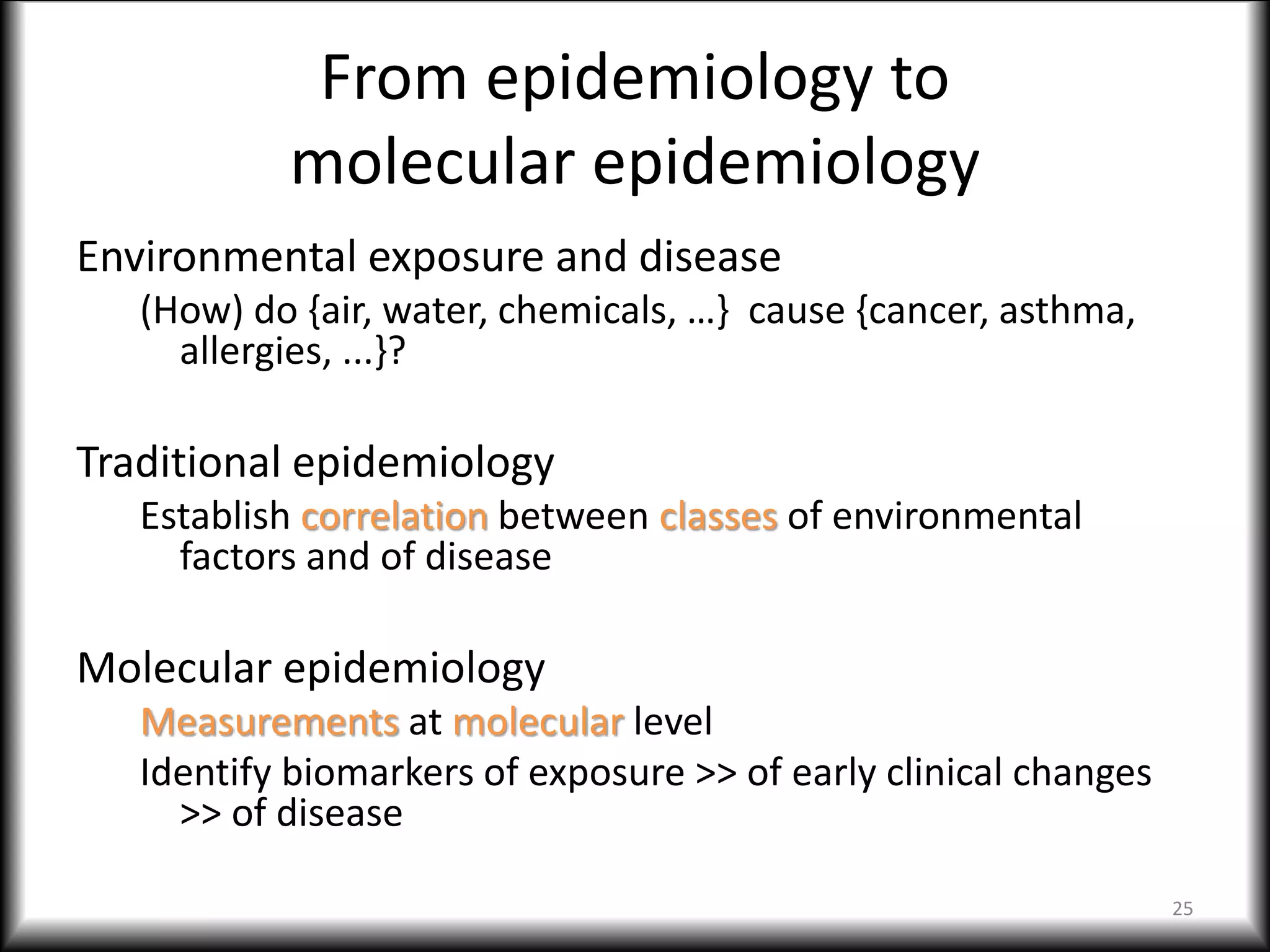
From epidemiology to
molecular epidemiology
Environmental exposure and disease
(How) do {air, water, chemicals, …} cause {cancer, asthma,
allergies, ...}?
Traditional epidemiology
Establish correlation between classes of environmental
factors and of disease
Molecular epidemiology
Measurements at molecular level
Identify biomarkers of exposure >> of early clinical changes
>> of disease
25
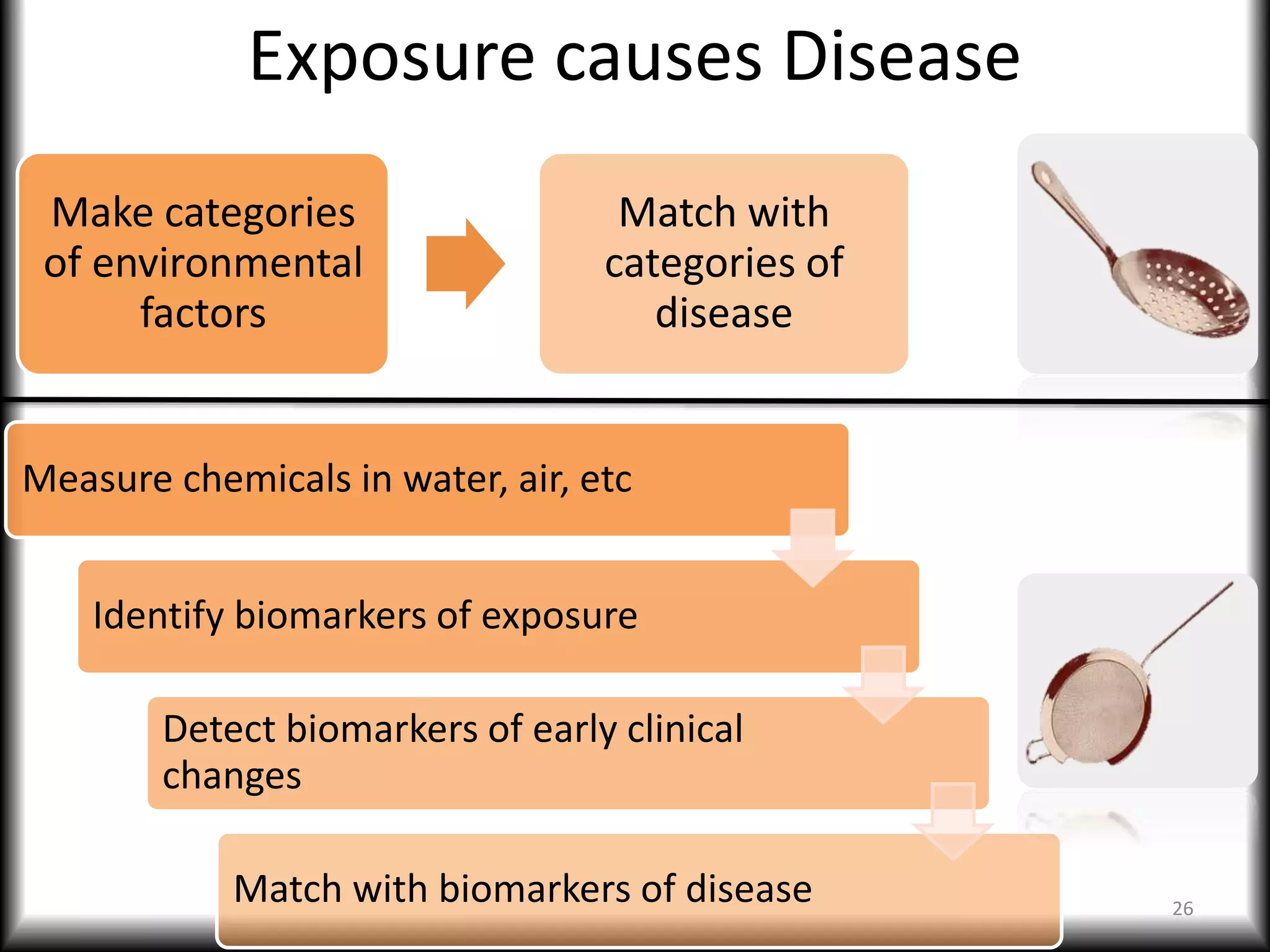
Exposure causes Disease
Measure chemicals in water, air, etc
Identify biomarkers of exposure
Detect biomarkers of early clinical
changes
Match with biomarkers of disease 26
Make categories
of environmental
factors
Match with
categories of
disease
BIG HEALTH DATA AND BIG STAKES
27
Data- and technology- driven
Big data helps with the generation of evidence
of correlation (statistical analyses) and of
mechanisms (omics analyses)
Specifically, technology is central to: generating,
processing, storing / archiving, curating,
analysing data
28
So far, some familiar tiles
 Mechanisms, correlations
 Discovery, inference, explanation
What if change the question?
Not just ‘What is causation?’ …
29
What are we measuring?
What is it that causes disease?
THE AETIOLOGICAL STANDPOINT
31
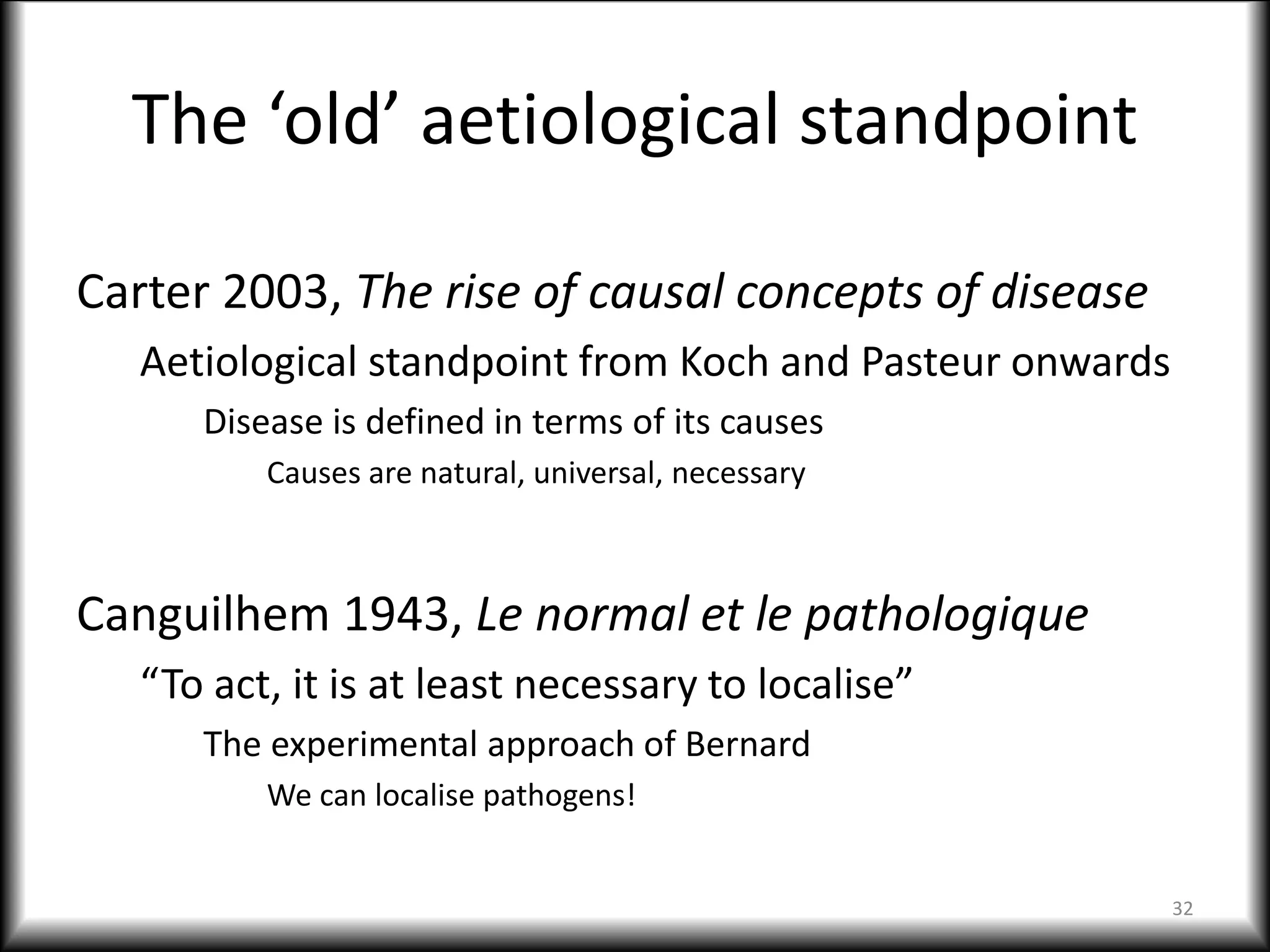
The ‘old’ aetiological standpoint
Carter 2003, The rise of causal concepts of disease
Aetiological standpoint from Koch and Pasteur onwards
Disease is defined in terms of its causes
Causes are natural, universal, necessary
Canguilhem 1943, Le normal et le pathologique
“To act, it is at least necessary to localise”
The experimental approach of Bernard
We can localise pathogens!
32
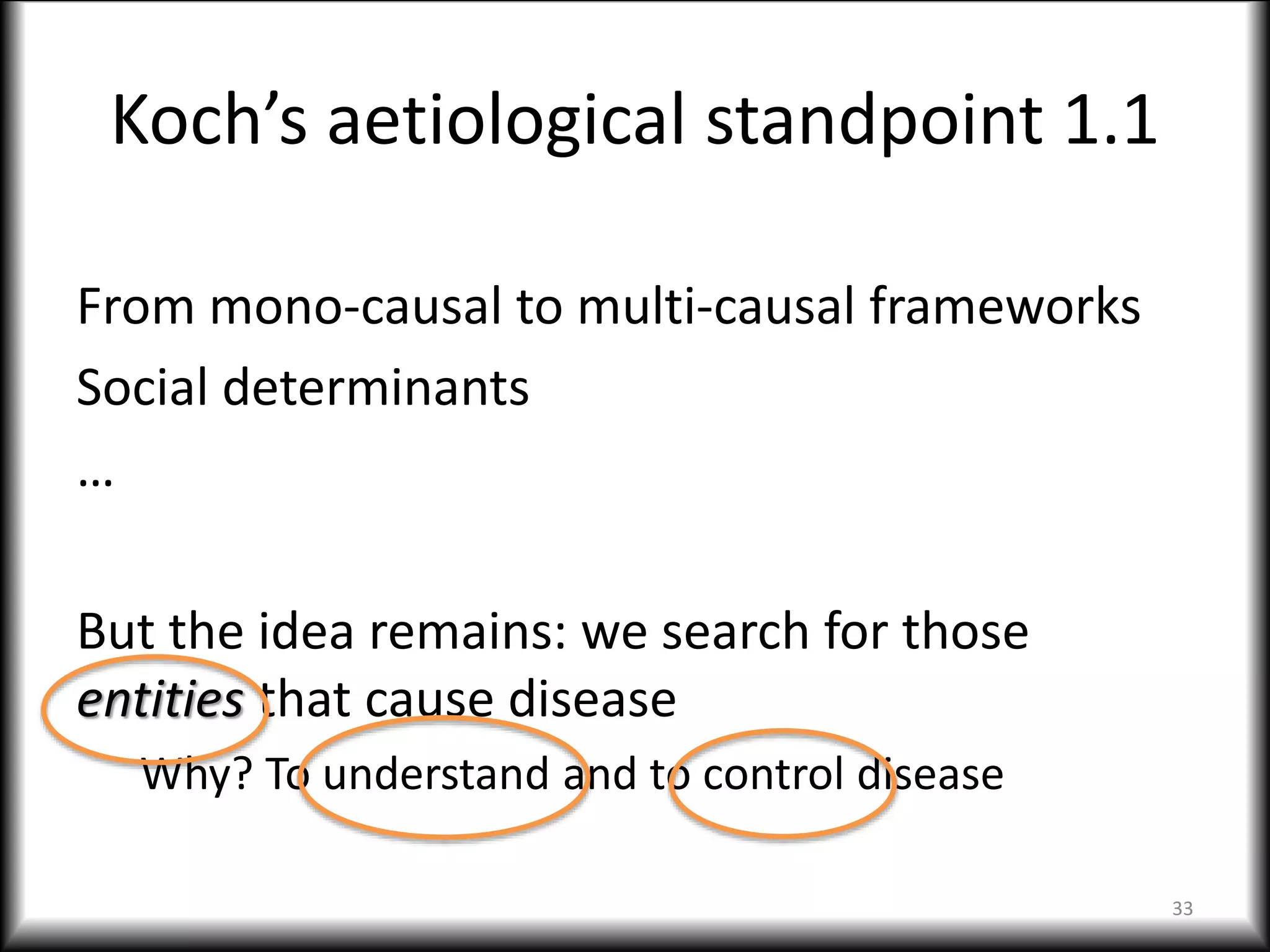
Koch’s aetiological standpoint 1.1
From mono-causal to multi-causal frameworks
Social determinants
…
But the idea remains: we search for those
entities that cause disease
Why? To understand and to control disease
33
The promise of biomarkers research
Using these ‘-omics’ technologies to inform hypothesis-directed
pathway-based approaches to molecular epidemiology and to help direct
genome-wide exploratory analyses into more promising directions. [...]
one might think of the ‘‘-omics’’ data as providing the missing link
among exposure, genes, and disease. (Thomas 2006, p. 490)
‘-Omics’ tools can be directly applied to samples from an epidemiologic
case-control or cohort study to better characterise intermediate
pathways, potentially providing the ‘missing links’ among
exposures, genes, and diseases. (Vineis et al. 2009)
Omic technologies offer great potential to identify biomarkers. (Vineis
and Chadeau-Hyam 2011)
34
The new aetiological standpoint?
Are biomarkers the sought
tiny-tiny entities?
THE ONTOLOGICAL STATUS OF
BIOMARKERS
36
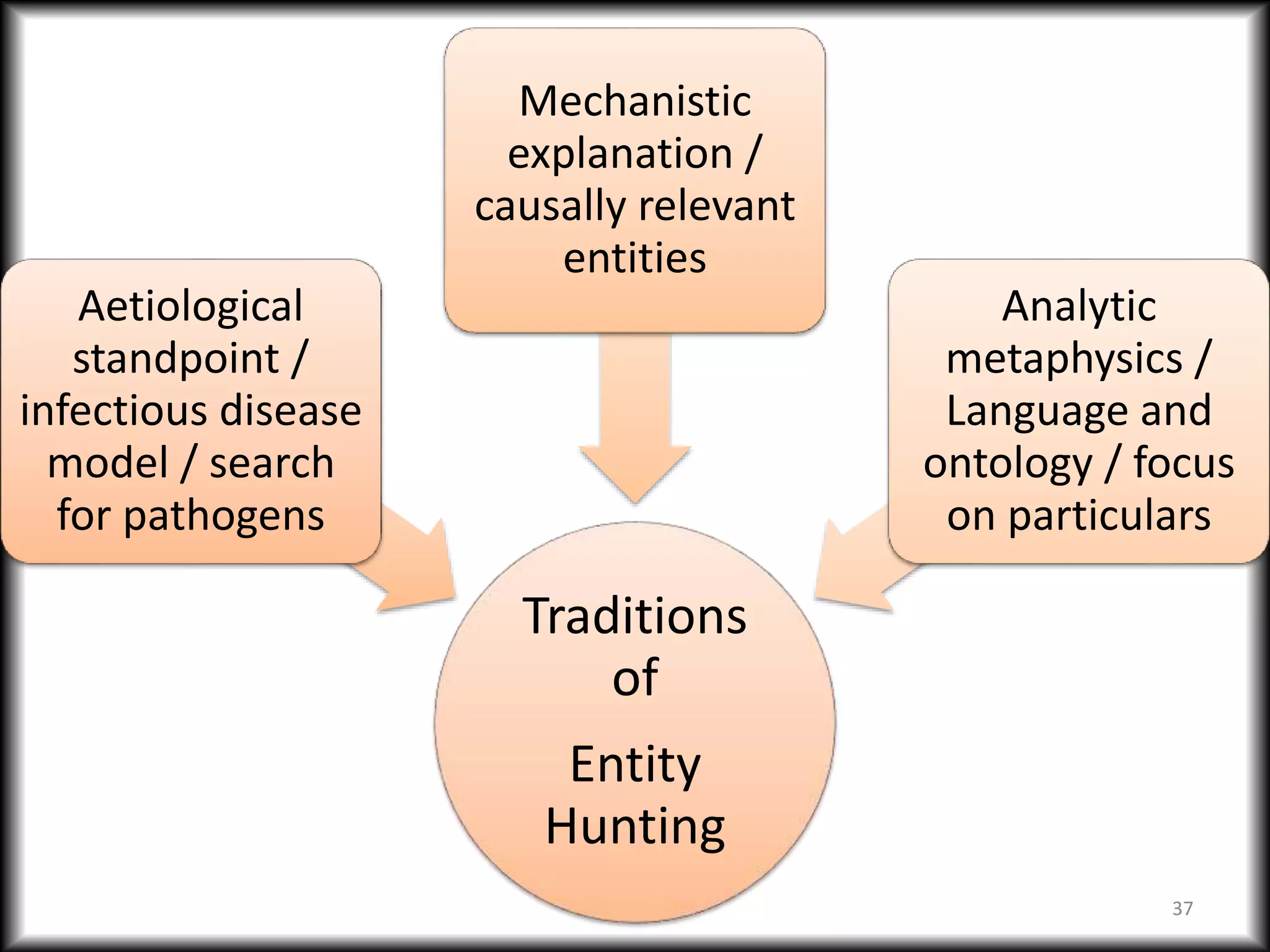
37
Traditions
of
Entity
Hunting
Aetiological
standpoint /
infectious disease
model / search
for pathogens
Mechanistic
explanation /
causally relevant
entities
Analytic
metaphysics /
Language and
ontology / focus
on particulars
Picking up entities?
While classical statistical models to analyzing -omics data serve the
purpose of identifying signals and separating them
from noise, little has been done in chronic diseases to model
time into the exposure-biomarker-disease continuum.
[Vineis and Chadeau-Hyam 2011]
From these two parallel analyses [statistical analyses], we obtained
lists of putative markers of (i) the disease outcome, and (ii)
exposure. These were compared in a second step in order to
identify possible intersecting signals, therefore defining
potential intermediate biomarkers.
[Chadeau-Hyam et al 2011]
38
We pick up signal!
Early theorisations of biomarkers
A must read
Molecular epidemiologist Paul Schulte (1993)
Biomarkers
Biological markers: ‘’technologically powerful
measures of biological variables’’
Indicate events in the continuum [E----D] at different
levels
39
What do biomarkers stand for?
It is vital to understand the nature of the relationship between the
mark and the event
“Does the marker represent an event, is it an event itself, is it a
correlate of the event, or is it a predictor of the event?
The answers to these questions may affect who is sampled, how
and when they are sampled, and what confounders or effect
modifiers are considered. […] Thus, a biologic marker often
refers to the use made of a piece of biologic
information rather than to a specific type of
information.”
Schulte, 1993, p.14-15.
40
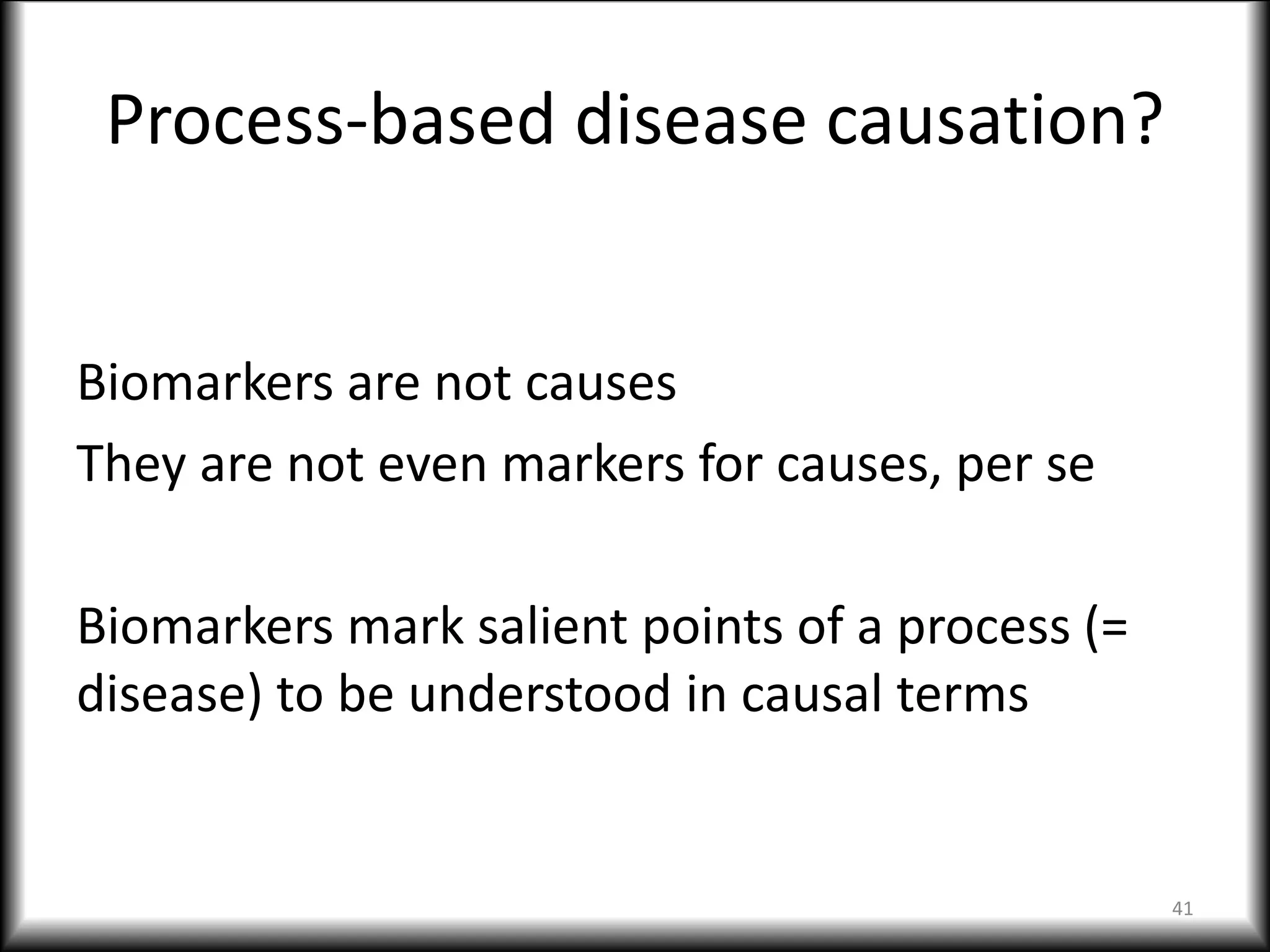
Process-based disease causation?
Biomarkers are not causes
They are not even markers for causes, per se
Biomarkers mark salient points of a process (=
disease) to be understood in causal terms
41
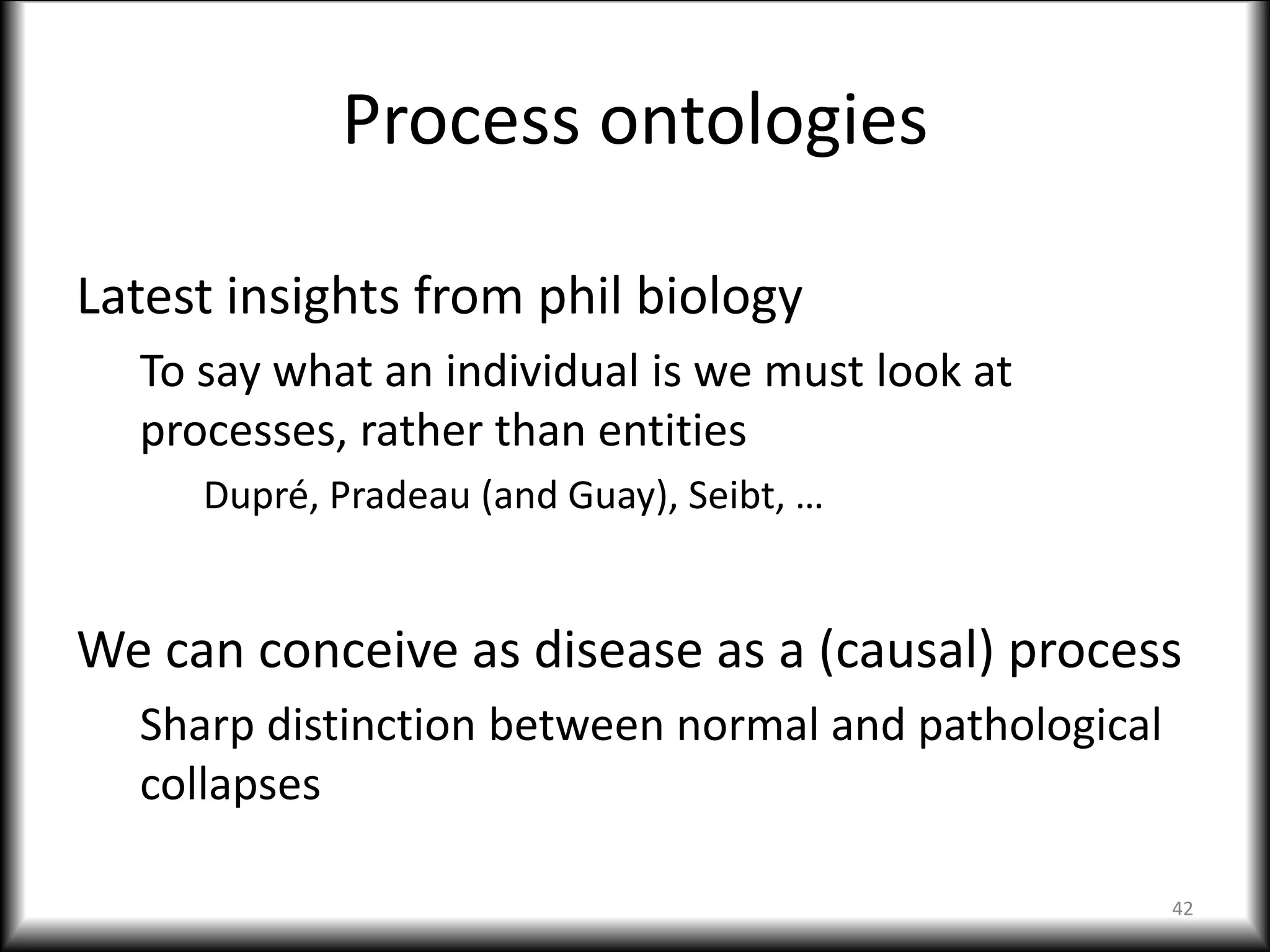
Process ontologies
Latest insights from phil biology
To say what an individual is we must look at
processes, rather than entities
Dupré, Pradeau (and Guay), Seibt, …
We can conceive as disease as a (causal) process
Sharp distinction between normal and pathological
collapses
42
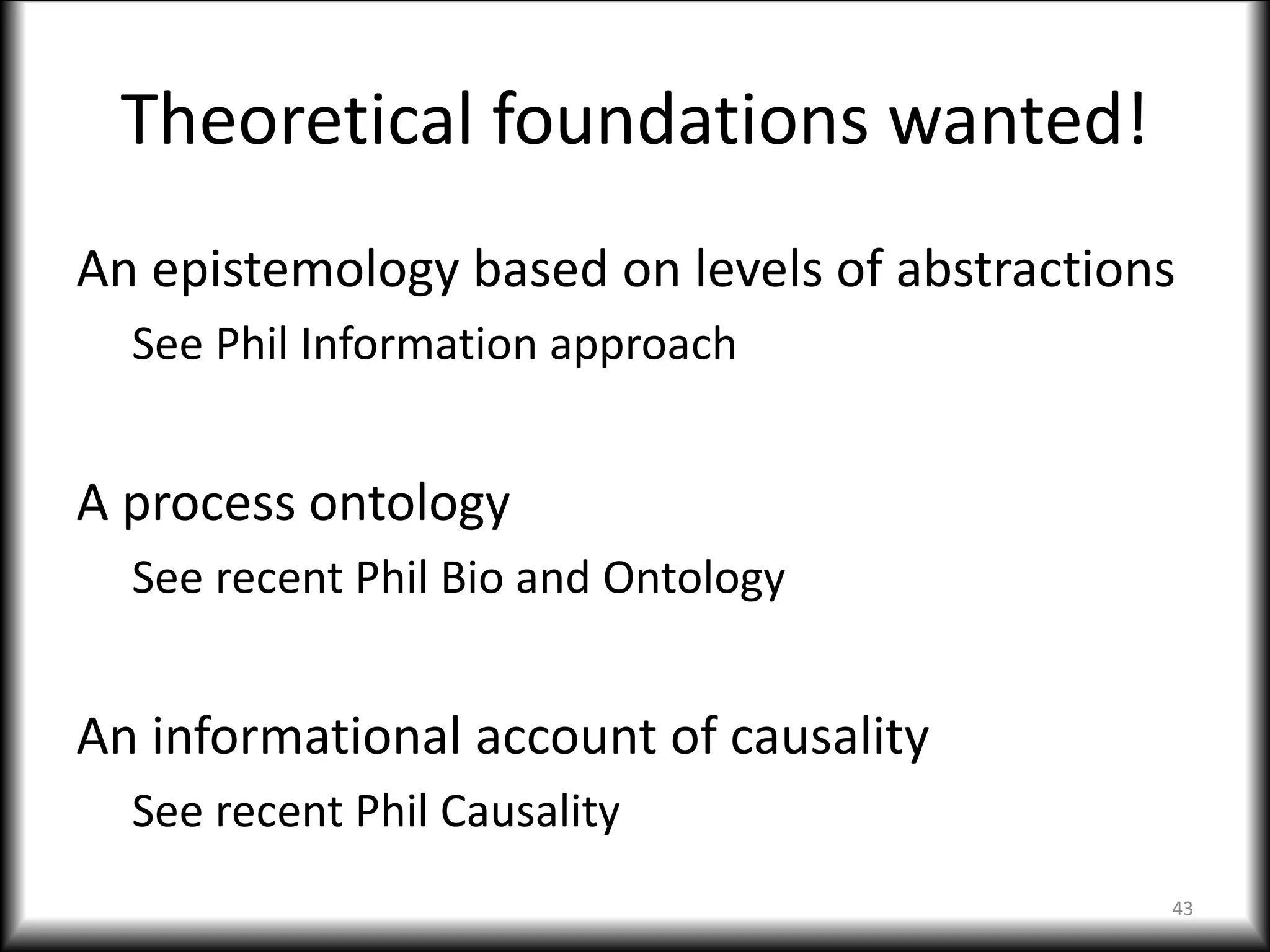
Theoretical foundations wanted!
An epistemology based on levels of abstractions
See Phil Information approach
A process ontology
See recent Phil Bio and Ontology
An informational account of causality
See recent Phil Causality
43
TO SUM UP AND CONCLUDE
44
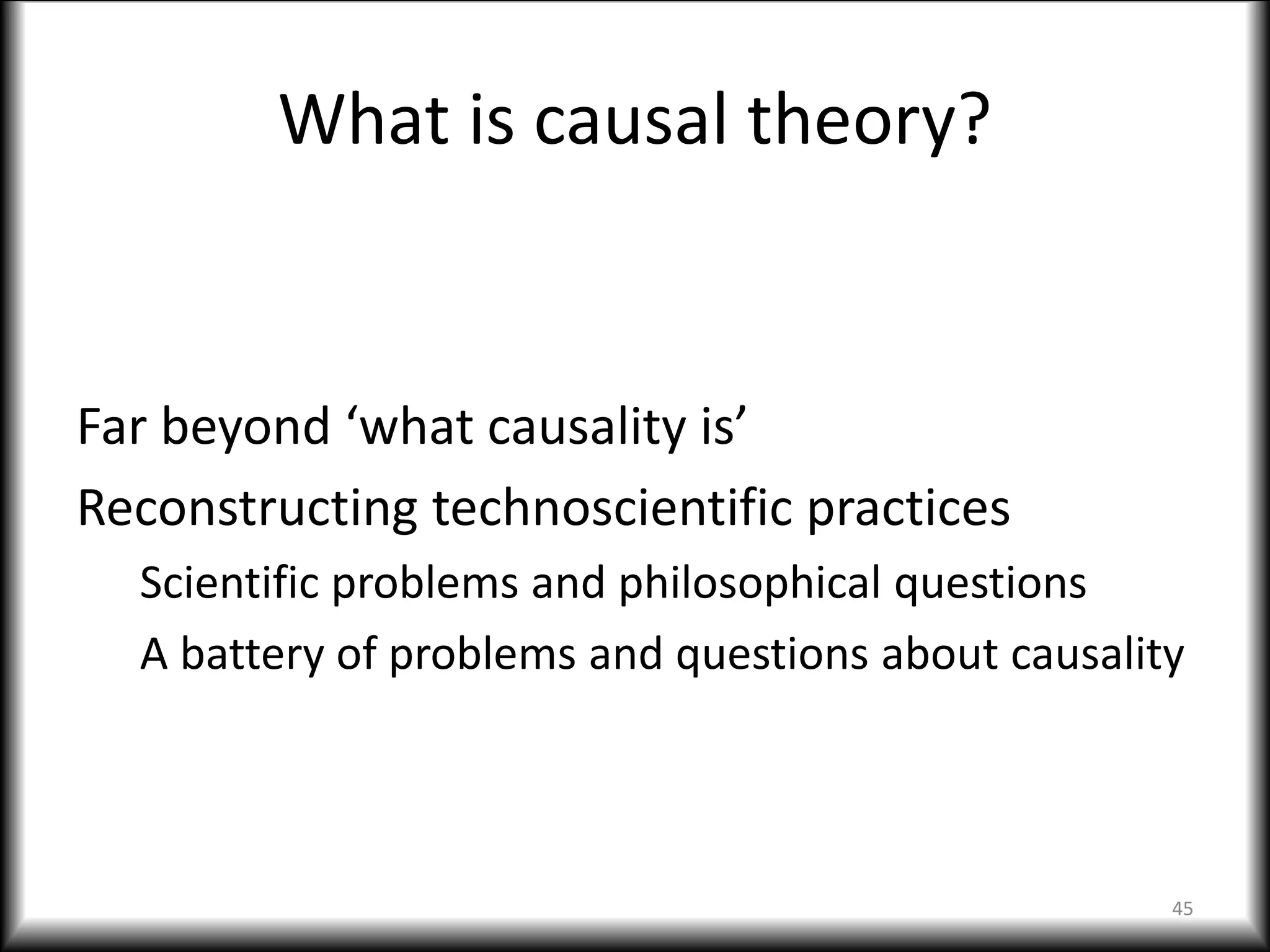
What is causal theory?
Far beyond ‘what causality is’
Reconstructing technoscientific practices
Scientific problems and philosophical questions
A battery of problems and questions about causality
45
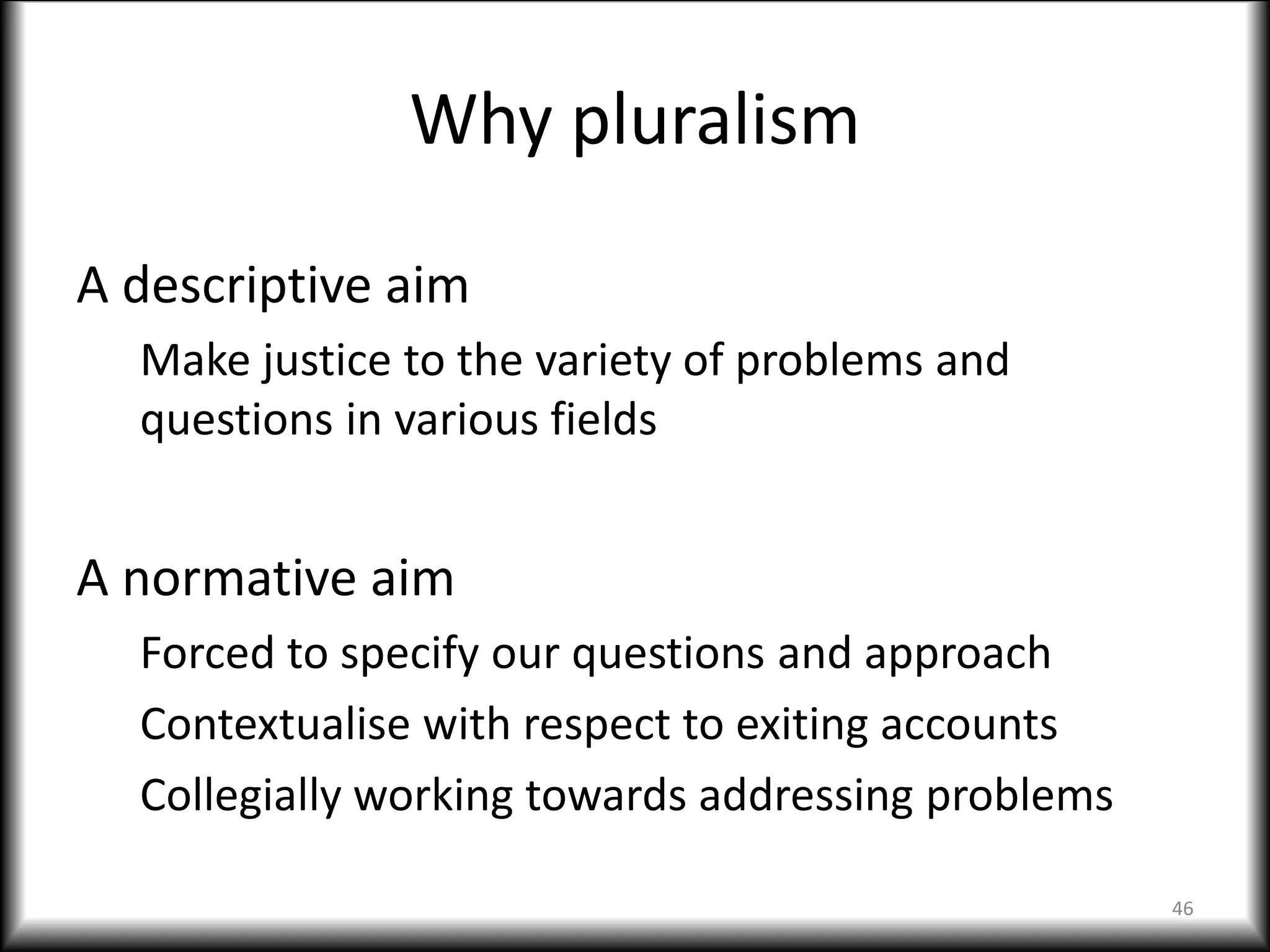
Why pluralism
A descriptive aim
Make justice to the variety of problems and
questions in various fields
A normative aim
Forced to specify our questions and approach
Contextualise with respect to exiting accounts
Collegially working towards addressing problems
46
Questions?
Scientific problems and philosophical questions
about causality:
Why we need a pluralistic approach
Federica Russo
Philosophy | Humanities | Amsterdam
russofederica.wordpress.com | @federicarusso

Scientific problems and philosophical questions about causality. Why we need a pluralistic approach

  • 1.
    Scientific problems andphilosophical questions about causality: Why we need a pluralistic approach Federica Russo Philosophy | Humanities | Amsterdam russofederica.wordpress.com | @federicarusso
  • 2.
    Overview Approaches to causality Conceptualanalysis, analysis of scientific practice Causal pluralism A plurality of pluralism Fragmenting and unifying causal theory A case study Causality in data-driven health sciences 2
  • 3.
  • 4.
  • 5.
    Conceptual analysis What explicatesthe concept of ‘causality’ What makes causal claims true What is causality, metaphysically 5
  • 6.
    How good areintuitions? Exploit everyday intuitions to draw conclusions about the metaphysics of causation from everyday or toy examples Examples The ‘Billy and Suzy’ episodes The assassins … Some conclusions There are two concepts of cause: production and dependence Counterfactual accounts are seriously flawed … 6
  • 7.
    Analysis of scientificpractice Growing CitS / PSP / PI Philosophical questions about causation (and other topics) are motivated by methodological and practical problems in real science Start from scientific practice to bottom up philosophy Partly descriptive and partly normative Examples Causal assessment in medicine Causal reasoning in quantitative social science … Some conclusions Causal assessment has two evidential components: mechanisms and difference- making Mechanisms are important for explanation … 7
  • 8.
  • 9.
    Making sense of avast intellectual enterprise Philosophical theorising about causes Long history, ups and downs, harsh criticisms, dominant views, etc Expansion of philosophical theorising about causes Beyond physics, attention to the special sciences, and medicine Attention for questions about use, besides traditional metaphysics, epistemology, and semantics 9
  • 10.
    10 Causal pluralism: Causality cannotbe reduced to one single concept but has to be analysed using several concepts
  • 11.
  • 12.
    Types of causing Anscombianpluralism: pulling, pushing, binding, … Aristotelian causes Concepts of causation Hall: Dependence vs production Types of inferences Inferential bases, inferential targets. Epistemic causality Sources of evidence Difference-making and mechanisms Different concepts for different scientific fields Physics, social science, … Methods for causal inference Quantitative, qualitative, observational, experimental, … 12
  • 13.
  • 14.
    5 philosophical questions Metaphysics Whatis causality? What kind of things are causes and effects? Semantics What does it mean that C causes E? Epistemology What notions guide causal reasoning? How can we use C to explain E? Methodology How to establish whether C causes E? Or how much of C causes E? Use What to do once we know that C causes E? 5 scientific problems Inference Does C cause E? To what extent? Prediction What to expect if C does (not) cause E? Explanation How does C cause or prevent E? Control What factors to hold fixed to study the relation between C and E? Reasoning What considerations enter in establishing whether / how / to what extent C causes E? 14
  • 15.
  • 16.
    Inference, Prediction, Explanation, Control,Reasoning Causal Mosaic Metaphysics, Semantics, Epistemology, Methodology, Use Necessary and sufficient Levels Evidence Probabilistic causality Counterfact uals Manipulatio n Invariance Exogeneity Simpson’s Paradox Process Mechanism Information Dispositions Regularity Variation Action Inference Validity Truth 16
  • 17.
    Unifying the fragments intothe ‘causal mosaic’ A (causal) mosaic is picture made of tiles Each fragment has a role that Is determined by the scientific challenge / philosophical question it addresses Stands in a relation with neighboring concepts The causal mosaic is dynamic, partly depends on scientists’ / philosophers’ perspectives 17
  • 18.
    Accounts of causalityCounterexamples Scope Relevant questions How many Found in the literature All possible worlds. What does causation logically mean? One logically possible example. Witches casting spells; Angels protecting glasses. Worlds close to the actual world. What is causation metaphysically? One metaphysically possible example. World with reverse temporal direction; Salmon’s moving spot of light. This world. What is causation in this world? One or more real examples. Kinetic theory of gases / quantum mechanics; Billy and Suzy / bombing the enemy town. Some region in this world. What is causation in biochemistry, or physics? A few real examples in the relevant domain. Causality in protein synthesis mechanisms. Some region of this world at some time. What kind of causal explanation can we give of the economic crisis in 1929? Can we give the same kind of explanation of the economic crisis now? A few real examples in the relevant domain at the relevant time; Typical not skewed examples. Causality in the discovery of protein synthesis. Causality in systems biological approaches to protein synthesis. 18
  • 19.
  • 20.
  • 21.
    Positioning the tiles Scientificareas that are well-studied Physics Biology and neuroscience Algorithmic search and causal language … 21
  • 22.
    What about newareas? Which tiles? How to place them?
  • 23.
  • 24.
    A science approach tohealth and disease Discovering the mechanisms of health and disease A tradition that starts at least in the 19th C Experimental medicine, biology, … Establishing correlations between categories – disease, exposure, determinants … A tradition that starts at least in the 17th C, blossoming in 2nd half of 20th C Epidemiology: the study how health and disease vary within and across populations 24
  • 25.
    From epidemiology to molecularepidemiology Environmental exposure and disease (How) do {air, water, chemicals, …} cause {cancer, asthma, allergies, ...}? Traditional epidemiology Establish correlation between classes of environmental factors and of disease Molecular epidemiology Measurements at molecular level Identify biomarkers of exposure >> of early clinical changes >> of disease 25
  • 26.
    Exposure causes Disease Measurechemicals in water, air, etc Identify biomarkers of exposure Detect biomarkers of early clinical changes Match with biomarkers of disease 26 Make categories of environmental factors Match with categories of disease
  • 27.
    BIG HEALTH DATAAND BIG STAKES 27
  • 28.
    Data- and technology-driven Big data helps with the generation of evidence of correlation (statistical analyses) and of mechanisms (omics analyses) Specifically, technology is central to: generating, processing, storing / archiving, curating, analysing data 28
  • 29.
    So far, somefamiliar tiles  Mechanisms, correlations  Discovery, inference, explanation What if change the question? Not just ‘What is causation?’ … 29
  • 30.
    What are wemeasuring? What is it that causes disease?
  • 31.
  • 32.
    The ‘old’ aetiologicalstandpoint Carter 2003, The rise of causal concepts of disease Aetiological standpoint from Koch and Pasteur onwards Disease is defined in terms of its causes Causes are natural, universal, necessary Canguilhem 1943, Le normal et le pathologique “To act, it is at least necessary to localise” The experimental approach of Bernard We can localise pathogens! 32
  • 33.
    Koch’s aetiological standpoint1.1 From mono-causal to multi-causal frameworks Social determinants … But the idea remains: we search for those entities that cause disease Why? To understand and to control disease 33
  • 34.
    The promise ofbiomarkers research Using these ‘-omics’ technologies to inform hypothesis-directed pathway-based approaches to molecular epidemiology and to help direct genome-wide exploratory analyses into more promising directions. [...] one might think of the ‘‘-omics’’ data as providing the missing link among exposure, genes, and disease. (Thomas 2006, p. 490) ‘-Omics’ tools can be directly applied to samples from an epidemiologic case-control or cohort study to better characterise intermediate pathways, potentially providing the ‘missing links’ among exposures, genes, and diseases. (Vineis et al. 2009) Omic technologies offer great potential to identify biomarkers. (Vineis and Chadeau-Hyam 2011) 34
  • 35.
    The new aetiologicalstandpoint? Are biomarkers the sought tiny-tiny entities?
  • 36.
    THE ONTOLOGICAL STATUSOF BIOMARKERS 36
  • 37.
    37 Traditions of Entity Hunting Aetiological standpoint / infectious disease model/ search for pathogens Mechanistic explanation / causally relevant entities Analytic metaphysics / Language and ontology / focus on particulars
  • 38.
    Picking up entities? Whileclassical statistical models to analyzing -omics data serve the purpose of identifying signals and separating them from noise, little has been done in chronic diseases to model time into the exposure-biomarker-disease continuum. [Vineis and Chadeau-Hyam 2011] From these two parallel analyses [statistical analyses], we obtained lists of putative markers of (i) the disease outcome, and (ii) exposure. These were compared in a second step in order to identify possible intersecting signals, therefore defining potential intermediate biomarkers. [Chadeau-Hyam et al 2011] 38 We pick up signal!
  • 39.
    Early theorisations ofbiomarkers A must read Molecular epidemiologist Paul Schulte (1993) Biomarkers Biological markers: ‘’technologically powerful measures of biological variables’’ Indicate events in the continuum [E----D] at different levels 39
  • 40.
    What do biomarkersstand for? It is vital to understand the nature of the relationship between the mark and the event “Does the marker represent an event, is it an event itself, is it a correlate of the event, or is it a predictor of the event? The answers to these questions may affect who is sampled, how and when they are sampled, and what confounders or effect modifiers are considered. […] Thus, a biologic marker often refers to the use made of a piece of biologic information rather than to a specific type of information.” Schulte, 1993, p.14-15. 40
  • 41.
    Process-based disease causation? Biomarkersare not causes They are not even markers for causes, per se Biomarkers mark salient points of a process (= disease) to be understood in causal terms 41
  • 42.
    Process ontologies Latest insightsfrom phil biology To say what an individual is we must look at processes, rather than entities Dupré, Pradeau (and Guay), Seibt, … We can conceive as disease as a (causal) process Sharp distinction between normal and pathological collapses 42
  • 43.
    Theoretical foundations wanted! Anepistemology based on levels of abstractions See Phil Information approach A process ontology See recent Phil Bio and Ontology An informational account of causality See recent Phil Causality 43
  • 44.
    TO SUM UPAND CONCLUDE 44
  • 45.
    What is causaltheory? Far beyond ‘what causality is’ Reconstructing technoscientific practices Scientific problems and philosophical questions A battery of problems and questions about causality 45
  • 46.
    Why pluralism A descriptiveaim Make justice to the variety of problems and questions in various fields A normative aim Forced to specify our questions and approach Contextualise with respect to exiting accounts Collegially working towards addressing problems 46
  • 47.
    Questions? Scientific problems andphilosophical questions about causality: Why we need a pluralistic approach Federica Russo Philosophy | Humanities | Amsterdam russofederica.wordpress.com | @federicarusso

Editor's Notes

  • #27 There is also an important change in the conceptualisation of disease E  D >> well identified causal relata E ------D >> continuum from E to D, no neat causal relata
  • #35 Biomarkers are not relata in E  D, simpliciter In the continuum from E to D, biomarkers signal that somethingis happening at some point in between