Productive causality
in techno-scientific research
Federica Russo
Philosophy | Humanities | Amsterdam
russofederica.wordpress.com | @federicarusso
Overview
The problem of productive causality
Traditional phil-causality
The new course
Productive causality in techno-scientific research
The case of molecular epidemiology
The prospects of ‘information transfer’
Productive causality and philosophical methodology
Philosophical questions, practice-based answers
Knitting philosophical traditions together
2
THE PROBLEM OF
PRODUCTIVE CAUSALITY
3
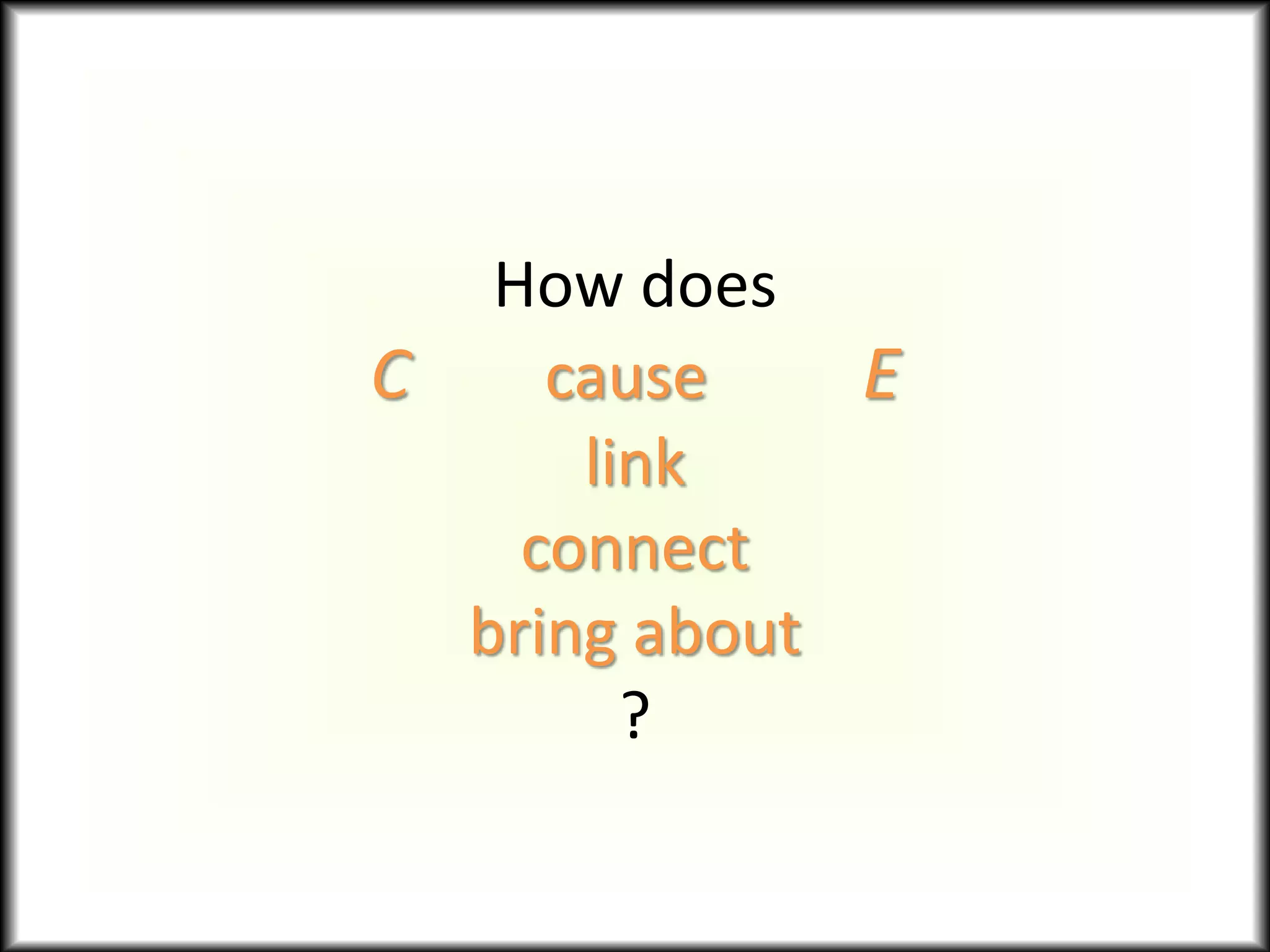
How does
C cause E
link
connect
bring about
?
Causal relations
• The noisy kids give me a headache
• Smoking causes cancer
• Lack of oxygen causes brain hypoxia
• The presence of oxygen is necessary for fire
• A physics process is causal if, interacting with another physics process, it
exchanges conserved quantities
• Aspirin relieves headache
• Exercising makes you lose weight but also hungrier, which may make you
fatter
• p53 mutation increases the chance of cancer
…
5
Traditional approaches
in phil-causality
Methods
Conceptual analysis
Analysis of causal language (mainly, ordinary)
Ideas / concepts / notions
Reduction to regular successions in space and time
‘The cement of the universe’
‘Dependence vs production’
Physics processes
...
6
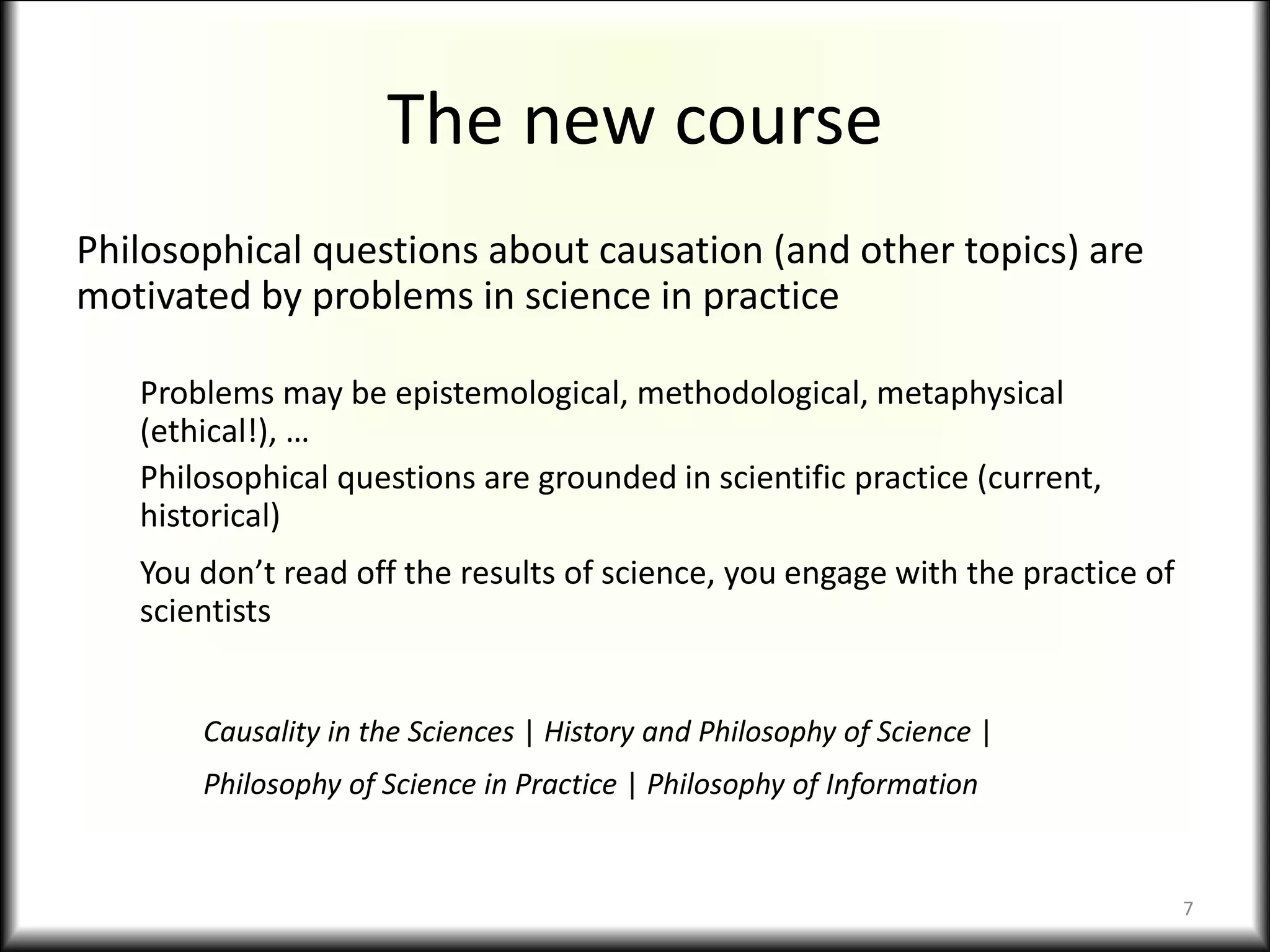
The new course
Philosophical questions about causation (and other topics) are
motivated by problems in science in practice
Problems may be epistemological, methodological, metaphysical
(ethical!), …
Philosophical questions are grounded in scientific practice (current,
historical)
You don’t read off the results of science, you engage with the practice of
scientists
Causality in the Sciences | History and Philosophy of Science |
Philosophy of Science in Practice | Philosophy of Information
7
Philosophical Questions
Metaphysics
What is causality? What kind of things
are causes and effects?
Semantics
What does it mean that C causes E?
Epistemology
What notions guide causal reasoning?
How can we use C to explain E?
Methodology
How to establish whether C causes E?
Or how much of C causes E?
Use
What to do once we know that C
causes E?
Scientific Problems
Inference
Does C cause E? To what extent?
Prediction
What to expect if C does (not) cause E?
Explanation
How does C cause or prevent E?
Control
What factors to hold fixed to study the
relation between C and E?
Reasoning
What considerations about whether /
how / to what extent C causes E?
8
PRODUCTIVE CAUSALITY
IN TECHNO-SCIENTIFIC RESEARCH
9
Techno-scientific research
Most of contemporary science is techno-science
[Perhaps, most of past science too]
Scientific practices where the use of technology is present at various stages
[Most stages? All?]
Science ⇌ Technology
No interest in
Who comes first?
Can we do one without the other?
Lots of interest in
Relations, interactions, interdependence
These are non-trivial
10
Ask your question again
Instead of just science, consider now techno-science
Does the picture change? How?
What happens to our notions?
Observation
Experiment
Causality
Knowledge
…
11
The case of molecular epidemiology
Environmental exposure and disease
(How) do {air, water, chemicals, …} cause {cancer, asthma, allergies, ...}?
Traditional epidemiology
Establish correlation between classes of environmental factors and of disease
Molecular epidemiology
Measurement at molecular level
Identify biomarkers of exposure, of early clinical changes, of disease
12
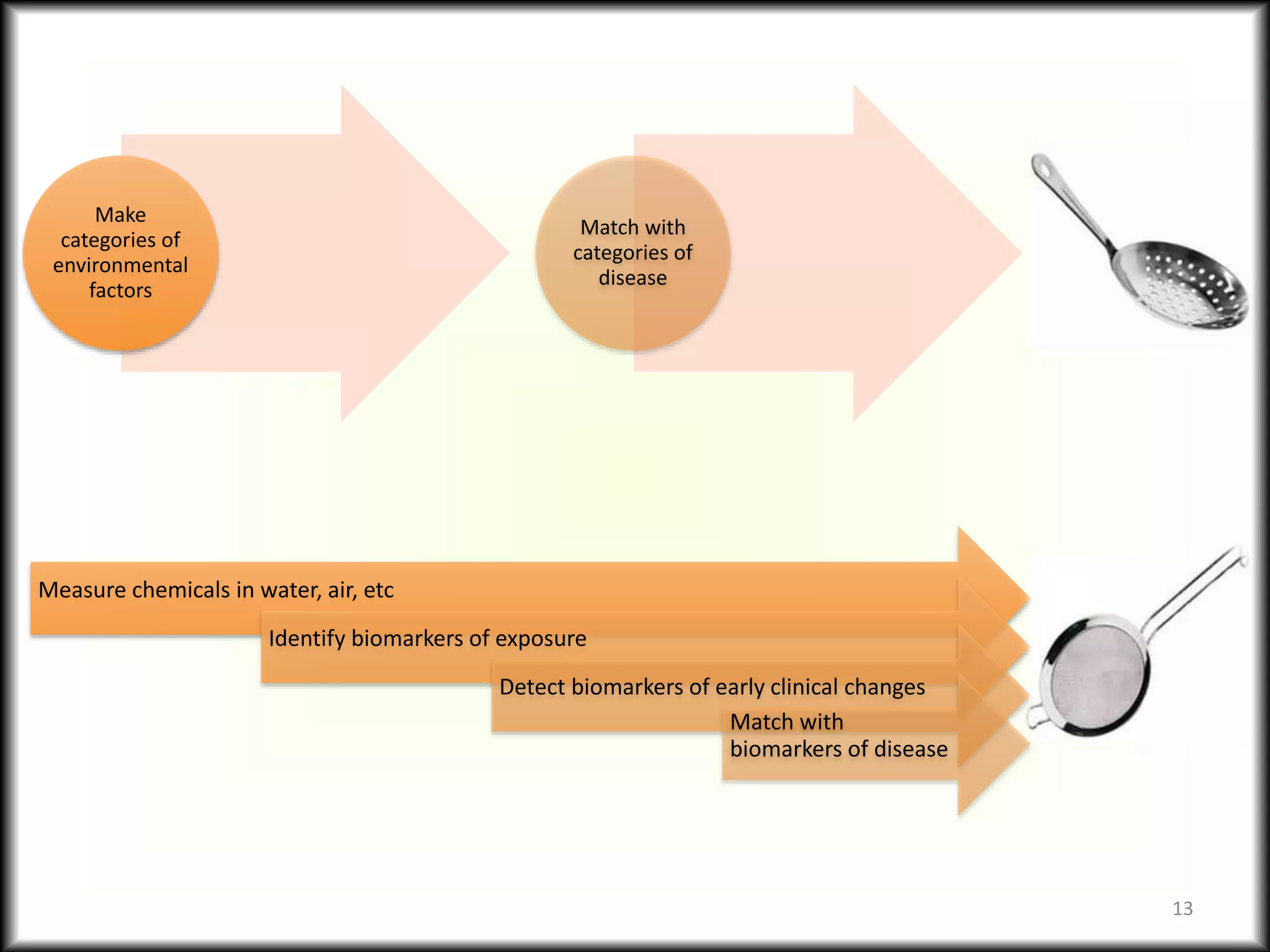
Measure chemicals in water, air, etc
Identify biomarkers of exposure
Detect biomarkers of early clinical changes
Match with
biomarkers of disease
13
Make
categories of
environmental
factors
Match with
categories of
disease
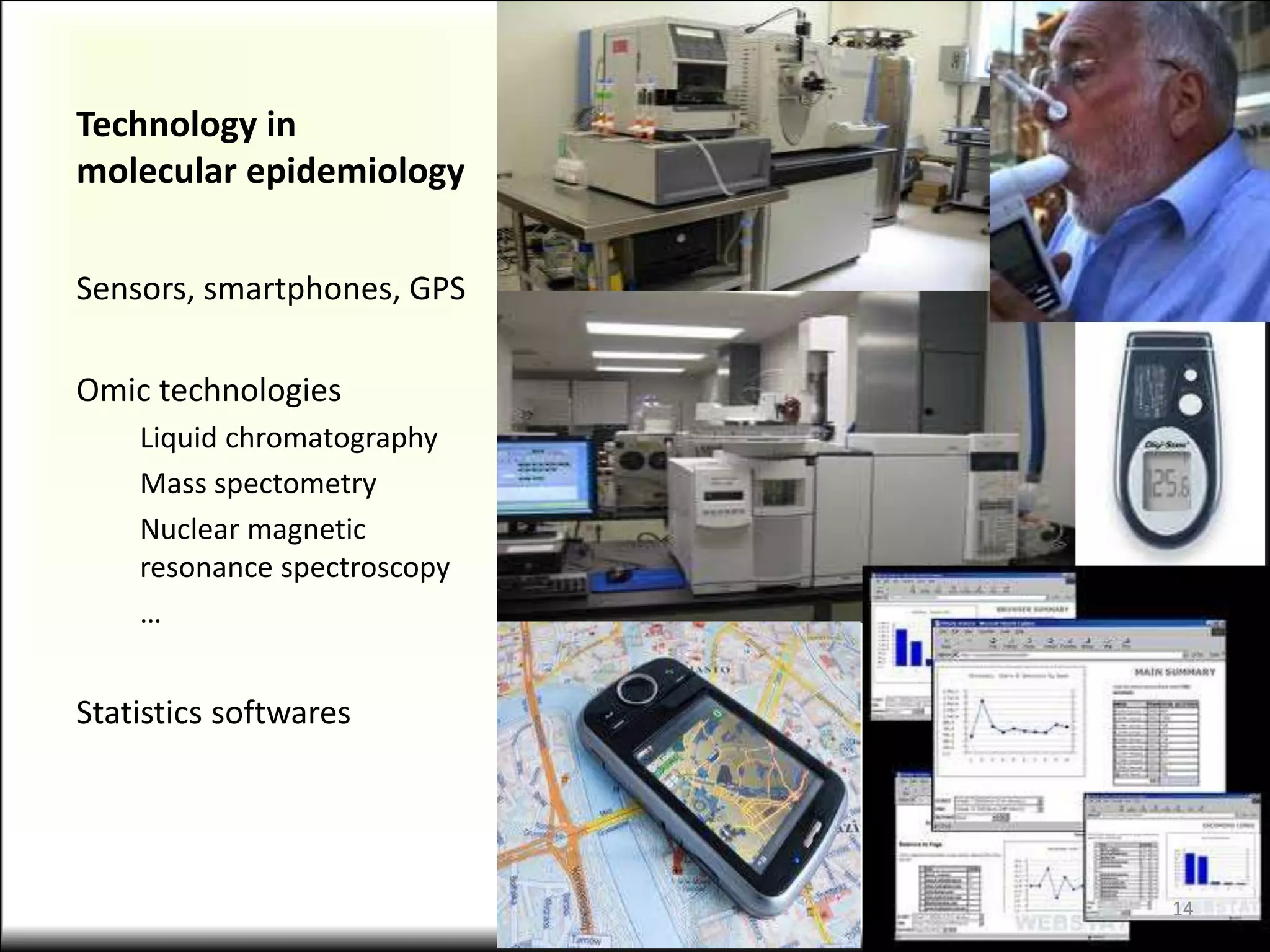
Technology in
molecular epidemiology
Sensors, smartphones, GPS
Omic technologies
Liquid chromatography
Mass spectometry
Nuclear magnetic
resonance spectroscopy
…
Statistics softwares
14
Selected epistemological and
metaphysical questions
What ‘levels’?
Generic, single case? Macro, micro? Biological, social?
What evidence?
Mechanisms? Difference-making?
What account of causality?
Processes? Mechanisms? Capacities?
15
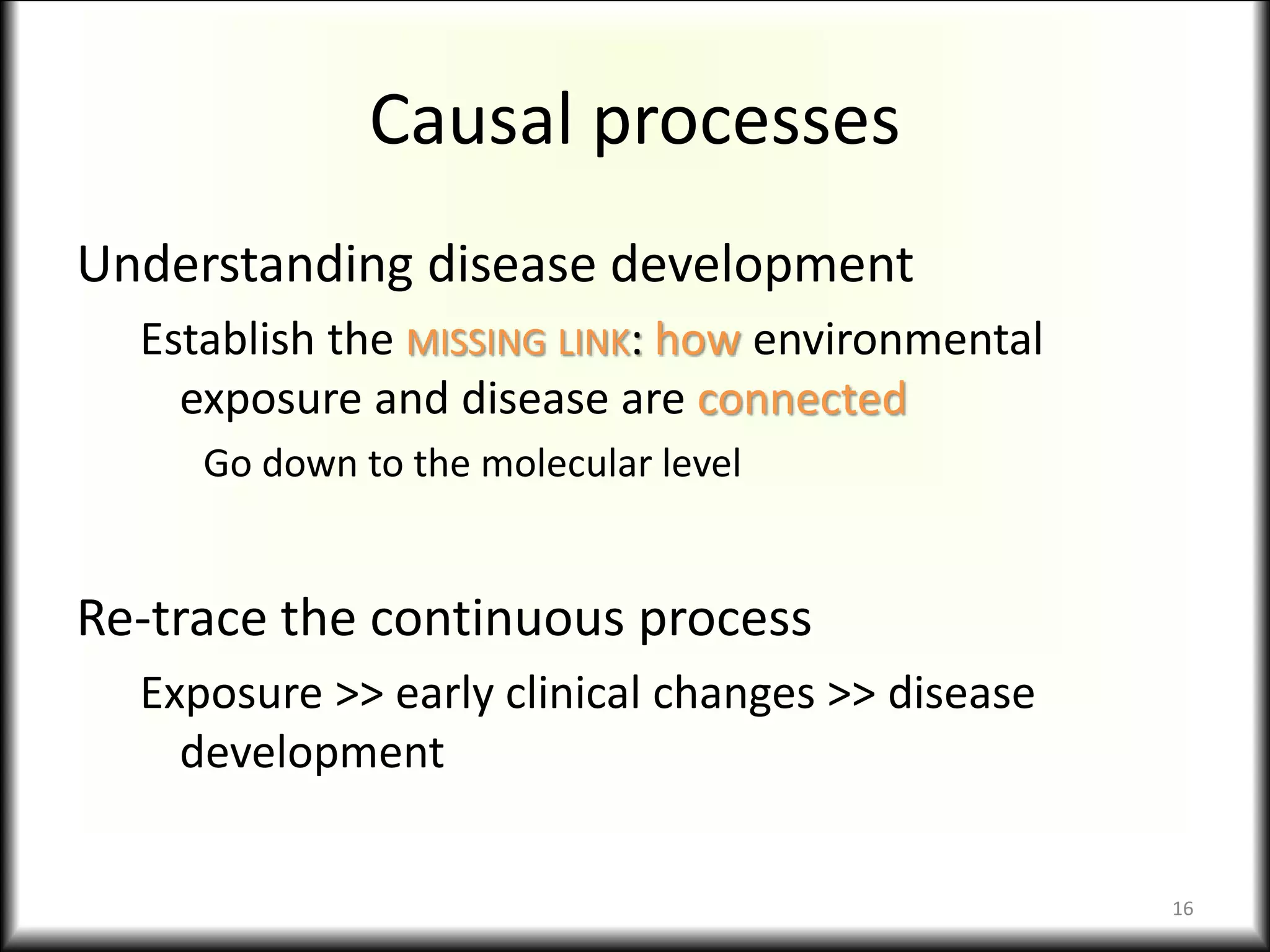
Causal processes
Understanding disease development
Establish the MISSING LINK: how environmental
exposure and disease are connected
Go down to the molecular level
Re-trace the continuous process
Exposure >> early clinical changes >> disease
development
16
What process?
Salmon-Dowe
Exchange of conserved quantities
Billiard balls colliding
Boniolo et al
Exchange between extensive quantities
Electric heating making environment hotter
Processes transmit / exchange physical quantities
Discriminate between causal and non-causal physical processes
Tied to description of processes in physics, only one type of
linking
17
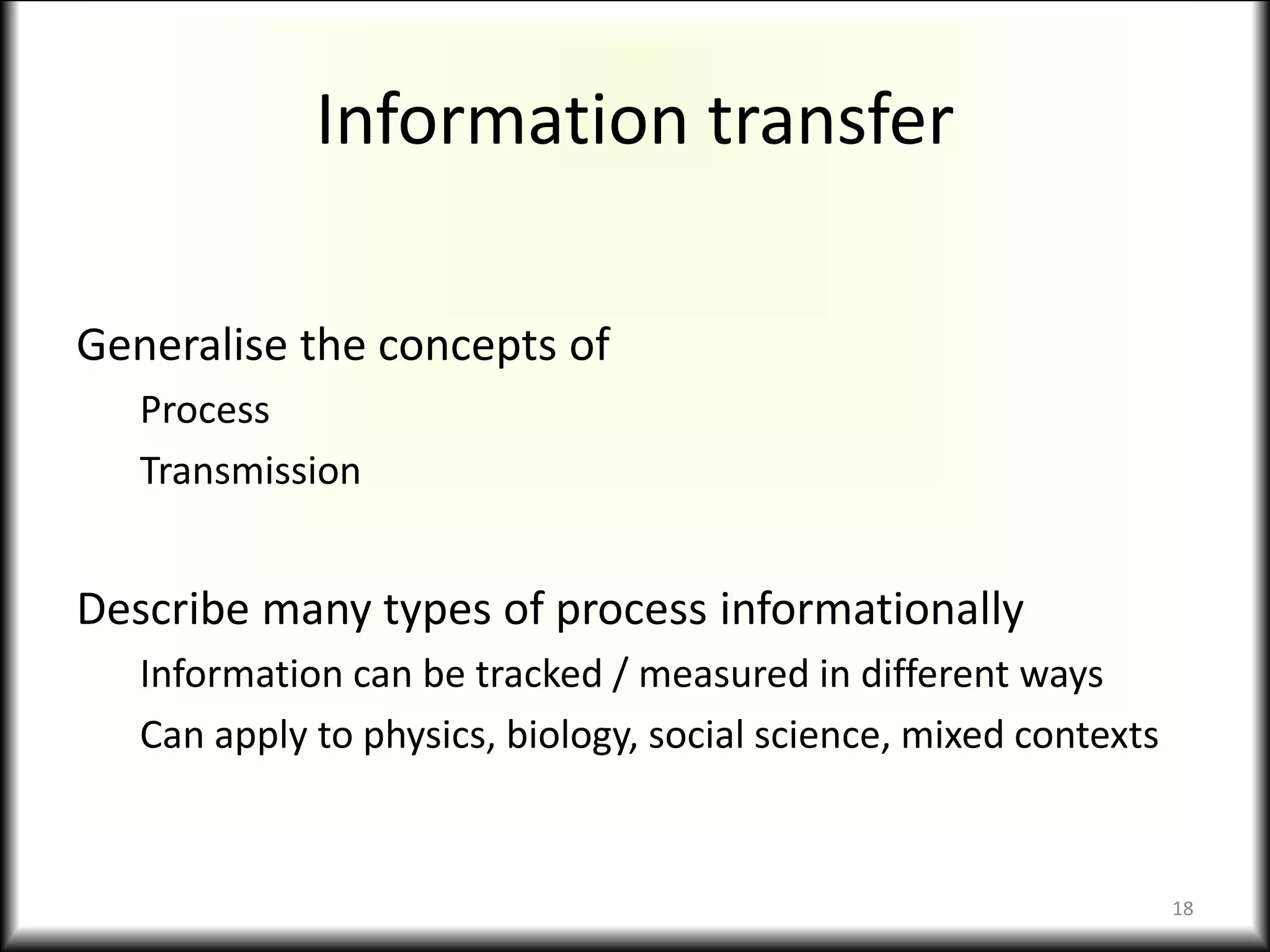
Information transfer
Generalise the concepts of
Process
Transmission
Describe many types of process informationally
Information can be tracked / measured in different ways
Can apply to physics, biology, social science, mixed contexts
18
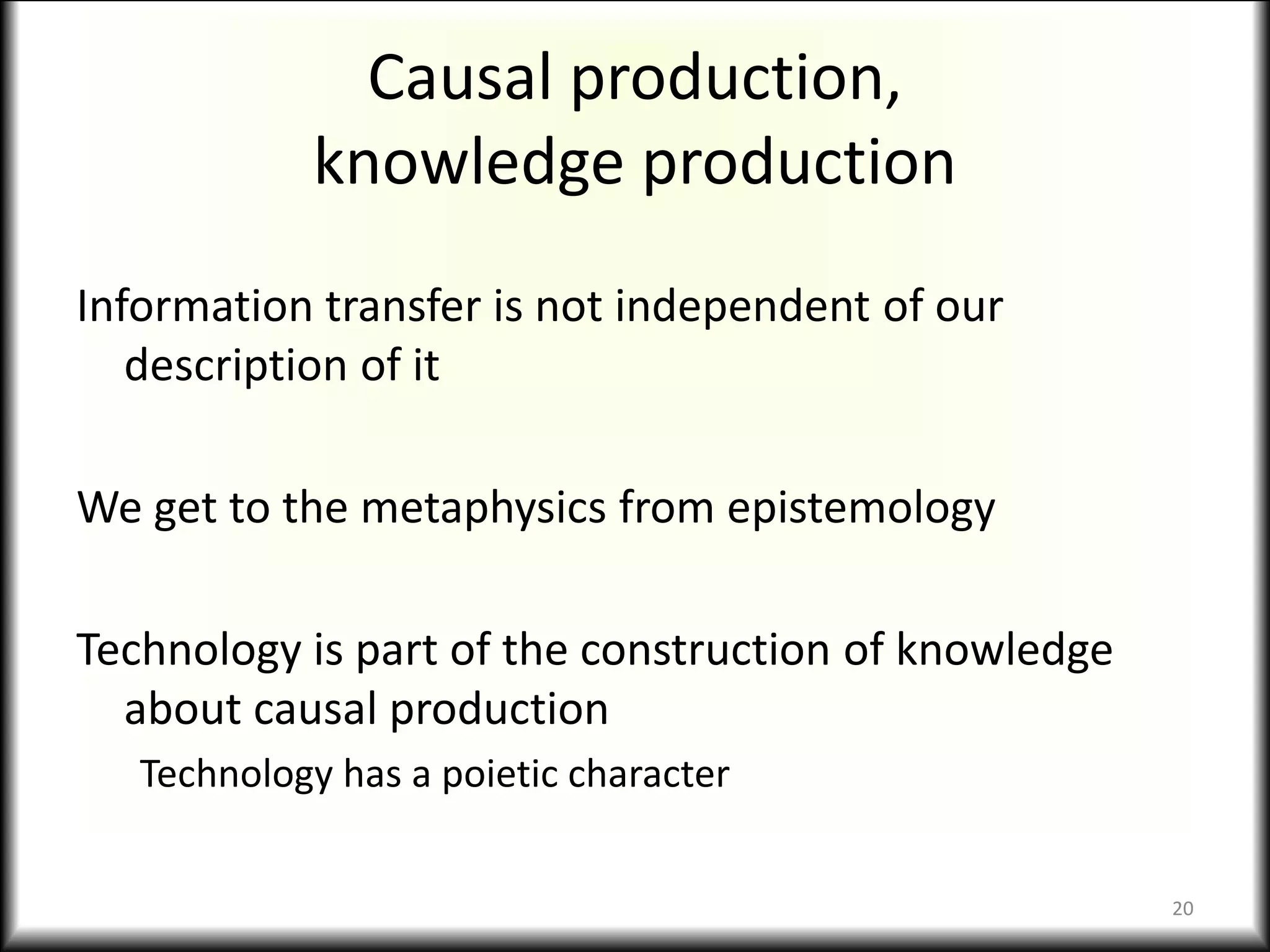
Why information
Gives a way of describing reality, of any kind
The secret connexion doesn’t have to be thick
19
Causal production,
knowledge production
Information transfer is not independent of our
description of it
We get to the metaphysics from epistemology
Technology is part of the construction of knowledge
about causal production
Technology has a poietic character
20
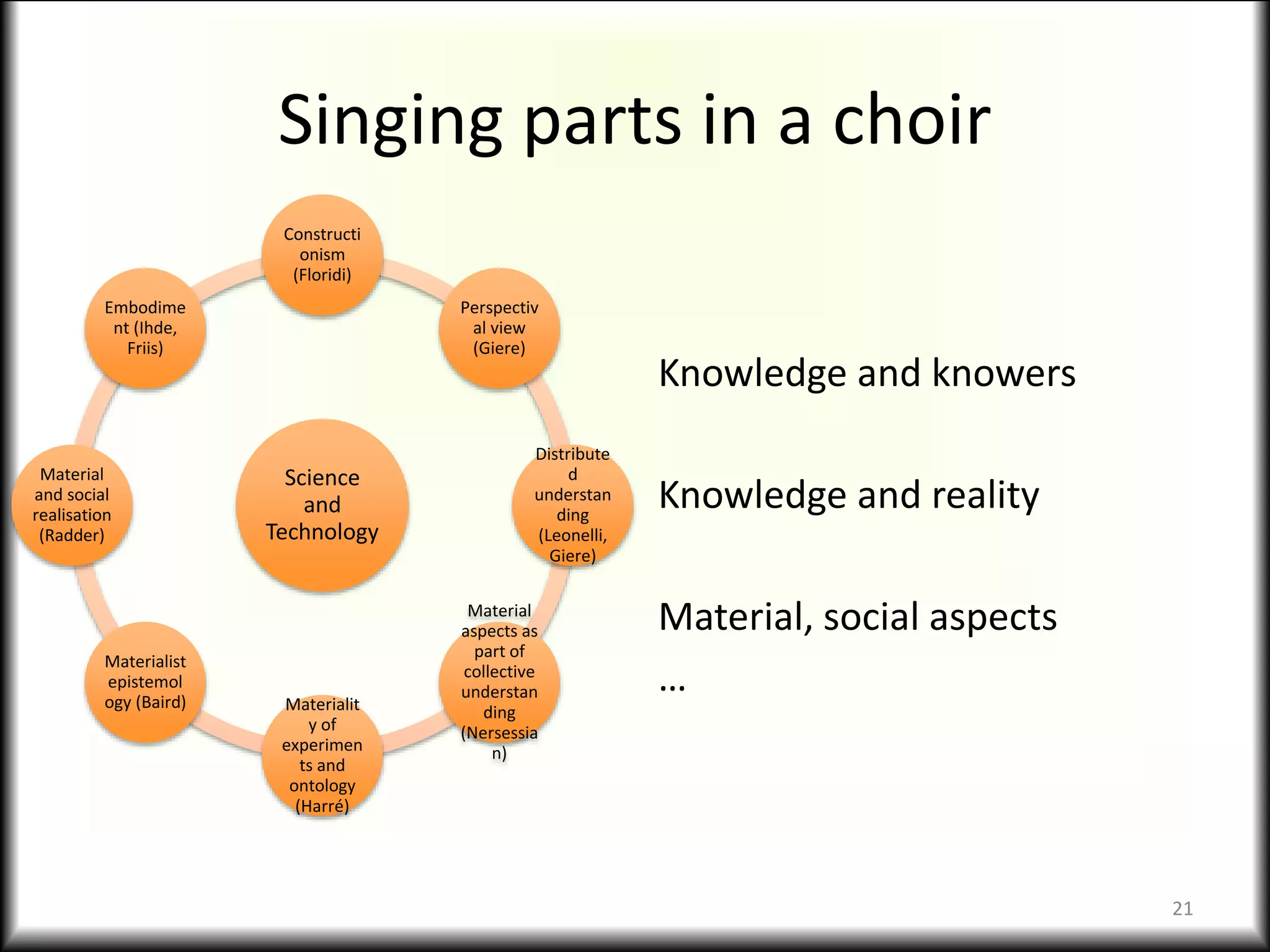
Singing parts in a choir
Science
and
Technology
Constructi
onism
(Floridi)
Perspectiv
al view
(Giere)
Distribute
d
understan
ding
(Leonelli,
Giere)
Material
aspects as
part of
collective
understan
ding
(Nersessia
n)
Materialit
y of
experimen
ts and
ontology
(Harré)
Materialist
epistemol
ogy (Baird)
Material
and social
realisation
(Radder)
Embodime
nt (Ihde,
Friis)
Knowledge and knowers
Knowledge and reality
Material, social aspects
…
21
PRODUCTIVE CAUSALITY
AND PHILOSOPHICAL METHODOLOGY
22
Knitting philosophical traditions
together
(Another) ‘parting of the ways’
Anglo-American phil sci
French epistemology
An exception:
The ‘Dutch school’ of phil sci and phil tech
23
Philosophical questions,
practice-based answers
A proper inclusion of technology in phil sci
A question of philosophical methodology
A wise integration of
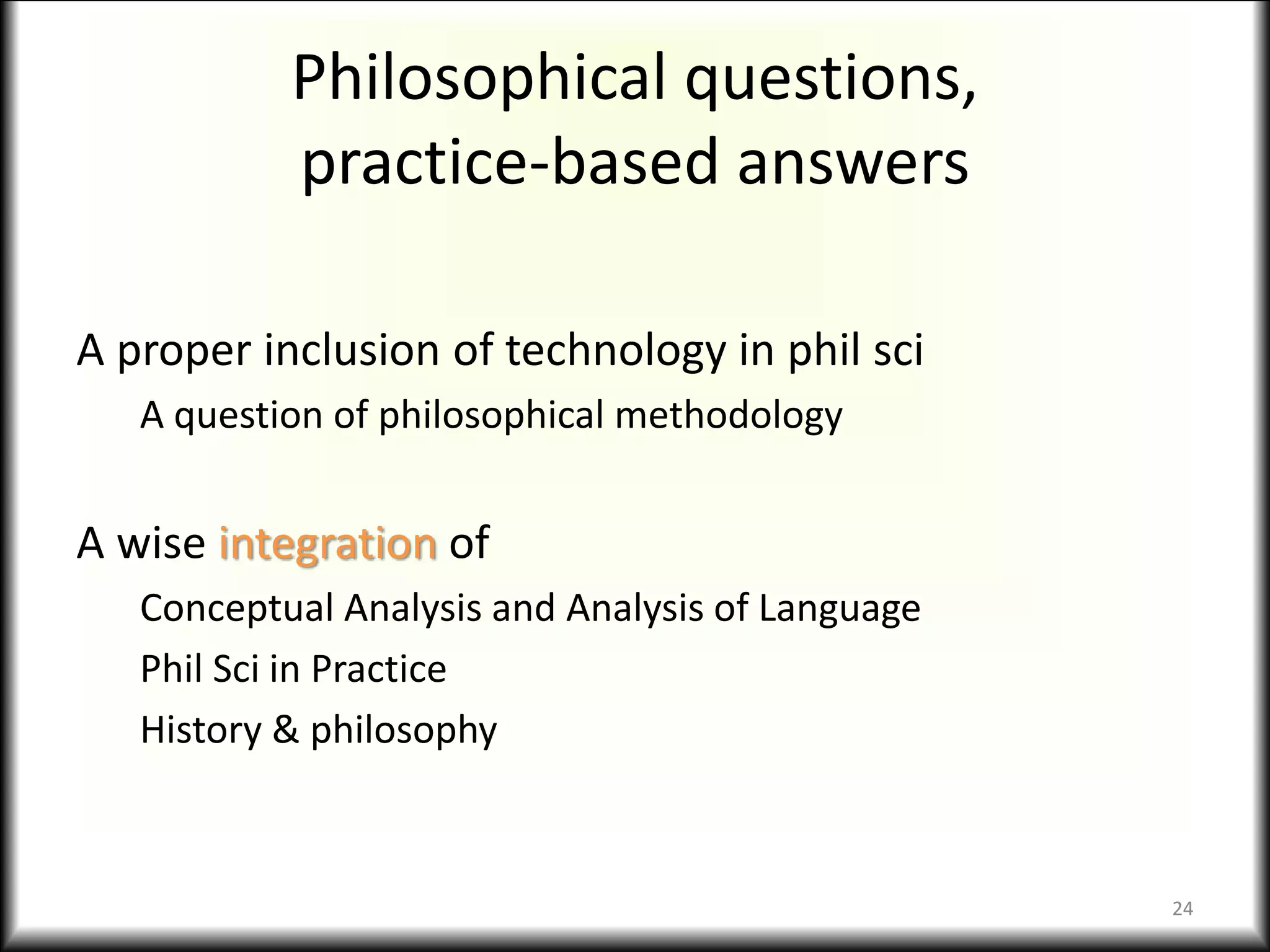
Conceptual Analysis and Analysis of Language
Phil Sci in Practice
History & philosophy
24
TO SUM UP AND CONCLUDE
25
Techno-scientific research
More than phil tech
An important component to be re-integrated in phil sci
We need to revisit our philosophical toolkit
Observation
Experiment
Causality
Knowledge
…
26
Revisiting productive causality
Information transmission
A thin, light metaphysics
Derives from our epistemology
Widely applicable, but not vacuous
27
Further readings
All authors mentioned in the presentation, see especially slide 17 and 21
Illari P. and Russo F. (2014) Causality: Philosophical Theory Meets Scientific Practice.
Oxford University Press
Russo F. and Vineis P. (2017) Opportunities and challenges of molecular epidemiology.
In G. Boniolo and M. J. Nathan (eds) Philosophy of Molecular Medicine:
Foundational Issues in Reserch and Practice. Routledge.
Russo F. (2016) On the poietic character of technology. Humana.Mente Journal of
Philosophical Studies, 30, 147-174.
Illari P. and Russo F. (2016) Causality and information. In The Routledge Handbook of
Philosophy of Information, edited by L. Floridi, 235-248.
Illari P. and Russo F. (2014) Information channels and biomarkers of disease. Topoi.
DOI: 10.1007/s11245-013-9228-1
Russo F. (2012). The homo poieticus and the bridge between physis and techne. In H.
Demir (eds), Luciano Floridi’s Philosophy of Technology. Critical Reflections.
Springer.
28

Productive causality in technoscientific research

  • 1.
    Productive causality in techno-scientificresearch Federica Russo Philosophy | Humanities | Amsterdam russofederica.wordpress.com | @federicarusso
  • 2.
    Overview The problem ofproductive causality Traditional phil-causality The new course Productive causality in techno-scientific research The case of molecular epidemiology The prospects of ‘information transfer’ Productive causality and philosophical methodology Philosophical questions, practice-based answers Knitting philosophical traditions together 2
  • 3.
  • 4.
    How does C causeE link connect bring about ?
  • 5.
    Causal relations • Thenoisy kids give me a headache • Smoking causes cancer • Lack of oxygen causes brain hypoxia • The presence of oxygen is necessary for fire • A physics process is causal if, interacting with another physics process, it exchanges conserved quantities • Aspirin relieves headache • Exercising makes you lose weight but also hungrier, which may make you fatter • p53 mutation increases the chance of cancer … 5
  • 6.
    Traditional approaches in phil-causality Methods Conceptualanalysis Analysis of causal language (mainly, ordinary) Ideas / concepts / notions Reduction to regular successions in space and time ‘The cement of the universe’ ‘Dependence vs production’ Physics processes ... 6
  • 7.
    The new course Philosophicalquestions about causation (and other topics) are motivated by problems in science in practice Problems may be epistemological, methodological, metaphysical (ethical!), … Philosophical questions are grounded in scientific practice (current, historical) You don’t read off the results of science, you engage with the practice of scientists Causality in the Sciences | History and Philosophy of Science | Philosophy of Science in Practice | Philosophy of Information 7
  • 8.
    Philosophical Questions Metaphysics What iscausality? What kind of things are causes and effects? Semantics What does it mean that C causes E? Epistemology What notions guide causal reasoning? How can we use C to explain E? Methodology How to establish whether C causes E? Or how much of C causes E? Use What to do once we know that C causes E? Scientific Problems Inference Does C cause E? To what extent? Prediction What to expect if C does (not) cause E? Explanation How does C cause or prevent E? Control What factors to hold fixed to study the relation between C and E? Reasoning What considerations about whether / how / to what extent C causes E? 8
  • 9.
  • 10.
    Techno-scientific research Most ofcontemporary science is techno-science [Perhaps, most of past science too] Scientific practices where the use of technology is present at various stages [Most stages? All?] Science ⇌ Technology No interest in Who comes first? Can we do one without the other? Lots of interest in Relations, interactions, interdependence These are non-trivial 10
  • 11.
    Ask your questionagain Instead of just science, consider now techno-science Does the picture change? How? What happens to our notions? Observation Experiment Causality Knowledge … 11
  • 12.
    The case ofmolecular epidemiology Environmental exposure and disease (How) do {air, water, chemicals, …} cause {cancer, asthma, allergies, ...}? Traditional epidemiology Establish correlation between classes of environmental factors and of disease Molecular epidemiology Measurement at molecular level Identify biomarkers of exposure, of early clinical changes, of disease 12
  • 13.
    Measure chemicals inwater, air, etc Identify biomarkers of exposure Detect biomarkers of early clinical changes Match with biomarkers of disease 13 Make categories of environmental factors Match with categories of disease
  • 14.
    Technology in molecular epidemiology Sensors,smartphones, GPS Omic technologies Liquid chromatography Mass spectometry Nuclear magnetic resonance spectroscopy … Statistics softwares 14
  • 15.
    Selected epistemological and metaphysicalquestions What ‘levels’? Generic, single case? Macro, micro? Biological, social? What evidence? Mechanisms? Difference-making? What account of causality? Processes? Mechanisms? Capacities? 15
  • 16.
    Causal processes Understanding diseasedevelopment Establish the MISSING LINK: how environmental exposure and disease are connected Go down to the molecular level Re-trace the continuous process Exposure >> early clinical changes >> disease development 16
  • 17.
    What process? Salmon-Dowe Exchange ofconserved quantities Billiard balls colliding Boniolo et al Exchange between extensive quantities Electric heating making environment hotter Processes transmit / exchange physical quantities Discriminate between causal and non-causal physical processes Tied to description of processes in physics, only one type of linking 17
  • 18.
    Information transfer Generalise theconcepts of Process Transmission Describe many types of process informationally Information can be tracked / measured in different ways Can apply to physics, biology, social science, mixed contexts 18
  • 19.
    Why information Gives away of describing reality, of any kind The secret connexion doesn’t have to be thick 19
  • 20.
    Causal production, knowledge production Informationtransfer is not independent of our description of it We get to the metaphysics from epistemology Technology is part of the construction of knowledge about causal production Technology has a poietic character 20
  • 21.
    Singing parts ina choir Science and Technology Constructi onism (Floridi) Perspectiv al view (Giere) Distribute d understan ding (Leonelli, Giere) Material aspects as part of collective understan ding (Nersessia n) Materialit y of experimen ts and ontology (Harré) Materialist epistemol ogy (Baird) Material and social realisation (Radder) Embodime nt (Ihde, Friis) Knowledge and knowers Knowledge and reality Material, social aspects … 21
  • 22.
  • 23.
    Knitting philosophical traditions together (Another)‘parting of the ways’ Anglo-American phil sci French epistemology An exception: The ‘Dutch school’ of phil sci and phil tech 23
  • 24.
    Philosophical questions, practice-based answers Aproper inclusion of technology in phil sci A question of philosophical methodology A wise integration of Conceptual Analysis and Analysis of Language Phil Sci in Practice History & philosophy 24
  • 25.
    TO SUM UPAND CONCLUDE 25
  • 26.
    Techno-scientific research More thanphil tech An important component to be re-integrated in phil sci We need to revisit our philosophical toolkit Observation Experiment Causality Knowledge … 26
  • 27.
    Revisiting productive causality Informationtransmission A thin, light metaphysics Derives from our epistemology Widely applicable, but not vacuous 27
  • 28.
    Further readings All authorsmentioned in the presentation, see especially slide 17 and 21 Illari P. and Russo F. (2014) Causality: Philosophical Theory Meets Scientific Practice. Oxford University Press Russo F. and Vineis P. (2017) Opportunities and challenges of molecular epidemiology. In G. Boniolo and M. J. Nathan (eds) Philosophy of Molecular Medicine: Foundational Issues in Reserch and Practice. Routledge. Russo F. (2016) On the poietic character of technology. Humana.Mente Journal of Philosophical Studies, 30, 147-174. Illari P. and Russo F. (2016) Causality and information. In The Routledge Handbook of Philosophy of Information, edited by L. Floridi, 235-248. Illari P. and Russo F. (2014) Information channels and biomarkers of disease. Topoi. DOI: 10.1007/s11245-013-9228-1 Russo F. (2012). The homo poieticus and the bridge between physis and techne. In H. Demir (eds), Luciano Floridi’s Philosophy of Technology. Critical Reflections. Springer. 28

Editor's Notes

  • #2 - What I take technoscientific research to be. Why exposomics is exemplar, rather than peculiar. The problem of productive causality Traditionally, causality out there in the world As opposed to: dependence, but also mind-dep defs of causality The prospects of an information transmission account peculiar aspects: not just out there nor in our minds. It is constructrued. Technology helps. Constructionism. More generally, relations between science and technology are at stake. Revive a debate. Echo voices, e.g. Radder, Baird, Boon.