Unit 1
Diversity in the living world
THE LIVING WORLD
Chapter-1
Prepared By-
Anita Mishra,
Birla Balika Vidyapeeth,
Pilani
Characteristics of living organism
 Cellular Organization
 Metabolism
 Growth
 Reproduction
 Consciousness/ Response to stimuli
CELLULAR ORGANIZATION
Cellular organisation of the body is the defining feature of life
forms.
The organisms are of 2 kinds based on the no. of cells they
have-
Unicellular- In unicellular organisms the division of labour is
at the level of organelles.
Multicellular- In multicellular organisms the division of
labour is at organ & organ system level.
Organisms are of 2 kinds based on the complexity of their
cells-
Prokaryotic- Genetic material is not bound by membrane & no
membrane bound cell organelles found.
Eukaryotic- Genetic material is bound by membrane hence
well defined nucleus & membrane bound cell organelles
found.
METABOLISM
 All organism are made of Biochemicals- of different sizes-
macro/ micro-molecules.
 The Biomolecules, which are made & converted to other molecules
through Biochemical reactions called Metabolism
 Metabolism is the Sum total of all chemical reactions- Metabolism
 Non- living- no metabolism
 Metabolic reactions- demonstrated outside the body in cell free
system (test tube/ in vitro) is neither living nor non living
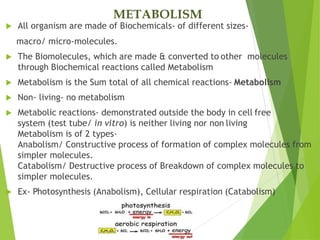
Metabolism is of 2 types-
Anabolism/ Constructive process of formation of complex molecules from
simpler molecules.
Catabolism/ Destructive process of Breakdown of complex molecules to
simpler molecules.
 Ex- Photosynthesis (Anabolism), Cellular respiration (Catabolism)
GROWTH
 All living organisms show growth either by multiplication or by
increase in size.
It is an irreversible increase in mass of individual.
Cell division leads to increase in size & No.
Plants- Growth is indeterminate & in animals is determinate.
Division of cells leads to repair of lost cells.
Unicellular- division to increase in number of organisms
Growth- increase in body mass & size in multicellular organisms
Non- living- grow with accumulation of materialon surface,
Eg- Mountains, Boulders, Sand mounds
Growth of living organisms is from within the body not like non
living things by accretion.
REPRODUCTION
 Organism reproduce to produce progeny of their own kind to continue
their race.
 The organisms reproduce by- Asexual & Sexual Reproduction
 Asexual Reproduction- In Fungi- Sporulation
Yeast & Hydra- Budding
Planaria & Fungi, Algae & mosses- Fragmentation
Amoeba – Binary fission
In unicellular organisms Growth & reproduction are synonyms.
 Organisms like Mules, worker bees, infertile human couple can’t
reproduce but are living so reproduction cannot be sole feature for living
things.
CONSCIOUSNESS/ RESPONSE TO STIMULI
 Living organism- sense their surroundings or environment stimuli (physical,
chemical or biological) this is called Consciousness.
 Organism perceive stimuli/ changes in surrounding through sense organs
 Plants respond to light, water, temperature, organism, pollutants as
stimuli
 Photoperiod influence reproduction- seasonal breeders (plants & animals)
 Human- aware of himself, i.e., self- consciousness
DIVERSITY OF LIVING WORLD
 Biodiversity : Biodiversity refers to the variety of living species on
Earth, including plants, animals, bacteria, and fungi.
 Number of species known- 1.7- 1.8 million
 Need for classification : For convenience of study of the wide
biodiversity the organisms need to be classified into categories.
The study of General features of the categories makes it
convenient to be named, remembered, studied and understood.
 Nomenclature- Need to standardize naming organism, so that
organism is named by same name all over world/ Universal
naming.
 The process of giving universal scientific name to all known
organisms is called nomenclature
 Identification- nomenclature or naming is only possible when the
organism is described correctly and we know to what organism
the name is attached to. This is identification
DIVERSITY OF LIVING WORLD
 Plants Nomenclature - based on principles &
criteria of ICBN (International Code for
Botanical Nomenclature)
 Animals Nomenclature- ICZN (International
Code of Zoological Nomenclature)
 Scientific names ensure that each organism has
only one name.
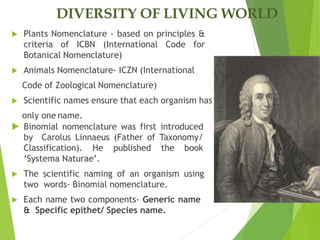
 Binomial nomenclature was first introduced
by Carolus Linnaeus (Father of Taxonomy/
Classification). He published the book
‘Systema Naturae’.
 The scientific naming of an organism using
two words- Binomial nomenclature.
 Each name two components- Generic name
& Specific epithet/ Species name.
1. Biological Names are generally
Latin & written in italics
2. First word represents genus &
second word denotes specific
epithet
3. Both word of biological name
should be underlined
separately when hand written
& italics if printed
4. First word denoting genus start
with capital letter & specific epithet
or species name should start with
small letter.
RULES FOR NOMENCLATURE
TAXONOMY
 Classification is based on characteristics of external & internal
structure, cell structure, development, ecological information-
basis for modern taxonomy
 Human being is interested to know different organism &
diversity along with their relationship with others-
Systematics
 Systematics : It deals with classification of organisms based
on their diversities and relationships among them. The word
systematics is derived from the Latin word ‘systema’ which
means systematic arrangement of organisms. The scope of
systematics was later enlarged to include identification,
nomenclature and classification. Systematics takes into account
evolutionary relationships between organisms.
TAXONOMY
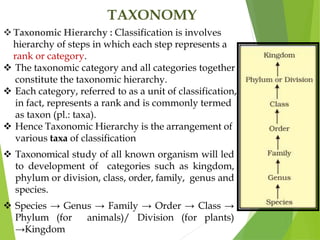
Taxonomic Hierarchy : Classification is involves
hierarchy of steps in which each step represents a
rank or category.
 The taxonomic category and all categories together
constitute the taxonomic hierarchy.
 Each category, referred to as a unit of classification,
in fact, represents a rank and is commonly termed
as taxon (pl.: taxa).
 Hence Taxonomic Hierarchy is the arrangement of
various taxa of classification
 Taxonomical study of all known organism will led
to development of categories such as kingdom,
phylum or division, class, order, family, genus and
species.
 Species → Genus → Family → Order → Class →
Phylum (for animals)/ Division (for plants)
→Kingdom
SPECIES
 Group of individuals having fundamental similarities and & which can
freely interbreed in nature are said to belong to same species.
Distinct morphological difference is there between two closely related
species
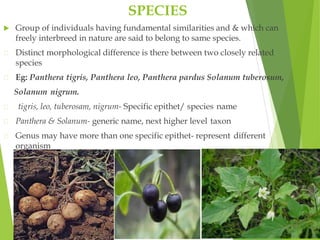
Eg: Panthera tigris, Panthera leo, Panthera pardus Solanum tuberosum,
Solanum nigrum.
tigris, leo, tuberosam, nigrum- Specific epithet/ species name
Panthera & Solanum- generic name, next higher level taxon
Genus may have more than one specific epithet- represent different
organism
GENUS
 Genus comprises a group of related species which has more
characters in common in comparison to species of other genera
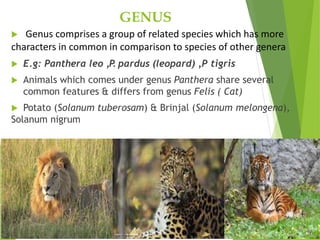
 E.g: Panthera leo ,P. pardus (leopard) ,P tigris
 Animals which comes under genus Panthera share several
common features & differs from genus Felis ( Cat)
 Potato (Solanum tuberosam) & Brinjal (Solanum melongena),
Solanum nigrum
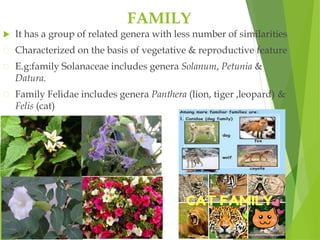
FAMILY
 It has a group of related genera with less number of similarities
Characterized on the basis of vegetative & reproductive feature
E.g:family Solanaceae includes genera Solanum, Petunia &
Datura.
Family Felidae includes genera Panthera (lion, tiger ,leopard) &
Felis (cat)
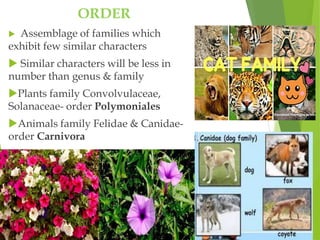
ORDER
 Assemblage of families which
exhibit few similar characters
 Similar characters will be less in
number than genus & family
Plants family Convolvulaceae,
Solanaceae- order Polymoniales
Animals family Felidae & Canidae-
order Carnivora
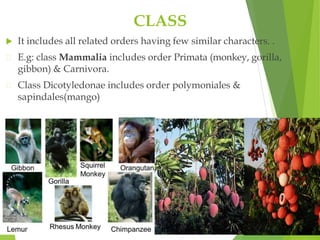
CLASS
 It includes all related orders having few similar characters. .
E.g: class Mammalia includes order Primata (monkey, gorilla,
gibbon) & Carnivora.
Class Dicotyledonae includes order polymoniales &
sapindales(mango)
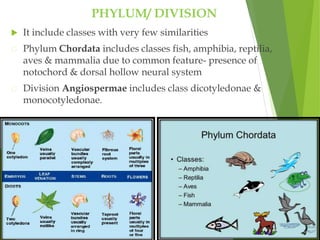
PHYLUM/ DIVISION
 It include classes with very few similarities
Phylum Chordata includes classes fish, amphibia, reptilia,
aves & mammalia due to common feature- presence of
notochord & dorsal hollow neural system
Division Angiospermae includes class dicotyledonae &
monocotyledonae.
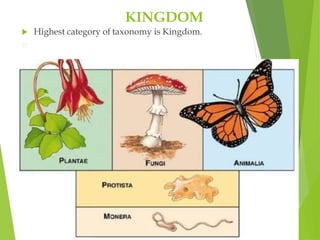
KINGDOM
 Highest category of taxonomy is Kingdom.
TAXONOMIC AIDS
 Taxonomic studies of various species of plants, animals and
other organisms- know bio- resources & diversity
 Studies require correct classification & identification-
collection of actual specimen of plants & animals
 Fundamental to studies & essential for training in
systematics
 Specimens are gathered, stored/ preserved with
information for future studies
Taxonomical aids are,
 Herbarium
 Botanical Garden
 Museum
 Zoological Park
HERBARIUM
 Herbarium is a store house of collected plant specimens that are dried,
pressed and preserved on sheets.
 Specimens- description on herbarium sheet, label of date & place of
collection, English, local & botanical name, family & collector name
 Quick referral system for taxonomic
studies BOTANICAL GARDEN
 Specialized garden having collection of living specimen
 Plants grown for identification purpose
 Plant is labelled with botanical/scientific name &
family MUSEUM
 Museums have collections of preserved plant and animal specimens-
study & reference
 Set up in educational institutes
 Specimen preserved in containers & jars in preservative solutions
 Plants & animals- dry specimens, insects- insect boxes after collecting,
killing & pinning, Large animals- stuffed & preserved
 Skeletons of animals
ZOOLOGICAL PARK
 Zoological Parks are the places where wild animals are
kept in protected under human care.
 Learn food habits & behavior
 Conditions are provided as animals natural habitat
KEY
 Key is another taxonomical aid used for identification of
plants and animals based on the similarities and
dissimilarities.
 Based on contrasting character, generally in pair- couplet
 Represent choice between two opposite options- accepting
one & rejecting another
 Each statement- lead
 Separate taxonomic keys- each taxonomic category like family,
genus & species- identification purpose
 Analytical in nature
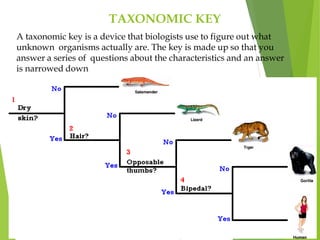
TAXONOMIC KEY
A taxonomic key is a device that biologists use to figure out what
unknown organisms actually are. The key is made up so that you
answer a series of questions about the characteristics and an answer
is narrowed down
The living world Class XI

The living world Class XI

  • 1.
    Unit 1 Diversity inthe living world THE LIVING WORLD Chapter-1 Prepared By- Anita Mishra, Birla Balika Vidyapeeth, Pilani
  • 2.
    Characteristics of livingorganism  Cellular Organization  Metabolism  Growth  Reproduction  Consciousness/ Response to stimuli
  • 3.
    CELLULAR ORGANIZATION Cellular organisationof the body is the defining feature of life forms. The organisms are of 2 kinds based on the no. of cells they have- Unicellular- In unicellular organisms the division of labour is at the level of organelles. Multicellular- In multicellular organisms the division of labour is at organ & organ system level. Organisms are of 2 kinds based on the complexity of their cells- Prokaryotic- Genetic material is not bound by membrane & no membrane bound cell organelles found. Eukaryotic- Genetic material is bound by membrane hence well defined nucleus & membrane bound cell organelles found.
  • 4.
    METABOLISM  All organismare made of Biochemicals- of different sizes- macro/ micro-molecules.  The Biomolecules, which are made & converted to other molecules through Biochemical reactions called Metabolism  Metabolism is the Sum total of all chemical reactions- Metabolism  Non- living- no metabolism  Metabolic reactions- demonstrated outside the body in cell free system (test tube/ in vitro) is neither living nor non living Metabolism is of 2 types- Anabolism/ Constructive process of formation of complex molecules from simpler molecules. Catabolism/ Destructive process of Breakdown of complex molecules to simpler molecules.  Ex- Photosynthesis (Anabolism), Cellular respiration (Catabolism)
  • 5.
    GROWTH  All livingorganisms show growth either by multiplication or by increase in size. It is an irreversible increase in mass of individual. Cell division leads to increase in size & No. Plants- Growth is indeterminate & in animals is determinate. Division of cells leads to repair of lost cells. Unicellular- division to increase in number of organisms Growth- increase in body mass & size in multicellular organisms Non- living- grow with accumulation of materialon surface, Eg- Mountains, Boulders, Sand mounds Growth of living organisms is from within the body not like non living things by accretion.
  • 6.
    REPRODUCTION  Organism reproduceto produce progeny of their own kind to continue their race.  The organisms reproduce by- Asexual & Sexual Reproduction  Asexual Reproduction- In Fungi- Sporulation Yeast & Hydra- Budding Planaria & Fungi, Algae & mosses- Fragmentation Amoeba – Binary fission In unicellular organisms Growth & reproduction are synonyms.  Organisms like Mules, worker bees, infertile human couple can’t reproduce but are living so reproduction cannot be sole feature for living things.
  • 7.
    CONSCIOUSNESS/ RESPONSE TOSTIMULI  Living organism- sense their surroundings or environment stimuli (physical, chemical or biological) this is called Consciousness.  Organism perceive stimuli/ changes in surrounding through sense organs  Plants respond to light, water, temperature, organism, pollutants as stimuli  Photoperiod influence reproduction- seasonal breeders (plants & animals)  Human- aware of himself, i.e., self- consciousness
  • 8.
    DIVERSITY OF LIVINGWORLD  Biodiversity : Biodiversity refers to the variety of living species on Earth, including plants, animals, bacteria, and fungi.  Number of species known- 1.7- 1.8 million  Need for classification : For convenience of study of the wide biodiversity the organisms need to be classified into categories. The study of General features of the categories makes it convenient to be named, remembered, studied and understood.  Nomenclature- Need to standardize naming organism, so that organism is named by same name all over world/ Universal naming.  The process of giving universal scientific name to all known organisms is called nomenclature  Identification- nomenclature or naming is only possible when the organism is described correctly and we know to what organism the name is attached to. This is identification
  • 9.
    DIVERSITY OF LIVINGWORLD  Plants Nomenclature - based on principles & criteria of ICBN (International Code for Botanical Nomenclature)  Animals Nomenclature- ICZN (International Code of Zoological Nomenclature)  Scientific names ensure that each organism has only one name.  Binomial nomenclature was first introduced by Carolus Linnaeus (Father of Taxonomy/ Classification). He published the book ‘Systema Naturae’.  The scientific naming of an organism using two words- Binomial nomenclature.  Each name two components- Generic name & Specific epithet/ Species name.
  • 10.
    1. Biological Namesare generally Latin & written in italics 2. First word represents genus & second word denotes specific epithet 3. Both word of biological name should be underlined separately when hand written & italics if printed 4. First word denoting genus start with capital letter & specific epithet or species name should start with small letter. RULES FOR NOMENCLATURE
  • 11.
    TAXONOMY  Classification isbased on characteristics of external & internal structure, cell structure, development, ecological information- basis for modern taxonomy  Human being is interested to know different organism & diversity along with their relationship with others- Systematics  Systematics : It deals with classification of organisms based on their diversities and relationships among them. The word systematics is derived from the Latin word ‘systema’ which means systematic arrangement of organisms. The scope of systematics was later enlarged to include identification, nomenclature and classification. Systematics takes into account evolutionary relationships between organisms.
  • 12.
    TAXONOMY Taxonomic Hierarchy :Classification is involves hierarchy of steps in which each step represents a rank or category.  The taxonomic category and all categories together constitute the taxonomic hierarchy.  Each category, referred to as a unit of classification, in fact, represents a rank and is commonly termed as taxon (pl.: taxa).  Hence Taxonomic Hierarchy is the arrangement of various taxa of classification  Taxonomical study of all known organism will led to development of categories such as kingdom, phylum or division, class, order, family, genus and species.  Species → Genus → Family → Order → Class → Phylum (for animals)/ Division (for plants) →Kingdom
  • 13.
    SPECIES  Group ofindividuals having fundamental similarities and & which can freely interbreed in nature are said to belong to same species. Distinct morphological difference is there between two closely related species Eg: Panthera tigris, Panthera leo, Panthera pardus Solanum tuberosum, Solanum nigrum. tigris, leo, tuberosam, nigrum- Specific epithet/ species name Panthera & Solanum- generic name, next higher level taxon Genus may have more than one specific epithet- represent different organism
  • 14.
    GENUS  Genus comprisesa group of related species which has more characters in common in comparison to species of other genera  E.g: Panthera leo ,P. pardus (leopard) ,P tigris  Animals which comes under genus Panthera share several common features & differs from genus Felis ( Cat)  Potato (Solanum tuberosam) & Brinjal (Solanum melongena), Solanum nigrum
  • 15.
    FAMILY  It hasa group of related genera with less number of similarities Characterized on the basis of vegetative & reproductive feature E.g:family Solanaceae includes genera Solanum, Petunia & Datura. Family Felidae includes genera Panthera (lion, tiger ,leopard) & Felis (cat)
  • 16.
    ORDER  Assemblage offamilies which exhibit few similar characters  Similar characters will be less in number than genus & family Plants family Convolvulaceae, Solanaceae- order Polymoniales Animals family Felidae & Canidae- order Carnivora
  • 17.
    CLASS  It includesall related orders having few similar characters. . E.g: class Mammalia includes order Primata (monkey, gorilla, gibbon) & Carnivora. Class Dicotyledonae includes order polymoniales & sapindales(mango)
  • 18.
    PHYLUM/ DIVISION  Itinclude classes with very few similarities Phylum Chordata includes classes fish, amphibia, reptilia, aves & mammalia due to common feature- presence of notochord & dorsal hollow neural system Division Angiospermae includes class dicotyledonae & monocotyledonae.
  • 19.
    KINGDOM  Highest categoryof taxonomy is Kingdom.
  • 20.
    TAXONOMIC AIDS  Taxonomicstudies of various species of plants, animals and other organisms- know bio- resources & diversity  Studies require correct classification & identification- collection of actual specimen of plants & animals  Fundamental to studies & essential for training in systematics  Specimens are gathered, stored/ preserved with information for future studies Taxonomical aids are,  Herbarium  Botanical Garden  Museum  Zoological Park
  • 21.
    HERBARIUM  Herbarium isa store house of collected plant specimens that are dried, pressed and preserved on sheets.  Specimens- description on herbarium sheet, label of date & place of collection, English, local & botanical name, family & collector name  Quick referral system for taxonomic studies BOTANICAL GARDEN  Specialized garden having collection of living specimen  Plants grown for identification purpose  Plant is labelled with botanical/scientific name & family MUSEUM  Museums have collections of preserved plant and animal specimens- study & reference  Set up in educational institutes  Specimen preserved in containers & jars in preservative solutions  Plants & animals- dry specimens, insects- insect boxes after collecting, killing & pinning, Large animals- stuffed & preserved  Skeletons of animals
  • 22.
    ZOOLOGICAL PARK  ZoologicalParks are the places where wild animals are kept in protected under human care.  Learn food habits & behavior  Conditions are provided as animals natural habitat KEY  Key is another taxonomical aid used for identification of plants and animals based on the similarities and dissimilarities.  Based on contrasting character, generally in pair- couplet  Represent choice between two opposite options- accepting one & rejecting another  Each statement- lead  Separate taxonomic keys- each taxonomic category like family, genus & species- identification purpose  Analytical in nature
  • 23.
    TAXONOMIC KEY A taxonomickey is a device that biologists use to figure out what unknown organisms actually are. The key is made up so that you answer a series of questions about the characteristics and an answer is narrowed down