RALLI INTERNATIONAL SCHOOL
Living
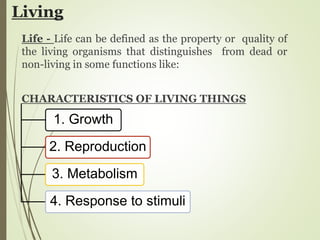
Life - Life can be defined as the property or quality of
the living organisms that distinguishes from dead or
non-living in some functions like:
CHARACTERISTICS OF LIVING THINGS
1. Growth
2. Reproduction
3. Metabolism
4. Response to stimuli
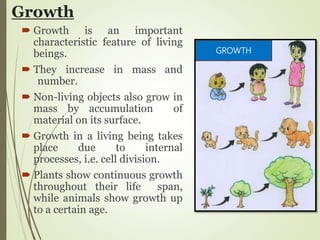
Growth
 Growth is an important
characteristic feature of living
beings.
 They increase in mass and
number.
 Non-living objects also grow in
mass by accumulation of
material on its surface.
 Growth in a living being takes
place due to internal
processes, i.e. cell division.
 Plants show continuous growth
throughout their life span,
while animals show growth up
to a certain age.
GROWTH
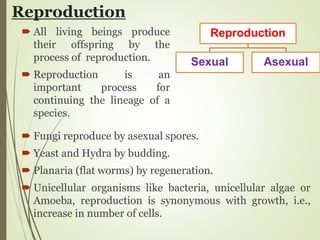
Reproduction
 All living beings produce
their offspring by the
process of reproduction.
 Reproduction is an
important process for
continuing the lineage of a
species.
Reproduction
Sexual Asexual
 Fungi reproduce by asexual spores.
 Yeast and Hydra by budding.
 Planaria (flat worms) by regeneration.
 Unicellular organisms like bacteria, unicellular algae or
Amoeba, reproduction is synonymous with growth, i.e.,
increase in number of cells.
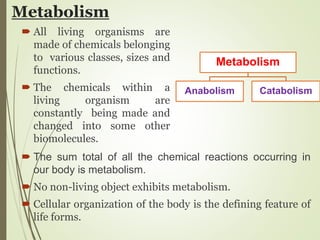
Metabolism
 All living organisms are
made of chemicals belonging
to various classes, sizes and
functions.
 The chemicals within a
living organism are
constantly being made and
changed into some other
biomolecules.
 The sum total of all the chemical reactions occurring in
our body is metabolism.
 No non-living object exhibits metabolism.
 Cellular organization of the body is the defining feature of
life forms.
Metabolism
Anabolism Catabolism
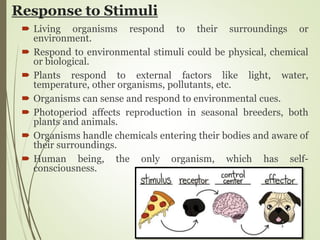
Response to Stimuli
 Living organisms respond to their surroundings or
environment.
 Respond to environmental stimuli could be physical, chemical
or biological.
 Plants respond to external factors like light, water,
temperature, other organisms, pollutants, etc.
 Organisms can sense and respond to environmental cues.
 Photoperiod affects reproduction in seasonal breeders, both
plants and animals.
 Organisms handle chemicals entering their bodies and aware of
their surroundings.
 Human being, the only organism, which has self-
consciousness.
Diversity In The Living World
Biodiversity
 The diverse form of organisms present on earth is called
biodiversity.
 The number of species that are known and described
range between 1.7-1.8 million.
Nomenclature
 It is a system of naming of organisms.
 There are millions of plants and animals in the world.
 Plants and animals are known in the local area by their
local names. These local names are vary from place to
place, region to region and within a country also.
 So, it is impossible for any person to remember the names
of an organism in all the languages.
 Hence, there is need for a uniform system
(standardization) of nomenclature of organisms.
Nomenclature
 Identification - Identification is the process of assigning a
pre-existing taxon name to an individual organism.
 ICBN - International Code for Botanical Nomenclature
 ICZN - International Code for Zoological Nomenclature
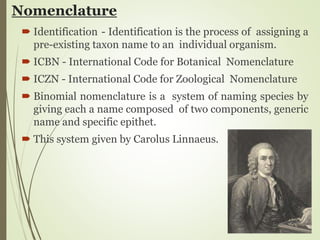
 Binomial nomenclature is a system of naming species by
giving each a name composed of two components, generic
name and specific epithet.
 This system given by Carolus Linnaeus.
Rules for Nomenclature
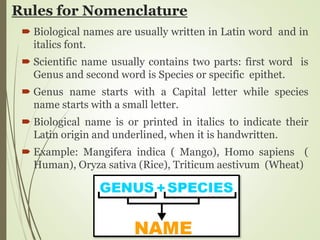
 Biological names are usually written in Latin word and in
italics font.
 Scientific name usually contains two parts: first word is
Genus and second word is Species or specific epithet.
 Genus name starts with a Capital letter while species
name starts with a small letter.
 Biological name is or printed in italics to indicate their
Latin origin and underlined, when it is handwritten.
 Example: Mangifera indica ( Mango), Homo sapiens (
Human), Oryza sativa (Rice), Triticum aestivum (Wheat)
Rules for Nomenclature
 Classification – It is nearly impossible to study all the living
organisms, it is necessary to devise some means to make this
possible. It is the process of grouping of organisms into
categories based on easily observable characters.
 Taxon - The scientific term for any unit used in the science of
biological classification is called taxon.
 Taxonomy - Taxonomy is the science of defining groups of
biological organisms on the basis of shared characteristics and
giving names to those groups.
 Carolus Linnaeus is regarded as the father of taxonomy.
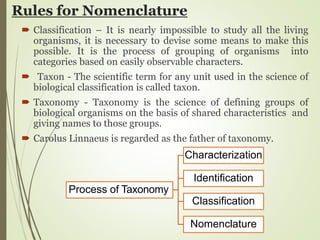
Process of Taxonomy
Characterization
Identification
Classification
Nomenclature
Systematics
 The word systematics is derived from the Latin word
‘systema’ means systematic arrangement of organisms.
 Systematics is the study of the diversification of living
forms, both past and present, and the relationships
among living things through time.
 Linnaeus used Systema Naturae as the title of his
publication
 Taxonomic Hierarchy : It is the arrangement of
various taxa of classification
 Taxonomical study of all known organism will led to
development of categories such as kingdom, phylum or
division, class, order, family, genus and species
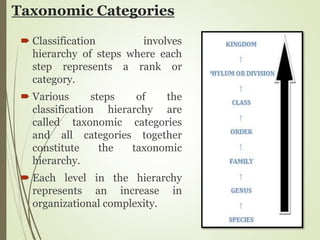
 Species → Genus → Family → Order → Class →
Phylum (for animals)/ Division (for plants)
→Kingdom
Taxonomic Categories
 Classification involves
hierarchy of steps where each
step represents a rank or
category.
 Various steps of the
classification hierarchy are
called taxonomic categories
and all categories together
constitute the taxonomic
hierarchy.
 Each level in the hierarchy
represents an increase in
organizational complexity.
Species
 Group of individuals having fundamental similarities and
successful reproduction takes place among themselves.
 Members of a species have a large number of similar
characters.
 Distinct morphological difference is there between two
closely related species
 Eg: Panthera tigris, Panthera leo, Solanum tuberosum,
Solanum nigrum.
 tigris, leo, tuberosam, nigrum- Specific epithet/ species
name
 Panthera & Solanum- generic name, next higher level
taxon
Genus
 Genus comprises a group of related species which has
more characters in common in comparison to species of
other genera.
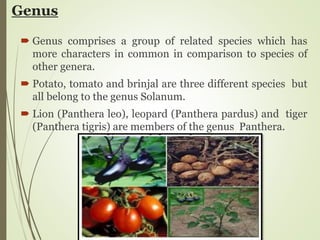
 Potato, tomato and brinjal are three different species but
all belong to the genus Solanum.
 Lion (Panthera leo), leopard (Panthera pardus) and tiger
(Panthera tigris) are members of the genus Panthera.
Family
 It has a group of related
genera with less number
of similarities
 Characterized on the
basis of vegetative &
reproductive feature
 E.g:family Solanaceae
includes genera
Solanum, Petunia &
Datura.
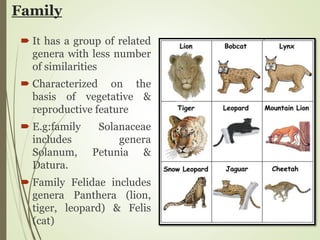
 Family Felidae includes
genera Panthera (lion,
tiger, leopard) & Felis
(cat)
Order
 A group of closely related
families is called order.
 Assemblage of families
which exhibit few similar
characters
 Order and other higher
taxonomic categories are
identified based on the
aggregates of characters.
 Plant families like
Convolvulaceae, Solanaceae
are included in the order
Polymoniales.
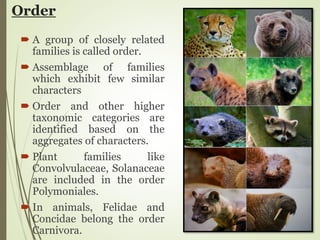
 In animals, Felidae and
Concidae belong the order
Carnivora.
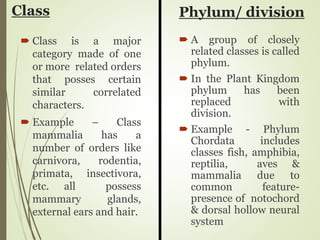
Class
 Class is a major
category made of one
or more related orders
that posses certain
similar correlated
characters.
 Example – Class
mammalia has a
number of orders like
carnivora, rodentia,
primata, insectivora,
etc. all possess
mammary glands,
external ears and hair.
Phylum/ division
 A group of closely
related classes is called
phylum.
 In the Plant Kingdom
phylum has been
replaced with
division.
 Example - Phylum
Chordata includes
classes fish, amphibia,
reptilia, aves &
mammalia due to
common feature-
presence of notochord
& dorsal hollow neural
system
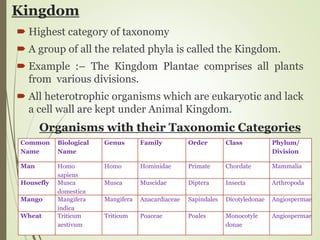
Kingdom
 Highest category of taxonomy
 A group of all the related phyla is called the Kingdom.
 Example :– The Kingdom Plantae comprises all plants
from various divisions.
 All heterotrophic organisms which are eukaryotic and lack
a cell wall are kept under Animal Kingdom.
Common
Name
Biological
Name
Genus Family Order Class Phylum/
Division
Man Homo
sapiens
Homo Hominidae Primate Chordate Mammalia
Housefly Musca
domestica
Musca Muscidae Diptera Insecta Arthropoda
Mango Mangifera
indica
Mangifera Anacardiaceae Sapindales Dicotyledonae Angiospermae
Wheat Triticum
aestivum
Triticum Poaceae Poales Monocotyle
donae
Angiospermae
Organisms with their Taxonomic Categories
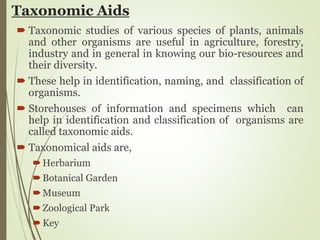
Taxonomic Aids
 Taxonomic studies of various species of plants, animals
and other organisms are useful in agriculture, forestry,
industry and in general in knowing our bio-resources and
their diversity.
 These help in identification, naming, and classification of
organisms.
 Storehouses of information and specimens which can
help in identification and classification of organisms are
called taxonomic aids.
 Taxonomical aids are,
Herbarium
Botanical Garden
Museum
Zoological Park
Key
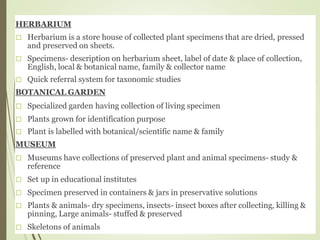
HERBARIUM
Herbarium is a store house of collected plant specimens that are dried, pressed
and preserved on sheets.
Specimens- description on herbarium sheet, label of date & place of collection,
English, local & botanical name, family & collector name
Quick referral system for taxonomic studies
BOTANICAL GARDEN
Specialized garden having collection of living specimen
Plants grown for identification purpose
Plant is labelled with botanical/scientific name & family
MUSEUM
Museums have collections of preserved plant and animal specimens- study &
reference
Set up in educational institutes
Specimen preserved in containers & jars in preservative solutions
Plants & animals- dry specimens, insects- insect boxes after collecting, killing &
pinning, Large animals- stuffed & preserved
Skeletons of animals
ZOOLOGICAL PARK
Zoological Parks are the places where wild animals are kept in protected
under human care.
Learn food habits & behavior
Conditions are provided as animals natural habitat
KEY
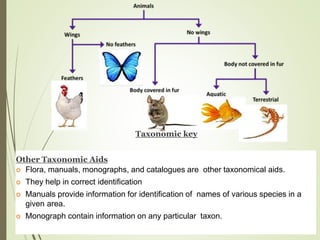
Key is another taxonomical aid used for identification of plants and animals
based on the similarities and dissimilarities.
Based on contrasting character, generally in pair- couplet
Represent choice between two opposite options- accepting one & rejecting
another
Each statement- lead
Separate taxonomic keys- each taxonomic category like family, genus & species-
identification purpose
Analytical in nature
Other Taxonomic Aids
 Flora, manuals, monographs, and catalogues are other taxonomical aids.
 They help in correct identification
 Manuals provide information for identification of names of various species in a
given area.
 Monograph contain information on any particular taxon.
Taxonomic key

Class xi ch 1

  • 1.
  • 3.
    Living Life - Lifecan be defined as the property or quality of the living organisms that distinguishes from dead or non-living in some functions like: CHARACTERISTICS OF LIVING THINGS 1. Growth 2. Reproduction 3. Metabolism 4. Response to stimuli
  • 4.
    Growth  Growth isan important characteristic feature of living beings.  They increase in mass and number.  Non-living objects also grow in mass by accumulation of material on its surface.  Growth in a living being takes place due to internal processes, i.e. cell division.  Plants show continuous growth throughout their life span, while animals show growth up to a certain age. GROWTH
  • 5.
    Reproduction  All livingbeings produce their offspring by the process of reproduction.  Reproduction is an important process for continuing the lineage of a species. Reproduction Sexual Asexual  Fungi reproduce by asexual spores.  Yeast and Hydra by budding.  Planaria (flat worms) by regeneration.  Unicellular organisms like bacteria, unicellular algae or Amoeba, reproduction is synonymous with growth, i.e., increase in number of cells.
  • 6.
    Metabolism  All livingorganisms are made of chemicals belonging to various classes, sizes and functions.  The chemicals within a living organism are constantly being made and changed into some other biomolecules.  The sum total of all the chemical reactions occurring in our body is metabolism.  No non-living object exhibits metabolism.  Cellular organization of the body is the defining feature of life forms. Metabolism Anabolism Catabolism
  • 7.
    Response to Stimuli Living organisms respond to their surroundings or environment.  Respond to environmental stimuli could be physical, chemical or biological.  Plants respond to external factors like light, water, temperature, other organisms, pollutants, etc.  Organisms can sense and respond to environmental cues.  Photoperiod affects reproduction in seasonal breeders, both plants and animals.  Organisms handle chemicals entering their bodies and aware of their surroundings.  Human being, the only organism, which has self- consciousness.
  • 8.
    Diversity In TheLiving World Biodiversity  The diverse form of organisms present on earth is called biodiversity.  The number of species that are known and described range between 1.7-1.8 million. Nomenclature  It is a system of naming of organisms.  There are millions of plants and animals in the world.  Plants and animals are known in the local area by their local names. These local names are vary from place to place, region to region and within a country also.  So, it is impossible for any person to remember the names of an organism in all the languages.  Hence, there is need for a uniform system (standardization) of nomenclature of organisms.
  • 9.
    Nomenclature  Identification -Identification is the process of assigning a pre-existing taxon name to an individual organism.  ICBN - International Code for Botanical Nomenclature  ICZN - International Code for Zoological Nomenclature  Binomial nomenclature is a system of naming species by giving each a name composed of two components, generic name and specific epithet.  This system given by Carolus Linnaeus.
  • 10.
    Rules for Nomenclature Biological names are usually written in Latin word and in italics font.  Scientific name usually contains two parts: first word is Genus and second word is Species or specific epithet.  Genus name starts with a Capital letter while species name starts with a small letter.  Biological name is or printed in italics to indicate their Latin origin and underlined, when it is handwritten.  Example: Mangifera indica ( Mango), Homo sapiens ( Human), Oryza sativa (Rice), Triticum aestivum (Wheat)
  • 11.
    Rules for Nomenclature Classification – It is nearly impossible to study all the living organisms, it is necessary to devise some means to make this possible. It is the process of grouping of organisms into categories based on easily observable characters.  Taxon - The scientific term for any unit used in the science of biological classification is called taxon.  Taxonomy - Taxonomy is the science of defining groups of biological organisms on the basis of shared characteristics and giving names to those groups.  Carolus Linnaeus is regarded as the father of taxonomy. Process of Taxonomy Characterization Identification Classification Nomenclature
  • 12.
    Systematics  The wordsystematics is derived from the Latin word ‘systema’ means systematic arrangement of organisms.  Systematics is the study of the diversification of living forms, both past and present, and the relationships among living things through time.  Linnaeus used Systema Naturae as the title of his publication  Taxonomic Hierarchy : It is the arrangement of various taxa of classification  Taxonomical study of all known organism will led to development of categories such as kingdom, phylum or division, class, order, family, genus and species  Species → Genus → Family → Order → Class → Phylum (for animals)/ Division (for plants) →Kingdom
  • 13.
    Taxonomic Categories  Classificationinvolves hierarchy of steps where each step represents a rank or category.  Various steps of the classification hierarchy are called taxonomic categories and all categories together constitute the taxonomic hierarchy.  Each level in the hierarchy represents an increase in organizational complexity.
  • 14.
    Species  Group ofindividuals having fundamental similarities and successful reproduction takes place among themselves.  Members of a species have a large number of similar characters.  Distinct morphological difference is there between two closely related species  Eg: Panthera tigris, Panthera leo, Solanum tuberosum, Solanum nigrum.  tigris, leo, tuberosam, nigrum- Specific epithet/ species name  Panthera & Solanum- generic name, next higher level taxon
  • 15.
    Genus  Genus comprisesa group of related species which has more characters in common in comparison to species of other genera.  Potato, tomato and brinjal are three different species but all belong to the genus Solanum.  Lion (Panthera leo), leopard (Panthera pardus) and tiger (Panthera tigris) are members of the genus Panthera.
  • 16.
    Family  It hasa group of related genera with less number of similarities  Characterized on the basis of vegetative & reproductive feature  E.g:family Solanaceae includes genera Solanum, Petunia & Datura.  Family Felidae includes genera Panthera (lion, tiger, leopard) & Felis (cat)
  • 17.
    Order  A groupof closely related families is called order.  Assemblage of families which exhibit few similar characters  Order and other higher taxonomic categories are identified based on the aggregates of characters.  Plant families like Convolvulaceae, Solanaceae are included in the order Polymoniales.  In animals, Felidae and Concidae belong the order Carnivora.
  • 18.
    Class  Class isa major category made of one or more related orders that posses certain similar correlated characters.  Example – Class mammalia has a number of orders like carnivora, rodentia, primata, insectivora, etc. all possess mammary glands, external ears and hair. Phylum/ division  A group of closely related classes is called phylum.  In the Plant Kingdom phylum has been replaced with division.  Example - Phylum Chordata includes classes fish, amphibia, reptilia, aves & mammalia due to common feature- presence of notochord & dorsal hollow neural system
  • 19.
    Kingdom  Highest categoryof taxonomy  A group of all the related phyla is called the Kingdom.  Example :– The Kingdom Plantae comprises all plants from various divisions.  All heterotrophic organisms which are eukaryotic and lack a cell wall are kept under Animal Kingdom. Common Name Biological Name Genus Family Order Class Phylum/ Division Man Homo sapiens Homo Hominidae Primate Chordate Mammalia Housefly Musca domestica Musca Muscidae Diptera Insecta Arthropoda Mango Mangifera indica Mangifera Anacardiaceae Sapindales Dicotyledonae Angiospermae Wheat Triticum aestivum Triticum Poaceae Poales Monocotyle donae Angiospermae Organisms with their Taxonomic Categories
  • 20.
    Taxonomic Aids  Taxonomicstudies of various species of plants, animals and other organisms are useful in agriculture, forestry, industry and in general in knowing our bio-resources and their diversity.  These help in identification, naming, and classification of organisms.  Storehouses of information and specimens which can help in identification and classification of organisms are called taxonomic aids.  Taxonomical aids are, Herbarium Botanical Garden Museum Zoological Park Key
  • 21.
    HERBARIUM Herbarium is astore house of collected plant specimens that are dried, pressed and preserved on sheets. Specimens- description on herbarium sheet, label of date & place of collection, English, local & botanical name, family & collector name Quick referral system for taxonomic studies BOTANICAL GARDEN Specialized garden having collection of living specimen Plants grown for identification purpose Plant is labelled with botanical/scientific name & family MUSEUM Museums have collections of preserved plant and animal specimens- study & reference Set up in educational institutes Specimen preserved in containers & jars in preservative solutions Plants & animals- dry specimens, insects- insect boxes after collecting, killing & pinning, Large animals- stuffed & preserved Skeletons of animals
  • 22.
    ZOOLOGICAL PARK Zoological Parksare the places where wild animals are kept in protected under human care. Learn food habits & behavior Conditions are provided as animals natural habitat KEY Key is another taxonomical aid used for identification of plants and animals based on the similarities and dissimilarities. Based on contrasting character, generally in pair- couplet Represent choice between two opposite options- accepting one & rejecting another Each statement- lead Separate taxonomic keys- each taxonomic category like family, genus & species- identification purpose Analytical in nature
  • 23.
    Other Taxonomic Aids Flora, manuals, monographs, and catalogues are other taxonomical aids.  They help in correct identification  Manuals provide information for identification of names of various species in a given area.  Monograph contain information on any particular taxon. Taxonomic key