Unit 1
Diversity in the
living world
Characteristics of
living organism
Growth
Reproduction
Metabolism
Cellular
Organization
Consciousness
Grow
th
Increase in mass & number
Cell division
Plants- division occurs continuously & Animals-
certain age
Division also enables to replace lost cells
Unicellular- division to increase in number
Growth- increase in body mass
Non- living- grow with accumulation of material on
surface, Eg- Mountains, Boulders, Sand mounds
Growth cannot be defining property- living
organism
Conditions when it is observed in living organism when
explained- characteristics of living
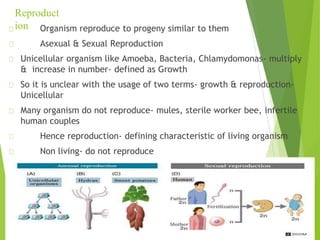
Reproduct
ion Organism reproduce to progeny similar to them
Asexual & Sexual Reproduction
Unicellular organism like Amoeba, Bacteria, Chlamydomonas- multiply
& increase in number- defined as Growth
So it is unclear with the usage of two terms- growth & reproduction-
Unicellular
Many organism do not reproduce- mules, sterile worker bee, infertile
human couples
Hence reproduction- defining characteristic of living organism
Non living- do not reproduce
Metaboli
sm
All organism are made of chemicals- small & big
Chemicals- Biomolecules, which are made & changed to other
molecules
Conversion reactions of these molecules- Metabolic
reactions
Sum total of all chemical reactions- Metabolism
Non- living- no metabolism
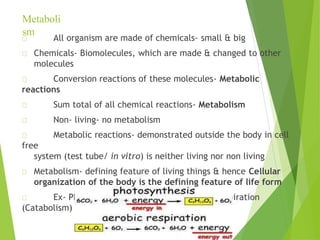
Metabolic reactions- demonstrated outside the body in cell
free
system (test tube/ in vitro) is neither living nor non living
Metabolism- defining feature of living things & hence Cellular
organization of the body is the defining feature of life form
Ex- Photosynthesis (Anabolism), Cellular respiration
(Catabolism)
conscious
ness
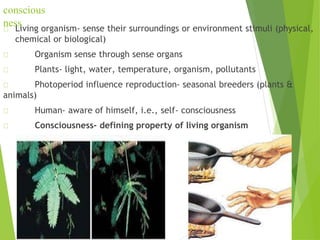
Living organism- sense their surroundings or environment stimuli (physical,
chemical or biological)
Organism sense through sense organs
Plants- light, water, temperature, organism, pollutants
Photoperiod influence reproduction- seasonal breeders (plants &
animals)
Human- aware of himself, i.e., self- consciousness
Consciousness- defining property of living organism
Diversity of
living world
Biodiversity : Term used to refer to the number of varieties of
plant and animals in region on earth.
Number of species known- 1.7- 1.8 million
Need for classification : living organisms are classified into categories
so that they could be named, remembered, studied and understood.
Need to standardize naming organism, so organism named same in all
over world- Nomenclature
Nomenclature- scientific name to all known organism
Plants- based on principles & criteria of ICBN (International Code for
Botanical Nomenclature)
Animals- ICZN (International Code of Zoological Nomenclature)
Scientific names ensure that each organism has only one name
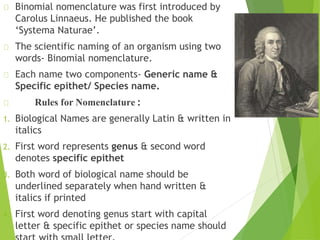
Binomial nomenclature was first introduced by
Carolus Linnaeus. He published the book
‘Systema Naturae’.
The scientific naming of an organism using two
words- Binomial nomenclature.
Each name two components- Generic name &
Specific epithet/ Species name.
Rules for Nomenclature :
1. Biological Names are generally Latin & written in
italics
2. First word represents genus & second word
denotes specific epithet
3. Both word of biological name should be
underlined separately when hand written &
italics if printed
4. First word denoting genus start with capital
letter & specific epithet or species name should
Taxono
my Process of classification based on characteristics of living
organism
External & internal structure, cell structure, development,
ecological information- basis of modern taxonomy
Human being is interested to know different organism & diversity
along with their relationship with others- Systematics
Systematics : It deals with classification of organisms based on their
diversities and relationships among them.
Taxonomic Hierarchy : It is the arrangement of various taxa of
classification
Taxonomical study of all known organism will led to development of
categories such as kingdom, phylum or division, class, order,
family, genus and species
Species → Genus → Family → Order → Class → Phylum (for
speci
es
Group of individuals having fundamental similarities and successful
reproduction takes place among themselves
Distinct morphological difference is there between two closely related
species
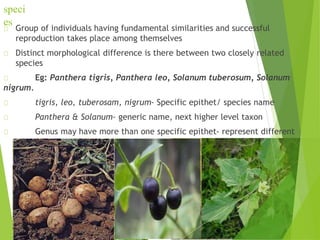
Eg: Panthera tigris, Panthera leo, Solanum tuberosum, Solanum
nigrum.
tigris, leo, tuberosam, nigrum- Specific epithet/ species name
Panthera & Solanum- generic name, next higher level taxon
Genus may have more than one specific epithet- represent different
organism
gen
us
Genera are aggregates of closely related species.
Group of related species with more characters in common
than species of other genera
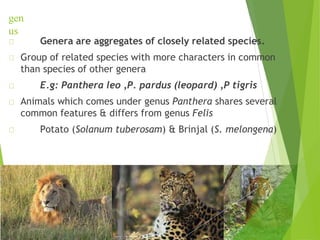
E.g: Panthera leo ,P. pardus (leopard) ,P tigris
Animals which comes under genus Panthera shares several
common features & differs from genus Felis
Potato (Solanum tuberosam) & Brinjal (S. melongena)
fami
ly It has a group of related genera with less number of
similarities
Characterized on the basis of vegetative & reproductive
feature
E.g:family Solanaceae includes genera Solanum, Petunia &
Datura.
Family Felidae includes genera Panthera (lion, tiger
,leopard) &
Felis (cat)
Order
Assemblage of families which exhibit few similar
characters
Similar characters will be less in number
Plants family Convolvulaceae, Solanaceae- order
cla
ss
It includes all related orders having few similar
characters. .
E.g: class Mammalia includes order Primata (monkey,
gorilla, gibbon) & Carnivora.
Class Dicotyledonae includes order polymoniales &
sapindales(mango)
Phylum/ division
It include classes with very few similarities
Phylum Chordata includes classes fish, amphibia,
reptilia, aves & mammalia due to common feature-
presence of notochord & dorsal hollow neural system
Division Angiospermae includes class dicotyledonae &
monocotyledonae.
kingdo
m Highest category of
taxonomy
Animals- Kingdom
Animalia
Plants- Kingdom Plantae

1. The Living World-converted pdf file -

  • 1.
    Unit 1 Diversity inthe living world
  • 2.
  • 3.
    Grow th Increase in mass& number Cell division Plants- division occurs continuously & Animals- certain age Division also enables to replace lost cells Unicellular- division to increase in number Growth- increase in body mass Non- living- grow with accumulation of material on surface, Eg- Mountains, Boulders, Sand mounds Growth cannot be defining property- living organism Conditions when it is observed in living organism when explained- characteristics of living
  • 4.
    Reproduct ion Organism reproduceto progeny similar to them Asexual & Sexual Reproduction Unicellular organism like Amoeba, Bacteria, Chlamydomonas- multiply & increase in number- defined as Growth So it is unclear with the usage of two terms- growth & reproduction- Unicellular Many organism do not reproduce- mules, sterile worker bee, infertile human couples Hence reproduction- defining characteristic of living organism Non living- do not reproduce
  • 5.
    Metaboli sm All organism aremade of chemicals- small & big Chemicals- Biomolecules, which are made & changed to other molecules Conversion reactions of these molecules- Metabolic reactions Sum total of all chemical reactions- Metabolism Non- living- no metabolism Metabolic reactions- demonstrated outside the body in cell free system (test tube/ in vitro) is neither living nor non living Metabolism- defining feature of living things & hence Cellular organization of the body is the defining feature of life form Ex- Photosynthesis (Anabolism), Cellular respiration (Catabolism)
  • 6.
    conscious ness Living organism- sensetheir surroundings or environment stimuli (physical, chemical or biological) Organism sense through sense organs Plants- light, water, temperature, organism, pollutants Photoperiod influence reproduction- seasonal breeders (plants & animals) Human- aware of himself, i.e., self- consciousness Consciousness- defining property of living organism
  • 7.
    Diversity of living world Biodiversity: Term used to refer to the number of varieties of plant and animals in region on earth. Number of species known- 1.7- 1.8 million Need for classification : living organisms are classified into categories so that they could be named, remembered, studied and understood. Need to standardize naming organism, so organism named same in all over world- Nomenclature Nomenclature- scientific name to all known organism Plants- based on principles & criteria of ICBN (International Code for Botanical Nomenclature) Animals- ICZN (International Code of Zoological Nomenclature) Scientific names ensure that each organism has only one name
  • 8.
    Binomial nomenclature wasfirst introduced by Carolus Linnaeus. He published the book ‘Systema Naturae’. The scientific naming of an organism using two words- Binomial nomenclature. Each name two components- Generic name & Specific epithet/ Species name. Rules for Nomenclature : 1. Biological Names are generally Latin & written in italics 2. First word represents genus & second word denotes specific epithet 3. Both word of biological name should be underlined separately when hand written & italics if printed 4. First word denoting genus start with capital letter & specific epithet or species name should
  • 9.
    Taxono my Process ofclassification based on characteristics of living organism External & internal structure, cell structure, development, ecological information- basis of modern taxonomy Human being is interested to know different organism & diversity along with their relationship with others- Systematics Systematics : It deals with classification of organisms based on their diversities and relationships among them. Taxonomic Hierarchy : It is the arrangement of various taxa of classification Taxonomical study of all known organism will led to development of categories such as kingdom, phylum or division, class, order, family, genus and species Species → Genus → Family → Order → Class → Phylum (for
  • 10.
    speci es Group of individualshaving fundamental similarities and successful reproduction takes place among themselves Distinct morphological difference is there between two closely related species Eg: Panthera tigris, Panthera leo, Solanum tuberosum, Solanum nigrum. tigris, leo, tuberosam, nigrum- Specific epithet/ species name Panthera & Solanum- generic name, next higher level taxon Genus may have more than one specific epithet- represent different organism
  • 11.
    gen us Genera are aggregatesof closely related species. Group of related species with more characters in common than species of other genera E.g: Panthera leo ,P. pardus (leopard) ,P tigris Animals which comes under genus Panthera shares several common features & differs from genus Felis Potato (Solanum tuberosam) & Brinjal (S. melongena)
  • 12.
    fami ly It hasa group of related genera with less number of similarities Characterized on the basis of vegetative & reproductive feature E.g:family Solanaceae includes genera Solanum, Petunia & Datura. Family Felidae includes genera Panthera (lion, tiger ,leopard) & Felis (cat) Order Assemblage of families which exhibit few similar characters Similar characters will be less in number Plants family Convolvulaceae, Solanaceae- order
  • 13.
    cla ss It includes allrelated orders having few similar characters. . E.g: class Mammalia includes order Primata (monkey, gorilla, gibbon) & Carnivora. Class Dicotyledonae includes order polymoniales & sapindales(mango) Phylum/ division It include classes with very few similarities Phylum Chordata includes classes fish, amphibia, reptilia, aves & mammalia due to common feature- presence of notochord & dorsal hollow neural system Division Angiospermae includes class dicotyledonae & monocotyledonae.
  • 14.
    kingdo m Highest categoryof taxonomy Animals- Kingdom Animalia Plants- Kingdom Plantae