

THE LIVING WORLD
BY Mr. Biswanath prusty
What is life?
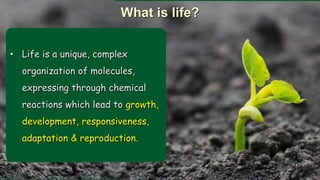
• Life is a unique, complex
organization of molecules,
expressing through chemical
reactions which lead to growth,
development, responsiveness,
adaptation & reproduction.
Growth
• It is irreversible increase in the mass & number of cells of living organisms.
• In plant it occurs by cell division and continuously through out life.
• In animal it is limited to a certain age only, but cell division occur in certain tissues to
replace old & worn out cell.
Reproduction
• It is production of progeny similar to their parents.
• In unicellular organism it occurs by cell division (usually mitosis).
• Reproduction may be sexual or asexual type.
Responsiveness or consciousness
• Living organism have the ability to sense their environment and respond to these
stimuli.
• Stimuli could be physical, chemical or biological like water, temp. , air and other
organism, chemical pollutants etc.
• Photoperiod affect reproduction in several seasonal breeders of animal and plants.
What is a Living organism?
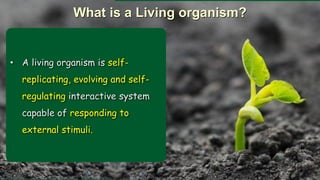
• A living organism is self-
replicating, evolving and self-
regulating interactive system
capable of responding to
external stimuli.
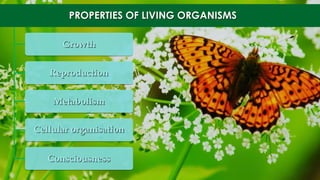
PROPERTIES OF LIVING ORGANISMS
Growth
Reproduction
Metabolism
Cellular organisation
Consciousness
Growth
Reproduction
Metabolism
Cellular organisation
Consciousness
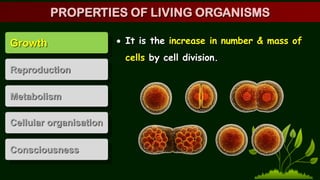
 It is the increase in number & mass of
cells by cell division.
PROPERTIES OF LIVING ORGANISMS
Growth
Reproduction
Metabolism
Cellular organisation
Consciousness
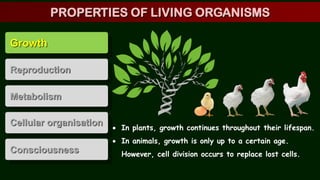
 In plants, growth continues throughout their lifespan.
 In animals, growth is only up to a certain age.
However, cell division occurs to replace lost cells.
PROPERTIES OF LIVING ORGANISMS
Growth
Reproduction
Metabolism
Cellular organisation
Consciousness
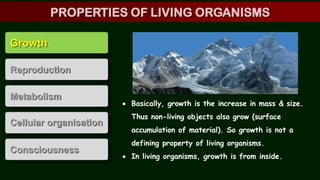
 Basically, growth is the increase in mass & size.
Thus non-living objects also grow (surface
accumulation of material). So growth is not a
defining property of living organisms.
 In living organisms, growth is from inside.
PROPERTIES OF LIVING ORGANISMS
Reproduction
Metabolism
Cellular organisation
Consciousness
Growth
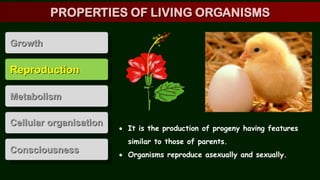
 It is the production of progeny having features
similar to those of parents.
 Organisms reproduce asexually and sexually.
PROPERTIES OF LIVING ORGANISMS
Reproduction
Metabolism
Cellular organisation
Consciousness
Growth
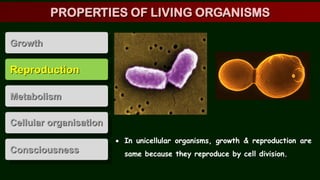
 In unicellular organisms, growth & reproduction are
same because they reproduce by cell division.
PROPERTIES OF LIVING ORGANISMS
Reproduction
Metabolism
Cellular organisation
Consciousness
Growth
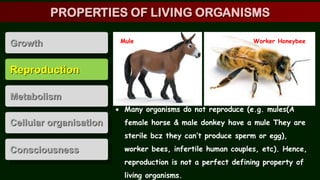
 Many organisms do not reproduce (e.g. mules(A
female horse & male donkey have a mule They are
sterile bcz they can’t produce sperm or egg),
worker bees, infertile human couples, etc). Hence,
reproduction is not a perfect defining property of
living organisms.
Mule Worker Honeybee
PROPERTIES OF LIVING ORGANISMS
Metabolism
Cellular organisation
Consciousness
Growth
Reproduction
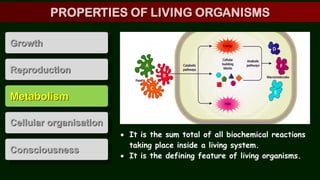
 It is the sum total of all biochemical reactions
taking place inside a living system.
 It is the defining feature of living organisms.
PROPERTIES OF LIVING ORGANISMS
Metabolism
Cellular organisation
Consciousness
Growth
Reproduction
 Metabolic reactions can be demonstrated outside
the body in cell-free systems.
 Isolated metabolic reactions in vitro are not living
things but are living reactions.
PROPERTIES OF LIVING ORGANISMS
Metabolism
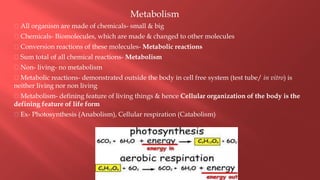
All organism are made of chemicals- small & big
Chemicals- Biomolecules, which are made & changed to other molecules
Conversion reactions of these molecules- Metabolic reactions
Sum total of all chemical reactions- Metabolism
Non- living- no metabolism
Metabolic reactions- demonstrated outside the body in cell free system (test tube/ in vitro) is
neither living nor non living
Metabolism- defining feature of living things & hence Cellular organization of the body is the
defining feature of life form
Ex- Photosynthesis (Anabolism), Cellular respiration (Catabolism)
consciousness
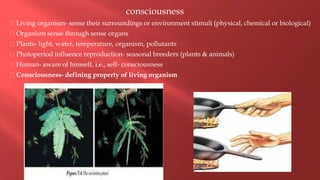
Living organism- sense their surroundings or environment stimuli (physical, chemical or biological)
Organism sense through sense organs
Plants- light, water, temperature, organism, pollutants
Photoperiod influence reproduction- seasonal breeders (plants & animals)
Human- aware of himself, i.e., self- consciousness
Consciousness- defining property of living organism
Diversity of living world
Biodiversity : Term used to refer to the number of varieties of plant
and animals in region on earth.
Number of species known- 1.7- 1.8 million
Need for classification : living organisms are classified into categories
so that they could be named, remembered, studied and understood.
Need to standardize naming organism, so organism named same in all
over world- Nomenclature
Nomenclature- scientific name to all known organism
Plants- based on principles & criteria of ICBN (International Code for
Botanical Nomenclature)
Animals- ICZN (International Code of Zoological Nomenclature)
Scientific names ensure that each organism has only one name
Binomial nomenclature was first introduced by Carolus Linnaeus. He
published the book
‘Systema Naturae’.
The scientific naming of an organism using two words- Binomial
nomenclature.
Each name two components- Generic name & Specific epithet/ Species
name.
Rules for Nomenclature :
1. Biological Names are generally Latin & written in italics
2. First word represents genus & second word denotes specific epithet
3. Both word of biological name should be
underlined separately when hand written &
italics if printed
4. First word denoting genus start with capital
letter & specific epithet or species name should
start with small letter.
Ex- Homo sapiens is the scientific name for human being.
Homo- genus sapiens- species
Taxonomy
Process of classification based on characteristics of living organism
External & internal structure, cell structure, development,
ecological information- basis of modern taxonomy
Human being is interested to know different organism & diversity
along with their relationship with others- Systematics
Systematics : It deals with classification of organisms based on their
diversities and relationships among them.
Taxonomic Hierarchy : It is the arrangement of various taxa of
classification
Taxonomical study of all known organism will led to development of
categories such as kingdom, phylum or division, class, order, family,
genus and species
Species → Genus → Family → Order → Class → Phylum (for
animals)/ Division (for plants) →Kingdom
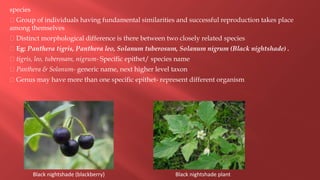
species
Group of individuals having fundamental similarities and successful reproduction takes place
among themselves
Distinct morphological difference is there between two closely related species
Eg: Panthera tigris, Panthera leo, Solanum tuberosum, Solanum nigrum (Black nightshade) .
tigris, leo, tuberosam, nigrum- Specific epithet/ species name
Panthera & Solanum- generic name, next higher level taxon
Genus may have more than one specific epithet- represent different organism
Black nightshade (blackberry) Black nightshade plant
genus
Genera are aggregates of closely related species.
Group of related species with more characters in common than species of
other genera
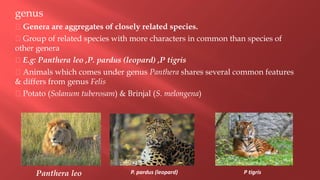
E.g: Panthera leo ,P. pardus (leopard) ,P tigris
Animals which comes under genus Panthera shares several common features
& differs from genus Felis
Potato (Solanum tuberosam) & Brinjal (S. melongena)
Panthera leo P. pardus (leopard) P tigris
family
It has a group of related genera with less number of similarities
Characterized on the basis of vegetative & reproductive feature
E.g:family Solanaceae includes genera Solanum, Petunia &
Datura.
Family Felidae includes genera Panthera (lion, tiger ,leopard) &
Felis (cat)
Order
Assemblage of families which exhibit few similar characters
Similar characters will be less in number
Plants family Convolvulaceae, Solanaceae- order Polymoniales
Animals family Felidae & Canidae- order Carnivora
class
It includes all related orders having few similar characters. .
E.g: class Mammalia includes order Primata (monkey, gorilla,
gibbon) & Carnivora.
Class Dicotyledonae includes order polymoniales &
sapindales(mango)
It include classes with very few similarities
Phylum Chordata includes classes fish, amphibia, reptilia,
aves & mammalia due to common feature- presence of
notochord & dorsal hollow neural system
Division Angiospermae includes class dicotyledonae &
monocotyledonae.
kingdom
Highest category of taxonomy
Animals- Kingdom Animalia
Plants- Kingdom Plantae
Taxonomic aids
Taxonomic studies of various species of plants, animals and other
organisms- know bio- resources & diversity
Studies require correct classification & identificationcollection of
actual specimen of plants & animals
Fundamental to studies & essential for training in systematics
Specimens are gathered, stored/ preserved with information for
future studies
Taxonomical aids are,
Herbarium
Botanical Garden
Museum
Zoological Park
HERBARIUM
Herbarium is a store house of collected plant specimens that are dried, pressed and
preserved on sheets.
Specimens- description on herbarium sheet, label of date & place of collection, English,
local & botanical name, family & collector name
Quick referral system for taxonomic studies
BOTANICAL GARDEN
Specialized garden having collection of living specimen
Plants grown for identification purpose
Plant is labelled with botanical/scientific name & family
MUSEUM
Museums have collections of preserved plant and animal specimens- study & reference
Set up in educational institutes
Specimen preserved in containers & jars in preservative solutions
Plants & animals- dry specimens, insects- insect boxes after collecting, killing & pinning,
Large animals- stuffed & preserved
Skeletons of animals
ZOOLOGICAL PARK
Zoological Parks are the places where wild animals are kept in protected
under human care.
Learn food habits & behavior
Conditions are provided as animals natural habitat
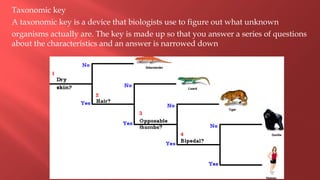
KEY
Key is another taxonomical aid used for identification of plants and
animals based on the similarities and dissimilarities.
Based on contrasting character, generally in pair- couplet
Represent choice between two opposite options- accepting one & rejecting
another
Each statement- lead
Separate taxonomic keys- each taxonomic category like family, genus &
species- identification purpose
Analytical in nature
Taxonomic key
A taxonomic key is a device that biologists use to figure out what unknown
organisms actually are. The key is made up so that you answer a series of questions
about the characteristics and an answer is narrowed down
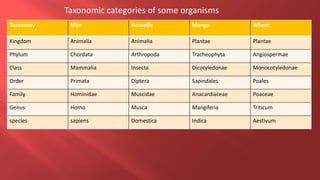
Taxonomy Man Housefly Mango Wheat
Kingdom Animalia Animalia Plantae Plantae
Phylum Chordata Arthropoda Tracheophyta Angiospermae
Class Mammalia Insecta Dicotyledonae Monocotyledonae
Order Primata Diptera Sapindales Poales
Family Hominidae Muscidae Anacardiaceae Poaceae
Genus Homo Musca Mangiferia Triticum
species sapiens Domestica Indica Aestivum
Taxonomic categories of some organisms

Living world by BNP

  • 1.
    THE LIVING WORLD BYMr. Biswanath prusty
  • 2.
    What is life? •Life is a unique, complex organization of molecules, expressing through chemical reactions which lead to growth, development, responsiveness, adaptation & reproduction.
  • 3.
    Growth • It isirreversible increase in the mass & number of cells of living organisms. • In plant it occurs by cell division and continuously through out life. • In animal it is limited to a certain age only, but cell division occur in certain tissues to replace old & worn out cell. Reproduction • It is production of progeny similar to their parents. • In unicellular organism it occurs by cell division (usually mitosis). • Reproduction may be sexual or asexual type. Responsiveness or consciousness • Living organism have the ability to sense their environment and respond to these stimuli. • Stimuli could be physical, chemical or biological like water, temp. , air and other organism, chemical pollutants etc. • Photoperiod affect reproduction in several seasonal breeders of animal and plants.
  • 4.
    What is aLiving organism? • A living organism is self- replicating, evolving and self- regulating interactive system capable of responding to external stimuli.
  • 5.
    PROPERTIES OF LIVINGORGANISMS Growth Reproduction Metabolism Cellular organisation Consciousness
  • 6.
    Growth Reproduction Metabolism Cellular organisation Consciousness  Itis the increase in number & mass of cells by cell division. PROPERTIES OF LIVING ORGANISMS
  • 7.
    Growth Reproduction Metabolism Cellular organisation Consciousness  Inplants, growth continues throughout their lifespan.  In animals, growth is only up to a certain age. However, cell division occurs to replace lost cells. PROPERTIES OF LIVING ORGANISMS
  • 8.
    Growth Reproduction Metabolism Cellular organisation Consciousness  Basically,growth is the increase in mass & size. Thus non-living objects also grow (surface accumulation of material). So growth is not a defining property of living organisms.  In living organisms, growth is from inside. PROPERTIES OF LIVING ORGANISMS
  • 9.
    Reproduction Metabolism Cellular organisation Consciousness Growth  Itis the production of progeny having features similar to those of parents.  Organisms reproduce asexually and sexually. PROPERTIES OF LIVING ORGANISMS
  • 10.
    Reproduction Metabolism Cellular organisation Consciousness Growth  Inunicellular organisms, growth & reproduction are same because they reproduce by cell division. PROPERTIES OF LIVING ORGANISMS
  • 11.
    Reproduction Metabolism Cellular organisation Consciousness Growth  Manyorganisms do not reproduce (e.g. mules(A female horse & male donkey have a mule They are sterile bcz they can’t produce sperm or egg), worker bees, infertile human couples, etc). Hence, reproduction is not a perfect defining property of living organisms. Mule Worker Honeybee PROPERTIES OF LIVING ORGANISMS
  • 12.
    Metabolism Cellular organisation Consciousness Growth Reproduction  Itis the sum total of all biochemical reactions taking place inside a living system.  It is the defining feature of living organisms. PROPERTIES OF LIVING ORGANISMS
  • 13.
    Metabolism Cellular organisation Consciousness Growth Reproduction  Metabolicreactions can be demonstrated outside the body in cell-free systems.  Isolated metabolic reactions in vitro are not living things but are living reactions. PROPERTIES OF LIVING ORGANISMS
  • 14.
    Metabolism All organism aremade of chemicals- small & big Chemicals- Biomolecules, which are made & changed to other molecules Conversion reactions of these molecules- Metabolic reactions Sum total of all chemical reactions- Metabolism Non- living- no metabolism Metabolic reactions- demonstrated outside the body in cell free system (test tube/ in vitro) is neither living nor non living Metabolism- defining feature of living things & hence Cellular organization of the body is the defining feature of life form Ex- Photosynthesis (Anabolism), Cellular respiration (Catabolism)
  • 15.
    consciousness Living organism- sensetheir surroundings or environment stimuli (physical, chemical or biological) Organism sense through sense organs Plants- light, water, temperature, organism, pollutants Photoperiod influence reproduction- seasonal breeders (plants & animals) Human- aware of himself, i.e., self- consciousness Consciousness- defining property of living organism
  • 16.
    Diversity of livingworld Biodiversity : Term used to refer to the number of varieties of plant and animals in region on earth. Number of species known- 1.7- 1.8 million Need for classification : living organisms are classified into categories so that they could be named, remembered, studied and understood. Need to standardize naming organism, so organism named same in all over world- Nomenclature Nomenclature- scientific name to all known organism Plants- based on principles & criteria of ICBN (International Code for Botanical Nomenclature) Animals- ICZN (International Code of Zoological Nomenclature) Scientific names ensure that each organism has only one name
  • 17.
    Binomial nomenclature wasfirst introduced by Carolus Linnaeus. He published the book ‘Systema Naturae’. The scientific naming of an organism using two words- Binomial nomenclature. Each name two components- Generic name & Specific epithet/ Species name. Rules for Nomenclature : 1. Biological Names are generally Latin & written in italics 2. First word represents genus & second word denotes specific epithet 3. Both word of biological name should be underlined separately when hand written & italics if printed 4. First word denoting genus start with capital letter & specific epithet or species name should start with small letter. Ex- Homo sapiens is the scientific name for human being. Homo- genus sapiens- species
  • 18.
    Taxonomy Process of classificationbased on characteristics of living organism External & internal structure, cell structure, development, ecological information- basis of modern taxonomy Human being is interested to know different organism & diversity along with their relationship with others- Systematics Systematics : It deals with classification of organisms based on their diversities and relationships among them. Taxonomic Hierarchy : It is the arrangement of various taxa of classification Taxonomical study of all known organism will led to development of categories such as kingdom, phylum or division, class, order, family, genus and species Species → Genus → Family → Order → Class → Phylum (for animals)/ Division (for plants) →Kingdom
  • 19.
    species Group of individualshaving fundamental similarities and successful reproduction takes place among themselves Distinct morphological difference is there between two closely related species Eg: Panthera tigris, Panthera leo, Solanum tuberosum, Solanum nigrum (Black nightshade) . tigris, leo, tuberosam, nigrum- Specific epithet/ species name Panthera & Solanum- generic name, next higher level taxon Genus may have more than one specific epithet- represent different organism Black nightshade (blackberry) Black nightshade plant
  • 20.
    genus Genera are aggregatesof closely related species. Group of related species with more characters in common than species of other genera E.g: Panthera leo ,P. pardus (leopard) ,P tigris Animals which comes under genus Panthera shares several common features & differs from genus Felis Potato (Solanum tuberosam) & Brinjal (S. melongena) Panthera leo P. pardus (leopard) P tigris
  • 21.
    family It has agroup of related genera with less number of similarities Characterized on the basis of vegetative & reproductive feature E.g:family Solanaceae includes genera Solanum, Petunia & Datura. Family Felidae includes genera Panthera (lion, tiger ,leopard) & Felis (cat) Order Assemblage of families which exhibit few similar characters Similar characters will be less in number Plants family Convolvulaceae, Solanaceae- order Polymoniales Animals family Felidae & Canidae- order Carnivora
  • 22.
    class It includes allrelated orders having few similar characters. . E.g: class Mammalia includes order Primata (monkey, gorilla, gibbon) & Carnivora. Class Dicotyledonae includes order polymoniales & sapindales(mango) It include classes with very few similarities Phylum Chordata includes classes fish, amphibia, reptilia, aves & mammalia due to common feature- presence of notochord & dorsal hollow neural system Division Angiospermae includes class dicotyledonae & monocotyledonae.
  • 23.
    kingdom Highest category oftaxonomy Animals- Kingdom Animalia Plants- Kingdom Plantae
  • 24.
    Taxonomic aids Taxonomic studiesof various species of plants, animals and other organisms- know bio- resources & diversity Studies require correct classification & identificationcollection of actual specimen of plants & animals Fundamental to studies & essential for training in systematics Specimens are gathered, stored/ preserved with information for future studies Taxonomical aids are, Herbarium Botanical Garden Museum Zoological Park
  • 25.
    HERBARIUM Herbarium is astore house of collected plant specimens that are dried, pressed and preserved on sheets. Specimens- description on herbarium sheet, label of date & place of collection, English, local & botanical name, family & collector name Quick referral system for taxonomic studies BOTANICAL GARDEN Specialized garden having collection of living specimen Plants grown for identification purpose Plant is labelled with botanical/scientific name & family MUSEUM Museums have collections of preserved plant and animal specimens- study & reference Set up in educational institutes Specimen preserved in containers & jars in preservative solutions Plants & animals- dry specimens, insects- insect boxes after collecting, killing & pinning, Large animals- stuffed & preserved Skeletons of animals
  • 26.
    ZOOLOGICAL PARK Zoological Parksare the places where wild animals are kept in protected under human care. Learn food habits & behavior Conditions are provided as animals natural habitat KEY Key is another taxonomical aid used for identification of plants and animals based on the similarities and dissimilarities. Based on contrasting character, generally in pair- couplet Represent choice between two opposite options- accepting one & rejecting another Each statement- lead Separate taxonomic keys- each taxonomic category like family, genus & species- identification purpose Analytical in nature
  • 27.
    Taxonomic key A taxonomickey is a device that biologists use to figure out what unknown organisms actually are. The key is made up so that you answer a series of questions about the characteristics and an answer is narrowed down
  • 28.
    Taxonomy Man HouseflyMango Wheat Kingdom Animalia Animalia Plantae Plantae Phylum Chordata Arthropoda Tracheophyta Angiospermae Class Mammalia Insecta Dicotyledonae Monocotyledonae Order Primata Diptera Sapindales Poales Family Hominidae Muscidae Anacardiaceae Poaceae Genus Homo Musca Mangiferia Triticum species sapiens Domestica Indica Aestivum Taxonomic categories of some organisms