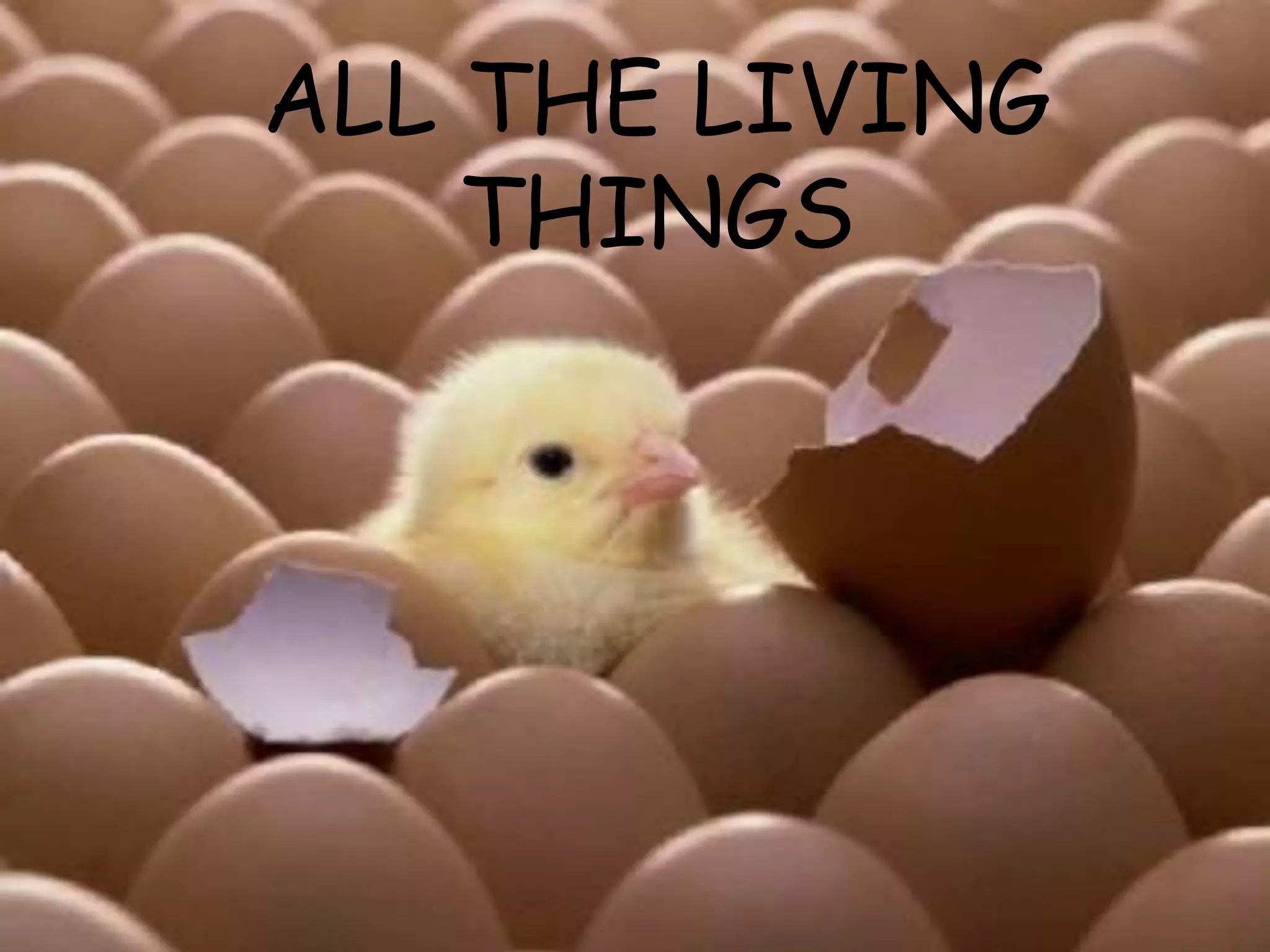
ALL THE LIVING
THINGS
LIFE PROCESSES
Living things
• All living things have three things in
common.
• These three things are called life
processes:
– Nutrition.
– Reproduction.
– Interaction with the enviroment.
THE THREE LIFE
PROCESSES
1
All living things
need nutrition
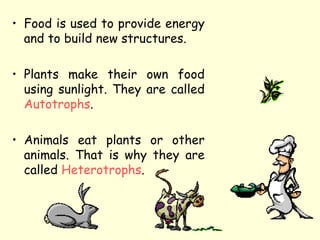
• Food is used to provide energy
and to build new structures.
• Plants make their own food
using sunlight. They are called
Autotrophs.
• Animals eat plants or other
animals. That is why they are
called Heterotrophs.
2
All living things
reproduce
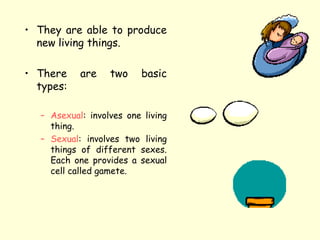
• They are able to produce
new living things.
• There are two basic
types:
– Asexual: involves one living
thing.
– Sexual: involves two living
things of different sexes.
Each one provides a sexual
cell called gamete.
3
All living things
interact with
the enviroment.
• All living things respond to
changes. Living things notice
changes in their surroundings
and react to them.
• Eg. Plants grow towards the
light.
• Eg. People react to the
temperature around them.
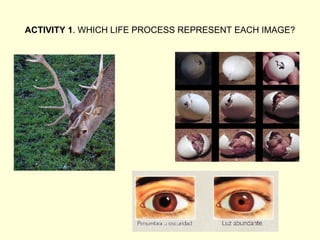
ACTIVITY 1. WHICH LIFE PROCESS REPRESENT EACH IMAGE?
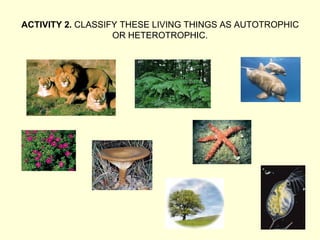
ACTIVITY 2. CLASSIFY THESE LIVING THINGS AS AUTOTROPHIC
OR HETEROTROPHIC.
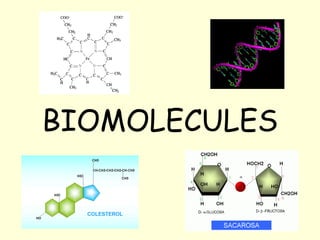
BIOMOLECULES
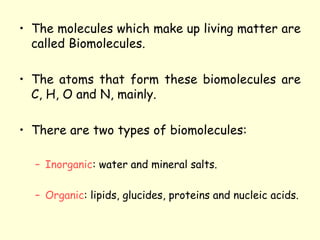
• The molecules which make up living matter are
called Biomolecules.
• The atoms that form these biomolecules are
C, H, O and N, mainly.
• There are two types of biomolecules:
– Inorganic: water and mineral salts.
– Organic: lipids, glucides, proteins and nucleic acids.
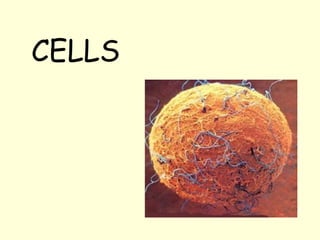
CELLS
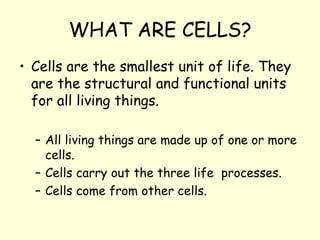
WHAT ARE CELLS?
• Cells are the smallest unit of life. They
are the structural and functional units
for all living things.
– All living things are made up of one or more
cells.
– Cells carry out the three life processes.
– Cells come from other cells.
Parts of a Cell
Parts of a Cell
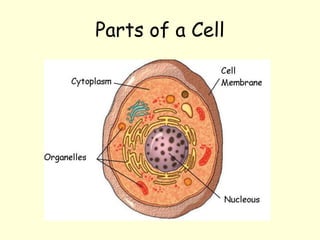
• The Cell Membrane covers the hole cell.
• The Cytoplasm is the inside of the cell.
It is a jelly-like substance. Organelles
are small structures in the cytoplasm,
and they are responsible for different
functions.
• The Nucleous: controls how cells work
and contains the hereditary information.
It is not in all cells types.
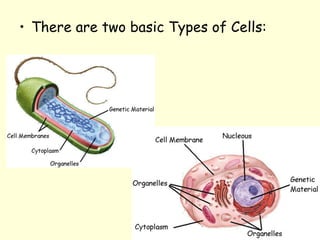
• There are two basic Types of Cells:
Prokaryotic Cells
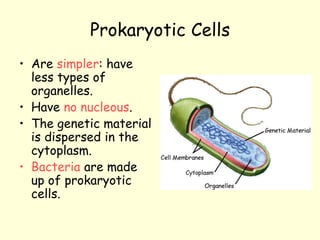
• Are simpler: have
less types of
organelles.
• Have no nucleous.
• The genetic material
is dispersed in the
cytoplasm.
• Bacteria are made
up of prokaryotic
cells.
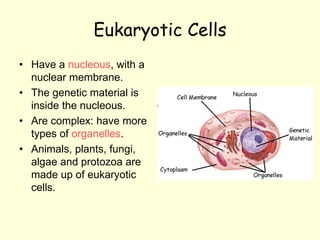
Eukaryotic Cells
• Have a nucleous, with a
nuclear membrane.
• The genetic material is
inside the nucleous.
• Are complex: have more
types of organelles.
• Animals, plants, fungi,
algae and protozoa are
made up of eukaryotic
cells.
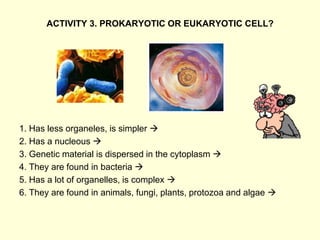
ACTIVITY 3. PROKARYOTIC OR EUKARYOTIC CELL?
1. Has less organeles, is simpler 
2. Has a nucleous 
3. Genetic material is dispersed in the cytoplasm 
4. They are found in bacteria 
5. Has a lot of organelles, is complex 
6. They are found in animals, fungi, plants, protozoa and algae 
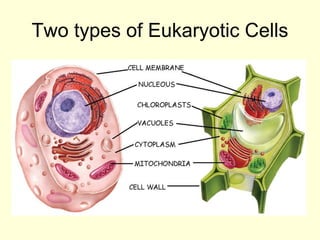
Two types of Eukaryotic Cells
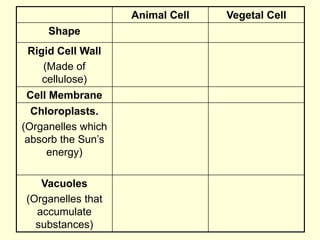
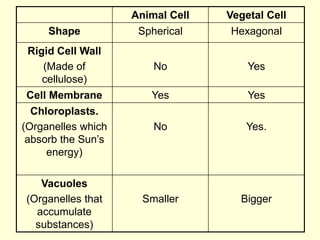
Animal Cell Vegetal Cell
Shape
Rigid Cell Wall
(Made of
cellulose)
Cell Membrane
Chloroplasts.
(Organelles which
absorb the Sun’s
energy)
Vacuoles
(Organelles that
accumulate
substances)
Animal Cell Vegetal Cell
Shape Spherical Hexagonal
Rigid Cell Wall
(Made of
cellulose)
No Yes
Cell Membrane Yes Yes
Chloroplasts.
(Organelles which
absorb the Sun’s
energy)
No Yes.
Vacuoles
(Organelles that
accumulate
substances)
Smaller Bigger
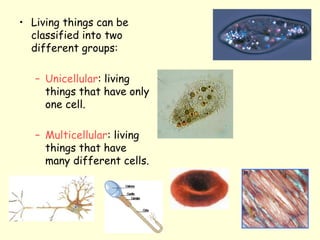
• Living things can be
classified into two
different groups:
– Unicellular: living
things that have only
one cell.
– Multicellular: living
things that have
many different cells.
Multicellular Organisation
• In multicellular living things, there are
different levels of complexity:
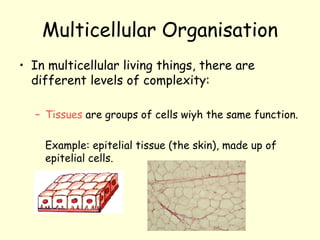
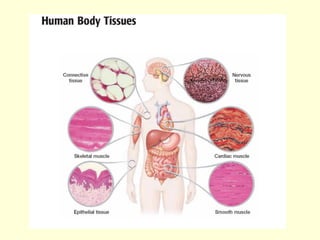
– Tissues are groups of cells wiyh the same function.
Example: epitelial tissue (the skin), made up of
epitelial cells.
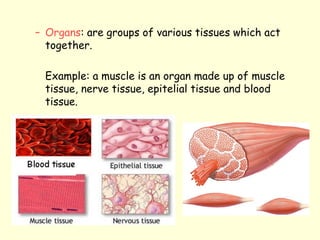
– Organs: are groups of various tissues which act
together.
Example: a muscle is an organ made up of muscle
tissue, nerve tissue, epitelial tissue and blood
tissue.
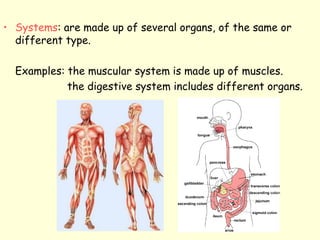
• Systems: are made up of several organs, of the same or
different type.
Examples: the muscular system is made up of muscles.
the digestive system includes different organs.
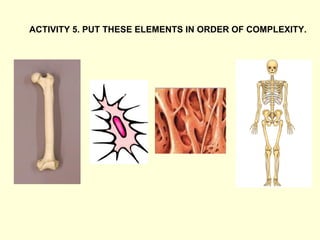
ACTIVITY 5. PUT THESE ELEMENTS IN ORDER OF COMPLEXITY.
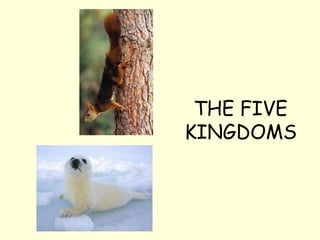
THE FIVE
KINGDOMS
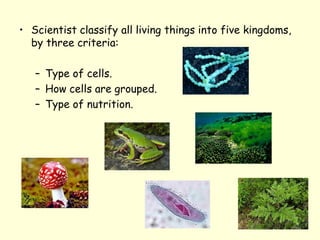
• Scientist classify all living things into five kingdoms,
by three criteria:
– Type of cells.
– How cells are grouped.
– Type of nutrition.
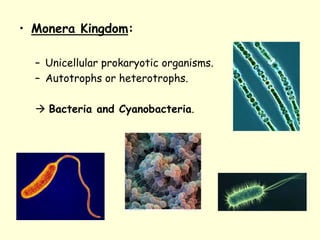
• Monera Kingdom:
– Unicellular prokaryotic organisms.
– Autotrophs or heterotrophs.
 Bacteria and Cyanobacteria.
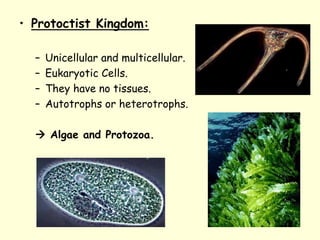
• Protoctist Kingdom:
– Unicellular and multicellular.
– Eukaryotic Cells.
– They have no tissues.
– Autotrophs or heterotrophs.
 Algae and Protozoa.
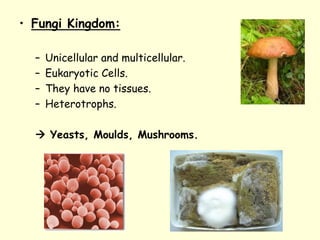
• Fungi Kingdom:
– Unicellular and multicellular.
– Eukaryotic Cells.
– They have no tissues.
– Heterotrophs.
 Yeasts, Moulds, Mushrooms.
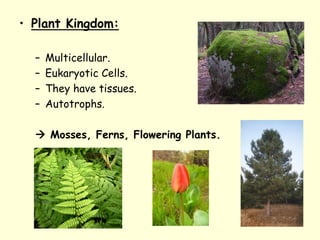
• Plant Kingdom:
– Multicellular.
– Eukaryotic Cells.
– They have tissues.
– Autotrophs.
 Mosses, Ferns, Flowering Plants.
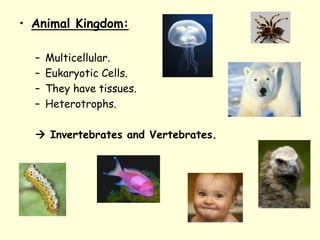
• Animal Kingdom:
– Multicellular.
– Eukaryotic Cells.
– They have tissues.
– Heterotrophs.
 Invertebrates and Vertebrates.
ACTIVITY 6. WHICH KINGDOMS……..?
• 1. Are made up of unicellular living things?
• 2. Have eukaryotic cells?
• 3. Are made up of autotrophs living things?
• 4. Have prokaryotic cells?
• 5. Are made up of heterotrophs living things?
• 6. Are made up of multicellular living things?
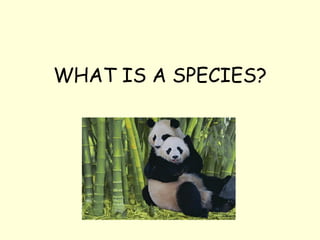
WHAT IS A SPECIES?
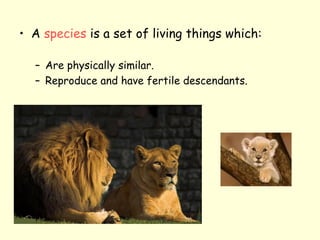
• A species is a set of living things which:
– Are physically similar.
– Reproduce and have fertile descendants.
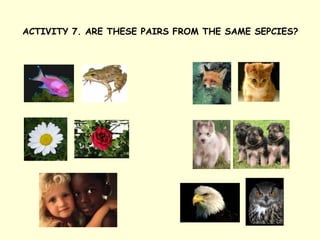
ACTIVITY 7. ARE THESE PAIRS FROM THE SAME SEPCIES?

The living things

  • 1.
  • 2.
  • 3.
    Living things • Allliving things have three things in common. • These three things are called life processes: – Nutrition. – Reproduction. – Interaction with the enviroment.
  • 4.
  • 5.
  • 6.
    • Food isused to provide energy and to build new structures. • Plants make their own food using sunlight. They are called Autotrophs. • Animals eat plants or other animals. That is why they are called Heterotrophs.
  • 7.
  • 8.
    • They areable to produce new living things. • There are two basic types: – Asexual: involves one living thing. – Sexual: involves two living things of different sexes. Each one provides a sexual cell called gamete.
  • 9.
    3 All living things interactwith the enviroment.
  • 10.
    • All livingthings respond to changes. Living things notice changes in their surroundings and react to them. • Eg. Plants grow towards the light. • Eg. People react to the temperature around them.
  • 11.
    ACTIVITY 1. WHICHLIFE PROCESS REPRESENT EACH IMAGE?
  • 12.
    ACTIVITY 2. CLASSIFYTHESE LIVING THINGS AS AUTOTROPHIC OR HETEROTROPHIC.
  • 13.
  • 14.
    • The moleculeswhich make up living matter are called Biomolecules. • The atoms that form these biomolecules are C, H, O and N, mainly. • There are two types of biomolecules: – Inorganic: water and mineral salts. – Organic: lipids, glucides, proteins and nucleic acids.
  • 15.
  • 16.
    WHAT ARE CELLS? •Cells are the smallest unit of life. They are the structural and functional units for all living things. – All living things are made up of one or more cells. – Cells carry out the three life processes. – Cells come from other cells.
  • 17.
  • 18.
    Parts of aCell • The Cell Membrane covers the hole cell. • The Cytoplasm is the inside of the cell. It is a jelly-like substance. Organelles are small structures in the cytoplasm, and they are responsible for different functions. • The Nucleous: controls how cells work and contains the hereditary information. It is not in all cells types.
  • 19.
    • There aretwo basic Types of Cells:
  • 20.
    Prokaryotic Cells • Aresimpler: have less types of organelles. • Have no nucleous. • The genetic material is dispersed in the cytoplasm. • Bacteria are made up of prokaryotic cells.
  • 21.
    Eukaryotic Cells • Havea nucleous, with a nuclear membrane. • The genetic material is inside the nucleous. • Are complex: have more types of organelles. • Animals, plants, fungi, algae and protozoa are made up of eukaryotic cells.
  • 22.
    ACTIVITY 3. PROKARYOTICOR EUKARYOTIC CELL? 1. Has less organeles, is simpler  2. Has a nucleous  3. Genetic material is dispersed in the cytoplasm  4. They are found in bacteria  5. Has a lot of organelles, is complex  6. They are found in animals, fungi, plants, protozoa and algae 
  • 23.
    Two types ofEukaryotic Cells
  • 24.
    Animal Cell VegetalCell Shape Rigid Cell Wall (Made of cellulose) Cell Membrane Chloroplasts. (Organelles which absorb the Sun’s energy) Vacuoles (Organelles that accumulate substances)
  • 25.
    Animal Cell VegetalCell Shape Spherical Hexagonal Rigid Cell Wall (Made of cellulose) No Yes Cell Membrane Yes Yes Chloroplasts. (Organelles which absorb the Sun’s energy) No Yes. Vacuoles (Organelles that accumulate substances) Smaller Bigger
  • 26.
    • Living thingscan be classified into two different groups: – Unicellular: living things that have only one cell. – Multicellular: living things that have many different cells.
  • 27.
    Multicellular Organisation • Inmulticellular living things, there are different levels of complexity: – Tissues are groups of cells wiyh the same function. Example: epitelial tissue (the skin), made up of epitelial cells.
  • 29.
    – Organs: aregroups of various tissues which act together. Example: a muscle is an organ made up of muscle tissue, nerve tissue, epitelial tissue and blood tissue.
  • 30.
    • Systems: aremade up of several organs, of the same or different type. Examples: the muscular system is made up of muscles. the digestive system includes different organs.
  • 31.
    ACTIVITY 5. PUTTHESE ELEMENTS IN ORDER OF COMPLEXITY.
  • 32.
  • 33.
    • Scientist classifyall living things into five kingdoms, by three criteria: – Type of cells. – How cells are grouped. – Type of nutrition.
  • 34.
    • Monera Kingdom: –Unicellular prokaryotic organisms. – Autotrophs or heterotrophs.  Bacteria and Cyanobacteria.
  • 35.
    • Protoctist Kingdom: –Unicellular and multicellular. – Eukaryotic Cells. – They have no tissues. – Autotrophs or heterotrophs.  Algae and Protozoa.
  • 36.
    • Fungi Kingdom: –Unicellular and multicellular. – Eukaryotic Cells. – They have no tissues. – Heterotrophs.  Yeasts, Moulds, Mushrooms.
  • 37.
    • Plant Kingdom: –Multicellular. – Eukaryotic Cells. – They have tissues. – Autotrophs.  Mosses, Ferns, Flowering Plants.
  • 38.
    • Animal Kingdom: –Multicellular. – Eukaryotic Cells. – They have tissues. – Heterotrophs.  Invertebrates and Vertebrates.
  • 39.
    ACTIVITY 6. WHICHKINGDOMS……..? • 1. Are made up of unicellular living things? • 2. Have eukaryotic cells? • 3. Are made up of autotrophs living things? • 4. Have prokaryotic cells? • 5. Are made up of heterotrophs living things? • 6. Are made up of multicellular living things?
  • 40.
    WHAT IS ASPECIES?
  • 41.
    • A speciesis a set of living things which: – Are physically similar. – Reproduce and have fertile descendants.
  • 42.
    ACTIVITY 7. ARETHESE PAIRS FROM THE SAME SEPCIES?