Characteristics of learningCharacteristics of learning
OrganizationOrganization
Submitted to :Submitted to : Submitted by:Submitted by:
Ashish MuggalAshish Muggal
Roll No._____Roll No._____
THE LEARNING ORGANISATION
CONTENTSCONTENTS
 INTRODUCTIONINTRODUCTION
 DEFINITIONSDEFINITIONS
 CHARACTERISTICS & RELEVANCECHARACTERISTICS & RELEVANCE
 BUILDING A LEARNING ORGANIZATIONBUILDING A LEARNING ORGANIZATION
““ WHEN THE RATE OF CHANGE OUTSIDEWHEN THE RATE OF CHANGE OUTSIDE
EXCEEDS THE RATE OF CHANGEEXCEEDS THE RATE OF CHANGE
INSIDE, THE END IS IN SIGHT.”INSIDE, THE END IS IN SIGHT.”
-JACK WELCH-JACK WELCH
INTRODUCTIONINTRODUCTION
 LEARNING:LEARNING:
Any relatively permanent change in behaviourAny relatively permanent change in behaviour
that occurs as a result of experience.that occurs as a result of experience.
 LEARNING ORGANISATION:LEARNING ORGANISATION:
An organization that has developed theAn organization that has developed the
continuous capacity to adapt and change.continuous capacity to adapt and change.
DEFINITIONSDEFINITIONS
““ A Learning Company is an organisationA Learning Company is an organisation
that facilitates the learning of all itsthat facilitates the learning of all its
members and continually transformsmembers and continually transforms
itself. ”itself. ”
-PEDLER, 1991-PEDLER, 1991
““Organizations where people continuallyOrganizations where people continually
expand their capacity to create the resultsexpand their capacity to create the results
they truly desire, where new and expansivethey truly desire, where new and expansive
patterns of thinking are nurtured, wherepatterns of thinking are nurtured, where
collective aspiration is set free, and wherecollective aspiration is set free, and where
people are continually learning to learnpeople are continually learning to learn
together.”together.”
- PETER SENGE- PETER SENGE
LEARNING ORGANIZATIONLEARNING ORGANIZATION
Mental
Models
Shared
Vision
Team
Learning
Systems
Thinking
Personal
Mastery
Learning
Organization
CHARACTERISTICSCHARACTERISTICS
CharacteristicCharacteristic DefinitionDefinition AssociatedAssociated
Best PracticesBest Practices
Positive By-Positive By-
productsproducts
Self mastery-Self mastery-
individualindividual
The ability toThe ability to
honestly andhonestly and
openly see realityopenly see reality
as it existsas it exists
1.Sharing1.Sharing
experiencesexperiences
2.More interaction2.More interaction
time betweentime between
supervisory levelssupervisory levels
3.Emphasis on3.Emphasis on
feedbackfeedback
1.Greater1.Greater
commitmentcommitment
2.Ability to face2.Ability to face
limitationslimitations
3.Ability to deal3.Ability to deal
with changewith change
Mental models -Mental models -
individualindividual
The ability toThe ability to
compare realitycompare reality
with perceptions;with perceptions;
reconciling bothreconciling both
into a coherentinto a coherent
understandingunderstanding
1.Time for learning1.Time for learning
2.Forgiveness2.Forgiveness
3.Flexibility3.Flexibility
1.Less avoidance1.Less avoidance
of difficultof difficult
situationssituations
Shared vision -Shared vision -
groupgroup
The ability of aThe ability of a
group ofgroup of
individuals to holdindividuals to hold
a shared picture ofa shared picture of
a mutuallya mutually
desirable futuredesirable future
1.Trust1.Trust
2.Empathy2.Empathy
3.Co-operation3.Co-operation
4.A common4.A common
languagelanguage
1.Faster change1.Faster change
2.More effective2.More effective
communicationcommunication
flowsflows
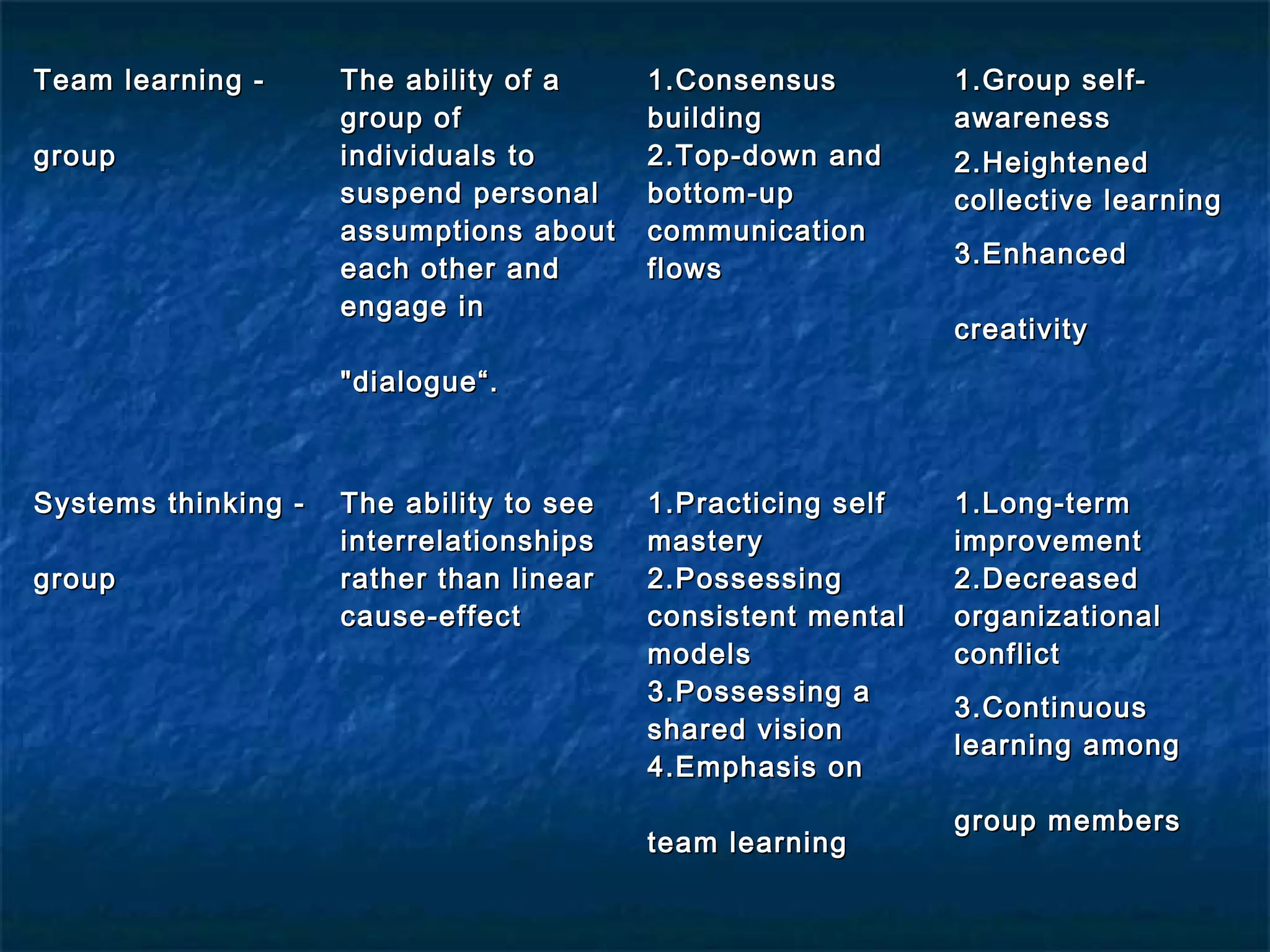
Team learning -Team learning -
groupgroup
The ability of aThe ability of a
group ofgroup of
individuals toindividuals to
suspend personalsuspend personal
assumptions aboutassumptions about
each other andeach other and
engage inengage in
"dialogue“."dialogue“.
1.Consensus1.Consensus
buildingbuilding
2.Top-down and2.Top-down and
bottom-upbottom-up
communicationcommunication
flowsflows
1.Group self-1.Group self-
awarenessawareness
2.Heightened2.Heightened
collective learningcollective learning
3.Enhanced3.Enhanced
creativitycreativity
Systems thinking -Systems thinking -
groupgroup
The ability to seeThe ability to see
interrelationshipsinterrelationships
rather than linearrather than linear
cause-effectcause-effect
1.Practicing self1.Practicing self
masterymastery
2.Possessing2.Possessing
consistent mentalconsistent mental
modelsmodels
3.Possessing a3.Possessing a
shared visionshared vision
4.Emphasis on4.Emphasis on
team learningteam learning
1.Long-term1.Long-term
improvementimprovement
2.Decreased2.Decreased
organizationalorganizational
conflictconflict
3.Continuous3.Continuous
learning amonglearning among
group membersgroup members
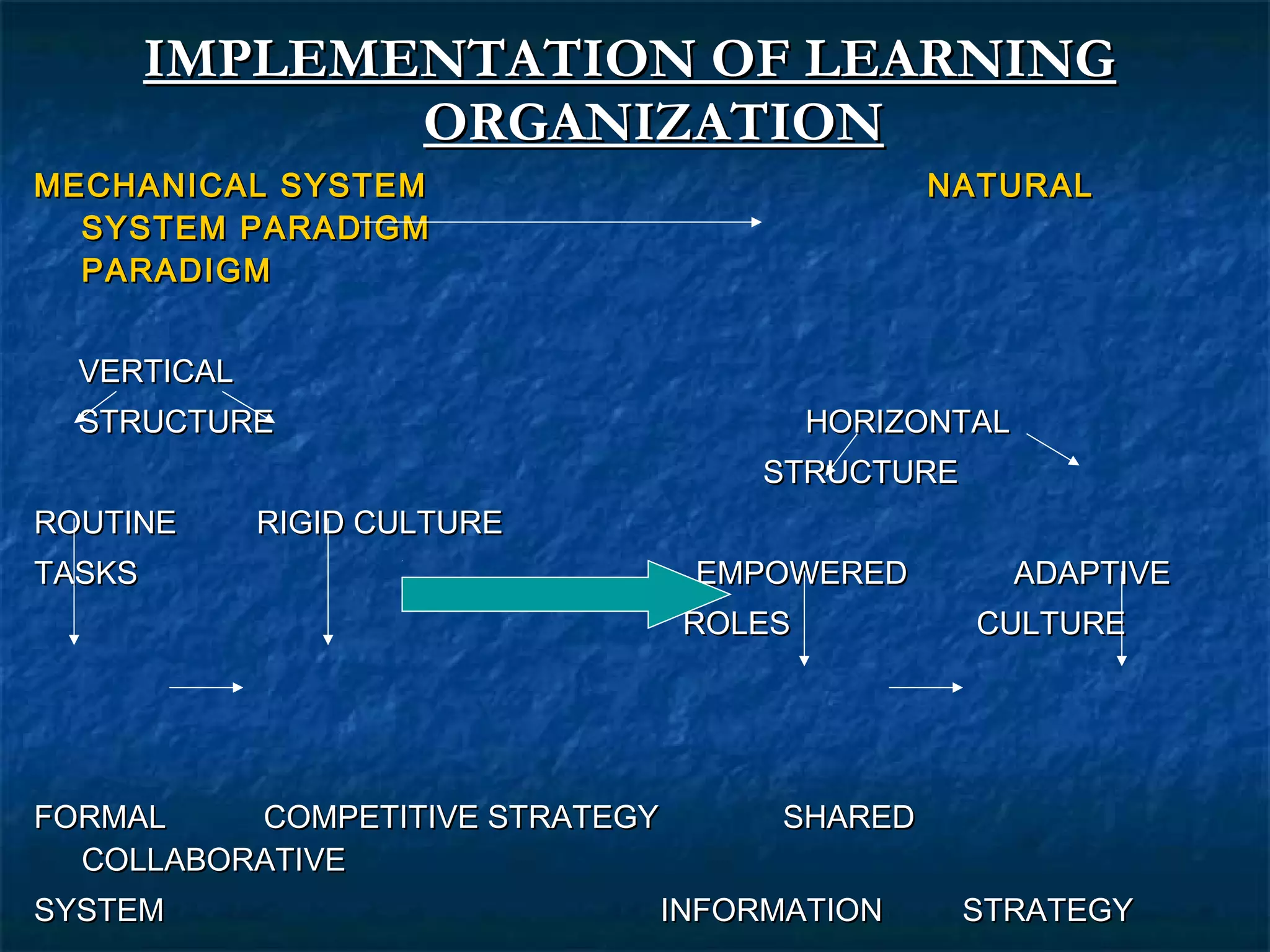
IMPLEMENTATION OF LEARNINGIMPLEMENTATION OF LEARNING
ORGANIZATIONORGANIZATION
MECHANICAL SYSTEM NATURALMECHANICAL SYSTEM NATURAL
SYSTEM PARADIGMSYSTEM PARADIGM
PARADIGMPARADIGM
VERTICALVERTICAL
STRUCTURE HORIZONTALSTRUCTURE HORIZONTAL
STRUCTURESTRUCTURE
ROUTINE RIGID CULTUREROUTINE RIGID CULTURE
TASKS EMPOWERED ADAPTIVETASKS EMPOWERED ADAPTIVE
ROLES CULTUREROLES CULTURE
FORMAL COMPETITIVE STRATEGY SHAREDFORMAL COMPETITIVE STRATEGY SHARED
COLLABORATIVECOLLABORATIVE
SYSTEM INFORMATION STRATEGYSYSTEM INFORMATION STRATEGY
BUILDING A LEARNINGBUILDING A LEARNING
ORGANIZATIONORGANIZATION
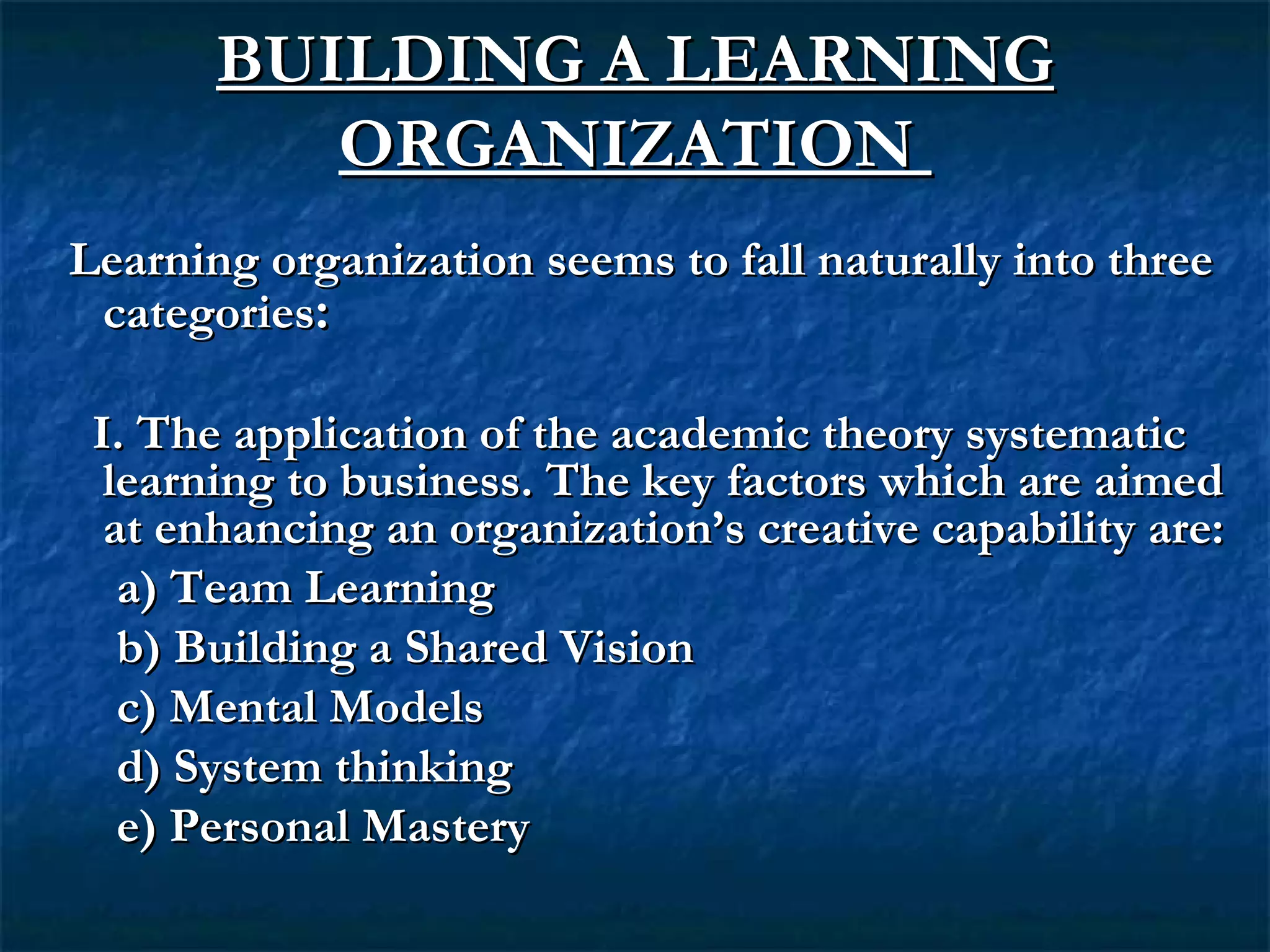
Learning organization seems to fall naturally into threeLearning organization seems to fall naturally into three
categoriescategories::
I. The application of the academic theory systematicI. The application of the academic theory systematic
learning to business. The key factors which are aimedlearning to business. The key factors which are aimed
at enhancing an organization’s creative capability are:at enhancing an organization’s creative capability are:
a) Team Learninga) Team Learning
b) Building a Shared Visionb) Building a Shared Vision
c) Mental Modelsc) Mental Models
d) System thinkingd) System thinking
e) Personal Masterye) Personal Mastery
II. The presentation of definitions followed byII. The presentation of definitions followed by
perspective ,practical solutions:perspective ,practical solutions:
a) Organizational Intentiona) Organizational Intention
b) Autonomyb) Autonomy
c) Fluctuation and creative chaosc) Fluctuation and creative chaos
d) Redundancyd) Redundancy
e) Requisite varietye) Requisite variety
III. The work of practitioners who decry aIII. The work of practitioners who decry a
prescriptive approach but offer guidelinesprescriptive approach but offer guidelines
and practical hints as to howand practical hints as to how
organizations can develop a bespokeorganizations can develop a bespoke
approach.approach.
A.) Systematic problem solving.A.) Systematic problem solving.
B.) ExperimentationB.) Experimentation

Characteristics of learning organization

  • 1.
    Characteristics of learningCharacteristicsof learning OrganizationOrganization Submitted to :Submitted to : Submitted by:Submitted by: Ashish MuggalAshish Muggal Roll No._____Roll No._____
  • 2.
  • 3.
    CONTENTSCONTENTS  INTRODUCTIONINTRODUCTION  DEFINITIONSDEFINITIONS CHARACTERISTICS & RELEVANCECHARACTERISTICS & RELEVANCE  BUILDING A LEARNING ORGANIZATIONBUILDING A LEARNING ORGANIZATION
  • 4.
    ““ WHEN THERATE OF CHANGE OUTSIDEWHEN THE RATE OF CHANGE OUTSIDE EXCEEDS THE RATE OF CHANGEEXCEEDS THE RATE OF CHANGE INSIDE, THE END IS IN SIGHT.”INSIDE, THE END IS IN SIGHT.” -JACK WELCH-JACK WELCH
  • 5.
    INTRODUCTIONINTRODUCTION  LEARNING:LEARNING: Any relativelypermanent change in behaviourAny relatively permanent change in behaviour that occurs as a result of experience.that occurs as a result of experience.  LEARNING ORGANISATION:LEARNING ORGANISATION: An organization that has developed theAn organization that has developed the continuous capacity to adapt and change.continuous capacity to adapt and change.
  • 6.
    DEFINITIONSDEFINITIONS ““ A LearningCompany is an organisationA Learning Company is an organisation that facilitates the learning of all itsthat facilitates the learning of all its members and continually transformsmembers and continually transforms itself. ”itself. ” -PEDLER, 1991-PEDLER, 1991
  • 7.
    ““Organizations where peoplecontinuallyOrganizations where people continually expand their capacity to create the resultsexpand their capacity to create the results they truly desire, where new and expansivethey truly desire, where new and expansive patterns of thinking are nurtured, wherepatterns of thinking are nurtured, where collective aspiration is set free, and wherecollective aspiration is set free, and where people are continually learning to learnpeople are continually learning to learn together.”together.” - PETER SENGE- PETER SENGE
  • 8.
  • 9.
    CHARACTERISTICSCHARACTERISTICS CharacteristicCharacteristic DefinitionDefinition AssociatedAssociated BestPracticesBest Practices Positive By-Positive By- productsproducts Self mastery-Self mastery- individualindividual The ability toThe ability to honestly andhonestly and openly see realityopenly see reality as it existsas it exists 1.Sharing1.Sharing experiencesexperiences 2.More interaction2.More interaction time betweentime between supervisory levelssupervisory levels 3.Emphasis on3.Emphasis on feedbackfeedback 1.Greater1.Greater commitmentcommitment 2.Ability to face2.Ability to face limitationslimitations 3.Ability to deal3.Ability to deal with changewith change
  • 10.
    Mental models -Mentalmodels - individualindividual The ability toThe ability to compare realitycompare reality with perceptions;with perceptions; reconciling bothreconciling both into a coherentinto a coherent understandingunderstanding 1.Time for learning1.Time for learning 2.Forgiveness2.Forgiveness 3.Flexibility3.Flexibility 1.Less avoidance1.Less avoidance of difficultof difficult situationssituations Shared vision -Shared vision - groupgroup The ability of aThe ability of a group ofgroup of individuals to holdindividuals to hold a shared picture ofa shared picture of a mutuallya mutually desirable futuredesirable future 1.Trust1.Trust 2.Empathy2.Empathy 3.Co-operation3.Co-operation 4.A common4.A common languagelanguage 1.Faster change1.Faster change 2.More effective2.More effective communicationcommunication flowsflows
  • 11.
    Team learning -Teamlearning - groupgroup The ability of aThe ability of a group ofgroup of individuals toindividuals to suspend personalsuspend personal assumptions aboutassumptions about each other andeach other and engage inengage in "dialogue“."dialogue“. 1.Consensus1.Consensus buildingbuilding 2.Top-down and2.Top-down and bottom-upbottom-up communicationcommunication flowsflows 1.Group self-1.Group self- awarenessawareness 2.Heightened2.Heightened collective learningcollective learning 3.Enhanced3.Enhanced creativitycreativity Systems thinking -Systems thinking - groupgroup The ability to seeThe ability to see interrelationshipsinterrelationships rather than linearrather than linear cause-effectcause-effect 1.Practicing self1.Practicing self masterymastery 2.Possessing2.Possessing consistent mentalconsistent mental modelsmodels 3.Possessing a3.Possessing a shared visionshared vision 4.Emphasis on4.Emphasis on team learningteam learning 1.Long-term1.Long-term improvementimprovement 2.Decreased2.Decreased organizationalorganizational conflictconflict 3.Continuous3.Continuous learning amonglearning among group membersgroup members
  • 12.
    IMPLEMENTATION OF LEARNINGIMPLEMENTATIONOF LEARNING ORGANIZATIONORGANIZATION MECHANICAL SYSTEM NATURALMECHANICAL SYSTEM NATURAL SYSTEM PARADIGMSYSTEM PARADIGM PARADIGMPARADIGM VERTICALVERTICAL STRUCTURE HORIZONTALSTRUCTURE HORIZONTAL STRUCTURESTRUCTURE ROUTINE RIGID CULTUREROUTINE RIGID CULTURE TASKS EMPOWERED ADAPTIVETASKS EMPOWERED ADAPTIVE ROLES CULTUREROLES CULTURE FORMAL COMPETITIVE STRATEGY SHAREDFORMAL COMPETITIVE STRATEGY SHARED COLLABORATIVECOLLABORATIVE SYSTEM INFORMATION STRATEGYSYSTEM INFORMATION STRATEGY
  • 13.
    BUILDING A LEARNINGBUILDINGA LEARNING ORGANIZATIONORGANIZATION Learning organization seems to fall naturally into threeLearning organization seems to fall naturally into three categoriescategories:: I. The application of the academic theory systematicI. The application of the academic theory systematic learning to business. The key factors which are aimedlearning to business. The key factors which are aimed at enhancing an organization’s creative capability are:at enhancing an organization’s creative capability are: a) Team Learninga) Team Learning b) Building a Shared Visionb) Building a Shared Vision c) Mental Modelsc) Mental Models d) System thinkingd) System thinking e) Personal Masterye) Personal Mastery
  • 14.
    II. The presentationof definitions followed byII. The presentation of definitions followed by perspective ,practical solutions:perspective ,practical solutions: a) Organizational Intentiona) Organizational Intention b) Autonomyb) Autonomy c) Fluctuation and creative chaosc) Fluctuation and creative chaos d) Redundancyd) Redundancy e) Requisite varietye) Requisite variety
  • 15.
    III. The workof practitioners who decry aIII. The work of practitioners who decry a prescriptive approach but offer guidelinesprescriptive approach but offer guidelines and practical hints as to howand practical hints as to how organizations can develop a bespokeorganizations can develop a bespoke approach.approach. A.) Systematic problem solving.A.) Systematic problem solving. B.) ExperimentationB.) Experimentation