Peter Michael Senge


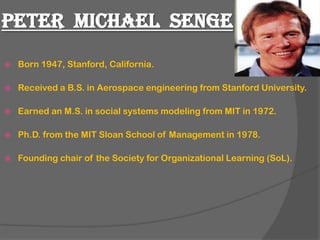
Born 1947, Stanford, California.



Received a B.S. in Aerospace engineering from Stanford University.



Earned an M.S. in social systems modeling from MIT in 1972.



Ph.D. from the MIT Sloan School of Management in 1978.



Founding chair of the Society for Organizational Learning (SoL).
The Fifth Discipline: The Art and Practice
of the Learning Organization (1990)


Convert companies into LEARNING ORGANIZATIONS.



Group problem solving using the systems thinking method .



The five disciplines represent approaches : Developing three core learning capabilities:
○ Fostering aspiration,

○ Developing reflective conversation,
○ Understanding complexity
The Learning Organization


Organizations

where

people

continually

expand their capacity to create the results
they truly desire.



New and expansive patterns of thinking are

nurtured.



Collective aspiration is set free.



People are continually learning to see the
whole together.
The Learning Organization

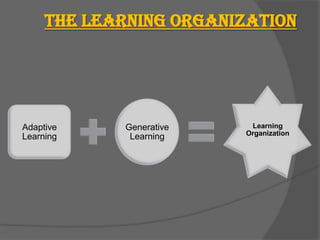
Adaptive
Learning

Generative
Learning

Learning
Organization
In a Learning Organization


Flexibility



People



Staff Opinions



Exchanging information



Learn new skills



Opportunities exist



Learning Occur
A compAny thAt needs to leArn…
1.

Employees seem unmotivated or uninterested in
their work.

2.

Workforce lack the skill and knowledge to adjust
to new jobs.

3.

Workforce simply follow orders.

4.

Lack communication between each other.

5.

Teams argue constantly
and lack real productivity.
The Five Disciplines


Distinguishes the learning organisation from traditional

ones on the basis of the mastery of five disciplines.



All five are concerned with a shift in focus from people as

„helpless reactors‟ to „active participants‟.



Who create the future instead of reacting to the present.
Five Basic Disciplines
1. Personal mastery


Measured by the difference
between our goals and our
current reality.



Relieve the tension by reducing
your goals to match your current
reality.



Change your perception of your
current reality to be closer to
your goal.
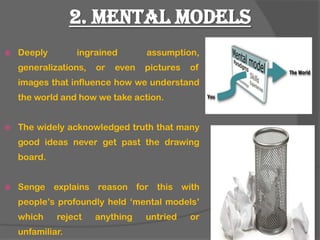
2. Mental Models


Deeply

ingrained

generalizations,

or

even

assumption,
pictures

of

images that influence how we understand
the world and how we take action.


The widely acknowledged truth that many

good ideas never get past the drawing
board.


Senge explains reason for this with
people‟s profoundly held „mental models‟
which

reject

unfamiliar.

anything

untried

or
3. Shared Vision


Shared vision is the difference between people doing work because
they are told to and doing it because they want to.



Vision must be dictated to the organisation through a „top-down‟
process.



An organisational vision is not truly shared until it connects with the
personal visions of everyone inside the organisation
3. Shared Vision


Allows the group to discover insights not attainable individually.



Is a shared vision only when it connects with the personal vision of people

throughout the organization.



Shows group how to recognize the patterns of interaction that undermine
learning.



Vision creates the spark; the excitement that lifts an organization out of the
mundane.



Fosters risk taking and experimentation.



Encourages building personal vision-personal mastery
4. Team Learning
4. Team Learning


Pooling knowledge, expertise and intellect to produce results which are
beyond the sum of the individual parts.



Begins with the practice of „dialogue‟, “the capacity of members of a team to
suspend assumptions and enter into a genuine „thinking together‟ .



When teams are effectively learning they are producing successful results.



Individual team members are growing faster than they could have on their
own.



If teams can not learn, neither can the organization.
5. Systems Thinking


Fifth Discipline that integrates the other four:-



Is a language for learning and acting.



Helps us see how we create our reality.



Points to higher leverage solutions to problems.



Helps us understand and describe complex issues.



One can only understand a system by stepping back and viewing it
from a distance
The Laws of the Fifth Discipline


Today‟s problems come from yesterday‟s “solutions.”



The harder you push, the harder the system pushes back.



Behavior grows better before it grows worse.



The cure can be worse than the disease.



Faster is slower.
Contd....


Cause and effect are not closely related in time and space.



You can have your cake and eat it too--but not at once.



Dividing the elephant in half does not produce two small
elephants.



There is no blame.

(Senge (1990) pp.. 57-67)
The Learning Disabilities:


Most organizations learn poorly and create fundamental learning
disabilities



The seven learning Disabilities:1. "I am my position."
2. "The enemy out there."
3. The Illusion of Taking Charge
4. The Fixation of Events

5. The Parable of the Boiling Frog
6. The Delusion of Learning from Experience
7. The Myth of the Management Team
1. I am my Position


Trained to be loyal to our job and confuse them with our own

identities.



Tendency to see responsibilities as limited to the boundaries of
position.



When people in organizations focus only on their position, they have
little sense of responsibility for the results produced when all

positions interact.
2. THE ENEMY IS OUT THERE


The propensity to find someone or something outside ourselves to

blame when things go wrong.



Thou shall always find an external agent to blame.



Marketing

blames

manufacturing

blames

engineering

marketing.



This syndrome is a by-product of "I am my position”.

blames
3. THE ILLUSION OF TAKING CHARGE


Proactiveness is reactiveness in disguise.



Aggressive fighting the „enemy out there‟ means we are
reacting.



True proactiveness comes from seeing how we
contribute to our own problem.
4. THE FIXATION ON EVENTS
•

Focusing on events distract from seeing the longer-term patterns of
change.

•

Distracts from understanding the cause of those patterns.

•

Cave men needed to react to events quickly for survival-ability.

•

Generative learning cannot be sustained in an organization if
people's thinking is dominated by short-term events.
5. The Delusion of Learning from
Experience


Practice makes permanent, rather than
perfect
6. THE PARABLE OF THE BOILED FROG



We are adept at responding to sudden changes in our
environment.



We are terrible at assessing slow, gradual changes,
even when they threaten our survival.
7. The Myth of the Management
Team


The team may function quite well with routine

issues.


But when they confront the complex issues that
may

be

embarrassing

or

threatening,

the

teamness seems to go to pot.


Avoiding anything that will make them look bad
personally



Pretending that everyone is behind the team‟s
collective strategy.
Books by him


The Fifth Discipline Field book: Strategies and Tools for

Building a Learning Organization (1994).



The Dance of Change.



The Challenges to Sustaining Momentum in Learning
Organizations (1999).



Schools That Learn (2000).
THANK YOU

Peter senge,Management,Five disipline

  • 2.
    Peter Michael Senge  Born1947, Stanford, California.  Received a B.S. in Aerospace engineering from Stanford University.  Earned an M.S. in social systems modeling from MIT in 1972.  Ph.D. from the MIT Sloan School of Management in 1978.  Founding chair of the Society for Organizational Learning (SoL).
  • 3.
    The Fifth Discipline:The Art and Practice of the Learning Organization (1990)  Convert companies into LEARNING ORGANIZATIONS.  Group problem solving using the systems thinking method .  The five disciplines represent approaches : Developing three core learning capabilities: ○ Fostering aspiration, ○ Developing reflective conversation, ○ Understanding complexity
  • 5.
    The Learning Organization  Organizations where people continually expandtheir capacity to create the results they truly desire.  New and expansive patterns of thinking are nurtured.  Collective aspiration is set free.  People are continually learning to see the whole together.
  • 6.
  • 7.
    In a LearningOrganization  Flexibility  People  Staff Opinions  Exchanging information  Learn new skills  Opportunities exist  Learning Occur
  • 8.
    A compAny thAtneeds to leArn… 1. Employees seem unmotivated or uninterested in their work. 2. Workforce lack the skill and knowledge to adjust to new jobs. 3. Workforce simply follow orders. 4. Lack communication between each other. 5. Teams argue constantly and lack real productivity.
  • 10.
    The Five Disciplines  Distinguishesthe learning organisation from traditional ones on the basis of the mastery of five disciplines.  All five are concerned with a shift in focus from people as „helpless reactors‟ to „active participants‟.  Who create the future instead of reacting to the present.
  • 11.
  • 12.
    1. Personal mastery  Measuredby the difference between our goals and our current reality.  Relieve the tension by reducing your goals to match your current reality.  Change your perception of your current reality to be closer to your goal.
  • 13.
    2. Mental Models  Deeply ingrained generalizations, or even assumption, pictures of imagesthat influence how we understand the world and how we take action.  The widely acknowledged truth that many good ideas never get past the drawing board.  Senge explains reason for this with people‟s profoundly held „mental models‟ which reject unfamiliar. anything untried or
  • 14.
    3. Shared Vision  Sharedvision is the difference between people doing work because they are told to and doing it because they want to.  Vision must be dictated to the organisation through a „top-down‟ process.  An organisational vision is not truly shared until it connects with the personal visions of everyone inside the organisation
  • 15.
    3. Shared Vision  Allowsthe group to discover insights not attainable individually.  Is a shared vision only when it connects with the personal vision of people throughout the organization.  Shows group how to recognize the patterns of interaction that undermine learning.  Vision creates the spark; the excitement that lifts an organization out of the mundane.  Fosters risk taking and experimentation.  Encourages building personal vision-personal mastery
  • 17.
  • 18.
    4. Team Learning  Poolingknowledge, expertise and intellect to produce results which are beyond the sum of the individual parts.  Begins with the practice of „dialogue‟, “the capacity of members of a team to suspend assumptions and enter into a genuine „thinking together‟ .  When teams are effectively learning they are producing successful results.  Individual team members are growing faster than they could have on their own.  If teams can not learn, neither can the organization.
  • 19.
    5. Systems Thinking  FifthDiscipline that integrates the other four:-  Is a language for learning and acting.  Helps us see how we create our reality.  Points to higher leverage solutions to problems.  Helps us understand and describe complex issues.  One can only understand a system by stepping back and viewing it from a distance
  • 20.
    The Laws ofthe Fifth Discipline  Today‟s problems come from yesterday‟s “solutions.”  The harder you push, the harder the system pushes back.  Behavior grows better before it grows worse.  The cure can be worse than the disease.  Faster is slower.
  • 21.
    Contd....  Cause and effectare not closely related in time and space.  You can have your cake and eat it too--but not at once.  Dividing the elephant in half does not produce two small elephants.  There is no blame. (Senge (1990) pp.. 57-67)
  • 22.
    The Learning Disabilities:  Mostorganizations learn poorly and create fundamental learning disabilities  The seven learning Disabilities:1. "I am my position." 2. "The enemy out there." 3. The Illusion of Taking Charge 4. The Fixation of Events 5. The Parable of the Boiling Frog 6. The Delusion of Learning from Experience 7. The Myth of the Management Team
  • 23.
    1. I ammy Position  Trained to be loyal to our job and confuse them with our own identities.  Tendency to see responsibilities as limited to the boundaries of position.  When people in organizations focus only on their position, they have little sense of responsibility for the results produced when all positions interact.
  • 24.
    2. THE ENEMYIS OUT THERE  The propensity to find someone or something outside ourselves to blame when things go wrong.  Thou shall always find an external agent to blame.  Marketing blames manufacturing blames engineering marketing.  This syndrome is a by-product of "I am my position”. blames
  • 25.
    3. THE ILLUSIONOF TAKING CHARGE  Proactiveness is reactiveness in disguise.  Aggressive fighting the „enemy out there‟ means we are reacting.  True proactiveness comes from seeing how we contribute to our own problem.
  • 26.
    4. THE FIXATIONON EVENTS • Focusing on events distract from seeing the longer-term patterns of change. • Distracts from understanding the cause of those patterns. • Cave men needed to react to events quickly for survival-ability. • Generative learning cannot be sustained in an organization if people's thinking is dominated by short-term events.
  • 27.
    5. The Delusionof Learning from Experience  Practice makes permanent, rather than perfect
  • 28.
    6. THE PARABLEOF THE BOILED FROG  We are adept at responding to sudden changes in our environment.  We are terrible at assessing slow, gradual changes, even when they threaten our survival.
  • 29.
    7. The Mythof the Management Team  The team may function quite well with routine issues.  But when they confront the complex issues that may be embarrassing or threatening, the teamness seems to go to pot.  Avoiding anything that will make them look bad personally  Pretending that everyone is behind the team‟s collective strategy.
  • 30.
    Books by him  TheFifth Discipline Field book: Strategies and Tools for Building a Learning Organization (1994).  The Dance of Change.  The Challenges to Sustaining Momentum in Learning Organizations (1999).  Schools That Learn (2000).
  • 31.

Editor's Notes

  • #7 Adaptive learning (aka survival learning) is the organization’s basic needs to survive. It is important and necessary, but it is not enough to create a learning organization.- Generative learning enhances our creative capacity.- These two techniques combine to create a learning organization, which is an organization that is continually expanding its capacity to create its future.
  • #8 Flexibility - core value of organization People - appreciated for skills, values and work Staff Opinions - sought and treated with respect. Exchanging information - sharing ideas and experiences is encouraged. Learn new skills - apply to jobs to enhance services and improvement. Opportunities exist - creative, learn from mistakes, take risks and reach new levels of expertise. Learning Occur – at individual, group and organization
  • #13 For those capable of a high level of personal mastery, this tension is a highly positive force.
  • #20 Systems thinking also needs the disciplines of building shared vision, mental models, team learning, and personal mastery to realize its potentialBuilding shared vision fosters a commitment to the long term. Mental models focus on the openness needed to unearth shortcomings in our present ways of seeing the world. Team learning develops the skills of groups of people to look for the larger picture beyond individual perspectives. And personal mastery fosters the personal motivation to continually learn how our actions affect our world."