5 Disciplines to becoming a
learning organization
1. Personal
mastery
2. Building a
shared
vision
3. Mental
models
4. Team
learning
5. Systems
thinking
2
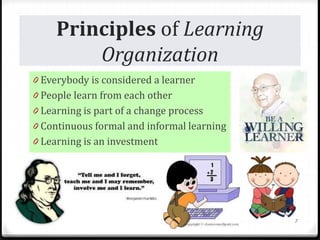
Principles of Learning
Organization
0 Everybody is considered a learner
0 People learn from each other
0 Learning is part of a change process
0 Continuous formal and informal learning
0 Learning is an investment
3
4 Key Dimensions of a
Learning Organization
1. Vision 2. Culture
3. Learning
Dynamics and
Systems
4. Knowledge
Management
and
Infrastructure
(Table 2.1) 4
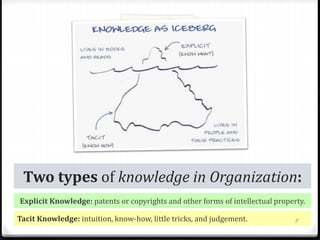
Two types of knowledge in Organization:
Explicit Knowledge: patents or copyrights and other forms of intellectual property.
Tacit Knowledge: intuition, know-how, little tricks, and judgement. 5
2 Types of Knowledge
Explicit Knowledge Tacit Knowledge
0 Can be written
into procedures or
coded into
database
0 Is transferred
fairly accurately
0 Only 20% of
corporate
knowledge is
explicit
0 80% of corporate
knowledge
0 Almost impossible to
transfer
0 Well-known example:
Decision-making
behaviour of dealers
in financial markets
0 Is said to be
instinctual
http://www.youtube.com/watch?v=cPNMQh6-I98 6
Human Capital
• Knowledge,
skills, and
abilities of
employees
Renewal
Capital
• Intellectual
property
Structural
Capital
• Formal systems
and informal
relationships
• Allow
employees
to:
Communicate,
solve
problems, and
make
decisions
Relationship
Capital
• Organization’s
relationships
with suppliers,
customers, and
competitors:
• Influence how
they do
business
Customer
Capital
• Value of an
organization’s
relationships
with its
customers
5 Types of Intellectual Capital
Intellectual Capital: An organization’s knowledge, experience, relationships,
process discoveries, innovations, market presence, and community influence.
7
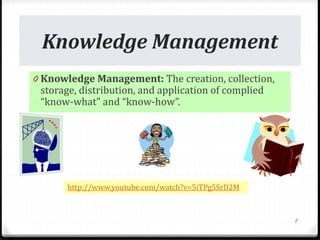
Knowledge Management
0 Knowledge Management: The creation, collection,
storage, distribution, and application of complied
“know-what” and “know-how”.
http://www.youtube.com/watch?v=5iTPg5SrD2M
8
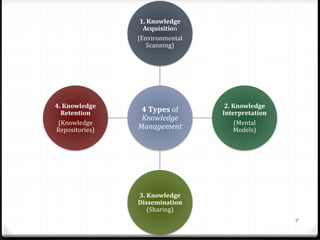
4 Types of
Knowledge
Management
1. Knowledge
Acquisition
(Environmental
Scanning)
2. Knowledge
Interpretation
(Mental
Models)
3. Knowledge
Dissemination
(Sharing)
4. Knowledge
Retention
(Knowledge
Repositories)
9
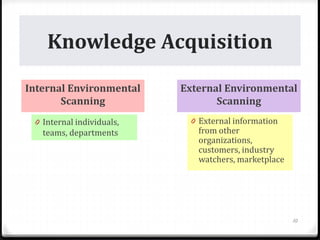
Knowledge Acquisition
Internal Environmental
Scanning
External Environmental
Scanning
0 Internal individuals,
teams, departments
0 External information
from other
organizations,
customers, industry
watchers, marketplace
10
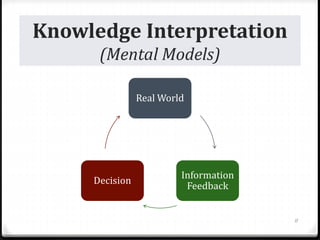
Knowledge Interpretation
(Mental Models)
Real World
Information
Feedback
Decision
11
Knowledge Dissemination
Knowledge
Sharing
12
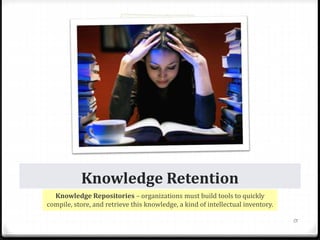
Knowledge Retention
Knowledge Repositories – organizations must build tools to quickly
compile, store, and retrieve this knowledge, a kind of intellectual inventory.
13
3 Characteristics of
Communities of Practice
http://www.youtube.com/watch?v=2paN0Ox-
Ia0&feature=youtu.be
1. Domain
2. Community
3. Practice
14
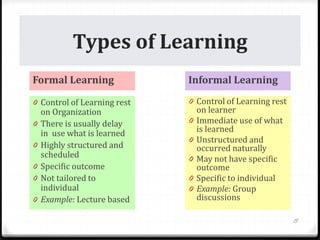
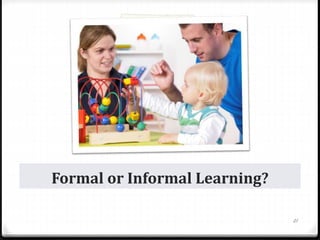
Types of Learning
Formal Learning Informal Learning
0 Control of Learning rest
on Organization
0 There is usually delay
in use what is learned
0 Highly structured and
scheduled
0 Specific outcome
0 Not tailored to
individual
0 Example: Lecture based
0 Control of Learning rest
on learner
0 Immediate use of what
is learned
0 Unstructured and
occurred naturally
0 May not have specific
outcome
0 Specific to individual
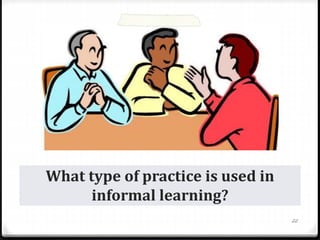
0 Example: Group
discussions
15
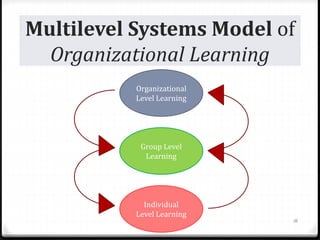
Group Level
Learning
Individual
Level Learning
Organizational
Level Learning
Multilevel Systems Model of
Organizational Learning
16
QUIZ TIME
17
What type of knowledge
management is this?
18
Which intellectual capital is
missing?
19
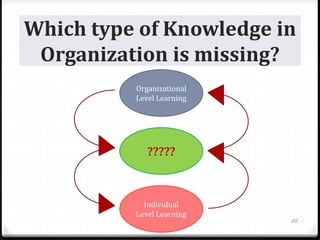
Which type of Knowledge in
Organization is missing?
?????
Individual
Level Learning
Organizational
Level Learning
20
Formal or Informal Learning?
21
What type of practice is used in
informal learning?
22
Video References
0 Dale, S. (2008). Communities of practices explained[Web].
Retrieved from
http://www.youtube.com/watch?v=2paN0Ox-
Ia0&feature=youtu.be
0 K3CubedLtd. (2012). Why should you be interested about
knowledge management today? [Web]. Retrieved from
http://www.youtube.com/watch?v=5iTPg5SrD2M
0 eClerxServices. (2012). Best ways to transfer
knowledge[Web]. Retrieved from
http://www.youtube.com/watch?v=cPNMQh6-I98
23
Wed Images References
0 unknown. (Artist). [Web Photo]. Retrieved from
http://blog.westinteractive.com/wp-content/uploads/Benjamin-
Franklin-Clip-Art3.png
0 unknown. (Artist). [Web Photo]. Retrieved from
http://www.challenge.gov.sg/wp-content/uploads/2011/01/be-a-
willing-learner-201101-03.jpg
0 unknown. (Artist). [Web Photo]. Retrieved from
http://www.monkeymagic.net/wp-
content/uploads/2013/07/368207381_5181538f5e.jpg
0 unknown. (Artist). [Web Photo]. Retrieved from
http://ozmosis.com/uploads/knowledge-everywhere-icon-lg.png
0 unknown. (Artist). [Web Photo]. Retrieved from
http://www.phf.org/Picture Library/Grouplearningtogether.png
24
Wed Images References
0 unknown. (Artist). [Web Photo]. Retrieved from
http://www.chemistryland.com/CHM107/Obstacles/PitfallsOfLear
ning.htm
0 unknown. (Artist). [Web Photo]. Retrieved from
http://www.infotrieve.com/share-and-collaborate
0 unknown. (Artist). [Web Photo]. Retrieved from
http://www.royceassociates.com/wp-
content/uploads/2009/06/chart21.gif
0 unknown. (Artist). [Web Photo]. Retrieved from
http://drsaraheaton.files.wordpress.com/2012/02/istock-family-
play-time.jpg
0 unknown. (Artist). [Web Photo]. Retrieved from
http://www.150queen.com/wp-
content/uploads/2012/10/Discussion.jpg
25

Organizational Learning Presentation (Training & Development) - Visual Learning Style

  • 2.
    5 Disciplines tobecoming a learning organization 1. Personal mastery 2. Building a shared vision 3. Mental models 4. Team learning 5. Systems thinking 2
  • 3.
    Principles of Learning Organization 0Everybody is considered a learner 0 People learn from each other 0 Learning is part of a change process 0 Continuous formal and informal learning 0 Learning is an investment 3
  • 4.
    4 Key Dimensionsof a Learning Organization 1. Vision 2. Culture 3. Learning Dynamics and Systems 4. Knowledge Management and Infrastructure (Table 2.1) 4
  • 5.
    Two types ofknowledge in Organization: Explicit Knowledge: patents or copyrights and other forms of intellectual property. Tacit Knowledge: intuition, know-how, little tricks, and judgement. 5
  • 6.
    2 Types ofKnowledge Explicit Knowledge Tacit Knowledge 0 Can be written into procedures or coded into database 0 Is transferred fairly accurately 0 Only 20% of corporate knowledge is explicit 0 80% of corporate knowledge 0 Almost impossible to transfer 0 Well-known example: Decision-making behaviour of dealers in financial markets 0 Is said to be instinctual http://www.youtube.com/watch?v=cPNMQh6-I98 6
  • 7.
    Human Capital • Knowledge, skills,and abilities of employees Renewal Capital • Intellectual property Structural Capital • Formal systems and informal relationships • Allow employees to: Communicate, solve problems, and make decisions Relationship Capital • Organization’s relationships with suppliers, customers, and competitors: • Influence how they do business Customer Capital • Value of an organization’s relationships with its customers 5 Types of Intellectual Capital Intellectual Capital: An organization’s knowledge, experience, relationships, process discoveries, innovations, market presence, and community influence. 7
  • 8.
    Knowledge Management 0 KnowledgeManagement: The creation, collection, storage, distribution, and application of complied “know-what” and “know-how”. http://www.youtube.com/watch?v=5iTPg5SrD2M 8
  • 9.
    4 Types of Knowledge Management 1.Knowledge Acquisition (Environmental Scanning) 2. Knowledge Interpretation (Mental Models) 3. Knowledge Dissemination (Sharing) 4. Knowledge Retention (Knowledge Repositories) 9
  • 10.
    Knowledge Acquisition Internal Environmental Scanning ExternalEnvironmental Scanning 0 Internal individuals, teams, departments 0 External information from other organizations, customers, industry watchers, marketplace 10
  • 11.
    Knowledge Interpretation (Mental Models) RealWorld Information Feedback Decision 11
  • 12.
  • 13.
    Knowledge Retention Knowledge Repositories– organizations must build tools to quickly compile, store, and retrieve this knowledge, a kind of intellectual inventory. 13
  • 14.
    3 Characteristics of Communitiesof Practice http://www.youtube.com/watch?v=2paN0Ox- Ia0&feature=youtu.be 1. Domain 2. Community 3. Practice 14
  • 15.
    Types of Learning FormalLearning Informal Learning 0 Control of Learning rest on Organization 0 There is usually delay in use what is learned 0 Highly structured and scheduled 0 Specific outcome 0 Not tailored to individual 0 Example: Lecture based 0 Control of Learning rest on learner 0 Immediate use of what is learned 0 Unstructured and occurred naturally 0 May not have specific outcome 0 Specific to individual 0 Example: Group discussions 15
  • 16.
    Group Level Learning Individual Level Learning Organizational LevelLearning Multilevel Systems Model of Organizational Learning 16
  • 17.
  • 18.
    What type ofknowledge management is this? 18
  • 19.
  • 20.
    Which type ofKnowledge in Organization is missing? ????? Individual Level Learning Organizational Level Learning 20
  • 21.
    Formal or InformalLearning? 21
  • 22.
    What type ofpractice is used in informal learning? 22
  • 23.
    Video References 0 Dale,S. (2008). Communities of practices explained[Web]. Retrieved from http://www.youtube.com/watch?v=2paN0Ox- Ia0&feature=youtu.be 0 K3CubedLtd. (2012). Why should you be interested about knowledge management today? [Web]. Retrieved from http://www.youtube.com/watch?v=5iTPg5SrD2M 0 eClerxServices. (2012). Best ways to transfer knowledge[Web]. Retrieved from http://www.youtube.com/watch?v=cPNMQh6-I98 23
  • 24.
    Wed Images References 0unknown. (Artist). [Web Photo]. Retrieved from http://blog.westinteractive.com/wp-content/uploads/Benjamin- Franklin-Clip-Art3.png 0 unknown. (Artist). [Web Photo]. Retrieved from http://www.challenge.gov.sg/wp-content/uploads/2011/01/be-a- willing-learner-201101-03.jpg 0 unknown. (Artist). [Web Photo]. Retrieved from http://www.monkeymagic.net/wp- content/uploads/2013/07/368207381_5181538f5e.jpg 0 unknown. (Artist). [Web Photo]. Retrieved from http://ozmosis.com/uploads/knowledge-everywhere-icon-lg.png 0 unknown. (Artist). [Web Photo]. Retrieved from http://www.phf.org/Picture Library/Grouplearningtogether.png 24
  • 25.
    Wed Images References 0unknown. (Artist). [Web Photo]. Retrieved from http://www.chemistryland.com/CHM107/Obstacles/PitfallsOfLear ning.htm 0 unknown. (Artist). [Web Photo]. Retrieved from http://www.infotrieve.com/share-and-collaborate 0 unknown. (Artist). [Web Photo]. Retrieved from http://www.royceassociates.com/wp- content/uploads/2009/06/chart21.gif 0 unknown. (Artist). [Web Photo]. Retrieved from http://drsaraheaton.files.wordpress.com/2012/02/istock-family- play-time.jpg 0 unknown. (Artist). [Web Photo]. Retrieved from http://www.150queen.com/wp- content/uploads/2012/10/Discussion.jpg 25