
1
The Fifth Discipline
by Peter Senge
2
Some Questions?
 Why do so many business strategies fail?
 Why do so many others fail to produce lasting results?
 Why do many businesses suffer from periodic crises and
fluctuating sales, earnings, and morale?
 Why do some firms grow while others stagnate? How do
once-dominant firms lose their competitive edge?
 And how can a firm identify and design high-leverage
policies, policies that are not thwarted by unanticipated
side effects?
 …?
3
What the Change does!
 Accelerating economic, technological, social,
and environmental change challenge
managers to learn at increasing rates.
 We must increasingly learn how to design
and manage complex systems with multiple
feedback effects, long time delays, and
nonlinear responses to our decisions .
4
Learning
 Effective learning in such environments
requires methods to represent and assess
such dynamic complexity and tools
managers can use to accelerate learning
throughout an organization
5
Learning is a Must!
 We must increasingly learn how to design
and manage complex systems with
multiple feedback effects, long time delays,
and nonlinear responses to our decisions.
 Effective learning requires methods and
tools which people can use to accelerate
learning.
6
Extraordinary Organizations…
 Are those that engage people’s
commitment and capacity to learn at all
levels in the organization
 Will recognize that the only truly
sustainable competitive advantage is the
rate at which organizations learn
 Nothing compares to the exhilaration that
comes from working within learning orgs.
7
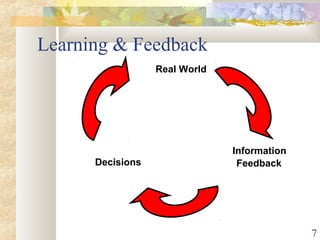
Real World
Information
FeedbackDecisions
Learning & Feedback
8
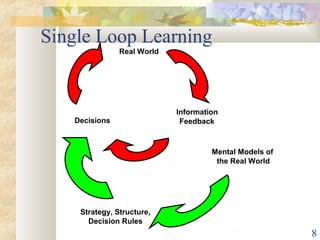
Real World
Information
FeedbackDecisions
Mental Models of
the Real World
Strategy, Structure,
Decision Rules
Single Loop Learning
9
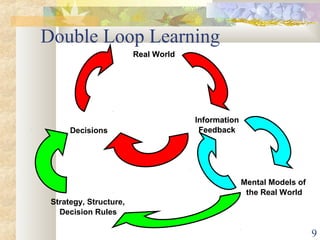
Real World
Information
Feedback
Real World
Information
FeedbackDecisions
Mental Models of
the Real World
Strategy, Structure,
Decision Rules
Double Loop Learning
10
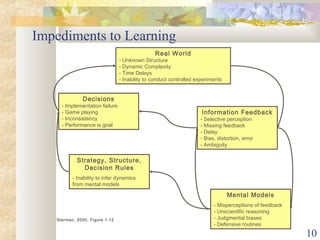
Real World
- Unknown Structure
- Dynamic Complexity
- Time Delays
- Inability to conduct controlled experiments
Mental Models
- Misperceptions of feedback
- Unscientific reasoning
- Judgmental biases
- Defensive routines
Information Feedback
- Selective perception
- Missing feedback
- Delay
- Bias, distortion, error
- Ambiguity
Strategy, Structure,
Decision Rules
- Inability to infer dynamics
from mental models
Decisions
- Implementation failure
- Game playing
- Inconsistency
- Performance is goal
Sterman, 2000, Figure 1-12
Impediments to Learning
11
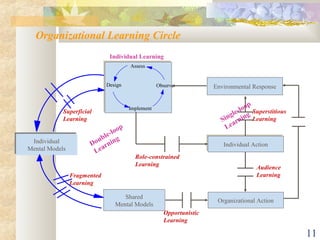
Design
Implement
Assess
Observe
Individual Learning
Individual
Mental Models
Individual
Mental Models
Role-constrained
Learning
Superstitious
Learning
Audience
Learning
Opportunistic
Learning
Superficial
Learning
Fragmented
Learning
Environmental Response
Individual ActionIndividual Action
Single-loop
Learning
Organizational Learning Circle
Shared
Mental Models
Organizational Action
Double-loop
Learning
12
Learning Organization
 "Organisations where people continually expand
their capacity to create the results they truly
desire, where new and expansive patterns of
thinking are nurtured, where collective aspiration
is set free, and where people are continually
learning to learn together"
Definition
 DEFINITION OF SYSTEM THEORY:
System theory is basically concerned with
problems of relationships, of structures,
and of interdependence, rather than with
the constant attributes of object (Katz and
Kahn, 1966).
Characteristics
 Haas & Drabek (1973) described eight
characteristics of organizations as open
systems:
 Organizations are systems within systems
 The systems are open, they cannot survive in
isolation from their environment
 Open systems follow the principle of
equifinality, i.e., the same final state can be
reached from different starting positions in
different ways
Characteristics (continued)
 Open systems have feedback and regulatory
mechanisms that allow adaptive responses to
environmental change
 Open systems should be viewed as patterned
sets of events
 Open systems have boundaries that
differentiate them from various environments,
the boundaries vary in permeability, i.e. what
and how can get through, and the situation at
hand
Characteristics (continued)
 System interaction, internally and externally,
reflects differing levels of control and
autonomy
 The open systems perspective is not
reductionistic – you cannot explain what
happens in the organization by focusing on
individual parts
Critique
 One of the criticisms of the open systems
perspective is that the concepts are difficult
to operationally define (Haas & Drabek,
1973)
 Peter M. Senge (2006) attempts to address
this criticism in his 2006 edition of The
fifth discipline
The Fifth Discipline
 Senge (2006) used Katz & Kahn’s (1966)
definition and Hass & Drabek’ s (1973)
characteristics in his work on the art and
practice of the learning organization.
 He argues that there are five core
disciplines necessary for a learning
organization: personal mastery, mental
models, shared visions, team learning, and
systems thinking
19
Disciplines of the Learning Organization
 Systems Thinking
 Personal Mastery
 Mental Models
 Shared Vision
 Team Learning
Personal Mastery
 “Personal mastery” is the phrase we use for
the discipline of personal growth and
learning. People with high levels of
personal mastery are continually expanding
their ability to create the results in life that
they truly seek (Senge, 2006, p. 131)
Underlying Movements
 Continually clarifying what is important to you.
 Continually learning how to see current reality
more clearly.
 Commitment to truth, “it means a relentless
willingness to root out the ways we limit or
deceive ourselves from seeing what is, and to
continually challenge our theories of why things
are the way they are” (Senge, 2006, p. 148).
Personal Mastery & Systems
Thinking
 “… integrating reason and intuition;
continually seeing more of our
connectedness to the world; compassion;
and commitment to the whole” (Senge,
2006, p. 156).
Mental Models
 Our mental models determine what we see
and what we do not see. They are the
symbols that we use to mentally process
the environment in which we function.
Mental Model Tools & Skills
 Pay attention to the distinction between
espoused theories (what we say) and
theories-in-use (the implied theory in what
we do)
 Recognizing leaps of abstraction –
attribution
 Balancing inquiry and advocacy
 Pay attention to what we think, but do not
say (Senge, 2006)
Systems Thinking
 Understand the patterns of behavior in your
organization.
 Figure out how to gain leverage/influence
of the patterns in your organization
References
 Von Bertalanffy, L. (1968). Passages from
General Systems Theory. Retrieved from
http://www.panarchy.org/vonbertalanffy/system
 Haas, J. E. and Drabek, T. E. (1973).
Complex organizations: A sociological
perspective. New York, NY: MacMillan.
References (continued)
 Katz, D. and Kahn, R. L. 1966. The social
psychology of organizations. New York,
NY: Wiley.
 Senge, P. M. (2006). The fifth discipline:
The art and practice of the learning
organization. New York, NY: Doubleday

The fifth discipline

  • 1.
  • 2.
    2 Some Questions?  Whydo so many business strategies fail?  Why do so many others fail to produce lasting results?  Why do many businesses suffer from periodic crises and fluctuating sales, earnings, and morale?  Why do some firms grow while others stagnate? How do once-dominant firms lose their competitive edge?  And how can a firm identify and design high-leverage policies, policies that are not thwarted by unanticipated side effects?  …?
  • 3.
    3 What the Changedoes!  Accelerating economic, technological, social, and environmental change challenge managers to learn at increasing rates.  We must increasingly learn how to design and manage complex systems with multiple feedback effects, long time delays, and nonlinear responses to our decisions .
  • 4.
    4 Learning  Effective learningin such environments requires methods to represent and assess such dynamic complexity and tools managers can use to accelerate learning throughout an organization
  • 5.
    5 Learning is aMust!  We must increasingly learn how to design and manage complex systems with multiple feedback effects, long time delays, and nonlinear responses to our decisions.  Effective learning requires methods and tools which people can use to accelerate learning.
  • 6.
    6 Extraordinary Organizations…  Arethose that engage people’s commitment and capacity to learn at all levels in the organization  Will recognize that the only truly sustainable competitive advantage is the rate at which organizations learn  Nothing compares to the exhilaration that comes from working within learning orgs.
  • 7.
  • 8.
    8 Real World Information FeedbackDecisions Mental Modelsof the Real World Strategy, Structure, Decision Rules Single Loop Learning
  • 9.
    9 Real World Information Feedback Real World Information FeedbackDecisions MentalModels of the Real World Strategy, Structure, Decision Rules Double Loop Learning
  • 10.
    10 Real World - UnknownStructure - Dynamic Complexity - Time Delays - Inability to conduct controlled experiments Mental Models - Misperceptions of feedback - Unscientific reasoning - Judgmental biases - Defensive routines Information Feedback - Selective perception - Missing feedback - Delay - Bias, distortion, error - Ambiguity Strategy, Structure, Decision Rules - Inability to infer dynamics from mental models Decisions - Implementation failure - Game playing - Inconsistency - Performance is goal Sterman, 2000, Figure 1-12 Impediments to Learning
  • 11.
    11 Design Implement Assess Observe Individual Learning Individual Mental Models Individual MentalModels Role-constrained Learning Superstitious Learning Audience Learning Opportunistic Learning Superficial Learning Fragmented Learning Environmental Response Individual ActionIndividual Action Single-loop Learning Organizational Learning Circle Shared Mental Models Organizational Action Double-loop Learning
  • 12.
    12 Learning Organization  "Organisationswhere people continually expand their capacity to create the results they truly desire, where new and expansive patterns of thinking are nurtured, where collective aspiration is set free, and where people are continually learning to learn together"
  • 13.
    Definition  DEFINITION OFSYSTEM THEORY: System theory is basically concerned with problems of relationships, of structures, and of interdependence, rather than with the constant attributes of object (Katz and Kahn, 1966).
  • 14.
    Characteristics  Haas &Drabek (1973) described eight characteristics of organizations as open systems:  Organizations are systems within systems  The systems are open, they cannot survive in isolation from their environment  Open systems follow the principle of equifinality, i.e., the same final state can be reached from different starting positions in different ways
  • 15.
    Characteristics (continued)  Opensystems have feedback and regulatory mechanisms that allow adaptive responses to environmental change  Open systems should be viewed as patterned sets of events  Open systems have boundaries that differentiate them from various environments, the boundaries vary in permeability, i.e. what and how can get through, and the situation at hand
  • 16.
    Characteristics (continued)  Systeminteraction, internally and externally, reflects differing levels of control and autonomy  The open systems perspective is not reductionistic – you cannot explain what happens in the organization by focusing on individual parts
  • 17.
    Critique  One ofthe criticisms of the open systems perspective is that the concepts are difficult to operationally define (Haas & Drabek, 1973)  Peter M. Senge (2006) attempts to address this criticism in his 2006 edition of The fifth discipline
  • 18.
    The Fifth Discipline Senge (2006) used Katz & Kahn’s (1966) definition and Hass & Drabek’ s (1973) characteristics in his work on the art and practice of the learning organization.  He argues that there are five core disciplines necessary for a learning organization: personal mastery, mental models, shared visions, team learning, and systems thinking
  • 19.
    19 Disciplines of theLearning Organization  Systems Thinking  Personal Mastery  Mental Models  Shared Vision  Team Learning
  • 20.
    Personal Mastery  “Personalmastery” is the phrase we use for the discipline of personal growth and learning. People with high levels of personal mastery are continually expanding their ability to create the results in life that they truly seek (Senge, 2006, p. 131)
  • 21.
    Underlying Movements  Continuallyclarifying what is important to you.  Continually learning how to see current reality more clearly.  Commitment to truth, “it means a relentless willingness to root out the ways we limit or deceive ourselves from seeing what is, and to continually challenge our theories of why things are the way they are” (Senge, 2006, p. 148).
  • 22.
    Personal Mastery &Systems Thinking  “… integrating reason and intuition; continually seeing more of our connectedness to the world; compassion; and commitment to the whole” (Senge, 2006, p. 156).
  • 23.
    Mental Models  Ourmental models determine what we see and what we do not see. They are the symbols that we use to mentally process the environment in which we function.
  • 24.
    Mental Model Tools& Skills  Pay attention to the distinction between espoused theories (what we say) and theories-in-use (the implied theory in what we do)  Recognizing leaps of abstraction – attribution  Balancing inquiry and advocacy  Pay attention to what we think, but do not say (Senge, 2006)
  • 25.
    Systems Thinking  Understandthe patterns of behavior in your organization.  Figure out how to gain leverage/influence of the patterns in your organization
  • 26.
    References  Von Bertalanffy,L. (1968). Passages from General Systems Theory. Retrieved from http://www.panarchy.org/vonbertalanffy/system  Haas, J. E. and Drabek, T. E. (1973). Complex organizations: A sociological perspective. New York, NY: MacMillan.
  • 27.
    References (continued)  Katz,D. and Kahn, R. L. 1966. The social psychology of organizations. New York, NY: Wiley.  Senge, P. M. (2006). The fifth discipline: The art and practice of the learning organization. New York, NY: Doubleday