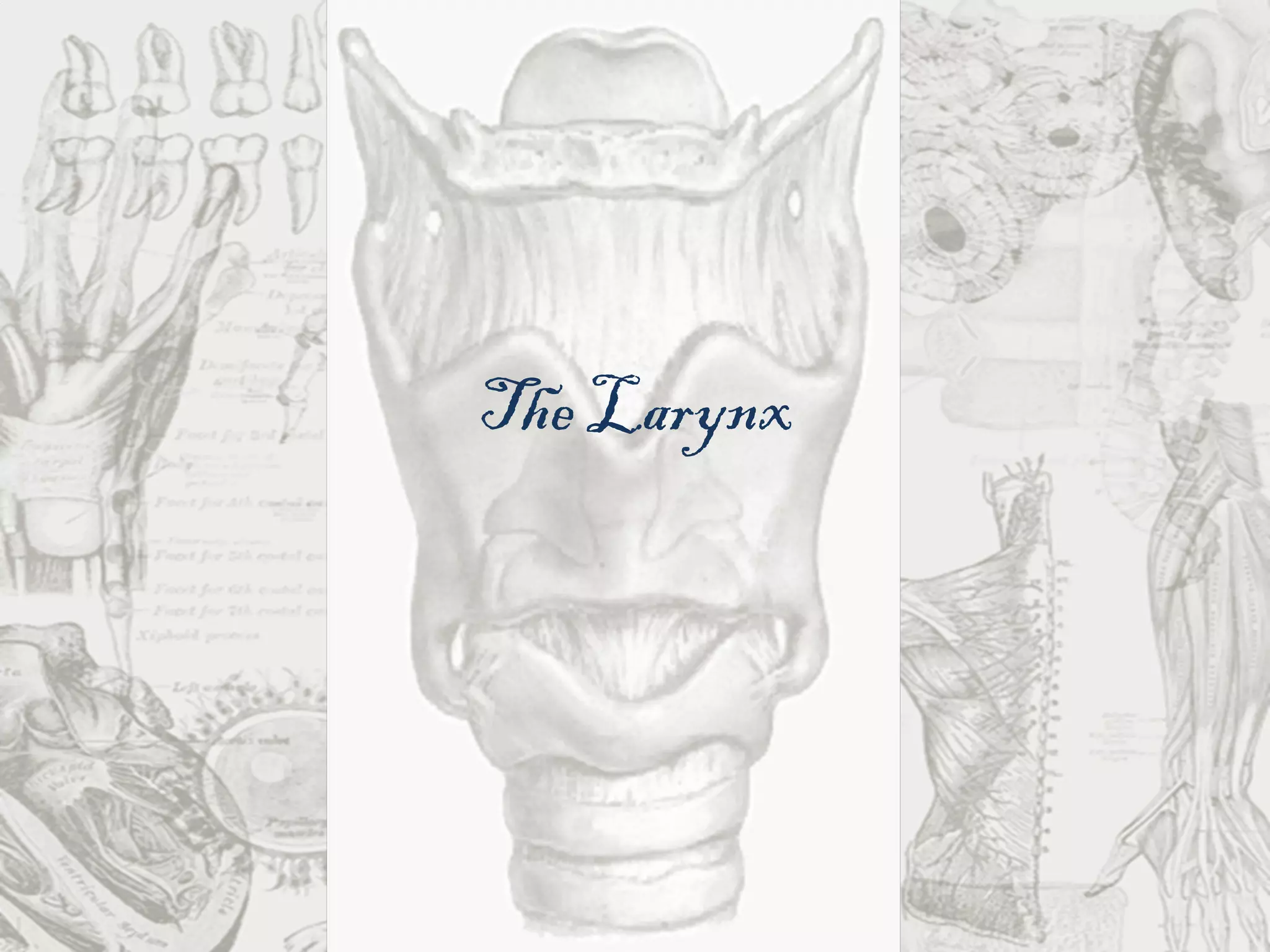
The Larynx
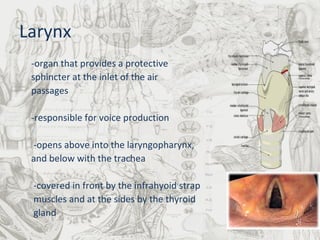
Larynx -organ that provides a protective  sphincter at the inlet of the air  passages -responsible for voice production   -opens above into the laryngopharynx,  and below with the trachea    -covered in front by the infrahyoid strap   muscles and at the sides by the thyroid    gland
Location -situated below the tongue and hyoid bone, between the great blood vessels of the neck -lies at the level of the 4 th , 5 th , and 6 th  cervical vertebrae
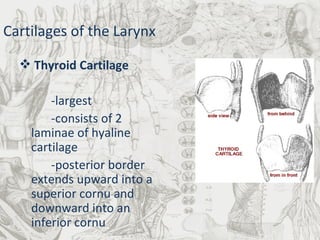
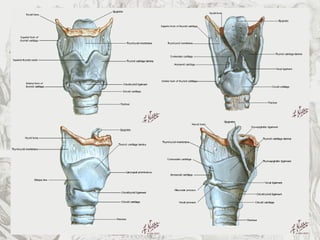
Cartilages of the Larynx Thyroid Cartilage -largest  -consists of 2 laminae of hyaline cartilage -posterior border extends upward into a superior cornu and downward into an  inferior cornu
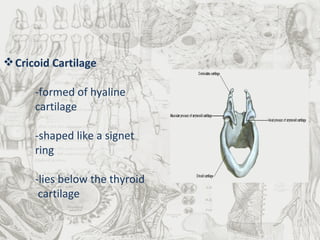
Cricoid Cartilage -formed of hyaline  cartilage -shaped like a signet  ring -lies below the thyroid   cartilage
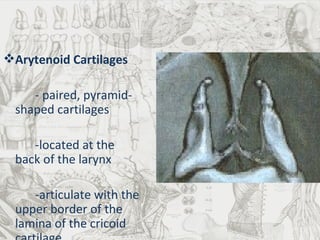
Arytenoid Cartilages - paired,  pyramid-shaped cartilages  -located at the back of the larynx -articulate with the upper border of the lamina of the cricoid cartilage
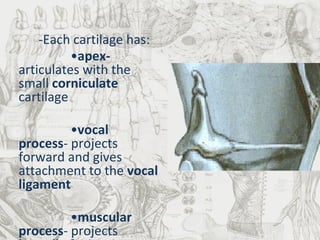
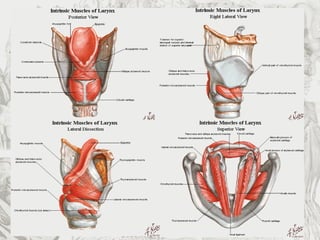
-Each cartilage has: • apex-  articulates with the small  corniculate  cartilage • vocal process - projects forward and gives attachment to the  vocal ligament • muscular process - projects laterally & gives attachment to the  posterior and lateral cricoarytenoid
 
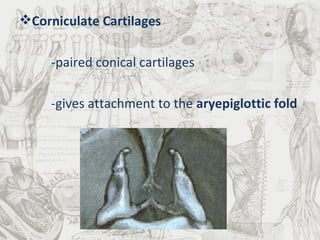
Corniculate Cartilages -paired conical cartilages -gives attachment to the  aryepiglottic fold
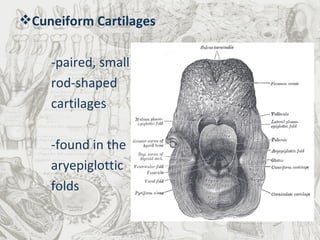
Cuneiform Cartilages  -paired, small  rod-shaped  cartilages -found in the aryepiglottic folds
 
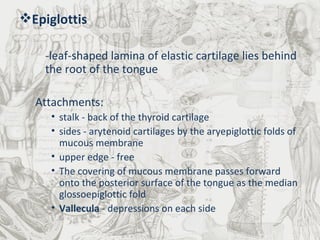
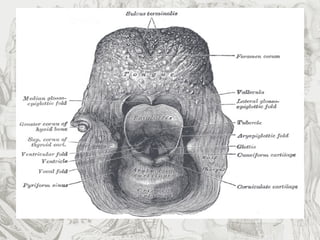
Epiglottis -leaf-shaped lamina of elastic cartilage lies behind the root of the tongue Attachments: stalk - back of the thyroid cartilage  sides - arytenoid cartilages by the aryepiglottic folds of mucous membrane upper edge - free  The covering of mucous membrane passes forward onto the posterior surface of the tongue as the median glossoepiglottic fold Vallecula  - depressions on each side
 
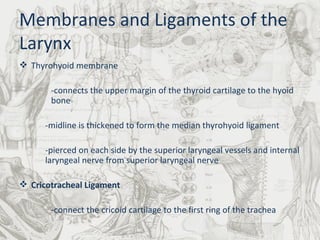
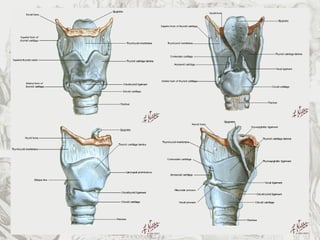
Membranes and Ligaments of the Larynx Thyrohyoid membrane -connects the upper margin of the thyroid cartilage to the hyoid  bone -midline is thickened to form the median thyrohyoid ligament  -pierced on each side by the superior laryngeal vessels and internal laryngeal nerve from superior laryngeal nerve Cricotracheal Ligament -connect the cricoid cartilage to the first ring of the trachea
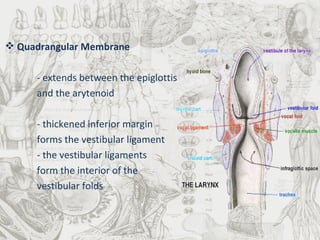
Quadrangular Membrane - extends between the epiglottis  and the arytenoid - thickened inferior margin  forms the vestibular ligament  - the vestibular ligaments  form the interior of the  vestibular folds
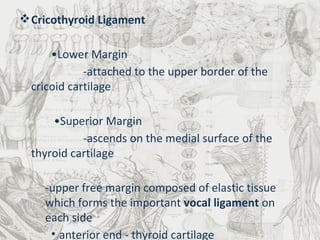
Cricothyroid Ligament • Lower Margin -attached to the upper border of the cricoid cartilage  • Superior Margin -ascends on the medial surface of the thyroid cartilage -upper free margin composed of elastic tissue which forms the important  vocal ligament  on each side anterior end - thyroid cartilage posterior end - arytenoid cartilage -vocal ligaments form the interior of the  vocal folds (vocal cords)
 
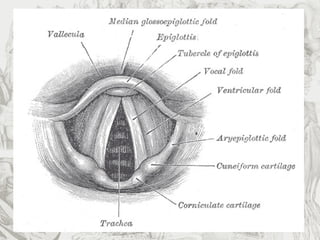
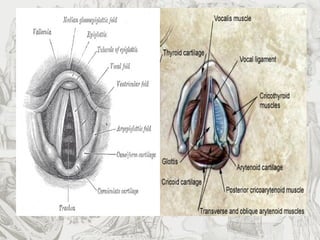
Inlet of the Larynx (Laryngeal aditus/Laryngeal aperture) -opening is wider in front than behind Boundaries:   • Anterior- Epiglottis    • Lateral- Aryepiglottic fold   • Posterior- Arytenoid cartilages &     Corniculate cartilages
 
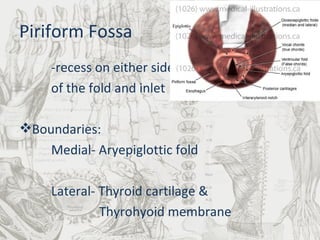
Piriform Fossa -recess on either side  of the fold and inlet Boundaries: Medial- Aryepiglottic fold Lateral- Thyroid cartilage &   Thyrohyoid membrane
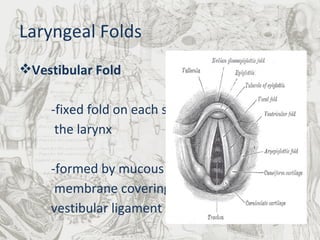
Laryngeal Folds Vestibular Fold -fixed fold on each side of   the larynx -formed by mucous   membrane covering the vestibular ligament -vascular and pink in   color
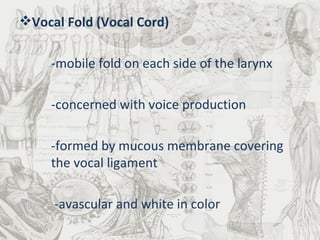
Vocal Fold (Vocal Cord) -mobile fold on each side of the larynx -concerned with voice production -formed by mucous membrane covering  the vocal ligament    -avascular and white in color
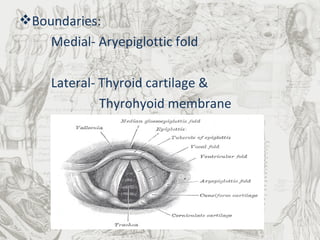
Boundaries: Medial- Aryepiglottic fold Lateral- Thyroid cartilage &   Thyrohyoid membrane
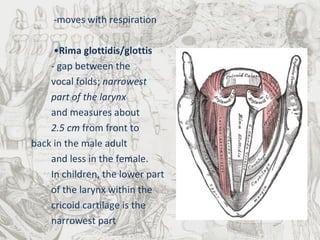
  -moves with respiration  • Rima glottidis/glottis  - gap between the  vocal folds;  narrowest part of the larynx   and measures about  2.5 cm  from front to back in the male adult and less in the female.  In children, the lower part  of the larynx within the  cricoid cartilage is the  narrowest part
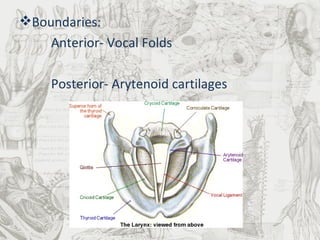
Boundaries: Anterior- Vocal Folds Posterior- Arytenoid cartilages
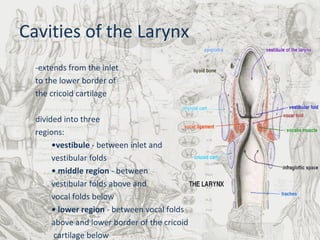
Cavities of the Larynx -extends from the inlet  to the lower border of  the cricoid cartilage divided into three regions: • vestibule  - between inlet and vestibular folds •  middle region  - between  vestibular folds above and  vocal folds below •  lower region  - between vocal folds above and lower border of the cricoid cartilage below
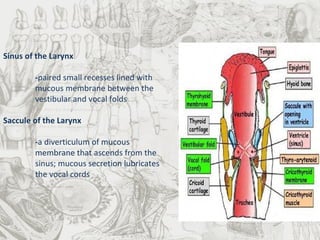
Sinus of the Larynx  - paired small recesses lined with mucous membrane between the vestibular and vocal folds Saccule of the Larynx  - a diverticulum of mucous  membrane that ascends from the sinus; mucous secretion lubricates the vocal cords
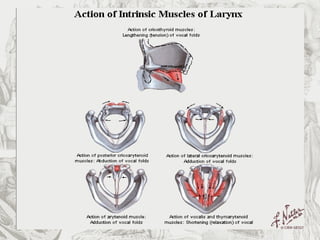
Muscles of the Larynx -divided into two groups Extrinsic - moves the larynx up and down during  swallowing
Muscles of the Larynx   • Elevation: Digastric Stylohyoid Mylohyoid Geniohyoid Stylopharyngeus Salpingopharyngeus  Palatopharyngeus   • Depression: Sternothyroid Sternohyoid Omohyoid
$
 
 
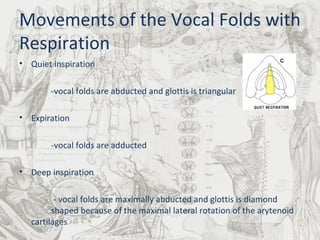
Movements of the Vocal Folds with Respiration Quiet inspiration  -vocal folds are abducted and glottis is triangular Expiration  -vocal folds are adducted Deep inspiration   - vocal folds are maximally abducted and glottis is diamond  shaped because of the maximal lateral rotation of the arytenoid cartilages
Sphincteric Function of the Larynx -two sphincters in the larynx sphincter at the inlet is used only during swallowing  epiglottis - serves as a cap over the laryngeal inlet rima glottidis serves as a sphincter in coughing or sneezing intrathoracic pressure rises; vocal folds are suddenly abducted;  Valsalva maneuver , forced expiration takes place against a closed glottis
Voice Production in the Larynx - intermittent release of expired air between  the  adducted vocal folds results in their vibration  and in the production of sound Frequency/pitch - length and tension of the vocal ligaments Quality - resonators above the larynx, namely, the pharynx, mouth, and paranasal sinuses; it is controlled by the muscles of the soft plate, tongue, floor of the mouth, cheeks, lips, and jaws
Voice Production in the Larynx Speech - intermittent release of expired air between the adducted vocal folds  Singing - prolonged release of the expired air between the adducted vocal folds Whispering - the vocal folds are adducted, but the arytenoid cartilages are separated
Mucous Membrane of the Larynx Cavity – lined by ciliated columnar epithelium  Vocal cords – lined by stratified squamous epithelium
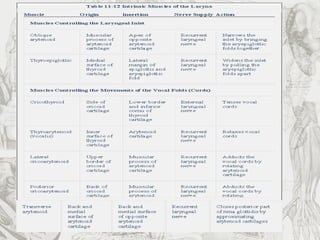
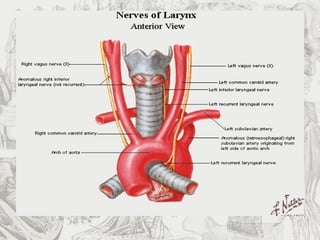
Nerve Supply of the Larynx Sensory Nerves Above the vocal cords:  internal laryngeal branch of the superior laryngeal branch of the vagus nerve Below the level of the vocal cords : recurrent laryngeal nerve Motor Nerves All: recurrent laryngeal nerve except cricothyroid muscle which is supplied by external laryngeal branch of the superior laryngeal branch of the vagus nerve
 
Blood Supply of the Larynx Upper half of the larynx: superior laryngeal branch of superior thyroid artery Lower half of the larynx: inferior laryngeal branch of inferior thyroid artery - deep cervical lymph nodes Lymph Drainage of the Larynx
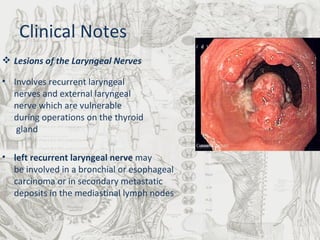
Lesions of the Laryngeal Nerves Involves recurrent laryngeal  nerves and external laryngeal  nerve which are vulnerable during operations on the thyroid   gland left recurrent laryngeal nerve  may  be involved in a bronchial or esophageal carcinoma or in secondary metastatic  deposits in the mediastinal lymph nodes Clinical Notes
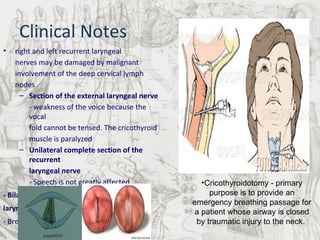
right and left recurrent laryngeal  nerves may be damaged by malignant  involvement of the deep cervical lymph  nodes Section of the external laryngeal nerve   - weakness of the voice because the vocal fold cannot be tensed. The cricothyroid  muscle is paralyzed  Unilateral complete section of the recurrent  laryngeal nerve - Speech is not greatly affected - Bilateral complete section of the recurrent  laryngeal nerve   - Breathing is impaired; speech is lost  Clinical Notes Cricothyroidotomy - primary purpose is to provide an emergency breathing passage for a patient whose airway is closed by traumatic injury to the neck.
END
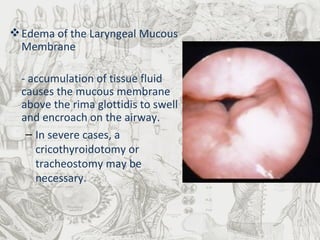
Edema of the Laryngeal Mucous Membrane - accumulation of tissue fluid causes the mucous membrane above the rima glottidis to swell and encroach on the airway.  In severe cases, a cricothyroidotomy or tracheostomy may be necessary.

Larynxxx

  • 1.
  • 2.
    Larynx -organ thatprovides a protective sphincter at the inlet of the air passages -responsible for voice production -opens above into the laryngopharynx, and below with the trachea -covered in front by the infrahyoid strap muscles and at the sides by the thyroid gland
  • 3.
    Location -situated belowthe tongue and hyoid bone, between the great blood vessels of the neck -lies at the level of the 4 th , 5 th , and 6 th cervical vertebrae
  • 4.
    Cartilages of theLarynx Thyroid Cartilage -largest -consists of 2 laminae of hyaline cartilage -posterior border extends upward into a superior cornu and downward into an inferior cornu
  • 5.
    Cricoid Cartilage -formedof hyaline cartilage -shaped like a signet ring -lies below the thyroid cartilage
  • 6.
    Arytenoid Cartilages -paired, pyramid-shaped cartilages -located at the back of the larynx -articulate with the upper border of the lamina of the cricoid cartilage
  • 7.
    -Each cartilage has:• apex- articulates with the small corniculate cartilage • vocal process - projects forward and gives attachment to the vocal ligament • muscular process - projects laterally & gives attachment to the posterior and lateral cricoarytenoid
  • 8.
  • 9.
    Corniculate Cartilages -pairedconical cartilages -gives attachment to the aryepiglottic fold
  • 10.
    Cuneiform Cartilages -paired, small rod-shaped cartilages -found in the aryepiglottic folds
  • 11.
  • 12.
    Epiglottis -leaf-shaped laminaof elastic cartilage lies behind the root of the tongue Attachments: stalk - back of the thyroid cartilage sides - arytenoid cartilages by the aryepiglottic folds of mucous membrane upper edge - free The covering of mucous membrane passes forward onto the posterior surface of the tongue as the median glossoepiglottic fold Vallecula - depressions on each side
  • 13.
  • 14.
    Membranes and Ligamentsof the Larynx Thyrohyoid membrane -connects the upper margin of the thyroid cartilage to the hyoid bone -midline is thickened to form the median thyrohyoid ligament -pierced on each side by the superior laryngeal vessels and internal laryngeal nerve from superior laryngeal nerve Cricotracheal Ligament -connect the cricoid cartilage to the first ring of the trachea
  • 15.
    Quadrangular Membrane -extends between the epiglottis and the arytenoid - thickened inferior margin forms the vestibular ligament - the vestibular ligaments form the interior of the vestibular folds
  • 16.
    Cricothyroid Ligament •Lower Margin -attached to the upper border of the cricoid cartilage • Superior Margin -ascends on the medial surface of the thyroid cartilage -upper free margin composed of elastic tissue which forms the important vocal ligament on each side anterior end - thyroid cartilage posterior end - arytenoid cartilage -vocal ligaments form the interior of the vocal folds (vocal cords)
  • 17.
  • 18.
    Inlet of theLarynx (Laryngeal aditus/Laryngeal aperture) -opening is wider in front than behind Boundaries: • Anterior- Epiglottis • Lateral- Aryepiglottic fold • Posterior- Arytenoid cartilages & Corniculate cartilages
  • 19.
  • 20.
    Piriform Fossa -recesson either side of the fold and inlet Boundaries: Medial- Aryepiglottic fold Lateral- Thyroid cartilage & Thyrohyoid membrane
  • 21.
    Laryngeal Folds VestibularFold -fixed fold on each side of the larynx -formed by mucous membrane covering the vestibular ligament -vascular and pink in color
  • 22.
    Vocal Fold (VocalCord) -mobile fold on each side of the larynx -concerned with voice production -formed by mucous membrane covering the vocal ligament -avascular and white in color
  • 23.
    Boundaries: Medial- Aryepiglotticfold Lateral- Thyroid cartilage & Thyrohyoid membrane
  • 24.
    -moveswith respiration • Rima glottidis/glottis - gap between the vocal folds; narrowest part of the larynx and measures about 2.5 cm from front to back in the male adult and less in the female. In children, the lower part of the larynx within the cricoid cartilage is the narrowest part
  • 25.
    Boundaries: Anterior- VocalFolds Posterior- Arytenoid cartilages
  • 26.
    Cavities of theLarynx -extends from the inlet to the lower border of the cricoid cartilage divided into three regions: • vestibule - between inlet and vestibular folds • middle region - between vestibular folds above and vocal folds below • lower region - between vocal folds above and lower border of the cricoid cartilage below
  • 27.
    Sinus of theLarynx - paired small recesses lined with mucous membrane between the vestibular and vocal folds Saccule of the Larynx - a diverticulum of mucous membrane that ascends from the sinus; mucous secretion lubricates the vocal cords
  • 28.
    Muscles of theLarynx -divided into two groups Extrinsic - moves the larynx up and down during swallowing
  • 29.
    Muscles of theLarynx • Elevation: Digastric Stylohyoid Mylohyoid Geniohyoid Stylopharyngeus Salpingopharyngeus Palatopharyngeus • Depression: Sternothyroid Sternohyoid Omohyoid
  • 30.
  • 31.
  • 32.
  • 33.
    Movements of theVocal Folds with Respiration Quiet inspiration -vocal folds are abducted and glottis is triangular Expiration -vocal folds are adducted Deep inspiration - vocal folds are maximally abducted and glottis is diamond shaped because of the maximal lateral rotation of the arytenoid cartilages
  • 34.
    Sphincteric Function ofthe Larynx -two sphincters in the larynx sphincter at the inlet is used only during swallowing epiglottis - serves as a cap over the laryngeal inlet rima glottidis serves as a sphincter in coughing or sneezing intrathoracic pressure rises; vocal folds are suddenly abducted; Valsalva maneuver , forced expiration takes place against a closed glottis
  • 35.
    Voice Production inthe Larynx - intermittent release of expired air between the adducted vocal folds results in their vibration and in the production of sound Frequency/pitch - length and tension of the vocal ligaments Quality - resonators above the larynx, namely, the pharynx, mouth, and paranasal sinuses; it is controlled by the muscles of the soft plate, tongue, floor of the mouth, cheeks, lips, and jaws
  • 36.
    Voice Production inthe Larynx Speech - intermittent release of expired air between the adducted vocal folds Singing - prolonged release of the expired air between the adducted vocal folds Whispering - the vocal folds are adducted, but the arytenoid cartilages are separated
  • 37.
    Mucous Membrane ofthe Larynx Cavity – lined by ciliated columnar epithelium Vocal cords – lined by stratified squamous epithelium
  • 38.
    Nerve Supply ofthe Larynx Sensory Nerves Above the vocal cords: internal laryngeal branch of the superior laryngeal branch of the vagus nerve Below the level of the vocal cords : recurrent laryngeal nerve Motor Nerves All: recurrent laryngeal nerve except cricothyroid muscle which is supplied by external laryngeal branch of the superior laryngeal branch of the vagus nerve
  • 39.
  • 40.
    Blood Supply ofthe Larynx Upper half of the larynx: superior laryngeal branch of superior thyroid artery Lower half of the larynx: inferior laryngeal branch of inferior thyroid artery - deep cervical lymph nodes Lymph Drainage of the Larynx
  • 41.
    Lesions of theLaryngeal Nerves Involves recurrent laryngeal nerves and external laryngeal nerve which are vulnerable during operations on the thyroid gland left recurrent laryngeal nerve may be involved in a bronchial or esophageal carcinoma or in secondary metastatic deposits in the mediastinal lymph nodes Clinical Notes
  • 42.
    right and leftrecurrent laryngeal nerves may be damaged by malignant involvement of the deep cervical lymph nodes Section of the external laryngeal nerve - weakness of the voice because the vocal fold cannot be tensed. The cricothyroid muscle is paralyzed Unilateral complete section of the recurrent laryngeal nerve - Speech is not greatly affected - Bilateral complete section of the recurrent laryngeal nerve - Breathing is impaired; speech is lost Clinical Notes Cricothyroidotomy - primary purpose is to provide an emergency breathing passage for a patient whose airway is closed by traumatic injury to the neck.
  • 43.
  • 44.
    Edema of theLaryngeal Mucous Membrane - accumulation of tissue fluid causes the mucous membrane above the rima glottidis to swell and encroach on the airway. In severe cases, a cricothyroidotomy or tracheostomy may be necessary.