• AMER MD
THE LARYNX
• The larynx is a complex hollow structure located in the
anterior midline region of the neck. It is anterior to the
esophagus and at the level of the third to the sixth
cervical vertebrae in its normal position. It consists of a
cartilaginous skeleton connected by membranes,
ligaments and associated muscles that suspend it from
surrounding structures.
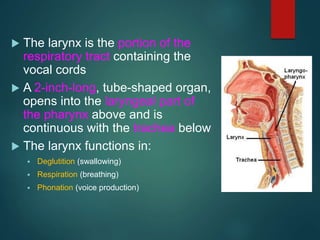
 The larynx is the portion of the
respiratory tract containing the
vocal cords
 A 2-inch-long, tube-shaped organ,
opens into the laryngeal part of
the pharynx above and is
continuous with the trachea below
 The larynx functions in:
 Deglutition (swallowing)
 Respiration (breathing)
 Phonation (voice production)
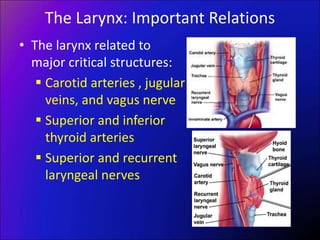
The Larynx: Important Relations
• The larynx related to
major critical structures:
 Carotid arteries , jugular
veins, and vagus nerve
 Superior and inferior
thyroid arteries
 Superior and recurrent
laryngeal nerves
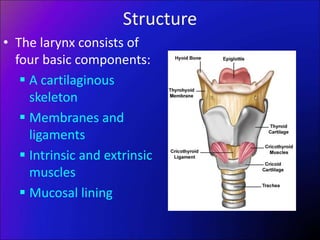
Structure
• The larynx consists of
four basic components:
 A cartilaginous
skeleton
 Membranes and
ligaments
 Intrinsic and extrinsic
muscles
 Mucosal lining
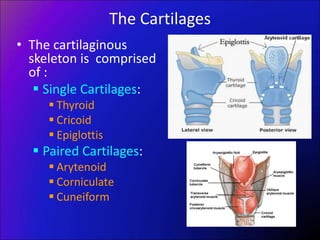
The Cartilages
• The cartilaginous
skeleton is comprised
of :
 Single Cartilages:
 Thyroid
 Cricoid
 Epiglottis
 Paired Cartilages:
 Arytenoid
 Corniculate
 Cuneiform
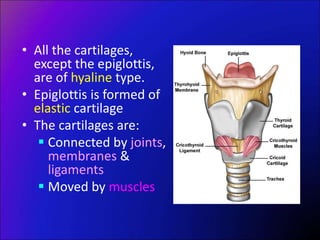
• All the cartilages,
except the epiglottis,
are of hyaline type.
• Epiglottis is formed of
elastic cartilage
• The cartilages are:
 Connected by joints,
membranes &
ligaments
 Moved by muscles
Thyroid Cartilage
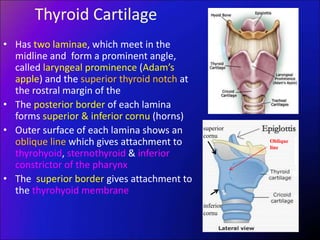
• Has two laminae, which meet in the
midline and form a prominent angle,
called laryngeal prominence (Adam’s
apple) and the superior thyroid notch at
the rostral margin of the
• The posterior border of each lamina
forms superior & inferior cornu (horns)
• Outer surface of each lamina shows an
oblique line which gives attachment to
thyrohyoid, sternothyroid & inferior
constrictor of the pharynx
• The superior border gives attachment to
the thyrohyoid membrane
Oblique
line
superior
cornu
inferior
cornu
Cricoid Cartilage
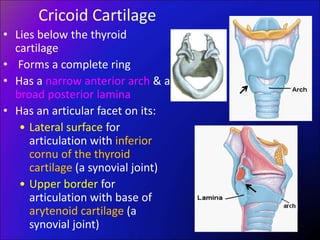
• Lies below the thyroid
cartilage
• Forms a complete ring
• Has a narrow anterior arch & a
broad posterior lamina
• Has an articular facet on its:
• Lateral surface for
articulation with inferior
cornu of the thyroid
cartilage (a synovial joint)
• Upper border for
articulation with base of
arytenoid cartilage (a
synovial joint)
Arytenoid Cartilages
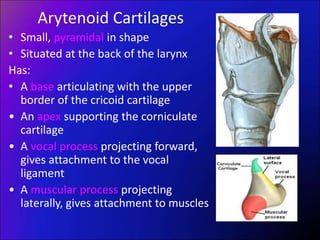
• Small, pyramidal in shape
• Situated at the back of the larynx
Has:
• A base articulating with the upper
border of the cricoid cartilage
• An apex supporting the corniculate
cartilage
• A vocal process projecting forward,
gives attachment to the vocal
ligament
• A muscular process projecting
laterally, gives attachment to muscles
Corniculate & Cuneiform Cartilages
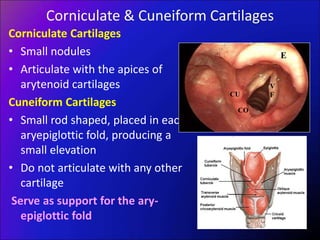
Corniculate Cartilages
• Small nodules
• Articulate with the apices of
arytenoid cartilages
Cuneiform Cartilages
• Small rod shaped, placed in each
aryepiglottic fold, producing a
small elevation
• Do not articulate with any other
cartilage
Serve as support for the ary-
epiglottic fold
E
CU
CO
V
F
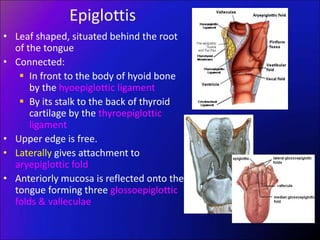
Epiglottis
• Leaf shaped, situated behind the root
of the tongue
• Connected:
 In front to the body of hyoid bone
by the hyoepiglottic ligament
 By its stalk to the back of thyroid
cartilage by the thyroepiglottic
ligament
• Upper edge is free.
• Laterally gives attachment to
aryepiglottic fold
• Anteriorly mucosa is reflected onto the
tongue forming three glossoepiglottic
folds & valleculae
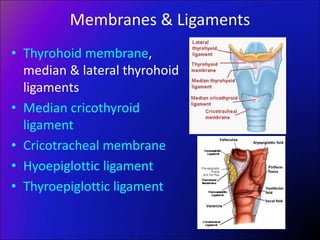
Membranes & Ligaments
• Thyrohoid membrane,
median & lateral thyrohoid
ligaments
• Median cricothyroid
ligament
• Cricotracheal membrane
• Hyoepiglottic ligament
• Thyroepiglottic ligament
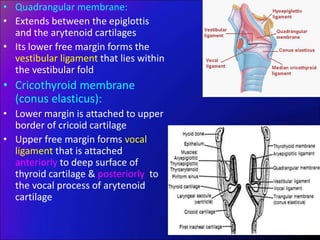
• Quadrangular membrane:
• Extends between the epiglottis
and the arytenoid cartilages
• Its lower free margin forms the
vestibular ligament that lies within
the vestibular fold
• Cricothyroid membrane
(conus elasticus):
• Lower margin is attached to upper
border of cricoid cartilage
• Upper free margin forms vocal
ligament that is attached
anteriorly to deep surface of
thyroid cartilage & posteriorly to
the vocal process of arytenoid
cartilage
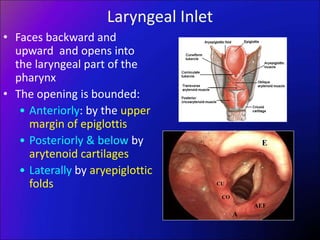
Laryngeal Inlet
• Faces backward and
upward and opens into
the laryngeal part of the
pharynx
• The opening is bounded:
• Anteriorly: by the upper
margin of epiglottis
• Posteriorly & below by
arytenoid cartilages
• Laterally by aryepiglottic
folds
E
CU
CO
AEF
A
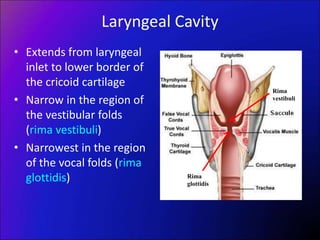
Laryngeal Cavity
• Extends from laryngeal
inlet to lower border of
the cricoid cartilage
• Narrow in the region of
the vestibular folds
(rima vestibuli)
• Narrowest in the region
of the vocal folds (rima
glottidis)
Rima
vestibuli
Rima
glottidis
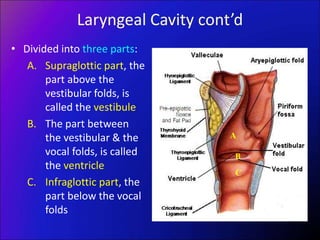
Laryngeal Cavity cont’d
• Divided into three parts:
A. Supraglottic part, the
part above the
vestibular folds, is
called the vestibule
B. The part between
the vestibular & the
vocal folds, is called
the ventricle
C. Infraglottic part, the
part below the vocal
folds
A
B
C
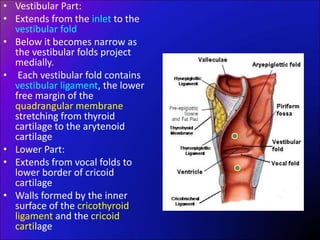
• Vestibular Part:
• Extends from the inlet to the
vestibular fold
• Below it becomes narrow as
the vestibular folds project
medially.
• Each vestibular fold contains
vestibular ligament, the lower
free margin of the
quadrangular membrane
stretching from thyroid
cartilage to the arytenoid
cartilage
• Lower Part:
• Extends from vocal folds to
lower border of cricoid
cartilage
• Walls formed by the inner
surface of the cricothyroid
ligament and the cricoid
cartilage
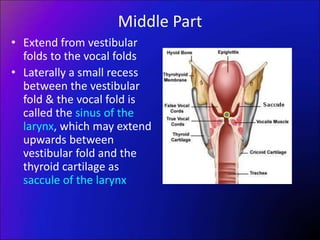
Middle Part
• Extend from vestibular
folds to the vocal folds
• Laterally a small recess
between the vestibular
fold & the vocal fold is
called the sinus of the
larynx, which may extend
upwards between
vestibular fold and the
thyroid cartilage as
saccule of the larynx
Mucous Membrane
• The cavity is lined with ciliated columnar epithelium
• The surface of vocal folds, because of exposure to continuous trauma
during phonation, is covered with stratified squamous epithelium
• Contains many mucous glands, more numerous in the saccule (for
lubrication of vocal folds)
Muscles:
Divided into two groups:
• Extrinsic muscles: divided into two groups
• Elevators of the larynx
• Depressors of the larynx
• Intrinsic muscles: divided into two groups
• Muscles controlling the laryngeal inlet
• Muscles controlling the movements of the vocal cords
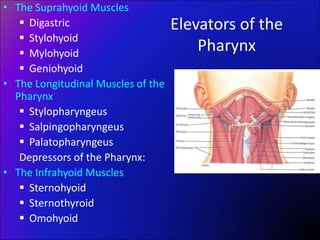
Elevators of the
Pharynx
• The Suprahyoid Muscles
 Digastric
 Stylohyoid
 Mylohyoid
 Geniohyoid
• The Longitudinal Muscles of the
Pharynx
 Stylopharyngeus
 Salpingopharyngeus
 Palatopharyngeus
Depressors of the Pharynx:
• The Infrahyoid Muscles
 Sternohyoid
 Sternothyroid
 Omohyoid
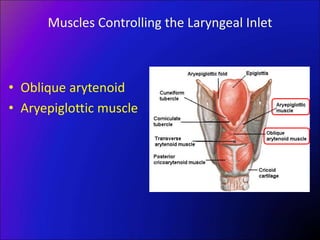
Muscles Controlling the Laryngeal Inlet
• Oblique arytenoid
• Aryepiglottic muscle
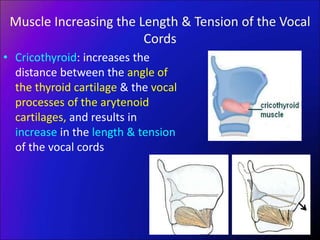
Muscle Increasing the Length & Tension of the Vocal
Cords
• Cricothyroid: increases the
distance between the angle of
the thyroid cartilage & the vocal
processes of the arytenoid
cartilages, and results in
increase in the length & tension
of the vocal cords
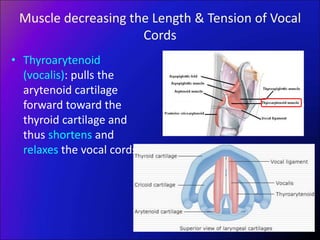
Muscle decreasing the Length & Tension of Vocal
Cords
• Thyroarytenoid
(vocalis): pulls the
arytenoid cartilage
forward toward the
thyroid cartilage and
thus shortens and
relaxes the vocal cords
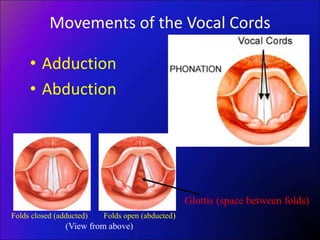
Movements of the Vocal Cords
• Adduction
• Abduction
Folds closed (adducted) Folds open (abducted)
(View from above)
Glottis (space between folds)
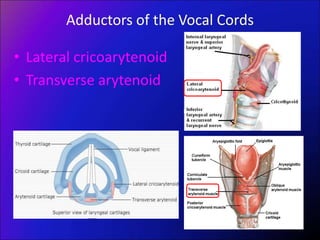
Adductors of the Vocal Cords
• Lateral cricoarytenoid
• Transverse arytenoid
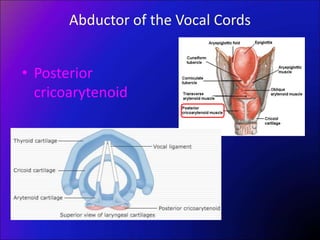
Abductor of the Vocal Cords
• Posterior
cricoarytenoid
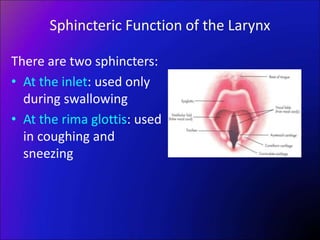
Sphincteric Function of the Larynx
There are two sphincters:
• At the inlet: used only
during swallowing
• At the rima glottis: used
in coughing and
sneezing
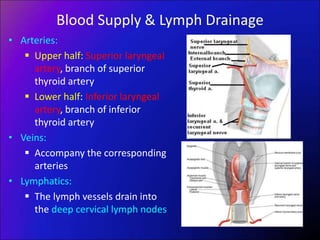
Blood Supply & Lymph Drainage
• Arteries:
 Upper half: Superior laryngeal
artery, branch of superior
thyroid artery
 Lower half: Inferior laryngeal
artery, branch of inferior
thyroid artery
• Veins:
 Accompany the corresponding
arteries
• Lymphatics:
 The lymph vessels drain into
the deep cervical lymph nodes
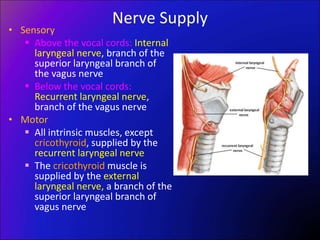
Nerve Supply
• Sensory
 Above the vocal cords: Internal
laryngeal nerve, branch of the
superior laryngeal branch of
the vagus nerve
 Below the vocal cords:
Recurrent laryngeal nerve,
branch of the vagus nerve
• Motor
 All intrinsic muscles, except
cricothyroid, supplied by the
recurrent laryngeal nerve
 The cricothyroid muscle is
supplied by the external
laryngeal nerve, a branch of the
superior laryngeal branch of
vagus nerve
Production of Voice
• The production of voice has three components:
• The generation of sound: Sound production originates from the larynx as a
fundamental tone by the intermittent release of expired air between the
adducted vocal cords resulting in their vibration.
• The resonance of sound: This tone is modified by various resonating
chambers (resonators) i.e. pharynx, mouth and paranasal sinuses.
• The articulation of voice (speech production) : Finally converted to speech
by the action of the mouth, nose, nasal cavity and throat, where the
tongue, palate, cheek and lips are involved in articulation
Parameters of Voice
• Quality, Loudness, and Pitch
• Quality :depends on symmetrical vibration at the midline of the glottis
• Loudness : is influenced by subglottic pressure, glottic resistance,
transglottic air flow, and amplitude of vibration
• Pitch : depends on the alterations in length and tension of vocal folds
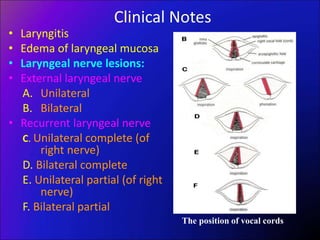
Clinical Notes
• Laryngitis
• Edema of laryngeal mucosa
• Laryngeal nerve lesions:
• External laryngeal nerve
A. Unilateral
B. Bilateral
• Recurrent laryngeal nerve
C. Unilateral complete (of
right nerve)
D. Bilateral complete
E. Unilateral partial (of right
nerve)
F. Bilateral partial
The position of vocal cords

LARYNX.pptx

  • 1.
  • 2.
    THE LARYNX • Thelarynx is a complex hollow structure located in the anterior midline region of the neck. It is anterior to the esophagus and at the level of the third to the sixth cervical vertebrae in its normal position. It consists of a cartilaginous skeleton connected by membranes, ligaments and associated muscles that suspend it from surrounding structures.
  • 3.
     The larynxis the portion of the respiratory tract containing the vocal cords  A 2-inch-long, tube-shaped organ, opens into the laryngeal part of the pharynx above and is continuous with the trachea below  The larynx functions in:  Deglutition (swallowing)  Respiration (breathing)  Phonation (voice production)
  • 4.
    The Larynx: ImportantRelations • The larynx related to major critical structures:  Carotid arteries , jugular veins, and vagus nerve  Superior and inferior thyroid arteries  Superior and recurrent laryngeal nerves
  • 5.
    Structure • The larynxconsists of four basic components:  A cartilaginous skeleton  Membranes and ligaments  Intrinsic and extrinsic muscles  Mucosal lining
  • 6.
    The Cartilages • Thecartilaginous skeleton is comprised of :  Single Cartilages:  Thyroid  Cricoid  Epiglottis  Paired Cartilages:  Arytenoid  Corniculate  Cuneiform
  • 7.
    • All thecartilages, except the epiglottis, are of hyaline type. • Epiglottis is formed of elastic cartilage • The cartilages are:  Connected by joints, membranes & ligaments  Moved by muscles
  • 8.
    Thyroid Cartilage • Hastwo laminae, which meet in the midline and form a prominent angle, called laryngeal prominence (Adam’s apple) and the superior thyroid notch at the rostral margin of the • The posterior border of each lamina forms superior & inferior cornu (horns) • Outer surface of each lamina shows an oblique line which gives attachment to thyrohyoid, sternothyroid & inferior constrictor of the pharynx • The superior border gives attachment to the thyrohyoid membrane Oblique line superior cornu inferior cornu
  • 9.
    Cricoid Cartilage • Liesbelow the thyroid cartilage • Forms a complete ring • Has a narrow anterior arch & a broad posterior lamina • Has an articular facet on its: • Lateral surface for articulation with inferior cornu of the thyroid cartilage (a synovial joint) • Upper border for articulation with base of arytenoid cartilage (a synovial joint)
  • 10.
    Arytenoid Cartilages • Small,pyramidal in shape • Situated at the back of the larynx Has: • A base articulating with the upper border of the cricoid cartilage • An apex supporting the corniculate cartilage • A vocal process projecting forward, gives attachment to the vocal ligament • A muscular process projecting laterally, gives attachment to muscles
  • 11.
    Corniculate & CuneiformCartilages Corniculate Cartilages • Small nodules • Articulate with the apices of arytenoid cartilages Cuneiform Cartilages • Small rod shaped, placed in each aryepiglottic fold, producing a small elevation • Do not articulate with any other cartilage Serve as support for the ary- epiglottic fold E CU CO V F
  • 12.
    Epiglottis • Leaf shaped,situated behind the root of the tongue • Connected:  In front to the body of hyoid bone by the hyoepiglottic ligament  By its stalk to the back of thyroid cartilage by the thyroepiglottic ligament • Upper edge is free. • Laterally gives attachment to aryepiglottic fold • Anteriorly mucosa is reflected onto the tongue forming three glossoepiglottic folds & valleculae
  • 13.
    Membranes & Ligaments •Thyrohoid membrane, median & lateral thyrohoid ligaments • Median cricothyroid ligament • Cricotracheal membrane • Hyoepiglottic ligament • Thyroepiglottic ligament
  • 14.
    • Quadrangular membrane: •Extends between the epiglottis and the arytenoid cartilages • Its lower free margin forms the vestibular ligament that lies within the vestibular fold • Cricothyroid membrane (conus elasticus): • Lower margin is attached to upper border of cricoid cartilage • Upper free margin forms vocal ligament that is attached anteriorly to deep surface of thyroid cartilage & posteriorly to the vocal process of arytenoid cartilage
  • 15.
    Laryngeal Inlet • Facesbackward and upward and opens into the laryngeal part of the pharynx • The opening is bounded: • Anteriorly: by the upper margin of epiglottis • Posteriorly & below by arytenoid cartilages • Laterally by aryepiglottic folds E CU CO AEF A
  • 16.
    Laryngeal Cavity • Extendsfrom laryngeal inlet to lower border of the cricoid cartilage • Narrow in the region of the vestibular folds (rima vestibuli) • Narrowest in the region of the vocal folds (rima glottidis) Rima vestibuli Rima glottidis
  • 17.
    Laryngeal Cavity cont’d •Divided into three parts: A. Supraglottic part, the part above the vestibular folds, is called the vestibule B. The part between the vestibular & the vocal folds, is called the ventricle C. Infraglottic part, the part below the vocal folds A B C
  • 18.
    • Vestibular Part: •Extends from the inlet to the vestibular fold • Below it becomes narrow as the vestibular folds project medially. • Each vestibular fold contains vestibular ligament, the lower free margin of the quadrangular membrane stretching from thyroid cartilage to the arytenoid cartilage • Lower Part: • Extends from vocal folds to lower border of cricoid cartilage • Walls formed by the inner surface of the cricothyroid ligament and the cricoid cartilage
  • 19.
    Middle Part • Extendfrom vestibular folds to the vocal folds • Laterally a small recess between the vestibular fold & the vocal fold is called the sinus of the larynx, which may extend upwards between vestibular fold and the thyroid cartilage as saccule of the larynx
  • 20.
    Mucous Membrane • Thecavity is lined with ciliated columnar epithelium • The surface of vocal folds, because of exposure to continuous trauma during phonation, is covered with stratified squamous epithelium • Contains many mucous glands, more numerous in the saccule (for lubrication of vocal folds) Muscles: Divided into two groups: • Extrinsic muscles: divided into two groups • Elevators of the larynx • Depressors of the larynx • Intrinsic muscles: divided into two groups • Muscles controlling the laryngeal inlet • Muscles controlling the movements of the vocal cords
  • 21.
    Elevators of the Pharynx •The Suprahyoid Muscles  Digastric  Stylohyoid  Mylohyoid  Geniohyoid • The Longitudinal Muscles of the Pharynx  Stylopharyngeus  Salpingopharyngeus  Palatopharyngeus Depressors of the Pharynx: • The Infrahyoid Muscles  Sternohyoid  Sternothyroid  Omohyoid
  • 22.
    Muscles Controlling theLaryngeal Inlet • Oblique arytenoid • Aryepiglottic muscle
  • 23.
    Muscle Increasing theLength & Tension of the Vocal Cords • Cricothyroid: increases the distance between the angle of the thyroid cartilage & the vocal processes of the arytenoid cartilages, and results in increase in the length & tension of the vocal cords
  • 24.
    Muscle decreasing theLength & Tension of Vocal Cords • Thyroarytenoid (vocalis): pulls the arytenoid cartilage forward toward the thyroid cartilage and thus shortens and relaxes the vocal cords
  • 25.
    Movements of theVocal Cords • Adduction • Abduction Folds closed (adducted) Folds open (abducted) (View from above) Glottis (space between folds)
  • 26.
    Adductors of theVocal Cords • Lateral cricoarytenoid • Transverse arytenoid
  • 27.
    Abductor of theVocal Cords • Posterior cricoarytenoid
  • 28.
    Sphincteric Function ofthe Larynx There are two sphincters: • At the inlet: used only during swallowing • At the rima glottis: used in coughing and sneezing
  • 29.
    Blood Supply &Lymph Drainage • Arteries:  Upper half: Superior laryngeal artery, branch of superior thyroid artery  Lower half: Inferior laryngeal artery, branch of inferior thyroid artery • Veins:  Accompany the corresponding arteries • Lymphatics:  The lymph vessels drain into the deep cervical lymph nodes
  • 30.
    Nerve Supply • Sensory Above the vocal cords: Internal laryngeal nerve, branch of the superior laryngeal branch of the vagus nerve  Below the vocal cords: Recurrent laryngeal nerve, branch of the vagus nerve • Motor  All intrinsic muscles, except cricothyroid, supplied by the recurrent laryngeal nerve  The cricothyroid muscle is supplied by the external laryngeal nerve, a branch of the superior laryngeal branch of vagus nerve
  • 31.
    Production of Voice •The production of voice has three components: • The generation of sound: Sound production originates from the larynx as a fundamental tone by the intermittent release of expired air between the adducted vocal cords resulting in their vibration. • The resonance of sound: This tone is modified by various resonating chambers (resonators) i.e. pharynx, mouth and paranasal sinuses. • The articulation of voice (speech production) : Finally converted to speech by the action of the mouth, nose, nasal cavity and throat, where the tongue, palate, cheek and lips are involved in articulation Parameters of Voice • Quality, Loudness, and Pitch • Quality :depends on symmetrical vibration at the midline of the glottis • Loudness : is influenced by subglottic pressure, glottic resistance, transglottic air flow, and amplitude of vibration • Pitch : depends on the alterations in length and tension of vocal folds
  • 32.
    Clinical Notes • Laryngitis •Edema of laryngeal mucosa • Laryngeal nerve lesions: • External laryngeal nerve A. Unilateral B. Bilateral • Recurrent laryngeal nerve C. Unilateral complete (of right nerve) D. Bilateral complete E. Unilateral partial (of right nerve) F. Bilateral partial The position of vocal cords