The Larynx
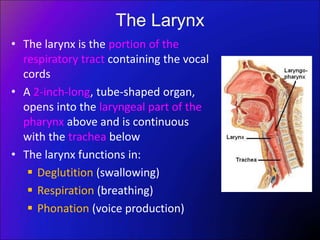
• The larynx is the portion of the
respiratory tract containing the vocal
cords
• A 2-inch-long, tube-shaped organ,
opens into the laryngeal part of the
pharynx above and is continuous
with the trachea below
• The larynx functions in:
 Deglutition (swallowing)
 Respiration (breathing)
 Phonation (voice production)
The Larynx: Important Relations
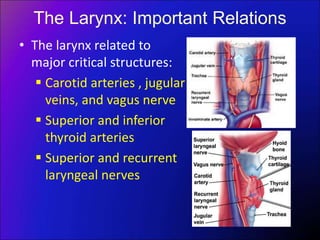
• The larynx related to
major critical structures:
 Carotid arteries , jugular
veins, and vagus nerve
 Superior and inferior
thyroid arteries
 Superior and recurrent
laryngeal nerves
Structure
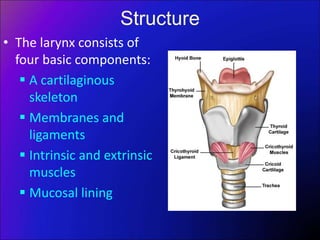
• The larynx consists of
four basic components:
 A cartilaginous
skeleton
 Membranes and
ligaments
 Intrinsic and extrinsic
muscles
 Mucosal lining
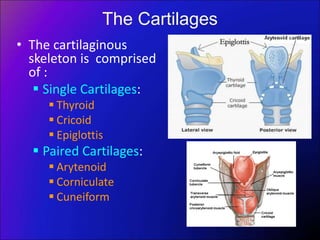
The Cartilages
• The cartilaginous
skeleton is comprised
of :
 Single Cartilages:
 Thyroid
 Cricoid
 Epiglottis
 Paired Cartilages:
 Arytenoid
 Corniculate
 Cuneiform
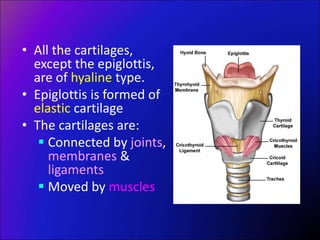
• All the cartilages,
except the epiglottis,
are of hyaline type.
• Epiglottis is formed of
elastic cartilage
• The cartilages are:
 Connected by joints,
membranes &
ligaments
 Moved by muscles
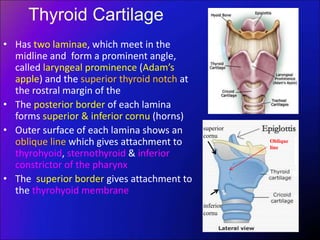
Thyroid Cartilage
• Has two laminae, which meet in the
midline and form a prominent angle,
called laryngeal prominence (Adam’s
apple) and the superior thyroid notch at
the rostral margin of the
• The posterior border of each lamina
forms superior & inferior cornu (horns)
• Outer surface of each lamina shows an
oblique line which gives attachment to
thyrohyoid, sternothyroid & inferior
constrictor of the pharynx
• The superior border gives attachment to
the thyrohyoid membrane
Oblique
line
superior
cornu
inferior
cornu
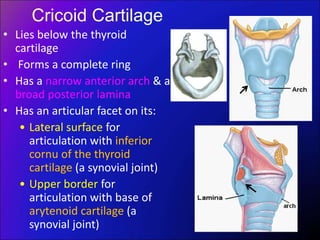
Cricoid Cartilage
• Lies below the thyroid
cartilage
• Forms a complete ring
• Has a narrow anterior arch & a
broad posterior lamina
• Has an articular facet on its:
• Lateral surface for
articulation with inferior
cornu of the thyroid
cartilage (a synovial joint)
• Upper border for
articulation with base of
arytenoid cartilage (a
synovial joint)
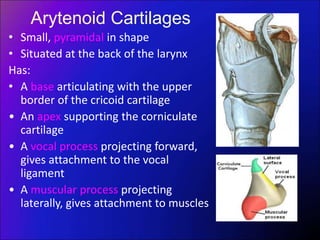
Arytenoid Cartilages
• Small, pyramidal in shape
• Situated at the back of the larynx
Has:
• A base articulating with the upper
border of the cricoid cartilage
• An apex supporting the corniculate
cartilage
• A vocal process projecting forward,
gives attachment to the vocal
ligament
• A muscular process projecting
laterally, gives attachment to muscles
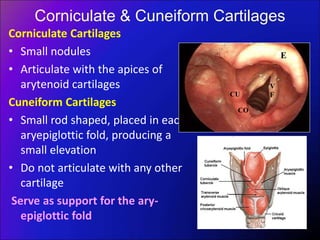
Corniculate & Cuneiform Cartilages
Corniculate Cartilages
• Small nodules
• Articulate with the apices of
arytenoid cartilages
Cuneiform Cartilages
• Small rod shaped, placed in each
aryepiglottic fold, producing a
small elevation
• Do not articulate with any other
cartilage
Serve as support for the ary-
epiglottic fold
E
CU
CO
V
F
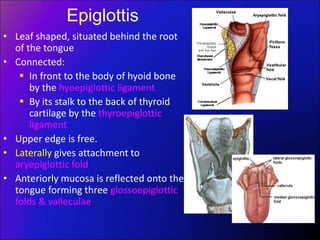
Epiglottis
• Leaf shaped, situated behind the root
of the tongue
• Connected:
 In front to the body of hyoid bone
by the hyoepiglottic ligament
 By its stalk to the back of thyroid
cartilage by the thyroepiglottic
ligament
• Upper edge is free.
• Laterally gives attachment to
aryepiglottic fold
• Anteriorly mucosa is reflected onto the
tongue forming three glossoepiglottic
folds & valleculae
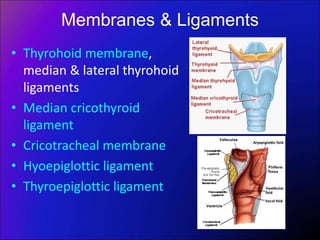
Membranes & Ligaments
• Thyrohoid membrane,
median & lateral thyrohoid
ligaments
• Median cricothyroid
ligament
• Cricotracheal membrane
• Hyoepiglottic ligament
• Thyroepiglottic ligament
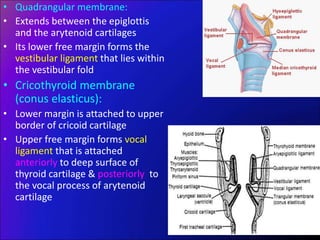
• Quadrangular membrane:
• Extends between the epiglottis
and the arytenoid cartilages
• Its lower free margin forms the
vestibular ligament that lies within
the vestibular fold
• Cricothyroid membrane
(conus elasticus):
• Lower margin is attached to upper
border of cricoid cartilage
• Upper free margin forms vocal
ligament that is attached
anteriorly to deep surface of
thyroid cartilage & posteriorly to
the vocal process of arytenoid
cartilage
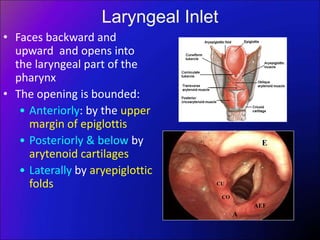
Laryngeal Inlet
• Faces backward and
upward and opens into
the laryngeal part of the
pharynx
• The opening is bounded:
• Anteriorly: by the upper
margin of epiglottis
• Posteriorly & below by
arytenoid cartilages
• Laterally by aryepiglottic
folds
E
CU
CO
AEF
A
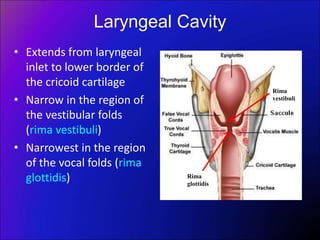
Laryngeal Cavity
• Extends from laryngeal
inlet to lower border of
the cricoid cartilage
• Narrow in the region of
the vestibular folds
(rima vestibuli)
• Narrowest in the region
of the vocal folds (rima
glottidis)
Rima
vestibuli
Rima
glottidis
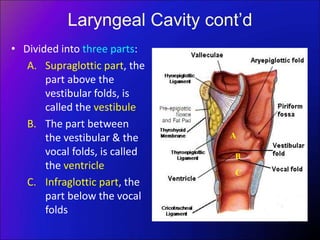
Laryngeal Cavity cont’d
• Divided into three parts:
A. Supraglottic part, the
part above the
vestibular folds, is
called the vestibule
B. The part between
the vestibular & the
vocal folds, is called
the ventricle
C. Infraglottic part, the
part below the vocal
folds
A
B
C
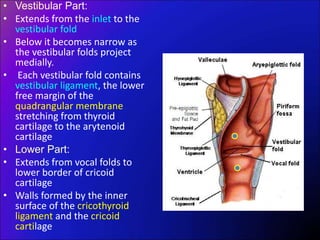
• Vestibular Part:
• Extends from the inlet to the
vestibular fold
• Below it becomes narrow as
the vestibular folds project
medially.
• Each vestibular fold contains
vestibular ligament, the lower
free margin of the
quadrangular membrane
stretching from thyroid
cartilage to the arytenoid
cartilage
• Lower Part:
• Extends from vocal folds to
lower border of cricoid
cartilage
• Walls formed by the inner
surface of the cricothyroid
ligament and the cricoid
cartilage
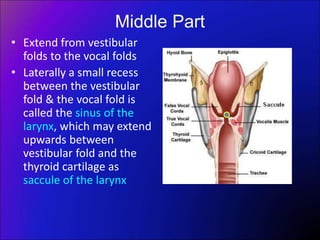
Middle Part
• Extend from vestibular
folds to the vocal folds
• Laterally a small recess
between the vestibular
fold & the vocal fold is
called the sinus of the
larynx, which may extend
upwards between
vestibular fold and the
thyroid cartilage as
saccule of the larynx
Mucous Membrane
• The cavity is lined with ciliated columnar epithelium
• The surface of vocal folds, because of exposure to continuous trauma
during phonation, is covered with stratified squamous epithelium
• Contains many mucous glands, more numerous in the saccule (for
lubrication of vocal folds)
Muscles:
Divided into two groups:
• Extrinsic muscles: divided into two groups
• Elevators of the larynx
• Depressors of the larynx
• Intrinsic muscles: divided into two groups
• Muscles controlling the laryngeal inlet
• Muscles controlling the movements of the vocal cords
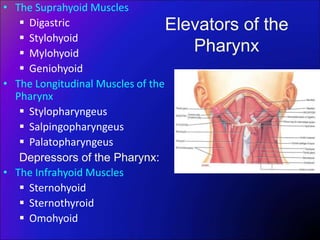
Elevators of the
Pharynx
• The Suprahyoid Muscles
 Digastric
 Stylohyoid
 Mylohyoid
 Geniohyoid
• The Longitudinal Muscles of the
Pharynx
 Stylopharyngeus
 Salpingopharyngeus
 Palatopharyngeus
Depressors of the Pharynx:
• The Infrahyoid Muscles
 Sternohyoid
 Sternothyroid
 Omohyoid
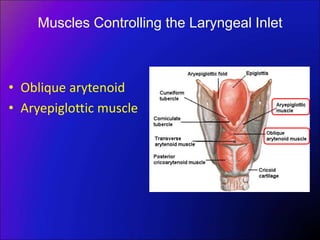
Muscles Controlling the Laryngeal Inlet
• Oblique arytenoid
• Aryepiglottic muscle
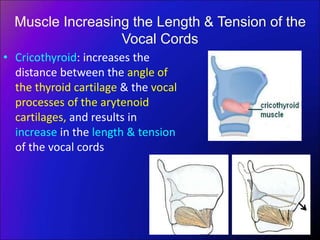
Muscle Increasing the Length & Tension of the
Vocal Cords
• Cricothyroid: increases the
distance between the angle of
the thyroid cartilage & the vocal
processes of the arytenoid
cartilages, and results in
increase in the length & tension
of the vocal cords
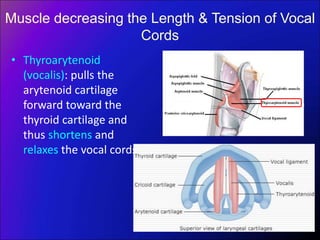
Muscle decreasing the Length & Tension of Vocal
Cords
• Thyroarytenoid
(vocalis): pulls the
arytenoid cartilage
forward toward the
thyroid cartilage and
thus shortens and
relaxes the vocal cords
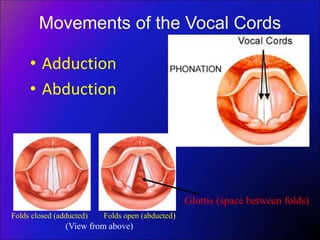
Movements of the Vocal Cords
• Adduction
• Abduction
Folds closed (adducted) Folds open (abducted)
(View from above)
Glottis (space between folds)
Adductors of the Vocal Cords
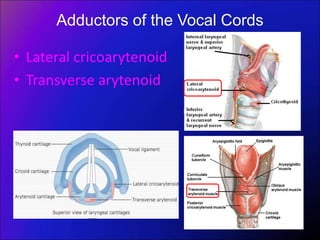
• Lateral cricoarytenoid
• Transverse arytenoid
Abductor of the Vocal Cords
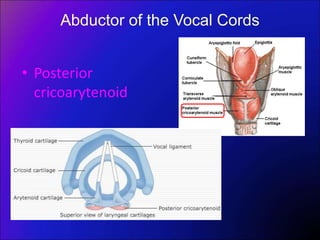
• Posterior
cricoarytenoid
Sphincteric Function of the Larynx
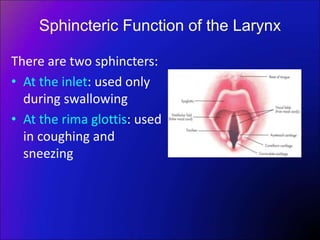
There are two sphincters:
• At the inlet: used only
during swallowing
• At the rima glottis: used
in coughing and
sneezing
Blood Supply & Lymph Drainage
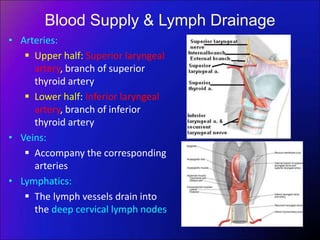
• Arteries:
 Upper half: Superior laryngeal
artery, branch of superior
thyroid artery
 Lower half: Inferior laryngeal
artery, branch of inferior
thyroid artery
• Veins:
 Accompany the corresponding
arteries
• Lymphatics:
 The lymph vessels drain into
the deep cervical lymph nodes
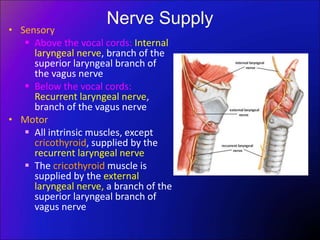
Nerve Supply
• Sensory
 Above the vocal cords: Internal
laryngeal nerve, branch of the
superior laryngeal branch of
the vagus nerve
 Below the vocal cords:
Recurrent laryngeal nerve,
branch of the vagus nerve
• Motor
 All intrinsic muscles, except
cricothyroid, supplied by the
recurrent laryngeal nerve
 The cricothyroid muscle is
supplied by the external
laryngeal nerve, a branch of the
superior laryngeal branch of
vagus nerve
Production of Voice
• The production of voice has three components:
• The generation of sound: Sound production originates from the larynx as a
fundamental tone by the intermittent release of expired air between the
adducted vocal cords resulting in their vibration.
• The resonance of sound: This tone is modified by various resonating
chambers (resonators) i.e. pharynx, mouth and paranasal sinuses.
• The articulation of voice (speech production) : Finally converted to speech
by the action of the mouth, nose, nasal cavity and throat, where the
tongue, palate, cheek and lips are involved in articulation
Parameters of Voice
• Quality, Loudness, and Pitch
• Quality :depends on symmetrical vibration at the midline of the glottis
• Loudness : is influenced by subglottic pressure, glottic resistance,
transglottic air flow, and amplitude of vibration
• Pitch : depends on the alterations in length and tension of vocal folds
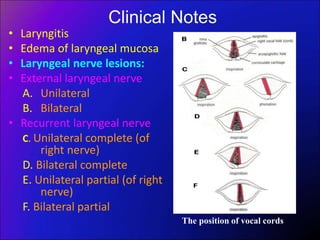
Clinical Notes
• Laryngitis
• Edema of laryngeal mucosa
• Laryngeal nerve lesions:
• External laryngeal nerve
A. Unilateral
B. Bilateral
• Recurrent laryngeal nerve
C. Unilateral complete (of
right nerve)
D. Bilateral complete
E. Unilateral partial (of right
nerve)
F. Bilateral partial
The position of vocal cords

15-LARYNX.ppt

  • 1.
    The Larynx • Thelarynx is the portion of the respiratory tract containing the vocal cords • A 2-inch-long, tube-shaped organ, opens into the laryngeal part of the pharynx above and is continuous with the trachea below • The larynx functions in:  Deglutition (swallowing)  Respiration (breathing)  Phonation (voice production)
  • 2.
    The Larynx: ImportantRelations • The larynx related to major critical structures:  Carotid arteries , jugular veins, and vagus nerve  Superior and inferior thyroid arteries  Superior and recurrent laryngeal nerves
  • 3.
    Structure • The larynxconsists of four basic components:  A cartilaginous skeleton  Membranes and ligaments  Intrinsic and extrinsic muscles  Mucosal lining
  • 4.
    The Cartilages • Thecartilaginous skeleton is comprised of :  Single Cartilages:  Thyroid  Cricoid  Epiglottis  Paired Cartilages:  Arytenoid  Corniculate  Cuneiform
  • 5.
    • All thecartilages, except the epiglottis, are of hyaline type. • Epiglottis is formed of elastic cartilage • The cartilages are:  Connected by joints, membranes & ligaments  Moved by muscles
  • 6.
    Thyroid Cartilage • Hastwo laminae, which meet in the midline and form a prominent angle, called laryngeal prominence (Adam’s apple) and the superior thyroid notch at the rostral margin of the • The posterior border of each lamina forms superior & inferior cornu (horns) • Outer surface of each lamina shows an oblique line which gives attachment to thyrohyoid, sternothyroid & inferior constrictor of the pharynx • The superior border gives attachment to the thyrohyoid membrane Oblique line superior cornu inferior cornu
  • 7.
    Cricoid Cartilage • Liesbelow the thyroid cartilage • Forms a complete ring • Has a narrow anterior arch & a broad posterior lamina • Has an articular facet on its: • Lateral surface for articulation with inferior cornu of the thyroid cartilage (a synovial joint) • Upper border for articulation with base of arytenoid cartilage (a synovial joint)
  • 8.
    Arytenoid Cartilages • Small,pyramidal in shape • Situated at the back of the larynx Has: • A base articulating with the upper border of the cricoid cartilage • An apex supporting the corniculate cartilage • A vocal process projecting forward, gives attachment to the vocal ligament • A muscular process projecting laterally, gives attachment to muscles
  • 9.
    Corniculate & CuneiformCartilages Corniculate Cartilages • Small nodules • Articulate with the apices of arytenoid cartilages Cuneiform Cartilages • Small rod shaped, placed in each aryepiglottic fold, producing a small elevation • Do not articulate with any other cartilage Serve as support for the ary- epiglottic fold E CU CO V F
  • 10.
    Epiglottis • Leaf shaped,situated behind the root of the tongue • Connected:  In front to the body of hyoid bone by the hyoepiglottic ligament  By its stalk to the back of thyroid cartilage by the thyroepiglottic ligament • Upper edge is free. • Laterally gives attachment to aryepiglottic fold • Anteriorly mucosa is reflected onto the tongue forming three glossoepiglottic folds & valleculae
  • 11.
    Membranes & Ligaments •Thyrohoid membrane, median & lateral thyrohoid ligaments • Median cricothyroid ligament • Cricotracheal membrane • Hyoepiglottic ligament • Thyroepiglottic ligament
  • 12.
    • Quadrangular membrane: •Extends between the epiglottis and the arytenoid cartilages • Its lower free margin forms the vestibular ligament that lies within the vestibular fold • Cricothyroid membrane (conus elasticus): • Lower margin is attached to upper border of cricoid cartilage • Upper free margin forms vocal ligament that is attached anteriorly to deep surface of thyroid cartilage & posteriorly to the vocal process of arytenoid cartilage
  • 13.
    Laryngeal Inlet • Facesbackward and upward and opens into the laryngeal part of the pharynx • The opening is bounded: • Anteriorly: by the upper margin of epiglottis • Posteriorly & below by arytenoid cartilages • Laterally by aryepiglottic folds E CU CO AEF A
  • 14.
    Laryngeal Cavity • Extendsfrom laryngeal inlet to lower border of the cricoid cartilage • Narrow in the region of the vestibular folds (rima vestibuli) • Narrowest in the region of the vocal folds (rima glottidis) Rima vestibuli Rima glottidis
  • 15.
    Laryngeal Cavity cont’d •Divided into three parts: A. Supraglottic part, the part above the vestibular folds, is called the vestibule B. The part between the vestibular & the vocal folds, is called the ventricle C. Infraglottic part, the part below the vocal folds A B C
  • 16.
    • Vestibular Part: •Extends from the inlet to the vestibular fold • Below it becomes narrow as the vestibular folds project medially. • Each vestibular fold contains vestibular ligament, the lower free margin of the quadrangular membrane stretching from thyroid cartilage to the arytenoid cartilage • Lower Part: • Extends from vocal folds to lower border of cricoid cartilage • Walls formed by the inner surface of the cricothyroid ligament and the cricoid cartilage
  • 17.
    Middle Part • Extendfrom vestibular folds to the vocal folds • Laterally a small recess between the vestibular fold & the vocal fold is called the sinus of the larynx, which may extend upwards between vestibular fold and the thyroid cartilage as saccule of the larynx
  • 18.
    Mucous Membrane • Thecavity is lined with ciliated columnar epithelium • The surface of vocal folds, because of exposure to continuous trauma during phonation, is covered with stratified squamous epithelium • Contains many mucous glands, more numerous in the saccule (for lubrication of vocal folds) Muscles: Divided into two groups: • Extrinsic muscles: divided into two groups • Elevators of the larynx • Depressors of the larynx • Intrinsic muscles: divided into two groups • Muscles controlling the laryngeal inlet • Muscles controlling the movements of the vocal cords
  • 19.
    Elevators of the Pharynx •The Suprahyoid Muscles  Digastric  Stylohyoid  Mylohyoid  Geniohyoid • The Longitudinal Muscles of the Pharynx  Stylopharyngeus  Salpingopharyngeus  Palatopharyngeus Depressors of the Pharynx: • The Infrahyoid Muscles  Sternohyoid  Sternothyroid  Omohyoid
  • 20.
    Muscles Controlling theLaryngeal Inlet • Oblique arytenoid • Aryepiglottic muscle
  • 21.
    Muscle Increasing theLength & Tension of the Vocal Cords • Cricothyroid: increases the distance between the angle of the thyroid cartilage & the vocal processes of the arytenoid cartilages, and results in increase in the length & tension of the vocal cords
  • 22.
    Muscle decreasing theLength & Tension of Vocal Cords • Thyroarytenoid (vocalis): pulls the arytenoid cartilage forward toward the thyroid cartilage and thus shortens and relaxes the vocal cords
  • 23.
    Movements of theVocal Cords • Adduction • Abduction Folds closed (adducted) Folds open (abducted) (View from above) Glottis (space between folds)
  • 24.
    Adductors of theVocal Cords • Lateral cricoarytenoid • Transverse arytenoid
  • 25.
    Abductor of theVocal Cords • Posterior cricoarytenoid
  • 26.
    Sphincteric Function ofthe Larynx There are two sphincters: • At the inlet: used only during swallowing • At the rima glottis: used in coughing and sneezing
  • 27.
    Blood Supply &Lymph Drainage • Arteries:  Upper half: Superior laryngeal artery, branch of superior thyroid artery  Lower half: Inferior laryngeal artery, branch of inferior thyroid artery • Veins:  Accompany the corresponding arteries • Lymphatics:  The lymph vessels drain into the deep cervical lymph nodes
  • 28.
    Nerve Supply • Sensory Above the vocal cords: Internal laryngeal nerve, branch of the superior laryngeal branch of the vagus nerve  Below the vocal cords: Recurrent laryngeal nerve, branch of the vagus nerve • Motor  All intrinsic muscles, except cricothyroid, supplied by the recurrent laryngeal nerve  The cricothyroid muscle is supplied by the external laryngeal nerve, a branch of the superior laryngeal branch of vagus nerve
  • 29.
    Production of Voice •The production of voice has three components: • The generation of sound: Sound production originates from the larynx as a fundamental tone by the intermittent release of expired air between the adducted vocal cords resulting in their vibration. • The resonance of sound: This tone is modified by various resonating chambers (resonators) i.e. pharynx, mouth and paranasal sinuses. • The articulation of voice (speech production) : Finally converted to speech by the action of the mouth, nose, nasal cavity and throat, where the tongue, palate, cheek and lips are involved in articulation Parameters of Voice • Quality, Loudness, and Pitch • Quality :depends on symmetrical vibration at the midline of the glottis • Loudness : is influenced by subglottic pressure, glottic resistance, transglottic air flow, and amplitude of vibration • Pitch : depends on the alterations in length and tension of vocal folds
  • 30.
    Clinical Notes • Laryngitis •Edema of laryngeal mucosa • Laryngeal nerve lesions: • External laryngeal nerve A. Unilateral B. Bilateral • Recurrent laryngeal nerve C. Unilateral complete (of right nerve) D. Bilateral complete E. Unilateral partial (of right nerve) F. Bilateral partial The position of vocal cords