3/5/2012


                                                                        ALLOY Versus AMALGAM
                                                                  • Alloy is a mixture of 2 or more metals
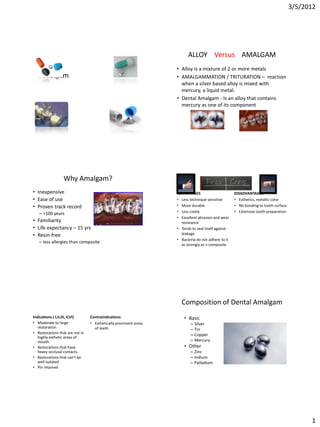
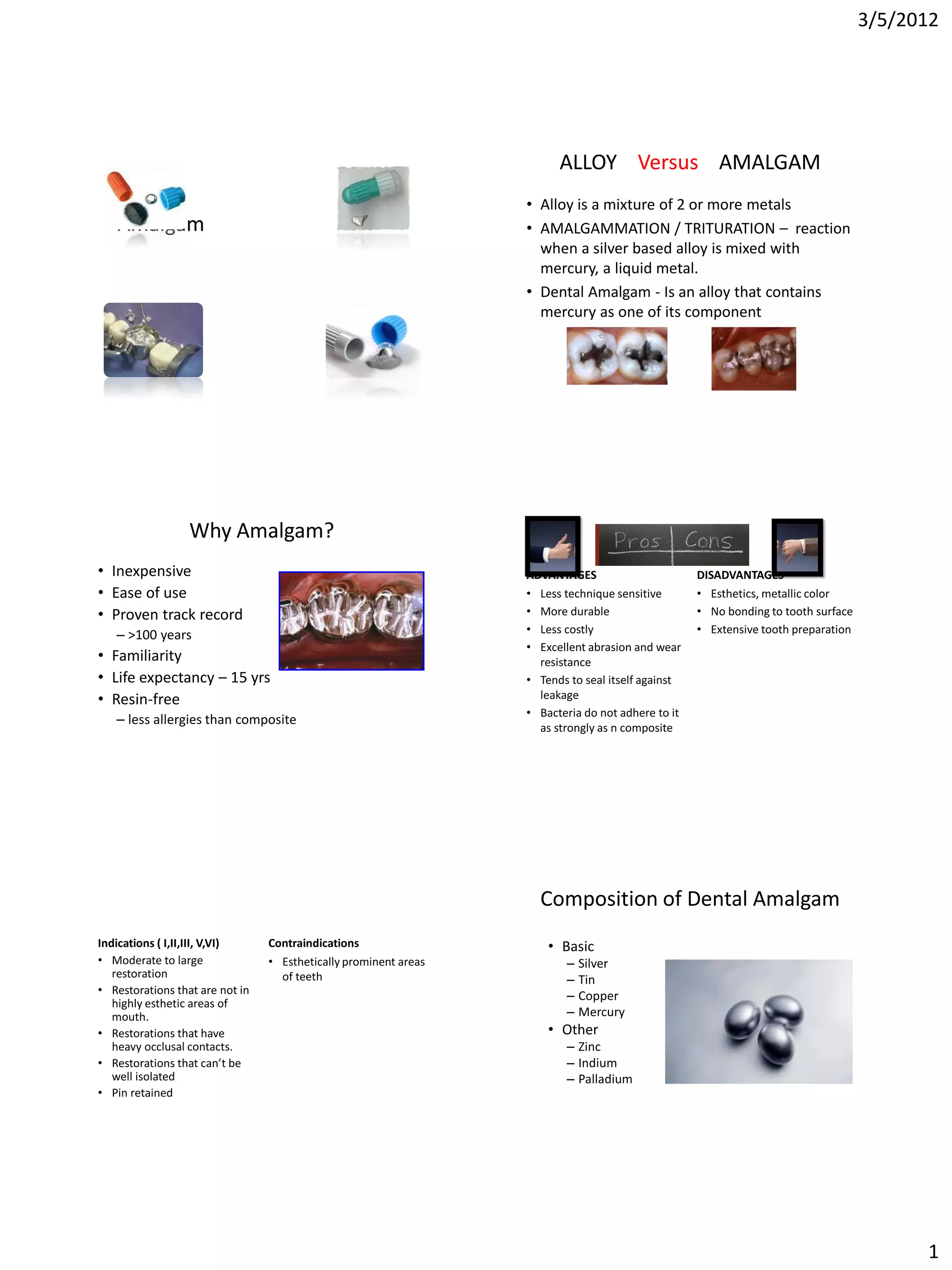
   Amalgam                                                        • AMALGAMMATION / TRITURATION – reaction
                                                                    when a silver based alloy is mixed with
                                                                    mercury, a liquid metal.
                                                                  • Dental Amalgam - Is an alloy that contains
                                                                    mercury as one of its component


                  Why Amalgam?
• Inexpensive                                                     ADVANTAGES                       DISADVANTAGES
• Ease of use                                                     • Less technique sensitive       • Esthetics, metallic color
• Proven track record                                             • More durable                   • No bonding to tooth surface
   – >100 years                                                   • Less costly                    • Extensive tooth preparation
                                                                  • Excellent abrasion and wear
• Familiarity                                                       resistance
• Life expectancy – 15 yrs                                        • Tends to seal itself against
• Resin-free                                                        leakage
                                                                  • Bacteria do not adhere to it
   – less allergies than composite
                                                                    as strongly as n composite


                                                                    Composition of Dental Amalgam
Indications ( I,II,III, V,VI)    Contraindications                    • Basic
• Moderate to large              • Esthetically prominent areas          –   Silver
   restoration                     of teeth                              –   Tin
• Restorations that are not in                                           –   Copper
   highly esthetic areas of
   mouth.                                                                –   Mercury
• Restorations that have                                              • Other
   heavy occlusal contacts.                                              – Zinc
• Restorations that can’t be                                             – Indium
   well isolated                                                         – Palladium
• Pin retained


                                                                                                                                         1
3/5/2012


              Basic Constituents                                                                  Basic Constituents
 • Silver (Ag)
    – increases strength                                                           • Copper (Cu)
    – increases expansion                                                             – increases strength
    – Decrease setting time
                                                                                      – reduces tarnish and corrosion
 • Tin (Sn)
    – decreased strength
                                                                                      – reduces creep
    – decreases expansion                                                                • reduces marginal deterioration
    – increases setting time
    – Improves physical properties
     when compounded with Ag

                                     Phillip’s Science of Dental Materials 2003
                                                                                                                                  Phillip’s Science of Dental Materials 2003
                                     Dental Materials - Saunders


                      Tarnish                                                                               Corrosion
• Oxidation that attacks the surface of the Am and                                • Oxidation from interaction of 2 dissimilar
  extends slightly below the surface.                                               metals in the presence of a solution
• Contact with oxygen, chlorides, and sulfides in                                   containing electrolytes
  the mouth.                                                                      • Galvanism
• Dark dull appearance but not destructive to Am                                  • Oxidation of one of the metals
• Palladium and Polishing may help reduce tarnish
• The rougher the surface, the more it tends to
  tarnish


                       Creep                                                                      Basic Constituents
                                                                                  • Mercury (Hg)
• Refers to the gradual change in shape of the                                      – activates reaction
  restoration from compression by the opposing                                      – only pure metal that is liquid
                                                                                      at room temperature
  dentition.                                                                        – spherical alloys
                                                                                       • require less mercury
                                                                                           – smaller surface area easier to wet
                                                                                               » 40 to 45% Hg
                                                                                    – admixed alloys
                                                                                       • require more mercury
                                                                                           – lathe-cut particles more difficult to wet
                                                                                                » 45 to 50% Hg


                                                                                                                                  Phillip’s Science of Dental Materials 2003


                                                                                                                                                                                 2
3/5/2012


                                                                                                        Other Constituents
 • Zinc (Zn)                                                                         • Indium (In)
       •   decreases oxidation of other elements
                                                                                           – decreases surface tension
    – provides better clinical performance                                                    • reduces amount of mercury necessary
       •   less marginal breakdown
                                                                                              • reduces emitted mercury vapor
                                                                                           – reduces creep and marginal breakdown
    – causes delayed expansion
       •   if contaminated with moisture during condensation                               – increases strength


                                                                                                                                                   Powell J Dent Res 1989
                                        Phillip’s Science of Dental Materials 2003


                Other Constituents
                                                                                     Component                  High copper Alloy %         Low copper alloy %


• Palladium (Pd)                                                                     Silver                     40 -70                      68 – 72
   – reduced corrosion
                                                                                     Tin                        12 – 30                     28 – 36
   – greater luster
                                                                                     Copper                     10 – 30                     4–6


                                                                                     Zinc                       0-1                         0-2


                                                    Mahler J Dent Res 1990


                    Classifications                                                                        Copper Content
• Based on copper content                                                            • Low-copper alloys
• Based on particle shape                                                                  – 4 to 6% Cu
                                                                                     • High-copper alloys
                                                                                           – thought that 6% Cu was maximum amount
                                                                                              •   due to fear of excessive corrosion and expansion
                                                                                           – Now contain 10 to 30% Cu
                                                                                              •   at expense of Ag


                                                                                                                                      Phillip’s Science of Dental Materials 2003


                                                                                                                                                                                     3
3/5/2012


                                                    Setting Reaction of Low Copper
          Low Copper Amalgam
                                                               Amalgam
• “traditional” “conventional”
                                               (β+γ ) + Hg   γ1 + γ2 + unconsumed alloy particles (β+γ )

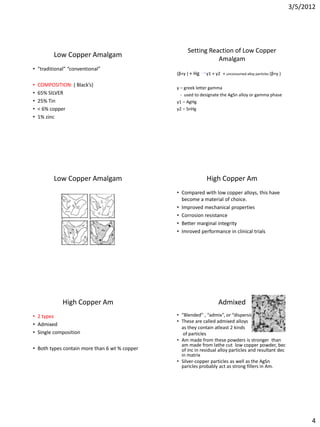
•   COMPOSITION: ( Black’s)
                                               γ – greek letter gamma
•   65% SILVER                                   - used to designate the AgSn alloy or gamma phase
•   25% Tin                                    γ1 – AgHg
•   < 6% copper                                γ2 – SnHg
•   1% zinc


          Low Copper Amalgam                                 High Copper Am
                                               • Compared with low copper alloys, this have
                                                 become a material of choice.
                                               • Improved mechanical properties
                                               • Corrosion resistance
                                               • Better marginal integrity
                                               • Imroved performance in clinical trials


              High Copper Am                                       Admixed
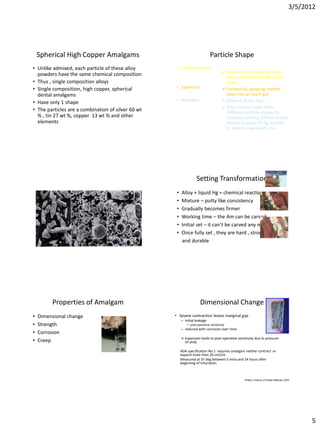
• 2 types                                      • “Blended” , “admix”, or “dispersion”
                                               • These are called admixed alloys
• Admixed
                                                 as they contain atleast 2 kinds
• Single composition                              of particles
                                               • Am made from these powders is stronger than
                                                 am made from lathe cut low copper powder, bec
• Both types contain more than 6 wt % copper     of inc in residual alloy particles and resultant dec
                                                 in matrix
                                               • Silver-copper particles as well as the AgSn
                                                 paricles probably act as strong fillers in Am.


                                                                                                                 4
3/5/2012


    Spherical High Copper Amalgams                                            Particle Shape
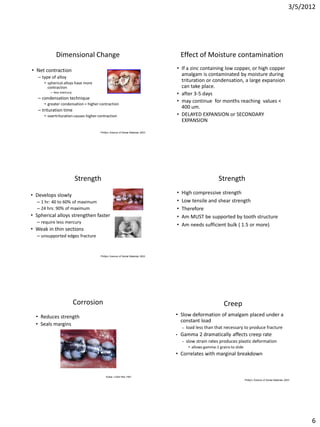
• Unlike admixed, each particle of these alloy       • Lathe cut alloy
  powders have the same chemical composition                                            Formed by shaving particles
                                                                                         from a block of the alloy by a
• Thus , single composition alloys                                                       lathe
• Single composition, high copper, spherical         • Spherical                        Formed by spraying molten
  dental amalgams                                                                        alloy into an inert gas
                                                     • Admixed                          Mixture of the two .
• Have only 1 shape
                                                                                        Alloy maybe made from
• The particles are a combination of silver 60 wt                                        different particle shapes to
  % , tin 27 wt %, copper 13 wt % and other                                              increase packing efficiency and
  elements                                                                               reduce amount of Hg needed
                                                                                         to obtain a workable mix.


                                                                   Setting Transformation
                                                     •   Alloy + liquid Hg = chemical reaction
                                                     •   Mixture – putty like consistency
                                                     •   Gradually becomes firmer
                                                     •   Working time – the Am can be carved
                                                     •   Initial set – it can’t be carved any more
                                                     •   Once fully set , they are hard , strong
                                                         and durable


         Properties of Amalgam                                        Dimensional Change
•   Dimensional change                              • Severe contraction leaves marginal gap
                                                         – initial leakage
•   Strength                                                 • post-operative sensitivity
                                                         – reduced with corrosion over time
•   Corrosion
                                                          Expansion leads to post operative sensitivity due to pressure
•   Creep                                                  on pulp

                                                         ADA specification No.1 requires amalgam neither contract or
                                                         expand more than 20 um/cm
                                                         Measured at 37 deg between 5 mins and 24 hours after
                                                         beginning of trituration.


                                                                                                  Phillip’s Science of Dental Materials 2003


                                                                                                                                                 5
3/5/2012


            Dimensional Change                                                          Effect of Moisture contamination
• Net contraction                                                                   • If a zinc containing low copper, or high copper
   – type of alloy
                                                                                      amalgam is contaminated by moisture during
      • spherical alloys have more
                                                                                      trituration or condensation, a large expansion
        contraction                                                                   can take place.
         – less mercury
                                                                                    • after 3-5 days
   – condensation technique
      • greater condensation = higher contraction
                                                                                    • may continue for months reaching values <
                                                                                      400 um.
   – trituration time
      • overtrituration causes higher contraction                                   • DELAYED EXPANSION or SECONDARY
                                                                                      EXPANSION

                                       Phillip’s Science of Dental Materials 2003


                          Strength                                                                            Strength

• Develops slowly                                                                   •   High compressive strength
  – 1 hr: 40 to 60% of maximum                                                      •   Low tensile and shear strength
  – 24 hrs: 90% of maximum                                                          •   Therefore
• Spherical alloys strengthen faster                                                •   Am MUST be supported by tooth structure
  – require less mercury
                                                                                    •   Am needs sufficient bulk ( 1.5 or more)
• Weak in thin sections
  – unsupported edges fracture


                                       Phillip’s Science of Dental Materials 2003


                          Corrosion                                                                              Creep
  • Reduces strength                                                                • Slow deformation of amalgam placed under a
                                                                                      constant load
  • Seals margins
                                                                                        –   load less than that necessary to produce fracture
                                                                                    •   Gamma 2 dramatically affects creep rate
                                                                                        –   slow strain rates produces plastic deformation
                                                                                             • allows gamma-1 grains to slide
                                                                                    • Correlates with marginal breakdown


                                           Sutow J Dent Res 1991
                                                                                                                                Phillip’s Science of Dental Materials 2003


                                                                                                                                                                               6
3/5/2012


                                                            Clinical performance of Am
                    Creep                                            Restoration
• Slow change in shape                               • Small amt of leakage under amalgam is unique
• caused by compression
                                                     • Properly inserted – leakage decreases as
                                                       restoration ages
• High-copper amalgams have
                                                     • Corrosion products form along the interface
  creep resistance                                     between the tooth and the resto
  – prevention of gamma-2 phase


                                                            Minimal Mercury Technique
           Mercury/alloy ratio
                                                                Eames Technique
• Historically, the only way to achieve smooth and   • Most obvious method for reducing mercury
  plastic mixes was to use mercury considerably in     content is to reduce the original mercury/ alloy
  excess of that desirable in final restoration.       ratio.
• For convenional mercury –added systems, 2          • Sufficient mercury must be present in the original
  techniques were employed to remove excess            mix to provide a coherent and plastic mass after
  mercury                                              trituration
1. Removal of excess mercury was accomplished by     • But low enough so that the mercury content is at
   squeezing or wringing themixed amalgam in a         an acceptable level without the need to remove
   squeeze cloth                                       an appreciable amt during condensation
2. Additional excess mercury was worked to top       • Mercury content of finished should be about 50%
   during condensation of each increment               wt% with lesser amt for spherical alloy


               Proportioning                                        Proportioning
• Recommended mercury / alloy ratio for most         • Mercury / alloy dispensers
  modern lathe cut alloy is approx 1:1 or 50%        • Preweighed pellets or tablets
  mercury                                            • Liquid mercury dispenser
  spherical alloys its closer to 42% mercury

• Proper proportioning = proper mix


                                                                                                                  7
3/5/2012


                  Proportioning                                                    Trituration
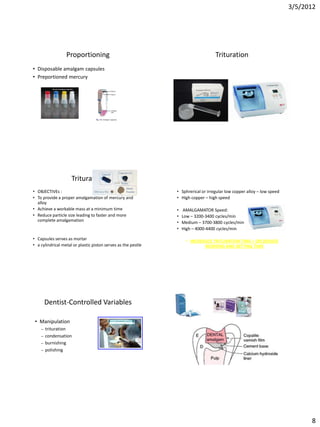
• Disposable amalgam capsules
• Preportioned mercury


                     Trituration
• OBJECTIVEs :                                                 • Sphrerical or irregular low copper alloy – low speed
• To provide a proper amalgamation of mercury and              • High copper – high speed
  alloy
• Achieve a workable mass at a minimum time                    •    AMALGAMATOR Speed:
• Reduce particle size leading to faster and more              •   Low – 3200-3400 cycles/min
  complete amalgamation                                        •   Medium – 3700-3800 cycles/min
                                                               •   High – 4000-4400 cycles/min

• Capsules serves as mortar                                         • INCREASED TRITURATION TIME = DECREASED
• a cylindrical metal or plastic piston serves as the pestle                WORKING AND SETTING TIME


        Dentist-Controlled Variables

 • Manipulation
    –   trituration
    –   condensation
    –   burnishing
    –   polishing


                                                                                                                              8
3/5/2012


                              Trituration                                                             Mercury content
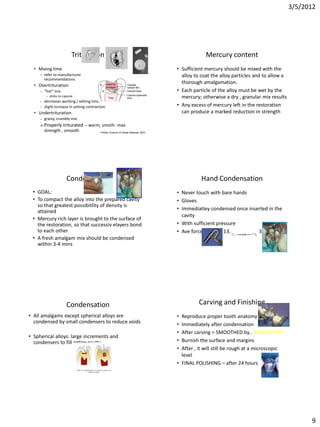
  • Mixing time                                                                          • Sufficient mercury should be mixed with the
     – refer to manufacturer                                                               alloy to coat the alloy particles and to allow a
       recommendations
                                                                                           thorough amalgamation.
  • Overtrituration
     –   “hot” mix                                                                       • Each particle of the alloy must be wet by the
          •   sticks to capsule                                                            mercury; otherwise a dry , granular mix results
     –   decreases working / setting time
     –   slight increase in setting contraction                                          • Any excess of mercury left in the restoration
  • Undertrituration                                                                       can produce a marked reduction in strength
     –   grainy, crumbly mix
      Properly         triturated – warm, smoth- max
         strength , smooth                  Phillip’s Science of Dental Materials 2003


                          Condensation                                                              Hand Condensation
 • GOAL:                                                                                 • Never touch with bare hands
 • To compact the alloy into the prepared cavity                                         • Gloves
   so that greatest possibitlity of density is
   attained                                                                              • Immediatley condensed once inserted in the
                                                                                           cavity
 • Mercury rich layer is brought to the surface of
   the restoration, so that successiv elayers bond                                       • With sufficient pressure
   to each other                                                                         • Ave force applied: 13.3-17.8 N or (3-4 lb)
 • A fresh amalgam mix should be condensed
   within 3-4 mins


                          Condensation                                                             Carving and Finishing
• All amalgams except spherical alloys are                                               • Reproduce proper tooth anatomy
  condensed by small condensers to reduce voids                                          • Immediately after condensation
                                                                                         • After carving = SMOOTHED by.. BURNISHING
• Spherical alloys: large increments and
  condensers to fill entire cavity.                                                      • Burnish the surface and margins
                                                                                         • After , it will still be rough at a microscopic
                                                                                           level
                                                                                         • FINAL POLISHING – after 24 hours


                                                                                                                                                    9
3/5/2012


            Side Effects of mercury                                                Allergy
• Am restoration is possible bec of mercury.                • Antibody – antigen reaction
                                                            • Itching,
• The use of mercury has raised concerns as
                                                            • Rashes
  well as alleged side effects that may be                  • Sneezing
  sustained by patients who received amalgam                • Difficulty in breathing
  restorations                                              • Swelling
                                                            • Contact Dermatitis or Coombs’Type IV
                                                              hypersensitivity
                                                            • But these are experienced by less tha 1% of
                                                              treated population.


                          Toxicity                                                 Toxicity
• It is still thought that mercury toxocity from            • The most significant contribution to mercury
  dental restoration is cause of certain undiagnosed          assimilation from dental amalgamis
  illnesses                                                 • VAPOR PHASE
                                                            • Encounter is brief
• And a real hazard may exist for dentists and
                                                            • Mercury vapor amt – NO EFFECT level
  dental assistants when mercury vapor is inhaled           • The threshold value for mercury industry workers-
  during mixing and placement of amalgam.                   • 350 -500 ug per dya ( 40 hr /wk)
• Improvements in encapsulation technology, scrap           • Patients get far below the values by US federal got
  storage, elimination of carpets and other mercury         • Max level occupational exposure (safe) 50 um per
  retention sites                                             cubic meter of air per day


                                                            Potential hazards form mercury can be
                                                                         reduced by:
• Mercury in blood                                          • Well ventilated Operatory
• Patients w/ Am – 0.7 ng/ml
• Patients w/o Am- 0.3 ng/ml                                • Well sealed containers ( Am scraps, capsules)
• 1 saltwater meal per wk raised mercury level in blood :
                                                            • Proper disposals
• From 2.3 to 5.1 ng/ml                                     • Spilled mercury- cleaned up as soon as
                                                              posiible
•   Daily normal intake of Hg:
•   15 um – food                                            • Mercury suppressant powders
•   1 ug – air                                              • If comes in contact with skin – wash with soap
•   0.4 ug - water
                                                              and H2O


                                                                                                                         10

Amalgam1

  • 1.
    3/5/2012 ALLOY Versus AMALGAM • Alloy is a mixture of 2 or more metals Amalgam • AMALGAMMATION / TRITURATION – reaction when a silver based alloy is mixed with mercury, a liquid metal. • Dental Amalgam - Is an alloy that contains mercury as one of its component Why Amalgam? • Inexpensive ADVANTAGES DISADVANTAGES • Ease of use • Less technique sensitive • Esthetics, metallic color • Proven track record • More durable • No bonding to tooth surface – >100 years • Less costly • Extensive tooth preparation • Excellent abrasion and wear • Familiarity resistance • Life expectancy – 15 yrs • Tends to seal itself against • Resin-free leakage • Bacteria do not adhere to it – less allergies than composite as strongly as n composite Composition of Dental Amalgam Indications ( I,II,III, V,VI) Contraindications • Basic • Moderate to large • Esthetically prominent areas – Silver restoration of teeth – Tin • Restorations that are not in – Copper highly esthetic areas of mouth. – Mercury • Restorations that have • Other heavy occlusal contacts. – Zinc • Restorations that can’t be – Indium well isolated – Palladium • Pin retained 1
  • 2.
    3/5/2012 Basic Constituents Basic Constituents • Silver (Ag) – increases strength • Copper (Cu) – increases expansion – increases strength – Decrease setting time – reduces tarnish and corrosion • Tin (Sn) – decreased strength – reduces creep – decreases expansion • reduces marginal deterioration – increases setting time – Improves physical properties when compounded with Ag Phillip’s Science of Dental Materials 2003 Phillip’s Science of Dental Materials 2003 Dental Materials - Saunders Tarnish Corrosion • Oxidation that attacks the surface of the Am and • Oxidation from interaction of 2 dissimilar extends slightly below the surface. metals in the presence of a solution • Contact with oxygen, chlorides, and sulfides in containing electrolytes the mouth. • Galvanism • Dark dull appearance but not destructive to Am • Oxidation of one of the metals • Palladium and Polishing may help reduce tarnish • The rougher the surface, the more it tends to tarnish Creep Basic Constituents • Mercury (Hg) • Refers to the gradual change in shape of the – activates reaction restoration from compression by the opposing – only pure metal that is liquid at room temperature dentition. – spherical alloys • require less mercury – smaller surface area easier to wet » 40 to 45% Hg – admixed alloys • require more mercury – lathe-cut particles more difficult to wet » 45 to 50% Hg Phillip’s Science of Dental Materials 2003 2
  • 3.
    3/5/2012 Other Constituents • Zinc (Zn) • Indium (In) • decreases oxidation of other elements – decreases surface tension – provides better clinical performance • reduces amount of mercury necessary • less marginal breakdown • reduces emitted mercury vapor – reduces creep and marginal breakdown – causes delayed expansion • if contaminated with moisture during condensation – increases strength Powell J Dent Res 1989 Phillip’s Science of Dental Materials 2003 Other Constituents Component High copper Alloy % Low copper alloy % • Palladium (Pd) Silver 40 -70 68 – 72 – reduced corrosion Tin 12 – 30 28 – 36 – greater luster Copper 10 – 30 4–6 Zinc 0-1 0-2 Mahler J Dent Res 1990 Classifications Copper Content • Based on copper content • Low-copper alloys • Based on particle shape – 4 to 6% Cu • High-copper alloys – thought that 6% Cu was maximum amount • due to fear of excessive corrosion and expansion – Now contain 10 to 30% Cu • at expense of Ag Phillip’s Science of Dental Materials 2003 3
  • 4.
    3/5/2012 Setting Reaction of Low Copper Low Copper Amalgam Amalgam • “traditional” “conventional” (β+γ ) + Hg γ1 + γ2 + unconsumed alloy particles (β+γ ) • COMPOSITION: ( Black’s) γ – greek letter gamma • 65% SILVER - used to designate the AgSn alloy or gamma phase • 25% Tin γ1 – AgHg • < 6% copper γ2 – SnHg • 1% zinc Low Copper Amalgam High Copper Am • Compared with low copper alloys, this have become a material of choice. • Improved mechanical properties • Corrosion resistance • Better marginal integrity • Imroved performance in clinical trials High Copper Am Admixed • 2 types • “Blended” , “admix”, or “dispersion” • These are called admixed alloys • Admixed as they contain atleast 2 kinds • Single composition of particles • Am made from these powders is stronger than am made from lathe cut low copper powder, bec • Both types contain more than 6 wt % copper of inc in residual alloy particles and resultant dec in matrix • Silver-copper particles as well as the AgSn paricles probably act as strong fillers in Am. 4
  • 5.
    3/5/2012 Spherical High Copper Amalgams Particle Shape • Unlike admixed, each particle of these alloy • Lathe cut alloy powders have the same chemical composition  Formed by shaving particles from a block of the alloy by a • Thus , single composition alloys lathe • Single composition, high copper, spherical • Spherical  Formed by spraying molten dental amalgams alloy into an inert gas • Admixed  Mixture of the two . • Have only 1 shape  Alloy maybe made from • The particles are a combination of silver 60 wt different particle shapes to % , tin 27 wt %, copper 13 wt % and other increase packing efficiency and elements reduce amount of Hg needed to obtain a workable mix. Setting Transformation • Alloy + liquid Hg = chemical reaction • Mixture – putty like consistency • Gradually becomes firmer • Working time – the Am can be carved • Initial set – it can’t be carved any more • Once fully set , they are hard , strong and durable Properties of Amalgam Dimensional Change • Dimensional change • Severe contraction leaves marginal gap – initial leakage • Strength • post-operative sensitivity – reduced with corrosion over time • Corrosion  Expansion leads to post operative sensitivity due to pressure • Creep on pulp ADA specification No.1 requires amalgam neither contract or expand more than 20 um/cm Measured at 37 deg between 5 mins and 24 hours after beginning of trituration. Phillip’s Science of Dental Materials 2003 5
  • 6.
    3/5/2012 Dimensional Change Effect of Moisture contamination • Net contraction • If a zinc containing low copper, or high copper – type of alloy amalgam is contaminated by moisture during • spherical alloys have more trituration or condensation, a large expansion contraction can take place. – less mercury • after 3-5 days – condensation technique • greater condensation = higher contraction • may continue for months reaching values < 400 um. – trituration time • overtrituration causes higher contraction • DELAYED EXPANSION or SECONDARY EXPANSION Phillip’s Science of Dental Materials 2003 Strength Strength • Develops slowly • High compressive strength – 1 hr: 40 to 60% of maximum • Low tensile and shear strength – 24 hrs: 90% of maximum • Therefore • Spherical alloys strengthen faster • Am MUST be supported by tooth structure – require less mercury • Am needs sufficient bulk ( 1.5 or more) • Weak in thin sections – unsupported edges fracture Phillip’s Science of Dental Materials 2003 Corrosion Creep • Reduces strength • Slow deformation of amalgam placed under a constant load • Seals margins – load less than that necessary to produce fracture • Gamma 2 dramatically affects creep rate – slow strain rates produces plastic deformation • allows gamma-1 grains to slide • Correlates with marginal breakdown Sutow J Dent Res 1991 Phillip’s Science of Dental Materials 2003 6
  • 7.
    3/5/2012 Clinical performance of Am Creep Restoration • Slow change in shape • Small amt of leakage under amalgam is unique • caused by compression • Properly inserted – leakage decreases as restoration ages • High-copper amalgams have • Corrosion products form along the interface creep resistance between the tooth and the resto – prevention of gamma-2 phase Minimal Mercury Technique Mercury/alloy ratio Eames Technique • Historically, the only way to achieve smooth and • Most obvious method for reducing mercury plastic mixes was to use mercury considerably in content is to reduce the original mercury/ alloy excess of that desirable in final restoration. ratio. • For convenional mercury –added systems, 2 • Sufficient mercury must be present in the original techniques were employed to remove excess mix to provide a coherent and plastic mass after mercury trituration 1. Removal of excess mercury was accomplished by • But low enough so that the mercury content is at squeezing or wringing themixed amalgam in a an acceptable level without the need to remove squeeze cloth an appreciable amt during condensation 2. Additional excess mercury was worked to top • Mercury content of finished should be about 50% during condensation of each increment wt% with lesser amt for spherical alloy Proportioning Proportioning • Recommended mercury / alloy ratio for most • Mercury / alloy dispensers modern lathe cut alloy is approx 1:1 or 50% • Preweighed pellets or tablets mercury • Liquid mercury dispenser spherical alloys its closer to 42% mercury • Proper proportioning = proper mix 7
  • 8.
    3/5/2012 Proportioning Trituration • Disposable amalgam capsules • Preportioned mercury Trituration • OBJECTIVEs : • Sphrerical or irregular low copper alloy – low speed • To provide a proper amalgamation of mercury and • High copper – high speed alloy • Achieve a workable mass at a minimum time • AMALGAMATOR Speed: • Reduce particle size leading to faster and more • Low – 3200-3400 cycles/min complete amalgamation • Medium – 3700-3800 cycles/min • High – 4000-4400 cycles/min • Capsules serves as mortar • INCREASED TRITURATION TIME = DECREASED • a cylindrical metal or plastic piston serves as the pestle WORKING AND SETTING TIME Dentist-Controlled Variables • Manipulation – trituration – condensation – burnishing – polishing 8
  • 9.
    3/5/2012 Trituration Mercury content • Mixing time • Sufficient mercury should be mixed with the – refer to manufacturer alloy to coat the alloy particles and to allow a recommendations thorough amalgamation. • Overtrituration – “hot” mix • Each particle of the alloy must be wet by the • sticks to capsule mercury; otherwise a dry , granular mix results – decreases working / setting time – slight increase in setting contraction • Any excess of mercury left in the restoration • Undertrituration can produce a marked reduction in strength – grainy, crumbly mix  Properly triturated – warm, smoth- max strength , smooth Phillip’s Science of Dental Materials 2003 Condensation Hand Condensation • GOAL: • Never touch with bare hands • To compact the alloy into the prepared cavity • Gloves so that greatest possibitlity of density is attained • Immediatley condensed once inserted in the cavity • Mercury rich layer is brought to the surface of the restoration, so that successiv elayers bond • With sufficient pressure to each other • Ave force applied: 13.3-17.8 N or (3-4 lb) • A fresh amalgam mix should be condensed within 3-4 mins Condensation Carving and Finishing • All amalgams except spherical alloys are • Reproduce proper tooth anatomy condensed by small condensers to reduce voids • Immediately after condensation • After carving = SMOOTHED by.. BURNISHING • Spherical alloys: large increments and condensers to fill entire cavity. • Burnish the surface and margins • After , it will still be rough at a microscopic level • FINAL POLISHING – after 24 hours 9
  • 10.
    3/5/2012 Side Effects of mercury Allergy • Am restoration is possible bec of mercury. • Antibody – antigen reaction • Itching, • The use of mercury has raised concerns as • Rashes well as alleged side effects that may be • Sneezing sustained by patients who received amalgam • Difficulty in breathing restorations • Swelling • Contact Dermatitis or Coombs’Type IV hypersensitivity • But these are experienced by less tha 1% of treated population. Toxicity Toxicity • It is still thought that mercury toxocity from • The most significant contribution to mercury dental restoration is cause of certain undiagnosed assimilation from dental amalgamis illnesses • VAPOR PHASE • Encounter is brief • And a real hazard may exist for dentists and • Mercury vapor amt – NO EFFECT level dental assistants when mercury vapor is inhaled • The threshold value for mercury industry workers- during mixing and placement of amalgam. • 350 -500 ug per dya ( 40 hr /wk) • Improvements in encapsulation technology, scrap • Patients get far below the values by US federal got storage, elimination of carpets and other mercury • Max level occupational exposure (safe) 50 um per retention sites cubic meter of air per day Potential hazards form mercury can be reduced by: • Mercury in blood • Well ventilated Operatory • Patients w/ Am – 0.7 ng/ml • Patients w/o Am- 0.3 ng/ml • Well sealed containers ( Am scraps, capsules) • 1 saltwater meal per wk raised mercury level in blood : • Proper disposals • From 2.3 to 5.1 ng/ml • Spilled mercury- cleaned up as soon as posiible • Daily normal intake of Hg: • 15 um – food • Mercury suppressant powders • 1 ug – air • If comes in contact with skin – wash with soap • 0.4 ug - water and H2O 10