Sub Topics
1. Craft System
2. Industrial Revolution
3. Scientific Management
4. Trade Unionism
5. Human Resource Relations
Movement
6. Human Resource Approach
7. Conclusion
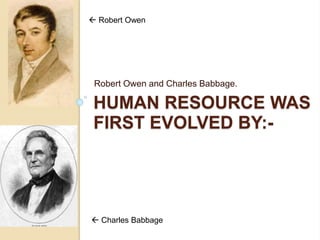
HUMAN RESOURCE WAS
FIRST EVOLVED BY:-
Robert Owen and Charles Babbage.
 Robert Owen
 Charles Babbage
Craft System
 This was the period before industrial revolution.
 HRM can be traced to England, where
craftspeople organized guilds.
 They used unity to improve working conditions.
Industrial revolution(1970-
1850) machines were brought in and establishment of
factory system and mass production.
 The place of work shifted from residence to
factory.
 jobs were more fragmented
 Workers were treated like “glorified machine
tools”
 Labor was looked upon as a commodity that
could be bought and sold
 Due to then prevailing political philosophy
of laissez faire, government did little to
protect the workers
POST INDUSTRIAL
REVOLUTION
The term “Human resource Management” saw a major
evolution after 1850.
Scientific Management
 During the world wars era, scientific
management, welfare work, and industrial
psychology merged.
 Frederick W. Taylor, the father of scientific
management, gave following:
Science Harmony Cooperation
Maximum output
 His scientific principles focused on
Worker’s Training Maintaining wage
uniformity attaining better productivity.
Contd.
 A differential piece rate system was also
advocated by Taylor to provide an incentive for
employees.
 All these principles led to improved economic
efficiency in manufacturing jobs.
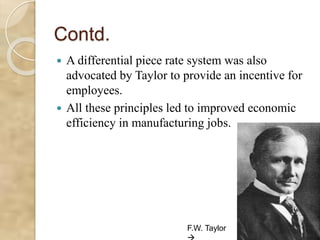
F.W. Taylor
Trade Unionism
 Workers joined hands to protect against the
exploitative tendencies of employers and the
prohibitive, unfair labor practices through
unions.
 Unions tried to improve the lot of workers
through collective bargaining, resolving the
grievances of workers relating to working
conditions, pay and benefits, disciplinary
actions.
Human Resource Relations
Movement
 Hawthorne experiments :- Elton Mayo and his
colleagues.
 These studies showed How others how stimuli,
unrelated to financial compensation and
working conditions, could yield more productive
workers.
 Observations and findings of Hawthorne
experiment shifted the focus of Human resource
from increasing worker’s productivity to
increasing worker’s efficiency through greater
work satisfaction.
Human Relations Approach
 Recognizing the fact that workers are unique in
their own ways- having individual needs.
 It was recognized that each employee is a
unique and highly complex individual with
different wants, needs and values.
 Douglas McGregor Theory X and Theory Y
(1960) and Abraham Maslow’s Hierarchy of
needs ( 1954) characterized this phase of
evolution of HRM.
CONCLUSION
As a result of these principles and studies , Human
resource management became increasingly line
management function , linked to core business
operations.
Some of the major activities of HR department are
listed as-
 Recruitment and selection of skilled workforce.
 Motivation and employee benefits
 Training and development of workforce
 Performance related salaries and appraisals.
SHORT QUIZ GAME
Q1. Name of Two people
behind the evolution of HR
field?
a) Abraham Maslow and Douglas McGregor
b) Max Weber and Frederick Herzberg
c) Robert Owen and Charles Babbage
d) Henry Fayol and F.W. Taylor
e) None of the above.
Q2. Name of style of political
style of leadership during
Industrial Revolution ?
a) Paternalistic
b) Laissez Faire
c) Democratic
d) Autocratic
e) None of the Above
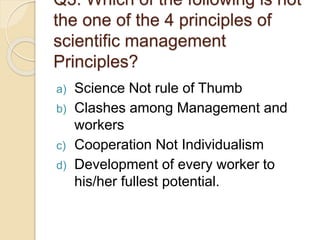
Q3. Which of the following is not
the one of the 4 principles of
scientific management
Principles?
a) Science Not rule of Thumb
b) Clashes among Management and
workers
c) Cooperation Not Individualism
d) Development of every worker to
his/her fullest potential.
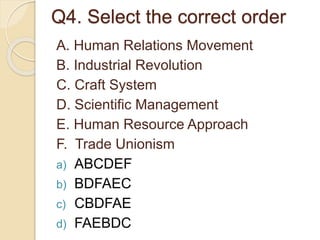
Q4. Select the correct order
A. Human Relations Movement
B. Industrial Revolution
C. Craft System
D. Scientific Management
E. Human Resource Approach
F. Trade Unionism
a) ABCDEF
b) BDFAEC
c) CBDFAE
d) FAEBDC
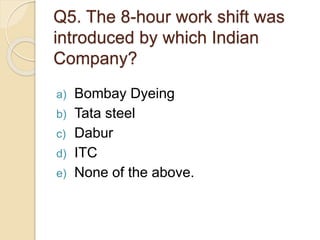
Q5. The 8-hour work shift was
introduced by which Indian
Company?
a) Bombay Dyeing
b) Tata steel
c) Dabur
d) ITC
e) None of the above.
Hrm ppt

Hrm ppt

  • 2.
    Sub Topics 1. CraftSystem 2. Industrial Revolution 3. Scientific Management 4. Trade Unionism 5. Human Resource Relations Movement 6. Human Resource Approach 7. Conclusion
  • 3.
    HUMAN RESOURCE WAS FIRSTEVOLVED BY:- Robert Owen and Charles Babbage.  Robert Owen  Charles Babbage
  • 4.
    Craft System  Thiswas the period before industrial revolution.  HRM can be traced to England, where craftspeople organized guilds.  They used unity to improve working conditions.
  • 5.
    Industrial revolution(1970- 1850) machineswere brought in and establishment of factory system and mass production.  The place of work shifted from residence to factory.  jobs were more fragmented  Workers were treated like “glorified machine tools”  Labor was looked upon as a commodity that could be bought and sold  Due to then prevailing political philosophy of laissez faire, government did little to protect the workers
  • 6.
    POST INDUSTRIAL REVOLUTION The term“Human resource Management” saw a major evolution after 1850.
  • 7.
    Scientific Management  Duringthe world wars era, scientific management, welfare work, and industrial psychology merged.  Frederick W. Taylor, the father of scientific management, gave following: Science Harmony Cooperation Maximum output  His scientific principles focused on Worker’s Training Maintaining wage uniformity attaining better productivity.
  • 8.
    Contd.  A differentialpiece rate system was also advocated by Taylor to provide an incentive for employees.  All these principles led to improved economic efficiency in manufacturing jobs. F.W. Taylor
  • 9.
    Trade Unionism  Workersjoined hands to protect against the exploitative tendencies of employers and the prohibitive, unfair labor practices through unions.  Unions tried to improve the lot of workers through collective bargaining, resolving the grievances of workers relating to working conditions, pay and benefits, disciplinary actions.
  • 10.
    Human Resource Relations Movement Hawthorne experiments :- Elton Mayo and his colleagues.  These studies showed How others how stimuli, unrelated to financial compensation and working conditions, could yield more productive workers.  Observations and findings of Hawthorne experiment shifted the focus of Human resource from increasing worker’s productivity to increasing worker’s efficiency through greater work satisfaction.
  • 11.
    Human Relations Approach Recognizing the fact that workers are unique in their own ways- having individual needs.  It was recognized that each employee is a unique and highly complex individual with different wants, needs and values.  Douglas McGregor Theory X and Theory Y (1960) and Abraham Maslow’s Hierarchy of needs ( 1954) characterized this phase of evolution of HRM.
  • 12.
  • 13.
    As a resultof these principles and studies , Human resource management became increasingly line management function , linked to core business operations. Some of the major activities of HR department are listed as-  Recruitment and selection of skilled workforce.  Motivation and employee benefits  Training and development of workforce  Performance related salaries and appraisals.
  • 15.
  • 16.
    Q1. Name ofTwo people behind the evolution of HR field? a) Abraham Maslow and Douglas McGregor b) Max Weber and Frederick Herzberg c) Robert Owen and Charles Babbage d) Henry Fayol and F.W. Taylor e) None of the above.
  • 17.
    Q2. Name ofstyle of political style of leadership during Industrial Revolution ? a) Paternalistic b) Laissez Faire c) Democratic d) Autocratic e) None of the Above
  • 18.
    Q3. Which ofthe following is not the one of the 4 principles of scientific management Principles? a) Science Not rule of Thumb b) Clashes among Management and workers c) Cooperation Not Individualism d) Development of every worker to his/her fullest potential.
  • 19.
    Q4. Select thecorrect order A. Human Relations Movement B. Industrial Revolution C. Craft System D. Scientific Management E. Human Resource Approach F. Trade Unionism a) ABCDEF b) BDFAEC c) CBDFAE d) FAEBDC
  • 20.
    Q5. The 8-hourwork shift was introduced by which Indian Company? a) Bombay Dyeing b) Tata steel c) Dabur d) ITC e) None of the above.