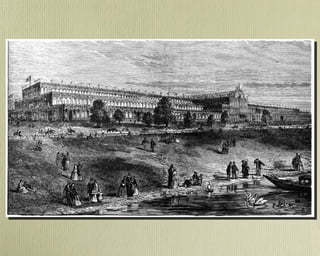
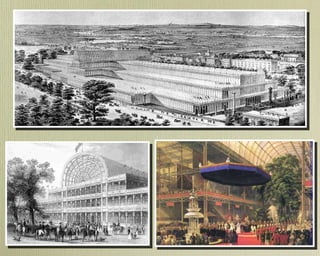
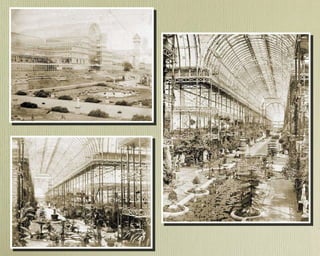
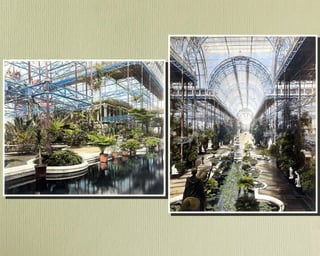
Architecture The Crystal Palace (1851, London) 1,850’ long, 110’ tall Iron and glass building constructed for the Great Exhibition of 1851 First in a series of “World’s Fair” exhibitions Celebration of modern technology and design Designed by Joseph Paxton Gardener who had experimented with glass and iron greenhouses
Architecture Contained multiple gardens and fountains, main fountains 250’ high After the Exhibition, Palace was relocated to another location in London Functioned as a tourist attraction, destroyed by fire in 1936


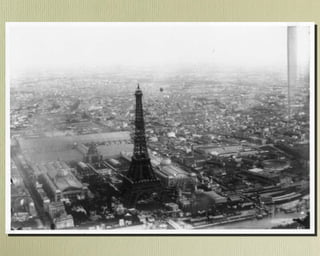
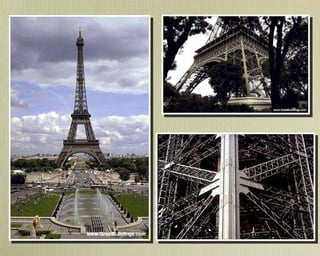
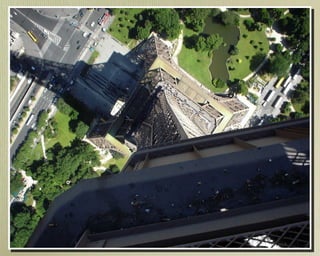
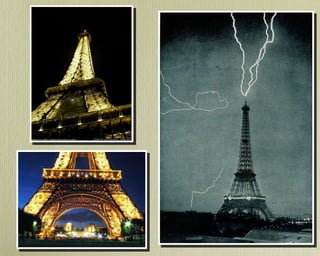
Architecture The Eiffel Tower (1887-89, Paris) 1,063’ high (81 floors) Designed by Gustave Eiffel, designed bridges Iron tower constructed as entrance for Paris’ World’s Fair 300 workers, one death during construction Tower was criticized as an eyesore Shape of the tower designed to withstand the force of wind


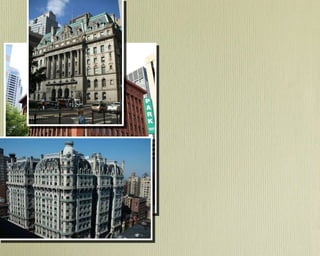
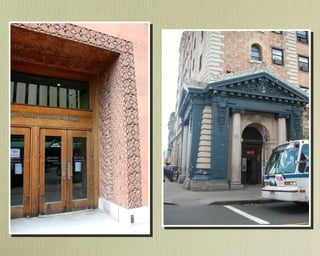
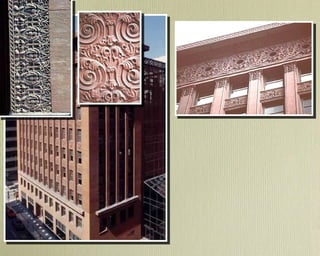
Architecture The Wainwright Building (1890-91, St. Louis) One of the first skyscrapers (11 floors) Red brick with steel frame- steel allowed taller buildings Designed by Louis Sullivan Rejected traditional architecture- new materials require new designs “ Form follows function”- The design of a building should reflect its purpose Vertical lines emphasizes the height of the building, plant designs symbolize growth


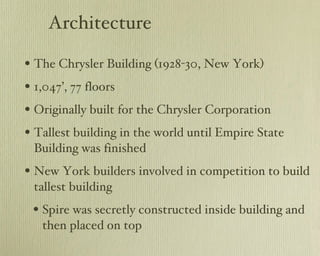
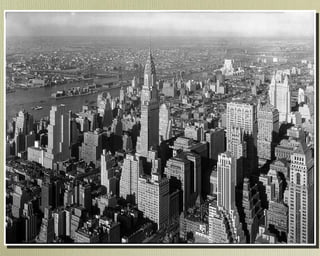
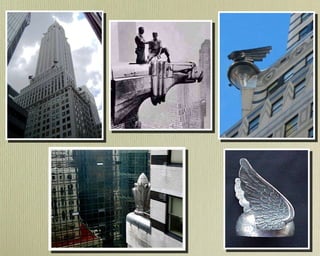
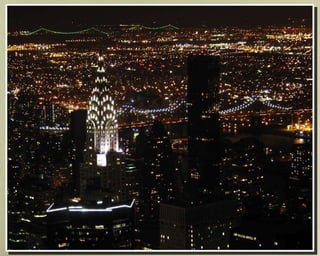
Architecture The Chrysler Building (1928-30, New York) 1,047’, 77 floors Originally built for the Chrysler Corporation Tallest building in the world until Empire State Building was finished New York builders involved in competition to build tallest building Spire was secretly constructed inside building and then placed on top
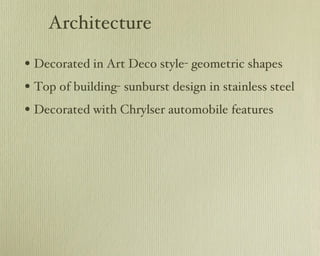
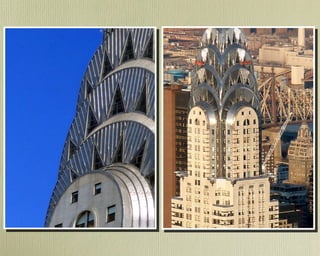
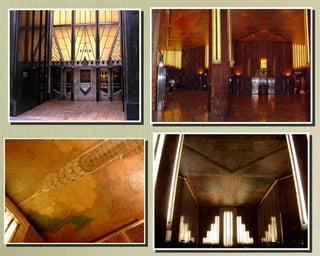
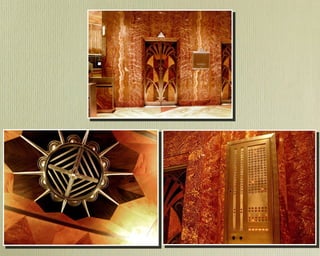
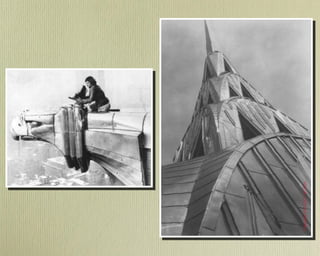
Architecture Decorated in Art Deco style- geometric shapes Top of building- sunburst design in stainless steel Decorated with Chrylser automobile features


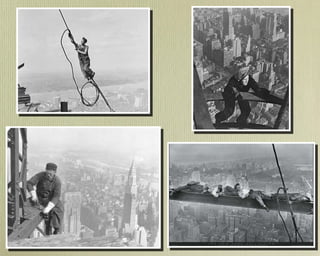
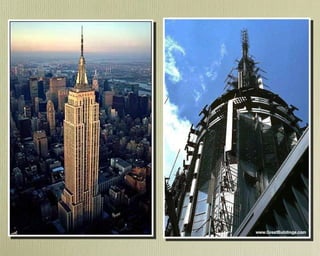
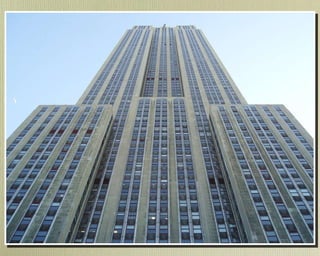
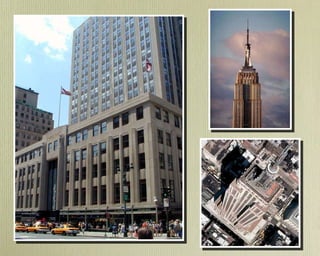
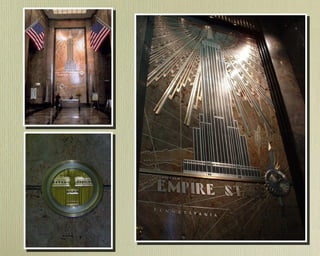
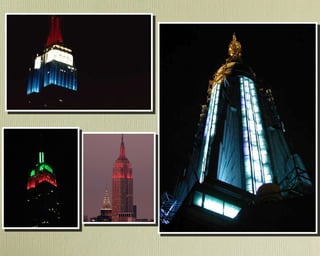
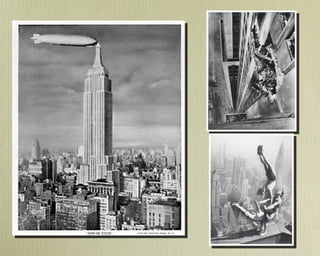
Architecture The Empire State Building (1929-31, New York) 1,472’, 102 floors Name derived from New York’s nickname Art Deco style World’s tallest building until 1972 Financed by General Motors Opening coincided with the Depression, resulted in lots of vacant office space- “The Empty State Building”
Architecture Building design involves a series of setbacks Spire designed to be mooring mast for blimps, proved to be impractical B-25 bomber collided with building in 1945 Colored floodlights coincide with seasons and events Multiple T.V. and radio stations broadcast from building
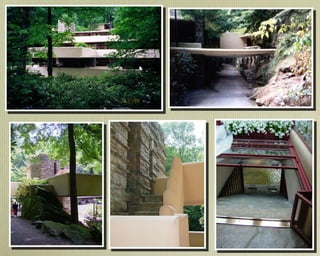


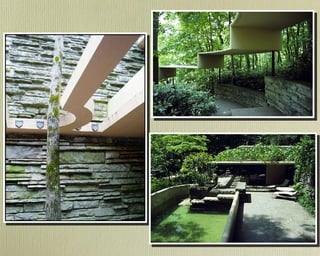
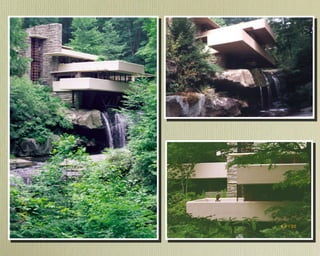
Architecture Fallingwater (1934-37, Pennsylvania) Vacation home Designed by Frank Lloyd Wright Philosophy of integrating the building with its environment Built over a waterfall- can be heard throughout house Uses local materials Constructed around boulders and trees Horizontal terraces resemble rock formations
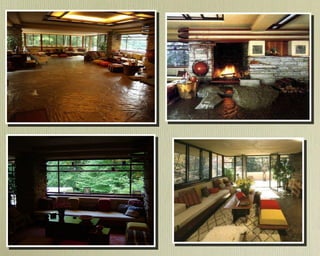
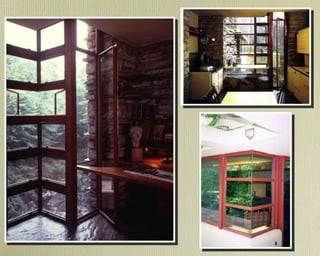
Architecture Broad expanses of windows and multiple balconies Extensive structural repairs in 2002 Humidity causes mold problems- “Rising Mildew” Has been a public museum since 1964


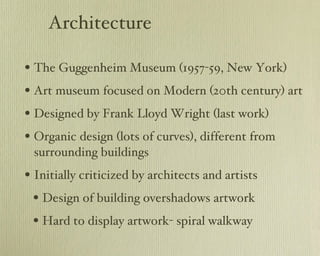
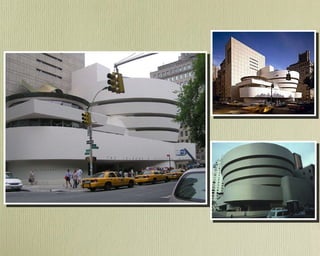
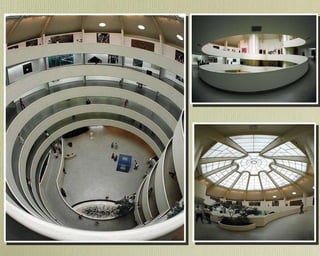
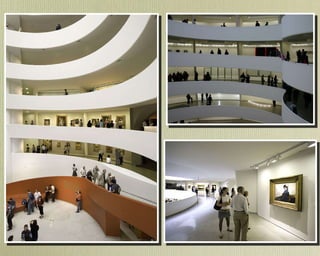
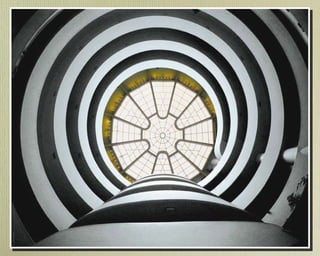
Architecture The Guggenheim Museum (1957-59, New York) Art museum focused on Modern (20th century) art Designed by Frank Lloyd Wright (last work) Organic design (lots of curves), different from surrounding buildings Initially criticized by architects and artists Design of building overshadows artwork Hard to display artwork- spiral walkway
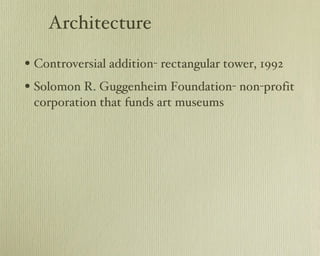
Architecture Controversial addition- rectangular tower, 1992 Solomon R. Guggenheim Foundation- non-profit corporation that funds art museums


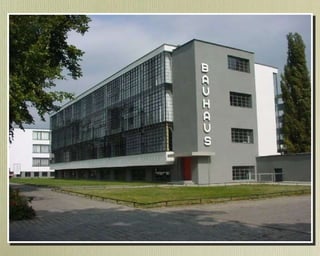
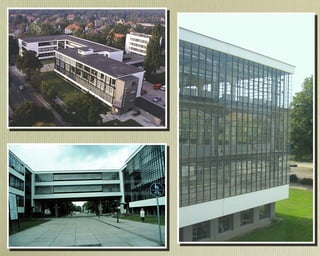
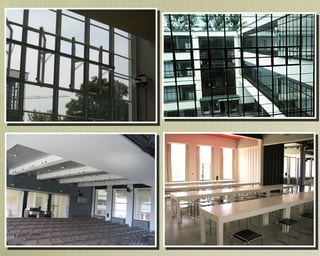
Architecture The Bauhaus Shop Block (1925-26, Dessau, Germany) Walter Gropius Art school-architecture, crafts, fine art Unify art, craft and technology Closed by Nazi’s in 1933- “un-German”
Architecture International Style- 1920s, 30s Foundation of modern architecture Radical simplification of forms Rejection of ornamentation Adoption of modern materials (glass, steel, concrete) Transparency of buildings Window- change from hole IN the wall to THE wall Style was independent of location- buildings look similar all over the world


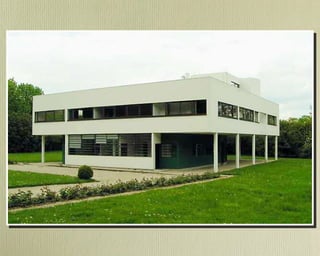
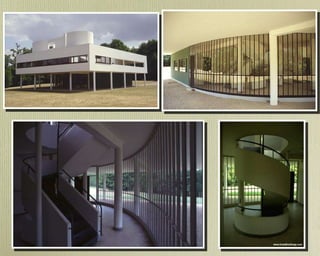
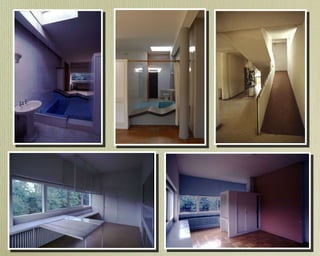
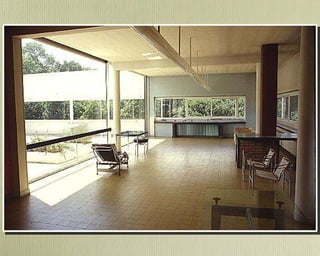
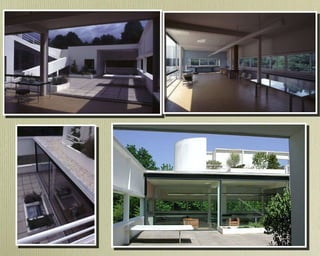
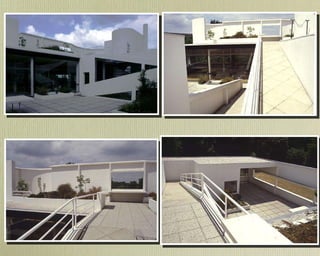
Architecture Villa Savoye (1929-30, near Paris) International Style Vacation home Designed by Le Corbusier (pseudonym) Helped create International Style Dedicated to better living conditions in crowded cities Urban planner (designed cities) Designed concrete buildings
Architecture “ The Five Points”- philosophy of designing buildings Supporting columns to raise building from the ground Flat roof with a terrace Free floor plan- no load bearing walls Horizontal windows Exterior- thin walls and windows- no load bearing walls Villa Savoye- windows integrate interior/exterior


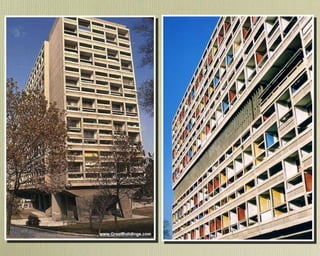
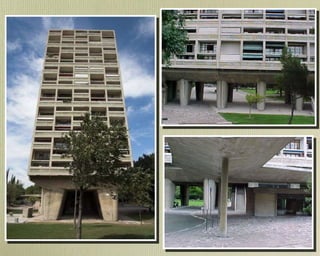
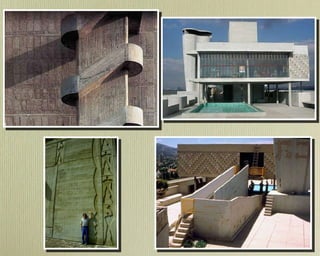
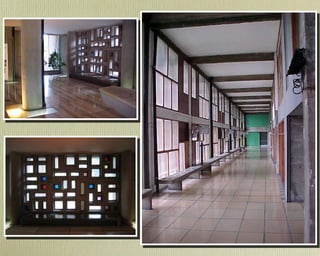
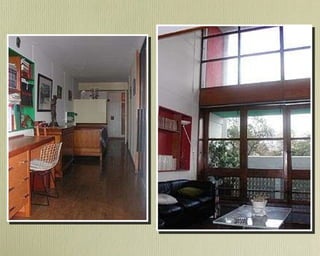
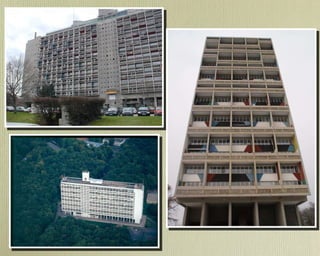
Architecture Unite d’Habitation (1947-52, Marseille, France) Apartment complex 337 apartments, 12 floors Designed by Le Corbusier Building includes shops, sports, medical, and educational facilities, and a hotel Made of concrete, inspired the Brutalism style Brutalism- Geometric forms, roughly textured cement Similar complexes built in other cities


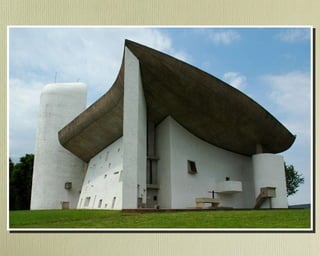
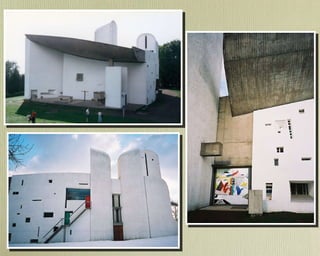
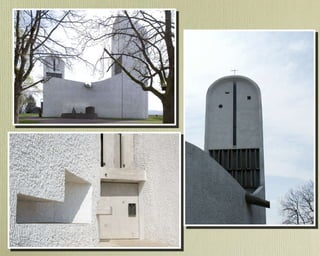
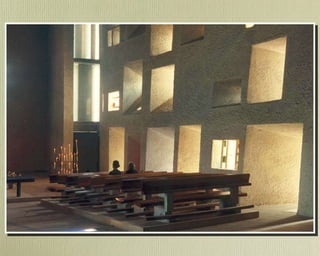
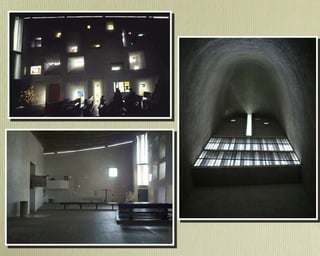
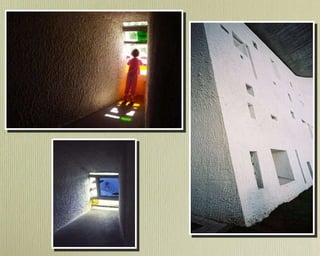
Architecture Notre Dame du Haut (1950-54, Ronchamp, France) Catholic pilgrimage chapel Designed by Le Corbusier Does not follow “The Five Points,” form inspired by hilltop location, organic forms Made of textured concrete Thick walls (7’ in places) with colored glass set deeply into them Interior and exterior pulpits


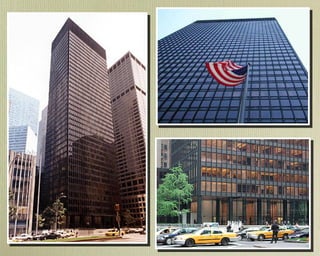
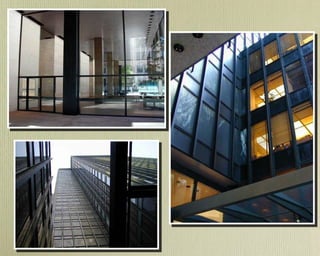
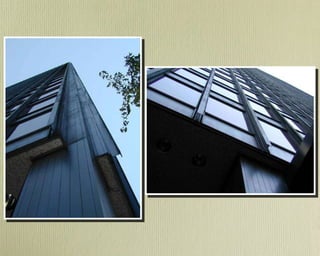
Architecture The Seagram Building (1954-58, New York) Skyscraper, 38 floors Designed by Ludwig Mies van der Rohe and Philip Johnson International Style External bronze I-beams reflect internal steel structure World’s most expensive skyscraper Window blinds designed to be regular- had three positions
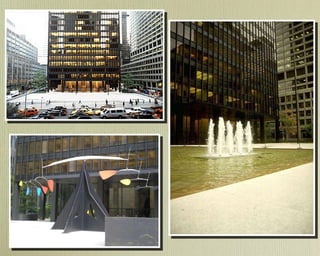
Architecture Large plaza in front of building- became popular gathering place New York building code added incentives for developers to include open spaces


Architecture After the Industrial Revolution

  • 1.
    Architecture The CrystalPalace (1851, London) 1,850’ long, 110’ tall Iron and glass building constructed for the Great Exhibition of 1851 First in a series of “World’s Fair” exhibitions Celebration of modern technology and design Designed by Joseph Paxton Gardener who had experimented with glass and iron greenhouses
  • 2.
    Architecture Contained multiplegardens and fountains, main fountains 250’ high After the Exhibition, Palace was relocated to another location in London Functioned as a tourist attraction, destroyed by fire in 1936
  • 3.
  • 4.
  • 5.
  • 6.
  • 7.
    Architecture The EiffelTower (1887-89, Paris) 1,063’ high (81 floors) Designed by Gustave Eiffel, designed bridges Iron tower constructed as entrance for Paris’ World’s Fair 300 workers, one death during construction Tower was criticized as an eyesore Shape of the tower designed to withstand the force of wind
  • 8.
  • 9.
  • 10.
  • 11.
  • 12.
    Architecture The WainwrightBuilding (1890-91, St. Louis) One of the first skyscrapers (11 floors) Red brick with steel frame- steel allowed taller buildings Designed by Louis Sullivan Rejected traditional architecture- new materials require new designs “ Form follows function”- The design of a building should reflect its purpose Vertical lines emphasizes the height of the building, plant designs symbolize growth
  • 13.
  • 14.
  • 15.
  • 16.
    Architecture The ChryslerBuilding (1928-30, New York) 1,047’, 77 floors Originally built for the Chrysler Corporation Tallest building in the world until Empire State Building was finished New York builders involved in competition to build tallest building Spire was secretly constructed inside building and then placed on top
  • 17.
    Architecture Decorated inArt Deco style- geometric shapes Top of building- sunburst design in stainless steel Decorated with Chrylser automobile features
  • 18.
  • 19.
  • 20.
  • 21.
  • 22.
  • 23.
  • 24.
  • 25.
  • 26.
    Architecture The EmpireState Building (1929-31, New York) 1,472’, 102 floors Name derived from New York’s nickname Art Deco style World’s tallest building until 1972 Financed by General Motors Opening coincided with the Depression, resulted in lots of vacant office space- “The Empty State Building”
  • 27.
    Architecture Building designinvolves a series of setbacks Spire designed to be mooring mast for blimps, proved to be impractical B-25 bomber collided with building in 1945 Colored floodlights coincide with seasons and events Multiple T.V. and radio stations broadcast from building
  • 28.
  • 29.
  • 30.
  • 31.
  • 32.
  • 33.
  • 34.
  • 35.
    Architecture Fallingwater (1934-37,Pennsylvania) Vacation home Designed by Frank Lloyd Wright Philosophy of integrating the building with its environment Built over a waterfall- can be heard throughout house Uses local materials Constructed around boulders and trees Horizontal terraces resemble rock formations
  • 36.
    Architecture Broad expansesof windows and multiple balconies Extensive structural repairs in 2002 Humidity causes mold problems- “Rising Mildew” Has been a public museum since 1964
  • 37.
  • 38.
  • 39.
  • 40.
  • 41.
  • 42.
    Architecture The GuggenheimMuseum (1957-59, New York) Art museum focused on Modern (20th century) art Designed by Frank Lloyd Wright (last work) Organic design (lots of curves), different from surrounding buildings Initially criticized by architects and artists Design of building overshadows artwork Hard to display artwork- spiral walkway
  • 43.
    Architecture Controversial addition-rectangular tower, 1992 Solomon R. Guggenheim Foundation- non-profit corporation that funds art museums
  • 44.
  • 45.
  • 46.
  • 47.
  • 48.
    Architecture The BauhausShop Block (1925-26, Dessau, Germany) Walter Gropius Art school-architecture, crafts, fine art Unify art, craft and technology Closed by Nazi’s in 1933- “un-German”
  • 49.
    Architecture International Style-1920s, 30s Foundation of modern architecture Radical simplification of forms Rejection of ornamentation Adoption of modern materials (glass, steel, concrete) Transparency of buildings Window- change from hole IN the wall to THE wall Style was independent of location- buildings look similar all over the world
  • 50.
  • 51.
  • 52.
  • 53.
    Architecture Villa Savoye(1929-30, near Paris) International Style Vacation home Designed by Le Corbusier (pseudonym) Helped create International Style Dedicated to better living conditions in crowded cities Urban planner (designed cities) Designed concrete buildings
  • 54.
    Architecture “ TheFive Points”- philosophy of designing buildings Supporting columns to raise building from the ground Flat roof with a terrace Free floor plan- no load bearing walls Horizontal windows Exterior- thin walls and windows- no load bearing walls Villa Savoye- windows integrate interior/exterior
  • 55.
  • 56.
  • 57.
  • 58.
  • 59.
  • 60.
  • 61.
    Architecture Unite d’Habitation(1947-52, Marseille, France) Apartment complex 337 apartments, 12 floors Designed by Le Corbusier Building includes shops, sports, medical, and educational facilities, and a hotel Made of concrete, inspired the Brutalism style Brutalism- Geometric forms, roughly textured cement Similar complexes built in other cities
  • 62.
  • 63.
  • 64.
  • 65.
  • 66.
  • 67.
  • 68.
    Architecture Notre Damedu Haut (1950-54, Ronchamp, France) Catholic pilgrimage chapel Designed by Le Corbusier Does not follow “The Five Points,” form inspired by hilltop location, organic forms Made of textured concrete Thick walls (7’ in places) with colored glass set deeply into them Interior and exterior pulpits
  • 69.
  • 70.
  • 71.
  • 72.
  • 73.
  • 74.
  • 75.
    Architecture The SeagramBuilding (1954-58, New York) Skyscraper, 38 floors Designed by Ludwig Mies van der Rohe and Philip Johnson International Style External bronze I-beams reflect internal steel structure World’s most expensive skyscraper Window blinds designed to be regular- had three positions
  • 76.
    Architecture Large plazain front of building- became popular gathering place New York building code added incentives for developers to include open spaces
  • 77.
  • 78.
  • 79.
  • 80.