The Industrial RevolutionThe US in the second half of the 19th Century
WHAT ALLOWED THE US TO GROW     AND BECOME THE INDUSTRIAL LEADER OF THE WORLD BY THE 1880S? The US Government invested in business and industry to encourage economic growth.Private Investment in BusinessLiberal Immigration Laws
The US Government Invested in BusinessPolicy #1: Laissez-Faire:  Government did not regulate or restrict business. Purpose: Wanted to encourage public investment in business which would lead to the growth of industry and the economy.Result: Reduction of competitionFormation of MonopoliesUnfair business practicesDestruction of the environmentUnsafe working and living conditionsLow wages/long hours
Policy #2:  High Protective TariffsPurpose:  Made domestic goods more competitively priced.  Encouraged Americans to buy domestic productsResult:Demand for American goods in the US rose.   High protective tariffs were placed on US goods in other countries.If protective tariffs are too high, foreign demand and exports decline.The US Government Invested in Business
Policy #: Investment in RailroadsPurpose:US government paid 1/3 of cost of building railroads in the West.US gave land equal to the size of Texas to the railroad companiesThe US government loaned $700 million to encourage railroad expansion out WestResult:Railroad system expanded across the West bringing more people to Western States.  Transcontinental Railroad connecting the East Coast to the West Coast, was completed in 1869The US Government Invested in Business
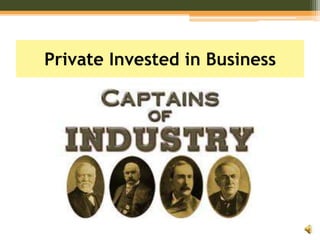
Private Invested in Business
Private Sector Invested in BusinessEconomies-of-Scale—large factories benefit because they are able to  mass produce lowering their cost of production which allows them to sell their goods at a  lower cost than small businessesCorporations:  A large business organization owned by investors who purchase stock in the company Advantages to Corporationsminimum risk to investorsable to raise a large amount of  capital (money)Longevity— able to exist for a long period of timeTypes of Business OrganizationsMonopoly—control over a certain good or industry by one company.Trust— a few companies that gain control of an industry to reduce competition. Horizontal Integration—joining businesses involved similar activities.  Example:  Rockefeller’s Standard Oil Company owned all of the oil refineries in the US.Vertical Integration—a business that controls all the phases of production of a product. Example:  Carnegie’s US Steel company owned the materials, transportation, distribution and factories that went into making steel.
John D. Rockefeller and the Standard Oil Company  Most successful example of horizontal integration  1870-controlled 2% of US oil by 1880 controlled 90% of it!!!! Sold oil extremely low to destroy competition, then raised his prices.Private Sector Invested in Business
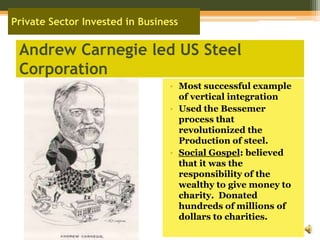
Andrew Carnegie led US Steel CorporationMost successful example of vertical integrationUsed the Bessemer process that revolutionized the Production of steel.Social Gospel: believed that it was the responsibility of the wealthy to give money to charity.  Donated hundreds of millions of dollars to charities.Private Sector Invested in Business
Private Sector Invested in Business
Liberal Immigration LawsProvided cheap labor for industrial growthIncreasing population means an increase in demand for product, increasing production, and increasing job positions.Irish and Chinese immigrant built the railroads for low pay and extremely dangerous conditions.
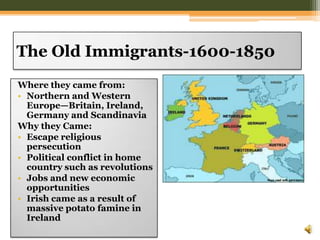
The Old Immigrants-1600-1850Where they came from:Northern and Western Europe—Britain, Ireland, Germany and ScandinaviaWhy they Came: Escape religious persecutionPolitical conflict in home country such as revolutionsJobs and new economic opportunitiesIrish came as a result of massive potato famine in Ireland
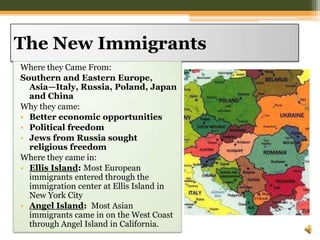
The New ImmigrantsWhere they Came From:Southern and Eastern Europe, Asia—Italy, Russia, Poland, Japan and China Why they came:Better economic opportunitiesPolitical freedomJews from Russia sought religious freedomWhere they came in:Ellis Island: Most European immigrants entered through the immigration center at Ellis Island in New York CityAngel Island:  Most Asian immigrants came in on the West Coast through Angel Island in California.
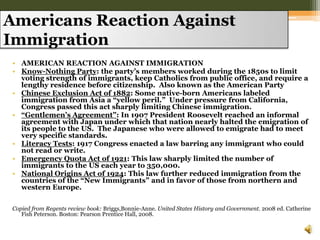
Americans Reaction Against ImmigrationAMERICAN REACTION AGAINST IMMIGRATIONKnow-Nothing Party: the party’s members worked during the 1850s to limit voting strength of immigrants, keep Catholics from public office, and require a lengthy residence before citizenship.  Also known as the American PartyChinese Exclusion Act of 1882: Some native-born Americans labeled immigration from Asia a “yellow peril.”  Under pressure from California, Congress passed this act sharply limiting Chinese immigration.“Gentlemen’s Agreement”: In 1907 President Roosevelt reached an informal agreement with Japan under which that nation nearly halted the emigration of its people to the US.  The Japanese who were allowed to emigrate had to meet very specific standards.Literacy Tests: 1917 Congress enacted a law barring any immigrant who could not read or write.Emergency Quota Act of 1921: This law sharply limited the number of immigrants to the US each year to 350,000.National Origins Act of 1924: This law further reduced immigration from the countries of the “New Immigrants” and in favor of those from northern and western Europe.Copied from Regents review book:Briggs,Bonnie-Anne. United States History and Government. 2008 ed. Catherine Fish Peterson. Boston: Pearson Prentice Hall, 2008.
EFFECTS OF INDUSTRIALIZATIONAND THE FIGHT FOR CHANGE
Poor Working Conditions1.  Wages were low due to large  supply of workers2.  Long work days were 14-16 hours per day, 6days a week.3.  Workers Lacked Benefits:	a.  NO Workers compensation	b.  NO Holidays/sick days	c.  NO Minimum Wage	d.  NO Job Security4.  Dangerous Conditions	a.  excessive temperatures in cotton mills	b.  fumes and poor ventilation	c.  coal mines:		1.  cave-ins were common		2.  unpredictable explosions and gas fumes		3. cramped quarters resultedin deformed bodies of children    		4.  unsafe machines led to bodily harm and loss of jobs5.  Women and Children as Workers:		 a.  low wages forced women and children to help support the family.		b.  both were paid lower wages than men		c.  violated the moral conscious of many.
Life in the CitiesCities Grew QuicklyAs industry expanded and millions of immigrants poured into the US, cities grew rapidly.This rapid growth led to poorly built housing, overcrowded cities, and deplorable conditions.  Tenements: multi-family apartments, poorly maintained, overcrowded, lack of running water and sanitation.Health: Disease spread through cities as a result of overcrowding, inadequate water supply, no sanitation or garbage removal.
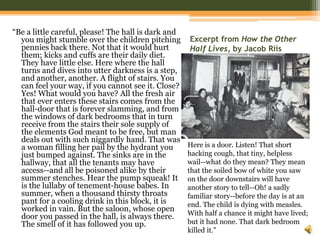
Excerpt from How the Other Half Lives, by Jacob RiisHere is a door. Listen! That short hacking cough, that tiny, helpless wail--what do they mean? They mean that the soiled bow of white you saw on the door downstairs will have another story to tell--Oh! a sadly familiar story--before the day is at an end. The child is dying with measles. With half a chance it might have lived; but it had none. That dark bedroom killed it.”“Be a little careful, please! The hall is dark and you might stumble over the children pitching pennies back there. Not that it would hurt them; kicks and cuffs are their daily diet. They have little else. Here where the hall turns and dives into utter darkness is a step, and another, another. A flight of stairs. You can feel your way, if you cannot see it. Close? Yes! What would you have? All the fresh air that ever enters these stairs comes from the hall-door that is forever slamming, and from the windows of dark bedrooms that in turn receive from the stairs their sole supply of the elements God meant to be free, but man deals out with such niggardly hand. That was a woman filling her pail by the hydrant you just bumped against. The sinks are in the hallway, that all the tenants may have access--and all be poisoned alike by their summer stenches. Hear the pump squeak! It is the lullaby of tenement-house babes. In summer, when a thousand thirsty throats pant for a cooling drink in this block, it is worked in vain. But the saloon, whose open door you passed in the hall, is always there. The smell of it has followed you up.
Growth of Labor Unions	Workers join together for change.
Workers advocated for higher wages, better workingconditions and protection against job loss due to injury by  machines.IssuesTactics Used to Push for ChangeLOW PAYLONG HOURS DANGEROUS WORKING   CONDITIONSWANTED BENEFITS AND  JOB SECURITYSTRIKE-refusal to workBOYCOTT-refusal to buy products of a particular companySLOW DOWN-decrease in productivity.Joining LABOR UNIONS
Development of Labor Unions1. KNIGHTS OF LABOR 	a.  began in 1869	b.  led by Terence Powderly	c.  welcomed all workers into the union including women and African  Americans	d.  Membership declined after 1866 Haymarket Square Riot2.  AFL—AMERICAN FEDERATION OF LABOR	a.  began by Samuel Gompers	b.  accepted only skilled labor	c.  didn’t accept _women, blacks, or immigrants.3.  Eugene V. Debs	a.  created 1st large scale industrial union.	b.  brought together all railroad workers: skilled and unskilled.4.  Labor Unions faced harassment from law enforcement,		Managers and government.
Business Owners/ManagementIssuesTactics Against LaborGranting any of the labor’s demands would cut into profits.  Large supply of labor meant workers could easily be replacedThe US government showed NO support for Labor.    LOCK-OUT-closed factory or place of employmentBLACK LIST-record kept by companies of employees who should not be hired because they want changes.HIRING SCABS-non-union, replacement workers hired during a strike.
Unions and Management ClashGreat Railway Strike 1877—July—workers at the B&O Railroad stopped rail lines in several states.President Hayes intervened calling on federal troops to end the strike.The Haymarket Affair—May 6, 1866—3000 workers inChicago to protest police brutality againststrikers.  Someone threw a bomb in the police line,police opened fire.  Several strikers and 7 police officerswere killed.  Public turned against the union movementPullman Strikea.  town built by George Pullmanb.  company laid off several workers and cut the wagesof the remaining employees.c.  President Grover Cleveland sent troops in.d.  Riots broke out and the union, led by Eugene V. Debs was blamed for the strike.  Debs was arrested and the    strike collapsed.Homestead Strike: 1892 workers at Carnegie Steel Plant organized a strike protesting reduced wages.  Riots broke out between strikers and security.  16 people were killed and the National Guard was brought in to end the strike.  DURING THE STRIKES OF THE LATE 1800S THE US GOVERNMENT CONSISTENTLY SUPPORTED MANAGEMENT AND OWNERS OVER WORKERS.  THE PROGRESSIVE ERA EFFORTS WOULD HELP CHANGE THIS.

The industrial revolution

  • 1.
    The Industrial RevolutionTheUS in the second half of the 19th Century
  • 2.
    WHAT ALLOWED THEUS TO GROW AND BECOME THE INDUSTRIAL LEADER OF THE WORLD BY THE 1880S? The US Government invested in business and industry to encourage economic growth.Private Investment in BusinessLiberal Immigration Laws
  • 3.
    The US GovernmentInvested in BusinessPolicy #1: Laissez-Faire: Government did not regulate or restrict business. Purpose: Wanted to encourage public investment in business which would lead to the growth of industry and the economy.Result: Reduction of competitionFormation of MonopoliesUnfair business practicesDestruction of the environmentUnsafe working and living conditionsLow wages/long hours
  • 4.
    Policy #2: High Protective TariffsPurpose: Made domestic goods more competitively priced. Encouraged Americans to buy domestic productsResult:Demand for American goods in the US rose. High protective tariffs were placed on US goods in other countries.If protective tariffs are too high, foreign demand and exports decline.The US Government Invested in Business
  • 5.
    Policy #: Investmentin RailroadsPurpose:US government paid 1/3 of cost of building railroads in the West.US gave land equal to the size of Texas to the railroad companiesThe US government loaned $700 million to encourage railroad expansion out WestResult:Railroad system expanded across the West bringing more people to Western States. Transcontinental Railroad connecting the East Coast to the West Coast, was completed in 1869The US Government Invested in Business
  • 6.
  • 7.
    Private Sector Investedin BusinessEconomies-of-Scale—large factories benefit because they are able to mass produce lowering their cost of production which allows them to sell their goods at a lower cost than small businessesCorporations: A large business organization owned by investors who purchase stock in the company Advantages to Corporationsminimum risk to investorsable to raise a large amount of capital (money)Longevity— able to exist for a long period of timeTypes of Business OrganizationsMonopoly—control over a certain good or industry by one company.Trust— a few companies that gain control of an industry to reduce competition. Horizontal Integration—joining businesses involved similar activities. Example: Rockefeller’s Standard Oil Company owned all of the oil refineries in the US.Vertical Integration—a business that controls all the phases of production of a product. Example: Carnegie’s US Steel company owned the materials, transportation, distribution and factories that went into making steel.
  • 8.
    John D. Rockefellerand the Standard Oil Company Most successful example of horizontal integration 1870-controlled 2% of US oil by 1880 controlled 90% of it!!!! Sold oil extremely low to destroy competition, then raised his prices.Private Sector Invested in Business
  • 9.
    Andrew Carnegie ledUS Steel CorporationMost successful example of vertical integrationUsed the Bessemer process that revolutionized the Production of steel.Social Gospel: believed that it was the responsibility of the wealthy to give money to charity. Donated hundreds of millions of dollars to charities.Private Sector Invested in Business
  • 10.
  • 11.
    Liberal Immigration LawsProvidedcheap labor for industrial growthIncreasing population means an increase in demand for product, increasing production, and increasing job positions.Irish and Chinese immigrant built the railroads for low pay and extremely dangerous conditions.
  • 12.
    The Old Immigrants-1600-1850Wherethey came from:Northern and Western Europe—Britain, Ireland, Germany and ScandinaviaWhy they Came: Escape religious persecutionPolitical conflict in home country such as revolutionsJobs and new economic opportunitiesIrish came as a result of massive potato famine in Ireland
  • 13.
    The New ImmigrantsWherethey Came From:Southern and Eastern Europe, Asia—Italy, Russia, Poland, Japan and China Why they came:Better economic opportunitiesPolitical freedomJews from Russia sought religious freedomWhere they came in:Ellis Island: Most European immigrants entered through the immigration center at Ellis Island in New York CityAngel Island: Most Asian immigrants came in on the West Coast through Angel Island in California.
  • 14.
    Americans Reaction AgainstImmigrationAMERICAN REACTION AGAINST IMMIGRATIONKnow-Nothing Party: the party’s members worked during the 1850s to limit voting strength of immigrants, keep Catholics from public office, and require a lengthy residence before citizenship. Also known as the American PartyChinese Exclusion Act of 1882: Some native-born Americans labeled immigration from Asia a “yellow peril.” Under pressure from California, Congress passed this act sharply limiting Chinese immigration.“Gentlemen’s Agreement”: In 1907 President Roosevelt reached an informal agreement with Japan under which that nation nearly halted the emigration of its people to the US. The Japanese who were allowed to emigrate had to meet very specific standards.Literacy Tests: 1917 Congress enacted a law barring any immigrant who could not read or write.Emergency Quota Act of 1921: This law sharply limited the number of immigrants to the US each year to 350,000.National Origins Act of 1924: This law further reduced immigration from the countries of the “New Immigrants” and in favor of those from northern and western Europe.Copied from Regents review book:Briggs,Bonnie-Anne. United States History and Government. 2008 ed. Catherine Fish Peterson. Boston: Pearson Prentice Hall, 2008.
  • 15.
  • 16.
    Poor Working Conditions1. Wages were low due to large supply of workers2. Long work days were 14-16 hours per day, 6days a week.3. Workers Lacked Benefits: a. NO Workers compensation b. NO Holidays/sick days c. NO Minimum Wage d. NO Job Security4. Dangerous Conditions a. excessive temperatures in cotton mills b. fumes and poor ventilation c. coal mines: 1. cave-ins were common 2. unpredictable explosions and gas fumes 3. cramped quarters resultedin deformed bodies of children 4. unsafe machines led to bodily harm and loss of jobs5. Women and Children as Workers: a. low wages forced women and children to help support the family. b. both were paid lower wages than men c. violated the moral conscious of many.
  • 17.
    Life in theCitiesCities Grew QuicklyAs industry expanded and millions of immigrants poured into the US, cities grew rapidly.This rapid growth led to poorly built housing, overcrowded cities, and deplorable conditions.  Tenements: multi-family apartments, poorly maintained, overcrowded, lack of running water and sanitation.Health: Disease spread through cities as a result of overcrowding, inadequate water supply, no sanitation or garbage removal.
  • 18.
    Excerpt from Howthe Other Half Lives, by Jacob RiisHere is a door. Listen! That short hacking cough, that tiny, helpless wail--what do they mean? They mean that the soiled bow of white you saw on the door downstairs will have another story to tell--Oh! a sadly familiar story--before the day is at an end. The child is dying with measles. With half a chance it might have lived; but it had none. That dark bedroom killed it.”“Be a little careful, please! The hall is dark and you might stumble over the children pitching pennies back there. Not that it would hurt them; kicks and cuffs are their daily diet. They have little else. Here where the hall turns and dives into utter darkness is a step, and another, another. A flight of stairs. You can feel your way, if you cannot see it. Close? Yes! What would you have? All the fresh air that ever enters these stairs comes from the hall-door that is forever slamming, and from the windows of dark bedrooms that in turn receive from the stairs their sole supply of the elements God meant to be free, but man deals out with such niggardly hand. That was a woman filling her pail by the hydrant you just bumped against. The sinks are in the hallway, that all the tenants may have access--and all be poisoned alike by their summer stenches. Hear the pump squeak! It is the lullaby of tenement-house babes. In summer, when a thousand thirsty throats pant for a cooling drink in this block, it is worked in vain. But the saloon, whose open door you passed in the hall, is always there. The smell of it has followed you up.
  • 19.
    Growth of LaborUnions Workers join together for change.
  • 20.
    Workers advocated forhigher wages, better workingconditions and protection against job loss due to injury by machines.IssuesTactics Used to Push for ChangeLOW PAYLONG HOURS DANGEROUS WORKING CONDITIONSWANTED BENEFITS AND JOB SECURITYSTRIKE-refusal to workBOYCOTT-refusal to buy products of a particular companySLOW DOWN-decrease in productivity.Joining LABOR UNIONS
  • 21.
    Development of LaborUnions1. KNIGHTS OF LABOR a. began in 1869 b. led by Terence Powderly c. welcomed all workers into the union including women and African Americans d. Membership declined after 1866 Haymarket Square Riot2. AFL—AMERICAN FEDERATION OF LABOR a. began by Samuel Gompers b. accepted only skilled labor c. didn’t accept _women, blacks, or immigrants.3. Eugene V. Debs a. created 1st large scale industrial union. b. brought together all railroad workers: skilled and unskilled.4. Labor Unions faced harassment from law enforcement, Managers and government.
  • 22.
    Business Owners/ManagementIssuesTactics AgainstLaborGranting any of the labor’s demands would cut into profits. Large supply of labor meant workers could easily be replacedThe US government showed NO support for Labor. LOCK-OUT-closed factory or place of employmentBLACK LIST-record kept by companies of employees who should not be hired because they want changes.HIRING SCABS-non-union, replacement workers hired during a strike.
  • 23.
    Unions and ManagementClashGreat Railway Strike 1877—July—workers at the B&O Railroad stopped rail lines in several states.President Hayes intervened calling on federal troops to end the strike.The Haymarket Affair—May 6, 1866—3000 workers inChicago to protest police brutality againststrikers. Someone threw a bomb in the police line,police opened fire. Several strikers and 7 police officerswere killed. Public turned against the union movementPullman Strikea. town built by George Pullmanb. company laid off several workers and cut the wagesof the remaining employees.c. President Grover Cleveland sent troops in.d. Riots broke out and the union, led by Eugene V. Debs was blamed for the strike. Debs was arrested and the strike collapsed.Homestead Strike: 1892 workers at Carnegie Steel Plant organized a strike protesting reduced wages. Riots broke out between strikers and security. 16 people were killed and the National Guard was brought in to end the strike. DURING THE STRIKES OF THE LATE 1800S THE US GOVERNMENT CONSISTENTLY SUPPORTED MANAGEMENT AND OWNERS OVER WORKERS. THE PROGRESSIVE ERA EFFORTS WOULD HELP CHANGE THIS.