
31.1 Postwar Uncertainty
The postwar period is one of loss and
uncertainty but also one of
invention, creativity, and new ideas.
A New Revolution in Science
• Impact of Einstein’s
Theory of Relativity
– Albert Einstein offered
radically new ideas in
field of physics
– Theory of relativity—
idea that space and
time are not constant
– New ideas make world
seem more uncertain
than before
A New Revolution in Science
• Influence of
Freudian Psychology
– Sigmund Freud—
Austrian doctor with
new ideas about the
mind
– Claims that human
behavior is not based
on reason
Literature in the 1920s: The Lost Generation
• Impact of the War
– Suffering caused by World
War I leads many to doubt
old beliefs.
– Many American younger
postwar writers choosing to
live in Europe are called
the “Lost Generation,” a
term used by Ernest
Hemingway in his novel
The Sun Also
Rises, himself a member of
the “lost generation.” The
term was coined by his
mentor, the writer Gertrude
Stein.
Lost Generation Writers
• T.S. Elliot
• Wrote The Waste
Land, a poem.
Lost Generation Writers
• F. Scott Fitzgerald
• Wrote the short story
“Bernice Bobs Her Hair”
as well as the novel The
Great Gatsby.
Lost Generation Writers
• Ezra Pound
– an American expatriate
poet, critic and a major
figure of the early
modernist movement.
– His best-known works
include Ripostes (1912),
Hugh Selwyn Mauberley
(1920), and his
unfinished 120-section
epic, The Cantos (1917–
1969).
Other Writers
• Writers Reflect
Society’s Concerns
– Novels of Franz Kafka
reflect uneasiness of
postwar years
– Novels of James
Joyce reflect Freud’s
ideas about the mind
Literature in the 1920s
• Thinkers React to
Uncertainties
– Philosophy of
existentialism—no
universal meaning
to life
– Friedrich Nietzsche
(right) urges return
to ancient heroic
values .
Literature in the 1920s
• French philosopher
Jean-Paul Satre (right)
becomes a leading
existentialist
philosopher.
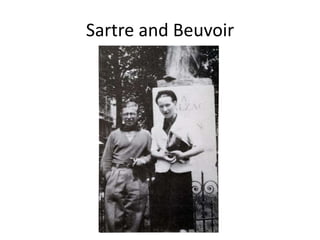
• Sartre’s partner
Simone De Beuvoir
(right) is also a
existentialist
philosopher and
feminist author.
Sartre and Beuvoir
Revolution in the Arts
• Artists Rebel Against Tradition
• Artists want to depict inner world of mind
– Cubism transforms natural shapes into geometric
forms
– Dadaism—art that rejected reason and
logic, prizing nonsense, anarchy, irrationality and
intuition
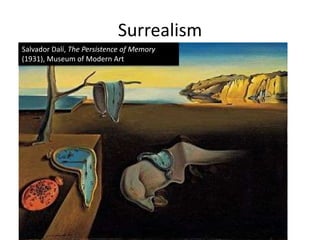
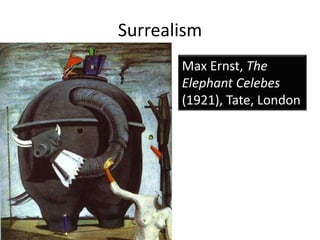
– Surrealism—art movement that links dreams with
real life
Cubism
• Pablo Picasso, Les
Demoiselles
d'Avignon, 1907.
Considered to be
a major step
towards the
founding of the
Cubist movement
Cubism
• Robert
Delaunay, Simultaneous
Windows on the
City, 1912, Hamburger
Kunsthalle, an example
of Abstract Cubism
Cubism
• Juan Gris, Portrait of
Picasso, 1912, oil on
canvas, Art Institute of
Chicago
Cubism
• Pablo Picasso, Three
Musicians (1921),
Museum of Modern
Art. Three Musicians is
a classic example of
Synthetic cubism.
Dadaism
• Hannah Höch, Cut with
the Dada Kitchen Knife
through the Last
Weimar Beer-Belly
Cultural Epoch in
Germany, 1919, collage
of pasted
papers, 90x144
cm, Nationalgalerie, Sta
atliche Museen zu
Berlin
Dadaism
• Fountain is a 1917 work
widely attributed to
Marcel Duchamp. The
scandalous work was a
porcelain urinal, which
was signed "R.Mutt"
and titled Fountain.
Dadaism
• Raoul Hausmann ABCD
(Self-portrait) A
photomontage from
1923-24
• The techniques of
Dadaism included
– Collage
– Photomantage
– Assemblage
– Readymades
(manufactured goods the
Dadaists considered art).
Surrealism
Salvador Dalí, The Persistence of Memory
(1931), Museum of Modern Art
Surrealism
Max Ernst, The
Elephant Celebes
(1921), Tate, London
Surrealism
René Magritte's "This is not a
pipe." The Treachery of Images
1928–29, Los Angeles County
Museum of Art
Composers Try New Styles
• Composers move away
from traditional styles
– Jazz—musical style that
captures age’s new
freedom
Louis Armstrong (above) and
Ferdinand Joseph LaMothe a.k.a.
“Jelly Role Morton” (left)
The King & Carter Jazzing Orchestra photographed in
Houston, Texas, January 1921.
Society Challenges Convention
• Women’s Roles Change
– Women take on new
roles during World War I
– This work helps many
win the right to vote
– In 1920s, women adopt
freer clothing, hairstyles
• “Flappers”
– Some women seek new
careers
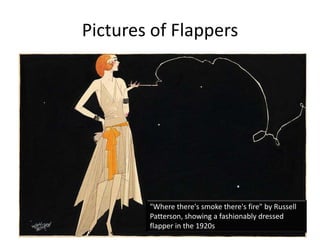
Pictures of Flappers
Actress Louise Brooks A flapper on board a ship
Pictures of Flappers
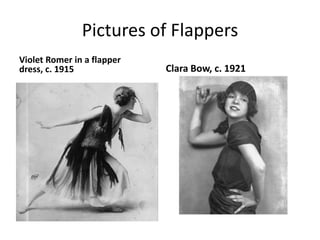
Violet Romer in a flapper
dress, c. 1915 Clara Bow, c. 1921
Pictures of Flappers
Actress Alice Joyce Actress Norma Talmage
Pictures of Flappers
"Where there's smoke there's fire" by Russell
Patterson, showing a fashionably dressed
flapper in the 1920s
Technological Advances Improve Life
• The Automobile Alters
Society
– Cars improve after the
war
– Cars become less
expensive
– Increased auto use
changes people’s lives
1925 Ford Model T touring sedan.
Technological Advances Improve Life
• Airplanes
Transform Travel
–Charles Lindbergh
is first to fly alone
across Atlantic
Technological Advances Improve Life
• Radio and Movies
Dominate Popular
Entertainment
– In
1920s, commercial
radio stations
spread across U.S.
– Motion pictures
become major
industry, art form
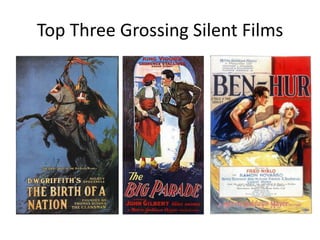
Top Three Grossing Silent Films

31.1 postwar uncertainty

  • 1.
    31.1 Postwar Uncertainty Thepostwar period is one of loss and uncertainty but also one of invention, creativity, and new ideas.
  • 2.
    A New Revolutionin Science • Impact of Einstein’s Theory of Relativity – Albert Einstein offered radically new ideas in field of physics – Theory of relativity— idea that space and time are not constant – New ideas make world seem more uncertain than before
  • 3.
    A New Revolutionin Science • Influence of Freudian Psychology – Sigmund Freud— Austrian doctor with new ideas about the mind – Claims that human behavior is not based on reason
  • 4.
    Literature in the1920s: The Lost Generation • Impact of the War – Suffering caused by World War I leads many to doubt old beliefs. – Many American younger postwar writers choosing to live in Europe are called the “Lost Generation,” a term used by Ernest Hemingway in his novel The Sun Also Rises, himself a member of the “lost generation.” The term was coined by his mentor, the writer Gertrude Stein.
  • 5.
    Lost Generation Writers •T.S. Elliot • Wrote The Waste Land, a poem.
  • 6.
    Lost Generation Writers •F. Scott Fitzgerald • Wrote the short story “Bernice Bobs Her Hair” as well as the novel The Great Gatsby.
  • 7.
    Lost Generation Writers •Ezra Pound – an American expatriate poet, critic and a major figure of the early modernist movement. – His best-known works include Ripostes (1912), Hugh Selwyn Mauberley (1920), and his unfinished 120-section epic, The Cantos (1917– 1969).
  • 8.
    Other Writers • WritersReflect Society’s Concerns – Novels of Franz Kafka reflect uneasiness of postwar years – Novels of James Joyce reflect Freud’s ideas about the mind
  • 9.
    Literature in the1920s • Thinkers React to Uncertainties – Philosophy of existentialism—no universal meaning to life – Friedrich Nietzsche (right) urges return to ancient heroic values .
  • 10.
    Literature in the1920s • French philosopher Jean-Paul Satre (right) becomes a leading existentialist philosopher. • Sartre’s partner Simone De Beuvoir (right) is also a existentialist philosopher and feminist author.
  • 11.
  • 12.
    Revolution in theArts • Artists Rebel Against Tradition • Artists want to depict inner world of mind – Cubism transforms natural shapes into geometric forms – Dadaism—art that rejected reason and logic, prizing nonsense, anarchy, irrationality and intuition – Surrealism—art movement that links dreams with real life
  • 13.
    Cubism • Pablo Picasso,Les Demoiselles d'Avignon, 1907. Considered to be a major step towards the founding of the Cubist movement
  • 14.
    Cubism • Robert Delaunay, Simultaneous Windowson the City, 1912, Hamburger Kunsthalle, an example of Abstract Cubism
  • 15.
    Cubism • Juan Gris,Portrait of Picasso, 1912, oil on canvas, Art Institute of Chicago
  • 16.
    Cubism • Pablo Picasso,Three Musicians (1921), Museum of Modern Art. Three Musicians is a classic example of Synthetic cubism.
  • 17.
    Dadaism • Hannah Höch,Cut with the Dada Kitchen Knife through the Last Weimar Beer-Belly Cultural Epoch in Germany, 1919, collage of pasted papers, 90x144 cm, Nationalgalerie, Sta atliche Museen zu Berlin
  • 18.
    Dadaism • Fountain isa 1917 work widely attributed to Marcel Duchamp. The scandalous work was a porcelain urinal, which was signed "R.Mutt" and titled Fountain.
  • 19.
    Dadaism • Raoul HausmannABCD (Self-portrait) A photomontage from 1923-24 • The techniques of Dadaism included – Collage – Photomantage – Assemblage – Readymades (manufactured goods the Dadaists considered art).
  • 20.
    Surrealism Salvador Dalí, ThePersistence of Memory (1931), Museum of Modern Art
  • 21.
    Surrealism Max Ernst, The ElephantCelebes (1921), Tate, London
  • 22.
    Surrealism René Magritte's "Thisis not a pipe." The Treachery of Images 1928–29, Los Angeles County Museum of Art
  • 23.
    Composers Try NewStyles • Composers move away from traditional styles – Jazz—musical style that captures age’s new freedom Louis Armstrong (above) and Ferdinand Joseph LaMothe a.k.a. “Jelly Role Morton” (left)
  • 24.
    The King &Carter Jazzing Orchestra photographed in Houston, Texas, January 1921.
  • 25.
    Society Challenges Convention •Women’s Roles Change – Women take on new roles during World War I – This work helps many win the right to vote – In 1920s, women adopt freer clothing, hairstyles • “Flappers” – Some women seek new careers
  • 26.
    Pictures of Flappers ActressLouise Brooks A flapper on board a ship
  • 27.
    Pictures of Flappers VioletRomer in a flapper dress, c. 1915 Clara Bow, c. 1921
  • 28.
    Pictures of Flappers ActressAlice Joyce Actress Norma Talmage
  • 29.
    Pictures of Flappers "Wherethere's smoke there's fire" by Russell Patterson, showing a fashionably dressed flapper in the 1920s
  • 30.
    Technological Advances ImproveLife • The Automobile Alters Society – Cars improve after the war – Cars become less expensive – Increased auto use changes people’s lives 1925 Ford Model T touring sedan.
  • 31.
    Technological Advances ImproveLife • Airplanes Transform Travel –Charles Lindbergh is first to fly alone across Atlantic
  • 32.
    Technological Advances ImproveLife • Radio and Movies Dominate Popular Entertainment – In 1920s, commercial radio stations spread across U.S. – Motion pictures become major industry, art form
  • 33.
    Top Three GrossingSilent Films