   Describe the role of Islamic leaders in the
    spread of Islam after Muhammad’s death
     Who were the leaders who spread Islam after
      Muhammad’s death?
     What role did they play in expanding the Muslim
      empire and spreading Islam?
VOCABULARY                  PEOPLE

   Caliph                     Abu Bakr
   Rightly Guided Caliph      Umar
                               Uthman
                               Ali
                               Umayyads
   Until his death
    Muhammad spread
    Islam throughout the
    Arabian Peninsula.
    While doing so he
    created a political
    empire.
   He united Bedouin
    tribes and brought
    order, justice, and hope
    of heaven to the people
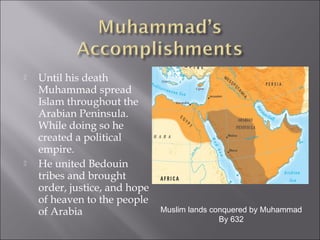
    of Arabia                  Muslim lands conquered by Muhammad
                                              By 632
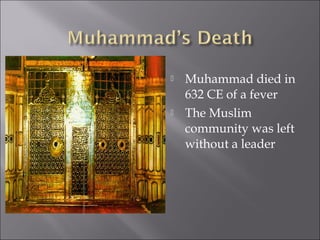
   Muhammad died in
    632 CE of a fever
   The Muslim
    community was left
    without a leader
   Muhammad had not named a successor or told
    his followers how to choose a leader
   As a result panic spread across the empire
     Some clans abandoned Islam
     Some refused to pay taxes
     Some individuals declared themselves prophets
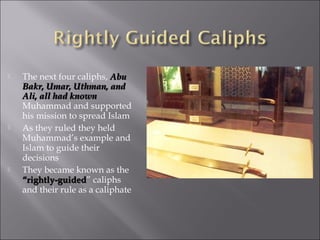
   The next four caliphs, Abu
    Bakr, Umar, Uthman, and
    Ali, all had known
    Muhammad and supported
    his mission to spread Islam
   As they ruled they held
    Muhammad’s example and
    Islam to guide their
    decisions
   They became known as the
    “rightly-guided” caliphs
    “rightly-guided
    and their rule as a caliphate
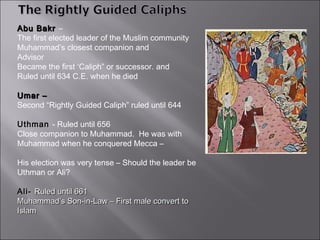
Abu Bakr –
The first elected leader of the Muslim community
Muhammad’s closest companion and
Advisor
Became the first ‘Caliph” or successor. and
Ruled until 634 C.E. when he died

Umar –
Second “Rightly Guided Caliph” ruled until 644

Uthman - Ruled until 656
Close companion to Muhammad. He was with
Muhammad when he conquered Mecca –

His election was very tense – Should the leader be
Uthman or Ali?

Ali- Ruled until 661
Muhammad’s Son-in-Law – First male convert to
Islam
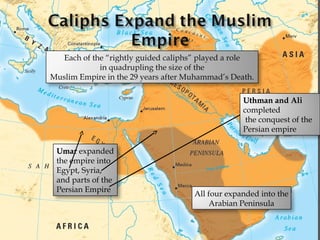
Each of the “rightly guided caliphs” played a role
             in quadrupling the size of the
Muslim Empire in the 29 years after Muhammad’s Death.

                                                  Uthman and Ali
                                                  completed
                                                   the conquest of the
                                                  Persian empire

 Umar expanded
 the empire into
 Egypt, Syria,
 and parts of the
 Persian Empire
                                     All four expanded into the
                                         Arabian Peninsula
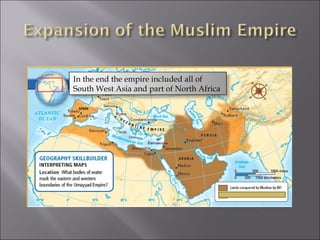
In the end the empire included all of
South West Asia and part of North Africa
   Muslims were energized by their faith and
    were willing to fight to spread Islam
   Great soldiers
   Byzantine and Persian empires were weakened
    by years of fighting
   Muslim conquerors let the Christians and Jews
    keep their faith
   Over time many of the cultures brought into
    the Muslim empire converted to Islam because
    of Islam’s message of equality and hope of
    salvation and the tax break they would receive
    by becoming Muslims.
   Take the quiz on Edmodo to see if you
    understood main ideas!
   Describe the role of Islamic leaders in the
    spread of Islam after Muhammad’s death
     Who were the leaders who spread Islam after
      Muhammad’s death?
     What role did they play in expanding the Muslim
      empire and spreading Islam?
   The Sunni/ Shi’ite split began as a result of
    deciding who was the rightful leader of the
    Muslim people.
   In 656, there was opposition to Ali, cousin and
    son in law of Muhammad, taking power over
    the Muslim community.
   Those who opposed Ali supported
    Muhammad’s cousin Muawiya, Uthman’s
    cousin
   After Uthman’s death a civil war broke out
    between different groups of Islam.
   One small group of Muslims believed that the
    caliph should be chosen by the Muslim
    Community
   The opposing side believed that the caliph
    should be chosen by hereditary
   Ali was appointed as the next caliph, but not
    accepted by all Muslims
   After Ali’s murder the Umayyad’s took power over the
    Muslim empire and set up a hereditary dynasty. The
    leader would be chosen by birth right.
   The Umayyad’s moved the capital from Medina to
    Damascus
   The Umayyad caliphs abandoned the simple life of the
    previous prophets and adopted a more lavish lifestyle
   Because they wanted peace most Muslims accepted the
    Umayyad rule
   The Sunnis believed in electing the Caliphs
   Ali’s supporters said that Muhammad’s family should
    succeed him and that he had trained Ali as his
    successor
   They didn’t accept that Abu Bakr, Umar, and Uthman
    had been real caliphs
   They thought that the Muawiya and his followers were
    more interested in power than Islam
   Ali’s supporters were called the Shi’a Ali (part of Ali)
    or Shi’ites for short
   They believed that the caliphs should always be a
    relative of the prophet
   The Shi’ites never regained control of Islam
   There were many more Sunni
   Today about 10% of Muslims are Shi’ites
   They are a powerful minority. They have
    power in Iran, Pakistan, and Iraq
   They believe that one day the final successor to
    Ali called Mahdi, will come to set up the
    perfect Muslim state

Islam after muhammad’s death

  • 2.
    Describe the role of Islamic leaders in the spread of Islam after Muhammad’s death  Who were the leaders who spread Islam after Muhammad’s death?  What role did they play in expanding the Muslim empire and spreading Islam?
  • 3.
    VOCABULARY PEOPLE  Caliph  Abu Bakr  Rightly Guided Caliph  Umar  Uthman  Ali  Umayyads
  • 4.
    Until his death Muhammad spread Islam throughout the Arabian Peninsula. While doing so he created a political empire.  He united Bedouin tribes and brought order, justice, and hope of heaven to the people of Arabia Muslim lands conquered by Muhammad By 632
  • 5.
    Muhammad died in 632 CE of a fever  The Muslim community was left without a leader
  • 6.
    Muhammad had not named a successor or told his followers how to choose a leader  As a result panic spread across the empire  Some clans abandoned Islam  Some refused to pay taxes  Some individuals declared themselves prophets
  • 7.
    The next four caliphs, Abu Bakr, Umar, Uthman, and Ali, all had known Muhammad and supported his mission to spread Islam  As they ruled they held Muhammad’s example and Islam to guide their decisions  They became known as the “rightly-guided” caliphs “rightly-guided and their rule as a caliphate
  • 8.
    Abu Bakr – Thefirst elected leader of the Muslim community Muhammad’s closest companion and Advisor Became the first ‘Caliph” or successor. and Ruled until 634 C.E. when he died Umar – Second “Rightly Guided Caliph” ruled until 644 Uthman - Ruled until 656 Close companion to Muhammad. He was with Muhammad when he conquered Mecca – His election was very tense – Should the leader be Uthman or Ali? Ali- Ruled until 661 Muhammad’s Son-in-Law – First male convert to Islam
  • 9.
    Each of the“rightly guided caliphs” played a role in quadrupling the size of the Muslim Empire in the 29 years after Muhammad’s Death. Uthman and Ali completed the conquest of the Persian empire Umar expanded the empire into Egypt, Syria, and parts of the Persian Empire All four expanded into the Arabian Peninsula
  • 10.
    In the endthe empire included all of South West Asia and part of North Africa
  • 11.
    Muslims were energized by their faith and were willing to fight to spread Islam  Great soldiers  Byzantine and Persian empires were weakened by years of fighting  Muslim conquerors let the Christians and Jews keep their faith
  • 12.
    Over time many of the cultures brought into the Muslim empire converted to Islam because of Islam’s message of equality and hope of salvation and the tax break they would receive by becoming Muslims.
  • 13.
    Take the quiz on Edmodo to see if you understood main ideas!  Describe the role of Islamic leaders in the spread of Islam after Muhammad’s death  Who were the leaders who spread Islam after Muhammad’s death?  What role did they play in expanding the Muslim empire and spreading Islam?
  • 14.
    The Sunni/ Shi’ite split began as a result of deciding who was the rightful leader of the Muslim people.  In 656, there was opposition to Ali, cousin and son in law of Muhammad, taking power over the Muslim community.  Those who opposed Ali supported Muhammad’s cousin Muawiya, Uthman’s cousin
  • 15.
    After Uthman’s death a civil war broke out between different groups of Islam.  One small group of Muslims believed that the caliph should be chosen by the Muslim Community  The opposing side believed that the caliph should be chosen by hereditary  Ali was appointed as the next caliph, but not accepted by all Muslims
  • 16.
    After Ali’s murder the Umayyad’s took power over the Muslim empire and set up a hereditary dynasty. The leader would be chosen by birth right.  The Umayyad’s moved the capital from Medina to Damascus  The Umayyad caliphs abandoned the simple life of the previous prophets and adopted a more lavish lifestyle  Because they wanted peace most Muslims accepted the Umayyad rule  The Sunnis believed in electing the Caliphs
  • 17.
    Ali’s supporters said that Muhammad’s family should succeed him and that he had trained Ali as his successor  They didn’t accept that Abu Bakr, Umar, and Uthman had been real caliphs  They thought that the Muawiya and his followers were more interested in power than Islam  Ali’s supporters were called the Shi’a Ali (part of Ali) or Shi’ites for short  They believed that the caliphs should always be a relative of the prophet
  • 18.
    The Shi’ites never regained control of Islam  There were many more Sunni  Today about 10% of Muslims are Shi’ites  They are a powerful minority. They have power in Iran, Pakistan, and Iraq  They believe that one day the final successor to Ali called Mahdi, will come to set up the perfect Muslim state