The Dark Side of the 1920s:
The Plight of the Farmer
Sharon Rounds
McElroy Project
through
Herbert Hoover Presidential Library & Museum
World War I
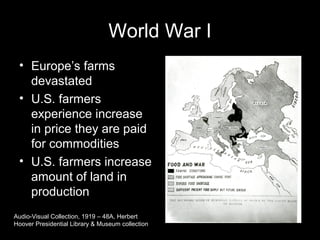
• Europe’s farms
devastated
• U.S. farmers
experience increase
in price they are paid
for commodities
• U.S. farmers increase
amount of land in
production
Audio-Visual Collection, 1919 – 48A, Herbert
Hoover Presidential Library & Museum collection
All People are Encouraged to
Save Food for Troops
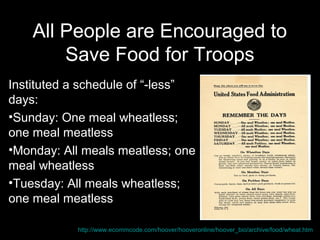
Instituted a schedule of “-less”
days:
•Sunday: One meal wheatless;
one meal meatless
•Monday: All meals meatless; one
meal wheatless
•Tuesday: All meals wheatless;
one meal meatless
http://www.ecommcode.com/hoover/hooveronline/hoover_bio/archive/food/wheat.htmhttp://www.ecommcode.com/hoover/hooveronline/hoover_bio/archive/food/wheat.htm
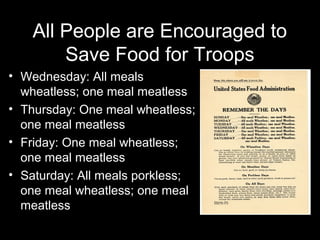
• Wednesday: All meals
wheatless; one meal meatless
• Thursday: One meal wheatless;
one meal meatless
• Friday: One meal wheatless;
one meal meatless
• Saturday: All meals porkless;
one meal wheatless; one meal
meatless
http://www.ecommcode.com/hoover/hooveronline/hoover_bio/archive/food/wheat.htm
All People are Encouraged to
Save Food for Troops
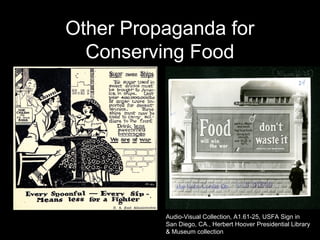
Other Propaganda for
Conserving Food
http://www.ecommcode.com/hoover/hooveronline/ho
over_bio/food.htm#p1
Audio-Visual Collection, A1.61-25, USFA Sign in
San Diego, CA., Herbert Hoover Presidential Library
& Museum collection
http://www.ecommcode.com/hoover/hooveronline/
hoover_and_belgian_relief/PROJECTS/G/J19.htm
l
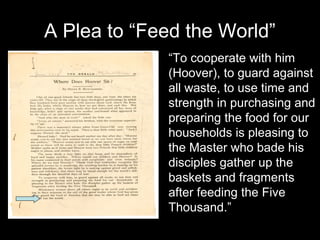
“To cooperate with him
(Hoover), to guard against
all waste, to use time and
strength in purchasing and
preparing the food for our
households is pleasing to
the Master who bade his
disciples gather up the
baskets and fragments
after feeding the Five
Thousand.”
A Plea to “Feed the World”
July 1918
• President Wilson vetoed a Congressional
attempt to raise the guaranteed price of wheat
• It was decided that the government price for
wheat would remain unchanged, while prices of
most other commodities were soaring
• Cotton remained exempt from mandatory price
restraints
Hoover Defends Price Controls
• Says without government price controls, the
price of wheat would be less than $1 a bushel
• Provided President Wilson ammo against public
criticisms of Senator Weeks
After the War
• Late in 1919, commodity prices started going
down
• Prices never recovered until after World War II
• Recovery of European agriculture after 1922
reduced demand and prices even further
What Did the U.S. Consumer do
after the War?
• Ate more fruits, vegetables, and meats after the
war, but less cereals
• Pushed through Prohibition, which further
lowered the demand for cereals and hops
• Bought synthetic products, which narrowed the
market for natural fibers like cotton
Parrish, Michael E. (1994). Anxious Decades: America in Prosperity and Depression, 1920–1941.
New York: W. W. Norton & Company, Inc. Copy available at the Herbert Hoover Presidential Library
& Museum, West Branch, IA.
So…Why Not Take Land Out of
Production to Raise Prices?
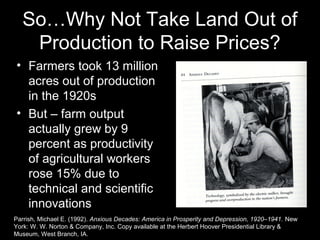
• Farmers took 13 million
acres out of production
in the 1920s
• But – farm output
actually grew by 9
percent as productivity
of agricultural workers
rose 15% due to
technical and scientific
innovations
Parrish, Michael E. (1992). Anxious Decades: America in Prosperity and Depression, 1920–1941. New
York: W. W. Norton & Company, Inc. Copy available at the Herbert Hoover Presidential Library &
Museum, West Branch, IA.

The darksideofthe20sfarming

  • 1.
    The Dark Sideof the 1920s: The Plight of the Farmer Sharon Rounds McElroy Project through Herbert Hoover Presidential Library & Museum
  • 2.
    World War I •Europe’s farms devastated • U.S. farmers experience increase in price they are paid for commodities • U.S. farmers increase amount of land in production Audio-Visual Collection, 1919 – 48A, Herbert Hoover Presidential Library & Museum collection
  • 3.
    All People areEncouraged to Save Food for Troops Instituted a schedule of “-less” days: •Sunday: One meal wheatless; one meal meatless •Monday: All meals meatless; one meal wheatless •Tuesday: All meals wheatless; one meal meatless http://www.ecommcode.com/hoover/hooveronline/hoover_bio/archive/food/wheat.htmhttp://www.ecommcode.com/hoover/hooveronline/hoover_bio/archive/food/wheat.htm
  • 4.
    • Wednesday: Allmeals wheatless; one meal meatless • Thursday: One meal wheatless; one meal meatless • Friday: One meal wheatless; one meal meatless • Saturday: All meals porkless; one meal wheatless; one meal meatless http://www.ecommcode.com/hoover/hooveronline/hoover_bio/archive/food/wheat.htm All People are Encouraged to Save Food for Troops
  • 5.
    Other Propaganda for ConservingFood http://www.ecommcode.com/hoover/hooveronline/ho over_bio/food.htm#p1 Audio-Visual Collection, A1.61-25, USFA Sign in San Diego, CA., Herbert Hoover Presidential Library & Museum collection
  • 6.
    http://www.ecommcode.com/hoover/hooveronline/ hoover_and_belgian_relief/PROJECTS/G/J19.htm l “To cooperate withhim (Hoover), to guard against all waste, to use time and strength in purchasing and preparing the food for our households is pleasing to the Master who bade his disciples gather up the baskets and fragments after feeding the Five Thousand.” A Plea to “Feed the World”
  • 7.
    July 1918 • PresidentWilson vetoed a Congressional attempt to raise the guaranteed price of wheat • It was decided that the government price for wheat would remain unchanged, while prices of most other commodities were soaring • Cotton remained exempt from mandatory price restraints
  • 8.
    Hoover Defends PriceControls • Says without government price controls, the price of wheat would be less than $1 a bushel • Provided President Wilson ammo against public criticisms of Senator Weeks
  • 9.
    After the War •Late in 1919, commodity prices started going down • Prices never recovered until after World War II • Recovery of European agriculture after 1922 reduced demand and prices even further
  • 10.
    What Did theU.S. Consumer do after the War? • Ate more fruits, vegetables, and meats after the war, but less cereals • Pushed through Prohibition, which further lowered the demand for cereals and hops • Bought synthetic products, which narrowed the market for natural fibers like cotton Parrish, Michael E. (1994). Anxious Decades: America in Prosperity and Depression, 1920–1941. New York: W. W. Norton & Company, Inc. Copy available at the Herbert Hoover Presidential Library & Museum, West Branch, IA.
  • 11.
    So…Why Not TakeLand Out of Production to Raise Prices? • Farmers took 13 million acres out of production in the 1920s • But – farm output actually grew by 9 percent as productivity of agricultural workers rose 15% due to technical and scientific innovations Parrish, Michael E. (1992). Anxious Decades: America in Prosperity and Depression, 1920–1941. New York: W. W. Norton & Company, Inc. Copy available at the Herbert Hoover Presidential Library & Museum, West Branch, IA.