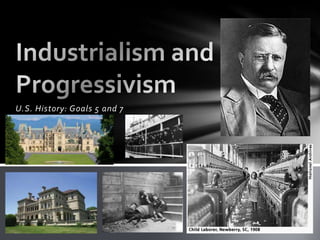
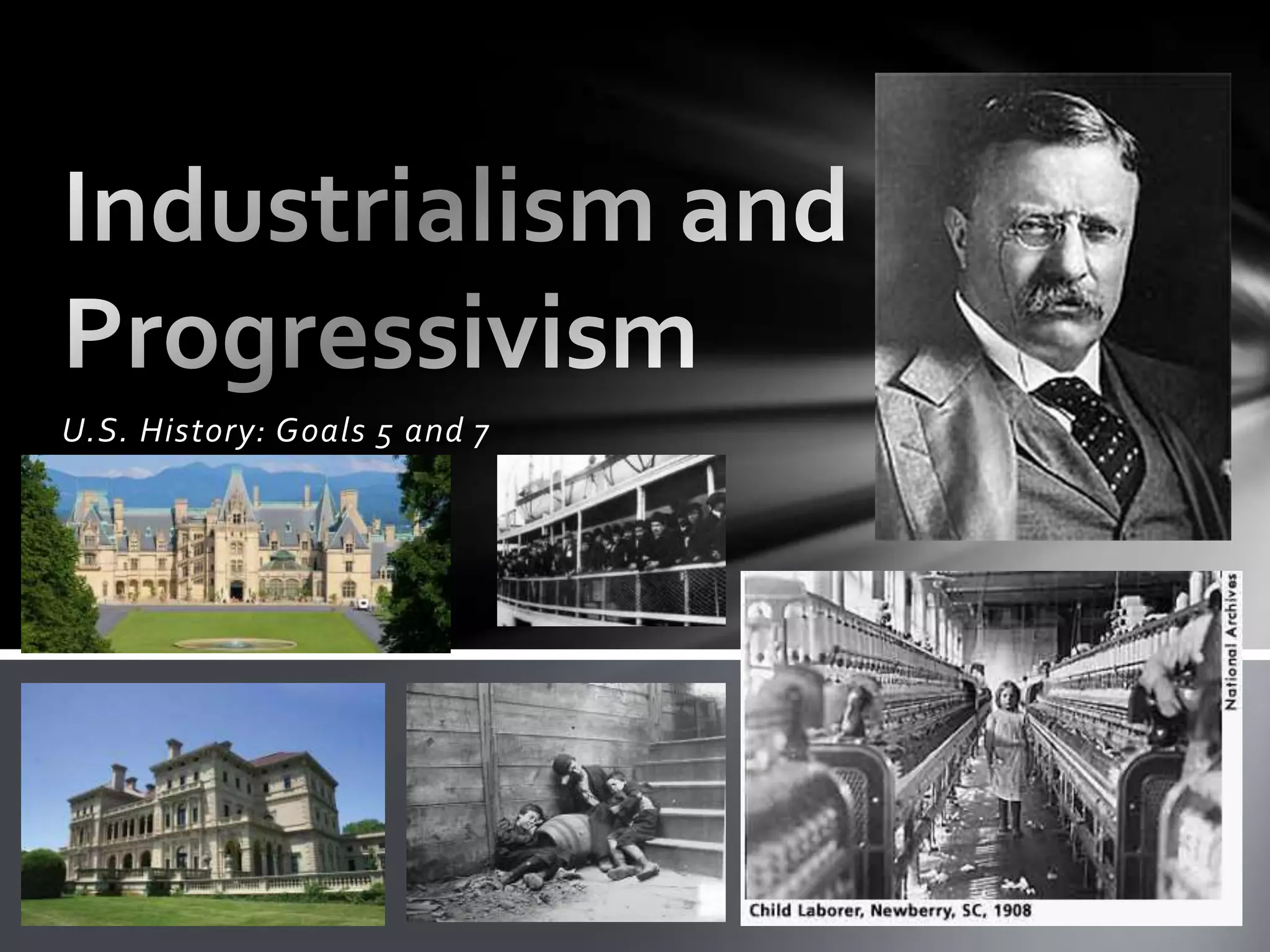
U.S. History: Goals 5 and 7
The Gilded Age
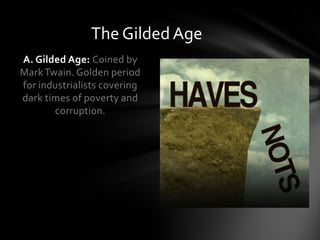
A. Gilded Age: Coined by
Mark Twain. Golden period
for industrialists covering
dark times of poverty and
corruption.
Immigration: Types and Where
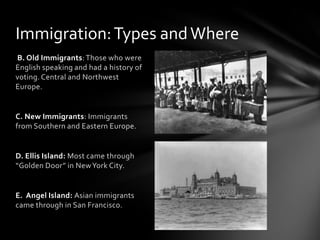
B. Old Immigrants: Those who were
English speaking and had a history of
voting. Central and Northwest
Europe.

C. New Immigrants: Immigrants
from Southern and Eastern Europe.

D. Ellis Island: Most came through
“Golden Door” in New York City.

E. Angel Island: Asian immigrants
came through in San Francisco.
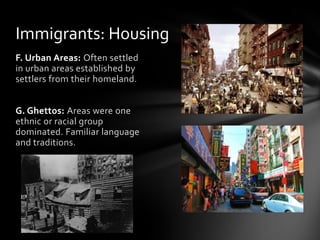
Immigrants: Housing
F. Urban Areas: Often settled
in urban areas established by
settlers from their homeland.
G. Ghettos: Areas were one
ethnic or racial group
dominated. Familiar language
and traditions.
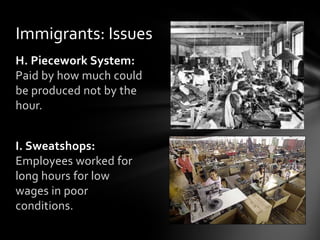
Immigrants: Issues
H. Piecework System:
Paid by how much could
be produced not by the
hour.

I. Sweatshops:
Employees worked for
long hours for low
wages in poor
conditions.
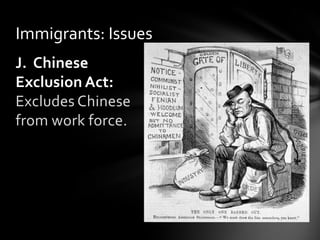
Immigrants: Issues
J. Chinese
Exclusion Act:
Excludes Chinese
from work force.
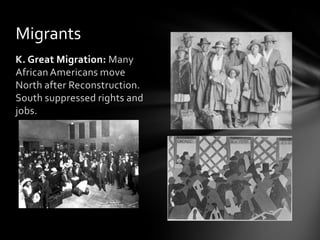
Migrants
K. Great Migration: Many
African Americans move
North after Reconstruction.
South suppressed rights and
jobs.
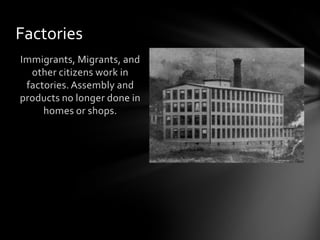
Factories
Immigrants, Migrants, and
other citizens work in
factories. Assembly and
products no longer done in
homes or shops.
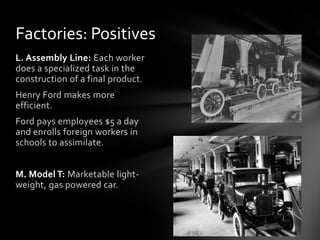
Factories: Positives
L. Assembly Line: Each worker
does a specialized task in the
construction of a final product.
Henry Ford makes more
efficient.
Ford pays employees $5 a day
and enrolls foreign workers in
schools to assimilate.
M. Model T: Marketable lightweight, gas powered car.
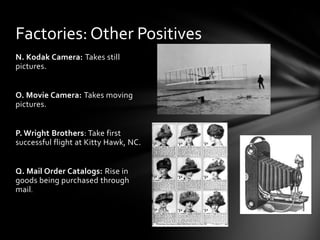
Factories: Other Positives
N. Kodak Camera: Takes still
pictures.
O. Movie Camera: Takes moving
pictures.
P. Wright Brothers: Take first
successful flight at Kitty Hawk, NC.
Q. Mail Order Catalogs: Rise in
goods being purchased through
mail.
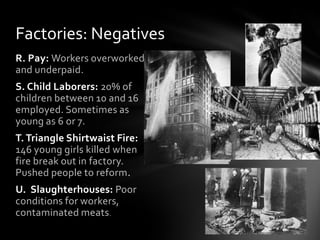
Factories: Negatives
R. Pay: Workers overworked
and underpaid.

S. Child Laborers: 20% of
children between 10 and 16
employed. Sometimes as
young as 6 or 7.
T. Triangle Shirtwaist Fire:
146 young girls killed when
fire break out in factory.
Pushed people to reform.
U. Slaughterhouses: Poor
conditions for workers,
contaminated meats .
Factories: Negatives
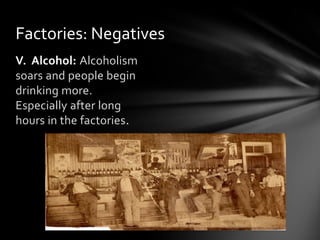
V. Alcohol: Alcoholism
soars and people begin
drinking more.
Especially after long
hours in the factories.
Labor
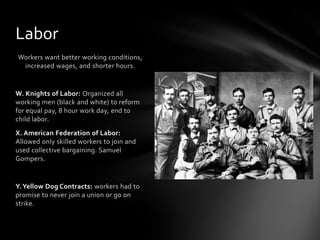
Workers want better working conditions,
increased wages, and shorter hours.

W. Knights of Labor: Organized all
working men (black and white) to reform
for equal pay, 8 hour work day, end to
child labor.
X. American Federation of Labor:
Allowed only skilled workers to join and
used collective bargaining. Samuel
Gompers.

Y. Yellow Dog Contracts: workers had to
promise to never join a union or go on
strike.
Labor
Many unions and workers
resorted to striking or refusing to
go to work to reform.
Z. Great Railroad Strike: Workers
strike when B&O Railroad
announce wage cuts of 10%.
Workers and military clash. 1877.

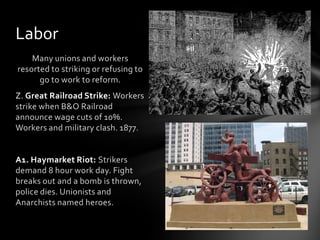
A1. Haymarket Riot: Strikers
demand 8 hour work day. Fight
breaks out and a bomb is thrown,
police dies. Unionists and
Anarchists named heroes.
Labor
Many unions and workers
resorted to striking or refusing to
go to work to reform.

B2. Homestead Strike: Wages
cut at Carnegie Steel. Strike
begins and anarchist attempts to
assassinate Carnegie’s partner.
Publics stops supporting Unions.
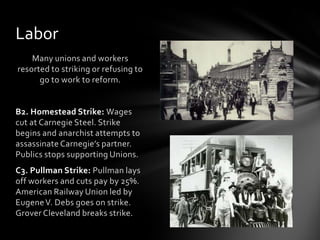
C3. Pullman Strike: Pullman lays
off workers and cuts pay by 25%.
American Railway Union led by
Eugene V. Debs goes on strike.
Grover Cleveland breaks strike.
Progressives
People who sought to
protect social welfare, moral
improvements, economic
reforms, and promote
efficiency.
Muckrakers: Journalists who wrote about the
corruption of business and public life in the 20 th
century.
Politicians/Presidents: Those who sought to
reform the government.

Citizens: Concerned Americans who wanted
change.
Progressive Response: Labor, Food,
Alcohol
Labor:
D4. Florence Kelley: Advocate for
improving the lives of women and children.

E5. Scientific Management: Studies to
make the workplace more efficient.
Food:
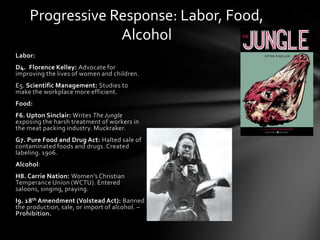
F6. Upton Sinclair: Writes The Jungle
exposing the harsh treatment of workers in
the meat packing industry. Muckraker.

G7. Pure Food and Drug Act: Halted sale of
contaminated foods and drugs. Created
labeling. 1906.
Alcohol:
H8. Carrie Nation: Women’s Christian
Temperance Union (WCTU). Entered
saloons, singing, praying.
I9. 18th Amendment (Volstead Act): Banned
the production, sale, or import of alcohol. –
Prohibition.
Urbanization
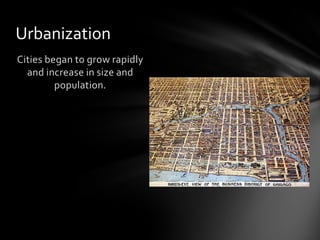
Cities began to grow rapidly
and increase in size and
population.
Urbanization: Positives
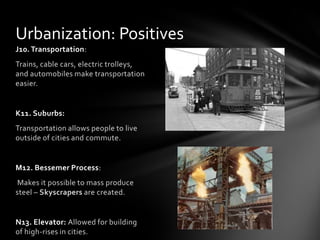
J10. Transportation:
Trains, cable cars, electric trolleys,
and automobiles make transportation
easier.

K11. Suburbs:
Transportation allows people to live
outside of cities and commute.
M12. Bessemer Process:
Makes it possible to mass produce
steel – Skyscrapers are created.

N13. Elevator: Allowed for building
of high-rises in cities.
Urbanization: Positives
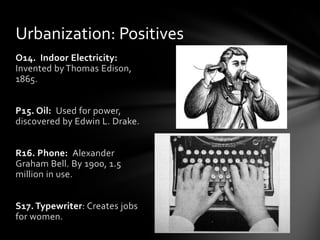
O14. Indoor Electricity:
Invented by Thomas Edison,
1865.
P15. Oil: Used for power,
discovered by Edwin L. Drake.
R16. Phone: Alexander
Graham Bell. By 1900, 1.5
million in use.
S17. Typewriter: Creates jobs
for women.
Urbanization: Positives
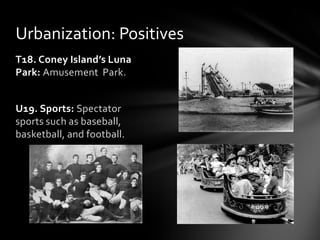
T18. Coney Island’s Luna
Park: Amusement Park.
U19. Sports: Spectator
sports such as baseball,
basketball, and football.
Urbanization: Negatives
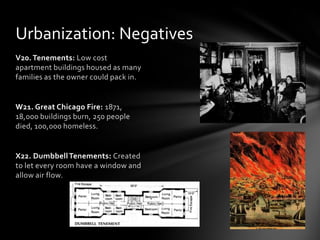
V20. Tenements: Low cost
apartment buildings housed as many
families as the owner could pack in.

W21. Great Chicago Fire: 1871,
18,000 buildings burn, 250 people
died, 100,000 homeless.

X22. Dumbbell Tenements: Created
to let every room have a window and
allow air flow.
Progressives
People who sought to
protect social welfare, moral
improvements, economic
reforms, and promote
efficiency.
Muckrakers: Journalists who wrote about the
corruption of business and public life in the 20 th
century.
Politicians/Presidents: Those who sought to
reform the government.

Citizens: Concerned Americans who wanted
change.
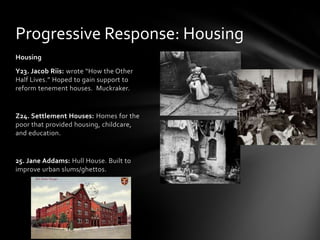
Progressive Response: Housing
Housing
Y23. Jacob Riis: wrote “How the Other
Half Lives.” Hoped to gain support to
reform tenement houses. Muckraker.

Z24. Settlement Houses: Homes for the
poor that provided housing, childcare,
and education.

25. Jane Addams: Hull House. Built to
improve urban slums/ghettos.
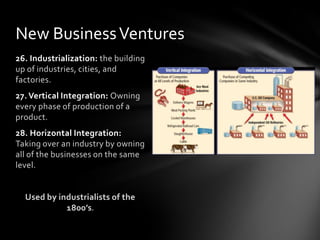
New Business Ventures
26. Industrialization: the building
up of industries, cities, and
factories.
27. Vertical Integration: Owning
every phase of production of a
product.
28. Horizontal Integration:
Taking over an industry by owning
all of the businesses on the same
level.

Used by industrialists of the
1800’s.
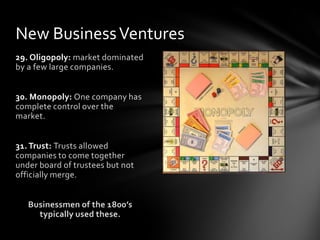
New Business Ventures
29. Oligopoly: market dominated
by a few large companies.
30. Monopoly: One company has
complete control over the
market.
31. Trust: Trusts allowed
companies to come together
under board of trustees but not
officially merge.
Businessmen of the 1800’s
typically used these.
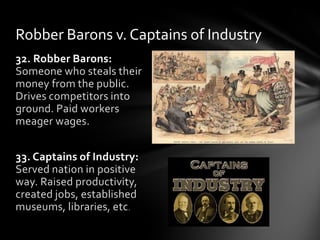
Robber Barons v. Captains of Industry
32. Robber Barons:
Someone who steals their
money from the public.
Drives competitors into
ground. Paid workers
meager wages.
33. Captains of Industry:
Served nation in positive
way. Raised productivity,
created jobs, established
museums, libraries, etc .
Robber Barons v. Captains of Industry
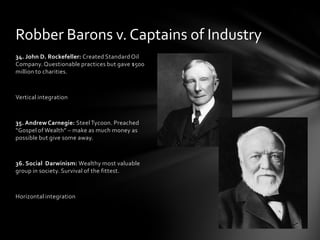
34. John D. Rockefeller: Created Standard Oil
Company. Questionable practices but gave $500
million to charities.

Vertical integration

35. Andrew Carnegie: Steel Tycoon. Preached
“Gospel of Wealth” – make as much money as
possible but give some away.

36. Social Darwinism: Wealthy most valuable
group in society. Survival of the fittest.

Horizontal integration
Progressives
People who sought to protect
social welfare, moral
improvements, economic
reforms, and promote
efficiency.
Muckrakers: Journalists who wrote about the
corruption of business and public life in the 20 th
century.
Politicians/Presidents: Those who sought to
reform the government.

Citizens: Concerned Americans who wanted
change.
Progressive Response - Industry
Industry:

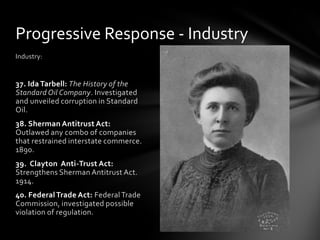
37. Ida Tarbell: The History of the
Standard Oil Company. Investigated
and unveiled corruption in Standard
Oil.
38. Sherman Antitrust Act:
Outlawed any combo of companies
that restrained interstate commerce.
1890.
39. Clayton Anti-Trust Act:
Strengthens Sherman Antitrust Act.
1914.

40. Federal Trade Act: Federal Trade
Commission, investigated possible
violation of regulation.
Political Bosses
Clashing interests between
different community groups
led to the rise of political
machines.
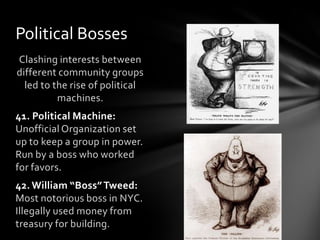
41. Political Machine:
Unofficial Organization set
up to keep a group in power.
Run by a boss who worked
for favors.
42. William “Boss” Tweed:
Most notorious boss in NYC.
Illegally used money from
treasury for building.
Progressives
Progressive Response: Political Bosses
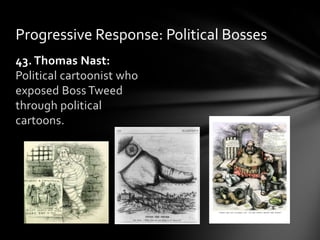
43. Thomas Nast:
Political cartoonist who
exposed Boss Tweed
through political
cartoons.
Political Corruption
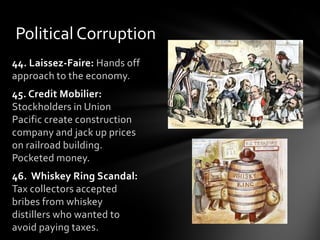
44. Laissez-Faire: Hands off
approach to the economy.
45. Credit Mobilier:
Stockholders in Union
Pacific create construction
company and jack up prices
on railroad building.
Pocketed money.
46. Whiskey Ring Scandal:
Tax collectors accepted
bribes from whiskey
distillers who wanted to
avoid paying taxes.
Political Corruption
47. Spoils System:
President Garfield
killed by unhappy
office seeker.
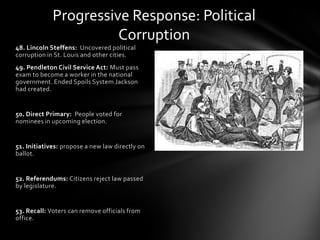
Progressive Response: Political
Corruption
48. Lincoln Steffens: Uncovered political
corruption in St. Louis and other cities.
49. Pendleton Civil Service Act: Must pass
exam to become a worker in the national
government. Ended Spoils System Jackson
had created.

50. Direct Primary: People voted for
nominees in upcoming election.

51. Initiatives: propose a new law directly on
ballot.

52. Referendums: Citizens reject law passed
by legislature.

53. Recall: Voters can remove officials from
office.
Progressive Response: Political
Corruption
54. 16th Amendment:
Allowed federal government
to collect income taxes.
55. 17th Amendment: Direct
election of senators.
56. Federal Reserve Act:
Created Federal Reserve
System of banks to
supervise private banks.
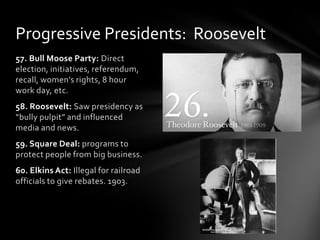
Progressive Presidents: Roosevelt
57. Bull Moose Party: Direct
election, initiatives, referendum,
recall, women’s rights, 8 hour
work day, etc.
58. Roosevelt: Saw presidency as
“bully pulpit” and influenced
media and news.

59. Square Deal: programs to
protect people from big business.
60. Elkins Act: Illegal for railroad
officials to give rebates. 1903.
Progressive Presidents: Roosevelt
61. Civil Rights: Invited
Booker T. Washington to
White House.
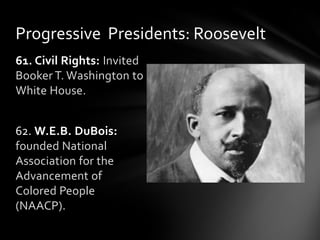
62. W.E.B. DuBois:
founded National
Association for the
Advancement of
Colored People
(NAACP).
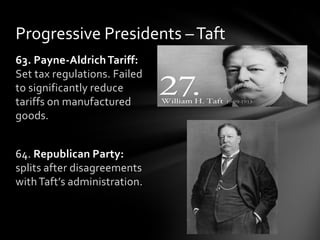
Progressive Presidents – Taft
63. Payne-Aldrich Tariff:
Set tax regulations. Failed
to significantly reduce
tariffs on manufactured
goods.
64. Republican Party:
splits after disagreements
with Taft’s administration.
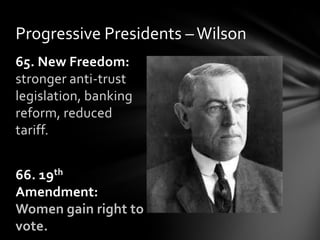
Progressive Presidents – Wilson
65. New Freedom:
stronger anti-trust
legislation, banking
reform, reduced
tariff.
66. 19th
Amendment:
Women gain right to
vote.

US History: Goal 5 & 7

  • 1.
  • 2.
    The Gilded Age A.Gilded Age: Coined by Mark Twain. Golden period for industrialists covering dark times of poverty and corruption.
  • 3.
    Immigration: Types andWhere B. Old Immigrants: Those who were English speaking and had a history of voting. Central and Northwest Europe. C. New Immigrants: Immigrants from Southern and Eastern Europe. D. Ellis Island: Most came through “Golden Door” in New York City. E. Angel Island: Asian immigrants came through in San Francisco.
  • 4.
    Immigrants: Housing F. UrbanAreas: Often settled in urban areas established by settlers from their homeland. G. Ghettos: Areas were one ethnic or racial group dominated. Familiar language and traditions.
  • 5.
    Immigrants: Issues H. PieceworkSystem: Paid by how much could be produced not by the hour. I. Sweatshops: Employees worked for long hours for low wages in poor conditions.
  • 6.
    Immigrants: Issues J. Chinese ExclusionAct: Excludes Chinese from work force.
  • 7.
    Migrants K. Great Migration:Many African Americans move North after Reconstruction. South suppressed rights and jobs.
  • 8.
    Factories Immigrants, Migrants, and othercitizens work in factories. Assembly and products no longer done in homes or shops.
  • 9.
    Factories: Positives L. AssemblyLine: Each worker does a specialized task in the construction of a final product. Henry Ford makes more efficient. Ford pays employees $5 a day and enrolls foreign workers in schools to assimilate. M. Model T: Marketable lightweight, gas powered car.
  • 10.
    Factories: Other Positives N.Kodak Camera: Takes still pictures. O. Movie Camera: Takes moving pictures. P. Wright Brothers: Take first successful flight at Kitty Hawk, NC. Q. Mail Order Catalogs: Rise in goods being purchased through mail.
  • 11.
    Factories: Negatives R. Pay:Workers overworked and underpaid. S. Child Laborers: 20% of children between 10 and 16 employed. Sometimes as young as 6 or 7. T. Triangle Shirtwaist Fire: 146 young girls killed when fire break out in factory. Pushed people to reform. U. Slaughterhouses: Poor conditions for workers, contaminated meats .
  • 12.
    Factories: Negatives V. Alcohol:Alcoholism soars and people begin drinking more. Especially after long hours in the factories.
  • 13.
    Labor Workers want betterworking conditions, increased wages, and shorter hours. W. Knights of Labor: Organized all working men (black and white) to reform for equal pay, 8 hour work day, end to child labor. X. American Federation of Labor: Allowed only skilled workers to join and used collective bargaining. Samuel Gompers. Y. Yellow Dog Contracts: workers had to promise to never join a union or go on strike.
  • 14.
    Labor Many unions andworkers resorted to striking or refusing to go to work to reform. Z. Great Railroad Strike: Workers strike when B&O Railroad announce wage cuts of 10%. Workers and military clash. 1877. A1. Haymarket Riot: Strikers demand 8 hour work day. Fight breaks out and a bomb is thrown, police dies. Unionists and Anarchists named heroes.
  • 15.
    Labor Many unions andworkers resorted to striking or refusing to go to work to reform. B2. Homestead Strike: Wages cut at Carnegie Steel. Strike begins and anarchist attempts to assassinate Carnegie’s partner. Publics stops supporting Unions. C3. Pullman Strike: Pullman lays off workers and cuts pay by 25%. American Railway Union led by Eugene V. Debs goes on strike. Grover Cleveland breaks strike.
  • 16.
    Progressives People who soughtto protect social welfare, moral improvements, economic reforms, and promote efficiency. Muckrakers: Journalists who wrote about the corruption of business and public life in the 20 th century. Politicians/Presidents: Those who sought to reform the government. Citizens: Concerned Americans who wanted change.
  • 17.
    Progressive Response: Labor,Food, Alcohol Labor: D4. Florence Kelley: Advocate for improving the lives of women and children. E5. Scientific Management: Studies to make the workplace more efficient. Food: F6. Upton Sinclair: Writes The Jungle exposing the harsh treatment of workers in the meat packing industry. Muckraker. G7. Pure Food and Drug Act: Halted sale of contaminated foods and drugs. Created labeling. 1906. Alcohol: H8. Carrie Nation: Women’s Christian Temperance Union (WCTU). Entered saloons, singing, praying. I9. 18th Amendment (Volstead Act): Banned the production, sale, or import of alcohol. – Prohibition.
  • 18.
    Urbanization Cities began togrow rapidly and increase in size and population.
  • 19.
    Urbanization: Positives J10. Transportation: Trains,cable cars, electric trolleys, and automobiles make transportation easier. K11. Suburbs: Transportation allows people to live outside of cities and commute. M12. Bessemer Process: Makes it possible to mass produce steel – Skyscrapers are created. N13. Elevator: Allowed for building of high-rises in cities.
  • 20.
    Urbanization: Positives O14. IndoorElectricity: Invented by Thomas Edison, 1865. P15. Oil: Used for power, discovered by Edwin L. Drake. R16. Phone: Alexander Graham Bell. By 1900, 1.5 million in use. S17. Typewriter: Creates jobs for women.
  • 21.
    Urbanization: Positives T18. ConeyIsland’s Luna Park: Amusement Park. U19. Sports: Spectator sports such as baseball, basketball, and football.
  • 22.
    Urbanization: Negatives V20. Tenements:Low cost apartment buildings housed as many families as the owner could pack in. W21. Great Chicago Fire: 1871, 18,000 buildings burn, 250 people died, 100,000 homeless. X22. Dumbbell Tenements: Created to let every room have a window and allow air flow.
  • 23.
    Progressives People who soughtto protect social welfare, moral improvements, economic reforms, and promote efficiency. Muckrakers: Journalists who wrote about the corruption of business and public life in the 20 th century. Politicians/Presidents: Those who sought to reform the government. Citizens: Concerned Americans who wanted change.
  • 24.
    Progressive Response: Housing Housing Y23.Jacob Riis: wrote “How the Other Half Lives.” Hoped to gain support to reform tenement houses. Muckraker. Z24. Settlement Houses: Homes for the poor that provided housing, childcare, and education. 25. Jane Addams: Hull House. Built to improve urban slums/ghettos.
  • 25.
    New Business Ventures 26.Industrialization: the building up of industries, cities, and factories. 27. Vertical Integration: Owning every phase of production of a product. 28. Horizontal Integration: Taking over an industry by owning all of the businesses on the same level. Used by industrialists of the 1800’s.
  • 26.
    New Business Ventures 29.Oligopoly: market dominated by a few large companies. 30. Monopoly: One company has complete control over the market. 31. Trust: Trusts allowed companies to come together under board of trustees but not officially merge. Businessmen of the 1800’s typically used these.
  • 27.
    Robber Barons v.Captains of Industry 32. Robber Barons: Someone who steals their money from the public. Drives competitors into ground. Paid workers meager wages. 33. Captains of Industry: Served nation in positive way. Raised productivity, created jobs, established museums, libraries, etc .
  • 28.
    Robber Barons v.Captains of Industry 34. John D. Rockefeller: Created Standard Oil Company. Questionable practices but gave $500 million to charities. Vertical integration 35. Andrew Carnegie: Steel Tycoon. Preached “Gospel of Wealth” – make as much money as possible but give some away. 36. Social Darwinism: Wealthy most valuable group in society. Survival of the fittest. Horizontal integration
  • 29.
    Progressives People who soughtto protect social welfare, moral improvements, economic reforms, and promote efficiency. Muckrakers: Journalists who wrote about the corruption of business and public life in the 20 th century. Politicians/Presidents: Those who sought to reform the government. Citizens: Concerned Americans who wanted change.
  • 30.
    Progressive Response -Industry Industry: 37. Ida Tarbell: The History of the Standard Oil Company. Investigated and unveiled corruption in Standard Oil. 38. Sherman Antitrust Act: Outlawed any combo of companies that restrained interstate commerce. 1890. 39. Clayton Anti-Trust Act: Strengthens Sherman Antitrust Act. 1914. 40. Federal Trade Act: Federal Trade Commission, investigated possible violation of regulation.
  • 31.
    Political Bosses Clashing interestsbetween different community groups led to the rise of political machines. 41. Political Machine: Unofficial Organization set up to keep a group in power. Run by a boss who worked for favors. 42. William “Boss” Tweed: Most notorious boss in NYC. Illegally used money from treasury for building.
  • 32.
  • 33.
    Progressive Response: PoliticalBosses 43. Thomas Nast: Political cartoonist who exposed Boss Tweed through political cartoons.
  • 34.
    Political Corruption 44. Laissez-Faire:Hands off approach to the economy. 45. Credit Mobilier: Stockholders in Union Pacific create construction company and jack up prices on railroad building. Pocketed money. 46. Whiskey Ring Scandal: Tax collectors accepted bribes from whiskey distillers who wanted to avoid paying taxes.
  • 35.
    Political Corruption 47. SpoilsSystem: President Garfield killed by unhappy office seeker.
  • 36.
    Progressive Response: Political Corruption 48.Lincoln Steffens: Uncovered political corruption in St. Louis and other cities. 49. Pendleton Civil Service Act: Must pass exam to become a worker in the national government. Ended Spoils System Jackson had created. 50. Direct Primary: People voted for nominees in upcoming election. 51. Initiatives: propose a new law directly on ballot. 52. Referendums: Citizens reject law passed by legislature. 53. Recall: Voters can remove officials from office.
  • 37.
    Progressive Response: Political Corruption 54.16th Amendment: Allowed federal government to collect income taxes. 55. 17th Amendment: Direct election of senators. 56. Federal Reserve Act: Created Federal Reserve System of banks to supervise private banks.
  • 38.
    Progressive Presidents: Roosevelt 57.Bull Moose Party: Direct election, initiatives, referendum, recall, women’s rights, 8 hour work day, etc. 58. Roosevelt: Saw presidency as “bully pulpit” and influenced media and news. 59. Square Deal: programs to protect people from big business. 60. Elkins Act: Illegal for railroad officials to give rebates. 1903.
  • 39.
    Progressive Presidents: Roosevelt 61.Civil Rights: Invited Booker T. Washington to White House. 62. W.E.B. DuBois: founded National Association for the Advancement of Colored People (NAACP).
  • 40.
    Progressive Presidents –Taft 63. Payne-Aldrich Tariff: Set tax regulations. Failed to significantly reduce tariffs on manufactured goods. 64. Republican Party: splits after disagreements with Taft’s administration.
  • 41.
    Progressive Presidents –Wilson 65. New Freedom: stronger anti-trust legislation, banking reform, reduced tariff. 66. 19th Amendment: Women gain right to vote.