Explain how the Monroe
Doctrine and the concept of
Manifest Destiny affected the
United States’ relationships
with foreign powers...
Compare the economic
development in different
regions (the South, the North,
And the West) of the United
States during the early
nineteenth century, including
ways that economic policy
contributed to political
controversies.
182018161812
180818041800
NOTE:
This is the last election in which
the Federalist Party participated
in a national election.
James Monroe (R-VA)
Fifth President of the U.S.
1817-1825
Last of the “Virginia Dynasty”
Continental Army Veteran
Former Antifederalist
“Era of Good Feeling”
Re-election nearly unanimous
http://www.whitehouse.gov/about/presidents/jamesmonroe
182018161812
180818041800
NATIONALISM
1824
Henry Clay’s “American System”
1. National Bank
– First B.U.S. had expired in 1811
2. Internal Improvements
– Infrastructure (roads, bridges, canals)
3. Protective Tariff
– Build and protect domestic
manufacturing
The Economics of Nationalism
Jeffersonian or Hamiltonian?
Henry Clay’s “American System”
1. National Bank
– Second B.U.S. chartered in 1816
2. Internal Improvements
3. Protective Tariff
– Tariff of 1816
The Economics of Nationalism
Strict or Loose Construction?
Wait... There’s more!
Calhoun’s “Bonus Bill”
“for constructing roads and canals, and
improving the navigation of water courses, in
order to facilitate… internal commerce among
the several States, and to render more easy
and less expensive the means and provisions
for the common defense…”
Calhoun
QUESTION:
Is an election map always
an accurate measure of the
national political climate?
NORTH SOUTH WEST
Economy
Commerce
Manufacturing
Agriculture
Agriculture
Developing
Political
Leaders
Daniel
Webster
John C.
Calhoun
Henry
Clay
Political
Issues
Tariff (+)
Slavery (-)
Tariff (-)
Slavery (+)
Internal
Improvements
Henry Clay’s “American System”
The Economics of Nationalism
Who Benefits? Who doesn’t?
1. National Bank
– First B.U.S. had expired in 1811
2. Internal Improvements
– Infrastructure (roads, bridges, canals)
3. Protective Tariff
– Build and protect domestic
manufacturing
The Missouri
Question
The First Crisis of the Union
ESSENTIAL QUESTIONS:
1. Are all states in the Union
equal, or are some “more
equal than others”?
2. Can Congress impose
conditions on new states that
all states don’t have to follow?
Tallmadge Amendment
(1819)
"And provided, That the
further introduction of slavery
or involuntary servitude be
prohibited…
and that all children born
within the said State, after the
admission thereof into the
Union, shall be free at the age
of twenty-five years."
Rep. James Tallmadge, Jr.
(R- NY)
Bicameralism at Work
“Concurrent Majority”
SENATE HOUSE
Passed
with
Tallmadge
Amendment
Passed
without
Tallmadge
Amendment
CONFERENCE
The Man of the Hour…
Henry Clay’s
Compromise Proposal:
1. Admit Maine as a Free State
2. Admit Missouri as a Slave State
3. Prohibit slavery in the
territories of the Louisiana
Purchase north of the 36˚30’
parallel.
36˚30’
SLAVERY
The Sage of Monticello…
Slavery
Primary Source: Jefferson to John
Holmes, April 22, 1820
The
South
A South Carolina Perspective…
During the debate,
Charles Pinckney (SC)
defended slavery as a
positive good.
Pinckney’s opinions did not hold much
water outside of South Carolina at the
time, but as Northerners continued to
criticize slavery, more Southerners
began to defend the institution.
Pinckney’s Speech
Pinckney
Bicameralism at Work
“Concurrent Majority”
SENATE
Passed
Clay’s
Compromise
Passed
Clay’s
Compromise
HOUSE
Crisis Averted… Let’s Review
Henry Clay’s
Compromise Proposal:
1. Admit Maine as a Free State
2. Admit Missouri as a Slave State
3. Prohibit slavery in the
territories of the Louisiana
Purchase north of the 36˚30’
parallel.
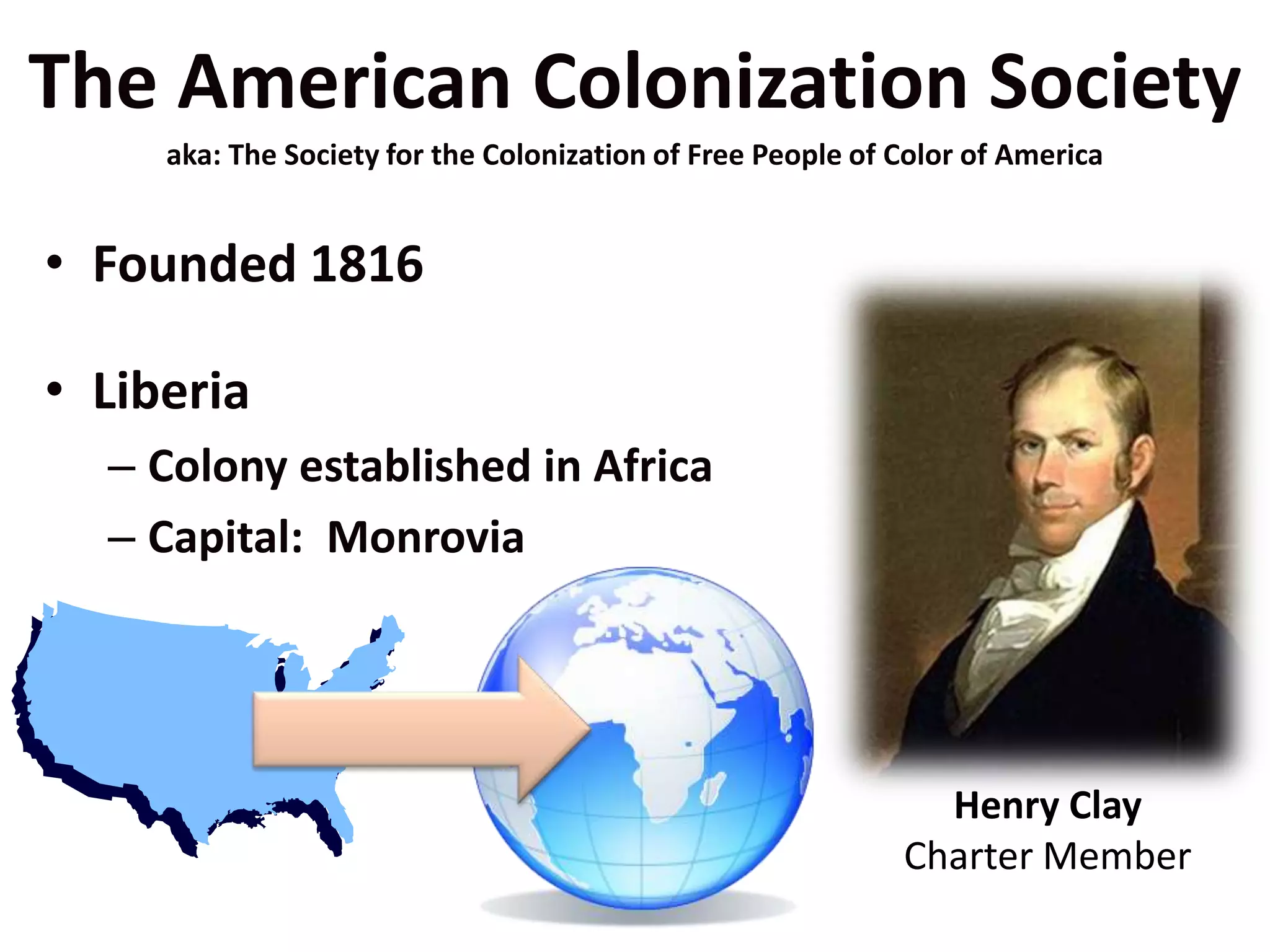
The American Colonization Society
• Founded 1816
• Liberia
– Colony established in Africa
– Capital: Monrovia
Henry Clay
Charter Member
aka: The Society for the Colonization of Free People of Color of America
Notable Members of ACS
• James Madison (U.S. President)
• James Monroe (U.S. President)
• Daniel Webster (U.S. Senator)
• Stephen Douglas (U.S. Senator)
• Henry Clay (Speaker of the House)
• Francis Scott Key (The Star Spangled Banner)
• John Marshall (Chief Justice)
Membership Certificate signed by James Madison
Sold for
$928 in
2006
Madison served as
President of the ACS
from 1833-1836
The Cotton Gin
Mechanized
cotton
production
Eli Whitney
Of Massachusetts
From Harper’s Weekly (1869)
“King Cotton”
The South’s
dependence
on slavery
0
500,000
1,000,000
1,500,000
2,000,000
2,500,000
3,000,000
1830 1860
Cotton Production
The (in)Effectiveness of Colonization
0
500,000
1,000,000
1,500,000
2,000,000
2,500,000
3,000,000
3,500,000
4,000,000
4,500,000
1820 1860
Number of Slaves in
U.S.
Number of Freed
Slaves Colonized
2,500,000 / 12,000 = 208
http://www.youtube.com/watch?v=OuLWgVOLbG4
The Monroe Doctrine
“The American
continents… are
henceforth not to be
considered as
subjects for future
colonization by any
European powers. . .”
-- From Monroe’s
Seventh Annual Message
EUROPE: KEEP OUT!!!
READ MY
NEW
COLONIES
182018161812
180818041800
1824
The end of
an era…
Nationalism and Sectionalism (1815-1824)

Nationalism and Sectionalism (1815-1824)

  • 2.
    Explain how theMonroe Doctrine and the concept of Manifest Destiny affected the United States’ relationships with foreign powers... Compare the economic development in different regions (the South, the North, And the West) of the United States during the early nineteenth century, including ways that economic policy contributed to political controversies.
  • 5.
    182018161812 180818041800 NOTE: This is thelast election in which the Federalist Party participated in a national election.
  • 6.
    James Monroe (R-VA) FifthPresident of the U.S. 1817-1825 Last of the “Virginia Dynasty” Continental Army Veteran Former Antifederalist “Era of Good Feeling” Re-election nearly unanimous http://www.whitehouse.gov/about/presidents/jamesmonroe
  • 7.
  • 8.
    Henry Clay’s “AmericanSystem” 1. National Bank – First B.U.S. had expired in 1811 2. Internal Improvements – Infrastructure (roads, bridges, canals) 3. Protective Tariff – Build and protect domestic manufacturing The Economics of Nationalism Jeffersonian or Hamiltonian?
  • 9.
    Henry Clay’s “AmericanSystem” 1. National Bank – Second B.U.S. chartered in 1816 2. Internal Improvements 3. Protective Tariff – Tariff of 1816 The Economics of Nationalism Strict or Loose Construction?
  • 10.
  • 11.
    Calhoun’s “Bonus Bill” “forconstructing roads and canals, and improving the navigation of water courses, in order to facilitate… internal commerce among the several States, and to render more easy and less expensive the means and provisions for the common defense…” Calhoun
  • 12.
    QUESTION: Is an electionmap always an accurate measure of the national political climate?
  • 14.
    NORTH SOUTH WEST Economy Commerce Manufacturing Agriculture Agriculture Developing Political Leaders Daniel Webster JohnC. Calhoun Henry Clay Political Issues Tariff (+) Slavery (-) Tariff (-) Slavery (+) Internal Improvements
  • 15.
    Henry Clay’s “AmericanSystem” The Economics of Nationalism Who Benefits? Who doesn’t? 1. National Bank – First B.U.S. had expired in 1811 2. Internal Improvements – Infrastructure (roads, bridges, canals) 3. Protective Tariff – Build and protect domestic manufacturing
  • 16.
    The Missouri Question The FirstCrisis of the Union ESSENTIAL QUESTIONS: 1. Are all states in the Union equal, or are some “more equal than others”? 2. Can Congress impose conditions on new states that all states don’t have to follow?
  • 18.
    Tallmadge Amendment (1819) "And provided,That the further introduction of slavery or involuntary servitude be prohibited… and that all children born within the said State, after the admission thereof into the Union, shall be free at the age of twenty-five years." Rep. James Tallmadge, Jr. (R- NY)
  • 19.
    Bicameralism at Work “ConcurrentMajority” SENATE HOUSE Passed with Tallmadge Amendment Passed without Tallmadge Amendment CONFERENCE
  • 20.
    The Man ofthe Hour… Henry Clay’s Compromise Proposal: 1. Admit Maine as a Free State 2. Admit Missouri as a Slave State 3. Prohibit slavery in the territories of the Louisiana Purchase north of the 36˚30’ parallel.
  • 23.
  • 24.
  • 25.
    The Sage ofMonticello… Slavery Primary Source: Jefferson to John Holmes, April 22, 1820 The South
  • 26.
    A South CarolinaPerspective… During the debate, Charles Pinckney (SC) defended slavery as a positive good. Pinckney’s opinions did not hold much water outside of South Carolina at the time, but as Northerners continued to criticize slavery, more Southerners began to defend the institution. Pinckney’s Speech Pinckney
  • 27.
    Bicameralism at Work “ConcurrentMajority” SENATE Passed Clay’s Compromise Passed Clay’s Compromise HOUSE
  • 28.
    Crisis Averted… Let’sReview Henry Clay’s Compromise Proposal: 1. Admit Maine as a Free State 2. Admit Missouri as a Slave State 3. Prohibit slavery in the territories of the Louisiana Purchase north of the 36˚30’ parallel.
  • 29.
    The American ColonizationSociety • Founded 1816 • Liberia – Colony established in Africa – Capital: Monrovia Henry Clay Charter Member aka: The Society for the Colonization of Free People of Color of America
  • 30.
    Notable Members ofACS • James Madison (U.S. President) • James Monroe (U.S. President) • Daniel Webster (U.S. Senator) • Stephen Douglas (U.S. Senator) • Henry Clay (Speaker of the House) • Francis Scott Key (The Star Spangled Banner) • John Marshall (Chief Justice)
  • 31.
    Membership Certificate signedby James Madison Sold for $928 in 2006 Madison served as President of the ACS from 1833-1836
  • 33.
  • 35.
  • 36.
    “King Cotton” The South’s dependence onslavery 0 500,000 1,000,000 1,500,000 2,000,000 2,500,000 3,000,000 1830 1860 Cotton Production
  • 37.
    The (in)Effectiveness ofColonization 0 500,000 1,000,000 1,500,000 2,000,000 2,500,000 3,000,000 3,500,000 4,000,000 4,500,000 1820 1860 Number of Slaves in U.S. Number of Freed Slaves Colonized 2,500,000 / 12,000 = 208
  • 38.
  • 39.
    The Monroe Doctrine “TheAmerican continents… are henceforth not to be considered as subjects for future colonization by any European powers. . .” -- From Monroe’s Seventh Annual Message EUROPE: KEEP OUT!!! READ MY NEW COLONIES
  • 41.