

The Immune
System
Prepared by Mickelder Kercy, MD - Instructor
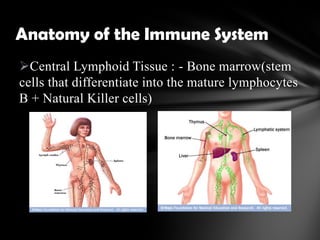
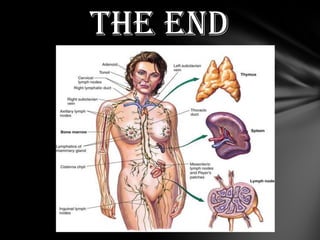
Central Lymphoid Tissue : - Bone marrow(stem
cells that differentiate into the mature lymphocytes
B + Natural Killer cells)
Anatomy of the Immune System
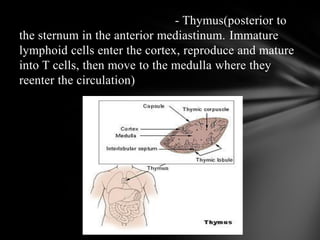
- Thymus(posterior to
the sternum in the anterior mediastinum. Immature
lymphoid cells enter the cortex, reproduce and mature
into T cells, then move to the medulla where they
reenter the circulation)
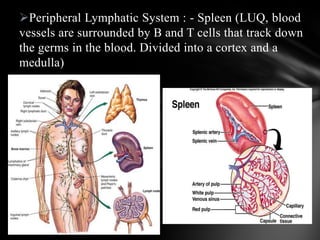
Peripheral Lymphatic System : - Spleen (LUQ, blood
vessels are surrounded by B and T cells that track down
the germs in the blood. Divided into a cortex and a
medulla)
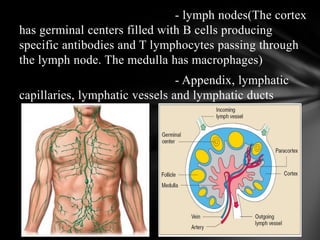
- lymph nodes(The cortex
has germinal centers filled with B cells producing
specific antibodies and T lymphocytes passing through
the lymph node. The medulla has macrophages)
- Appendix, lymphatic
capillaries, lymphatic vessels and lymphatic ducts
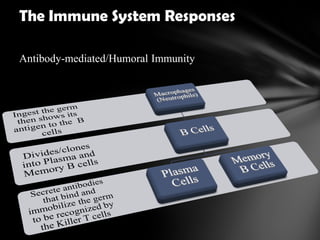
The Immune System Responses
Antibody-mediated/Humoral Immunity
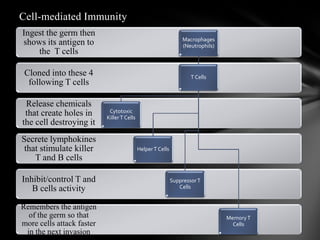
Cell-mediated Immunity
Remembers the antigen
of the germ so that
more cells attack faster
in the next invasion
Inhibit/control T and
B cells activity
Secrete lymphokines
that stimulate killer
T and B cells
Release chemicals
that create holes in
the cell destroying it
Cloned into these 4
following T cells
Ingest the germ then
shows its antigen to
the T cells
Macrophages
(Neutrophils)
T Cells
Cytotoxic
KillerT Cells
HelperT Cells
SuppressorT
Cells
MemoryT
Cells
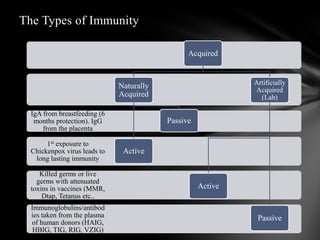
The Types of Immunity
Immunoglobulins/antibod
ies taken from the plasma
of human donors (HAIG,
HBIG, TIG, RIG, VZIG)
Killed germs or live
germs with attenuated
toxins in vaccines (MMR,
Dtap, Tetanus etc..
1st exposure to
Chickenpox virus leads to
long lasting immunity
IgA from breastfeeding (6
months protection). IgG
from the placenta
Acquired
Naturally
Acquired
Active
Passive
Artificially
Acquired
(Lab)
Passive
Active
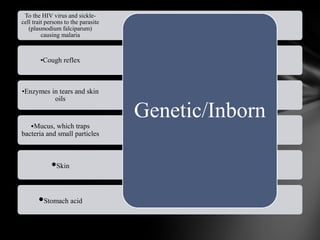
•Stomach acid
•Skin
•Mucus, which traps
bacteria and small particles
•Enzymes in tears and skin
oils
•Cough reflex
To the HIV virus and sickle-
cell trait persons to the parasite
(plasmodium falciparum)
causing malaria
Genetic/Inborn
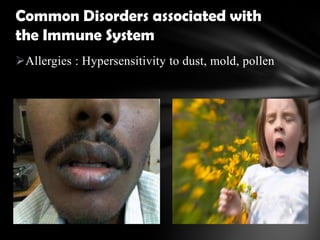
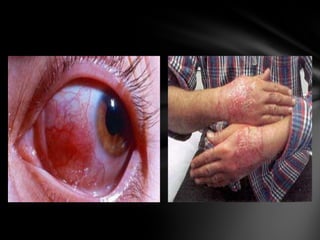
Allergies : Hypersensitivity to dust, mold, pollen
Common Disorders associated with
the Immune System
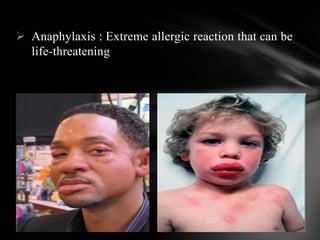
 Anaphylaxis : Extreme allergic reaction that can be
life-threatening
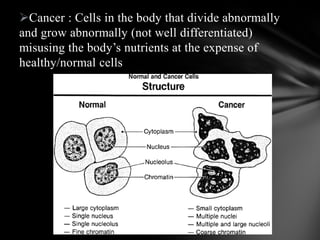
Cancer : Cells in the body that divide abnormally
and grow abnormally (not well differentiated)
misusing the body’s nutrients at the expense of
healthy/normal cells
Chronic Fatigue Syndrome : Caused by a defect in
the immune system
Infectious Mononucleosis/kissing disease : Caused
by the Epstein-barr virus(EBV) leading to an increase
in the number of WBC (monocytes and lymphocytes) .
Spread by saliva.
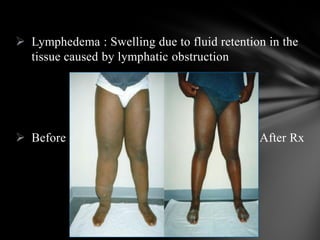
 Lymphedema : Swelling due to fluid retention in the
tissue caused by lymphatic obstruction
 Before After Rx
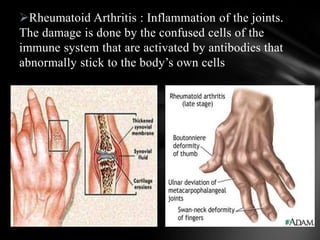
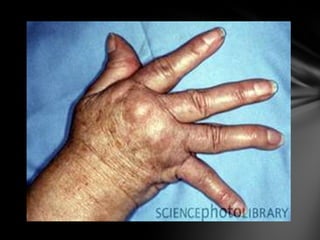
Rheumatoid Arthritis : Inflammation of the joints.
The damage is done by the confused cells of the
immune system that are activated by antibodies that
abnormally stick to the body’s own cells
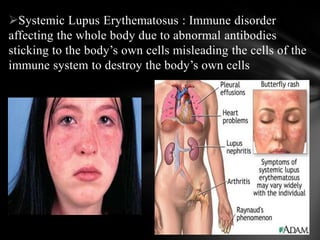
Systemic Lupus Erythematosus : Immune disorder
affecting the whole body due to abnormal antibodies
sticking to the body’s own cells misleading the cells of the
immune system to destroy the body’s own cells
The End

The immune system

  • 1.
    The Immune System Prepared byMickelder Kercy, MD - Instructor
  • 2.
    Central Lymphoid Tissue: - Bone marrow(stem cells that differentiate into the mature lymphocytes B + Natural Killer cells) Anatomy of the Immune System
  • 4.
    - Thymus(posterior to thesternum in the anterior mediastinum. Immature lymphoid cells enter the cortex, reproduce and mature into T cells, then move to the medulla where they reenter the circulation)
  • 5.
    Peripheral Lymphatic System: - Spleen (LUQ, blood vessels are surrounded by B and T cells that track down the germs in the blood. Divided into a cortex and a medulla)
  • 6.
    - lymph nodes(Thecortex has germinal centers filled with B cells producing specific antibodies and T lymphocytes passing through the lymph node. The medulla has macrophages) - Appendix, lymphatic capillaries, lymphatic vessels and lymphatic ducts
  • 8.
    The Immune SystemResponses Antibody-mediated/Humoral Immunity
  • 10.
    Cell-mediated Immunity Remembers theantigen of the germ so that more cells attack faster in the next invasion Inhibit/control T and B cells activity Secrete lymphokines that stimulate killer T and B cells Release chemicals that create holes in the cell destroying it Cloned into these 4 following T cells Ingest the germ then shows its antigen to the T cells Macrophages (Neutrophils) T Cells Cytotoxic KillerT Cells HelperT Cells SuppressorT Cells MemoryT Cells
  • 12.
    The Types ofImmunity Immunoglobulins/antibod ies taken from the plasma of human donors (HAIG, HBIG, TIG, RIG, VZIG) Killed germs or live germs with attenuated toxins in vaccines (MMR, Dtap, Tetanus etc.. 1st exposure to Chickenpox virus leads to long lasting immunity IgA from breastfeeding (6 months protection). IgG from the placenta Acquired Naturally Acquired Active Passive Artificially Acquired (Lab) Passive Active
  • 13.
    •Stomach acid •Skin •Mucus, whichtraps bacteria and small particles •Enzymes in tears and skin oils •Cough reflex To the HIV virus and sickle- cell trait persons to the parasite (plasmodium falciparum) causing malaria Genetic/Inborn
  • 14.
    Allergies : Hypersensitivityto dust, mold, pollen Common Disorders associated with the Immune System
  • 16.
     Anaphylaxis :Extreme allergic reaction that can be life-threatening
  • 17.
    Cancer : Cellsin the body that divide abnormally and grow abnormally (not well differentiated) misusing the body’s nutrients at the expense of healthy/normal cells
  • 19.
    Chronic Fatigue Syndrome: Caused by a defect in the immune system Infectious Mononucleosis/kissing disease : Caused by the Epstein-barr virus(EBV) leading to an increase in the number of WBC (monocytes and lymphocytes) . Spread by saliva.
  • 20.
     Lymphedema :Swelling due to fluid retention in the tissue caused by lymphatic obstruction  Before After Rx
  • 21.
    Rheumatoid Arthritis :Inflammation of the joints. The damage is done by the confused cells of the immune system that are activated by antibodies that abnormally stick to the body’s own cells
  • 23.
    Systemic Lupus Erythematosus: Immune disorder affecting the whole body due to abnormal antibodies sticking to the body’s own cells misleading the cells of the immune system to destroy the body’s own cells
  • 24.