THE IMMUNITY SYSTEM
Dr. Hayat AL AKOUM
DEFINITION OF TERMS
 Immune system: group of cells, molecules,
and organs that act together to defend the
body against foreign invaders that may
cause disease such as bacteria, viruses or
fungi.
 Immunology: the study of our protection
from foreign macromolecules or invading
microorganisms and our responses to them.
DEFINITION OF TERMS
 Immunity: ability to resist damage from
foreign substances.
 Antigen: any molecules that trigger an
immune response; a protein that stimulates
an immune reaction, causing the production
of antibodies.
 Antibodies: proteins that fight infections; a
globulin produced by B cells as a defense
mechanism against foreign materials.
DEFINITION OF TERMS
Epidemiology: study of how disease
is produced, and its distribution in a
given population.
Pathogens: microorganisms or
proteinaceous substances capable of
producing disease.
Virulence: ability to cause diseases
DEFINITION OF TERMS
 Nosocomial infections: acquired in a health care
setting
 Immunocompetent : client whose immune system
is able to identify antigens and effectively destroy or
remove them.
 Immunocompromised: client whose immune
system is unable to effectively destroy or remove
antigens
 Mast cells: tissue cells that resemble a peripheral
blood basophil and that contains granules with
chemical mediators.
BASIC CLASSIFICATION OF IMMUNITY
WHAT IS THE IMMUNE SYSTEM
The body’s defense against disease causing
organisms, malfunctioning cells, and foreign particles
WHERE IS THE IMMUNE SYSTEM
Cells of the immune system are:
 Distributed throughout the body in the blood, lymph,
epithelial and CT.
 oArranged in small spherical nodules (lymphoid
nodules) found in CT and inside various organs.
 Found in the mucosa of digestive (tonsils, Peyer’s
patches), respiratory, reproductive, urinary systems are
MALT (mucosa-associated lymphoid tissue.
 Organized as differently sized organs—lymphoid
organs—the lymph nodes, spleen, thymus, bone
marrow.
IMMUNE SYSTEM COMPONENTS
 All parts of the body
that help in the
recognition and
destruction of foreign
materials. White blood
cells, phagocytes and
lymphocytes, bone
marrow, lymph nodes,
tonsils, thymus, and
your spleen are all part
of the immune system.
IMMUNE SYSTEM COMPONENTS
1. Leukocytes
1. Engulf and destroy
pathogens
(bacteria)
2. Suppress inflammation
3. Fight parasitic infections
4. Produce antibodies
and provide immunity
a. Granulocytes-
immediate response to
cell injury
• Neutrophils-
phagocytic, first cell to
site of cell injury
• Eosinophils-
hypersensitivity reaction
• Basophil-inflammatory
response
b. Agranulocytes-
fight infection
• Monocytes –phagocytosis
• Lymphocytes- production of
immunoglobulins
Class Percentage
of Total
Characteristics and Functions
IgG 75% Found in blood, lymph, and intestines
Active against bacteria, its toxins and viruses
Enhances phagocytosis, crosses placenta and is active in a
second response
IgA 10-15% Saliva, tears, bronchial, GI, prostatic and vaginal secretions
Provides local protection on exposed mucous membrane
surfaces and potent antiviral activity
Prevents absorption of antigens from food, and protects
against respiratory, GI, and GU infections
IgM 5-10% Levels decrease during stress
Found in blood and lymph
First antibody produced with primary immune response
High concentrations early in infection, decrease within about
a week
IgD <1% Unknown function, found in blood and lymph
IgE <0.1%
Found on mast cells and basophils
Involved in immediate hypersensitivity response
IMMUNOGLOBULIN CHARACTERISTICS AND FUNCTIONS
CELLS INVOLVED IN THE IMMUNE SYSTEM
 Macrophages
 B-cells
 T-cells
 NK-cells
LIFE IS A THREAT FROM EVERYTHING IN
NATURE
THE IMMUNE SYSTEM REACTS TO ANY
FOREIGN INVASION
IMMUNITY
Innate immunity Acquired immunity
Non-specific Immediate onset Specific Delay onset
Humoral
Immune Response
Cellular
Immune Response
Antibodies production
15
T-cell activation
16
Primary Lymphoid Organs
o Bone Marrow and Thymus
o Maturation Site
Secondary Lymphoid Organs
o Spleen, lymph nodes,
o MALT (mucosal associated lymph tissue)
o GALT (gut associated lymph tissue)
o Trap antigen, APC (antigen-
presenting cell), Lymphocyte
Proliferation
ORGANS OF IMMUNE SYSTEM
CENTRAL IMMUNE ORGANS
Central Immune Organs are the sites of generation,
differentiation and maturation of immunocytes.
 Bone marrow
 Thymus
 Bursa of Fabricius (the
site of B cells
maturation in birds)
But absent in Humans
THE IMMUNE SYSTEM
An antigen (invading bacteria) enters the body.
A macrophage attacks the antigen and retains some
of the antigen’s protein on its surface.
The macrophage carries the protein markers to
lymphoid tissue; T-lymphocytes interpret them as
foreign.
Antibodies attack the antigens.
FUNCTIONS OF THE IMMUNE SYSTEM
 Defend and protect the body from infection
by bacteria, viruses, fungi and parasites.
 Removing and destroying damaged or dead
cells.
 Identifying and destroying malignant cells,
thereby preventing their further
development into tumors.
INFECTIO
N immunity
Bolus of infection x virulence
immunity
Disease =
FACTORS INVOLVED IN INFECTION
 Portal of entry
 Virulence of organism
 Aggressiveness
 Toxin production
 Dose (number) of pathogens
 Individual condition (predisposition) to infection
FACTORS CONTRIBUTING TO HIGH RISK OF
INFECTION IN OLDER ADULTS
 High prevalence of chronic conditions
 High rate of hospitalization and institutionalization
 Age-related changes
INTERVENTIONS TO STRENGTHEN THE
IMMUNE SYSTEM
 Promote good general health.
 Assure immunizations are current.
 Encourage foods that have positive effect on immunity
 Assist patient to maintain skin integrity.
 Teach stress management techniques.
 Encourage regular exercise.
 Counsel against overuse of antibiotics.
 Teach infection control measures.
 Adhere to strict infection prevention measures.
EFFECTS OF AGING ON THE IMMUNE SYSTEM
 Thymus gland progressively declines in size.
 Immature T-cells increase.
 T-cell function declines.
 Cell-mediated immunity is deficient.
 Serum distribution of IgA and IgG increase.
 Serum distribution of IgM and IgD decrease.
 Antibody response to vaccines is reduced.
 Skin loses macrophages.
EFFECTS OF FASTING ON THE IMMUNE
SYSTEM
 Increased:
 Macrophage activity
 Immunoglobulin levels
 Neutrophil antibacterial activity
 Improvement of:
 Cell-mediated immunity
 Ability of monocytes to kill bacteria
 Natural killer cell activity
 Reductions in:
 Free radicals
 Antioxidant damage
FACTORS AFFECTING THE IMMUNE SYSTEM
 Diet
 Exercise
 Immunization
 Stress
 Mind-body connection
 Antibiotic use
ORGANS INVOLVED IN STRESS RESPONSE
 Thymus
 Spleen
 Lymph nodes
 Stress can affect the function of the immune
system.
STRESS REDUCTION MEASURES
 Progressive relaxation
 Meditation
 Prayer
 Yoga
 Imagery
 Exercise
 Diversional activity
TRAITS CONSISTENT WITH A STRONG IMMUNE
SYSTEM
 Assertiveness
 Faith in God or a higher power
 Ability to trust and offer unconditional love
 Willingness to be open and confide in others
 Purposeful activity
 Control over one’s life
 Acceptance of stress as a challenge rather than a
threat
 Altruism
 Development and exercise of multiple facets of
personality
PROMOTING SAFE ANTIBIOTIC USE
 Assist patients in health promotion efforts.
 Adhere to strict infection control practices.
 Use alternatives to antibiotics whenever possible.
 Educate about the realities and risks of antibiotics.
 Advise patients not to save and use antibiotics for
future illnesses.
TYPES OF BODY DEFENSES AGAINST
DISEASE
 Nonspecific defenses
 Effective against any harmful agent
 Specific defenses
 Effective against a certain agent only
NONSPECIFIC IMMUNITY
 Nonspecific immunity is composed of successive
lines of defense.
 First line of defense: barriers
 Second line of defense: internal nonspecific responses
 Specific immunity is the final line of defense.
NONSPECIFIC IMMUNITY
THE FIRST LINE OF DEFENSE
Barriers
 Skin
 Mucous membranes
 Body secretions
 Body reflexes
 Sneezing
 Coughing
 Vomiting
 Diarrhea
NONSPECIFIC IMMUNITY
THE SECOND LINE OF DEFENSE
 Nonspecific Reponses Phagocytosis
 Neutrophils
 Macrophages
 Natural killer cells
 Inflammation
 Fever
 Interferon
 Complement
NONSPECIFIC IMMUNITY
Phagocytosis
White blood cells take in and destroy waste and
foreign material.
 Neutrophils
 Macrophages
Natural Killer Cell
 Type of lymphocyte found in lymph nodes, spleen,
bone marrow, blood
 Recognizes body cells with abnormal membranes
and secretes protein that breaks down cell
membrane
NONSPECIFIC IMMUNITY
Inflammation
 Infection is inflammation caused by pathogens
 Inflammatory reaction
 Heat, redness, swelling, pain
 Cells release histamine
 Leukocytes enter tissue
 Granulocytes, macrophages, mast cells
 Leukocytes and plasma produce inflammatory
exudate
 Pus is produced
 Lymph nodes enlarge
FACTORS THAT MAY IMPAIR HEALING
Factors Effect
Malnutrition
Protein deficient Prolongs inflammation and impairs healing
process
Carbohydrates and
kilocalorie deficient
Impairs metabolic process; proteins are
used for energy rather than healing
Vitamin deficits
Vit. A Limits epithelialization and capillary
formation
B-complex Inhibits enzymatic reaction that contributes
to wound healing
Vit. C Impairs collagen synthesis
Tissue Hypoxia Associated with an increase risk of infection
and impaired healing
Impaired blood supply Inadequate delivery of Oxygen and
nutrients
NONSPECIFIC IMMUNITY
FEVER
 As phagocytes work, they release substances that
raise body temperature.
 Stimulates phagocytes
 Increases metabolism
 Decreases some organisms’ ability to multiply
NONSPECIFIC IMMUNITY
INTERFERON
 Group of substances that prevent nearby cells from
producing more virus
 IFN α (alpha)
 IFN β (beta)
 IFN γ (gamma)
 Also acts nonspecifically on immune system cells
NONSPECIFIC IMMUNITY
COMPLEMENT
Specialized proteins in blood that are activated by
immune responses
Functions:
 Coats foreign cells
 Destroys cells
 Promotes inflammation
 Attracts phagocytes
SPECIFIC IMMUNITY
Power to overcome a specific disease agent
Characteristics
 Specific response to specific pathogens
 Acquired over lifetime
 Stimulated by antigens
SPECIFIC IMMUNITY
Antigens
 Foreign substances that
 Enter body
 Induce immune response of certain lymphocytes
 T cells
 B cells
SPECIFIC IMMUNITY
T Cells
 Originate in red bone marrow
 Mature in thymus
 Become sensitized to specific antigens
 Provide cell-mediated immunity
SPECIFIC IMMUNITY
Types of T cells
 Cytoxic T cells
 Helper T cells
 Regulatory T cells
 Memory T cells
Stimulated by antigen-presenting cells
 Macrophages
 Dendritic cells
SPECIFIC IMMUNITY
B Cells
 Originate and mature in red bone marrow
 Produce antibodies
 Provide humoral immunity
Cell types
 Plasma cells
 Secrete antibodies
 Memory b cells
SPECIFIC IMMUNITY
FUNCTIONS OF ANTIBODIES
 Bind antigen
 Promote phagocytosis
 Activate nk cells
 Neutralize toxins
 Activate complement
SPECIFIC IMMUNITY
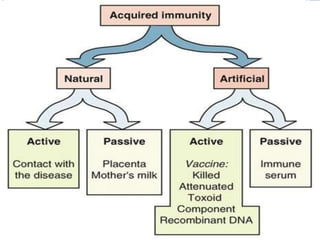
TYPES OF SPECIFIC IMMUNITY
 Naturally acquired immunity
 Natural active immunity
 Natural passive immunity
 Artificially acquired immunity
 Artificial active immunity
 Artificial passive immunity
SPECIFIC IMMUNITY
NATURALLY ACQUIRED IMMUNITY
 Natural active immunity
 Acquired through contact with a specific disease
organism
 Natural passive immunity
 Acquired through transmission of maternal antibodies to
fetus and baby
SPECIFIC IMMUNITY
ARTIFICIALLY ACQUIRED IMMUNITY
 Artificial active immunity
 Acquired through contact with a vaccine
 Artificial passive immunity
 Acquired through delivery of manufactured antibodies to
individual
SPECIFIC IMMUNITY
TYPES OF VACCINES
 Live
 Attenuated
 Toxoid Killed by heat or chemicals
 Antigenic component
 Genetically engineered
SPECIFIC IMMUNITY
BOOSTERS
 Active immunity does not always last a lifetime
 Repeated inoculations (booster shots) help
maintain high titer of antibodies in the blood
 Number and timing varies with vaccines
DISORDERS OF THE IMMUNE SYSTEM
 Allergy
 Hypersensitivity
 Anaphylaxis
 Autoimmunity
 Immune deficiency diseases
 Congenital
 Acquired (e.g., AIDS)
 Multiple myeloma
DISORDERS OF THE IMMUNE SYSTEM
ALLERGY
 Abnormal reactivity to one’s own tissues
 Factors
 Disease
 Loss of immune system control
 Cross-reaction of antibodies and self antigens
 Treatments
 Immune-suppressing drugs
 Chemotherapy/stem cell replacement
DISORDERS OF THE IMMUNE SYSTEM
 Failure of immune system
 May involve any part of system
 Varies in severity
 Congenital or acquired (e.g., AIDS)
 HIV
 A retrovirus; uses reverse transcriptase enzyme
DISEASE DISORDERS OF THE IMMUNE SYSTEM
MULTIPLE MYELOMA
 Cancer of blood-forming bone marrow cells
 Effects of disease
 Lowered resistance to infection
 Anemia
 Bone pain
 Bone tissue loss
 Kidney failure
 Treatment
 Chemotherapy
 Bone marrow transplants
THE IMMUNE SYSTEM AND CANCER
 Immune surveillance
 Declines with age
 Immunotherapy
 T cells activated with interleukin
 Vaccines
TRANSPLANTATION AND REJECTION
SYNDROME
 Rejection syndrome caused by normal antigen–
antibody reaction
 Reduced by
 Tissue typing
 Immune suppression drugs

1. Immunity.pptx

  • 1.
  • 2.
    DEFINITION OF TERMS Immune system: group of cells, molecules, and organs that act together to defend the body against foreign invaders that may cause disease such as bacteria, viruses or fungi.  Immunology: the study of our protection from foreign macromolecules or invading microorganisms and our responses to them.
  • 3.
    DEFINITION OF TERMS Immunity: ability to resist damage from foreign substances.  Antigen: any molecules that trigger an immune response; a protein that stimulates an immune reaction, causing the production of antibodies.  Antibodies: proteins that fight infections; a globulin produced by B cells as a defense mechanism against foreign materials.
  • 4.
    DEFINITION OF TERMS Epidemiology:study of how disease is produced, and its distribution in a given population. Pathogens: microorganisms or proteinaceous substances capable of producing disease. Virulence: ability to cause diseases
  • 5.
    DEFINITION OF TERMS Nosocomial infections: acquired in a health care setting  Immunocompetent : client whose immune system is able to identify antigens and effectively destroy or remove them.  Immunocompromised: client whose immune system is unable to effectively destroy or remove antigens  Mast cells: tissue cells that resemble a peripheral blood basophil and that contains granules with chemical mediators.
  • 6.
  • 7.
    WHAT IS THEIMMUNE SYSTEM The body’s defense against disease causing organisms, malfunctioning cells, and foreign particles
  • 8.
    WHERE IS THEIMMUNE SYSTEM Cells of the immune system are:  Distributed throughout the body in the blood, lymph, epithelial and CT.  oArranged in small spherical nodules (lymphoid nodules) found in CT and inside various organs.  Found in the mucosa of digestive (tonsils, Peyer’s patches), respiratory, reproductive, urinary systems are MALT (mucosa-associated lymphoid tissue.  Organized as differently sized organs—lymphoid organs—the lymph nodes, spleen, thymus, bone marrow.
  • 9.
    IMMUNE SYSTEM COMPONENTS All parts of the body that help in the recognition and destruction of foreign materials. White blood cells, phagocytes and lymphocytes, bone marrow, lymph nodes, tonsils, thymus, and your spleen are all part of the immune system.
  • 10.
    IMMUNE SYSTEM COMPONENTS 1.Leukocytes 1. Engulf and destroy pathogens (bacteria) 2. Suppress inflammation 3. Fight parasitic infections 4. Produce antibodies and provide immunity a. Granulocytes- immediate response to cell injury • Neutrophils- phagocytic, first cell to site of cell injury • Eosinophils- hypersensitivity reaction • Basophil-inflammatory response b. Agranulocytes- fight infection • Monocytes –phagocytosis • Lymphocytes- production of immunoglobulins
  • 11.
    Class Percentage of Total Characteristicsand Functions IgG 75% Found in blood, lymph, and intestines Active against bacteria, its toxins and viruses Enhances phagocytosis, crosses placenta and is active in a second response IgA 10-15% Saliva, tears, bronchial, GI, prostatic and vaginal secretions Provides local protection on exposed mucous membrane surfaces and potent antiviral activity Prevents absorption of antigens from food, and protects against respiratory, GI, and GU infections IgM 5-10% Levels decrease during stress Found in blood and lymph First antibody produced with primary immune response High concentrations early in infection, decrease within about a week IgD <1% Unknown function, found in blood and lymph IgE <0.1% Found on mast cells and basophils Involved in immediate hypersensitivity response IMMUNOGLOBULIN CHARACTERISTICS AND FUNCTIONS
  • 12.
    CELLS INVOLVED INTHE IMMUNE SYSTEM  Macrophages  B-cells  T-cells  NK-cells
  • 13.
    LIFE IS ATHREAT FROM EVERYTHING IN NATURE
  • 14.
    THE IMMUNE SYSTEMREACTS TO ANY FOREIGN INVASION
  • 15.
    IMMUNITY Innate immunity Acquiredimmunity Non-specific Immediate onset Specific Delay onset Humoral Immune Response Cellular Immune Response Antibodies production 15 T-cell activation
  • 16.
    16 Primary Lymphoid Organs oBone Marrow and Thymus o Maturation Site Secondary Lymphoid Organs o Spleen, lymph nodes, o MALT (mucosal associated lymph tissue) o GALT (gut associated lymph tissue) o Trap antigen, APC (antigen- presenting cell), Lymphocyte Proliferation ORGANS OF IMMUNE SYSTEM
  • 18.
    CENTRAL IMMUNE ORGANS CentralImmune Organs are the sites of generation, differentiation and maturation of immunocytes.  Bone marrow  Thymus  Bursa of Fabricius (the site of B cells maturation in birds) But absent in Humans
  • 19.
    THE IMMUNE SYSTEM Anantigen (invading bacteria) enters the body. A macrophage attacks the antigen and retains some of the antigen’s protein on its surface. The macrophage carries the protein markers to lymphoid tissue; T-lymphocytes interpret them as foreign. Antibodies attack the antigens.
  • 20.
    FUNCTIONS OF THEIMMUNE SYSTEM  Defend and protect the body from infection by bacteria, viruses, fungi and parasites.  Removing and destroying damaged or dead cells.  Identifying and destroying malignant cells, thereby preventing their further development into tumors.
  • 21.
    INFECTIO N immunity Bolus ofinfection x virulence immunity Disease =
  • 22.
    FACTORS INVOLVED ININFECTION  Portal of entry  Virulence of organism  Aggressiveness  Toxin production  Dose (number) of pathogens  Individual condition (predisposition) to infection
  • 23.
    FACTORS CONTRIBUTING TOHIGH RISK OF INFECTION IN OLDER ADULTS  High prevalence of chronic conditions  High rate of hospitalization and institutionalization  Age-related changes
  • 24.
    INTERVENTIONS TO STRENGTHENTHE IMMUNE SYSTEM  Promote good general health.  Assure immunizations are current.  Encourage foods that have positive effect on immunity  Assist patient to maintain skin integrity.  Teach stress management techniques.  Encourage regular exercise.  Counsel against overuse of antibiotics.  Teach infection control measures.  Adhere to strict infection prevention measures.
  • 25.
    EFFECTS OF AGINGON THE IMMUNE SYSTEM  Thymus gland progressively declines in size.  Immature T-cells increase.  T-cell function declines.  Cell-mediated immunity is deficient.  Serum distribution of IgA and IgG increase.  Serum distribution of IgM and IgD decrease.  Antibody response to vaccines is reduced.  Skin loses macrophages.
  • 26.
    EFFECTS OF FASTINGON THE IMMUNE SYSTEM  Increased:  Macrophage activity  Immunoglobulin levels  Neutrophil antibacterial activity  Improvement of:  Cell-mediated immunity  Ability of monocytes to kill bacteria  Natural killer cell activity  Reductions in:  Free radicals  Antioxidant damage
  • 27.
    FACTORS AFFECTING THEIMMUNE SYSTEM  Diet  Exercise  Immunization  Stress  Mind-body connection  Antibiotic use
  • 28.
    ORGANS INVOLVED INSTRESS RESPONSE  Thymus  Spleen  Lymph nodes  Stress can affect the function of the immune system.
  • 29.
    STRESS REDUCTION MEASURES Progressive relaxation  Meditation  Prayer  Yoga  Imagery  Exercise  Diversional activity
  • 30.
    TRAITS CONSISTENT WITHA STRONG IMMUNE SYSTEM  Assertiveness  Faith in God or a higher power  Ability to trust and offer unconditional love  Willingness to be open and confide in others  Purposeful activity  Control over one’s life  Acceptance of stress as a challenge rather than a threat  Altruism  Development and exercise of multiple facets of personality
  • 31.
    PROMOTING SAFE ANTIBIOTICUSE  Assist patients in health promotion efforts.  Adhere to strict infection control practices.  Use alternatives to antibiotics whenever possible.  Educate about the realities and risks of antibiotics.  Advise patients not to save and use antibiotics for future illnesses.
  • 32.
    TYPES OF BODYDEFENSES AGAINST DISEASE  Nonspecific defenses  Effective against any harmful agent  Specific defenses  Effective against a certain agent only
  • 33.
    NONSPECIFIC IMMUNITY  Nonspecificimmunity is composed of successive lines of defense.  First line of defense: barriers  Second line of defense: internal nonspecific responses  Specific immunity is the final line of defense.
  • 34.
    NONSPECIFIC IMMUNITY THE FIRSTLINE OF DEFENSE Barriers  Skin  Mucous membranes  Body secretions  Body reflexes  Sneezing  Coughing  Vomiting  Diarrhea
  • 35.
    NONSPECIFIC IMMUNITY THE SECONDLINE OF DEFENSE  Nonspecific Reponses Phagocytosis  Neutrophils  Macrophages  Natural killer cells  Inflammation  Fever  Interferon  Complement
  • 37.
    NONSPECIFIC IMMUNITY Phagocytosis White bloodcells take in and destroy waste and foreign material.  Neutrophils  Macrophages Natural Killer Cell  Type of lymphocyte found in lymph nodes, spleen, bone marrow, blood  Recognizes body cells with abnormal membranes and secretes protein that breaks down cell membrane
  • 38.
    NONSPECIFIC IMMUNITY Inflammation  Infectionis inflammation caused by pathogens  Inflammatory reaction  Heat, redness, swelling, pain  Cells release histamine  Leukocytes enter tissue  Granulocytes, macrophages, mast cells  Leukocytes and plasma produce inflammatory exudate  Pus is produced  Lymph nodes enlarge
  • 40.
    FACTORS THAT MAYIMPAIR HEALING Factors Effect Malnutrition Protein deficient Prolongs inflammation and impairs healing process Carbohydrates and kilocalorie deficient Impairs metabolic process; proteins are used for energy rather than healing Vitamin deficits Vit. A Limits epithelialization and capillary formation B-complex Inhibits enzymatic reaction that contributes to wound healing Vit. C Impairs collagen synthesis Tissue Hypoxia Associated with an increase risk of infection and impaired healing Impaired blood supply Inadequate delivery of Oxygen and nutrients
  • 41.
    NONSPECIFIC IMMUNITY FEVER  Asphagocytes work, they release substances that raise body temperature.  Stimulates phagocytes  Increases metabolism  Decreases some organisms’ ability to multiply
  • 42.
    NONSPECIFIC IMMUNITY INTERFERON  Groupof substances that prevent nearby cells from producing more virus  IFN α (alpha)  IFN β (beta)  IFN γ (gamma)  Also acts nonspecifically on immune system cells
  • 43.
    NONSPECIFIC IMMUNITY COMPLEMENT Specialized proteinsin blood that are activated by immune responses Functions:  Coats foreign cells  Destroys cells  Promotes inflammation  Attracts phagocytes
  • 45.
    SPECIFIC IMMUNITY Power toovercome a specific disease agent Characteristics  Specific response to specific pathogens  Acquired over lifetime  Stimulated by antigens
  • 46.
    SPECIFIC IMMUNITY Antigens  Foreignsubstances that  Enter body  Induce immune response of certain lymphocytes  T cells  B cells
  • 47.
    SPECIFIC IMMUNITY T Cells Originate in red bone marrow  Mature in thymus  Become sensitized to specific antigens  Provide cell-mediated immunity
  • 48.
    SPECIFIC IMMUNITY Types ofT cells  Cytoxic T cells  Helper T cells  Regulatory T cells  Memory T cells Stimulated by antigen-presenting cells  Macrophages  Dendritic cells
  • 50.
    SPECIFIC IMMUNITY B Cells Originate and mature in red bone marrow  Produce antibodies  Provide humoral immunity Cell types  Plasma cells  Secrete antibodies  Memory b cells
  • 52.
    SPECIFIC IMMUNITY FUNCTIONS OFANTIBODIES  Bind antigen  Promote phagocytosis  Activate nk cells  Neutralize toxins  Activate complement
  • 54.
    SPECIFIC IMMUNITY TYPES OFSPECIFIC IMMUNITY  Naturally acquired immunity  Natural active immunity  Natural passive immunity  Artificially acquired immunity  Artificial active immunity  Artificial passive immunity
  • 55.
    SPECIFIC IMMUNITY NATURALLY ACQUIREDIMMUNITY  Natural active immunity  Acquired through contact with a specific disease organism  Natural passive immunity  Acquired through transmission of maternal antibodies to fetus and baby
  • 56.
    SPECIFIC IMMUNITY ARTIFICIALLY ACQUIREDIMMUNITY  Artificial active immunity  Acquired through contact with a vaccine  Artificial passive immunity  Acquired through delivery of manufactured antibodies to individual
  • 58.
    SPECIFIC IMMUNITY TYPES OFVACCINES  Live  Attenuated  Toxoid Killed by heat or chemicals  Antigenic component  Genetically engineered
  • 59.
    SPECIFIC IMMUNITY BOOSTERS  Activeimmunity does not always last a lifetime  Repeated inoculations (booster shots) help maintain high titer of antibodies in the blood  Number and timing varies with vaccines
  • 60.
    DISORDERS OF THEIMMUNE SYSTEM  Allergy  Hypersensitivity  Anaphylaxis  Autoimmunity  Immune deficiency diseases  Congenital  Acquired (e.g., AIDS)  Multiple myeloma
  • 61.
    DISORDERS OF THEIMMUNE SYSTEM ALLERGY  Abnormal reactivity to one’s own tissues  Factors  Disease  Loss of immune system control  Cross-reaction of antibodies and self antigens  Treatments  Immune-suppressing drugs  Chemotherapy/stem cell replacement
  • 62.
    DISORDERS OF THEIMMUNE SYSTEM  Failure of immune system  May involve any part of system  Varies in severity  Congenital or acquired (e.g., AIDS)  HIV  A retrovirus; uses reverse transcriptase enzyme
  • 64.
    DISEASE DISORDERS OFTHE IMMUNE SYSTEM MULTIPLE MYELOMA  Cancer of blood-forming bone marrow cells  Effects of disease  Lowered resistance to infection  Anemia  Bone pain  Bone tissue loss  Kidney failure  Treatment  Chemotherapy  Bone marrow transplants
  • 65.
    THE IMMUNE SYSTEMAND CANCER  Immune surveillance  Declines with age  Immunotherapy  T cells activated with interleukin  Vaccines
  • 66.
    TRANSPLANTATION AND REJECTION SYNDROME Rejection syndrome caused by normal antigen– antibody reaction  Reduced by  Tissue typing  Immune suppression drugs