HUMAN MEMORY
REMEMBERING AND
FORGETTING.
WHAT IS MEMORY?
 Memory is the process of encoding, storing and retrieving
information (Feldman, 2000).
 Memory is also defined as the retention of information over
time (Omari, 2006).
 Generally, memory is the storing of information over time.
It is one of the most important concepts in learning; if
things are not remembered, no learning can take place.
MEANING OF MEMORY CONT…..
 Learning is the relative permanent change of
behaviours resulting from experience and reflection
(Omari, 2006).
 That means you cannot separate memory and
learning. Learning cannot take place without
memory. Memory allows a student to retrieve a large
amount of what she/he has learnt.
MEANING OF MEMORY CONT……
 Generally, memory is essential for human
survival. You cannot think, reason, or
making decision without memory.
PROCESSES OF MEMORY (HOW MEMORY
OCCURS)
• Memory is a dynamic process, which involves
three interrelated processes,
1. Encoding/ acquisition
2. Storage
3. Retrieve
1. ENCODING:
 This is the act of organizing and
transforming information so that it can enter
into memory. This is an initial process of
recording of information.
2. STORAGE:
This is the process of maintaining/retaining
information in memory. OR is the act of
retaining information for future use, be in the
sensory memory, the short-term memory or
the more permanent long-term memory.
3. RETRIEVAL:
This is the process of bringing back the stored
information. OR is the process of sorting and getting
out the information that has been stored into
memory. When we are able to retrieve we say we have
remembered, when unable to retrieve we say we have
forgotten.
CONT………
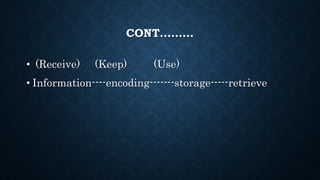
• (Receive) (Keep) (Use)
• Information----encoding-------storage-----retrieve
TYPES OF MEMORY.
There are three types of memory
1. Sensory Memory
2. Short Term Memory
3. Long Term Memory
SENSORY MEMORY (SM).
 Sensory memory is the lowest level of memory, which holds
a large amount of information for a very brief time.
 As the name imply, sensory memory comes from sense
organ (eyes, ears etc).
Only information that is transferred to another level of
memory will be preserved for more than one or two seconds.
SENSORY MEMORY CONT….
 Information in the sensory memory is un-
interpreted. Example: You lose concentration in
class during a lecture. Suddenly you hear a
significant word and return your focus to the
lecture. You should be able to remember what was
said just before the key word since it is in your
sensory register.
TYPES OF SENSORY MEMORY
1. Iconic sensory memory:
This is the memory derived from vision. Store a large
amount of information but disappear quickly, in less
than one second.
2. ECHOIC MEMORY/AUDITORY SENSORY
MEMORY:
 This is the memory that comes from hearing.
It disappears quickly, it just stay for less than
four seconds.
3. TACTILE (TOUCH) SENSORY MEMORY:
 This is the memory that comes from touch. It also
disappears quickly, it just stay for less than one-half
second.
Note: Similar systems are assumed to exist for other
sensory systems (taste, and smell), although
researchers have studied these senses less thoroughly.
SHORT TERM OR WORKING MEMORY (STM)
• Psychologists originally used the term short-term memory
to refer to the ability to hold information in mind over a
brief period of time. Memory stage in which information is
held in consciousness for about 10-30 seconds.
• According to Omari (2006), information in short term
memory retained for 30 seconds and then lost unless
rehearsed.
STM CONT………
• STM can hold only a limited amount of information at one
time. People can overcome such storage limitations by
grouping information into chunks, or meaningful units.
• For example, choose a seven-digit number and see how well
you can remember it. Let say our number is 2000000. It is
possible to remember this number if you group it. The
number can be grouped into 3 or 2 groups. The number
would be grouped 2 with 3 sets of zeros or 2 and six zeros.
STM CONT…….
 The ability to remember this number depends on working
memory capacity, which varies individually.
 Studies have shown that working memory changes with
age. As children grow older, their working memory capacity
increases. Working memory declines in old age and in some
types of brain diseases, such as Alzheimer’s disease (brain
disorder).
LONG TERM MEMORY (LTM).
 This Is the type of memory that holds or retain huge
amount of memory for a long period, it can be from
hours to years.
 In fact many theorists believe that individual may
never forget information in long term memory, rather
he/she might just lose the ability to find the information
within his/her memory.
LTM CONT……
 For this reason some theorists use the term
permanent memory (Byrne, 1996).
This is the type of memory whose capacity is
staggering and unlimited (LTM has unlimited
memory capacity).
DIVISION OF LONG-TERM MEMORY.
Theorists divide long-term memory into two
major parts which are:
1. Declarative and
2. Non-declarative/Procedural memory
1. DECLARATIVE MEMORY:
This is the aspect of human memory that an individual stores/recall
facts, events, and experiences and then verbally declares or describes
their recollections. This occurs consciously.
 Declarative memory is further broken down into two components:
which are
1. Episodic and
2. Semantic memory.
EPISODIC MEMORY:
 This is the memory for the past and personally
experienced events. OR are memories about
bibliographic details of an individual life. Sometimes
called an autobiographical dates.
 This is the kind of memory that consists of particular
events, where, when, what time an event had occurred
etc.
EPISODIC MEMORY CONT….
 Our personal experiences are stored in episodic memory; these memories involve
events that occurred at certain times with specific people, places, and things. E.g.
arriving on campus for the first day.
 Episodic memory has the capability of acquisition and retention of knowledge about
personally experienced events and their temporal relations in subjective time and
the ability to mentally “travel back” in time.
SEMANTIC MEMORY:
This is a memory of general knowledge and facts about
words.
 In semantic memory, the brain stores information about
words, what they look like and represent, and how they are
used in an organized way. E.g. it is unusual for a person to
forget the meaning of the word "dictionary," or to be unable
to call up a visual image of a refrigerator when the word is
heard or read.
SEMANTIC MEMORY CONT….
 Semantic memory allows humans to communicate with
language. The following are examples of items that that
might be stored in semantic memory:
1. Tanzania shares a border with Kenya
2. 9 – 6 = 3
SEMANTIC MEMORY CONT…..
 Semantic memory is characterized by the
additional capability of internally representing
states of the world that are not perceptually present.
It permits the organism to construct mental models
of the world. Models that can be manipulated and
operated on covertly, independently of any overt
behavior.
2. NON-DECLARATIVE/ PROCEDURAL
MEMORY:
This is a memory of skills and habits like driving a car, play
football, cards, how to make a table, etc. (Memories we use in
making responses and skilled action).
 Procedural memory is expressed through performance
 It is difficult to recall when you are not engaging in an activity
 You are not aware of having them until you engage in an
activity or stimuli
CONT……..
 Mind you, procedural memories are used at the
same time with other types of memory. E.g.
remembering how to drive a car involves procedural
memory. Remembering traffic laws, however,
involves the memory of general principles.
CONT……
Episodic, semantic and procedural memory store information in
different ways .
 Information in an episodic memory is stored in the form of images
that are organized on the basis of when and where events happened
 Information in semantic memory is organized in the form of network
ideas
 Information in procedural memory is stored as a complex of stimulus-
response pairing.
RELATIONSHIP BETWEEN 3 TYPES OF
MEMORY.
NB: Information can enter into STM by two means
1. Information is moved from SM to STM for rehearsed.
2. Information is moved from LTM to STM as a retrieval of
the memory.
REMEMBERING AND FORGETTING.
 Every human being has the tendency of remembering and
forgetting information, thus forgetting is one of the
functions of memory.
When any of these behaviors is in an excess we intend that
behavior to be abnormal
Forgetting refers to being unable to retrieve what is in the
memory storage.
FACTORS THAT FACILITATE MEMORY (HOW
CAN A PERSON BE ABLE TO REMEMBER THE
LEARNED MATERIALS?)
1. Rehearsal:
This involves repeating or reciting the skill or
information as many as may be necessary to store in
long-term memory.
2. ORGANIZATION:
If the information to be learned is well organized, it
can be remembered easily. One way of organizing the
information is to break it into small unit (chunk) and
to link these units to each other in the way they
relate to each other so that remembering one unit will
lead to remembering another related unit.
3. MEANINGFULNESS:
If the information learned has inherent/latent
meaning, it will be retained in long-term
memory. Information meets the criteria for
meaningfulness if the new information can be
related in some way to what a person already
known.
4. ACTIVITY:
students who spend some times discussing
what they have leant or who simply talk to
themselves about what they have studied,
remember such information more than
those who read it silently.
5. ATTENTION:
This is the process of selecting what is important for
further processing. It is vital to remembering
because, unless selective and proper attention is paid
to the information to be learned, learning is unlikely
to be effective. Selection determines which stimuli
will become part of our permanent experience and
which will be dropped from the memory instantly.
6. RECOGNITION:
This is the product of two sets of information. One is
stimulus and the second is information related to the
stimulus already existing in long term memory. For
example, recognizing a cow as a cow depends on
features such as horns, height and length
WHY DO PEOPLE FORGET INFORMATION?
There are various reasons that make people to forget.
Ideas from the participants.
1. INTERFERENCE:
This is the disruption of ability to remember one piece of information by
the presence of other information. It occurs into two ways: retroactive
and proactive.
 Retroactive: occurs when new memory impairs memory for
something learned earlier. New learning makes forget the previous
learning, while
Proactive interference occurs when the previous learning impairs the
new learning. The previous experiences make it difficult to learn new
materials
2. DECAY:
This refers to fading (departure) away
information with time. The information
disappears because there is no use of it.
3.AMNESIA:
This is the loss of memory over entire life span or over long period of
time result from brain damage, infection, accident. It may appear into
two ways retrograde amnesia and anterograde amnesia.
 Retrograde amnesia is a form of amnesia where someone will be
unable to recall events that occurred before the onset of amnesia. The
term is used to categories patterns of symptoms, rather than to
indicate a particular cause while.
ANTEROGRADE AMNESIA
This occurs when the individual cannot retain
any new memories. This type of amnesia
usually occurs after a brain injury, which forms
the cut-off point for memories.
4. REPRESSION:
This is the tendency where by real memories are push
out because they are emotionally painful. Ignoring
the information sometimes is called motivated
forgetting.
5. INADEQUATE REHEARSAL:
If you do not have enough time for repetition of
information, you will get into forgetting. The
more the rehearsal the quicker the information
will be recalled.
6. FAILURE TO ENCODE:
When you receive the information and you fail
to organize, it may lead to forgetting. This can
be caused by failure to understand the material
clearly.
THE END.
Mr. Hussein Ally Hussein
Special Needs Education Teacher, Guidance &
counseling, psychology & youth matter consultant.
Phone: +255625640278/+255764735205
email: chusehussein20@gmail.com

Human memory

  • 1.
  • 2.
    WHAT IS MEMORY? Memory is the process of encoding, storing and retrieving information (Feldman, 2000).  Memory is also defined as the retention of information over time (Omari, 2006).  Generally, memory is the storing of information over time. It is one of the most important concepts in learning; if things are not remembered, no learning can take place.
  • 3.
    MEANING OF MEMORYCONT…..  Learning is the relative permanent change of behaviours resulting from experience and reflection (Omari, 2006).  That means you cannot separate memory and learning. Learning cannot take place without memory. Memory allows a student to retrieve a large amount of what she/he has learnt.
  • 4.
    MEANING OF MEMORYCONT……  Generally, memory is essential for human survival. You cannot think, reason, or making decision without memory.
  • 5.
    PROCESSES OF MEMORY(HOW MEMORY OCCURS) • Memory is a dynamic process, which involves three interrelated processes, 1. Encoding/ acquisition 2. Storage 3. Retrieve
  • 6.
    1. ENCODING:  Thisis the act of organizing and transforming information so that it can enter into memory. This is an initial process of recording of information.
  • 7.
    2. STORAGE: This isthe process of maintaining/retaining information in memory. OR is the act of retaining information for future use, be in the sensory memory, the short-term memory or the more permanent long-term memory.
  • 8.
    3. RETRIEVAL: This isthe process of bringing back the stored information. OR is the process of sorting and getting out the information that has been stored into memory. When we are able to retrieve we say we have remembered, when unable to retrieve we say we have forgotten.
  • 9.
    CONT……… • (Receive) (Keep)(Use) • Information----encoding-------storage-----retrieve
  • 10.
    TYPES OF MEMORY. Thereare three types of memory 1. Sensory Memory 2. Short Term Memory 3. Long Term Memory
  • 11.
    SENSORY MEMORY (SM). Sensory memory is the lowest level of memory, which holds a large amount of information for a very brief time.  As the name imply, sensory memory comes from sense organ (eyes, ears etc). Only information that is transferred to another level of memory will be preserved for more than one or two seconds.
  • 12.
    SENSORY MEMORY CONT…. Information in the sensory memory is un- interpreted. Example: You lose concentration in class during a lecture. Suddenly you hear a significant word and return your focus to the lecture. You should be able to remember what was said just before the key word since it is in your sensory register.
  • 13.
    TYPES OF SENSORYMEMORY 1. Iconic sensory memory: This is the memory derived from vision. Store a large amount of information but disappear quickly, in less than one second.
  • 14.
    2. ECHOIC MEMORY/AUDITORYSENSORY MEMORY:  This is the memory that comes from hearing. It disappears quickly, it just stay for less than four seconds.
  • 15.
    3. TACTILE (TOUCH)SENSORY MEMORY:  This is the memory that comes from touch. It also disappears quickly, it just stay for less than one-half second. Note: Similar systems are assumed to exist for other sensory systems (taste, and smell), although researchers have studied these senses less thoroughly.
  • 16.
    SHORT TERM ORWORKING MEMORY (STM) • Psychologists originally used the term short-term memory to refer to the ability to hold information in mind over a brief period of time. Memory stage in which information is held in consciousness for about 10-30 seconds. • According to Omari (2006), information in short term memory retained for 30 seconds and then lost unless rehearsed.
  • 17.
    STM CONT……… • STMcan hold only a limited amount of information at one time. People can overcome such storage limitations by grouping information into chunks, or meaningful units. • For example, choose a seven-digit number and see how well you can remember it. Let say our number is 2000000. It is possible to remember this number if you group it. The number can be grouped into 3 or 2 groups. The number would be grouped 2 with 3 sets of zeros or 2 and six zeros.
  • 18.
    STM CONT…….  Theability to remember this number depends on working memory capacity, which varies individually.  Studies have shown that working memory changes with age. As children grow older, their working memory capacity increases. Working memory declines in old age and in some types of brain diseases, such as Alzheimer’s disease (brain disorder).
  • 19.
    LONG TERM MEMORY(LTM).  This Is the type of memory that holds or retain huge amount of memory for a long period, it can be from hours to years.  In fact many theorists believe that individual may never forget information in long term memory, rather he/she might just lose the ability to find the information within his/her memory.
  • 20.
    LTM CONT……  Forthis reason some theorists use the term permanent memory (Byrne, 1996). This is the type of memory whose capacity is staggering and unlimited (LTM has unlimited memory capacity).
  • 21.
    DIVISION OF LONG-TERMMEMORY. Theorists divide long-term memory into two major parts which are: 1. Declarative and 2. Non-declarative/Procedural memory
  • 22.
    1. DECLARATIVE MEMORY: Thisis the aspect of human memory that an individual stores/recall facts, events, and experiences and then verbally declares or describes their recollections. This occurs consciously.  Declarative memory is further broken down into two components: which are 1. Episodic and 2. Semantic memory.
  • 23.
    EPISODIC MEMORY:  Thisis the memory for the past and personally experienced events. OR are memories about bibliographic details of an individual life. Sometimes called an autobiographical dates.  This is the kind of memory that consists of particular events, where, when, what time an event had occurred etc.
  • 24.
    EPISODIC MEMORY CONT…. Our personal experiences are stored in episodic memory; these memories involve events that occurred at certain times with specific people, places, and things. E.g. arriving on campus for the first day.  Episodic memory has the capability of acquisition and retention of knowledge about personally experienced events and their temporal relations in subjective time and the ability to mentally “travel back” in time.
  • 25.
    SEMANTIC MEMORY: This isa memory of general knowledge and facts about words.  In semantic memory, the brain stores information about words, what they look like and represent, and how they are used in an organized way. E.g. it is unusual for a person to forget the meaning of the word "dictionary," or to be unable to call up a visual image of a refrigerator when the word is heard or read.
  • 26.
    SEMANTIC MEMORY CONT…. Semantic memory allows humans to communicate with language. The following are examples of items that that might be stored in semantic memory: 1. Tanzania shares a border with Kenya 2. 9 – 6 = 3
  • 27.
    SEMANTIC MEMORY CONT….. Semantic memory is characterized by the additional capability of internally representing states of the world that are not perceptually present. It permits the organism to construct mental models of the world. Models that can be manipulated and operated on covertly, independently of any overt behavior.
  • 28.
    2. NON-DECLARATIVE/ PROCEDURAL MEMORY: Thisis a memory of skills and habits like driving a car, play football, cards, how to make a table, etc. (Memories we use in making responses and skilled action).  Procedural memory is expressed through performance  It is difficult to recall when you are not engaging in an activity  You are not aware of having them until you engage in an activity or stimuli
  • 29.
    CONT……..  Mind you,procedural memories are used at the same time with other types of memory. E.g. remembering how to drive a car involves procedural memory. Remembering traffic laws, however, involves the memory of general principles.
  • 30.
    CONT…… Episodic, semantic andprocedural memory store information in different ways .  Information in an episodic memory is stored in the form of images that are organized on the basis of when and where events happened  Information in semantic memory is organized in the form of network ideas  Information in procedural memory is stored as a complex of stimulus- response pairing.
  • 31.
    RELATIONSHIP BETWEEN 3TYPES OF MEMORY. NB: Information can enter into STM by two means 1. Information is moved from SM to STM for rehearsed. 2. Information is moved from LTM to STM as a retrieval of the memory.
  • 32.
    REMEMBERING AND FORGETTING. Every human being has the tendency of remembering and forgetting information, thus forgetting is one of the functions of memory. When any of these behaviors is in an excess we intend that behavior to be abnormal Forgetting refers to being unable to retrieve what is in the memory storage.
  • 33.
    FACTORS THAT FACILITATEMEMORY (HOW CAN A PERSON BE ABLE TO REMEMBER THE LEARNED MATERIALS?) 1. Rehearsal: This involves repeating or reciting the skill or information as many as may be necessary to store in long-term memory.
  • 34.
    2. ORGANIZATION: If theinformation to be learned is well organized, it can be remembered easily. One way of organizing the information is to break it into small unit (chunk) and to link these units to each other in the way they relate to each other so that remembering one unit will lead to remembering another related unit.
  • 35.
    3. MEANINGFULNESS: If theinformation learned has inherent/latent meaning, it will be retained in long-term memory. Information meets the criteria for meaningfulness if the new information can be related in some way to what a person already known.
  • 36.
    4. ACTIVITY: students whospend some times discussing what they have leant or who simply talk to themselves about what they have studied, remember such information more than those who read it silently.
  • 37.
    5. ATTENTION: This isthe process of selecting what is important for further processing. It is vital to remembering because, unless selective and proper attention is paid to the information to be learned, learning is unlikely to be effective. Selection determines which stimuli will become part of our permanent experience and which will be dropped from the memory instantly.
  • 38.
    6. RECOGNITION: This isthe product of two sets of information. One is stimulus and the second is information related to the stimulus already existing in long term memory. For example, recognizing a cow as a cow depends on features such as horns, height and length
  • 39.
    WHY DO PEOPLEFORGET INFORMATION? There are various reasons that make people to forget. Ideas from the participants.
  • 40.
    1. INTERFERENCE: This isthe disruption of ability to remember one piece of information by the presence of other information. It occurs into two ways: retroactive and proactive.  Retroactive: occurs when new memory impairs memory for something learned earlier. New learning makes forget the previous learning, while Proactive interference occurs when the previous learning impairs the new learning. The previous experiences make it difficult to learn new materials
  • 41.
    2. DECAY: This refersto fading (departure) away information with time. The information disappears because there is no use of it.
  • 42.
    3.AMNESIA: This is theloss of memory over entire life span or over long period of time result from brain damage, infection, accident. It may appear into two ways retrograde amnesia and anterograde amnesia.  Retrograde amnesia is a form of amnesia where someone will be unable to recall events that occurred before the onset of amnesia. The term is used to categories patterns of symptoms, rather than to indicate a particular cause while.
  • 43.
    ANTEROGRADE AMNESIA This occurswhen the individual cannot retain any new memories. This type of amnesia usually occurs after a brain injury, which forms the cut-off point for memories.
  • 44.
    4. REPRESSION: This isthe tendency where by real memories are push out because they are emotionally painful. Ignoring the information sometimes is called motivated forgetting.
  • 45.
    5. INADEQUATE REHEARSAL: Ifyou do not have enough time for repetition of information, you will get into forgetting. The more the rehearsal the quicker the information will be recalled.
  • 46.
    6. FAILURE TOENCODE: When you receive the information and you fail to organize, it may lead to forgetting. This can be caused by failure to understand the material clearly.
  • 47.
    THE END. Mr. HusseinAlly Hussein Special Needs Education Teacher, Guidance & counseling, psychology & youth matter consultant. Phone: +255625640278/+255764735205 email: chusehussein20@gmail.com