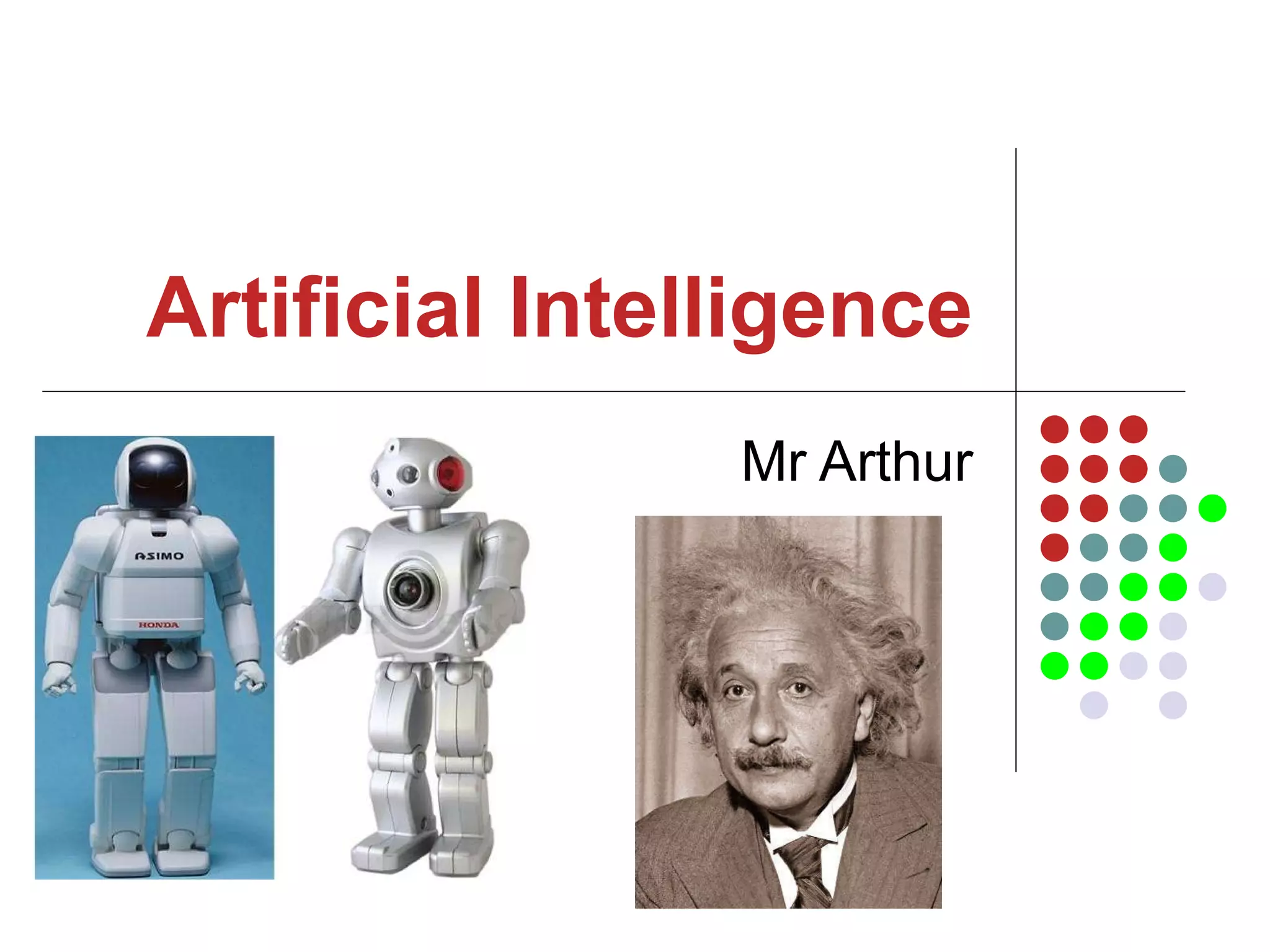
Artificial Intelligence Mr Arthur
Aims of Lesson 1 What is Intelligence?? Turing Test Problems with the Turing Test
What is Intelligence???? “ Intelligence is the name we give to the data processing activity of entities which respond to information with behaviour which appears to be intended to be optional with respect to pre-set goals” “ Intelligence involves Knowing and  Choosing”
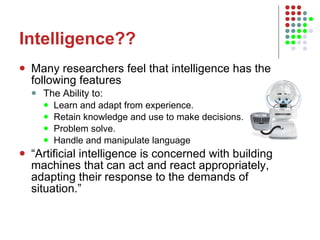
Intelligence?? Many researchers feel that intelligence has the following features The Ability to: Learn and adapt from experience. Retain knowledge and use to make decisions. Problem solve. Handle and manipulate language “ Artificial intelligence is concerned with building machines that can act and react appropriately, adapting their response to the demands of situation.”
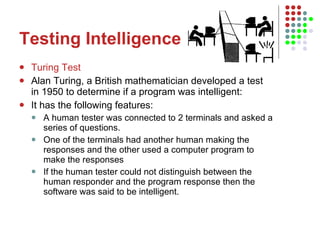
Testing Intelligence Turing Test Alan Turing, a British mathematician developed a test in 1950 to determine if a program was intelligent:  It has the following features: A human tester was connected to 2 terminals and asked a series of questions.  One of the terminals had another human making the responses and the other used a computer program to make the responses If the human tester could not distinguish between the human responder and the program response then the software was said to be intelligent.
Problems with Turing Test It needed a fairly limited problem domain i.e. the area of the knowledge had to be small. Did the program pretend to forget things or make errors in order to fool the human tester?
Lesson Starter Give 3 features of Intelligence Give 3 examples of AI in everyday life What is the name of the test that is used to determine if a system is Intelligent? Describe this test
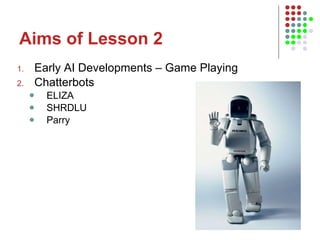
Aims of Lesson 2 Early AI Developments – Game Playing Chatterbots ELIZA SHRDLU Parry
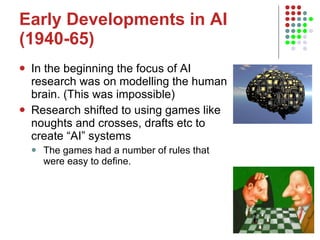
Early Developments in AI (1940-65) In the beginning the focus of AI research was on modelling the human brain. (This was impossible) Research shifted to using games like noughts and crosses, drafts etc to create “AI” systems The games had a number of rules that were easy to define.
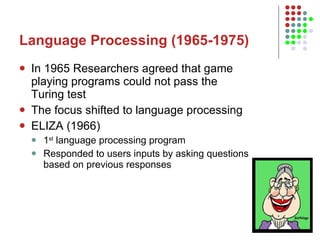
Language Processing (1965-1975) In 1965 Researchers agreed that game playing programs could not pass the Turing test The focus shifted to language processing ELIZA (1966) 1 st  language processing program Responded to users inputs by asking questions based on previous responses
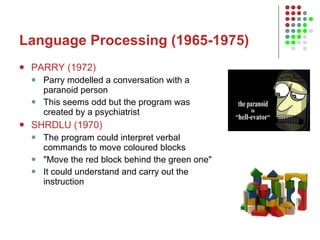
Language Processing (1965-1975) PARRY (1972) Parry modelled a conversation with a paranoid person This seems odd but the program was created by a psychiatrist  SHRDLU (1970) The program could interpret verbal commands to move coloured blocks "Move the red block behind the green one"  It could understand and carry out the instruction
Lesson Starter Give 1 problem with the Turing test Why did early AI development focus on Game Playing? Describe the response from the chatterbot ELIZA
Aims of Lesson 4 Last Lesson Definition of intelligence The Turing Test Early Developments in AI = Game Playing Language Processing ELIZA SHRDLU PARRY Chatterbots Today’s Lesson Developments in Hardware
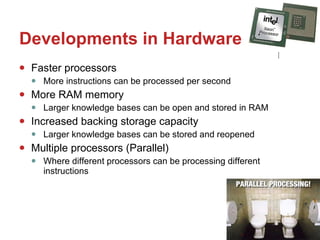
Developments in Hardware Faster processors More instructions can be processed per second More RAM memory Larger knowledge bases can be open and stored in RAM Increased backing storage capacity Larger knowledge bases can be stored and reopened Multiple processors (Parallel) Where different processors can be processing different instructions
Aims of Lesson 5 Last Lesson Definition of intelligence The Turing Test Early Developments in AI = Game Playing Language Processing ELIZA SHRDLU PARRY Chatterbots Today’s Lesson Expert Systems
Expert Systems An expert system is a computer program which uses a knowledge base of facts and rules populated by a human expert The expert system will give reliable advice on a limited area of expertise, and can interact and explain it reasoning to the user (justification facilities) Examples NHS 24 MYCIN to diagnose blood disorders Legal advice Chemical analysis, DENDRAL was designed to identify unknown substances  Car mechanic expert system BABY used to monitor premature babies
Aims of Lesson 5 Last Lesson Definition of intelligence The Turing Test Early Developments in AI = Game Playing Language Processing ELIZA SHRDLU PARRY Chatterbots Today’s Lesson Expert Systems Advantages/Disadvantages
Advantages of Expert Systems Expertise Available to access 24/7 Reduced wage bill Expert System will never get tired You can have multiple copies of the expert system Can combine the knowledge of many experts No human emotion involved No possibility of expert system retiring No barrier due to poor communication skills
Social/Legal/Ethical Issues of Expert Systems No common sense is used Legal  = If the expert system makes an error who is responsible? Developer? Company using it? Moral  =  Expert system wouldn't make a decision on what is morally correct, it would only use facts and rules Loss of jobs Loss of human expertise over time
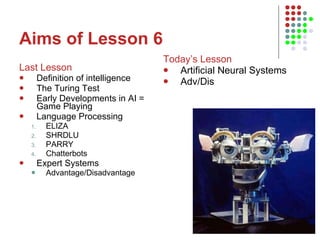
Aims of Lesson 6 Last Lesson Definition of intelligence The Turing Test Early Developments in AI = Game Playing Language Processing ELIZA SHRDLU PARRY Chatterbots Expert Systems Advantage/Disadvantage Today’s Lesson Artificial Neural Systems Adv/Dis
Revision Questions Give 4 features of Intelligence I have a black and white image that is 3 inches by 7 inches with a Resolution of 400 dpi. Calculate the storage requirements in Kb Convert 152 to binary Describe a Client Server network List the 7 stages in the SD process What is a Macro? Give 3 symptoms of your computer being infected by a virus Give 3 features that you could use to Evaluate software Give 3 disadvantages of an Expert System How many bits are used to represent a character is ASCII?
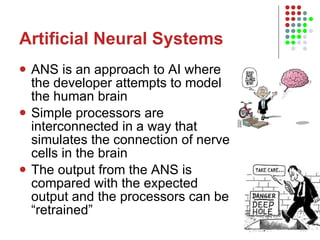
Artificial Neural Systems ANS is an approach to AI where the developer attempts to model the human brain Simple processors are interconnected in a way that simulates the connection of nerve cells in the brain The output from the ANS is compared with the expected output and the processors can be “retrained”
Give 3 features of intelligence What is the name of the Test that is used to test intelligence? Describe this test Why did early AI development focus on Game Playing? Give 3 examples of chatterbots Describe the response the user would get from ELIZA What is an Expert System? Give 2 examples of Expert Systems Give 2 advantages of Expert Systems Give 2 possible disadvantages of an Expert System What is meant by the term Artifical Neural System
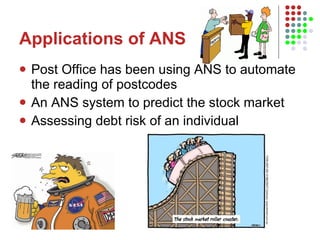
Applications of ANS Post Office has been using ANS to automate the reading of postcodes An ANS system to predict the stock market Assessing debt risk of an individual
Adv/Disadv of ANS Advantages They can learn without needing to be reprogrammed They have a good success rate at predicting the correct response Disadvantages Time consuming and requires a lot of technical expertise to set up ANS cannot explain reasoning behind decision
Lesson Starter What is an Artificial Neural System? Give 2 advances in hardware that has led to the development of AI What is meant by the term parallel processing?
Aims of Lesson 6 Last Lesson Definition of intelligence The Turing Test Early Developments in AI = Game Playing Language Processing ELIZA SHRDLU PARRY Chatterbots Expert Systems Advantage/Disadvantage Artificial Neural Systems Adv/Dis Today’s Lesson Vision Systems
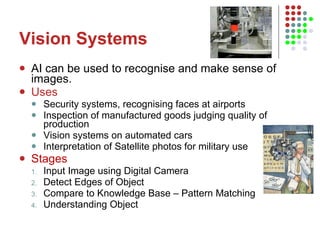
Vision Systems AI can be used to recognise and make sense of images. Uses Security systems, recognising faces at airports Inspection of manufactured goods judging quality of production Vision systems on automated cars Interpretation of Satellite photos for military use Stages Input Image using Digital Camera Detect Edges of Object Compare to Knowledge Base – Pattern Matching Understanding Object
Vision Systems Difficulties with Vision Systems Shadows on Objects Identifying the Edge of the Image Glare Objects hiding other parts of the Image Viewing from different angles
Lesson Starter Give 3 examples of Vision Systems in everyday life Give the 4 stages in a Vision System Give 2 possible problems with Vision Systems
Aims of Lesson 8 Last Lesson Definition of intelligence The Turing Test Early Developments in AI = Game Playing Language Processing ELIZA SHRDLU PARRY Chatterbots Expert Systems Advantage/Disadvantage Artificial Neural Systems Adv/Dis Vision Systems Today’s Lesson Natural Language Processing
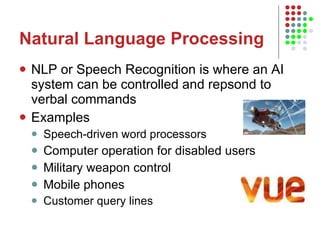
Natural Language Processing NLP or Speech Recognition is where an AI system can be controlled and repsond to verbal commands Examples Speech-driven word processors Computer operation for disabled users Military weapon control Mobile phones Customer query lines
Problems with NLP The need to train the NLP system to your voice Background noise Ambiguity of words and phrases I saw a man eating fish I saw a man hitting a boy with a stick Changing English language i.e. bouncebackability Accents and dialects i.e. I ken what you are talking about!! Similar sounding words and phrases e.g. furry boots are you fae?? Inconsistencies with grammar
Lesson Starter What is meant by the term Natural Language Processing? Give 3 examples in everyday life Give 3 problems with accuracy of NLP systems
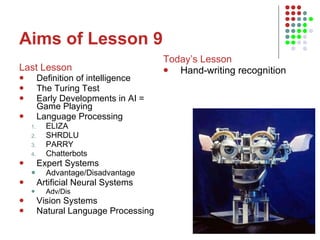
Aims of Lesson 9 Last Lesson Definition of intelligence The Turing Test Early Developments in AI = Game Playing Language Processing ELIZA SHRDLU PARRY Chatterbots Expert Systems Advantage/Disadvantage Artificial Neural Systems Adv/Dis Vision Systems Natural Language Processing Today’s Lesson Hand-writing recognition
Handwriting Recognition This is where handwritten words are converted into editable text Applications Mainly used for Input into Palmtop computers and Tablet PCs Hand writing varies considerably so there is a need to train the software to your style of handwriting
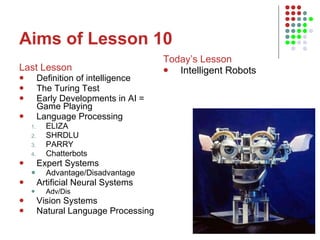
Aims of Lesson 10 Last Lesson Definition of intelligence The Turing Test Early Developments in AI = Game Playing Language Processing ELIZA SHRDLU PARRY Chatterbots Expert Systems Advantage/Disadvantage Artificial Neural Systems Adv/Dis Vision Systems Natural Language Processing Today’s Lesson Intelligent Robots
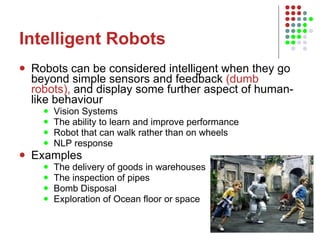
Intelligent Robots Robots can be considered intelligent when they go beyond simple sensors and feedback  (dumb robots),  and display some further aspect of human-like behaviour Vision Systems The ability to learn and improve performance Robot that can walk rather than on wheels NLP response Examples The delivery of goods in warehouses The inspection of pipes Bomb Disposal Exploration of Ocean floor or space
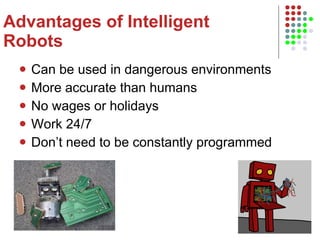
Advantages of Intelligent Robots Can be used in dangerous environments More accurate than humans No wages or holidays Work 24/7 Don’t need to be constantly programmed
Aims of Lesson 11 Last Lesson Definition of intelligence The Turing Test Early Developments in AI = Game Playing Language Processing ELIZA SHRDLU PARRY Chatterbots Expert Systems Advantage/Disadvantage Artificial Neural Systems Adv/Dis Vision Systems Natural Language Processing Intelligent Robots Today’s Lesson Knowledge Representation Semantic Nets Facts, Rules and Queries
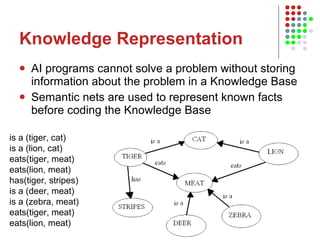
Knowledge Representation AI programs cannot solve a problem without storing information about the problem in a Knowledge Base Semantic nets are used to represent known facts before coding the Knowledge Base is a (tiger, cat) is a (lion, cat) eats(tiger, meat) eats(lion, meat) has(tiger, stripes) is a (deer, meat) is a (zebra, meat) eats(tiger, meat) eats(lion, meat)
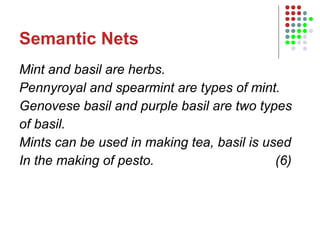
Semantic Nets Mint and basil are herbs. Pennyroyal and spearmint are types of mint. Genovese basil and purple basil are two types of basil. Mints can be used in making tea, basil is used In the making of pesto. (6)
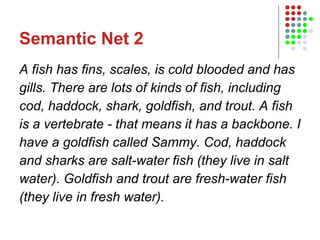
Semantic Net 2 A fish has fins, scales, is cold blooded and has gills. There are lots of kinds of fish, including cod, haddock, shark, goldfish, and trout. A fish is a vertebrate - that means it has a backbone. I have a goldfish called Sammy. Cod, haddock and sharks are salt-water fish (they live in salt water). Goldfish and trout are fresh-water fish (they live in fresh water).
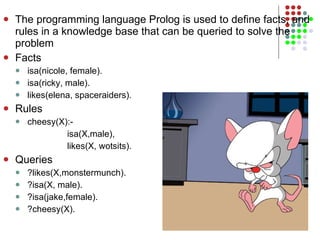
The programming language Prolog is used to define facts, and rules in a knowledge base that can be queried to solve the problem Facts isa(nicole, female). isa(ricky, male). likes(elena, spaceraiders). Rules cheesy(X):- isa(X,male), likes(X, wotsits). Queries ?likes(X,monstermunch). ?isa(X, male). ?isa(jake,female). ?cheesy(X).
Aims of Lesson 12 Last Lesson Definition of intelligence The Turing Test Early Developments in AI = Game Playing Language Processing ELIZA SHRDLU PARRY Chatterbots Expert Systems Advantage/Disadvantage Artificial Neural Systems Adv/Dis Vision Systems Natural Language Processing Intelligent Robots Knowledge Representation Semantic Nets Facts, Rules and Queries Today’s Lesson Search techniques
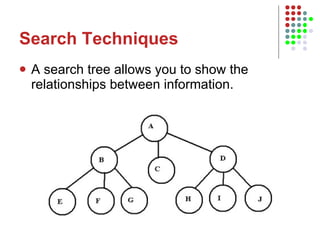
Search Techniques A search tree allows you to show the relationships between information.
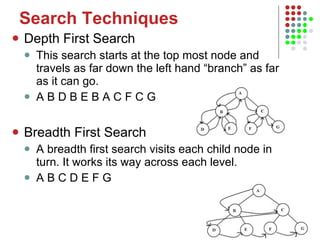
Search Techniques Depth First Search This search starts at the top most node and travels as far down the left hand “branch” as far as it can go.  A B D B E B A C F C G Breadth First Search A breadth first search visits each child node in turn. It works its way across each level. A B C D E F G
Arrangements The development of artificial intelligence  Description of human intelligence (including the ability to communicate, retain knowledge, solve problems)  Description of the Turing test and explanation of its rationale  Explanation of the need for a different approach to programming which could represent knowledge  Simple description of the development of game playing programs from simple early examples to contemporary complex examples exhibiting intelligence  Simple description of the development of language processing from Eliza to chatterbots and contemporary applications  Simple description of the development of expert systems  Identification of hardware developments (including faster processors, more memory, and increasing backing store capacity) which have assisted the development of AI
Arrangements Expert systems:  Description of purpose of expert systems  Description of advantages of expert systems over human experts, including expertise always available, reduced wage bill, combines expertise of several experts, less chance of errors  Description of contemporary applications of expert systems  Description of social, legal and ethical issues related to the use of expert systems (including loss of jobs, training issues, public reactions, loss of human expertise)  Artificial neural systems:  Simple description of a neural network as an electronic model of the brain consisting of many interconnected simple processors  Description of uses and examples of artificial neural systems (including learning to read postcodes; stock market prediction; debt risk assessment; other examples of pattern recognition )  Description of advantages and disadvantages of artificial neural systems Vision systems:  Explanation of the need to interpret/make sense of visual input.  Description of applications (including industrial, military use, satellite photo interpretation)  Speech recognition:  Description of applications (including word processor, punctuation commands, disabled users, cars, military, mobile phones)  Description of characteristics (training for each voice pattern, control instructions, influence of background noise, factors affecting accuracy)   Handwriting recognition:  Description of common applications (including palmtops and tablet PCs)  Explanation of possible need to train the system
Arrangements Search techniques  Exemplification of problem solving by search  Construction of a simple search tree  Description of breadth-first and depth-first search and exemplification on a search tree  Knowledge representation  Construction of semantic net to represent simple relationships and facts  Description and exemplification of the following features in Prolog (or similar declarative language): simple facts (single/double argument), simple rules (up to two sub-goals), simple queries (true/false, single variable), operators: and, >, < , =  Explanation of the concepts of goals and sub-goals  Perform simple manual trace: one rule/level  Intelligent robots:  Description of types of sensors used  Description of contemporary applications (including automated delivery, pipe inspection, bomb disposal, exploration of unknown environments)  Description of advantages of intelligent robots

Artificial intelligence

  • 1.
  • 2.
    Aims of Lesson1 What is Intelligence?? Turing Test Problems with the Turing Test
  • 3.
    What is Intelligence????“ Intelligence is the name we give to the data processing activity of entities which respond to information with behaviour which appears to be intended to be optional with respect to pre-set goals” “ Intelligence involves Knowing and Choosing”
  • 4.
    Intelligence?? Many researchersfeel that intelligence has the following features The Ability to: Learn and adapt from experience. Retain knowledge and use to make decisions. Problem solve. Handle and manipulate language “ Artificial intelligence is concerned with building machines that can act and react appropriately, adapting their response to the demands of situation.”
  • 5.
    Testing Intelligence TuringTest Alan Turing, a British mathematician developed a test in 1950 to determine if a program was intelligent: It has the following features: A human tester was connected to 2 terminals and asked a series of questions. One of the terminals had another human making the responses and the other used a computer program to make the responses If the human tester could not distinguish between the human responder and the program response then the software was said to be intelligent.
  • 6.
    Problems with TuringTest It needed a fairly limited problem domain i.e. the area of the knowledge had to be small. Did the program pretend to forget things or make errors in order to fool the human tester?
  • 7.
    Lesson Starter Give3 features of Intelligence Give 3 examples of AI in everyday life What is the name of the test that is used to determine if a system is Intelligent? Describe this test
  • 8.
    Aims of Lesson2 Early AI Developments – Game Playing Chatterbots ELIZA SHRDLU Parry
  • 9.
    Early Developments inAI (1940-65) In the beginning the focus of AI research was on modelling the human brain. (This was impossible) Research shifted to using games like noughts and crosses, drafts etc to create “AI” systems The games had a number of rules that were easy to define.
  • 10.
    Language Processing (1965-1975)In 1965 Researchers agreed that game playing programs could not pass the Turing test The focus shifted to language processing ELIZA (1966) 1 st language processing program Responded to users inputs by asking questions based on previous responses
  • 11.
    Language Processing (1965-1975)PARRY (1972) Parry modelled a conversation with a paranoid person This seems odd but the program was created by a psychiatrist SHRDLU (1970) The program could interpret verbal commands to move coloured blocks &quot;Move the red block behind the green one&quot; It could understand and carry out the instruction
  • 12.
    Lesson Starter Give1 problem with the Turing test Why did early AI development focus on Game Playing? Describe the response from the chatterbot ELIZA
  • 13.
    Aims of Lesson4 Last Lesson Definition of intelligence The Turing Test Early Developments in AI = Game Playing Language Processing ELIZA SHRDLU PARRY Chatterbots Today’s Lesson Developments in Hardware
  • 14.
    Developments in HardwareFaster processors More instructions can be processed per second More RAM memory Larger knowledge bases can be open and stored in RAM Increased backing storage capacity Larger knowledge bases can be stored and reopened Multiple processors (Parallel) Where different processors can be processing different instructions
  • 15.
    Aims of Lesson5 Last Lesson Definition of intelligence The Turing Test Early Developments in AI = Game Playing Language Processing ELIZA SHRDLU PARRY Chatterbots Today’s Lesson Expert Systems
  • 16.
    Expert Systems Anexpert system is a computer program which uses a knowledge base of facts and rules populated by a human expert The expert system will give reliable advice on a limited area of expertise, and can interact and explain it reasoning to the user (justification facilities) Examples NHS 24 MYCIN to diagnose blood disorders Legal advice Chemical analysis, DENDRAL was designed to identify unknown substances Car mechanic expert system BABY used to monitor premature babies
  • 17.
    Aims of Lesson5 Last Lesson Definition of intelligence The Turing Test Early Developments in AI = Game Playing Language Processing ELIZA SHRDLU PARRY Chatterbots Today’s Lesson Expert Systems Advantages/Disadvantages
  • 18.
    Advantages of ExpertSystems Expertise Available to access 24/7 Reduced wage bill Expert System will never get tired You can have multiple copies of the expert system Can combine the knowledge of many experts No human emotion involved No possibility of expert system retiring No barrier due to poor communication skills
  • 19.
    Social/Legal/Ethical Issues ofExpert Systems No common sense is used Legal = If the expert system makes an error who is responsible? Developer? Company using it? Moral = Expert system wouldn't make a decision on what is morally correct, it would only use facts and rules Loss of jobs Loss of human expertise over time
  • 20.
    Aims of Lesson6 Last Lesson Definition of intelligence The Turing Test Early Developments in AI = Game Playing Language Processing ELIZA SHRDLU PARRY Chatterbots Expert Systems Advantage/Disadvantage Today’s Lesson Artificial Neural Systems Adv/Dis
  • 21.
    Revision Questions Give4 features of Intelligence I have a black and white image that is 3 inches by 7 inches with a Resolution of 400 dpi. Calculate the storage requirements in Kb Convert 152 to binary Describe a Client Server network List the 7 stages in the SD process What is a Macro? Give 3 symptoms of your computer being infected by a virus Give 3 features that you could use to Evaluate software Give 3 disadvantages of an Expert System How many bits are used to represent a character is ASCII?
  • 22.
    Artificial Neural SystemsANS is an approach to AI where the developer attempts to model the human brain Simple processors are interconnected in a way that simulates the connection of nerve cells in the brain The output from the ANS is compared with the expected output and the processors can be “retrained”
  • 23.
    Give 3 featuresof intelligence What is the name of the Test that is used to test intelligence? Describe this test Why did early AI development focus on Game Playing? Give 3 examples of chatterbots Describe the response the user would get from ELIZA What is an Expert System? Give 2 examples of Expert Systems Give 2 advantages of Expert Systems Give 2 possible disadvantages of an Expert System What is meant by the term Artifical Neural System
  • 24.
    Applications of ANSPost Office has been using ANS to automate the reading of postcodes An ANS system to predict the stock market Assessing debt risk of an individual
  • 25.
    Adv/Disadv of ANSAdvantages They can learn without needing to be reprogrammed They have a good success rate at predicting the correct response Disadvantages Time consuming and requires a lot of technical expertise to set up ANS cannot explain reasoning behind decision
  • 26.
    Lesson Starter Whatis an Artificial Neural System? Give 2 advances in hardware that has led to the development of AI What is meant by the term parallel processing?
  • 27.
    Aims of Lesson6 Last Lesson Definition of intelligence The Turing Test Early Developments in AI = Game Playing Language Processing ELIZA SHRDLU PARRY Chatterbots Expert Systems Advantage/Disadvantage Artificial Neural Systems Adv/Dis Today’s Lesson Vision Systems
  • 28.
    Vision Systems AIcan be used to recognise and make sense of images. Uses Security systems, recognising faces at airports Inspection of manufactured goods judging quality of production Vision systems on automated cars Interpretation of Satellite photos for military use Stages Input Image using Digital Camera Detect Edges of Object Compare to Knowledge Base – Pattern Matching Understanding Object
  • 29.
    Vision Systems Difficultieswith Vision Systems Shadows on Objects Identifying the Edge of the Image Glare Objects hiding other parts of the Image Viewing from different angles
  • 30.
    Lesson Starter Give3 examples of Vision Systems in everyday life Give the 4 stages in a Vision System Give 2 possible problems with Vision Systems
  • 31.
    Aims of Lesson8 Last Lesson Definition of intelligence The Turing Test Early Developments in AI = Game Playing Language Processing ELIZA SHRDLU PARRY Chatterbots Expert Systems Advantage/Disadvantage Artificial Neural Systems Adv/Dis Vision Systems Today’s Lesson Natural Language Processing
  • 32.
    Natural Language ProcessingNLP or Speech Recognition is where an AI system can be controlled and repsond to verbal commands Examples Speech-driven word processors Computer operation for disabled users Military weapon control Mobile phones Customer query lines
  • 33.
    Problems with NLPThe need to train the NLP system to your voice Background noise Ambiguity of words and phrases I saw a man eating fish I saw a man hitting a boy with a stick Changing English language i.e. bouncebackability Accents and dialects i.e. I ken what you are talking about!! Similar sounding words and phrases e.g. furry boots are you fae?? Inconsistencies with grammar
  • 34.
    Lesson Starter Whatis meant by the term Natural Language Processing? Give 3 examples in everyday life Give 3 problems with accuracy of NLP systems
  • 35.
    Aims of Lesson9 Last Lesson Definition of intelligence The Turing Test Early Developments in AI = Game Playing Language Processing ELIZA SHRDLU PARRY Chatterbots Expert Systems Advantage/Disadvantage Artificial Neural Systems Adv/Dis Vision Systems Natural Language Processing Today’s Lesson Hand-writing recognition
  • 36.
    Handwriting Recognition Thisis where handwritten words are converted into editable text Applications Mainly used for Input into Palmtop computers and Tablet PCs Hand writing varies considerably so there is a need to train the software to your style of handwriting
  • 37.
    Aims of Lesson10 Last Lesson Definition of intelligence The Turing Test Early Developments in AI = Game Playing Language Processing ELIZA SHRDLU PARRY Chatterbots Expert Systems Advantage/Disadvantage Artificial Neural Systems Adv/Dis Vision Systems Natural Language Processing Today’s Lesson Intelligent Robots
  • 38.
    Intelligent Robots Robotscan be considered intelligent when they go beyond simple sensors and feedback (dumb robots), and display some further aspect of human-like behaviour Vision Systems The ability to learn and improve performance Robot that can walk rather than on wheels NLP response Examples The delivery of goods in warehouses The inspection of pipes Bomb Disposal Exploration of Ocean floor or space
  • 39.
    Advantages of IntelligentRobots Can be used in dangerous environments More accurate than humans No wages or holidays Work 24/7 Don’t need to be constantly programmed
  • 40.
    Aims of Lesson11 Last Lesson Definition of intelligence The Turing Test Early Developments in AI = Game Playing Language Processing ELIZA SHRDLU PARRY Chatterbots Expert Systems Advantage/Disadvantage Artificial Neural Systems Adv/Dis Vision Systems Natural Language Processing Intelligent Robots Today’s Lesson Knowledge Representation Semantic Nets Facts, Rules and Queries
  • 41.
    Knowledge Representation AIprograms cannot solve a problem without storing information about the problem in a Knowledge Base Semantic nets are used to represent known facts before coding the Knowledge Base is a (tiger, cat) is a (lion, cat) eats(tiger, meat) eats(lion, meat) has(tiger, stripes) is a (deer, meat) is a (zebra, meat) eats(tiger, meat) eats(lion, meat)
  • 42.
    Semantic Nets Mintand basil are herbs. Pennyroyal and spearmint are types of mint. Genovese basil and purple basil are two types of basil. Mints can be used in making tea, basil is used In the making of pesto. (6)
  • 43.
    Semantic Net 2A fish has fins, scales, is cold blooded and has gills. There are lots of kinds of fish, including cod, haddock, shark, goldfish, and trout. A fish is a vertebrate - that means it has a backbone. I have a goldfish called Sammy. Cod, haddock and sharks are salt-water fish (they live in salt water). Goldfish and trout are fresh-water fish (they live in fresh water).
  • 44.
    The programming languageProlog is used to define facts, and rules in a knowledge base that can be queried to solve the problem Facts isa(nicole, female). isa(ricky, male). likes(elena, spaceraiders). Rules cheesy(X):- isa(X,male), likes(X, wotsits). Queries ?likes(X,monstermunch). ?isa(X, male). ?isa(jake,female). ?cheesy(X).
  • 45.
    Aims of Lesson12 Last Lesson Definition of intelligence The Turing Test Early Developments in AI = Game Playing Language Processing ELIZA SHRDLU PARRY Chatterbots Expert Systems Advantage/Disadvantage Artificial Neural Systems Adv/Dis Vision Systems Natural Language Processing Intelligent Robots Knowledge Representation Semantic Nets Facts, Rules and Queries Today’s Lesson Search techniques
  • 46.
    Search Techniques Asearch tree allows you to show the relationships between information.
  • 47.
    Search Techniques DepthFirst Search This search starts at the top most node and travels as far down the left hand “branch” as far as it can go. A B D B E B A C F C G Breadth First Search A breadth first search visits each child node in turn. It works its way across each level. A B C D E F G
  • 48.
    Arrangements The developmentof artificial intelligence Description of human intelligence (including the ability to communicate, retain knowledge, solve problems) Description of the Turing test and explanation of its rationale Explanation of the need for a different approach to programming which could represent knowledge Simple description of the development of game playing programs from simple early examples to contemporary complex examples exhibiting intelligence Simple description of the development of language processing from Eliza to chatterbots and contemporary applications Simple description of the development of expert systems Identification of hardware developments (including faster processors, more memory, and increasing backing store capacity) which have assisted the development of AI
  • 49.
    Arrangements Expert systems: Description of purpose of expert systems Description of advantages of expert systems over human experts, including expertise always available, reduced wage bill, combines expertise of several experts, less chance of errors Description of contemporary applications of expert systems Description of social, legal and ethical issues related to the use of expert systems (including loss of jobs, training issues, public reactions, loss of human expertise) Artificial neural systems: Simple description of a neural network as an electronic model of the brain consisting of many interconnected simple processors Description of uses and examples of artificial neural systems (including learning to read postcodes; stock market prediction; debt risk assessment; other examples of pattern recognition ) Description of advantages and disadvantages of artificial neural systems Vision systems: Explanation of the need to interpret/make sense of visual input. Description of applications (including industrial, military use, satellite photo interpretation) Speech recognition: Description of applications (including word processor, punctuation commands, disabled users, cars, military, mobile phones) Description of characteristics (training for each voice pattern, control instructions, influence of background noise, factors affecting accuracy) Handwriting recognition: Description of common applications (including palmtops and tablet PCs) Explanation of possible need to train the system
  • 50.
    Arrangements Search techniques Exemplification of problem solving by search Construction of a simple search tree Description of breadth-first and depth-first search and exemplification on a search tree Knowledge representation Construction of semantic net to represent simple relationships and facts Description and exemplification of the following features in Prolog (or similar declarative language): simple facts (single/double argument), simple rules (up to two sub-goals), simple queries (true/false, single variable), operators: and, >, < , = Explanation of the concepts of goals and sub-goals Perform simple manual trace: one rule/level Intelligent robots: Description of types of sensors used Description of contemporary applications (including automated delivery, pipe inspection, bomb disposal, exploration of unknown environments) Description of advantages of intelligent robots