PHYLUM
     CONIFEROPHYTA

                     Plant Kingdom
                       Brooke Loegering


Monday, May 21, 12                        1
Introduction to Coniferophyta


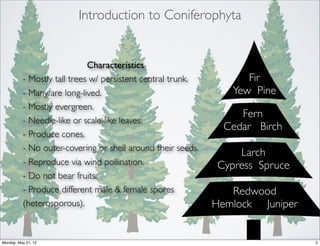
                             Characteristics
          - Mostly tall trees w/ persistent central trunk.         Fir
          - Many are long-lived.                                Yew Pine
          - Mostly evergreen.
                                                                  Fern
          - Needle-like or scale-like leaves.
                                                               Cedar Birch
          - Produce cones.
          - No outer-covering or shell around their seeds.
                                                                 Larch
          - Reproduce via wind pollination.                  Cypress Spruce
          - Do not bear fruits.
          - Produce different male & female spores              Redwood
          (heterosporous).                                   Hemlock Juniper


Monday, May 21, 12                                                             2
Introduction to Coniferophyta

                     What distinguishes them from other member of the same kingdom?

                     Pollination
                         - Angiosperms rely on plants & animals: This helped with the evolution of
                         flowers to entice the insects and animals to spread their pollen.
                         - Gymnosperms rely on wind as their main source of pollination, which leads
                         to trees with very similar genotypes in a very concentrated area.
                     Time from pollination to fertilization
                         - Angiosperms: Pollinate & fertilize almost simultaneously.
                         - Gymnosperms: Pollen often sits within the cone for up to 15 months or
                         more before fertilization occurs.
                     Double fertilization
                         - Angiosperms: One sperm fertilizes the egg while the other combines to
                         form an endosperm.
                         - Gymnosperms: No double fertilization.
                     Fruit
                         - Angiosperms: Produce fruit, evolve with mammals to entice animals to
                         spread pollen.
                         - Gymnosperms: Seeds without fruit.

Monday, May 21, 12                                                                                 3
Introduction to Coniferophyta


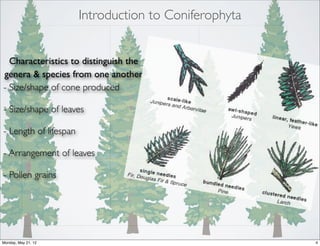
  Characteristics to distinguish the
genera & species from one another
- Size/shape of cone produced

- Size/shape of leaves

- Length of lifespan

- Arrangement of leaves

- Pollen grains


Monday, May 21, 12                                     4
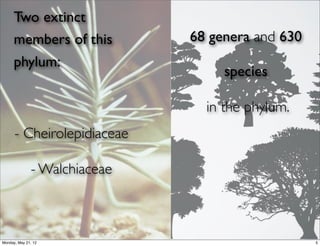
Two extinct
      members of this         68 genera and 630
      phylum:
                                   species

                                in the phylum.
      - Cheirolepidiaceae

              - Walchiaceae


Monday, May 21, 12                                5
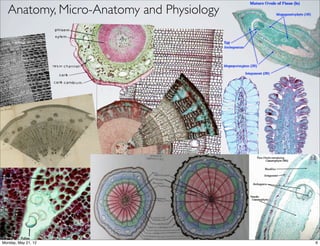
Anatomy, Micro-Anatomy and Physiology


Monday, May 21, 12                        6
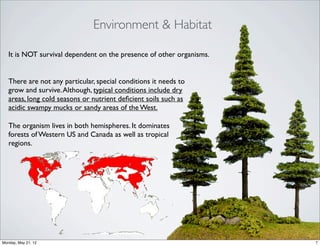
Environment & Habitat

   It is NOT survival dependent on the presence of other organisms.


   There are not any particular, special conditions it needs to
   grow and survive. Although, typical conditions include dry
   areas, long cold seasons or nutrient deficient soils such as
   acidic swampy mucks or sandy areas of the West.

   The organism lives in both hemispheres. It dominates
   forests of Western US and Canada as well as tropical
   regions.


Monday, May 21, 12                                                    7
Life Cycle (Reproduction)
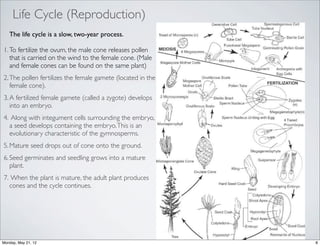
   The life cycle is a slow, two-year process.

1. To fertilize the ovum, the male cone releases pollen
   that is carried on the wind to the female cone. (Male
   and female cones can be found on the same plant)
2. The pollen fertilizes the female gamete (located in the
   female cone).
3. A fertilized female gamete (called a zygote) develops
   into an embryo.
4. Along with integument cells surrounding the embryo,
  a seed develops containing the embryo. This is an
  evolutionary characteristic of the gymnosperms.
5. Mature seed drops out of cone onto the ground.
6. Seed germinates and seedling grows into a mature
   plant.
7. When the plant is mature, the adult plant produces
  cones and the cycle continues.


Monday, May 21, 12                                           8
Life Cycle (Reproduction)

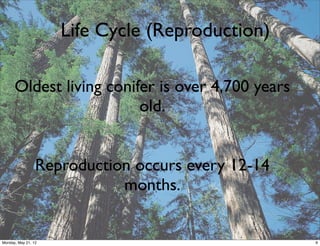
      Oldest living conifer is over 4,700 years
                         old.


                 Reproduction occurs every 12-14
                            months.


Monday, May 21, 12                                 9
Genetics, Phylogenetics, Evolution


                     Have genetic studies on this organism revealed new insights as to how
                     this organism is related to members of other phyla?

                     Yes, the diversification of Conifers during the Mesozoic helps to mark a
                     significant change in the world's flora. Paleozoic flora was dominated by
                     ferns and clubmosses (Paleophytic flora). The Paleophytic flora gave way
                     to a Mesophytic flora during the Triassic period. Woody seed-bearing
                     plants and their relatives dominated Mesophytic flora. Thus, the change
                     from Paleophytic to Mesophytic represented a change in reproductive
                     strategy; from spore producers to seed producers. Conifers, cycads, and
                     ginkgoes diversified during this time and dominated the landscape
                     (Kenrick & Davis, 2004, p. 143).


Monday, May 21, 12                                                                             10

Coniferophyta

  • 1.
    PHYLUM CONIFEROPHYTA Plant Kingdom Brooke Loegering Monday, May 21, 12 1
  • 2.
    Introduction to Coniferophyta Characteristics - Mostly tall trees w/ persistent central trunk. Fir - Many are long-lived. Yew Pine - Mostly evergreen. Fern - Needle-like or scale-like leaves. Cedar Birch - Produce cones. - No outer-covering or shell around their seeds. Larch - Reproduce via wind pollination. Cypress Spruce - Do not bear fruits. - Produce different male & female spores Redwood (heterosporous). Hemlock Juniper Monday, May 21, 12 2
  • 3.
    Introduction to Coniferophyta What distinguishes them from other member of the same kingdom? Pollination - Angiosperms rely on plants & animals: This helped with the evolution of flowers to entice the insects and animals to spread their pollen. - Gymnosperms rely on wind as their main source of pollination, which leads to trees with very similar genotypes in a very concentrated area. Time from pollination to fertilization - Angiosperms: Pollinate & fertilize almost simultaneously. - Gymnosperms: Pollen often sits within the cone for up to 15 months or more before fertilization occurs. Double fertilization - Angiosperms: One sperm fertilizes the egg while the other combines to form an endosperm. - Gymnosperms: No double fertilization. Fruit - Angiosperms: Produce fruit, evolve with mammals to entice animals to spread pollen. - Gymnosperms: Seeds without fruit. Monday, May 21, 12 3
  • 4.
    Introduction to Coniferophyta Characteristics to distinguish the genera & species from one another - Size/shape of cone produced - Size/shape of leaves - Length of lifespan - Arrangement of leaves - Pollen grains Monday, May 21, 12 4
  • 5.
    Two extinct members of this 68 genera and 630 phylum: species in the phylum. - Cheirolepidiaceae - Walchiaceae Monday, May 21, 12 5
  • 6.
    Anatomy, Micro-Anatomy andPhysiology Monday, May 21, 12 6
  • 7.
    Environment & Habitat It is NOT survival dependent on the presence of other organisms. There are not any particular, special conditions it needs to grow and survive. Although, typical conditions include dry areas, long cold seasons or nutrient deficient soils such as acidic swampy mucks or sandy areas of the West. The organism lives in both hemispheres. It dominates forests of Western US and Canada as well as tropical regions. Monday, May 21, 12 7
  • 8.
    Life Cycle (Reproduction) The life cycle is a slow, two-year process. 1. To fertilize the ovum, the male cone releases pollen that is carried on the wind to the female cone. (Male and female cones can be found on the same plant) 2. The pollen fertilizes the female gamete (located in the female cone). 3. A fertilized female gamete (called a zygote) develops into an embryo. 4. Along with integument cells surrounding the embryo, a seed develops containing the embryo. This is an evolutionary characteristic of the gymnosperms. 5. Mature seed drops out of cone onto the ground. 6. Seed germinates and seedling grows into a mature plant. 7. When the plant is mature, the adult plant produces cones and the cycle continues. Monday, May 21, 12 8
  • 9.
    Life Cycle (Reproduction) Oldest living conifer is over 4,700 years old. Reproduction occurs every 12-14 months. Monday, May 21, 12 9
  • 10.
    Genetics, Phylogenetics, Evolution Have genetic studies on this organism revealed new insights as to how this organism is related to members of other phyla? Yes, the diversification of Conifers during the Mesozoic helps to mark a significant change in the world's flora. Paleozoic flora was dominated by ferns and clubmosses (Paleophytic flora). The Paleophytic flora gave way to a Mesophytic flora during the Triassic period. Woody seed-bearing plants and their relatives dominated Mesophytic flora. Thus, the change from Paleophytic to Mesophytic represented a change in reproductive strategy; from spore producers to seed producers. Conifers, cycads, and ginkgoes diversified during this time and dominated the landscape (Kenrick & Davis, 2004, p. 143). Monday, May 21, 12 10