Geologic TimeScale
By;NoshabaMunawar
Mphil.Zoology
Measuring Time
•
•
•
TheGeological time scale is arecord of the life
forms and geological events in Earth’shistory.
Scientists developedthe time scaleby studying rock
layers and fossils world wide.
Radioactive dating helped determine the
absolute divisions inthe time scale.
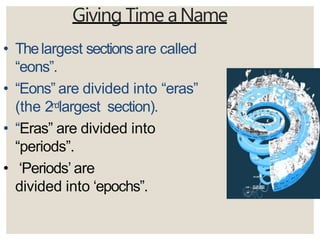
Giving Time aName
• Thelargest sectionsare called
“eons”.
• “Eons” are divided into “eras”
(the 2ndlargest section).
• “Eras” are divided into
“periods”.
• ‘Periods’ are
divided into ‘epochs”.
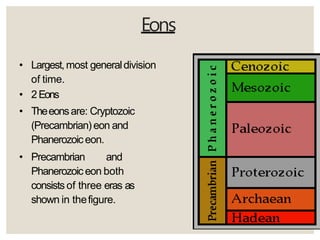
Eons
• Largest,most generaldivision
of time.
• 2Eons
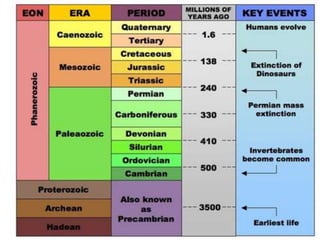
• Theeonsare: Cryptozoic
(Precambrian) eon and
Phanerozoiceon.
• Precambrian and
Phanerozoiceon both
consists of three eras as
shown in thefigure.
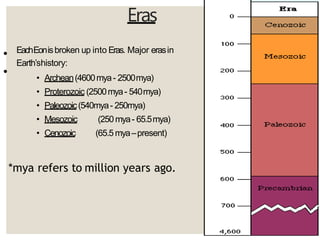
Eras
•
•
EachEonisbroken up into Eras. Major erasin
Earth’shistory:
• Archean(4600mya- 2500mya)
• Proterozoic (2500mya- 540mya)
• Paleozoic(540mya- 250mya)
• Mesozoic (250mya- 65.5mya)
• Cenozoic (65.5mya–present)
*mya refers to million years ago.
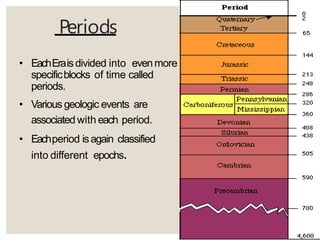
Periods
• EachEraisdivided into evenmore
specificblocks of time called
periods.
• Various geologic events are
associated with each period.
• Eachperiod isagain classified
into different epochs.
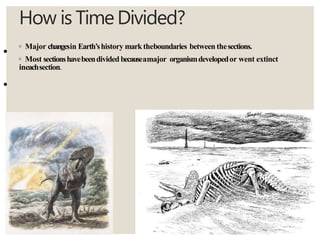
How is TimeDivided?
◦ Major changesin Earth’shistory marktheboundaries between thesections.
◦ Most sectionshavebeendivided becauseamajor organismdevelopedor went extinct
ineachsection.
•
•
Cryptozoiceon(Precambrian time)
•
•
•
•
•
Lastedfrom 540million yearsagoto
4600million yearsago.
Oldest andlongest (coversalmost90% of
earth’shistory).
simple organisms- bacteria,algae,
protozoa wasborn.
Oldest rocksthat we know werefound in
this eon which dates to about 3.5 billion
yearsold.
Divided into 2eras: Proterozoicand
Archeanera.
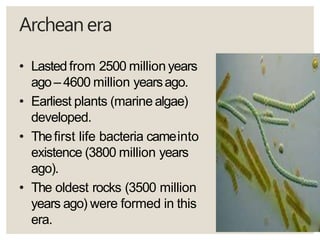
Archeanera
• Lastedfrom 2500 million years
ago– 4600 million yearsago.
• Earliest plants (marine algae)
developed.
• Thefirst life bacteria cameinto
existence (3800 million years
ago).
• The oldest rocks (3500 million
years ago) were formed in this
era.
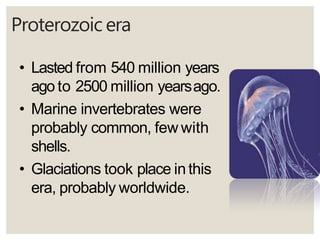
Proterozoic era
• Lasted from 540 million years
ago to 2500 million yearsago.
• Marine invertebrates were
probably common, few with
shells.
• Glaciations took place inthis
era, probably worldwide.
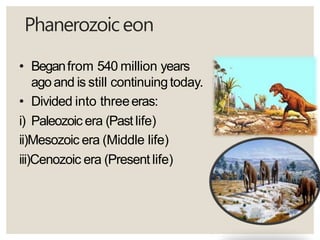
Phanerozoiceon
• Beganfrom 540 million years
agoand is still continuingtoday.
• Divided into threeeras:
i) Paleozoic era (Past life)
ii)Mesozoic era (Middle life)
iii)Cenozoic era (Present life)
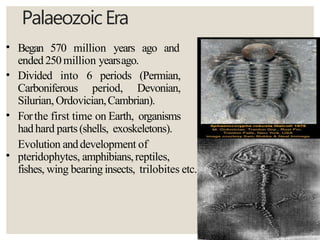
PalaeozoicEra
•
•
•
•
Began 570 million years ago and
ended 250million yearsago.
Divided into 6 periods (Permian,
Carboniferous period, Devonian,
Silurian, Ordovician,Cambrian).
Forthe first time on Earth, organisms
hadhard parts(shells, exoskeletons).
Evolution anddevelopment of
pteridophytes, amphibians,reptiles,
fishes, wing bearing insects, trilobites etc.
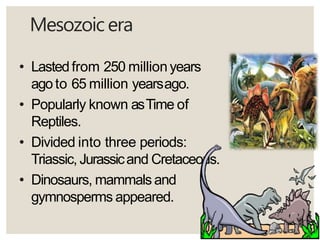
Mesozoic era
• Lastedfrom 250 millionyears
agoto 65 million yearsago.
• Popularly known asTime of
Reptiles.
• Divided into three periods:
Triassic, Jurassicand Cretaceous.
• Dinosaurs, mammals and
gymnosperms appeared.
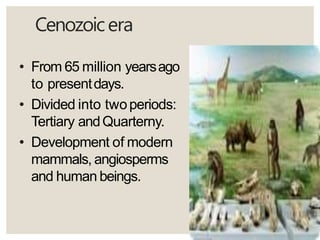
Cenozoicera
• From 65 million yearsago
to presentdays.
• Divided into twoperiods:
Tertiary andQuarterny.
• Development of modern
mammals, angiosperms
and human beings.
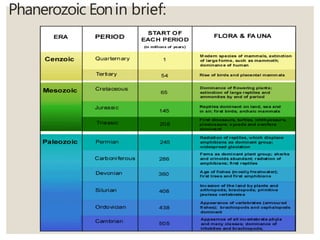
Phanerozoic Eonin brief:
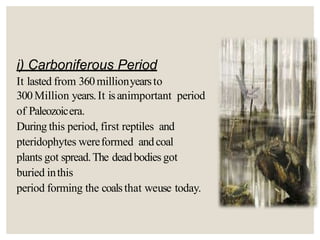
i) Carboniferous Period
It lasted from 360millionyearsto
300Million years.It isanimportant period
of Paleozoicera.
During this period, first reptiles and
pteridophytes wereformed andcoal
plants got spread.The deadbodies got
buried inthis
period forming the coalsthat weuse today.
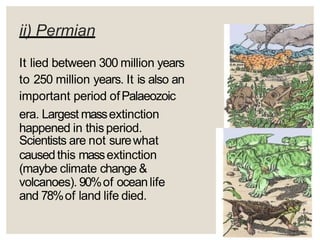
ii) Permian
It lied between 300 million years
to 250 million years. It is also an
important period ofPalaeozoic
era. Largest massextinction
happened in thisperiod.
Scientists are not surewhat
causedthis massextinction
(maybe climate change &
volcanoes). 90%of oceanlife
and 78%of land life died.
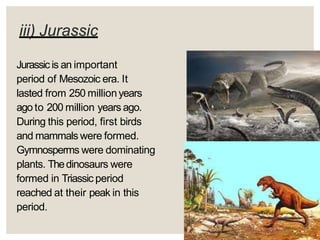
iii) Jurassic
Jurassic is an important
period of Mesozoic era. It
lasted from 250 millionyears
ago to 200 million years ago.
During this period, first birds
and mammals were formed.
Gymnosperms were dominating
plants. Thedinosaurs were
formed in Triassic period
reached at their peak in this
period.
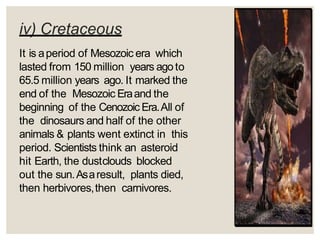
iv) Cretaceous
It is aperiod of Mesozoic era which
lasted from 150 million years agoto
65.5 million years ago. It marked the
end of the Mesozoic Eraand the
beginning of the Cenozoic Era.All of
the dinosaurs and half of the other
animals & plants went extinct in this
period. Scientists think an asteroid
hit Earth, the dustclouds blocked
out the sun.Asaresult, plants died,
then herbivores,then carnivores.
v)Quarternery period
It is aperiod of Cenozoicera
which hasbeen lasting from
1.8 million years agoto
present days. In thisperiod,
the humans evolved asthe
most intelligent creature of
earth and took over. It is
divided into 2 epochs
namely: Pleistocene and
Holocene.

Geological time Scale

  • 1.
  • 3.
    Measuring Time • • • TheGeological timescale is arecord of the life forms and geological events in Earth’shistory. Scientists developedthe time scaleby studying rock layers and fossils world wide. Radioactive dating helped determine the absolute divisions inthe time scale.
  • 4.
    Giving Time aName •Thelargest sectionsare called “eons”. • “Eons” are divided into “eras” (the 2ndlargest section). • “Eras” are divided into “periods”. • ‘Periods’ are divided into ‘epochs”.
  • 5.
    Eons • Largest,most generaldivision oftime. • 2Eons • Theeonsare: Cryptozoic (Precambrian) eon and Phanerozoiceon. • Precambrian and Phanerozoiceon both consists of three eras as shown in thefigure.
  • 6.
    Eras • • EachEonisbroken up intoEras. Major erasin Earth’shistory: • Archean(4600mya- 2500mya) • Proterozoic (2500mya- 540mya) • Paleozoic(540mya- 250mya) • Mesozoic (250mya- 65.5mya) • Cenozoic (65.5mya–present) *mya refers to million years ago.
  • 7.
    Periods • EachEraisdivided intoevenmore specificblocks of time called periods. • Various geologic events are associated with each period. • Eachperiod isagain classified into different epochs.
  • 8.
    How is TimeDivided? ◦Major changesin Earth’shistory marktheboundaries between thesections. ◦ Most sectionshavebeendivided becauseamajor organismdevelopedor went extinct ineachsection. • •
  • 9.
    Cryptozoiceon(Precambrian time) • • • • • Lastedfrom 540millionyearsagoto 4600million yearsago. Oldest andlongest (coversalmost90% of earth’shistory). simple organisms- bacteria,algae, protozoa wasborn. Oldest rocksthat we know werefound in this eon which dates to about 3.5 billion yearsold. Divided into 2eras: Proterozoicand Archeanera.
  • 10.
    Archeanera • Lastedfrom 2500million years ago– 4600 million yearsago. • Earliest plants (marine algae) developed. • Thefirst life bacteria cameinto existence (3800 million years ago). • The oldest rocks (3500 million years ago) were formed in this era.
  • 11.
    Proterozoic era • Lastedfrom 540 million years ago to 2500 million yearsago. • Marine invertebrates were probably common, few with shells. • Glaciations took place inthis era, probably worldwide.
  • 12.
    Phanerozoiceon • Beganfrom 540million years agoand is still continuingtoday. • Divided into threeeras: i) Paleozoic era (Past life) ii)Mesozoic era (Middle life) iii)Cenozoic era (Present life)
  • 13.
    PalaeozoicEra • • • • Began 570 millionyears ago and ended 250million yearsago. Divided into 6 periods (Permian, Carboniferous period, Devonian, Silurian, Ordovician,Cambrian). Forthe first time on Earth, organisms hadhard parts(shells, exoskeletons). Evolution anddevelopment of pteridophytes, amphibians,reptiles, fishes, wing bearing insects, trilobites etc.
  • 14.
    Mesozoic era • Lastedfrom250 millionyears agoto 65 million yearsago. • Popularly known asTime of Reptiles. • Divided into three periods: Triassic, Jurassicand Cretaceous. • Dinosaurs, mammals and gymnosperms appeared.
  • 15.
    Cenozoicera • From 65million yearsago to presentdays. • Divided into twoperiods: Tertiary andQuarterny. • Development of modern mammals, angiosperms and human beings.
  • 16.
  • 17.
    i) Carboniferous Period Itlasted from 360millionyearsto 300Million years.It isanimportant period of Paleozoicera. During this period, first reptiles and pteridophytes wereformed andcoal plants got spread.The deadbodies got buried inthis period forming the coalsthat weuse today.
  • 18.
    ii) Permian It liedbetween 300 million years to 250 million years. It is also an important period ofPalaeozoic era. Largest massextinction happened in thisperiod. Scientists are not surewhat causedthis massextinction (maybe climate change & volcanoes). 90%of oceanlife and 78%of land life died.
  • 19.
    iii) Jurassic Jurassic isan important period of Mesozoic era. It lasted from 250 millionyears ago to 200 million years ago. During this period, first birds and mammals were formed. Gymnosperms were dominating plants. Thedinosaurs were formed in Triassic period reached at their peak in this period.
  • 20.
    iv) Cretaceous It isaperiod of Mesozoic era which lasted from 150 million years agoto 65.5 million years ago. It marked the end of the Mesozoic Eraand the beginning of the Cenozoic Era.All of the dinosaurs and half of the other animals & plants went extinct in this period. Scientists think an asteroid hit Earth, the dustclouds blocked out the sun.Asaresult, plants died, then herbivores,then carnivores.
  • 21.
    v)Quarternery period It isaperiod of Cenozoicera which hasbeen lasting from 1.8 million years agoto present days. In thisperiod, the humans evolved asthe most intelligent creature of earth and took over. It is divided into 2 epochs namely: Pleistocene and Holocene.