Laws of Thermodynamics
Mr. Boggio
April 2015
Zeroth Law of thermodynamics
First law of thermodynamics
Second law of thermodynamics
Third law of thermodynamics
LAWS OF THERMODYNAMICS
Zeroth Law of Thermodynamics
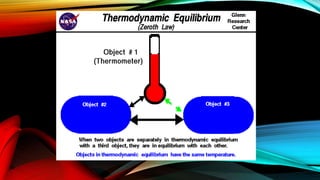
If object A is in thermal equilibrium with object B and B is in thermal
equilibrium with object C then A & C are in thermal equilibrium with each
other
if two closed system with different temperatures are come into contact
then heat is transferred from high temp. to law temp.
it is the basis for temperature measurement of a body or object.
This law is also used for designing the thermometer.
First Law of Thermodynamics
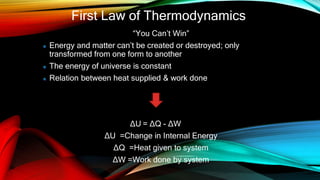
“You Can’t Win”
Energy and matter can’t be created or destroyed; only
transformed from one form to another
The energy of universe is constant
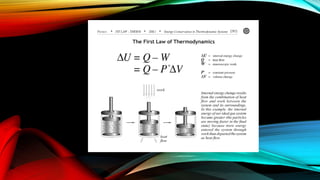
Relation between heat supplied & work done
∆U = ∆Q - ∆W
∆U =Change in Internal Energy
∆Q =Heat given to system
∆W =Work done by system
Second Law of Thermodynamics
“You Can’t Break Even”
In any spontaneous reaction the entropy of system will always increase & gibb’s free
energy will always decrease
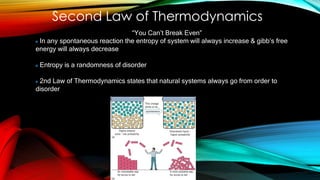
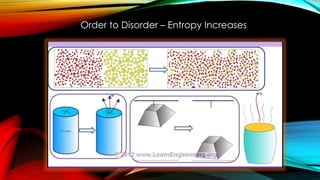
Entropy is a randomness of disorder
2nd Law of Thermodynamics states that natural systems always go from order to
disorder
Order to Disorder – Entropy Increases
Third law of thermodynamics
The entropy of any crystalline material at absolute zero
temperature will be zero
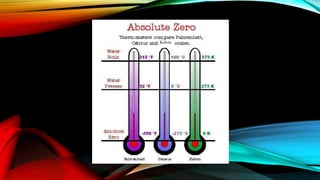
The absolute zero temperature is the reference point for
determining the entropy of a system.
Importance of this law:
1. It helps in calculating the thermodynamic properties.
2. It explains the behavior of solids at very low temperature.
“You can’t get out of the game”
(because absolute zero is unattainable)
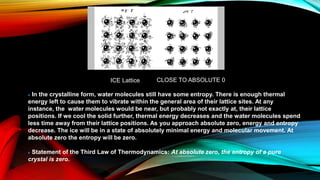
In the crystalline form, water molecules still have some entropy. There is enough thermal
energy left to cause them to vibrate within the general area of their lattice sites. At any
instance, the water molecules would be near, but probably not exactly at, their lattice
positions. If we cool the solid further, thermal energy decreases and the water molecules spend
less time away from their lattice positions. As you approach absolute zero, energy and entropy
decrease. The ice will be in a state of absolutely minimal energy and molecular movement. At
absolute zero the entropy will be zero.
Statement of the Third Law of Thermodynamics: At absolute zero, the entropy of a pure
crystal is zero.
ICE Lattice CLOSE TO ABSOLUTE 0

Laws of Thermodynamics

  • 1.
    Laws of Thermodynamics Mr.Boggio April 2015
  • 3.
    Zeroth Law ofthermodynamics First law of thermodynamics Second law of thermodynamics Third law of thermodynamics LAWS OF THERMODYNAMICS
  • 4.
    Zeroth Law ofThermodynamics If object A is in thermal equilibrium with object B and B is in thermal equilibrium with object C then A & C are in thermal equilibrium with each other if two closed system with different temperatures are come into contact then heat is transferred from high temp. to law temp. it is the basis for temperature measurement of a body or object. This law is also used for designing the thermometer.
  • 6.
    First Law ofThermodynamics “You Can’t Win” Energy and matter can’t be created or destroyed; only transformed from one form to another The energy of universe is constant Relation between heat supplied & work done ∆U = ∆Q - ∆W ∆U =Change in Internal Energy ∆Q =Heat given to system ∆W =Work done by system
  • 8.
    Second Law ofThermodynamics “You Can’t Break Even” In any spontaneous reaction the entropy of system will always increase & gibb’s free energy will always decrease Entropy is a randomness of disorder 2nd Law of Thermodynamics states that natural systems always go from order to disorder
  • 9.
    Order to Disorder– Entropy Increases
  • 10.
    Third law ofthermodynamics The entropy of any crystalline material at absolute zero temperature will be zero The absolute zero temperature is the reference point for determining the entropy of a system. Importance of this law: 1. It helps in calculating the thermodynamic properties. 2. It explains the behavior of solids at very low temperature. “You can’t get out of the game” (because absolute zero is unattainable)
  • 12.
    In the crystallineform, water molecules still have some entropy. There is enough thermal energy left to cause them to vibrate within the general area of their lattice sites. At any instance, the water molecules would be near, but probably not exactly at, their lattice positions. If we cool the solid further, thermal energy decreases and the water molecules spend less time away from their lattice positions. As you approach absolute zero, energy and entropy decrease. The ice will be in a state of absolutely minimal energy and molecular movement. At absolute zero the entropy will be zero. Statement of the Third Law of Thermodynamics: At absolute zero, the entropy of a pure crystal is zero. ICE Lattice CLOSE TO ABSOLUTE 0