
Clinical syndromes and
epidemiology of the FTLD-
spectrum disorders in Latin
          America
Outline


• Clinical syndromes of FTLD.

• Prevalence and incidence of FTLD.

• Estimating number of cases of the FTLD in LA.

• Mean survival time of FTLD.

• Economic impact of FTLD in LA.
Outline


• Clinical syndromes of FTLD.

• Prevalence and incidence of FTLD.

• Estimating number of cases of the FTLD in LA.

• Mean survival time of FTLD.

• Economic impact of FTLD in LA.
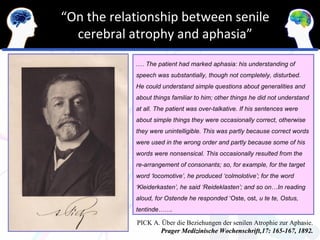
“On the relationship between senile
  cerebral atrophy and aphasia”
            .… The patient had marked aphasia: his understanding of
            speech was substantially, though not completely, disturbed.
            He could understand simple questions about generalities and
            about things familiar to him; other things he did not understand
            at all. The patient was over-talkative. If his sentences were
            about simple things they were occasionally correct, otherwise
            they were unintelligible. This was partly because correct words
            were used in the wrong order and partly because some of his
            words were nonsensical. This occasionally resulted from the
            re-arrangement of consonants; so, for example, for the target
            word ‘locomotive’, he produced ‘colmolotive’; for the word
            ‘Kleiderkasten’, he said ‘Reideklasten’; and so on…In reading
            aloud, for Ostende he responded ‘Oste, ost, u te te, Ostus,
            tentinde…….

            PICK A. Über die Beziehungen der senilen Atrophie zur Aphasie.
                   Prager Medizinische Wochenschrift,17: 165-167, 1892.
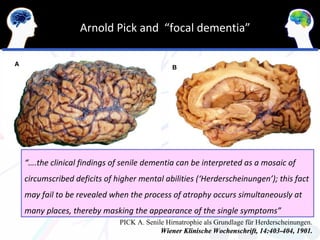
Arnold Pick and “focal dementia”


“….the clinical findings of senile dementia can be interpreted as a mosaic of
circumscribed deficits of higher mental abilities (‘Herderscheinungen’); this fact
may fail to be revealed when the process of atrophy occurs simultaneously at
many places, thereby masking the appearance of the single symptoms”
                           PICK A. Senile Hirnatrophie als Grundlage für Herderscheinungen.
                                        Wiener Klinische Wochenschrift, 14:403-404, 1901.
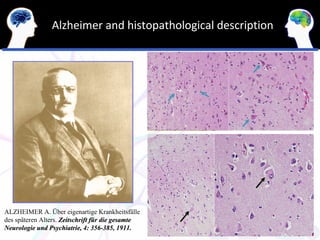
Alzheimer and histopathological description


ALZHEIMER A. Über eigenartige Krankheitsfälle
des späteren Alters. Zeitschrift für die gesamte
Neurologie und Psychiatrie, 4: 356-385, 1911.
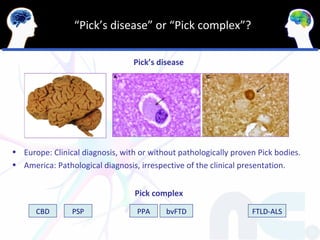
“Pick’s disease” or “Pick complex”?

                                 Pick’s disease


• Europe: Clinical diagnosis, with or without pathologically proven Pick bodies.
• America: Pathological diagnosis, irrespective of the clinical presentation.


                                  Pick complex

      CBD       PSP               PPA     bvFTD                   FTLD-ALS
Fronto-temporal lobar degeneration


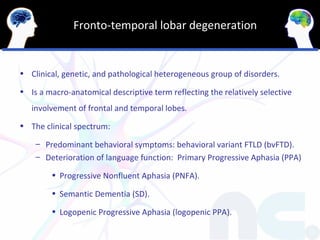
• Clinical, genetic, and pathological heterogeneous group of disorders.

• Is a macro-anatomical descriptive term reflecting the relatively selective
   involvement of frontal and temporal lobes.
• The clinical spectrum:

    – Predominant behavioral symptoms: behavioral variant FTLD (bvFTD).
    – Deterioration of language function: Primary Progressive Aphasia (PPA)

        • Progressive Nonfluent Aphasia (PNFA).

        • Semantic Dementia (SD).

        • Logopenic Progressive Aphasia (logopenic PPA).
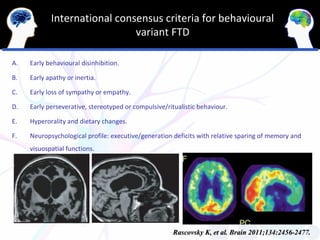
International consensus criteria for behavioural
                              variant FTD

A.   Early behavioural disinhibition.

B.   Early apathy or inertia.

C.   Early loss of sympathy or empathy.

D.   Early perseverative, stereotyped or compulsive/ritualistic behaviour.

E.   Hyperorality and dietary changes.

F.   Neuropsychological profile: executive/generation deficits with relative sparing of memory and
     visuospatial functions.


                                                      Rascovsky K, et al. Brain 2011;134:2456-2477.
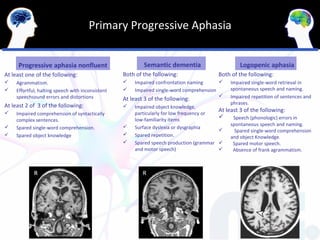
Primary Progressive Aphasia


      Progressive aphasia nonfluent                        Semantic dementia                         Logopenic aphasia
At least one of the following:                     Both of the following:                   Both of the following:
    Agrammatism.                                      Impaired confrontation naming           Impaired single-word retrieval in
    Effortful, halting speech with inconsistent       Impaired single-word comprehension       spontaneous speech and naming.
     speechsound errors and distortions            At least 3 of the following:                 Impaired repetition of sentences and
                                                                                                 phrases.
At least 2 of 3 of the following:                      Impaired object knowledge,
                                                        particularly for low frequency or
                                                                                            At least 3 of the following:
    Impaired comprehension of syntactically
     complex sentences.                                 low-familiarity items                    Speech (phonologic) errors in
                                                                                                 spontaneous speech and naming.
    Spared single-word comprehension.                 Surface dyslexia or dysgraphia
                                                                                                  Spared single-word comprehension
    Spared object knowledge                           Spared repetition.                       and object Knowledge.
                                                       Spared speech production (grammar        Spared motor speech.
                                                        and motor speech)                        Absence of frank agrammatism.
Outline


• Clinical syndromes of FTLD.

• Prevalence and incidence of FTLD.

• Estimating number of cases of the FTLD in LA.

• Mean survival time of FTLD.

• Economic impact of FTLD in LA.
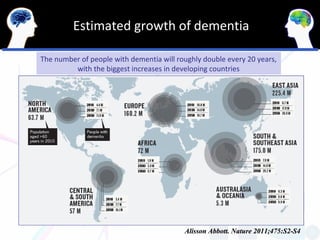
Estimated growth of dementia

The number of people with dementia will roughly double every 20 years,
         with the biggest increases in developing countries


                                          Alisson Abbott. Nature 2011;475:S2-S4
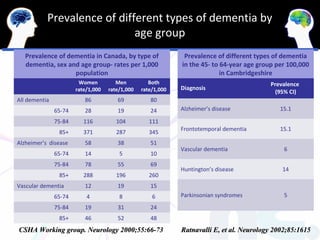
Prevalence of different types of dementia by
                             age group
   Prevalence of dementia in Canada, by type of                Prevalence of different types of dementia
   dementia, sex and age group- rates per 1,000               in the 45- to 64-year age group per 100,000
                   population                                               in Cambridgeshire
                        Women          Men          Both                                   Prevalence
                       rate/1,000   rate/1,000   rate/1,000   Diagnosis
                                                                                             (95% CI)
All dementia              86           69           80
               65-74      28           19           24        Alzheimer’s disease              15.1

               75-84      116          104          111
                                                              Frontotemporal dementia          15.1
                85+       371          287          345
Alzheimer’s disease       58           38           51
                                                              Vascular dementia                 6
               65-74      14            5           10
               75-84      78           55           69
                                                              Huntington’s disease             14
                85+       288          196          260
Vascular dementia         12           19           15
               65-74       4            8            6        Parkinsonian syndromes            5
               75-84      19           31           24
                85+       46           52           48
CSHA Working group. Neurology 2000;55:66-73                   Ratnavalli E, et al. Neurology 2002;85:1615
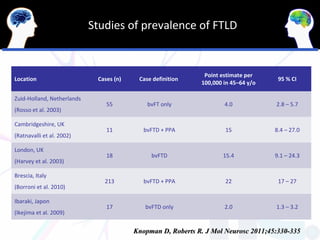
Studies of prevalence of FTLD


                                                              Point estimate per
Location                     Cases (n)    Case definition                            95 % CI
                                                             100,000 in 45–64 y/o

Zuid-Holland, Netherlands
                                55           bvFT only               4.0            2.8 – 5.7
(Rosso et al. 2003)

Cambridgeshire, UK
                                11          bvFTD + PPA              15             8.4 – 27.0
(Ratnavalli et al. 2002)

London, UK
                                18            bvFTD                 15.4            9.1 – 24.3
(Harvey et al. 2003)

Brescia, Italy
                               213          bvFTD + PPA              22              17 – 27
(Borroni et al. 2010)

Ibaraki, Japon
                                17          bvFTD only               2.0            1.3 – 3.2
(Ikejima et al. 2009)


                                         Knopman D, Roberts R. J Mol Neurosc 2011;45:330-335
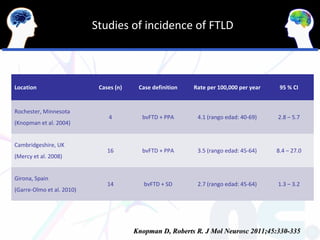
Studies of incidence of FTLD


Location                    Cases (n)    Case definition   Rate per 100,000 per year    95 % CI


Rochester, Minnesota
                               4          bvFTD + PPA       4.1 (rango edad: 40-69)    2.8 – 5.7
(Knopman et al. 2004)


Cambridgeshire, UK
                               16         bvFTD + PPA       3.5 (rango edad: 45-64)    8.4 – 27.0
(Mercy et al. 2008)


Girona, Spain
                               14          bvFTD + SD       2.7 (rango edad: 45-64)    1.3 – 3.2
(Garre-Olmo et al. 2010)


                                        Knopman D, Roberts R. J Mol Neurosc 2011;45:330-335
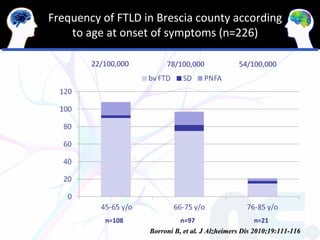
Frequency of FTLD in Brescia county according
    to age at onset of symptoms (n=226)

        22/100,000        78/100,000              54/100,000


           n=108              n=97                       n=21
                     Borroni B, et al. J Alzheimers Dis 2010;19:111-116
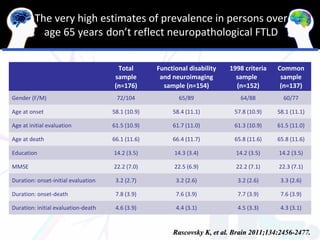
The very high estimates of prevalence in persons over
           age 65 years don’t reflect neuropathological FTLD


                                      Total        Functional disability   1998 criteria   Common
                                     sample         and neuroimaging         sample         sample
                                     (n=176)         sample (n=154)          (n=152)        (n=137)
Gender (F/M)                          72/104              65/89               64/88          60/77

Age at onset                         58.1 (10.9)        58.4 (11.1)         57.8 (10.9)    58.1 (11.1)

Age at initial evaluation            61.5 (10.9)        61.7 (11.0)         61.3 (10.9)    61.5 (11.0)

Age at death                         66.1 (11.6)        66.4 (11.7)         65.8 (11.6)    65.8 (11.6)

Education                            14.2 (3.5)          14.3 (3.4)          14.2 (3.5)    14.2 (3.5)

MMSE                                 22.2 (7.0)          22.5 (6.9)          22.2 (7.1)    22.3 (7.1)

Duration: onset-initial evaluation    3.2 (2.7)          3.2 (2.6)           3.2 (2.6)      3.3 (2.6)

Duration: onset-death                 7.8 (3.9)          7.6 (3.9)           7.7 (3.9)      7.6 (3.9)

Duration: initial evaluation-death    4.6 (3.9)          4.4 (3.1)           4.5 (3.3)      4.3 (3.1)


                                                        Rascovsky K, et al. Brain 2011;134:2456-2477.
Outline


• Clinical syndromes of FTLD.

• Prevalence and incidence of FTLD.

• Estimating number of cases of the FTLD in LA.

• Mean survival time of FTLD.

• Economic impact of FTLD in LA.
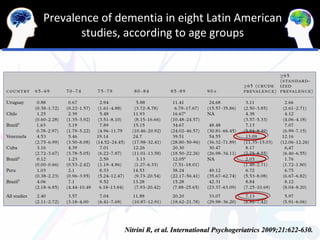
Prevalence of dementia in eight Latin American
       studies, according to age groups


               Nitrini R, et al. International Psychogeriatrics 2009;21:622-630.
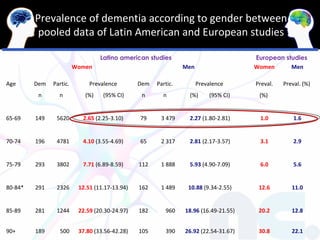
Prevalence of dementia according to gender between
          pooled data of Latin American and European studies

                                  Latino american studies                             European studies
                         Women                                  Men                   Women      Men

Age      Dem   Partic.        Prevalence        Dem   Partic.         Prevalence      Preval.   Preval. (%)
          n      n          (%)    (95% CI)      n      n        (%)      (95% CI)     (%)


65-69    149    5620       2.65 (2.25-3.10)     79     3 479     2.27 (1.80-2.81)      1.0          1.6


70-74    196    4781       4.10 (3.55-4.69)     65     2 317     2.81 (2.17-3.57)      3.1          2.9


75-79    293    3802       7.71 (6.89-8.59)     112    1 888     5.93 (4.90-7.09)      6.0          5.6


80-84*   291    2326      12.51 (11.17-13.94)   162    1 489     10.88 (9.34-2.55)     12.6        11.0


85-89    281    1244      22.59 (20.30-24.97)   182      960    18.96 (16.49-21.55)    20.2        12.8


90+      189     500      37.80 (33.56-42.28)   105      390    26.92 (22.54-31.67)    30.8        22.1
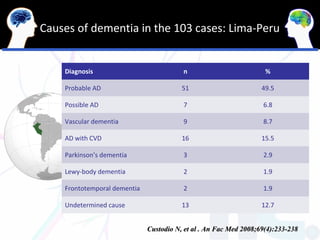
Causes of dementia in the 103 cases: Lima-Peru


    Diagnosis                            n                          %

    Probable AD                          51                        49.5

    Possible AD                          7                         6.8

    Vascular dementia                    9                         8.7

    AD with CVD                          16                        15.5

    Parkinson’s dementia                 3                         2.9

    Lewy-body dementia                   2                         1.9

    Frontotemporal dementia              2                         1.9

    Undetermined cause                   13                        12.7


                              Custodio N, et al . An Fac Med 2008;69(4):233-238
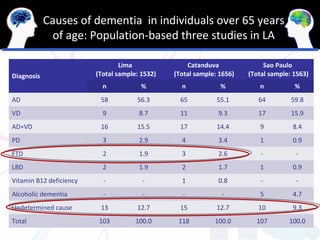
Causes of dementia in individuals over 65 years
             of age: Population-based three studies in LA

                                 Lima               Catanduva               Sao Paulo
Diagnosis                (Total sample: 1532)   (Total sample: 1656)   (Total sample: 1563)
                           n            %         n            %          n           %
AD                        58          56.3        65          55.1        64         59.8
VD                         9           8.7        11          9.3         17         15.9
AD+VD                     16          15.5        17          14.4        9          8.4
PD                         3           2.9        4           3.4         1          0.9
FTD                        2           1.9        3           2.6          -          -
LBD                        2           1.9        2           1.7         1          0.9
Vitamin B12 deficiency     -            -         1           0.8          -          -
Alcoholic dementia         -            -         -            -          5          4.7
Undetermined cause        13          12.7        15          12.7        10         9.3
Total                     103         100.0      118         100.0       107        100.0
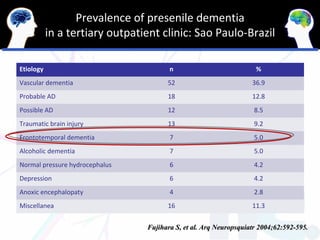
Prevalence of presenile dementia
           in a tertiary outpatient clinic: Sao Paulo-Brazil

Etiology                               n                           %
Vascular dementia                     52                          36.9
Probable AD                           18                          12.8
Possible AD                           12                           8.5
Traumatic brain injury                13                           9.2
Frontotemporal dementia                7                           5.0
Alcoholic dementia                     7                           5.0
Normal pressure hydrocephalus          6                           4.2
Depression                             6                           4.2
Anoxic encephalopaty                   4                           2.8
Miscellanea                           16                          11.3


                                Fujihara S, et al. Arq Neuropsquiatr 2004;62:592-595.
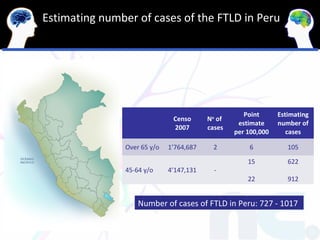
Estimating number of cases of the FTLD in Peru


                                                     Point      Estimating
                               Censo      No of
                                                   estimate     number of
                               2007       cases
                                                  per 100,000      cases

                Over 65 y/o   1’764,687    2          6            105

                                                      15           622
                45-64 y/o     4’147,131     -
                                                      22           912


                    Number of cases of FTLD in Peru: 727 - 1017
Outline


• Clinical syndromes of FTLD.

• Prevalence and incidence of FTLD.

• Estimating number of cases of the FTLD in LA.

• Mean survival time of FTLD.

• Economic impact of FTLD in LA.
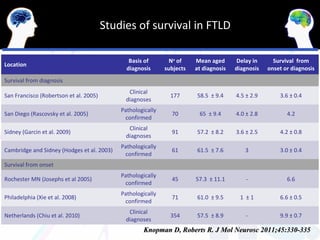
Studies of survival in FTLD

                                               Basis of        No of    Mean aged      Delay in      Survival from
Location
                                              diagnosis      subjects   at diagnosis   diagnosis   onset or diagnosis
Survival from diagnosis
                                              Clinical
San Francisco (Robertson et al. 2005)                          177      58.5 ± 9.4     4.5 ± 2.9       3.6 ± 0.4
                                             diagnoses
                                            Pathologically
San Diego (Rascovsky et al. 2005)                              70        65 ± 9.4      4.0 ± 2.8          4.2
                                             confirmed
                                              Clinical
Sidney (Garcin et al. 2009)                                    91       57.2 ± 8.2     3.6 ± 2.5       4.2 ± 0.8
                                             diagnoses
                                            Pathologically
Cambridge and Sidney (Hodges et al. 2003)                      61       61.5 ± 7.6        3            3.0 ± 0.4
                                             confirmed
Survival from onset
                                            Pathologically
Rochester MN (Josephs et al 2005)                              45       57.3 ± 11.1        -              6.6
                                             confirmed
                                            Pathologically
Philadelphia (Xie et al. 2008)                                 71       61.0 ± 9.5      1 ±1           6.6 ± 0.5
                                             confirmed
                                              Clinical
Netherlands (Chiu et al. 2010)                                 354      57.5 ± 8.9         -           9.9 ± 0.7
                                             diagnoses
                                                    Knopman D, Roberts R. J Mol Neurosc 2011;45:330-335
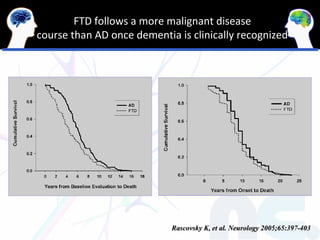
FTD follows a more malignant disease
course than AD once dementia is clinically recognized


                            Rascovsky K, et al. Neurology 2005;65:397-403
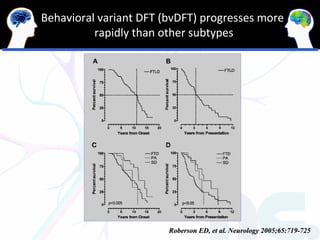
Behavioral variant DFT (bvDFT) progresses more
          rapidly than other subtypes


                        Roberson ED, et al. Neurology 2005;65:719-725
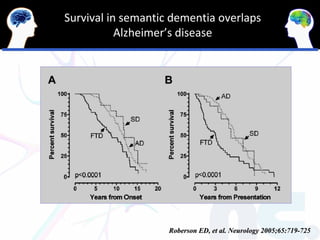
Survival in semantic dementia overlaps
           Alzheimer’s disease


                    Roberson ED, et al. Neurology 2005;65:719-725
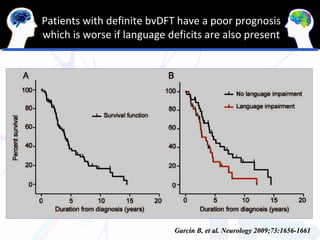
Patients with definite bvDFT have a poor prognosis
which is worse if language deficits are also present


                            Garcin B, et al. Neurology 2009;73:1656-1661
Outline


• Clinical syndromes of FTLD.

• Prevalence and incidence of FTLD.

• Estimating number of cases of the FTLD in LA.

• Mean survival time of FTLD.

• Economic impact of FTLD in LA.
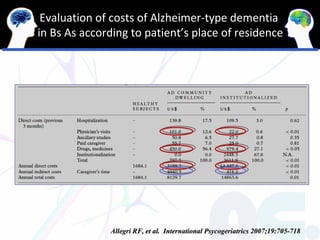
Evaluation of costs of Alzheimer-type dementia
in Bs As according to patient’s place of residence


              Allegri RF, et al. International Psycogeriatrics 2007;19:705-718
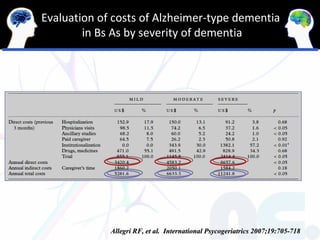
Evaluation of costs of Alzheimer-type dementia
        in Bs As by severity of dementia


             Allegri RF, et al. International Psycogeriatrics 2007;19:705-718
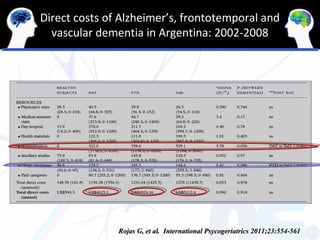
Direct costs of Alzheimer’s, frontotemporal and
  vascular dementia in Argentina: 2002-2008


               Rojas G, et al. International Psycogeriatrics 2011;23:554-561
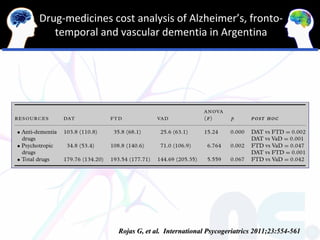
Drug-medicines cost analysis of Alzheimer’s, fronto-
   temporal and vascular dementia in Argentina


                Rojas G, et al. International Psycogeriatrics 2011;23:554-561
Conclusions

•   Historically, researchers have used a varied nomenclature to describe FTLD.
•   Clinical profile and the underlying pathological changes are heterogeneous in FLTD.
•   Two broad presentations are recognized: progressive deterioration in social function and
    personality and insidious decline in language skills.
•   Several research groups have used passive surveillance methods to estimate prevalence or
    incidence of the cognitive syndromes of the FTLDs.
•   Epidemiological studies suggest that FTLD is the second most common cause of young onset
    dementia after AD.
•   bvDFT progresses more rapidly than other subtypes, which is worse if language deficits are
    also present.
•   In Latin America, the costs to treat DFT are higher than for AD, but less than for DV, and has
    high costs in the use of psychotropic drugs.
Nilton Custodio
niltoncustodio@neuroconsultas.com
       www.neuroconsultas.com


        neuroconsultas


        twitter.com/neuroconsultas


        neuroconsultas.blogspot.com


        slideshare.net/neuroconsultas

Clinical Syndromes and Epidemiology of the FTLD-Spectrum Disorders in Latin America

  • 1.
    Clinical syndromes and epidemiologyof the FTLD- spectrum disorders in Latin America
  • 2.
    Outline • Clinical syndromesof FTLD. • Prevalence and incidence of FTLD. • Estimating number of cases of the FTLD in LA. • Mean survival time of FTLD. • Economic impact of FTLD in LA.
  • 3.
    Outline • Clinical syndromesof FTLD. • Prevalence and incidence of FTLD. • Estimating number of cases of the FTLD in LA. • Mean survival time of FTLD. • Economic impact of FTLD in LA.
  • 4.
    “On the relationshipbetween senile cerebral atrophy and aphasia” .… The patient had marked aphasia: his understanding of speech was substantially, though not completely, disturbed. He could understand simple questions about generalities and about things familiar to him; other things he did not understand at all. The patient was over-talkative. If his sentences were about simple things they were occasionally correct, otherwise they were unintelligible. This was partly because correct words were used in the wrong order and partly because some of his words were nonsensical. This occasionally resulted from the re-arrangement of consonants; so, for example, for the target word ‘locomotive’, he produced ‘colmolotive’; for the word ‘Kleiderkasten’, he said ‘Reideklasten’; and so on…In reading aloud, for Ostende he responded ‘Oste, ost, u te te, Ostus, tentinde……. PICK A. Über die Beziehungen der senilen Atrophie zur Aphasie. Prager Medizinische Wochenschrift,17: 165-167, 1892.
  • 5.
    Arnold Pick and“focal dementia” “….the clinical findings of senile dementia can be interpreted as a mosaic of circumscribed deficits of higher mental abilities (‘Herderscheinungen’); this fact may fail to be revealed when the process of atrophy occurs simultaneously at many places, thereby masking the appearance of the single symptoms” PICK A. Senile Hirnatrophie als Grundlage für Herderscheinungen. Wiener Klinische Wochenschrift, 14:403-404, 1901.
  • 6.
    Alzheimer and histopathologicaldescription ALZHEIMER A. Über eigenartige Krankheitsfälle des späteren Alters. Zeitschrift für die gesamte Neurologie und Psychiatrie, 4: 356-385, 1911.
  • 7.
    “Pick’s disease” or“Pick complex”? Pick’s disease • Europe: Clinical diagnosis, with or without pathologically proven Pick bodies. • America: Pathological diagnosis, irrespective of the clinical presentation. Pick complex CBD PSP PPA bvFTD FTLD-ALS
  • 8.
    Fronto-temporal lobar degeneration •Clinical, genetic, and pathological heterogeneous group of disorders. • Is a macro-anatomical descriptive term reflecting the relatively selective involvement of frontal and temporal lobes. • The clinical spectrum: – Predominant behavioral symptoms: behavioral variant FTLD (bvFTD). – Deterioration of language function: Primary Progressive Aphasia (PPA) • Progressive Nonfluent Aphasia (PNFA). • Semantic Dementia (SD). • Logopenic Progressive Aphasia (logopenic PPA).
  • 9.
    International consensus criteriafor behavioural variant FTD A. Early behavioural disinhibition. B. Early apathy or inertia. C. Early loss of sympathy or empathy. D. Early perseverative, stereotyped or compulsive/ritualistic behaviour. E. Hyperorality and dietary changes. F. Neuropsychological profile: executive/generation deficits with relative sparing of memory and visuospatial functions. Rascovsky K, et al. Brain 2011;134:2456-2477.
  • 10.
    Primary Progressive Aphasia Progressive aphasia nonfluent Semantic dementia Logopenic aphasia At least one of the following: Both of the following: Both of the following:  Agrammatism.  Impaired confrontation naming  Impaired single-word retrieval in  Effortful, halting speech with inconsistent  Impaired single-word comprehension spontaneous speech and naming. speechsound errors and distortions At least 3 of the following:  Impaired repetition of sentences and phrases. At least 2 of 3 of the following:  Impaired object knowledge, particularly for low frequency or At least 3 of the following:  Impaired comprehension of syntactically complex sentences. low-familiarity items  Speech (phonologic) errors in spontaneous speech and naming.  Spared single-word comprehension.  Surface dyslexia or dysgraphia  Spared single-word comprehension  Spared object knowledge  Spared repetition. and object Knowledge.  Spared speech production (grammar  Spared motor speech. and motor speech)  Absence of frank agrammatism.
  • 11.
    Outline • Clinical syndromesof FTLD. • Prevalence and incidence of FTLD. • Estimating number of cases of the FTLD in LA. • Mean survival time of FTLD. • Economic impact of FTLD in LA.
  • 12.
    Estimated growth ofdementia The number of people with dementia will roughly double every 20 years, with the biggest increases in developing countries Alisson Abbott. Nature 2011;475:S2-S4
  • 13.
    Prevalence of differenttypes of dementia by age group Prevalence of dementia in Canada, by type of Prevalence of different types of dementia dementia, sex and age group- rates per 1,000 in the 45- to 64-year age group per 100,000 population in Cambridgeshire Women Men Both Prevalence rate/1,000 rate/1,000 rate/1,000 Diagnosis (95% CI) All dementia 86 69 80 65-74 28 19 24 Alzheimer’s disease 15.1 75-84 116 104 111 Frontotemporal dementia 15.1 85+ 371 287 345 Alzheimer’s disease 58 38 51 Vascular dementia 6 65-74 14 5 10 75-84 78 55 69 Huntington’s disease 14 85+ 288 196 260 Vascular dementia 12 19 15 65-74 4 8 6 Parkinsonian syndromes 5 75-84 19 31 24 85+ 46 52 48 CSHA Working group. Neurology 2000;55:66-73 Ratnavalli E, et al. Neurology 2002;85:1615
  • 14.
    Studies of prevalenceof FTLD Point estimate per Location Cases (n) Case definition 95 % CI 100,000 in 45–64 y/o Zuid-Holland, Netherlands 55 bvFT only 4.0 2.8 – 5.7 (Rosso et al. 2003) Cambridgeshire, UK 11 bvFTD + PPA 15 8.4 – 27.0 (Ratnavalli et al. 2002) London, UK 18 bvFTD 15.4 9.1 – 24.3 (Harvey et al. 2003) Brescia, Italy 213 bvFTD + PPA 22 17 – 27 (Borroni et al. 2010) Ibaraki, Japon 17 bvFTD only 2.0 1.3 – 3.2 (Ikejima et al. 2009) Knopman D, Roberts R. J Mol Neurosc 2011;45:330-335
  • 15.
    Studies of incidenceof FTLD Location Cases (n) Case definition Rate per 100,000 per year 95 % CI Rochester, Minnesota 4 bvFTD + PPA 4.1 (rango edad: 40-69) 2.8 – 5.7 (Knopman et al. 2004) Cambridgeshire, UK 16 bvFTD + PPA 3.5 (rango edad: 45-64) 8.4 – 27.0 (Mercy et al. 2008) Girona, Spain 14 bvFTD + SD 2.7 (rango edad: 45-64) 1.3 – 3.2 (Garre-Olmo et al. 2010) Knopman D, Roberts R. J Mol Neurosc 2011;45:330-335
  • 16.
    Frequency of FTLDin Brescia county according to age at onset of symptoms (n=226) 22/100,000 78/100,000 54/100,000 n=108 n=97 n=21 Borroni B, et al. J Alzheimers Dis 2010;19:111-116
  • 17.
    The very highestimates of prevalence in persons over age 65 years don’t reflect neuropathological FTLD Total Functional disability 1998 criteria Common sample and neuroimaging sample sample (n=176) sample (n=154) (n=152) (n=137) Gender (F/M) 72/104 65/89 64/88 60/77 Age at onset 58.1 (10.9) 58.4 (11.1) 57.8 (10.9) 58.1 (11.1) Age at initial evaluation 61.5 (10.9) 61.7 (11.0) 61.3 (10.9) 61.5 (11.0) Age at death 66.1 (11.6) 66.4 (11.7) 65.8 (11.6) 65.8 (11.6) Education 14.2 (3.5) 14.3 (3.4) 14.2 (3.5) 14.2 (3.5) MMSE 22.2 (7.0) 22.5 (6.9) 22.2 (7.1) 22.3 (7.1) Duration: onset-initial evaluation 3.2 (2.7) 3.2 (2.6) 3.2 (2.6) 3.3 (2.6) Duration: onset-death 7.8 (3.9) 7.6 (3.9) 7.7 (3.9) 7.6 (3.9) Duration: initial evaluation-death 4.6 (3.9) 4.4 (3.1) 4.5 (3.3) 4.3 (3.1) Rascovsky K, et al. Brain 2011;134:2456-2477.
  • 18.
    Outline • Clinical syndromesof FTLD. • Prevalence and incidence of FTLD. • Estimating number of cases of the FTLD in LA. • Mean survival time of FTLD. • Economic impact of FTLD in LA.
  • 19.
    Prevalence of dementiain eight Latin American studies, according to age groups Nitrini R, et al. International Psychogeriatrics 2009;21:622-630.
  • 20.
    Prevalence of dementiaaccording to gender between pooled data of Latin American and European studies Latino american studies European studies Women Men Women Men Age Dem Partic. Prevalence Dem Partic. Prevalence Preval. Preval. (%) n n (%) (95% CI) n n (%) (95% CI) (%) 65-69 149 5620 2.65 (2.25-3.10) 79 3 479 2.27 (1.80-2.81) 1.0 1.6 70-74 196 4781 4.10 (3.55-4.69) 65 2 317 2.81 (2.17-3.57) 3.1 2.9 75-79 293 3802 7.71 (6.89-8.59) 112 1 888 5.93 (4.90-7.09) 6.0 5.6 80-84* 291 2326 12.51 (11.17-13.94) 162 1 489 10.88 (9.34-2.55) 12.6 11.0 85-89 281 1244 22.59 (20.30-24.97) 182 960 18.96 (16.49-21.55) 20.2 12.8 90+ 189 500 37.80 (33.56-42.28) 105 390 26.92 (22.54-31.67) 30.8 22.1
  • 21.
    Causes of dementiain the 103 cases: Lima-Peru Diagnosis n % Probable AD 51 49.5 Possible AD 7 6.8 Vascular dementia 9 8.7 AD with CVD 16 15.5 Parkinson’s dementia 3 2.9 Lewy-body dementia 2 1.9 Frontotemporal dementia 2 1.9 Undetermined cause 13 12.7 Custodio N, et al . An Fac Med 2008;69(4):233-238
  • 22.
    Causes of dementiain individuals over 65 years of age: Population-based three studies in LA Lima Catanduva Sao Paulo Diagnosis (Total sample: 1532) (Total sample: 1656) (Total sample: 1563) n % n % n % AD 58 56.3 65 55.1 64 59.8 VD 9 8.7 11 9.3 17 15.9 AD+VD 16 15.5 17 14.4 9 8.4 PD 3 2.9 4 3.4 1 0.9 FTD 2 1.9 3 2.6 - - LBD 2 1.9 2 1.7 1 0.9 Vitamin B12 deficiency - - 1 0.8 - - Alcoholic dementia - - - - 5 4.7 Undetermined cause 13 12.7 15 12.7 10 9.3 Total 103 100.0 118 100.0 107 100.0
  • 23.
    Prevalence of preseniledementia in a tertiary outpatient clinic: Sao Paulo-Brazil Etiology n % Vascular dementia 52 36.9 Probable AD 18 12.8 Possible AD 12 8.5 Traumatic brain injury 13 9.2 Frontotemporal dementia 7 5.0 Alcoholic dementia 7 5.0 Normal pressure hydrocephalus 6 4.2 Depression 6 4.2 Anoxic encephalopaty 4 2.8 Miscellanea 16 11.3 Fujihara S, et al. Arq Neuropsquiatr 2004;62:592-595.
  • 24.
    Estimating number ofcases of the FTLD in Peru Point Estimating Censo No of estimate number of 2007 cases per 100,000 cases Over 65 y/o 1’764,687 2 6 105 15 622 45-64 y/o 4’147,131 - 22 912 Number of cases of FTLD in Peru: 727 - 1017
  • 25.
    Outline • Clinical syndromesof FTLD. • Prevalence and incidence of FTLD. • Estimating number of cases of the FTLD in LA. • Mean survival time of FTLD. • Economic impact of FTLD in LA.
  • 26.
    Studies of survivalin FTLD Basis of No of Mean aged Delay in Survival from Location diagnosis subjects at diagnosis diagnosis onset or diagnosis Survival from diagnosis Clinical San Francisco (Robertson et al. 2005) 177 58.5 ± 9.4 4.5 ± 2.9 3.6 ± 0.4 diagnoses Pathologically San Diego (Rascovsky et al. 2005) 70 65 ± 9.4 4.0 ± 2.8 4.2 confirmed Clinical Sidney (Garcin et al. 2009) 91 57.2 ± 8.2 3.6 ± 2.5 4.2 ± 0.8 diagnoses Pathologically Cambridge and Sidney (Hodges et al. 2003) 61 61.5 ± 7.6 3 3.0 ± 0.4 confirmed Survival from onset Pathologically Rochester MN (Josephs et al 2005) 45 57.3 ± 11.1 - 6.6 confirmed Pathologically Philadelphia (Xie et al. 2008) 71 61.0 ± 9.5 1 ±1 6.6 ± 0.5 confirmed Clinical Netherlands (Chiu et al. 2010) 354 57.5 ± 8.9 - 9.9 ± 0.7 diagnoses Knopman D, Roberts R. J Mol Neurosc 2011;45:330-335
  • 27.
    FTD follows amore malignant disease course than AD once dementia is clinically recognized Rascovsky K, et al. Neurology 2005;65:397-403
  • 28.
    Behavioral variant DFT(bvDFT) progresses more rapidly than other subtypes Roberson ED, et al. Neurology 2005;65:719-725
  • 29.
    Survival in semanticdementia overlaps Alzheimer’s disease Roberson ED, et al. Neurology 2005;65:719-725
  • 30.
    Patients with definitebvDFT have a poor prognosis which is worse if language deficits are also present Garcin B, et al. Neurology 2009;73:1656-1661
  • 31.
    Outline • Clinical syndromesof FTLD. • Prevalence and incidence of FTLD. • Estimating number of cases of the FTLD in LA. • Mean survival time of FTLD. • Economic impact of FTLD in LA.
  • 32.
    Evaluation of costsof Alzheimer-type dementia in Bs As according to patient’s place of residence Allegri RF, et al. International Psycogeriatrics 2007;19:705-718
  • 33.
    Evaluation of costsof Alzheimer-type dementia in Bs As by severity of dementia Allegri RF, et al. International Psycogeriatrics 2007;19:705-718
  • 34.
    Direct costs ofAlzheimer’s, frontotemporal and vascular dementia in Argentina: 2002-2008 Rojas G, et al. International Psycogeriatrics 2011;23:554-561
  • 35.
    Drug-medicines cost analysisof Alzheimer’s, fronto- temporal and vascular dementia in Argentina Rojas G, et al. International Psycogeriatrics 2011;23:554-561
  • 36.
    Conclusions • Historically, researchers have used a varied nomenclature to describe FTLD. • Clinical profile and the underlying pathological changes are heterogeneous in FLTD. • Two broad presentations are recognized: progressive deterioration in social function and personality and insidious decline in language skills. • Several research groups have used passive surveillance methods to estimate prevalence or incidence of the cognitive syndromes of the FTLDs. • Epidemiological studies suggest that FTLD is the second most common cause of young onset dementia after AD. • bvDFT progresses more rapidly than other subtypes, which is worse if language deficits are also present. • In Latin America, the costs to treat DFT are higher than for AD, but less than for DV, and has high costs in the use of psychotropic drugs.
  • 37.
    Nilton Custodio niltoncustodio@neuroconsultas.com www.neuroconsultas.com neuroconsultas twitter.com/neuroconsultas neuroconsultas.blogspot.com slideshare.net/neuroconsultas