Topic:
Presenter :
iqra mosssbeen
• ….downsizing tends to make us
timid when we need to be bold
• ….the creative employees are the
ones that will survive
Creativity is a mental process
involving the generation of new
ideas or concepts, or new
associations of the creative mind
between existing ideas or
concepts
creativity
• Creativity falls under the rubric of intellectual
property for the legal profession. For
organizations these concern outputs (rather than
processes)
• Creativity is characterized by the ability to
perceive the world in new ways, to find hidden
patterns, to make connections between seemingly
unrelated phenomena, and to generate solutions.
Creativity involves two processes: thinking, then
producing. If you have ideas, but don’t act on
them, you are imaginative but not creative.
An alternative
conception of
creativity is that
it is simply the
act of making
something new.
“A great wind is blowing and that
gives you either imagination or a
headache”
• Creativity can be used when confronted
with a decision making problem.
• To over come from routine
• To meet the demand of the era
• The work environment
• Traits
• The four step creative process
• Brainstorming
• Divergent thinking
The work environment
• The size of the team is critical
• Think about where you come up with
your more creative ideas
• A passion for what they were doing, a
genuine respect for others’ ideas
• Simply believing you’re creative
• Curiosity
• Confidence
• Courage
• Constancy
• To understand the creative process itself
• Preparation
• Incubation
• Inspiration
• Verification
Gather data
About the specific subject
Divergent ( to gather the data without any
influence like time, money, people etc).
Steps to achieve “alpha state”
 Close your eyes
Slow, deep breaths
Focus on a single image
• Be prepared to act
• Don’t waste a good idea
• Determining And Testing
• Validity of idea
• Usefulness of idea
• Ideas are common…..
• …it takes more than merely a good idea
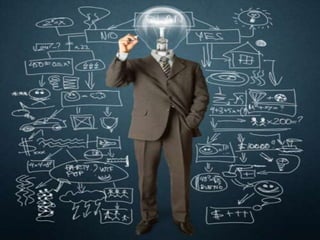
Process for generating creative ideas and
solutions through intensive and freewheeling
group discussion.
Every participant is encouraged to think aloud
and suggest as many ideas as possible, no matter
seemingly how outlandish or strange.
When most people do brainstorming, they
run all over the place and think outside the
box,
Ralph Keeney says” I think they should think
inside the box—the right-sided box.”
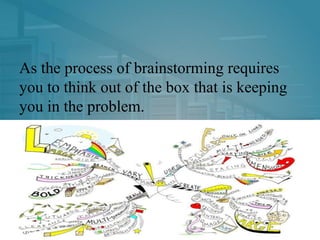
As the process of brainstorming requires
you to think out of the box that is keeping
you in the problem.
Time travel:
Suppose you are facing a particular
problem at this particular time. How would
you dealt with the problem if it occurs to
you 10 years back? Or a year back? Or
even a month back? This technique helps
to gather new ideas according to the
situation of the time.
Teleportation:
What if you were facing this problem in a
different place? Different country?
Different geographic region? Different
universe? Different plane of existence?
How would you handle it?
Attribute change:
How would you think about this if you were a
different gender? Age? Race? Intellect?
Height? Weight? Nationality? Your Sanity?
Rolestorming:
What would you do if you were someone
else? Your parent? Your teacher? Your
manager? Your partner? Your best friend?
Your enemy? Etc?
Gap Filling:
Identify your current spot – Point A – and
your end goal – Point B. What is the gap
that exists between A and B? What are all
the things you need to fill up this gap? List
them down and find out what it takes to
get them.
SWOT Analysis:
Do a SWOT of your situation – What are the
Strengths? Weaknesses? Opportunities?
Threats? The analysis will open you up to
ideas you may not be aware before.
Brain Writing:
Get a group of people and have them write
their ideas on their own sheet of paper. After
10 minutes, rotate the sheets to different
people and build off what the others wrote on
their paper.
Trigger Method:
Brainstorm on as many ideas as possible.
Then select the best ones and brainstorm
on those ideas as ‘triggers’ for more ideas.
Repeat until you find the best solution.
Reverse Thinking:
Think about what everyone will typically
do in your situation. Then do the opposite.
Resource Availability:
What if money, time, people, supplies are
not issues at all? What if you can ask for
whatever you want and have it happen?
What will you do?
Exaggeration:
 Exaggerate your goal and see how you will
deal with it now. Enlarge it: What if it is 10
times its current size? 100 times? 1000 times?
Shrink it: What if it is 1/10 its current size?
Meditation:
 Focus on your key question such as ‘How can
I solve XX problem?’ or ‘How can I achieve
XX goal?’ and meditate on it in a quiet place.
Have a pen and paper in front of you so you
can write immediately whatever comes to
mind. Do this for 30 minutes or as long as it
takes.
Write a list of 101 ideas:
Open your word processor and write a laundry
list of at least 101 ideas to deal with your
situation. Go wild and write whatever you can
think of without restricting yourself. Do not
stop until you have at least 101.
It include the ability to elaborate, and think
of diverse and original ideas with fluency
and speed
The goal of divergent thinking is to generate
many different ideas about a topic in a short
period of time
We can use strategies:
Self Analysis: ask question to yourself
Topic Analysis: analyze the topic you have
‘Invention refers to new concepts or products
that derive from individual’s ideas or from
scientific research. Innovation, on the other
hand, is the commercialization of the invention
itself”
Innovation
Ber said “Innovation is a process of taking new
ideas through to satisfied customers. It is the
conversion of new knowledge into products and
services”
Management innovation
Revolutionary innovation
experimental innovation services
innovation value innovation
structure innovation market innovation
strategic innovation process
innovation
marketing innovation product innovation
user lead innovation
brand innovation
technology innovation
What are you talking
about?
Innovation comes in
many flavors
Map provide you the
orientation
A frame work for defining the innovation
outcomes
Internal innovation
External innovation
Continuous / Evolutionary Innovation
Discontinuous / Revolutionary Innovation
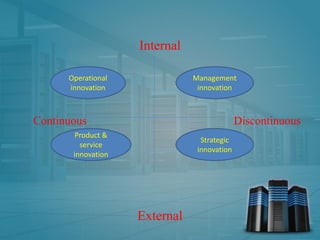
Internal
Continuous Discontinuous
External
Operational
innovation
Management
innovation
Product &
service
innovation
Strategic
innovation
Operational innovation: Process innovation: making processes
for established offers in established markets more effective or
efficient & technological innovation in manufacturing
Product & service innovation: taking established offers in
established markets to the next level & making surface
modifications that improve customers' experience of
established products
Strategic innovation: new business models, or new
markets (either by creating new ones or reshaping
existing ones), or increased value for both the customer
and the company
Management innovation: Management innovation is
anything that substantially alters the way in which the
work of management is carried out, or significantly
modifies customary organizational forms, and, by doing
so, advances organizational goals.“ Gary Hamel
Innovation strategy
“They can & they ll follow him,
first individual & then whole
crowds”
In terms of innovation
strategy first tend to:
Explore
Or exploit
• Merle C Crawford (1980) describe
four innovation strategies
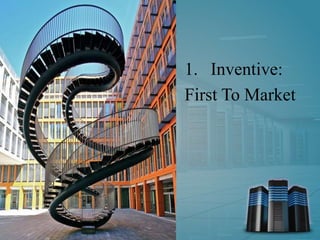
1. Inventive:
First To Market
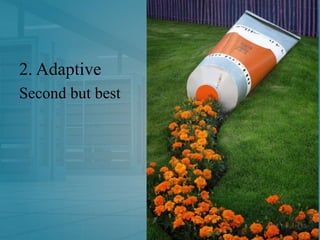
2. Adaptive
Second but best
• 3. Economic
Low-cost
producer
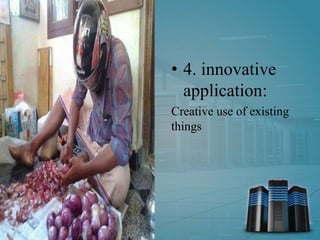
• 4. innovative
application:
Creative use of existing
things
Each innovation strategy require
innovation. However, innovation
occur in different areas.
Innovation strategy can be risky in
reality, even if firm perceives it as
being low cost
Being first (innovative) does not
necessarily lead success.
Being 2nd (adaptive ) can work but can
fail in industries with short product life
cycles or network effects
There is more universally more
“innovative” way : being a low cost
producer (economics) usually require
lot of manufacturing innovation
New application of existing technology
is more interesting strategy
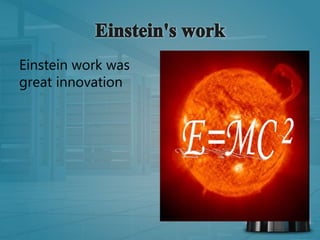
Einstein work was
great innovation
Many of us today live in a ‘knowledge society’.
In this ‘knowledge society’ we are swimming in
an ocean of masses of data, information, possibly
also of knowledge
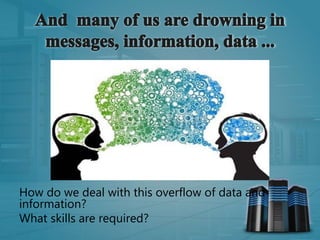
How do we deal with this overflow of data and
information?
What skills are required?
• The simple answer is
There is way do to better –find it
• Creativity is typically used to refer to the
act of producing new ideas, approaches or
actions.
• Innovation is the process of both
generating and applying such creative
ideas in some specific context.
• In the context of an organization, therefore, the
term innovation is often used to refer to the entire
process by which an organization generates
creative new ideas and converts them into novel,
useful and viable commercial products, services,
and business practices.
• While the term creativity is reserved to apply
specifically to the generation of novel ideas by
individuals or groups, as a necessary step within
the innovation process.
• innovation "begins with creative ideas,„
• "...creativity by individuals and teams is a
starting point for innovation; the first is a
necessary but not sufficient condition for the
second.„
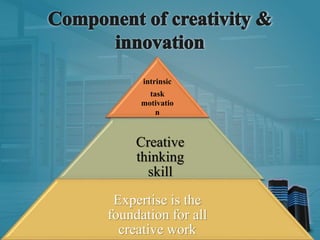
intrinsic
task
motivatio
n
Creative
thinking
skill
Expertise is the
foundation for all
creative work
• Intrinsic motivation:-
Intrinsic motivation refers to motivation that
comes from inside an individual rather than from
any outside or external award, such as money or
grades.
The motivation comes from the pleasure one gets
from the task itself or from the sense of
satisfaction in completing or even working on a
task .
• Creative thinking skill :-
• It refers to the ability to form new combination of
ideas to fulfill a need or to get original or otherwise
appropriate results by the criteria of the domain in
question.
• Creativity and innovation are necessary to cope up
with the changing environmental conditions.
• It may lead to new ideas for:
 manufacturing processes
 decision- making
 problem solving
• creativity helps managers in decision making and
problem solving conditions
• In an organization it may also help:
 in the generation of new products.
coping with the competition
tackling any external/internal event that
may affect the organization.
• Innovation makes the work area excited
and full of fun
Thinking provide you “knowledge “&
knowledge makes you -great
• http://www.businessdictionary.com/definition/brainstorming.html#ixzz3igTM41Ut
• http://personalexcellence.co/blog/brainstorming-techniques/
• http://thesecondprinciple.com/creativity/creativity-essentials/types-of-creative-
thinking/
• http://faculty.washington.edu/ezent/imdt.htm
• Hickson DJ, Miller, S.& D. Wilson ‘Planned or Prioritised? Two Options in the
Implementation of Strategic Decisions, Journal of Management Studies, 47 ,
November 2003.
• Gary Hamel, Bill Breen „The Future of Management“, Harvard Business School Press,
2007
• www.cad.strath.ac.uk/AID02_workshop/knowledge.pdf
• http://www.google.com.pk/imgres?imgurl=http://monaloosa.com/wp-
content/uploads/yapb_cache/bismillah_abstract_art_red_and_orange_islamic_calligrap
hy.bdfk3o5549skss004wockkg88.92gy272ag7occ8cssswg0csc8.th.jpeg&imgrefurl=htt
p://monaloosa.com/category/texts/bismillah-
texts/page/3/&h=375&w=500&tbnid=qii7Q9AL2pUa9M:&docid=SK0VHnGn7g7DG
M&ei=0LvNVfqmFMyxaq7dofAF&tbm=isch&ved=0CFgQMyhVMFU4yAFqFQoTCPrOv
vinqMcCFcyYGgodrm4IXg
• Marketing & management by Nadeem Irfan Bukhari
creativity and innovation

creativity and innovation

  • 1.
  • 2.
  • 4.
    • ….downsizing tendsto make us timid when we need to be bold • ….the creative employees are the ones that will survive
  • 5.
    Creativity is amental process involving the generation of new ideas or concepts, or new associations of the creative mind between existing ideas or concepts creativity
  • 6.
    • Creativity fallsunder the rubric of intellectual property for the legal profession. For organizations these concern outputs (rather than processes) • Creativity is characterized by the ability to perceive the world in new ways, to find hidden patterns, to make connections between seemingly unrelated phenomena, and to generate solutions. Creativity involves two processes: thinking, then producing. If you have ideas, but don’t act on them, you are imaginative but not creative.
  • 7.
    An alternative conception of creativityis that it is simply the act of making something new.
  • 9.
    “A great windis blowing and that gives you either imagination or a headache”
  • 10.
    • Creativity canbe used when confronted with a decision making problem. • To over come from routine • To meet the demand of the era
  • 11.
    • The workenvironment • Traits • The four step creative process • Brainstorming • Divergent thinking
  • 12.
    The work environment •The size of the team is critical • Think about where you come up with your more creative ideas • A passion for what they were doing, a genuine respect for others’ ideas
  • 13.
    • Simply believingyou’re creative • Curiosity • Confidence • Courage • Constancy • To understand the creative process itself
  • 14.
    • Preparation • Incubation •Inspiration • Verification
  • 15.
    Gather data About thespecific subject Divergent ( to gather the data without any influence like time, money, people etc).
  • 16.
    Steps to achieve“alpha state”  Close your eyes Slow, deep breaths Focus on a single image
  • 17.
    • Be preparedto act • Don’t waste a good idea
  • 18.
    • Determining AndTesting • Validity of idea • Usefulness of idea
  • 19.
    • Ideas arecommon….. • …it takes more than merely a good idea
  • 20.
    Process for generatingcreative ideas and solutions through intensive and freewheeling group discussion. Every participant is encouraged to think aloud and suggest as many ideas as possible, no matter seemingly how outlandish or strange.
  • 22.
    When most peopledo brainstorming, they run all over the place and think outside the box, Ralph Keeney says” I think they should think inside the box—the right-sided box.”
  • 23.
    As the processof brainstorming requires you to think out of the box that is keeping you in the problem.
  • 24.
    Time travel: Suppose youare facing a particular problem at this particular time. How would you dealt with the problem if it occurs to you 10 years back? Or a year back? Or even a month back? This technique helps to gather new ideas according to the situation of the time.
  • 25.
    Teleportation: What if youwere facing this problem in a different place? Different country? Different geographic region? Different universe? Different plane of existence? How would you handle it?
  • 26.
    Attribute change: How wouldyou think about this if you were a different gender? Age? Race? Intellect? Height? Weight? Nationality? Your Sanity?
  • 27.
    Rolestorming: What would youdo if you were someone else? Your parent? Your teacher? Your manager? Your partner? Your best friend? Your enemy? Etc?
  • 28.
    Gap Filling: Identify yourcurrent spot – Point A – and your end goal – Point B. What is the gap that exists between A and B? What are all the things you need to fill up this gap? List them down and find out what it takes to get them.
  • 29.
    SWOT Analysis: Do aSWOT of your situation – What are the Strengths? Weaknesses? Opportunities? Threats? The analysis will open you up to ideas you may not be aware before.
  • 30.
    Brain Writing: Get agroup of people and have them write their ideas on their own sheet of paper. After 10 minutes, rotate the sheets to different people and build off what the others wrote on their paper.
  • 31.
    Trigger Method: Brainstorm onas many ideas as possible. Then select the best ones and brainstorm on those ideas as ‘triggers’ for more ideas. Repeat until you find the best solution.
  • 32.
    Reverse Thinking: Think aboutwhat everyone will typically do in your situation. Then do the opposite.
  • 33.
    Resource Availability: What ifmoney, time, people, supplies are not issues at all? What if you can ask for whatever you want and have it happen? What will you do?
  • 34.
    Exaggeration:  Exaggerate yourgoal and see how you will deal with it now. Enlarge it: What if it is 10 times its current size? 100 times? 1000 times? Shrink it: What if it is 1/10 its current size?
  • 35.
    Meditation:  Focus onyour key question such as ‘How can I solve XX problem?’ or ‘How can I achieve XX goal?’ and meditate on it in a quiet place. Have a pen and paper in front of you so you can write immediately whatever comes to mind. Do this for 30 minutes or as long as it takes.
  • 36.
    Write a listof 101 ideas: Open your word processor and write a laundry list of at least 101 ideas to deal with your situation. Go wild and write whatever you can think of without restricting yourself. Do not stop until you have at least 101.
  • 37.
    It include theability to elaborate, and think of diverse and original ideas with fluency and speed
  • 38.
    The goal ofdivergent thinking is to generate many different ideas about a topic in a short period of time We can use strategies: Self Analysis: ask question to yourself Topic Analysis: analyze the topic you have
  • 40.
    ‘Invention refers tonew concepts or products that derive from individual’s ideas or from scientific research. Innovation, on the other hand, is the commercialization of the invention itself” Innovation
  • 41.
    Ber said “Innovationis a process of taking new ideas through to satisfied customers. It is the conversion of new knowledge into products and services”
  • 42.
    Management innovation Revolutionary innovation experimentalinnovation services innovation value innovation structure innovation market innovation strategic innovation process innovation marketing innovation product innovation user lead innovation brand innovation technology innovation
  • 43.
    What are youtalking about?
  • 44.
  • 45.
    Map provide youthe orientation
  • 46.
    A frame workfor defining the innovation outcomes Internal innovation External innovation Continuous / Evolutionary Innovation Discontinuous / Revolutionary Innovation
  • 47.
  • 48.
    Operational innovation: Processinnovation: making processes for established offers in established markets more effective or efficient & technological innovation in manufacturing Product & service innovation: taking established offers in established markets to the next level & making surface modifications that improve customers' experience of established products
  • 49.
    Strategic innovation: newbusiness models, or new markets (either by creating new ones or reshaping existing ones), or increased value for both the customer and the company Management innovation: Management innovation is anything that substantially alters the way in which the work of management is carried out, or significantly modifies customary organizational forms, and, by doing so, advances organizational goals.“ Gary Hamel
  • 51.
    Innovation strategy “They can& they ll follow him, first individual & then whole crowds”
  • 52.
    In terms ofinnovation strategy first tend to:
  • 53.
  • 54.
  • 55.
    • Merle CCrawford (1980) describe four innovation strategies
  • 56.
  • 57.
  • 58.
  • 59.
  • 60.
    Each innovation strategyrequire innovation. However, innovation occur in different areas.
  • 61.
    Innovation strategy canbe risky in reality, even if firm perceives it as being low cost
  • 62.
    Being first (innovative)does not necessarily lead success.
  • 63.
    Being 2nd (adaptive) can work but can fail in industries with short product life cycles or network effects
  • 64.
    There is moreuniversally more “innovative” way : being a low cost producer (economics) usually require lot of manufacturing innovation
  • 65.
    New application ofexisting technology is more interesting strategy
  • 67.
  • 68.
    Many of ustoday live in a ‘knowledge society’. In this ‘knowledge society’ we are swimming in an ocean of masses of data, information, possibly also of knowledge
  • 69.
    How do wedeal with this overflow of data and information? What skills are required?
  • 70.
    • The simpleanswer is There is way do to better –find it
  • 71.
    • Creativity istypically used to refer to the act of producing new ideas, approaches or actions. • Innovation is the process of both generating and applying such creative ideas in some specific context.
  • 72.
    • In thecontext of an organization, therefore, the term innovation is often used to refer to the entire process by which an organization generates creative new ideas and converts them into novel, useful and viable commercial products, services, and business practices. • While the term creativity is reserved to apply specifically to the generation of novel ideas by individuals or groups, as a necessary step within the innovation process.
  • 73.
    • innovation "beginswith creative ideas,„ • "...creativity by individuals and teams is a starting point for innovation; the first is a necessary but not sufficient condition for the second.„
  • 74.
  • 75.
    • Intrinsic motivation:- Intrinsicmotivation refers to motivation that comes from inside an individual rather than from any outside or external award, such as money or grades. The motivation comes from the pleasure one gets from the task itself or from the sense of satisfaction in completing or even working on a task .
  • 76.
    • Creative thinkingskill :- • It refers to the ability to form new combination of ideas to fulfill a need or to get original or otherwise appropriate results by the criteria of the domain in question.
  • 77.
    • Creativity andinnovation are necessary to cope up with the changing environmental conditions. • It may lead to new ideas for:  manufacturing processes  decision- making  problem solving • creativity helps managers in decision making and problem solving conditions
  • 78.
    • In anorganization it may also help:  in the generation of new products. coping with the competition tackling any external/internal event that may affect the organization. • Innovation makes the work area excited and full of fun
  • 79.
    Thinking provide you“knowledge “& knowledge makes you -great
  • 81.
    • http://www.businessdictionary.com/definition/brainstorming.html#ixzz3igTM41Ut • http://personalexcellence.co/blog/brainstorming-techniques/ •http://thesecondprinciple.com/creativity/creativity-essentials/types-of-creative- thinking/ • http://faculty.washington.edu/ezent/imdt.htm • Hickson DJ, Miller, S.& D. Wilson ‘Planned or Prioritised? Two Options in the Implementation of Strategic Decisions, Journal of Management Studies, 47 , November 2003. • Gary Hamel, Bill Breen „The Future of Management“, Harvard Business School Press, 2007 • www.cad.strath.ac.uk/AID02_workshop/knowledge.pdf • http://www.google.com.pk/imgres?imgurl=http://monaloosa.com/wp- content/uploads/yapb_cache/bismillah_abstract_art_red_and_orange_islamic_calligrap hy.bdfk3o5549skss004wockkg88.92gy272ag7occ8cssswg0csc8.th.jpeg&imgrefurl=htt p://monaloosa.com/category/texts/bismillah- texts/page/3/&h=375&w=500&tbnid=qii7Q9AL2pUa9M:&docid=SK0VHnGn7g7DG M&ei=0LvNVfqmFMyxaq7dofAF&tbm=isch&ved=0CFgQMyhVMFU4yAFqFQoTCPrOv vinqMcCFcyYGgodrm4IXg • Marketing & management by Nadeem Irfan Bukhari