

You have an Idea …

Do you have a
Business?

Marty Kaszubowski
President, General Ideas
Topics
1. Don’t be a “Solution Looking for a
Problem …”
2. Find a REAL problem and fix it
3. Experiment until you find a viable and
repeatable business model
4. Decide/Determine what kind of
company you want to/can be
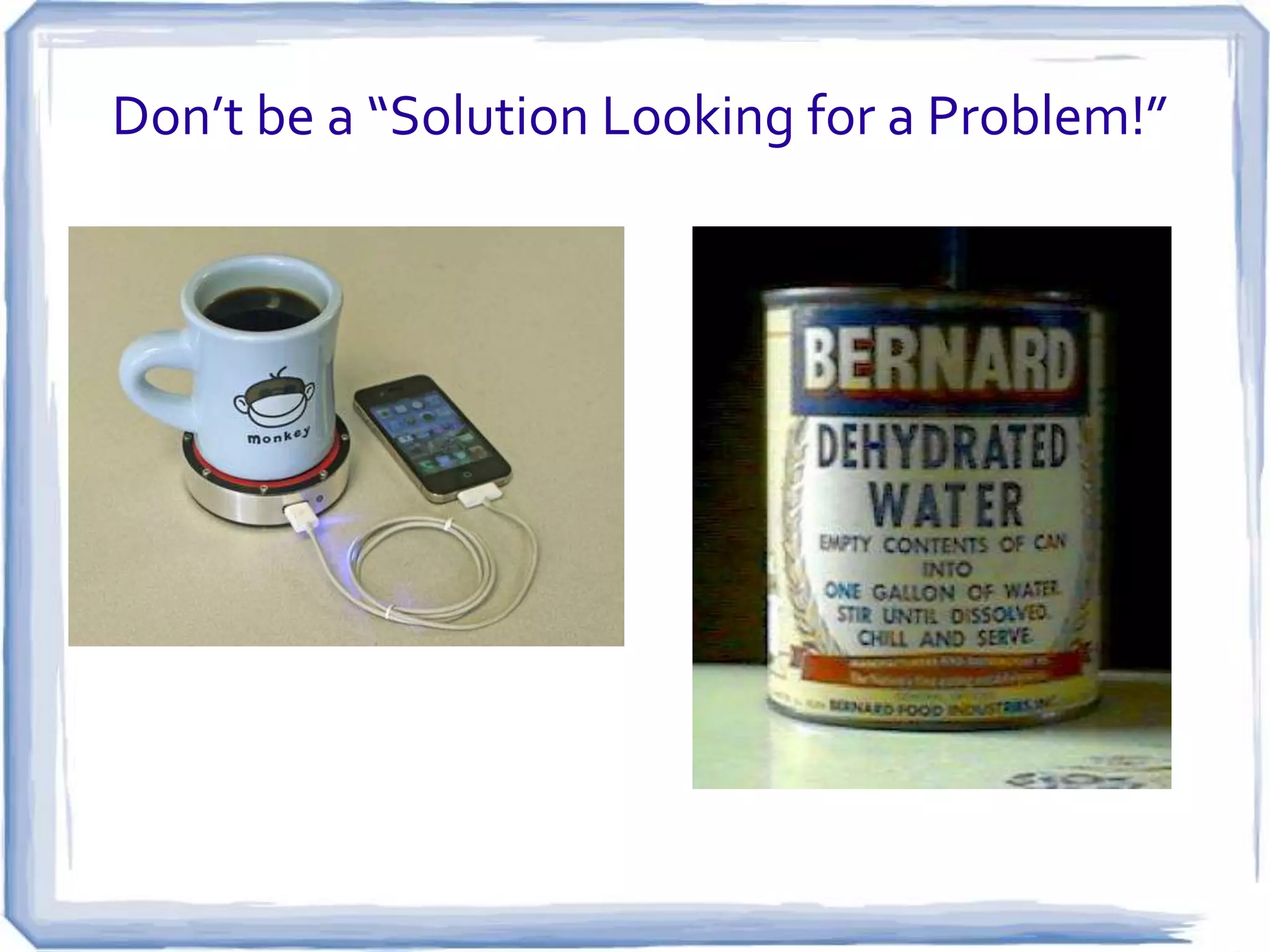
Don’t be a “Solution Looking for a Problem!”
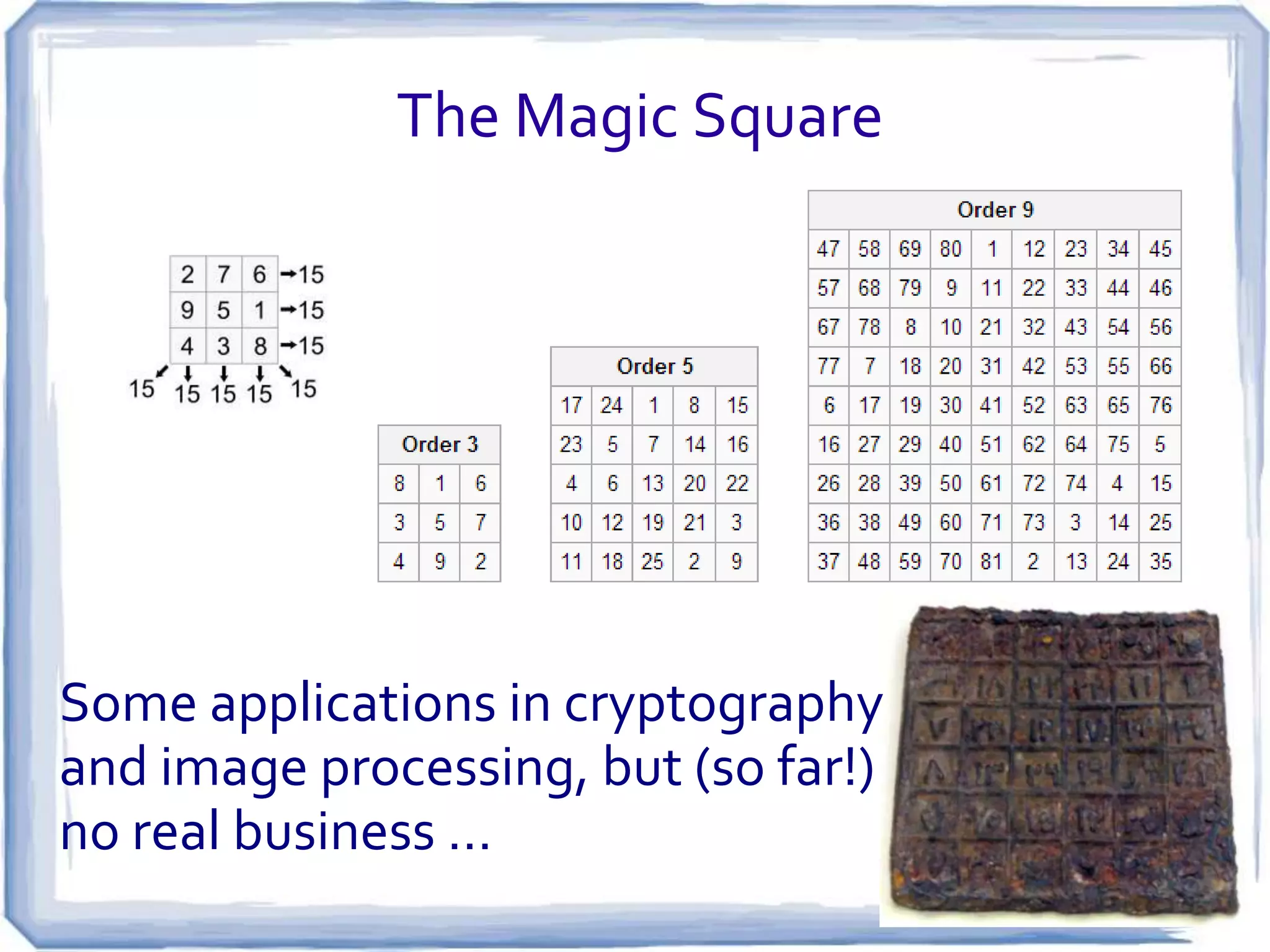
The Magic Square

Some applications in cryptography
and image processing, but (so far!)
no real business …
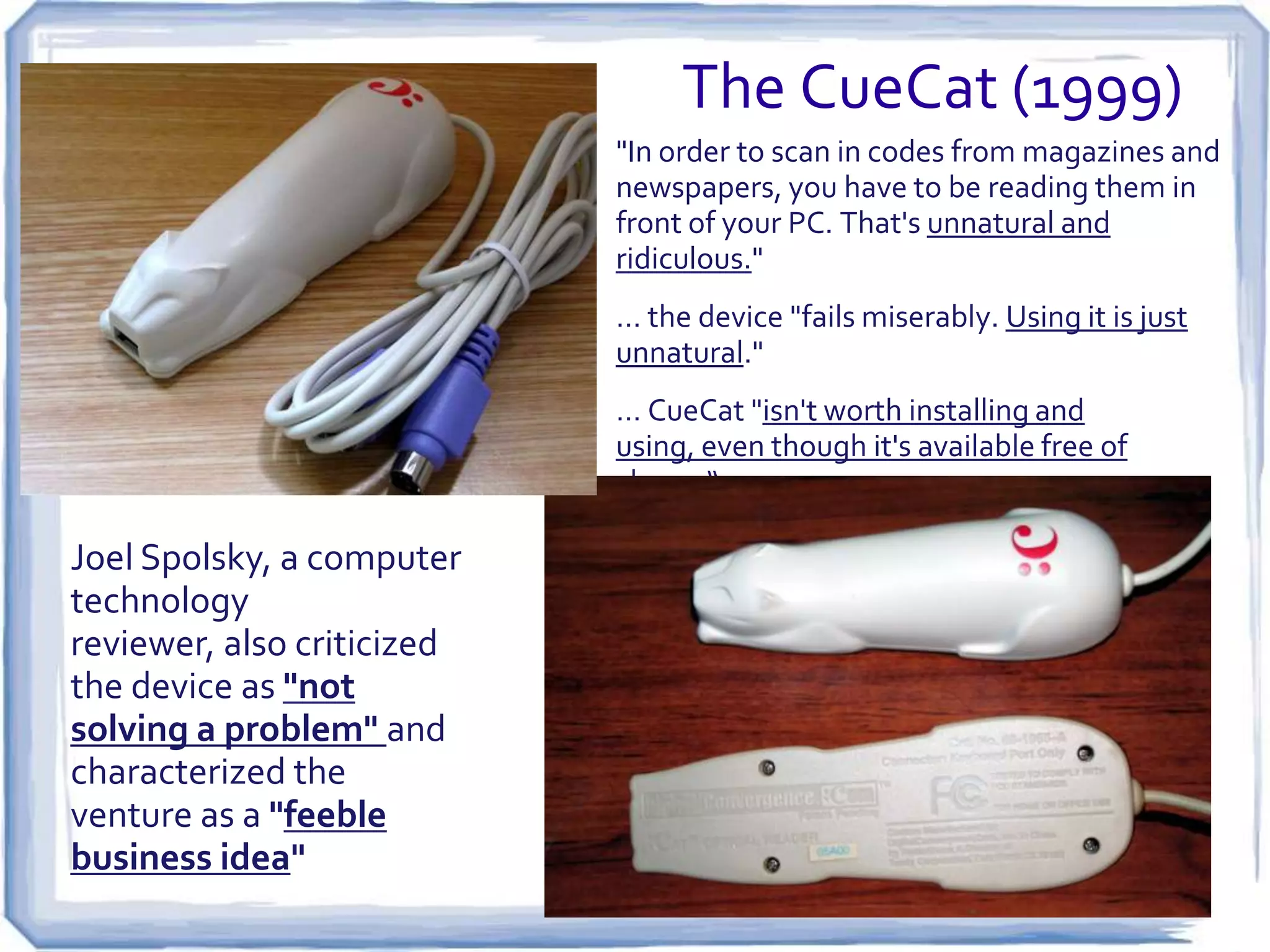
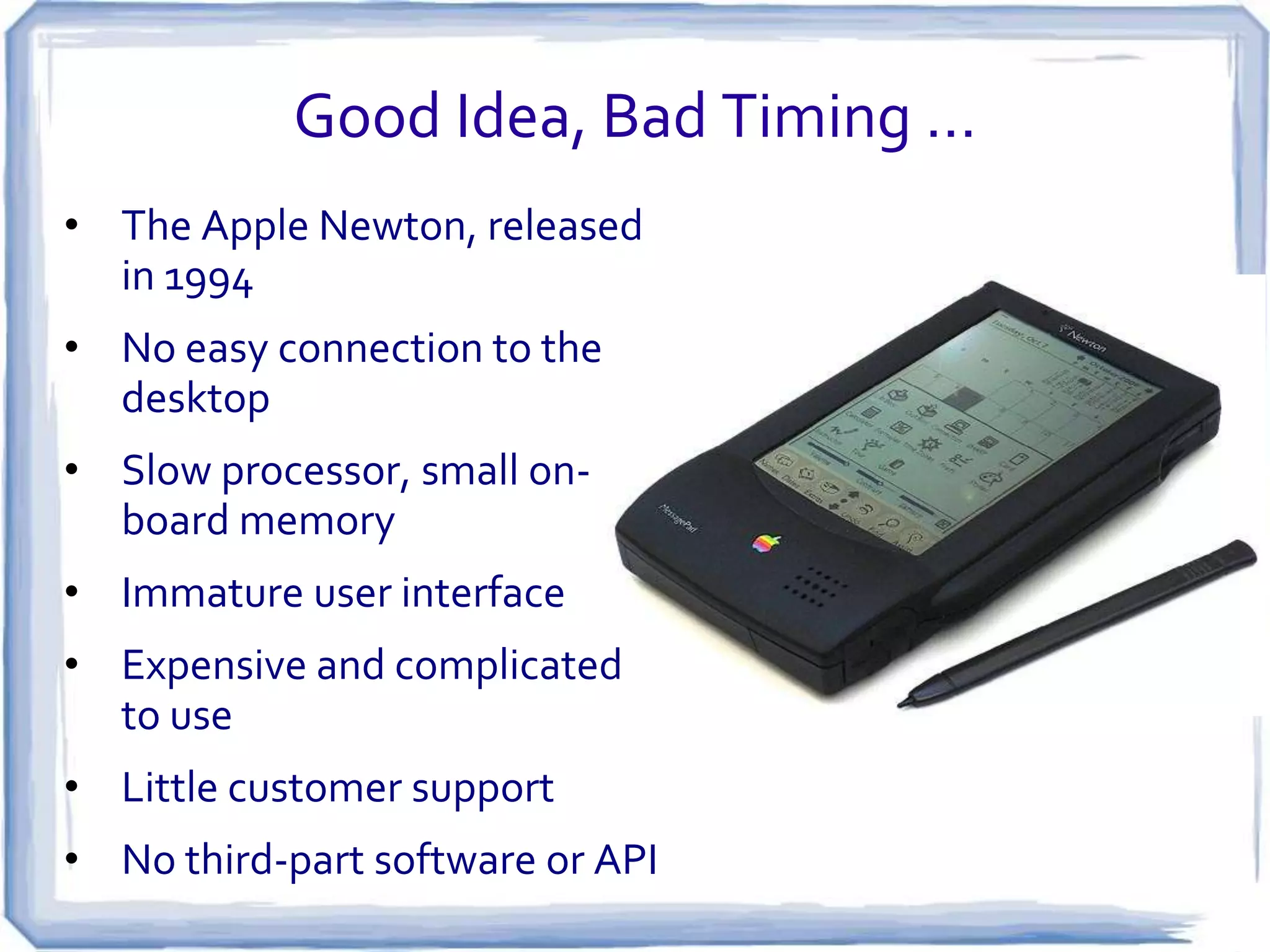
The CueCat (1999)
"In order to scan in codes from magazines and
newspapers, you have to be reading them in
front of your PC. That's unnatural and
ridiculous."
… the device "fails miserably. Using it is just
unnatural."
… CueCat "isn't worth installing and using,
even though it's available free of charge“

Joel Spolsky, a computer
technology reviewer,
also criticized the device
as "not solving a
problem" and
characterized the
venture as a "feeble
business idea"
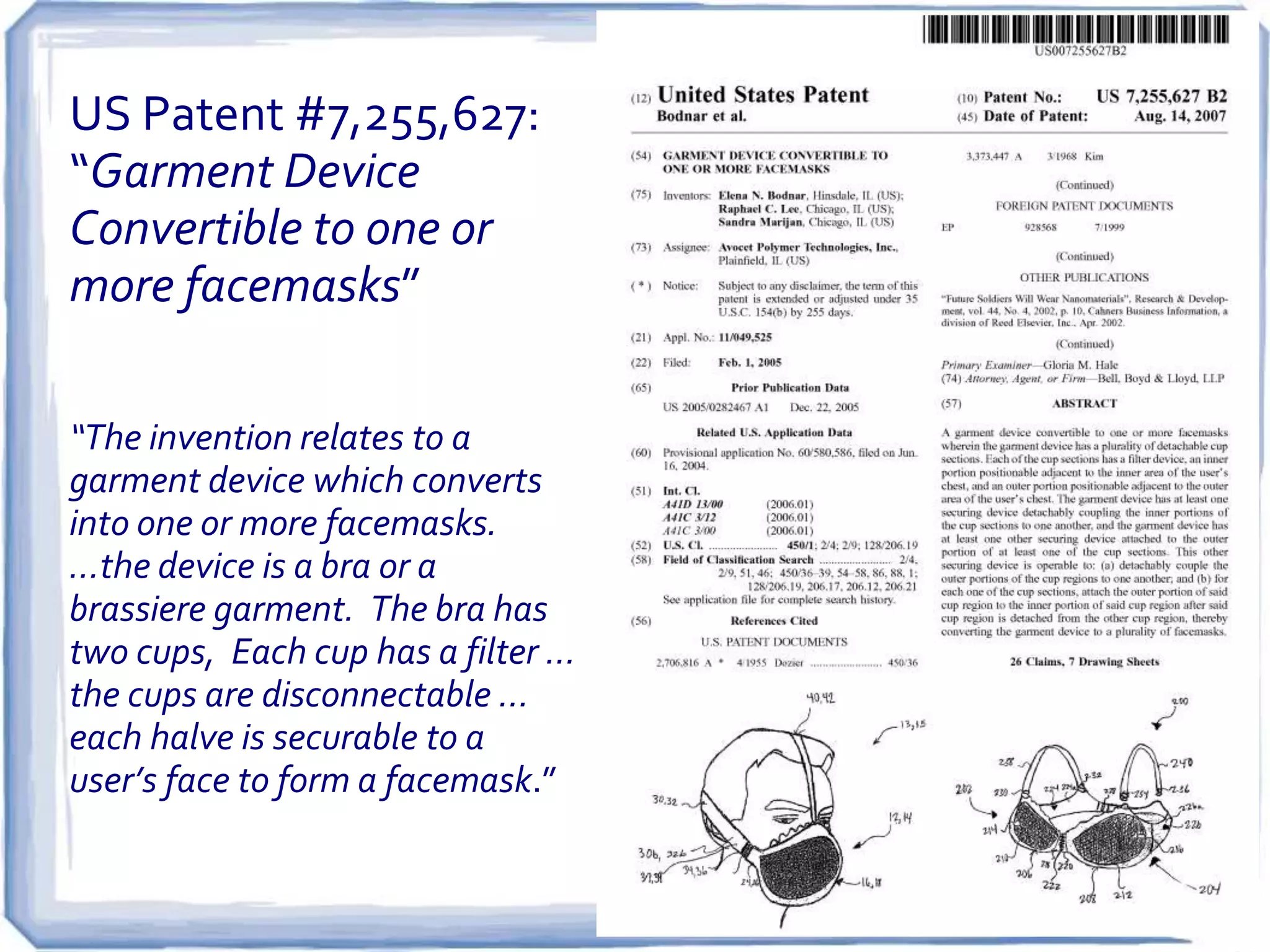
Good Idea, Bad Timing …
• The Apple Newton, released
in 1994

• No easy connection to the
desktop
• Slow processor, small onboard memory
• Immature user interface
• Expensive and complicated
to use
• Little customer support
• No third-part software or API
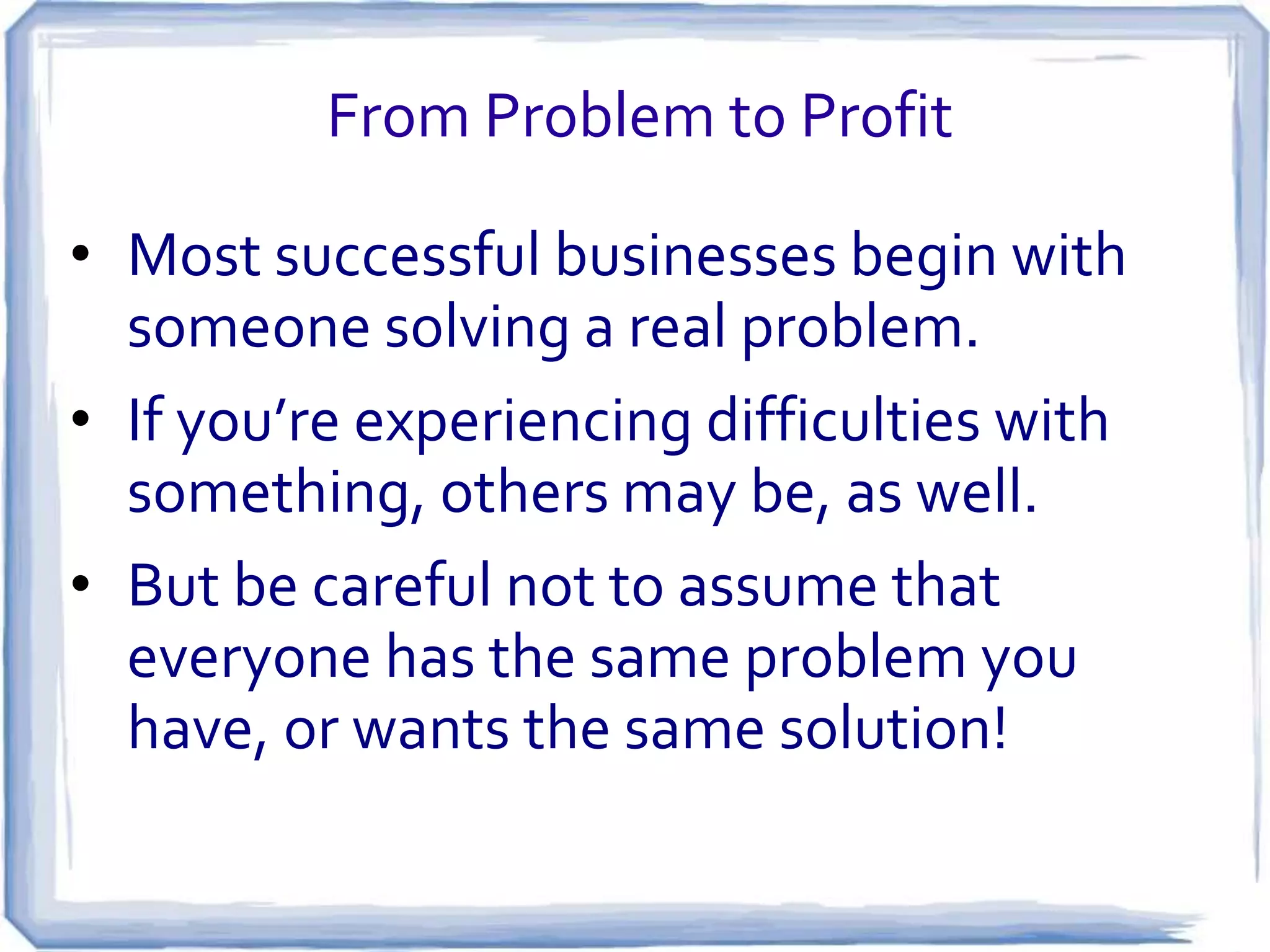
Eyeglasses with rear-view mirror
Banana Protection Device
From Problem to Profit
• Most successful businesses begin with
someone solving a real problem.
• If you’re experiencing difficulties with
something, others may be, as well.
• But be careful not to assume that
everyone has the same problem you
have, or wants the same solution!
Three questions to ask yourself
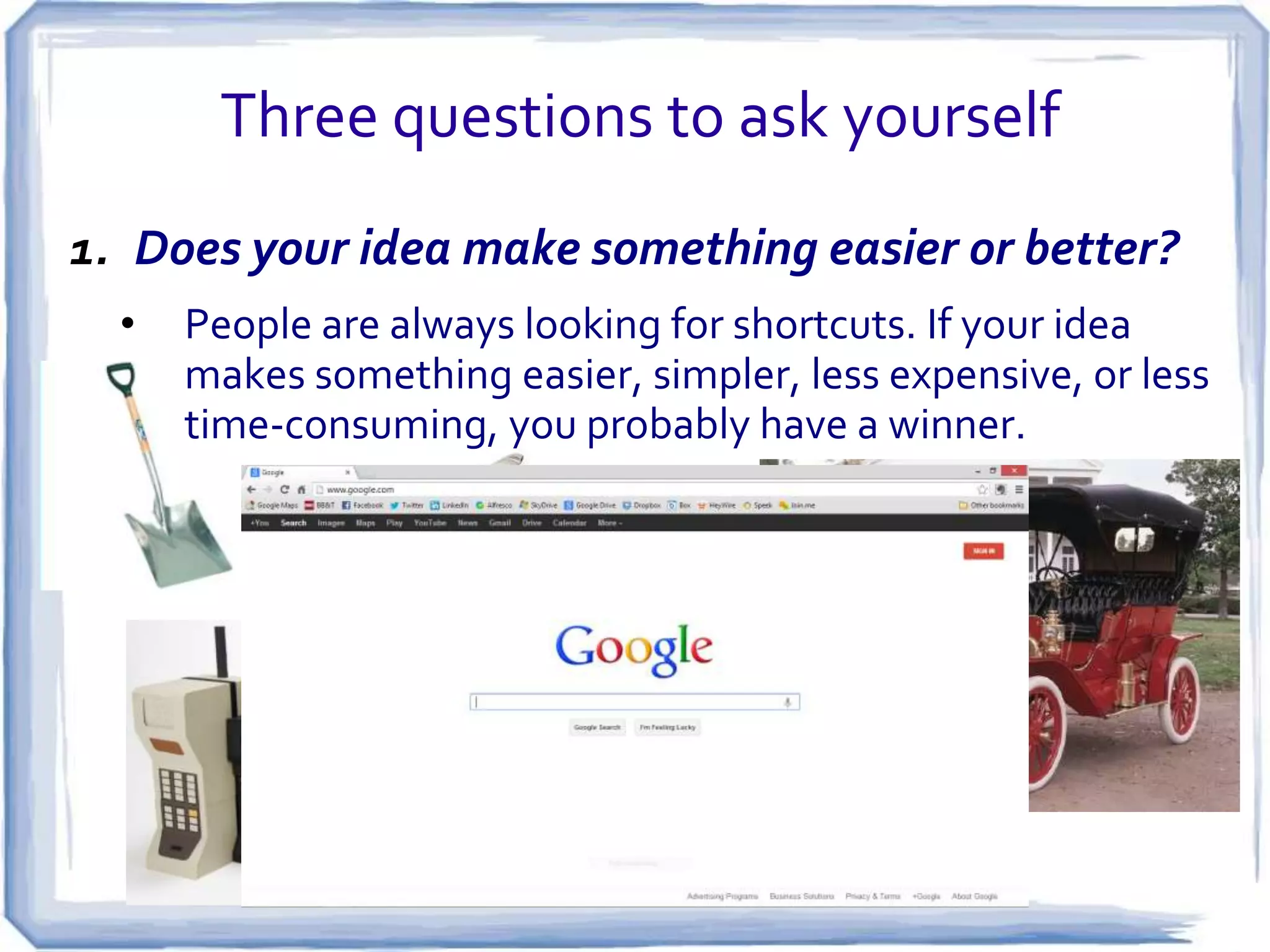
1. Does your idea make something easier or better?
•

People are always looking for shortcuts. If your idea
makes something easier, simpler, less expensive, or less
time-consuming, you probably have a winner.
Three questions to ask yourself
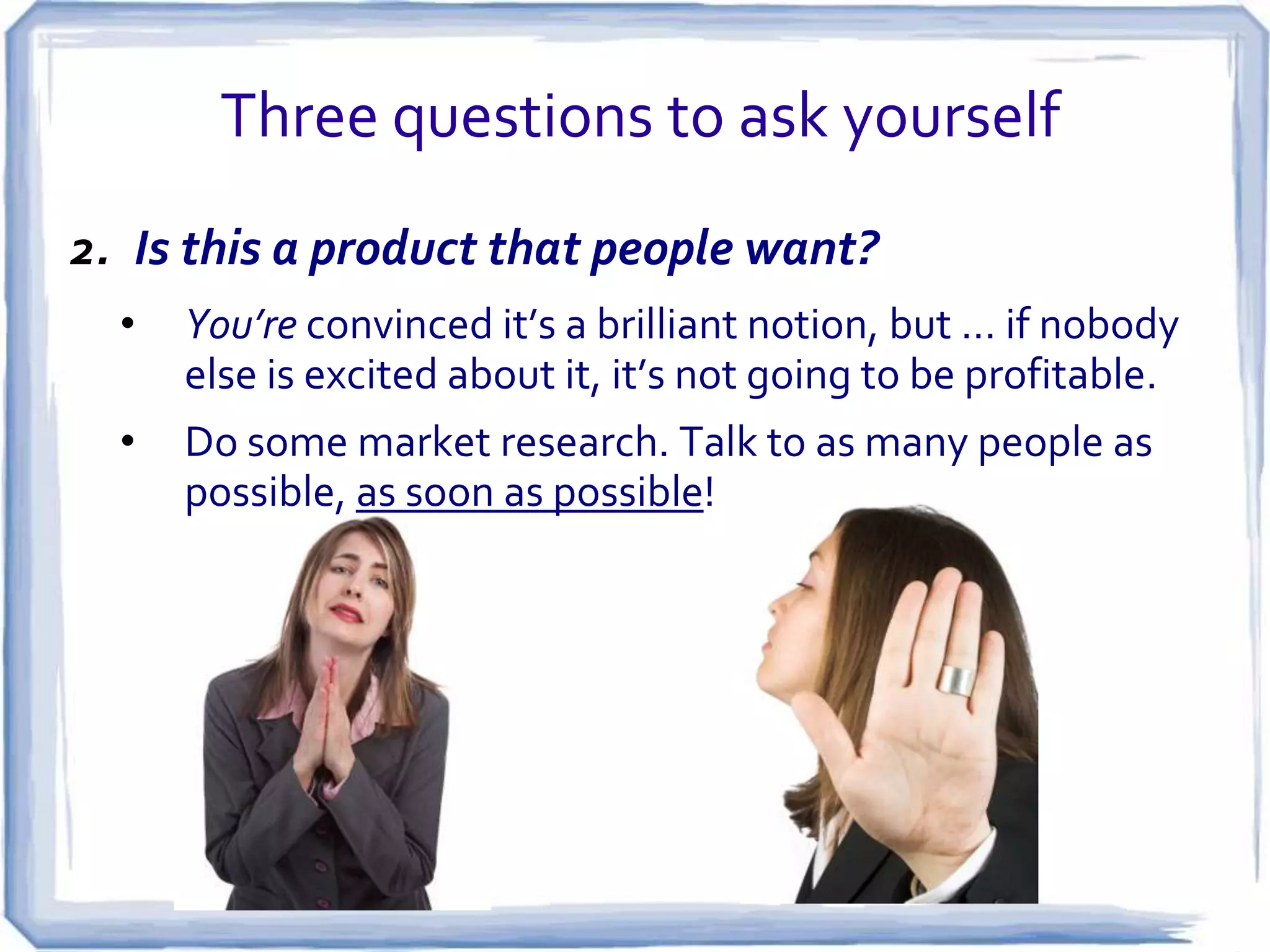
2. Is this a product that people want?
•

You’re convinced it’s a brilliant notion, but … if nobody
else is excited about it, it’s not going to be profitable.

•

Do some market research. Talk to as many people as
possible, as soon as possible!
Three questions to ask yourself
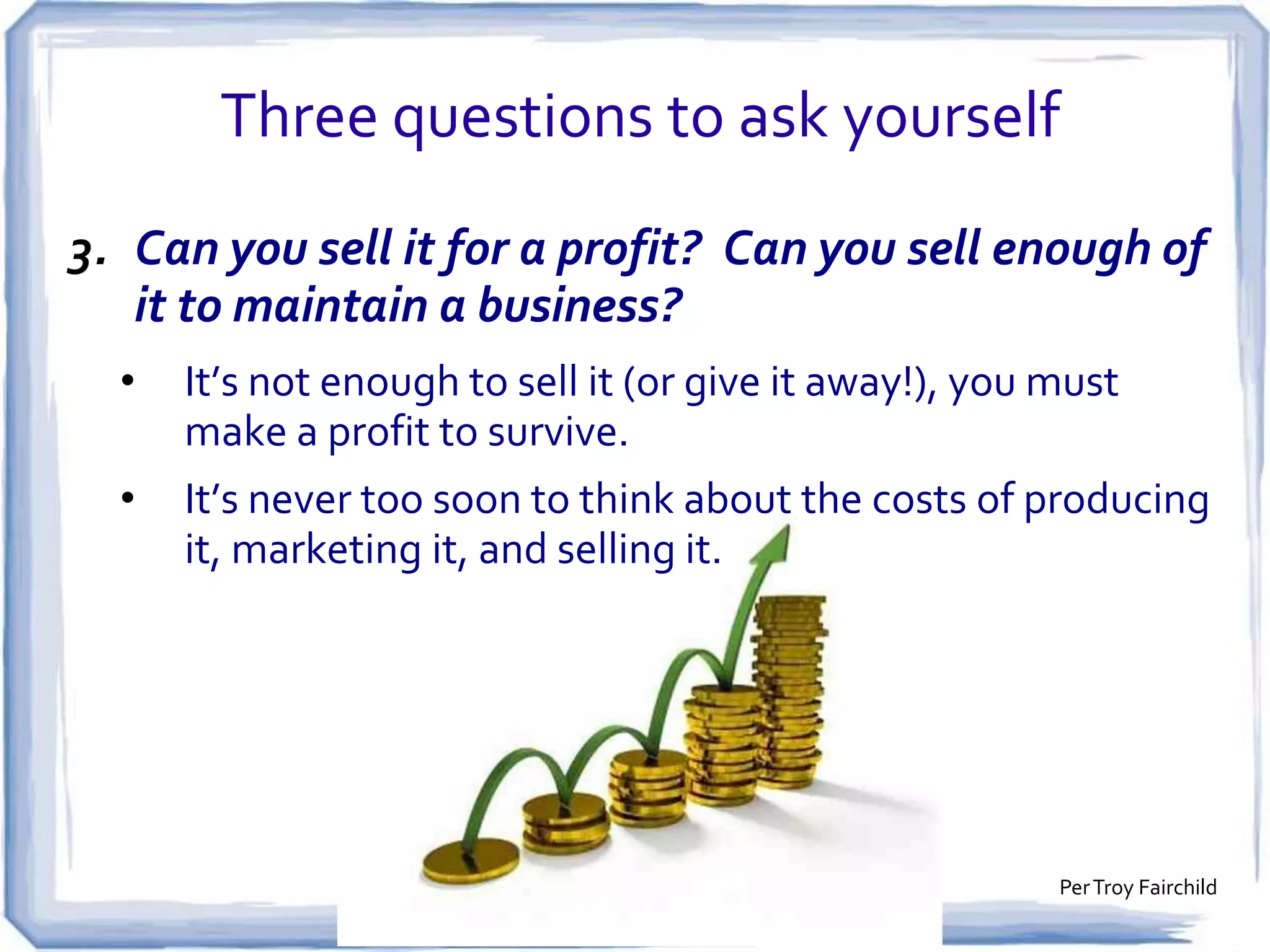
3. Can you sell it for a profit? Can you sell enough of
it to maintain a business?
•

It’s not enough to sell it (or give it away!), you must
make a profit to survive.

•

It’s never too soon to think about the costs of producing
it, marketing it, and selling it.

Per Troy Fairchild
But How Do I Find a Good Idea?
1. Build your startup around real-life problems that need to be solved:
• You probably already complain about things … Stop complaining and start fixing!

2. Question inefficient patterns and processes:
• Look for annoying manual processes; useless intermediaries & boring repetitive tasks.

3. Focus on time, money, and convenience:
• Behavioral solutions matter more than technological solutions -- reduce cost, make life
simpler, make technology less intrusive, help people find more time in their day.

4. Be realistic, but futuristic:
• It’s difficult to change the world all at once …
• Fix one specific problem in a way that makes things easier, faster, less expensive.

5. Iterate, iterate, iterate:
• Build,/release/improve, Build,/release/improve, Build,/release/improve…
Per Paul Graham
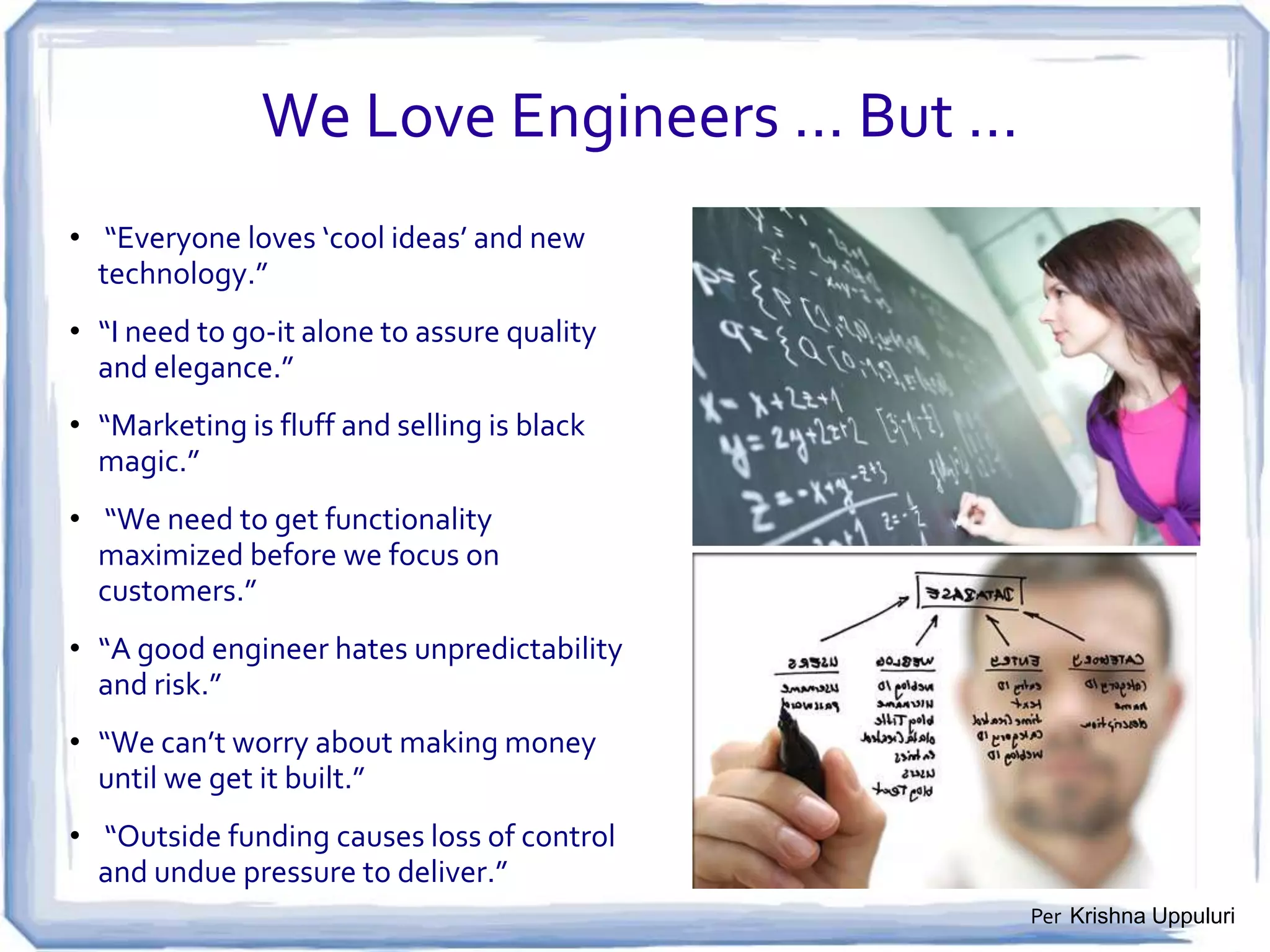
We Love Engineers … But …
• “Everyone loves ‘cool ideas’ and new
technology.”
• “I need to go-it alone to assure quality
and elegance.”
• “Marketing is fluff and selling is black
magic.”
• “We need to get functionality
maximized before we focus on
customers.”
• “A good engineer hates unpredictability
and risk.”
• “We can’t worry about making money
until we get it built.”
• “Outside funding causes loss of control
and undue pressure to deliver.”
Per Krishna Uppuluri
The Next Big Thing Will Be …
1.Deep:

• A deep product or service solves an immediate problem but has
room for a robust set of features that anticipate what your
customers will need in the future
• BUT DON’T TRY TO DO EVERYTHNG AT ONCE!!!!
The Next Big Thing Will Be …
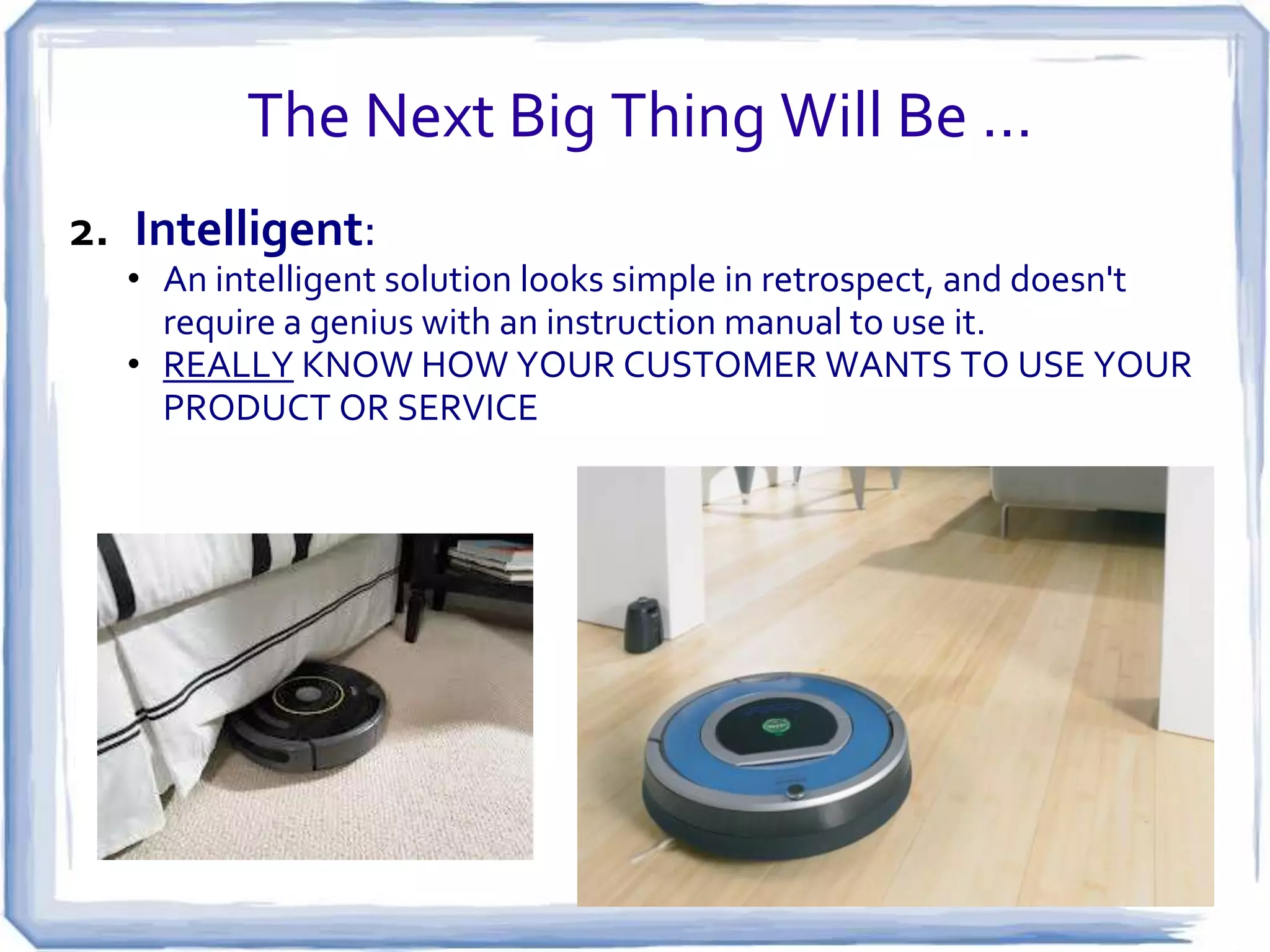
2. Intelligent:

• An intelligent solution looks simple in retrospect, and doesn't
require a genius with an instruction manual to use it.
• REALLY KNOW HOW YOUR CUSTOMER WANTS TO USE YOUR
PRODUCT OR SERVICE
The Next Big Thing Will Be …
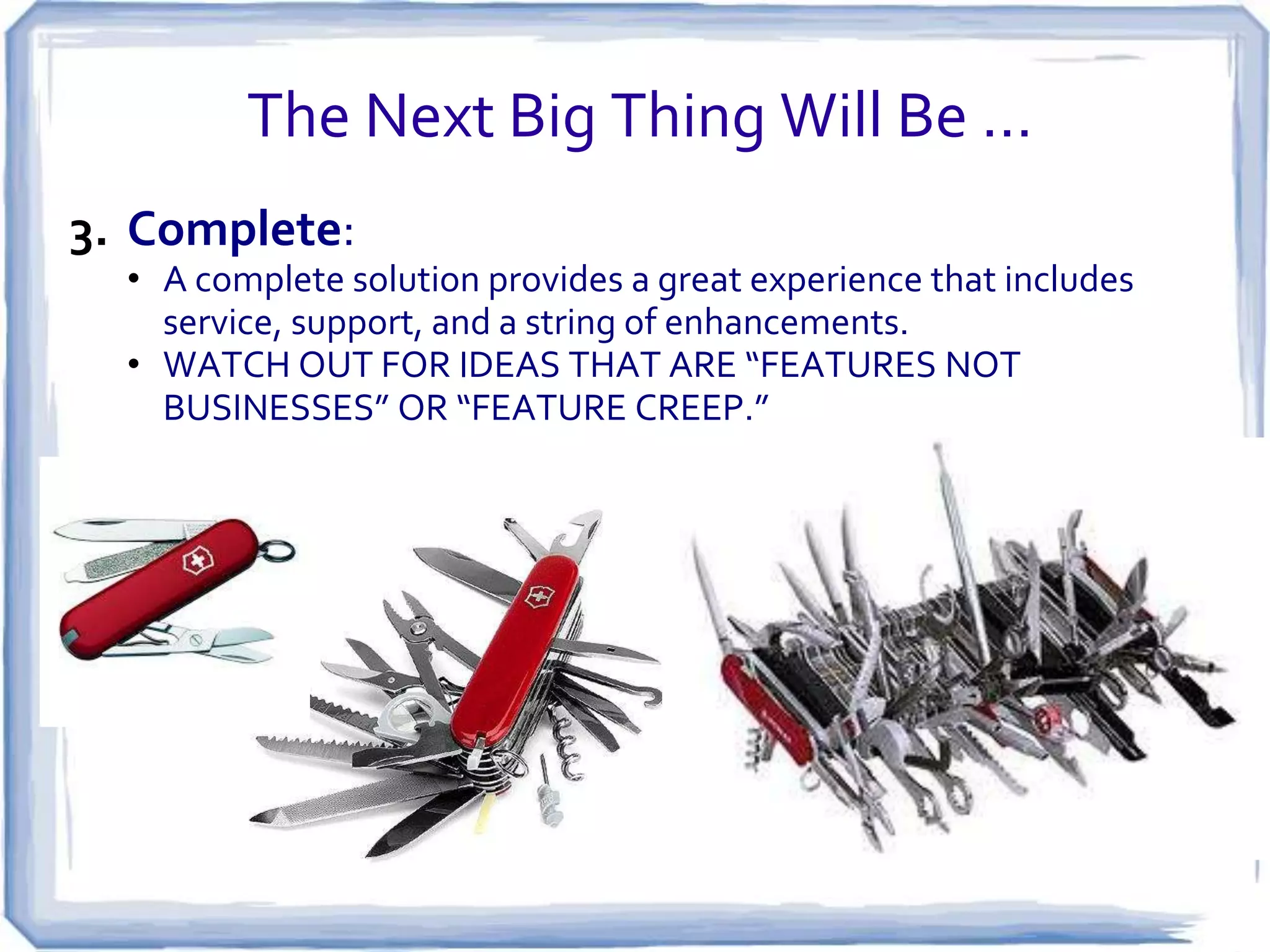
3. Complete:

• A complete solution provides a great experience that includes
service, support, and a string of enhancements.
• WATCH OUT FOR IDEAS THAT ARE “FEATURES NOT
BUSINESSES” OR “FEATURE CREEP.”
The Next Big Thing Will Be …
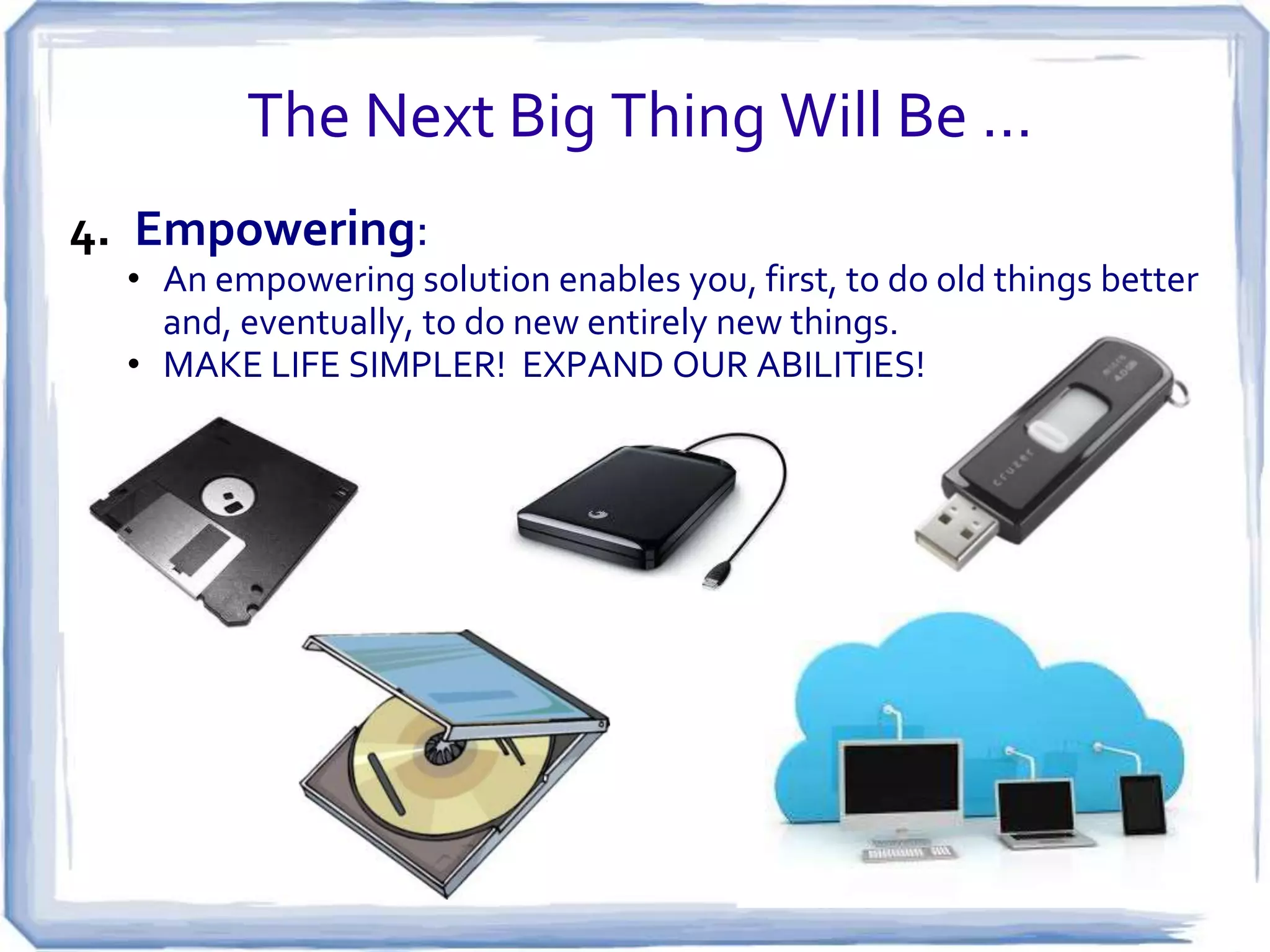
4. Empowering:

• An empowering solution enables you, first, to do old things better
and, eventually, to do new entirely new things.
• MAKE LIFE SIMPLER! EXPAND OUR ABILITIES!
The Next Big Thing Will Be …
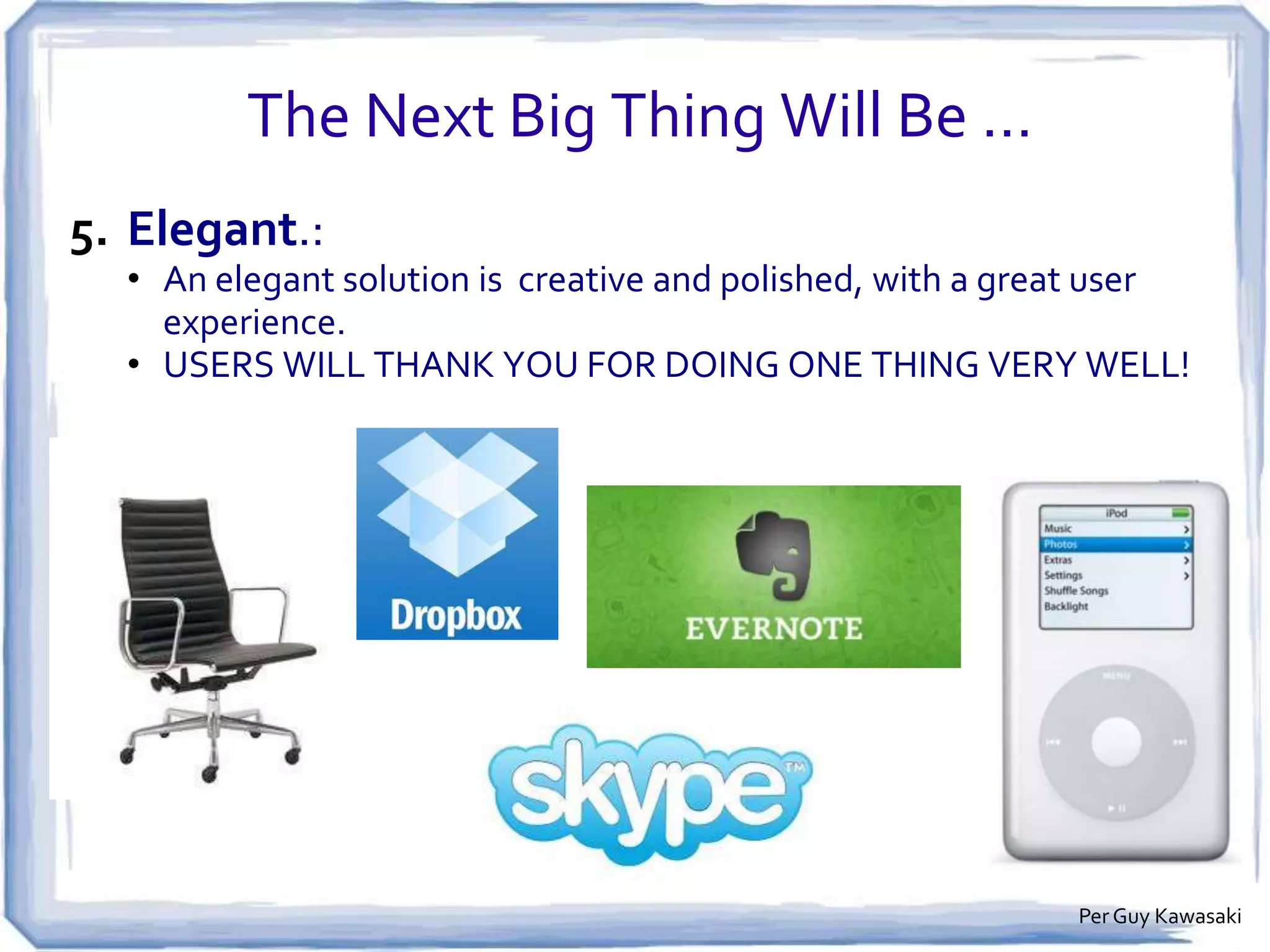
5. Elegant.:

• An elegant solution is creative and polished, with a great user
experience.
• USERS WILL THANK YOU FOR DOING ONE THING VERY WELL!

Per Guy Kawasaki
Is your idea
Deep?
Intelligent?
Complete?
Empowering?
Elegant?
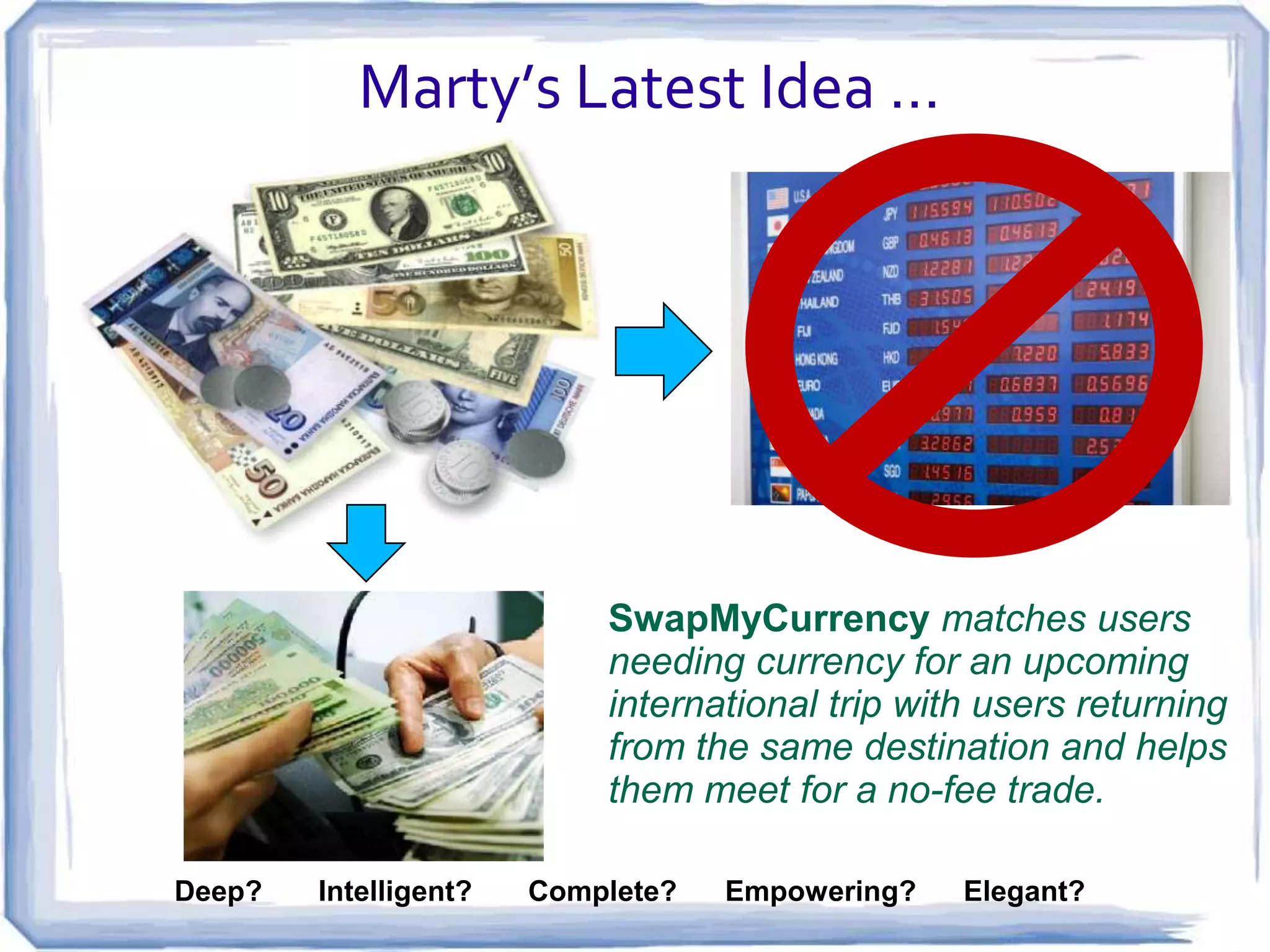
Marty’s Latest Idea …

SwapMyCurrency matches users
needing currency for an upcoming
international trip with users returning
from the same destination and helps
them meet for a no-fee trade.
Deep?

Intelligent?

Complete?

Empowering?

Elegant?
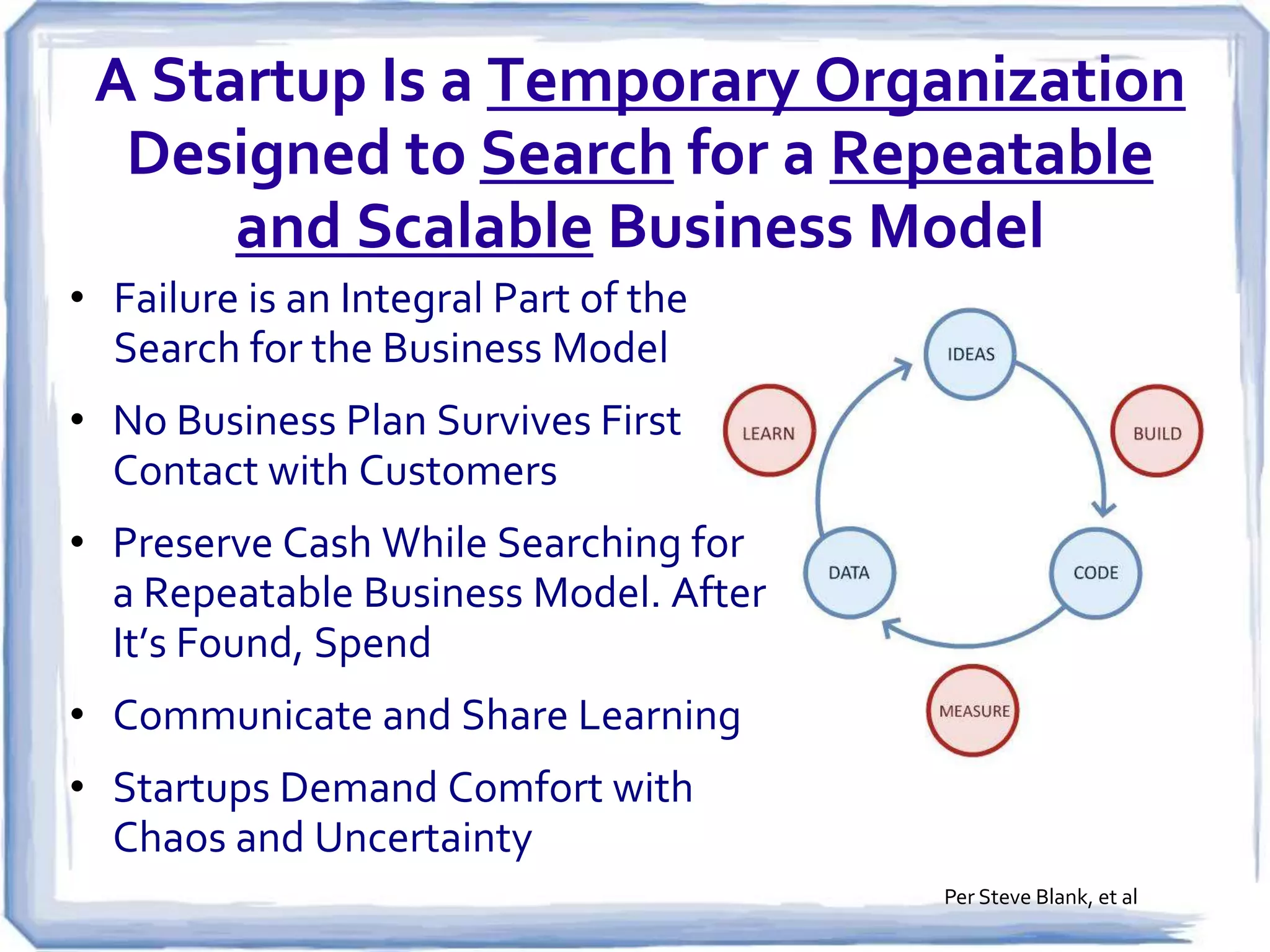
A Startup Is a Temporary Organization
Designed to Search for a Repeatable
and Scalable Business Model
• Failure is an Integral Part of the
Search for the Business Model

• No Business Plan Survives First
Contact with Customers
• Preserve Cash While Searching for
a Repeatable Business Model. After
It’s Found, Spend
• Communicate and Share Learning

• Startups Demand Comfort with
Chaos and Uncertainty
Per Steve Blank, et al
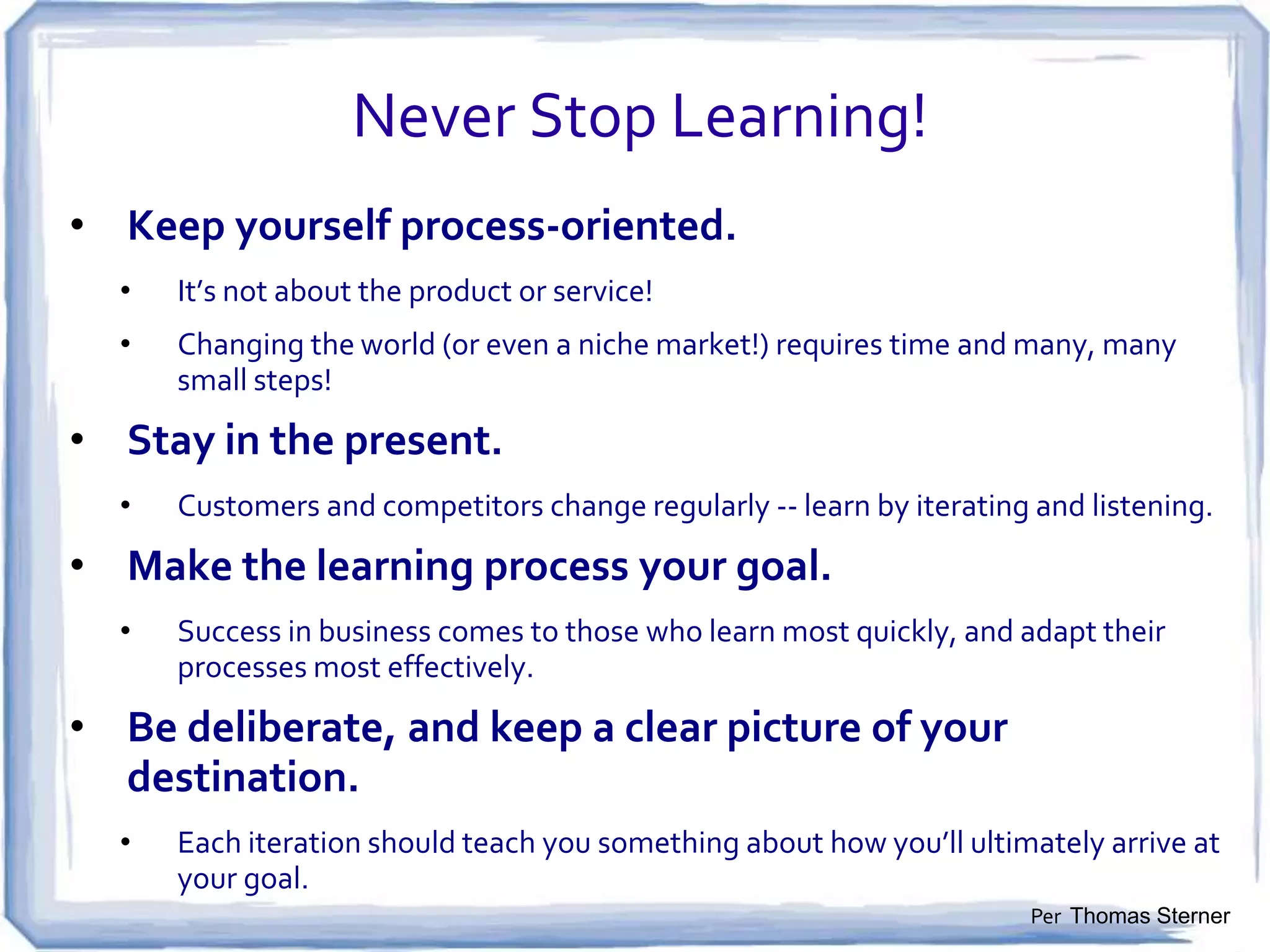
Never Stop Learning!
• Keep yourself process-oriented.
•

It’s not about the product or service!

•

Changing the world (or even a niche market!) requires time and many, many
small steps!

• Stay in the present.
•

Customers and competitors change regularly -- learn by iterating and listening.

• Make the learning process your goal.
•

Success in business comes to those who learn most quickly, and adapt their
processes most effectively.

• Be deliberate, and keep a clear picture of your
destination.
•

Each iteration should teach you something about how you’ll ultimately arrive at
your goal.
Per Thomas Sterner
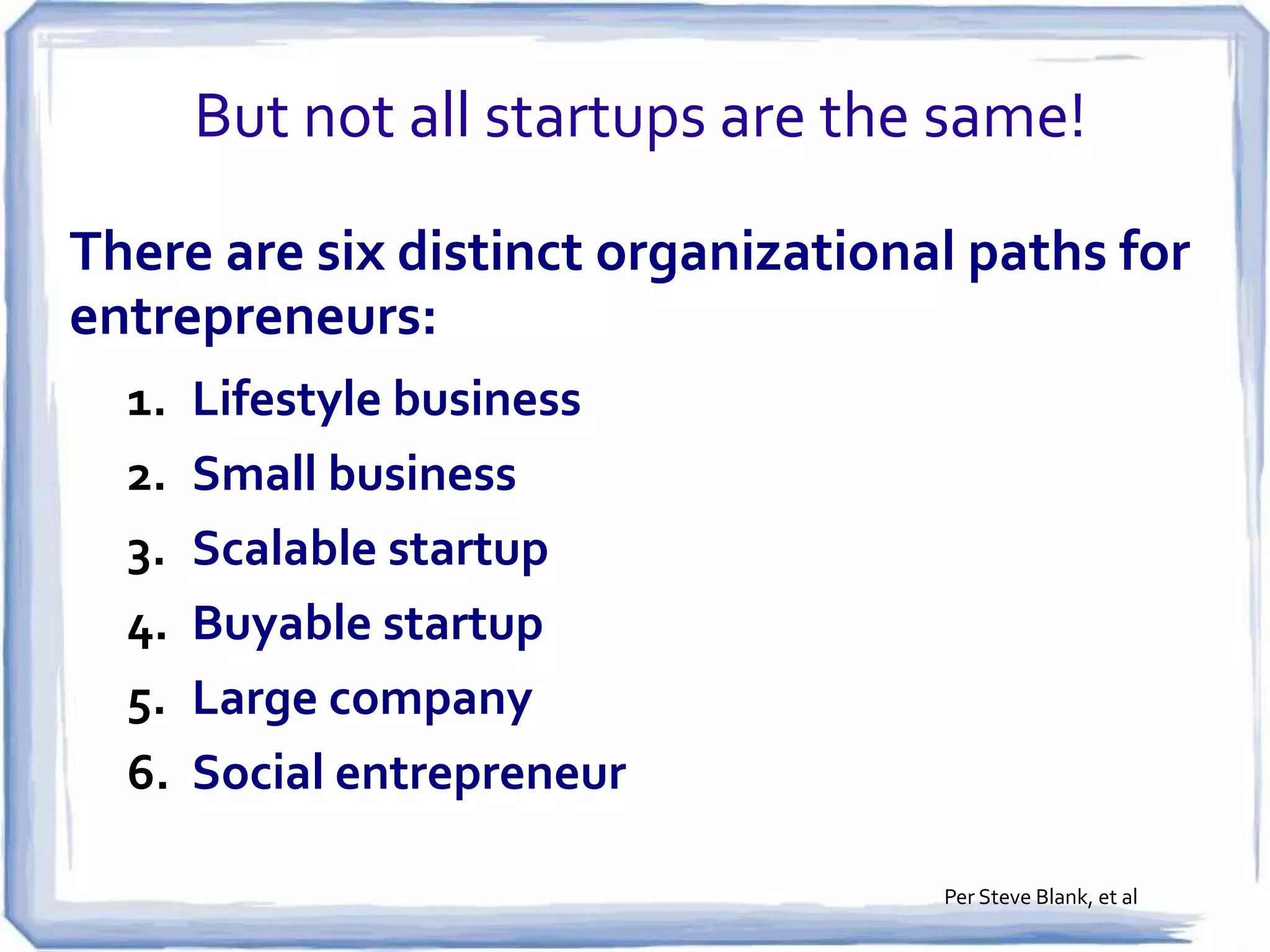
But not all startups are the same!
There are six distinct organizational paths for
entrepreneurs:
1.
2.
3.
4.
5.
6.

Lifestyle business
Small business
Scalable startup
Buyable startup
Large company
Social entrepreneur
Per Steve Blank, et al
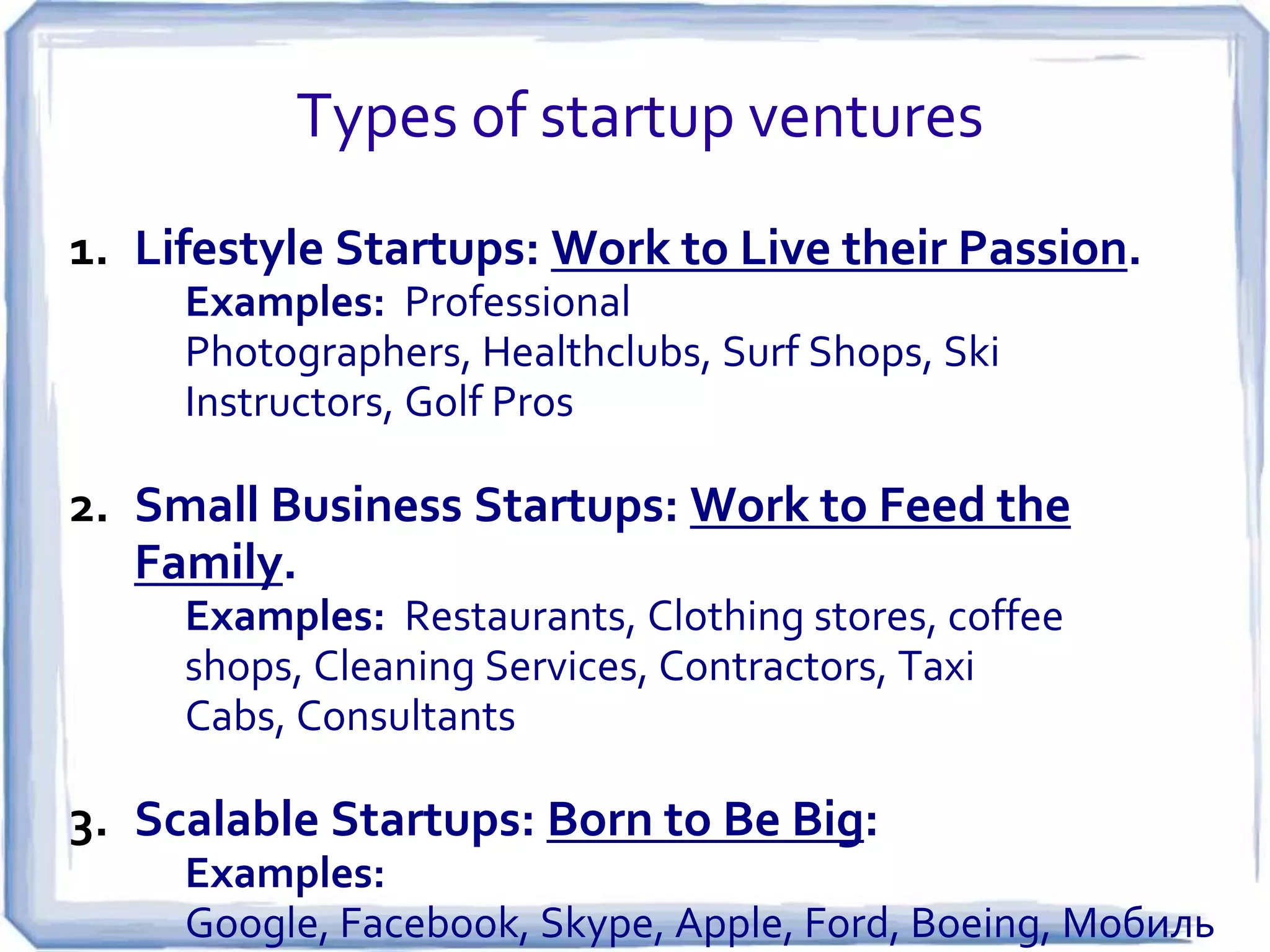
Types of startup ventures
1. Lifestyle Startups: Work to Live their Passion.
Examples: Professional Photographers, Healthclubs,
Surf Shops, Ski Instructors, Golf Pros

2. Small Business Startups: Work to Feed the
Family.
Examples: Restaurants, Clothing stores, coffee shops,
Cleaning Services, Contractors, Taxi Cabs, Consultants

3. Scalable Startups: Born to Be Big:
Examples: Google, Facebook, Skype, Apple, Ford,
Boeing, Мобильные Телесистемы, SoftServe, etc.
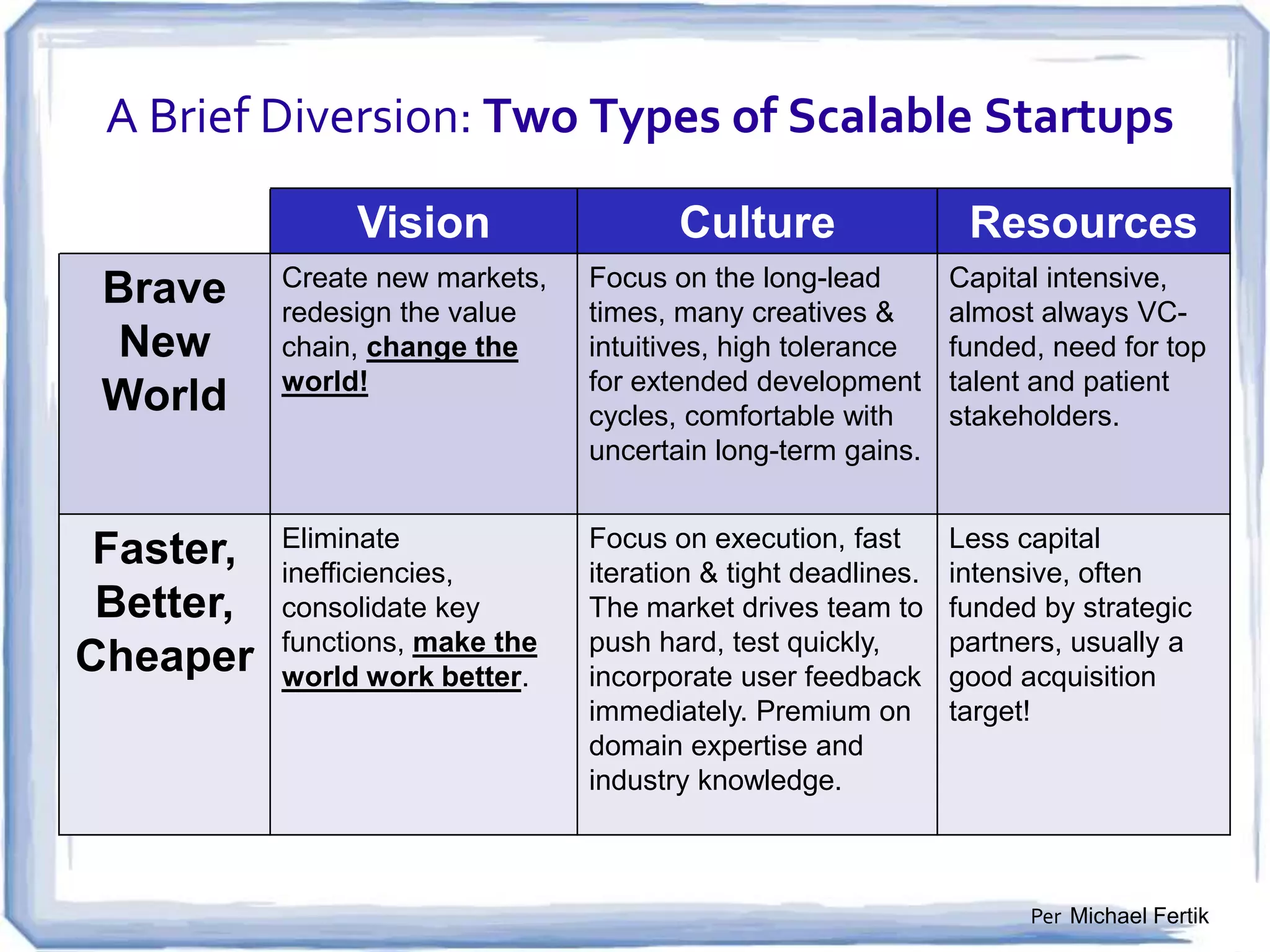
A Brief Diversion: Two Types of Scalable Startups
Vision

Culture

Resources

Brave
New
World

Create new markets,
redesign the value
chain, change the
world!

Focus on the long-lead
times, many creatives &
intuitives, high tolerance
for extended development
cycles, comfortable with
uncertain long-term gains.

Capital intensive,
almost always VCfunded, need for top
talent and patient
stakeholders.

Faster,
Better,
Cheaper

Eliminate
inefficiencies,
consolidate key
functions, make the
world work better.

Focus on execution, fast
iteration & tight deadlines.
The market drives team to
push hard, test quickly,
incorporate user feedback
immediately. Premium on
domain expertise and
industry knowledge.

Less capital
intensive, often
funded by strategic
partners, usually a
good acquisition
target!

Per Michael Fertik
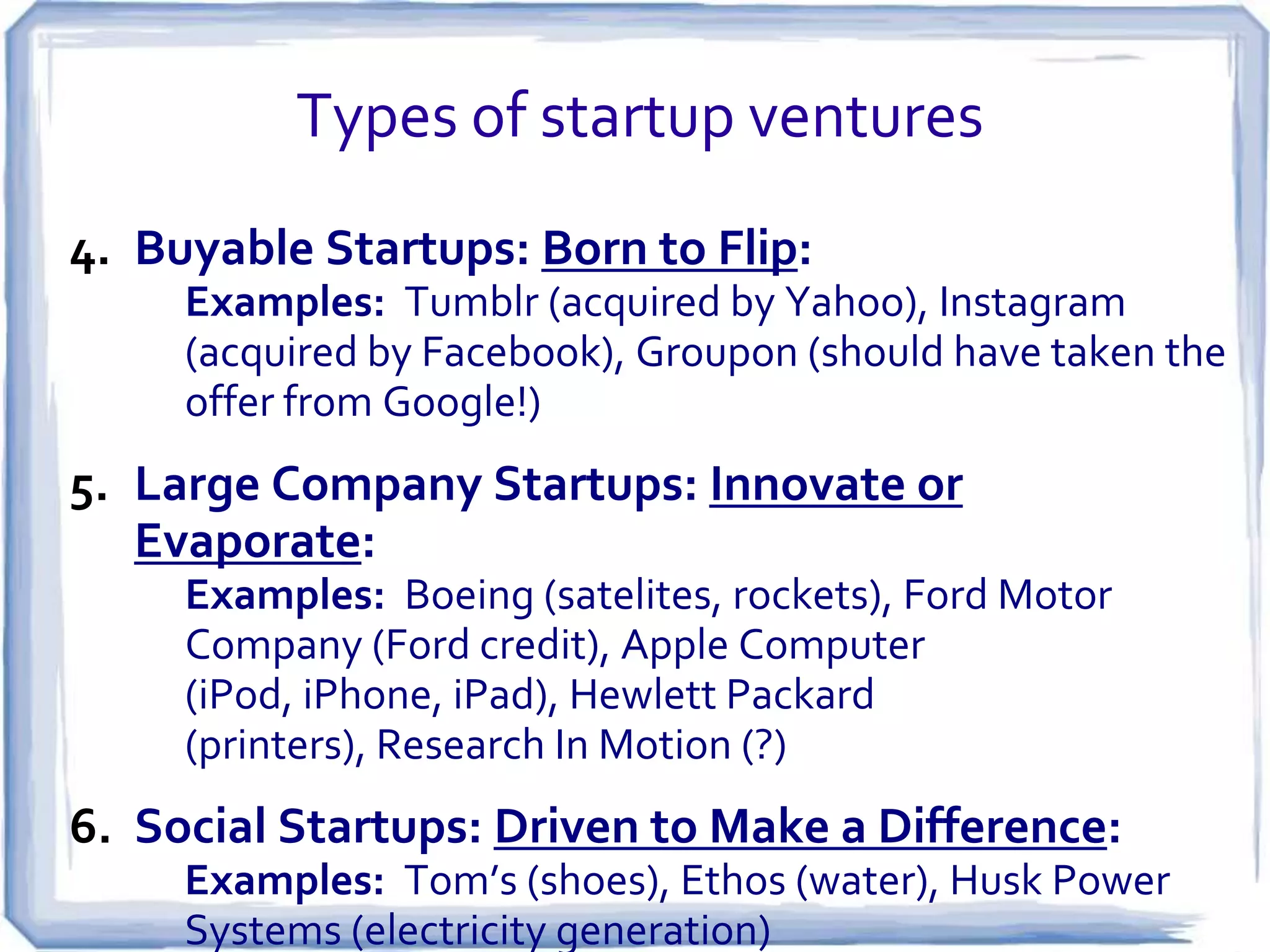
Types of startup ventures
4. Buyable Startups: Born to Flip:
Examples: Tumblr (acquired by Yahoo), Instagram
(acquired by Facebook), Groupon (should have taken the
offer from Google!)

5. Large Company Startups: Innovate or
Evaporate:
Examples: Boeing (satelites, rockets), Ford Motor
Company (Ford credit), Apple Computer (iPod, iPhone,
iPad), Hewlett Packard (printers), Research In Motion (?)

6. Social Startups: Driven to Make a Difference:
Examples: Tom’s (shoes), Ethos (water), Husk Power
Systems (electricity generation)
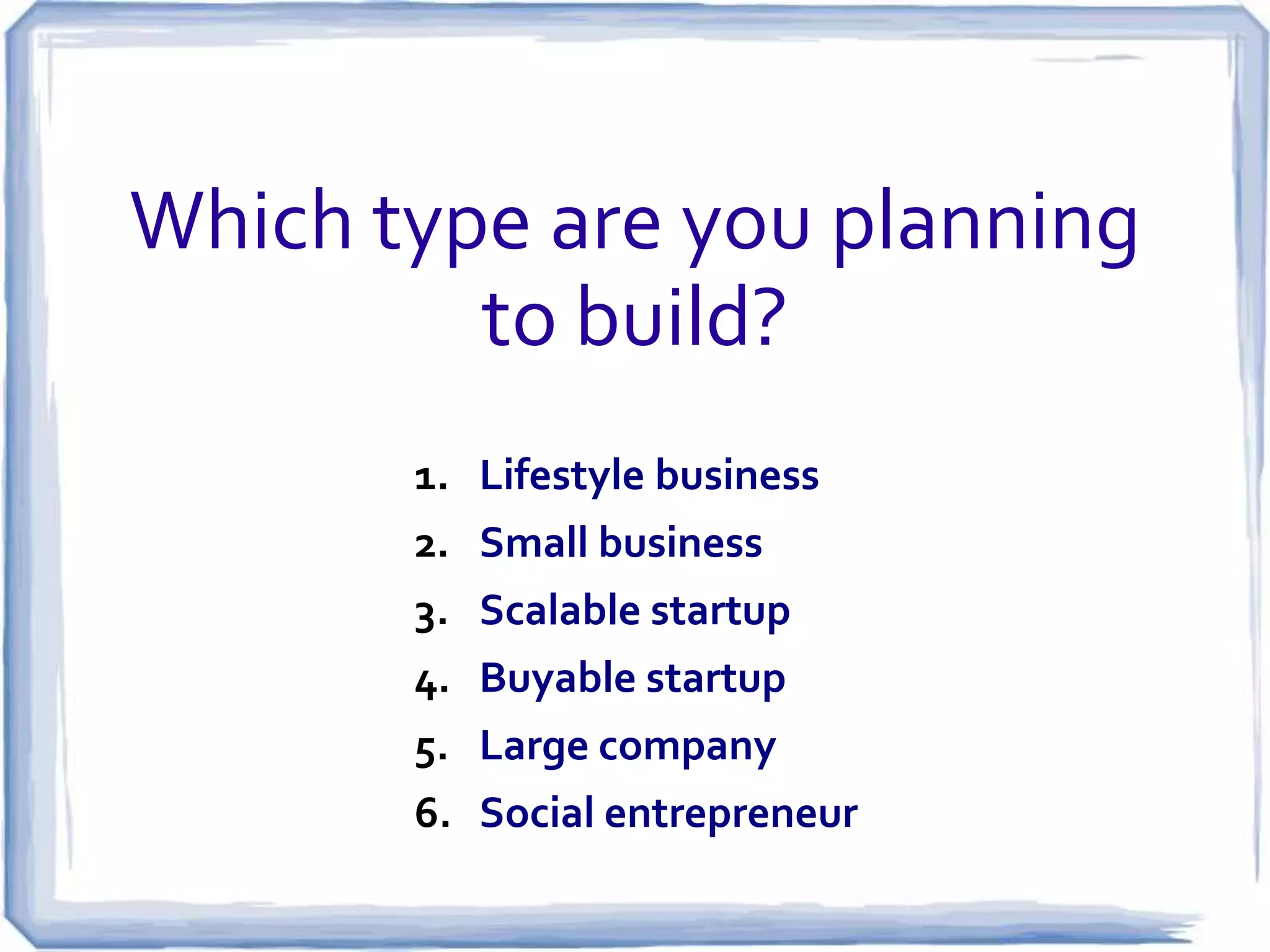
Which type are you planning
to build?
1. Lifestyle business

2. Small business
3. Scalable startup
4. Buyable startup

5. Large company
6. Social entrepreneur
10 Step Start-up
1. Have a plan, but skip
The Plan

6. Sell something

2. Start to assess the
market

8. Fake it to make it

3. Build a brand

7. Work the media

9. Work in and on the
business

4. Create the legal entity 10.Party!
5. Build a Lean Machine,
deliver MVP
Leave until later …
•
•
•
•

“Sales Whales”
• Cool office space
High end web site • Internal sales
staff
Consultants
• Outside
New products &
marketing &
services
Public Relations
• Strategic
Planning
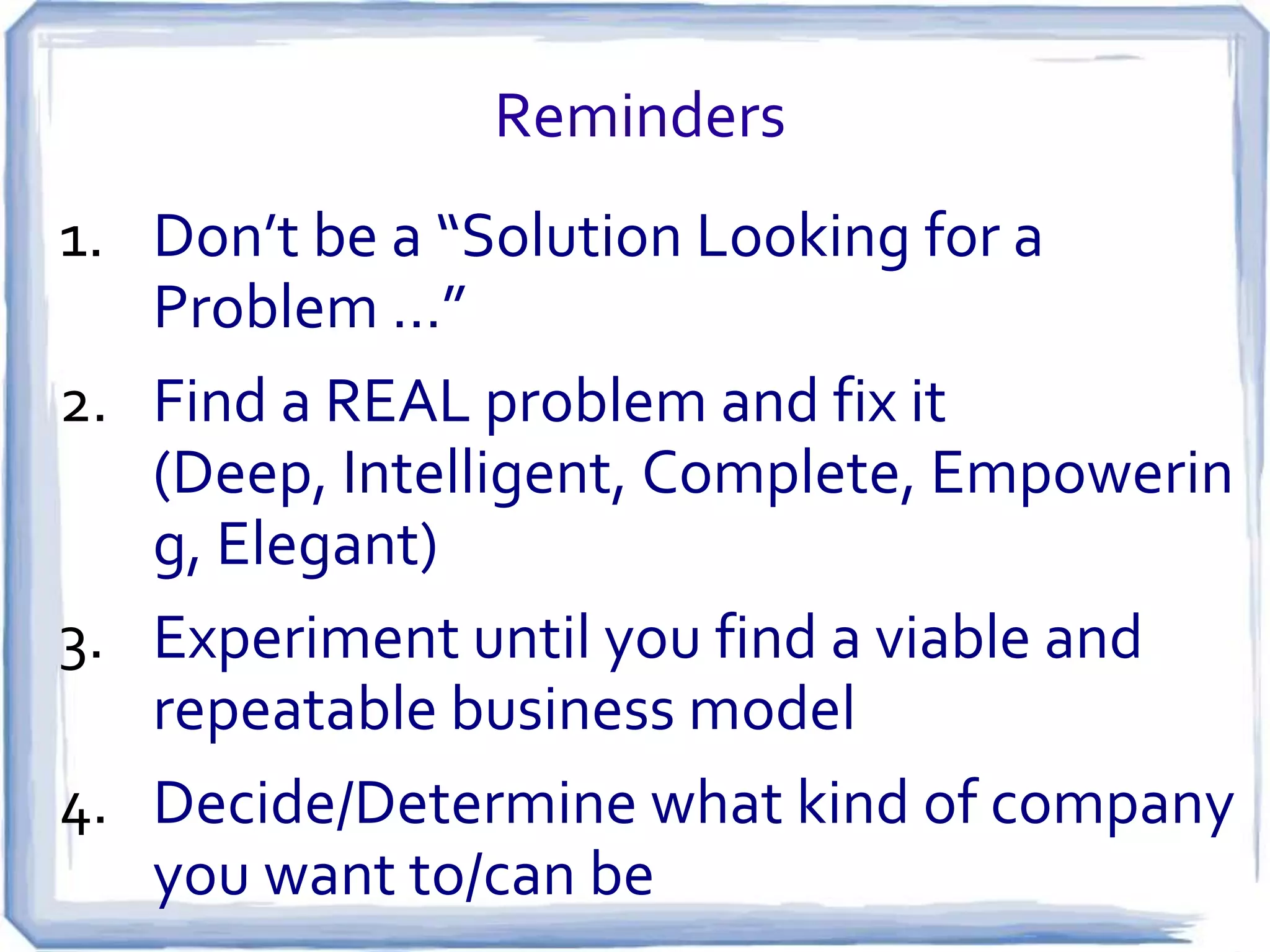
Reminders
1. Don’t be a “Solution Looking for a
Problem …”
2. Find a REAL problem and fix it (Deep,
Intelligent, Complete, Empowering,
Elegant)
3. Experiment until you find a viable and
repeatable business model
4. Decide/Determine what kind of company
you want to/can be
Questions?

Updated: You Have An Idea ... Do You Have A Business?

  • 1.
    You have anIdea … Do you have a Business? Marty Kaszubowski President, General Ideas
  • 2.
    Topics 1. Don’t bea “Solution Looking for a Problem …” 2. Find a REAL problem and fix it 3. Experiment until you find a viable and repeatable business model 4. Decide/Determine what kind of company you want to/can be
  • 3.
    Don’t be a“Solution Looking for a Problem!”
  • 4.
    The Magic Square Someapplications in cryptography and image processing, but (so far!) no real business …
  • 5.
    The CueCat (1999) "Inorder to scan in codes from magazines and newspapers, you have to be reading them in front of your PC. That's unnatural and ridiculous." … the device "fails miserably. Using it is just unnatural." … CueCat "isn't worth installing and using, even though it's available free of charge“ Joel Spolsky, a computer technology reviewer, also criticized the device as "not solving a problem" and characterized the venture as a "feeble business idea"
  • 6.
    Good Idea, BadTiming … • The Apple Newton, released in 1994 • No easy connection to the desktop • Slow processor, small onboard memory • Immature user interface • Expensive and complicated to use • Little customer support • No third-part software or API
  • 9.
    Eyeglasses with rear-viewmirror Banana Protection Device
  • 10.
    From Problem toProfit • Most successful businesses begin with someone solving a real problem. • If you’re experiencing difficulties with something, others may be, as well. • But be careful not to assume that everyone has the same problem you have, or wants the same solution!
  • 11.
    Three questions toask yourself 1. Does your idea make something easier or better? • People are always looking for shortcuts. If your idea makes something easier, simpler, less expensive, or less time-consuming, you probably have a winner.
  • 12.
    Three questions toask yourself 2. Is this a product that people want? • You’re convinced it’s a brilliant notion, but … if nobody else is excited about it, it’s not going to be profitable. • Do some market research. Talk to as many people as possible, as soon as possible!
  • 13.
    Three questions toask yourself 3. Can you sell it for a profit? Can you sell enough of it to maintain a business? • It’s not enough to sell it (or give it away!), you must make a profit to survive. • It’s never too soon to think about the costs of producing it, marketing it, and selling it. Per Troy Fairchild
  • 14.
    But How DoI Find a Good Idea? 1. Build your startup around real-life problems that need to be solved: • You probably already complain about things … Stop complaining and start fixing! 2. Question inefficient patterns and processes: • Look for annoying manual processes; useless intermediaries & boring repetitive tasks. 3. Focus on time, money, and convenience: • Behavioral solutions matter more than technological solutions -- reduce cost, make life simpler, make technology less intrusive, help people find more time in their day. 4. Be realistic, but futuristic: • It’s difficult to change the world all at once … • Fix one specific problem in a way that makes things easier, faster, less expensive. 5. Iterate, iterate, iterate: • Build,/release/improve, Build,/release/improve, Build,/release/improve… Per Paul Graham
  • 15.
    We Love Engineers… But … • “Everyone loves ‘cool ideas’ and new technology.” • “I need to go-it alone to assure quality and elegance.” • “Marketing is fluff and selling is black magic.” • “We need to get functionality maximized before we focus on customers.” • “A good engineer hates unpredictability and risk.” • “We can’t worry about making money until we get it built.” • “Outside funding causes loss of control and undue pressure to deliver.” Per Krishna Uppuluri
  • 16.
    The Next BigThing Will Be … 1.Deep: • A deep product or service solves an immediate problem but has room for a robust set of features that anticipate what your customers will need in the future • BUT DON’T TRY TO DO EVERYTHNG AT ONCE!!!!
  • 17.
    The Next BigThing Will Be … 2. Intelligent: • An intelligent solution looks simple in retrospect, and doesn't require a genius with an instruction manual to use it. • REALLY KNOW HOW YOUR CUSTOMER WANTS TO USE YOUR PRODUCT OR SERVICE
  • 18.
    The Next BigThing Will Be … 3. Complete: • A complete solution provides a great experience that includes service, support, and a string of enhancements. • WATCH OUT FOR IDEAS THAT ARE “FEATURES NOT BUSINESSES” OR “FEATURE CREEP.”
  • 19.
    The Next BigThing Will Be … 4. Empowering: • An empowering solution enables you, first, to do old things better and, eventually, to do new entirely new things. • MAKE LIFE SIMPLER! EXPAND OUR ABILITIES!
  • 20.
    The Next BigThing Will Be … 5. Elegant.: • An elegant solution is creative and polished, with a great user experience. • USERS WILL THANK YOU FOR DOING ONE THING VERY WELL! Per Guy Kawasaki
  • 21.
  • 22.
    Marty’s Latest Idea… SwapMyCurrency matches users needing currency for an upcoming international trip with users returning from the same destination and helps them meet for a no-fee trade. Deep? Intelligent? Complete? Empowering? Elegant?
  • 23.
    A Startup Isa Temporary Organization Designed to Search for a Repeatable and Scalable Business Model • Failure is an Integral Part of the Search for the Business Model • No Business Plan Survives First Contact with Customers • Preserve Cash While Searching for a Repeatable Business Model. After It’s Found, Spend • Communicate and Share Learning • Startups Demand Comfort with Chaos and Uncertainty Per Steve Blank, et al
  • 24.
    Never Stop Learning! •Keep yourself process-oriented. • It’s not about the product or service! • Changing the world (or even a niche market!) requires time and many, many small steps! • Stay in the present. • Customers and competitors change regularly -- learn by iterating and listening. • Make the learning process your goal. • Success in business comes to those who learn most quickly, and adapt their processes most effectively. • Be deliberate, and keep a clear picture of your destination. • Each iteration should teach you something about how you’ll ultimately arrive at your goal. Per Thomas Sterner
  • 25.
    But not allstartups are the same! There are six distinct organizational paths for entrepreneurs: 1. 2. 3. 4. 5. 6. Lifestyle business Small business Scalable startup Buyable startup Large company Social entrepreneur Per Steve Blank, et al
  • 26.
    Types of startupventures 1. Lifestyle Startups: Work to Live their Passion. Examples: Professional Photographers, Healthclubs, Surf Shops, Ski Instructors, Golf Pros 2. Small Business Startups: Work to Feed the Family. Examples: Restaurants, Clothing stores, coffee shops, Cleaning Services, Contractors, Taxi Cabs, Consultants 3. Scalable Startups: Born to Be Big: Examples: Google, Facebook, Skype, Apple, Ford, Boeing, Мобильные Телесистемы, SoftServe, etc.
  • 27.
    A Brief Diversion:Two Types of Scalable Startups Vision Culture Resources Brave New World Create new markets, redesign the value chain, change the world! Focus on the long-lead times, many creatives & intuitives, high tolerance for extended development cycles, comfortable with uncertain long-term gains. Capital intensive, almost always VCfunded, need for top talent and patient stakeholders. Faster, Better, Cheaper Eliminate inefficiencies, consolidate key functions, make the world work better. Focus on execution, fast iteration & tight deadlines. The market drives team to push hard, test quickly, incorporate user feedback immediately. Premium on domain expertise and industry knowledge. Less capital intensive, often funded by strategic partners, usually a good acquisition target! Per Michael Fertik
  • 28.
    Types of startupventures 4. Buyable Startups: Born to Flip: Examples: Tumblr (acquired by Yahoo), Instagram (acquired by Facebook), Groupon (should have taken the offer from Google!) 5. Large Company Startups: Innovate or Evaporate: Examples: Boeing (satelites, rockets), Ford Motor Company (Ford credit), Apple Computer (iPod, iPhone, iPad), Hewlett Packard (printers), Research In Motion (?) 6. Social Startups: Driven to Make a Difference: Examples: Tom’s (shoes), Ethos (water), Husk Power Systems (electricity generation)
  • 29.
    Which type areyou planning to build? 1. Lifestyle business 2. Small business 3. Scalable startup 4. Buyable startup 5. Large company 6. Social entrepreneur
  • 30.
    10 Step Start-up 1.Have a plan, but skip The Plan 6. Sell something 2. Start to assess the market 8. Fake it to make it 3. Build a brand 7. Work the media 9. Work in and on the business 4. Create the legal entity 10.Party! 5. Build a Lean Machine, deliver MVP
  • 31.
    Leave until later… • • • • “Sales Whales” • Cool office space High end web site • Internal sales staff Consultants • Outside New products & marketing & services Public Relations • Strategic Planning
  • 32.
    Reminders 1. Don’t bea “Solution Looking for a Problem …” 2. Find a REAL problem and fix it (Deep, Intelligent, Complete, Empowering, Elegant) 3. Experiment until you find a viable and repeatable business model 4. Decide/Determine what kind of company you want to/can be
  • 33.

Editor's Notes

  • #24 Sandra will go into more detail on this later!