Testing the Myths
of Innovation
Photo by Josh Boot on Unsplash
Adam Knight
linkedin.com/in/adampknight
@adampknight
Why Would We Want to be
Involved in Innovation?
• Creativity
• Recognition
Correlation between employee engagement
and innovation?
Innovation Silos
Innovation Silos
Potential Silos
• The Research Scientist
“Without him we
wouldn’t have a
company”
“Assumed right – onus
on testing to prove
otherwise”
Innovation Silos
Potential Silos
• The Research Scientist
• The Architect
Introducing new
“Frameworks”
Often prototype quality
code
False impression of
release readiness
Delegated responsibility
for quality
Innovation Silos
Potential Silos
• The Research Scientist
• The Creative Agency
• The Architect
The source of ‘ideas’
No discussion with
technical roles as to
practical feasibility
Resentment
Disillusionment
Suppression of own ideas
Detachment from Product
Responsibility without
connection to ideas
What are the Consequences?
Increased Perception of Risk
Why are Testers Excluded
from Innovation?
Discussion Point I
Not perceived as a creative activity
Low appreciation of the skills of testing
Isolated from other development roles
We’re not pushy
Seen as coming in ‘at the end’ of
process
Why Are Testers Left Out?
What drives innovation…?
Dispelling some myths…
• The lone creator
Edison didn’t invent the
lightbulb, he ran a research
company that refined previous
inventions.
Lone creators are often used
as a useful marketing
figurehead for an efficient
research and innovation
group.
What drives innovation…?
Dispelling some myths…
• The lone creator
• The creative type
Studies of ‘creative’ people and
‘non-creative’ people have
show no difference in their
personality dimensions using
widely adopted measures of
personality
Studies on twins have shown no
genetic link between genes and
creativity in individuals
Categorisation of individuals
and roles can result in
promoting or suppressing
creativity
What drives innovation…?
Dispelling some myths…
• The lone creator
• The creative type
• The ‘eureka’ moment
Eureka moments are usually the
outcome of a period of
reflection or ‘incubation’ after a
period of intensive study into a
problem.
Insight comes through a process
of
- Preparation
- Incubation
- Insight
- Evaluation
- Elaboration
It needs preparation and
incubation
What drives innovation…?
Dispelling some myths…
• The lone creator
• The creative type
• The ‘eureka’ moment
• The expert myth
Experience and expertise don’t
always create better innovation.
Youth and fresh thinking can
generate the greatest leaps
forward.
What drives innovation…?
Dispelling some myths…
• The lone creator
• The creative type
• The ‘eureka’ moment
• The expert myth
• The Incentive Myth
Providing incentives to innovate
does not drive innovation.
Intrinsic motivation in the form
of engagement with the
problem is a greater driver of
innovation.
What drives innovation…?
Dispelling some myths…
• The lone creator
• The creative type
• The ‘eureka’ moment
• The expert myth
• The Incentive Myth
• The Originality Myth
Most innovations are not new
ideas but rather a progression
or combination of existing
ideas.
What drives innovation…?
Dispelling some myths…
• The lone creator
• The creative type
• The ‘eureka’ moment
• The expert myth
• The Incentive Myth
• The Originality Myth
• The Constraints Myth
Removing constraints doesn’t
permit greater innovation.
Constraints don’t suppress
innovation.
Innovation loves constraints as
long as they are not too
restrictive to support our ability
to progress.
What drives innovation…?
Dispelling some myths…
• The lone creator
• The creative type
• The ‘eureka’ moment
• The expert myth
• The Incentive Myth
• The Originality Myth
• The Constraints Myth
• The Cohesive Myth
We don’t all have to get along
to be creative.
Whilst personal grievances are
not constructive, disagreement
and conflict around a challenge
can result in better results
What drives innovation…?
Dispelling some myths…
• The lone creator
• The creative type
• The ‘eureka’ moment
• The expert myth
• The Incentive Myth
• The Originality Myth
• The Constraints Myth
• The Cohesive Myth
• The Mousetrap Myth
Just creating a great product
does not guarantee success.
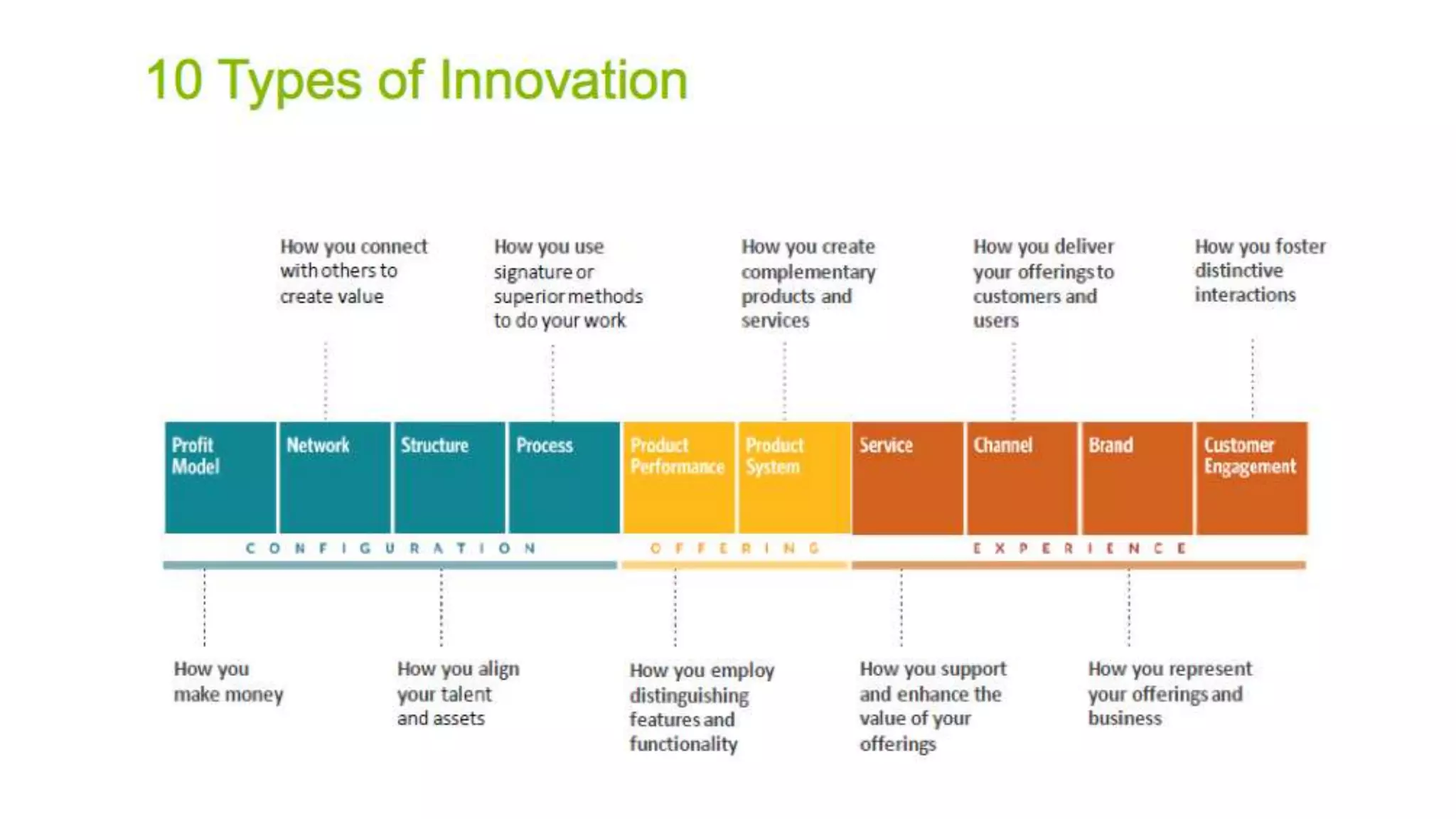
Keely’s “Ten types of
innovation” suggests that many
innovations fail due to too
much focus on the “Product
System” and not enough on the
supporting elements around
organisational configuration,
and customer experience.
What drives innovation…?
Dispelling some myths…
• The lone creator
• The creative type
• The ‘eureka’ moment
• The expert myth
• The Incentive Myth
• The Originality Myth
• The Constraints Myth
• The Cohesive Myth
• The Mousetrap Myth
• The Brainstorming Myth
Chucking people in a room with
some white-boards and post-its
will not automatically yield
great results.
Brainstorming can be effective
but needs to be done in the
context of prior research and
understanding – a bringing
together of ideas rather than a
blank canvas.
What actually drives innovation…?
Discussion Point II
What actually drives innovation…?
Domain expertise
People willing to engage
Culture supportive of new ideas
Creativity Relevant Processes
What we really need…
What Actually Drives Innovation
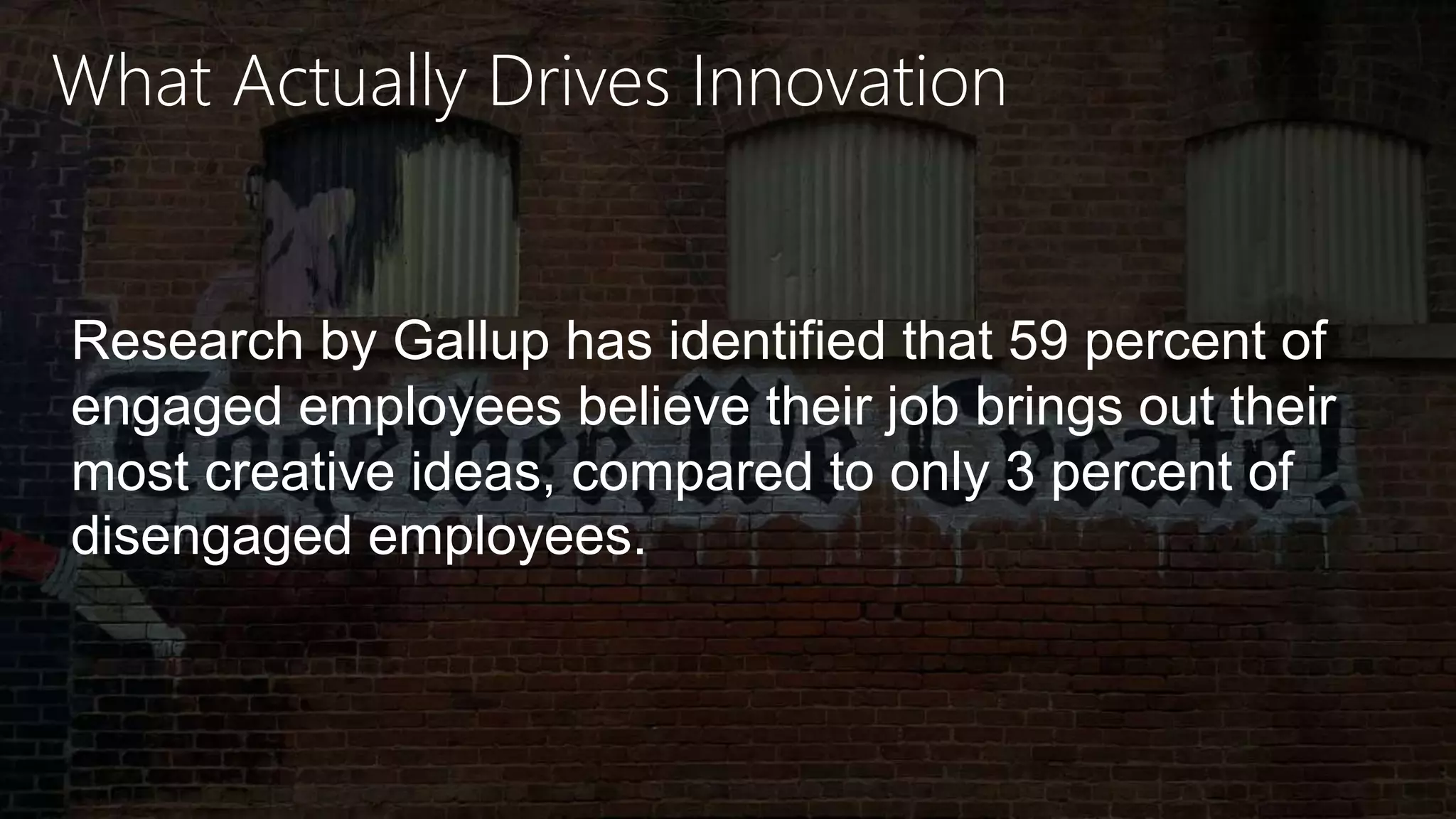
Research by Gallup has identified that 59 percent of
engaged employees believe their job brings out their
most creative ideas, compared to only 3 percent of
disengaged employees.
What can Testers Offer?
Discussion Point III
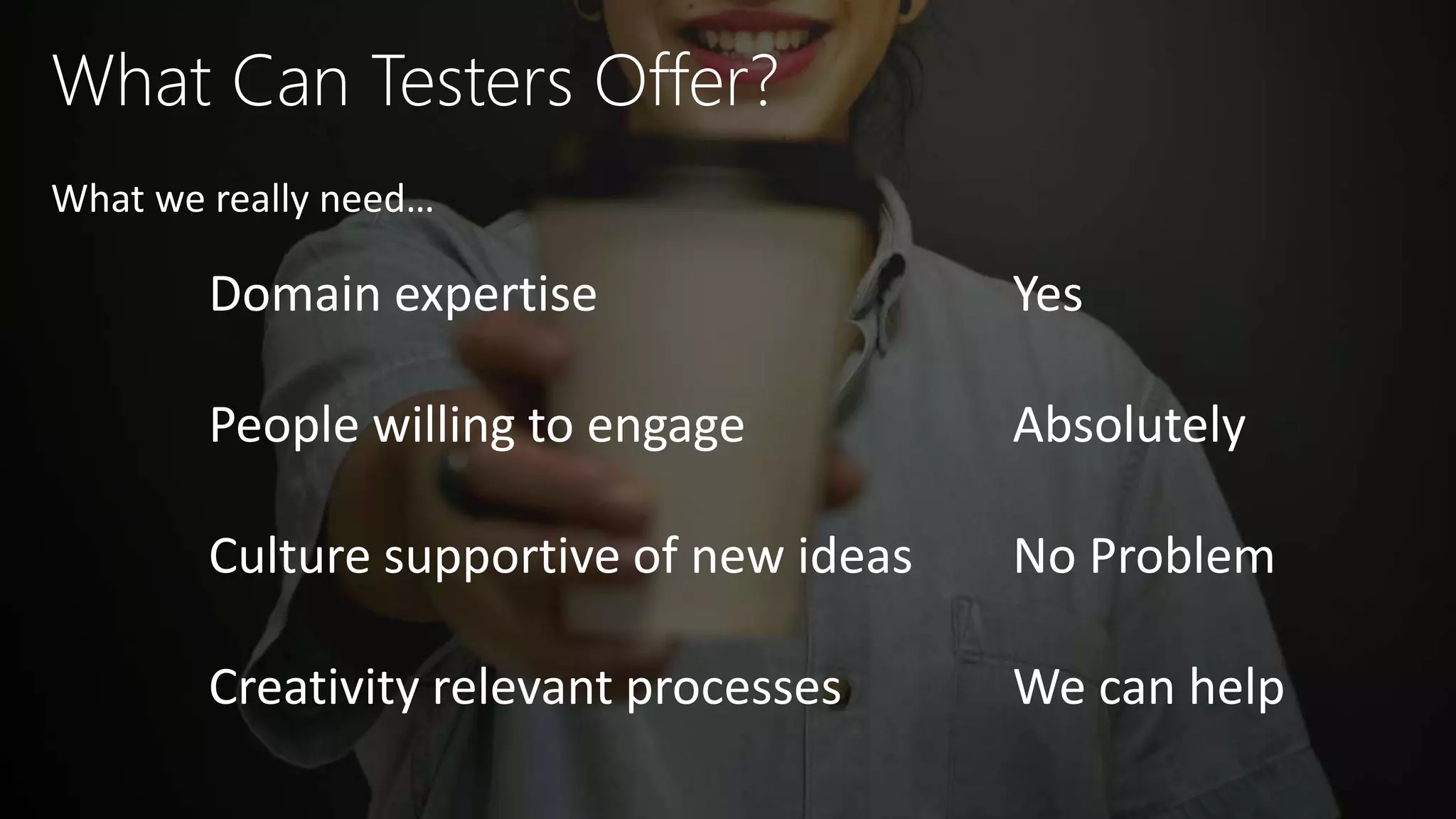
What Can Testers Offer?
Domain expertise
People willing to engage
Culture supportive of new ideas
Creativity relevant processes
What we really need…
Yes
Absolutely
No Problem
We can help
What Can Testers Offer?
• Knowledge across systems to make
connections
• Understanding of users and their needs
• Identify risks, impracticalities and flaws early
• Lateral thinking
• Validating ideas and Testing approaches
Plus…
How Can We Get Involved?
Discussion Point IV
So what are we here to do?
The RIG
How Can We Get Involved?
What Can We Do About It?
So what are we here to do?
1.The RIG does not own all of the innovation, we aim to foster a culture of
innovation across the whole of River
2.The RIG is an open community and encourages participation from people
across the business
3.We encourage cross-functional knowledge and thinking and look for
opportunities to innovate in all areas, not just products
4.We aim to continuously improve and question and innovate on our
existing ideas as much as new ones
5.We don't dismiss any ideas and celebrate any failures as opportunities to
learn
6.We aim to empower and encourage people to be confident in owning their
The RIG
Principles
THANKS
Photo by Josh Boot on Unsplash
Adam Knight
linkedin.com/in/adampknight
@adampknight

ALF Innovation and Testing Adam Knight

  • 1.
    Testing the Myths ofInnovation Photo by Josh Boot on Unsplash Adam Knight linkedin.com/in/adampknight @adampknight
  • 2.
    Why Would WeWant to be Involved in Innovation? • Creativity • Recognition Correlation between employee engagement and innovation?
  • 3.
  • 4.
    Innovation Silos Potential Silos •The Research Scientist “Without him we wouldn’t have a company” “Assumed right – onus on testing to prove otherwise”
  • 5.
    Innovation Silos Potential Silos •The Research Scientist • The Architect Introducing new “Frameworks” Often prototype quality code False impression of release readiness Delegated responsibility for quality
  • 6.
    Innovation Silos Potential Silos •The Research Scientist • The Creative Agency • The Architect The source of ‘ideas’ No discussion with technical roles as to practical feasibility
  • 7.
    Resentment Disillusionment Suppression of ownideas Detachment from Product Responsibility without connection to ideas What are the Consequences? Increased Perception of Risk
  • 8.
    Why are TestersExcluded from Innovation? Discussion Point I
  • 9.
    Not perceived asa creative activity Low appreciation of the skills of testing Isolated from other development roles We’re not pushy Seen as coming in ‘at the end’ of process Why Are Testers Left Out?
  • 10.
    What drives innovation…? Dispellingsome myths… • The lone creator Edison didn’t invent the lightbulb, he ran a research company that refined previous inventions. Lone creators are often used as a useful marketing figurehead for an efficient research and innovation group.
  • 11.
    What drives innovation…? Dispellingsome myths… • The lone creator • The creative type Studies of ‘creative’ people and ‘non-creative’ people have show no difference in their personality dimensions using widely adopted measures of personality Studies on twins have shown no genetic link between genes and creativity in individuals Categorisation of individuals and roles can result in promoting or suppressing creativity
  • 12.
    What drives innovation…? Dispellingsome myths… • The lone creator • The creative type • The ‘eureka’ moment Eureka moments are usually the outcome of a period of reflection or ‘incubation’ after a period of intensive study into a problem. Insight comes through a process of - Preparation - Incubation - Insight - Evaluation - Elaboration It needs preparation and incubation
  • 13.
    What drives innovation…? Dispellingsome myths… • The lone creator • The creative type • The ‘eureka’ moment • The expert myth Experience and expertise don’t always create better innovation. Youth and fresh thinking can generate the greatest leaps forward.
  • 14.
    What drives innovation…? Dispellingsome myths… • The lone creator • The creative type • The ‘eureka’ moment • The expert myth • The Incentive Myth Providing incentives to innovate does not drive innovation. Intrinsic motivation in the form of engagement with the problem is a greater driver of innovation.
  • 15.
    What drives innovation…? Dispellingsome myths… • The lone creator • The creative type • The ‘eureka’ moment • The expert myth • The Incentive Myth • The Originality Myth Most innovations are not new ideas but rather a progression or combination of existing ideas.
  • 16.
    What drives innovation…? Dispellingsome myths… • The lone creator • The creative type • The ‘eureka’ moment • The expert myth • The Incentive Myth • The Originality Myth • The Constraints Myth Removing constraints doesn’t permit greater innovation. Constraints don’t suppress innovation. Innovation loves constraints as long as they are not too restrictive to support our ability to progress.
  • 17.
    What drives innovation…? Dispellingsome myths… • The lone creator • The creative type • The ‘eureka’ moment • The expert myth • The Incentive Myth • The Originality Myth • The Constraints Myth • The Cohesive Myth We don’t all have to get along to be creative. Whilst personal grievances are not constructive, disagreement and conflict around a challenge can result in better results
  • 18.
    What drives innovation…? Dispellingsome myths… • The lone creator • The creative type • The ‘eureka’ moment • The expert myth • The Incentive Myth • The Originality Myth • The Constraints Myth • The Cohesive Myth • The Mousetrap Myth Just creating a great product does not guarantee success. Keely’s “Ten types of innovation” suggests that many innovations fail due to too much focus on the “Product System” and not enough on the supporting elements around organisational configuration, and customer experience.
  • 20.
    What drives innovation…? Dispellingsome myths… • The lone creator • The creative type • The ‘eureka’ moment • The expert myth • The Incentive Myth • The Originality Myth • The Constraints Myth • The Cohesive Myth • The Mousetrap Myth • The Brainstorming Myth Chucking people in a room with some white-boards and post-its will not automatically yield great results. Brainstorming can be effective but needs to be done in the context of prior research and understanding – a bringing together of ideas rather than a blank canvas.
  • 21.
    What actually drivesinnovation…? Discussion Point II
  • 22.
    What actually drivesinnovation…? Domain expertise People willing to engage Culture supportive of new ideas Creativity Relevant Processes What we really need…
  • 23.
    What Actually DrivesInnovation Research by Gallup has identified that 59 percent of engaged employees believe their job brings out their most creative ideas, compared to only 3 percent of disengaged employees.
  • 24.
    What can TestersOffer? Discussion Point III
  • 25.
    What Can TestersOffer? Domain expertise People willing to engage Culture supportive of new ideas Creativity relevant processes What we really need… Yes Absolutely No Problem We can help
  • 26.
    What Can TestersOffer? • Knowledge across systems to make connections • Understanding of users and their needs • Identify risks, impracticalities and flaws early • Lateral thinking • Validating ideas and Testing approaches Plus…
  • 27.
    How Can WeGet Involved? Discussion Point IV
  • 28.
    So what arewe here to do? The RIG How Can We Get Involved?
  • 29.
    What Can WeDo About It? So what are we here to do? 1.The RIG does not own all of the innovation, we aim to foster a culture of innovation across the whole of River 2.The RIG is an open community and encourages participation from people across the business 3.We encourage cross-functional knowledge and thinking and look for opportunities to innovate in all areas, not just products 4.We aim to continuously improve and question and innovate on our existing ideas as much as new ones 5.We don't dismiss any ideas and celebrate any failures as opportunities to learn 6.We aim to empower and encourage people to be confident in owning their The RIG Principles
  • 30.
    THANKS Photo by JoshBoot on Unsplash Adam Knight linkedin.com/in/adampknight @adampknight

Editor's Notes

  • #2 Hello and welcome. For those of you who don’t know me my name is Adam and I am currently head of Product and Testing at River I’m going to talk about a subject that is often not associated with testing, that is innovation. In this session I’m going to share some personal experiences around innovation and why we as testers may suffer from being excluded The format will be that I’ll present through some slides, and at key points I’ll open up the discussion to the room with a question around testing and innovation. I’ll try to be open around the discussion but if it’s veering off, particularly into a later section, I’ll reel it in and I may need to move on to keep to time.
  • #3 So why would we want to be involved in innovation? Well – in my recent work I’ve been particularly focussed on the area of employee engagement. [Clikc] And it turns out there is a strong correlation between innovation and employee engagement. The landmark 2009 Mcleod report on employee engagement devotes significant content to highlighting the correlation between employee engagement and innovation. [Clikc] It’s easy to see why. Looking at classic psychological theories of human motivation such as Maslow’s hierarchy of needs or the work of Fredrick Herzberg who presented a ‘two factor’ theory of motivation separating motivators from more basic ‘hygiene’ needs – being involved in creative work is intrinsically motivating and something that we naturally aspire to. [Clikc] Innovation is also typically something that receives greater recognition in organisations , and recognition for our work is again a strong motivator that fulfils our desires for self-actualisation.
  • #4 It’s natural then that, given how engaging it is being involved in innovation, some folks might want to keep it to themselves. One reason that testers may be excluded from innovation is that, to put it simply, most people in the company are excluded from innovation. Can anyone tell me what this is? [Click] Yes it’s a silo - (this is not a discussion break by the way) interesting phenomenon in the US where trees grow in disused silos, protected from the environment outside. Similarly I’ve seen a number of situations where innovation within a company is siloed off and protected from others, with pretty damaging results.
  • #5 One situation I’ve seen in startups is where one of the founding members takes the job of ‘research’ scientist (sometimes as CTO) [Clikc] They are seen as fundamental to the existence of the company and they therefore are afforded the freedom to go off and try new things. [Clikc] I’ve encountered this and one of the challenges here was that, each new creation was assumed to be brilliant, even when they weren’t for a more inexperienced tester the onus was on me to prove that these new innovations were flawed. I remember having to test and retest a new data importer module for a previous product to prove that it was less performant than the one that we already had, which was daunting when the developer was one of the company founders.
  • #6 Architects. Give an architect enough time and they’ll develop a framework. Whilst often the role of a more established company than the research scientist, architects are still often afforded a lot of slack and have the remit to create new architectures as they see fit. [click] I’ve encountered more than one situation where these frameworks were developed away from testers , and The code is often prototype level, [click] Yet presented to leadership as release ready. [click] Usually what then happens is some poor testers and developers are delegated the task of releasing the new framework into product, Inevitably this is the point at which all of the problems are found and inevitably those poor individuals are the ones that come under pressure for the poor quality
  • #7 An interesting one I discovered at River was where we have a creative comms team who worked exclusively with an external agency on ‘creative’ work including design. [Clikc] All the ideas and designs came in via that team and were handed to the development teams to deliver, [Click] This was done without any consideration for whether the designs were practically deliverable
  • #8 So what are the consequences for those people who are not part of the innovation activities. They end up with all the responsibility of delivery but no ownership of the ideas They resent the products and the flaws in them They feel that their own ideas are suppressed They feel emotionally detached from the product they are working on Interestingly Risk has an inverse relationship to perceived value - This detachment from the value actually results in a higher perceived risk around delivery of those products
  • #9 I’d like to look more specifically at Testing now. I’m going to open it up to the room for my first question. It’s a common complaint amongst testers that they are not included in innovative activities. Why is it that testers are excluded from innovation?
  • #10 Here are some of the reasons that I came up with
  • #11 Are these reasons valid. I read a great book last year entitled the “Myths of Creativity” by Steven Burkus. In it Burkus examines some of the false beliefs that propagate around innovation he identifies 10 The first is the idea of the lone creator… Included light bulb here as one of the most famous stories of innovation relates to the first myth. Thomas Edison didn’t invent the light bulb alone. He’d created a facility called Menlo park from previous earnings in which he employed many people who innovated and tested inventions which he then put his name to. .
  • #20 I’ll bring it up here as an aside – Keely’s 10 types of innovation provides a great canvas to understand the different areas that your company might innovate.
  • #22 QUESTION POINT? If these 10 myths don’t drive innovation What do we think are the elements needed to support effective innovation?
  • #23 Well Burkus quotes extensive studies into innovation by Harvard professor Teresa Amabile She suggests what we really need for innovation are 4 factors Domain Expertise are the domain relevant skills that will navigate us through the creative process People Willing to Engage and are motivated to innovate A company acceptance of New ideas – is our social environment set up to accept and promote new ideas? And processes that are supportive of creativity None of these are exclusive to specific roles or people, and only the company culture sits outside the domain of things that can be learned or adopted by any individual.
  • #24 I’ll at this point also refer back to the link between engagement and innovation. Whilst causation has not as far as I know been proved either way What we can say is that people who are regarded as ‘engaged’ in their work are far more likely to feel that they are able to provide creative ideas to their work than those that are not As this stat from Gallup neatly demonstrates.
  • #25 So now we have a better understanding of what actually is needed to drive innovation What do we think that testers specifically can offer?
  • #28 So my final discussion point is this Given that we can clearly offer so much How can we get more involved in innovation in our companies?
  • #29 I’ll finish with one idea. At River we set up an open group called the River Innovation Group or “The RIG” I run the group – however it’s an open group that anyone in the company can join , and we encourage them to do so. We try to meet once a fortnight. But we don’t meet to innovate. What we do is meet to try to promote innovation in the company. Here are our principles….
  • #30 Read – 1 - 6 So if you are struggling to think of ways to promote inclusive innovation in your company Consider setting up a RIG of your own.
  • #31 Thanks