Innovation/Creativity
• Sources ofnew product ideas
• Creativity: can it be learned?
• Techniques for fostering group creativity
• Increasing personal creativity
3.
Importance of Innovationto Companies*
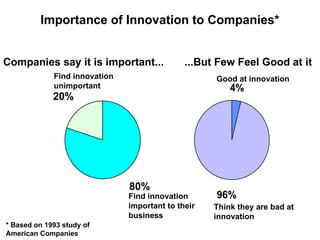
20%
80%
Companies say it is important... ...But Few Feel Good at it
Find innovation
unimportant
Find innovation
important to their
business
4%
96%
Good at innovation
Think they are bad at
innovation
* Based on 1993 study of
American Companies
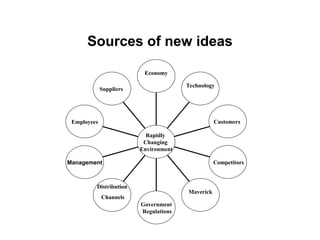
Sources of newideas
Suppliers
Employees
Management
Distribution
Channels
Government
Regulations
Maverick
Competitors
Customers
Technology
Economy
Rapidly
Changing
Environment
6.
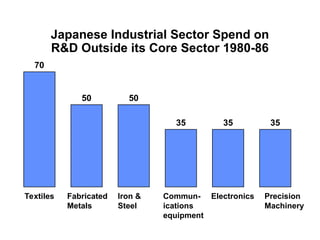
Japanese Industrial SectorSpend on
R&D Outside its Core Sector 1980-86
70
50 50
35 35 35
Textiles Fabricated
Metals
Iron &
Steel
Commun-
ications
equipment
Electronics Precision
Machinery
7.
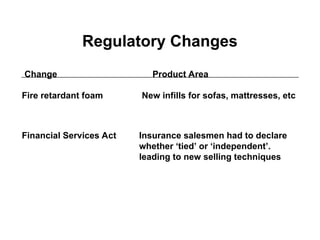
Regulatory Changes
Change ProductArea
Fire retardant foam
Financial Services Act
New infills for sofas, mattresses, etc
Insurance salesmen had to declare
whether ‘tied’ or ‘independent’.
leading to new selling techniques
8.
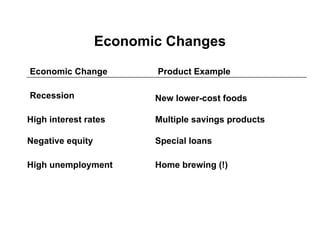
Economic Changes
Economic ChangeProduct Example
Recession
High interest rates
Negative equity
High unemployment
Multiple savings products
New lower-cost foods
Special loans
Home brewing (!)
9.
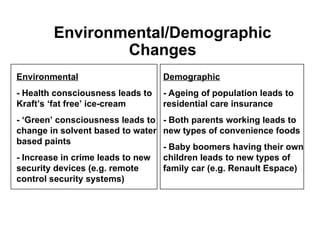
Environmental/Demographic
Changes
Environmental
- Health consciousnessleads to
Kraft’s ‘fat free’ ice-cream
- ‘Green’ consciousness leads to
change in solvent based to water
based paints
- Increase in crime leads to new
security devices (e.g. remote
control security systems)
Demographic
- Ageing of population leads to
residential care insurance
- Both parents working leads to
new types of convenience foods
- Baby boomers having their own
children leads to new types of
family car (e.g. Renault Espace)
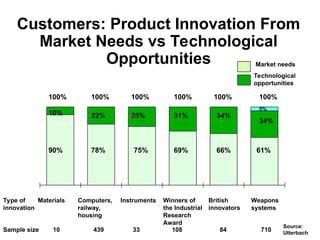
Customers: Product InnovationFrom
Market Needs vs Technological
Opportunities
100% 100% 100% 100% 100% 100%
90%
10% 22%
78%
25%
75%
31%
69%
34%
66%
34%
61%
5%
Materials Computers,
railway,
housing
Instruments Winners of
the Industrial
Research
Award
British
innovators
Weapons
systems
Type of
innovation
Sample size 10 439 33 108 84 710
Market needs
Technological
opportunities
Source:
Utterbach
12.
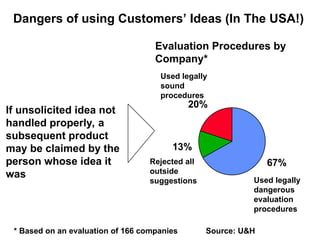
Dangers of usingCustomers’ Ideas (In The USA!)
If unsolicited idea not
handled properly, a
subsequent product
may be claimed by the
person whose idea it
was
67%
13%
20%
Evaluation Procedures by
Company*
Used legally
dangerous
evaluation
procedures
Rejected all
outside
suggestions
Used legally
sound
procedures
* Based on an evaluation of 166 companies Source: U&H
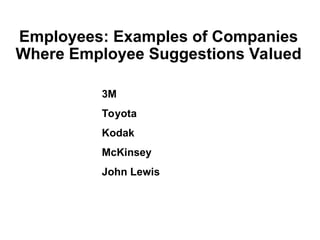
Employees: Examples ofCompanies
Where Employee Suggestions Valued
3M
Toyota
Kodak
McKinsey
John Lewis
15.
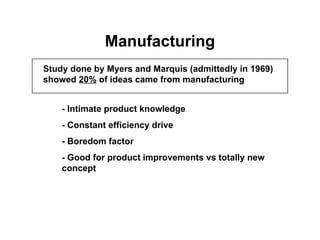
Manufacturing
Study done byMyers and Marquis (admittedly in 1969)
showed 20% of ideas came from manufacturing
- Intimate product knowledge
- Constant efficiency drive
- Boredom factor
- Good for product improvements vs totally new
concept
16.
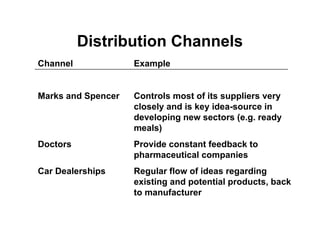
Distribution Channels
Channel Example
Marksand Spencer Controls most of its suppliers very
closely and is key idea-source in
developing new sectors (e.g. ready
meals)
Doctors Provide constant feedback to
pharmaceutical companies
Car Dealerships Regular flow of ideas regarding
existing and potential products, back
to manufacturer
17.
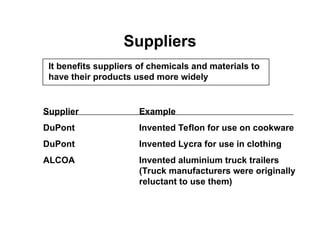
Suppliers
It benefits suppliersof chemicals and materials to
have their products used more widely
Supplier Example
DuPont Invented Teflon for use on cookware
DuPont Invented Lycra for use in clothing
ALCOA Invented aluminium truck trailers
(Truck manufacturers were originally
reluctant to use them)
18.
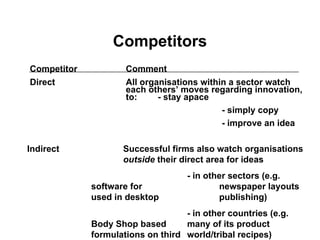
Competitors
Competitor Comment
Direct Allorganisations within a sector watch
each others’ moves regarding innovation,
to: - stay apace
- simply copy
- improve an idea
Indirect Successful firms also watch organisations
outside their direct area for ideas
- in other sectors (e.g.
software for newspaper layouts
used in desktop publishing)
- in other countries (e.g.
Body Shop based many of its product
formulations on third world/tribal recipes)
19.
Creativity Can BeLearned
“Inventing is a skill that some people have and
some don’t. But you can learn how to invent.
You have to have the will not to jump at the
first solution because the elegant solution
might be around the corner. An inventor is
someone who says, ‘Yes, that’s one way to do
it but it doesn’t seem to be an optimum
solution.’ Then he keeps on thinking”.
Ray Dolby, inventor
20.
“Problems cannot besolved by
thinking within the framework
within which the problems were
created”
Albert Einstein
21.
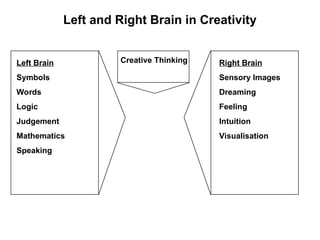
Left and RightBrain in Creativity
Left Brain
Symbols
Words
Logic
Judgement
Mathematics
Speaking
Right Brain
Sensory Images
Dreaming
Feeling
Intuition
Visualisation
Creative Thinking
22.
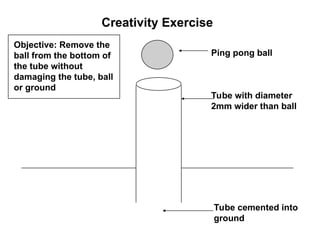
Creativity Exercise
Ping pongball
Tube with diameter
2mm wider than ball
Tube cemented into
ground
Objective: Remove the
ball from the bottom of
the tube without
damaging the tube, ball
or ground
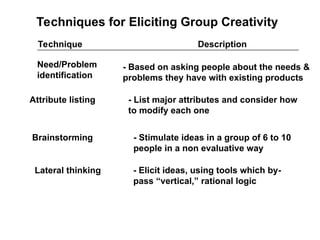
Techniques for ElicitingGroup Creativity
Technique Description
Attribute listing - List major attributes and consider how
to modify each one
- Stimulate ideas in a group of 6 to 10
people in a non evaluative way
Brainstorming
- Elicit ideas, using tools which by-
pass “vertical,” rational logic
Lateral thinking
- Based on asking people about the needs &
problems they have with existing products
Need/Problem
identification
26.
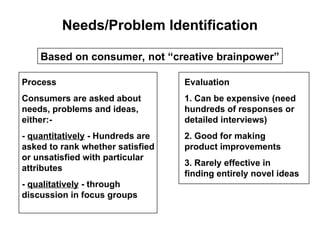
Needs/Problem Identification
Based onconsumer, not “creative brainpower”
Process
Consumers are asked about
needs, problems and ideas,
either:-
- quantitatively - Hundreds are
asked to rank whether satisfied
or unsatisfied with particular
attributes
- qualitatively - through
discussion in focus groups
Evaluation
1. Can be expensive (need
hundreds of responses or
detailed interviews)
2. Good for making
product improvements
3. Rarely effective in
finding entirely novel ideas
27.
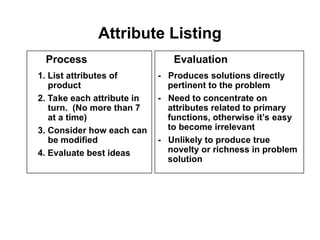
Attribute Listing
1. Listattributes of
product
2. Take each attribute in
turn. (No more than 7
at a time)
3. Consider how each can
be modified
4. Evaluate best ideas
- Produces solutions directly
pertinent to the problem
- Need to concentrate on
attributes related to primary
functions, otherwise it’s easy
to become irrelevant
- Unlikely to produce true
novelty or richness in problem
solution
Process Evaluation
28.
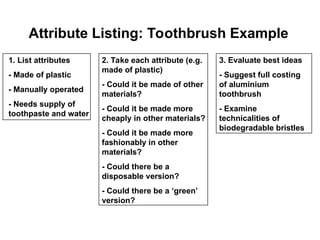
Attribute Listing: ToothbrushExample
1. List attributes
- Made of plastic
- Manually operated
- Needs supply of
toothpaste and water
2. Take each attribute (e.g.
made of plastic)
- Could it be made of other
materials?
- Could it be made more
cheaply in other materials?
- Could it be made more
fashionably in other
materials?
- Could there be a
disposable version?
- Could there be a ‘green’
version?
3. Evaluate best ideas
- Suggest full costing
of aluminium
toothbrush
- Examine
technicalities of
biodegradable bristles
29.
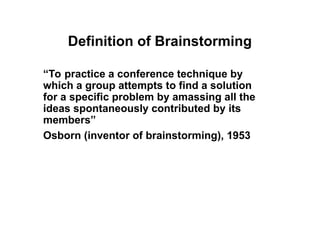
Definition of Brainstorming
“Topractice a conference technique by
which a group attempts to find a solution
for a specific problem by amassing all the
ideas spontaneously contributed by its
members”
Osborn (inventor of brainstorming), 1953
30.
Basic Rules ofBrainstorming
• No criticism whatsoever
• Free-wheeling is welcome. The whackier the
idea, the better
• The more ideas, the better
• Building on others’ ideas is encouraged
Brainstorming : ProblemsSolved And
Group Composition
GROUP COMPOSITION
Open minded individuals
Few vested interests
Avoid extremes - dominant or
insecure personalities
Variation in age
Variation in background
TYPICAL PROBLEMS
ADDRESSED
Suggestions for new
research
New concepts for products
or markets
Managerial problems (eg
how to make work more
fulfilling)
Improvements to
processes
33.
Brainstorming : Evaluation
•Frequently used technique
• Easy to implement
• Time efficient
• Prone to inaccurate usage
• Research findings on usefulness are
contradictory (both positive and negative)
• Inconclusive
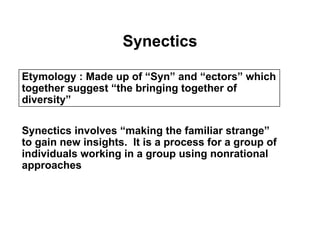
Synectics
Etymology : Madeup of “Syn” and “ectors” which
together suggest “the bringing together of
diversity”
Synectics involves “making the familiar strange”
to gain new insights. It is a process for a group of
individuals working in a group using nonrational
approaches
36.
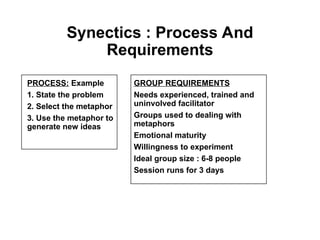
Synectics : ProcessAnd
Requirements
PROCESS: Example
1. State the problem
2. Select the metaphor
3. Use the metaphor to
generate new ideas
GROUP REQUIREMENTS
Needs experienced, trained and
uninvolved facilitator
Groups used to dealing with
metaphors
Emotional maturity
Willingness to experiment
Ideal group size : 6-8 people
Session runs for 3 days
37.
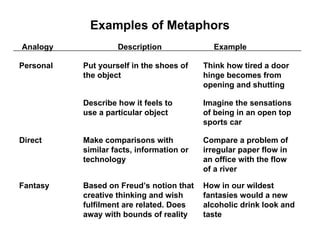
Examples of Metaphors
AnalogyDescription Example
Personal
Direct
Fantasy
Put yourself in the shoes of
the object
Describe how it feels to
use a particular object
Make comparisons with
similar facts, information or
technology
Based on Freud’s notion that
creative thinking and wish
fulfilment are related. Does
away with bounds of reality
Think how tired a door
hinge becomes from
opening and shutting
Imagine the sensations
of being in an open top
sports car
Compare a problem of
irregular paper flow in
an office with the flow
of a river
How in our wildest
fantasies would a new
alcoholic drink look and
taste
38.
Synectics : Evaluation
•Dependent on trained facilitator and receptive
group members
• Good at generating novel solutions
• Used less than brainstorming due to need for
facilitator and general risk-aversion
associated with ‘wild thinking’
• Used more in the USA than here
Ways of EnhancingPersonal
Creativity
1. Accept there’s no right answer
2. Don’t follow the rules
3. Be foolish
4. Ask ‘What if?’
5. Think outside your area
6. Go for ambiguity
7. Believe in yourself
41.
1. No RightAnswer
• The best way to get a good idea is to get a lot
of ideas
• Change your question (eg IBM should have
thought in terms of solutions to problems, not
computing hardware)
• Avoid workplaces with a culture of uniformity
42.
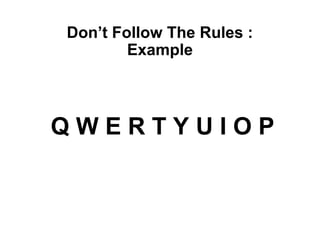
2. Don’t FollowThe Rules
• We make rules based on reasons that make
sense
• We follow these rules
• Time passes, things change
• The original reasons for the rules no longer
exist, but because the rules are still in place,
we continue to follow them
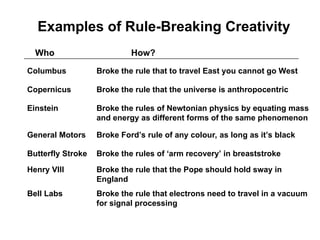
Examples of Rule-BreakingCreativity
Who How?
Columbus
Copernicus
Einstein
General Motors
Butterfly Stroke
Henry VIII
Bell Labs
Broke the rule that to travel East you cannot go West
Broke the rule that the universe is anthropocentric
Broke the rules of Newtonian physics by equating mass
and energy as different forms of the same phenomenon
Broke Ford’s rule of any colour, as long as it’s black
Broke the rules of ‘arm recovery’ in breaststroke
Broke the rule that the Pope should hold sway in
England
Broke the rule that electrons need to travel in a vacuum
for signal processing
45.
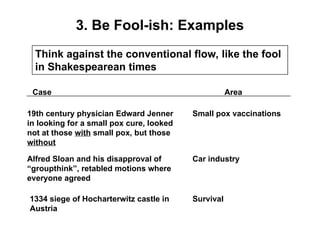
3. Be Fool-ish:Examples
Think against the conventional flow, like the fool
in Shakespearean times
Case Area
19th century physician Edward Jenner
in looking for a small pox cure, looked
not at those with small pox, but those
without
Alfred Sloan and his disapproval of
“groupthink”, retabled motions where
everyone agreed
1334 siege of Hocharterwitz castle in
Austria
Small pox vaccinations
Car industry
Survival
46.
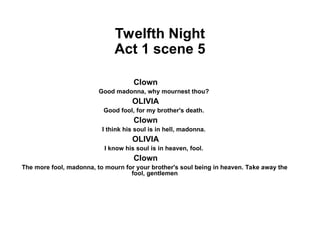
Twelfth Night
Act 1scene 5
Clown
Good madonna, why mournest thou?
OLIVIA
Good fool, for my brother's death.
Clown
I think his soul is in hell, madonna.
OLIVIA
I know his soul is in heaven, fool.
Clown
The more fool, madonna, to mourn for your brother's soul being in heaven. Take away the
fool, gentlemen
47.
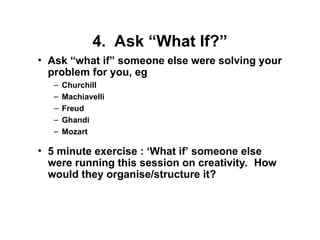
4. Ask “WhatIf?”
• Ask “what if” someone else were solving your
problem for you, eg
– Churchill
– Machiavelli
– Freud
– Ghandi
– Mozart
• 5 minute exercise : ‘What if’ someone else
were running this session on creativity. How
would they organise/structure it?
48.
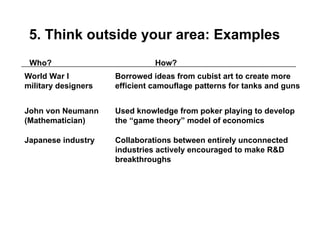
5. Think outsideyour area: Examples
Who? How?
World War I
military designers
John von Neumann
(Mathematician)
Japanese industry
Borrowed ideas from cubist art to create more
efficient camouflage patterns for tanks and guns
Used knowledge from poker playing to develop
the “game theory” model of economics
Collaborations between entirely unconnected
industries actively encouraged to make R&D
breakthroughs
49.
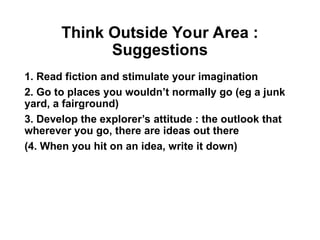
Think Outside YourArea :
Suggestions
1. Read fiction and stimulate your imagination
2. Go to places you wouldn’t normally go (eg a junk
yard, a fairground)
3. Develop the explorer’s attitude : the outlook that
wherever you go, there are ideas out there
(4. When you hit on an idea, write it down)
50.
6. Go ForAmbiguity
“If you tell people where to go, but not how
to get there, you’ll be amazed at the
results”
George S Patton (American General)
51.
Ambiguity As FoundIn The
Workplace
• Non hierarchical organisation
• Tolerance (or even encouragement) of
different approaches
• Broad goals defined, but little else
52.
Believe in Yourself
Lackof creativity is a self-fulfilling prophecy
(as substantiated by research!)
53.
Innovation/creativity:
conclusions
• Creativity CANbe learned . If your
organisation/group doesn’t make use of
specific creative techniques, why not
introduce them?
• Be willing to think ‘whacky’ thoughts -
collectively these can spark excellent ideas.
• Be constantly receptive – creativity comes
from the most unlikely sources!