THE COMPLEMENT
SYSTEM
GROUP 11
GROUP MEMBERS
• Vanessa Ohui Dadeboe UE20015417
• Priscilla Bandah UE20014517
Koomson Abigail UE20016917
OBJECTIVES
• History
• Overview of the complement system.
• Functions
• Three main pathways
• Regulation
• Role in disease
• References
HISTORY
• Discovered in the 1890’s by Jules Bordet, a young
Belgian scientist in Paris.
• She said the serum has two components. The heat
stable component responsible for specific immunity
and the heat sensitive component responsible for non-
specific immunity.
• Paul Ehrlich named the heat-sensitive component
complement.
OVERVIEW
• The complement system is a part of the innate immune system
that enhances the ability of antibodies and phagocytic cells to
clear microbes and damaged cells from an organism.
• It can be activated by antibodies generated by the adaptive
immune system
• It is a defensive system consisting of over 30 proteins and protein
fragments produced by the liver and found in circulating blood
serum.
• It functions in a cascade system.
• Complement proteins are often designated by “C”. From C1 –
C9.
OVERVIEW CONTINUED
• Proteolysis results in large fragments “b” and smaller
fragments “a”. Eg. C3a and C5b
• The only exception is C2, where C2a is the large fragment
and C2b is the smaller fragment.
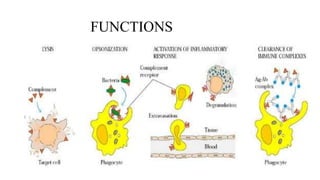
FUNCTIONS
PATHWAYS
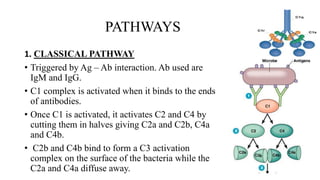
1. CLASSICAL PATHWAY
• Triggered by Ag – Ab interaction. Ab used are
IgM and IgG.
• C1 complex is activated when it binds to the ends
of antibodies.
• Once C1 is activated, it activates C2 and C4 by
cutting them in halves giving C2a and C2b, C4a
and C4b.
• C2b and C4b bind to form a C3 activation
complex on the surface of the bacteria while the
C2a and C4a diffuse away.
PATHWAYS CONTINUED
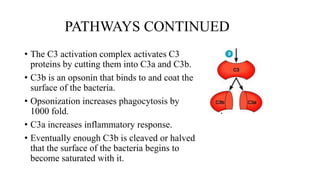
• The C3 activation complex activates C3
proteins by cutting them into C3a and C3b.
• C3b is an opsonin that binds to and coat the
surface of the bacteria.
• Opsonization increases phagocytosis by
1000 fold.
• C3a increases inflammatory response.
• Eventually enough C3b is cleaved or halved
that the surface of the bacteria begins to
become saturated with it.
PATHWAYS CONTINUED
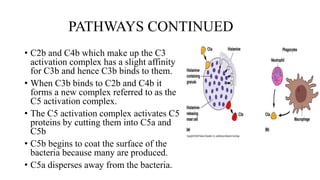
• C2b and C4b which make up the C3
activation complex has a slight affinity
for C3b and hence C3b binds to them.
• When C3b binds to C2b and C4b it
forms a new complex referred to as the
C5 activation complex.
• The C5 activation complex activates C5
proteins by cutting them into C5a and
C5b
• C5b begins to coat the surface of the
bacteria because many are produced.
• C5a disperses away from the bacteria.
PATHWAYS CONTINUED
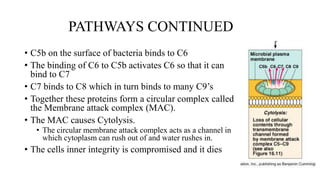
• C5b on the surface of bacteria binds to C6
• The binding of C6 to C5b activates C6 so that it can
bind to C7
• C7 binds to C8 which in turn binds to many C9’s
• Together these proteins form a circular complex called
the Membrane attack complex (MAC).
• The MAC causes Cytolysis.
• The circular membrane attack complex acts as a channel in
which cytoplasm can rush out of and water rushes in.
• The cells inner integrity is compromised and it dies
PATHWAYS CONTINUED
2. ALTERNATIVE PATHWAY
• It is slower than the classical pathway.
• Activated by C3b binding to microbial cell surfaces.
• C3 contains an unstable thioester bond which slows spontaneous
hydrolysis to C3b and C3a.
• C3b is able to bind to foreign surface antigens.
• The C3b on the surface of a foreign cell binds to another plasma
protein called Factor B.
PATHWAYS CONTINUED
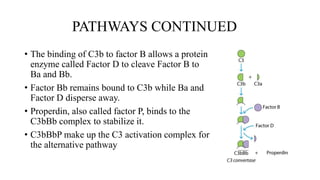
• The binding of C3b to factor B allows a protein
enzyme called Factor D to cleave Factor B to
Ba and Bb.
• Factor Bb remains bound to C3b while Ba and
Factor D disperse away.
• Properdin, also called factor P, binds to the
C3bBb complex to stabilize it.
• C3bBbP make up the C3 activation complex for
the alternative pathway
PATHWAYS CONTINUED
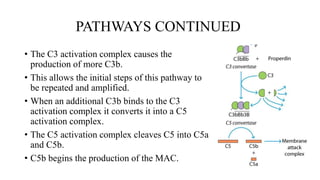
• The C3 activation complex causes the
production of more C3b.
• This allows the initial steps of this pathway to
be repeated and amplified.
• When an additional C3b binds to the C3
activation complex it converts it into a C5
activation complex.
• The C5 activation complex cleaves C5 into C5a
and C5b.
• C5b begins the production of the MAC.
PATHWAYS CONTINUED
3. LECTIN PATHWAY
• Lectins are carbohydrate binding proteins.
• It is similar to the classical pathway but with the opsonin, mannose-
binding lectin (MBL) and ficolins instead of C1q.
• Activated by the binding of MBL to mannose residues which activates
the MBL associated serine proteases, MASP-1 and MASP-2 which is
similar to C1r and C1s respectively.
• This complex activates C2 and C4 by cutting them into C2a and C2b,
C4a and C4b.
• C4b binds to C2b to form the C3-convertase as in the classical
pathway.
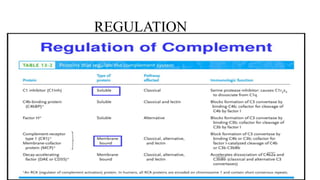
REGULATION
ROLE IN DISEASES
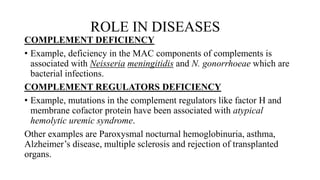
COMPLEMENT DEFICIENCY
• Example, deficiency in the MAC components of complements is
associated with Neisseria meningitidis and N. gonorrhoeae which are
bacterial infections.
COMPLEMENT REGULATORS DEFICIENCY
• Example, mutations in the complement regulators like factor H and
membrane cofactor protein have been associated with atypical
hemolytic uremic syndrome.
Other examples are Paroxysmal nocturnal hemoglobinuria, asthma,
Alzheimer’s disease, multiple sclerosis and rejection of transplanted
organs.
REFERENCES
• Roitt I, Brostoff J, Male D (2001). Immunology (6th ed), 480p. St. Louis:
Mosby, ISBN 0-7234-3189-2
• Parham P (2005). The immune system. New York: Garland, ISBN 0-
8153-4093-1
• DeFranco AL, Locksley RM, Robertson M (2007). Immunity: The
immune response in infectious and inflammatory disease. London;
Sunderland, MA: New Science Press; Sinauer Associates, ISBN 987-0-
9539181-0-2.
• Stoemer, Kristina A, Morrison, Thomas E. (15 March 2011).
Complement and Viral pathogenesis, Virology. 411 (2): 362-373
Central.

The complement system

  • 1.
  • 2.
    GROUP MEMBERS • VanessaOhui Dadeboe UE20015417 • Priscilla Bandah UE20014517 Koomson Abigail UE20016917
  • 3.
    OBJECTIVES • History • Overviewof the complement system. • Functions • Three main pathways • Regulation • Role in disease • References
  • 4.
    HISTORY • Discovered inthe 1890’s by Jules Bordet, a young Belgian scientist in Paris. • She said the serum has two components. The heat stable component responsible for specific immunity and the heat sensitive component responsible for non- specific immunity. • Paul Ehrlich named the heat-sensitive component complement.
  • 5.
    OVERVIEW • The complementsystem is a part of the innate immune system that enhances the ability of antibodies and phagocytic cells to clear microbes and damaged cells from an organism. • It can be activated by antibodies generated by the adaptive immune system • It is a defensive system consisting of over 30 proteins and protein fragments produced by the liver and found in circulating blood serum. • It functions in a cascade system. • Complement proteins are often designated by “C”. From C1 – C9.
  • 6.
    OVERVIEW CONTINUED • Proteolysisresults in large fragments “b” and smaller fragments “a”. Eg. C3a and C5b • The only exception is C2, where C2a is the large fragment and C2b is the smaller fragment.
  • 7.
  • 8.
    PATHWAYS 1. CLASSICAL PATHWAY •Triggered by Ag – Ab interaction. Ab used are IgM and IgG. • C1 complex is activated when it binds to the ends of antibodies. • Once C1 is activated, it activates C2 and C4 by cutting them in halves giving C2a and C2b, C4a and C4b. • C2b and C4b bind to form a C3 activation complex on the surface of the bacteria while the C2a and C4a diffuse away.
  • 9.
    PATHWAYS CONTINUED • TheC3 activation complex activates C3 proteins by cutting them into C3a and C3b. • C3b is an opsonin that binds to and coat the surface of the bacteria. • Opsonization increases phagocytosis by 1000 fold. • C3a increases inflammatory response. • Eventually enough C3b is cleaved or halved that the surface of the bacteria begins to become saturated with it.
  • 10.
    PATHWAYS CONTINUED • C2band C4b which make up the C3 activation complex has a slight affinity for C3b and hence C3b binds to them. • When C3b binds to C2b and C4b it forms a new complex referred to as the C5 activation complex. • The C5 activation complex activates C5 proteins by cutting them into C5a and C5b • C5b begins to coat the surface of the bacteria because many are produced. • C5a disperses away from the bacteria.
  • 11.
    PATHWAYS CONTINUED • C5bon the surface of bacteria binds to C6 • The binding of C6 to C5b activates C6 so that it can bind to C7 • C7 binds to C8 which in turn binds to many C9’s • Together these proteins form a circular complex called the Membrane attack complex (MAC). • The MAC causes Cytolysis. • The circular membrane attack complex acts as a channel in which cytoplasm can rush out of and water rushes in. • The cells inner integrity is compromised and it dies
  • 12.
    PATHWAYS CONTINUED 2. ALTERNATIVEPATHWAY • It is slower than the classical pathway. • Activated by C3b binding to microbial cell surfaces. • C3 contains an unstable thioester bond which slows spontaneous hydrolysis to C3b and C3a. • C3b is able to bind to foreign surface antigens. • The C3b on the surface of a foreign cell binds to another plasma protein called Factor B.
  • 13.
    PATHWAYS CONTINUED • Thebinding of C3b to factor B allows a protein enzyme called Factor D to cleave Factor B to Ba and Bb. • Factor Bb remains bound to C3b while Ba and Factor D disperse away. • Properdin, also called factor P, binds to the C3bBb complex to stabilize it. • C3bBbP make up the C3 activation complex for the alternative pathway
  • 14.
    PATHWAYS CONTINUED • TheC3 activation complex causes the production of more C3b. • This allows the initial steps of this pathway to be repeated and amplified. • When an additional C3b binds to the C3 activation complex it converts it into a C5 activation complex. • The C5 activation complex cleaves C5 into C5a and C5b. • C5b begins the production of the MAC.
  • 15.
    PATHWAYS CONTINUED 3. LECTINPATHWAY • Lectins are carbohydrate binding proteins. • It is similar to the classical pathway but with the opsonin, mannose- binding lectin (MBL) and ficolins instead of C1q. • Activated by the binding of MBL to mannose residues which activates the MBL associated serine proteases, MASP-1 and MASP-2 which is similar to C1r and C1s respectively. • This complex activates C2 and C4 by cutting them into C2a and C2b, C4a and C4b. • C4b binds to C2b to form the C3-convertase as in the classical pathway.
  • 16.
  • 17.
    ROLE IN DISEASES COMPLEMENTDEFICIENCY • Example, deficiency in the MAC components of complements is associated with Neisseria meningitidis and N. gonorrhoeae which are bacterial infections. COMPLEMENT REGULATORS DEFICIENCY • Example, mutations in the complement regulators like factor H and membrane cofactor protein have been associated with atypical hemolytic uremic syndrome. Other examples are Paroxysmal nocturnal hemoglobinuria, asthma, Alzheimer’s disease, multiple sclerosis and rejection of transplanted organs.
  • 18.
    REFERENCES • Roitt I,Brostoff J, Male D (2001). Immunology (6th ed), 480p. St. Louis: Mosby, ISBN 0-7234-3189-2 • Parham P (2005). The immune system. New York: Garland, ISBN 0- 8153-4093-1 • DeFranco AL, Locksley RM, Robertson M (2007). Immunity: The immune response in infectious and inflammatory disease. London; Sunderland, MA: New Science Press; Sinauer Associates, ISBN 987-0- 9539181-0-2. • Stoemer, Kristina A, Morrison, Thomas E. (15 March 2011). Complement and Viral pathogenesis, Virology. 411 (2): 362-373 Central.