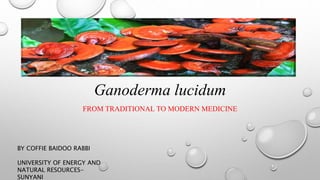

Ganoderma lucidum
FROM TRADITIONAL TO MODERN MEDICINE
BY COFFIE BAIDOO RABBI
UNIVERSITY OF ENERGY AND
NATURAL RESOURCES-
SUNYANI
OUTLINE
Ganoderma lucidum identity
Ganoderma lucidum in traditional medicine
Ganoderma lucidum in the modern medicine
The biologically active compounds of Ganoderma lucidum
Future perspectives of Ganoderma lucidum in medicine
PRESENTATION OBJECTIVES
At the end of the presentation, students should
Know the identity of Ganoderma lucidum
Describe how the Asians used it
State some of the diseases G. lucidum cures
State the biological components of G. lucidum
Describe how G. lucidum is used in modern medicine
INTRODUCTION
TAXONOMIC TREE
• Domain: Eukaryota
• Kingdom: Fungi
• Phylum: Basidiomycota
• Subphylum: Agaricomycotina
• Class: Agaricomycetes
• Subclass: Agaricomycetidae
• Order: Polyporales
• Family: Ganodermataceae
• Genus: Ganoderma
• Species: Ganoderma lucidum
INTRODUCTION
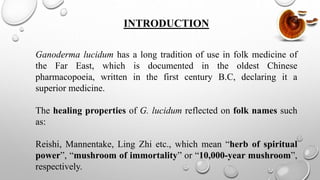
Ganoderma lucidum has a long tradition of use in folk medicine of
the Far East, which is documented in the oldest Chinese
pharmacopoeia, written in the first century B.C, declaring it a
superior medicine.
The healing properties of G. lucidum reflected on folk names such
as:
Reishi, Mannentake, Ling Zhi etc., which mean “herb of spiritual
power”, “mushroom of immortality” or “10,000-year mushroom”,
respectively.
Cont……
It has been known, for thousands of years, that this species extends life
span, increases youthful vigor and vitality and was used to treat a lot
of diseases
Modern scientific researches and numerous clinical trails, conducted
in recent decades, have confirmed the ancient knowledge of Eastern
nations and given them a scientific basis.
Ganoderma lucidum IN TRADITIONAL MEDICINE
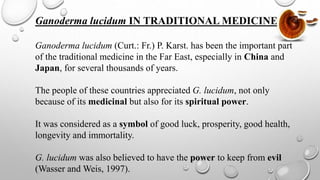
Ganoderma lucidum (Curt.: Fr.) P. Karst. has been the important part
of the traditional medicine in the Far East, especially in China and
Japan, for several thousands of years.
The people of these countries appreciated G. lucidum, not only
because of its medicinal but also for its spiritual power.
It was considered as a symbol of good luck, prosperity, good health,
longevity and immortality.
G. lucidum was also believed to have the power to keep from evil
(Wasser and Weis, 1997).
Cont…
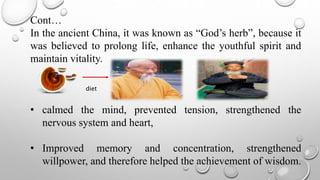
In the ancient China, it was known as “God’s herb”, because it
was believed to prolong life, enhance the youthful spirit and
maintain vitality.
• calmed the mind, prevented tension, strengthened the
nervous system and heart,
• Improved memory and concentration, strengthened
willpower, and therefore helped the achievement of wisdom.
diet
Cont….
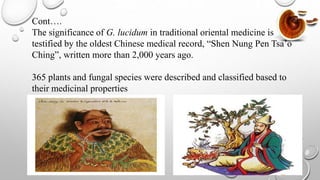
The significance of G. lucidum in traditional oriental medicine is
testified by the oldest Chinese medical record, “Shen Nung Pen Tsa’o
Ching”, written more than 2,000 years ago.
365 plants and fungal species were described and classified based to
their medicinal properties
Cont……
Likewise, in Japan, it is thought that depending on the color and
taste of G. lucidum fruiting bodies, they heal different organs.
• Thus, gray and the acidic ones: improve vision;
• red and bitter: regulate the functioning of the internal organs and
improve memory;
• yellow and sweet ones: affect the spleen and “soothing soul”
• red and hot: act on the lung and increase the courage and boost
will
• black and the salty ones: protect kidneys; and
• sweet ones: improve hearing, act on joints and muscles and
improve the complexion.
Cont…….
This species has been used for several thousands of years in the
treatment of
• hepatitis
• kidney disease
• hypertension
• arthritis
• asthma
• bronchitis
• arteriosclerosis
• ulcers and various types of cancer (Berovič et al. 2003).
Ganoderma lucidum IN THE MODERN MEDICINE
The current researches and numerous clinical trails conducted in recent
decades have confirmed the ancient knowledge of the Eastern nation and
given them a scientific basis.
These studies have demonstrated many biological activities of G. lucidum,
including immunomodulating, cytotoxic, antioxidative, antimicrobial,
anti-inflammatory, hypoglycemic antiallergic, neuroprotective, etc. (Chang
et al. 2006; Zhou et al. 2010; Bishop et al. 2015).
Cont…..
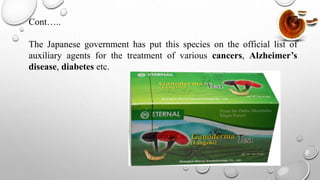
The Japanese government has put this species on the official list of
auxiliary agents for the treatment of various cancers, Alzheimer’s
disease, diabetes etc.
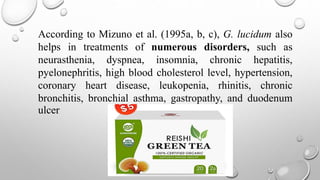
According to Mizuno et al. (1995a, b, c), G. lucidum also
helps in treatments of numerous disorders, such as
neurasthenia, dyspnea, insomnia, chronic hepatitis,
pyelonephritis, high blood cholesterol level, hypertension,
coronary heart disease, leukopenia, rhinitis, chronic
bronchitis, bronchial asthma, gastropathy, and duodenum
ulcer
Cont…
The results of the clinical trail including 2,000 patients suffering from
chronic bronchitis who had been treated with G. lucidum tablets for 2
weeks, showed an improvement of the clinical picture in about 60%–90%
of patients (Chang and But, 1986).
Likewise, it was confirmed that the extract of this species decreased the
blood and plasma viscosities in patients with hypertension and
hyperlipidemia who were recovering from cerebral thrombosis (Wasser
and Weis, 1997).
The usage of G. lucidum in the treatment of hepatitis, in particular in the
case of severe liver damage, has proved rather effective.
THE BIOLOGICALLY ACTIVE COMPOUNDS OF Ganoderma
lucidum
1. Polysaccharides are the main biologically active macromolecules and
the most responsible for the therapeutic application of G. lucidum acting
as immunomodulators and carcinostatics (Berovič et al. 2003).
2. Terpenoids, besides polysaccharides, are the most important bioactive
metabolites and ones of the main carriers of G. lucidum medicinal
properties.
• significant antiviral activity
• inhibition of HIV-1 and HIV-2 protease, as well as HIV-1 reverse
transcriptase.
Cont……
3. Proteins: The bioactive proteins have also been isolated and
characterized from G. lucidum. Example is the immunomodulatory protein
known as Ling Zhi-8 (LZ-8).
The polysaccharide-peptide complexes (Gl-PP) have antitumor and
antiangiogenesis (prevent growth of new blood cells) activities
G. lucidum protein, ganodermin, has antifungal activity against various
micromycetes, especially against some phytopathogens, such as Botrytis
cinerea, Fusarium oxysporum and Physalospora piricola.
4. Phenolic compounds
The dominant phenolic compounds isolated from G. lucidum are gallic
and protocatechuic acids (Stajić et al. 2015).
Polyphenols are the main antioxidative (inhibit oxidation) agents
because they act either as free radicals’ scavengers or carriers of metal
ions
FUTURE PERSPECTIVES OF Ganoderma lucidum IN
MEDICINE
• Despite a long history of usage in traditional medicine and current
studies that proved medicinal potential of G. lucidum, a number of
challenges are still in front of scientists with the aim of its usage in
a clinical practice.
• Firstly, the clarifying of the taxonomy is necessary, since other
Ganoderma species can be mistaken with G. lucidum.
• Further studies on the identification of active ingredients as well as
safe doses ranges should be declared for each disease.
Cont….
• The important research goal should also be the optimization of G. lucidum
cultivation conditions in order to increase yield and to maximize active
constituents’ production.
• Finally, the most important and the most challenging tasks are extensive
preclinical and clinical trials which will provide a convincing evidence of
the effectiveness of G. lucidum based medications.
• NB: preclinical trials are conducted to ascertain the effectiveness of the drug on the
treatment of the targeted disease
CONCLUSION
REFERENCES
1. Berovič M, Habijanič J, Zore I, Wraber B, Hodžar D, Boh B, Pohleven F (2003):
Submerged cultivation of Ganoderma lucidum biomass and immunostimulatory
effects of fungal polysaccharides. J. Biotechnol. 103: 77–86.
2. Bishop KS, Kao CHJ, Xu Y, Glucina MP, Paterson RRM, Ferguson LR (2015):
From 2000 years of Ganoderma lucidum to recent developments in nutraceuticals.
Phytochemistry 114: 56–65.
3. Cao Q, Lin Z (2006): Ganoderma lucidum polysaccharides peptide inhibits the
growth of vascular endothelial cell and the induction of VEGF in human lung
cancer cell. Life Sci. 78: 1457–1463.
4. Chang H, But P (1986): Lingzhi. Pharmacology and application of Chinese
material medica. World Scientific Publishing, Singapore.
5. Ćilerdžić J, Vukojević J, Stajić M, Stanojković T, Glamočlija J (2014): Biological
activity of Ganoderma lucidum basidiocarps cultivated on alternative and
commercial substrate. J. Ethnopharmacol. 155: 312–319.

Ganoderma lucidum

  • 1.
    Ganoderma lucidum FROM TRADITIONALTO MODERN MEDICINE BY COFFIE BAIDOO RABBI UNIVERSITY OF ENERGY AND NATURAL RESOURCES- SUNYANI
  • 2.
    OUTLINE Ganoderma lucidum identity Ganodermalucidum in traditional medicine Ganoderma lucidum in the modern medicine The biologically active compounds of Ganoderma lucidum Future perspectives of Ganoderma lucidum in medicine
  • 3.
    PRESENTATION OBJECTIVES At theend of the presentation, students should Know the identity of Ganoderma lucidum Describe how the Asians used it State some of the diseases G. lucidum cures State the biological components of G. lucidum Describe how G. lucidum is used in modern medicine
  • 4.
    INTRODUCTION TAXONOMIC TREE • Domain:Eukaryota • Kingdom: Fungi • Phylum: Basidiomycota • Subphylum: Agaricomycotina • Class: Agaricomycetes • Subclass: Agaricomycetidae • Order: Polyporales • Family: Ganodermataceae • Genus: Ganoderma • Species: Ganoderma lucidum
  • 5.
    INTRODUCTION Ganoderma lucidum hasa long tradition of use in folk medicine of the Far East, which is documented in the oldest Chinese pharmacopoeia, written in the first century B.C, declaring it a superior medicine. The healing properties of G. lucidum reflected on folk names such as: Reishi, Mannentake, Ling Zhi etc., which mean “herb of spiritual power”, “mushroom of immortality” or “10,000-year mushroom”, respectively.
  • 6.
    Cont…… It has beenknown, for thousands of years, that this species extends life span, increases youthful vigor and vitality and was used to treat a lot of diseases Modern scientific researches and numerous clinical trails, conducted in recent decades, have confirmed the ancient knowledge of Eastern nations and given them a scientific basis.
  • 7.
    Ganoderma lucidum INTRADITIONAL MEDICINE Ganoderma lucidum (Curt.: Fr.) P. Karst. has been the important part of the traditional medicine in the Far East, especially in China and Japan, for several thousands of years. The people of these countries appreciated G. lucidum, not only because of its medicinal but also for its spiritual power. It was considered as a symbol of good luck, prosperity, good health, longevity and immortality. G. lucidum was also believed to have the power to keep from evil (Wasser and Weis, 1997).
  • 8.
    Cont… In the ancientChina, it was known as “God’s herb”, because it was believed to prolong life, enhance the youthful spirit and maintain vitality. • calmed the mind, prevented tension, strengthened the nervous system and heart, • Improved memory and concentration, strengthened willpower, and therefore helped the achievement of wisdom. diet
  • 9.
    Cont…. The significance ofG. lucidum in traditional oriental medicine is testified by the oldest Chinese medical record, “Shen Nung Pen Tsa’o Ching”, written more than 2,000 years ago. 365 plants and fungal species were described and classified based to their medicinal properties
  • 10.
    Cont…… Likewise, in Japan,it is thought that depending on the color and taste of G. lucidum fruiting bodies, they heal different organs. • Thus, gray and the acidic ones: improve vision; • red and bitter: regulate the functioning of the internal organs and improve memory; • yellow and sweet ones: affect the spleen and “soothing soul” • red and hot: act on the lung and increase the courage and boost will • black and the salty ones: protect kidneys; and • sweet ones: improve hearing, act on joints and muscles and improve the complexion.
  • 11.
    Cont……. This species hasbeen used for several thousands of years in the treatment of • hepatitis • kidney disease • hypertension • arthritis • asthma • bronchitis • arteriosclerosis • ulcers and various types of cancer (Berovič et al. 2003).
  • 12.
    Ganoderma lucidum INTHE MODERN MEDICINE The current researches and numerous clinical trails conducted in recent decades have confirmed the ancient knowledge of the Eastern nation and given them a scientific basis. These studies have demonstrated many biological activities of G. lucidum, including immunomodulating, cytotoxic, antioxidative, antimicrobial, anti-inflammatory, hypoglycemic antiallergic, neuroprotective, etc. (Chang et al. 2006; Zhou et al. 2010; Bishop et al. 2015).
  • 13.
    Cont….. The Japanese governmenthas put this species on the official list of auxiliary agents for the treatment of various cancers, Alzheimer’s disease, diabetes etc.
  • 14.
    According to Mizunoet al. (1995a, b, c), G. lucidum also helps in treatments of numerous disorders, such as neurasthenia, dyspnea, insomnia, chronic hepatitis, pyelonephritis, high blood cholesterol level, hypertension, coronary heart disease, leukopenia, rhinitis, chronic bronchitis, bronchial asthma, gastropathy, and duodenum ulcer
  • 15.
    Cont… The results ofthe clinical trail including 2,000 patients suffering from chronic bronchitis who had been treated with G. lucidum tablets for 2 weeks, showed an improvement of the clinical picture in about 60%–90% of patients (Chang and But, 1986). Likewise, it was confirmed that the extract of this species decreased the blood and plasma viscosities in patients with hypertension and hyperlipidemia who were recovering from cerebral thrombosis (Wasser and Weis, 1997). The usage of G. lucidum in the treatment of hepatitis, in particular in the case of severe liver damage, has proved rather effective.
  • 16.
    THE BIOLOGICALLY ACTIVECOMPOUNDS OF Ganoderma lucidum 1. Polysaccharides are the main biologically active macromolecules and the most responsible for the therapeutic application of G. lucidum acting as immunomodulators and carcinostatics (Berovič et al. 2003). 2. Terpenoids, besides polysaccharides, are the most important bioactive metabolites and ones of the main carriers of G. lucidum medicinal properties. • significant antiviral activity • inhibition of HIV-1 and HIV-2 protease, as well as HIV-1 reverse transcriptase.
  • 17.
    Cont…… 3. Proteins: Thebioactive proteins have also been isolated and characterized from G. lucidum. Example is the immunomodulatory protein known as Ling Zhi-8 (LZ-8). The polysaccharide-peptide complexes (Gl-PP) have antitumor and antiangiogenesis (prevent growth of new blood cells) activities G. lucidum protein, ganodermin, has antifungal activity against various micromycetes, especially against some phytopathogens, such as Botrytis cinerea, Fusarium oxysporum and Physalospora piricola.
  • 18.
    4. Phenolic compounds Thedominant phenolic compounds isolated from G. lucidum are gallic and protocatechuic acids (Stajić et al. 2015). Polyphenols are the main antioxidative (inhibit oxidation) agents because they act either as free radicals’ scavengers or carriers of metal ions
  • 19.
    FUTURE PERSPECTIVES OFGanoderma lucidum IN MEDICINE • Despite a long history of usage in traditional medicine and current studies that proved medicinal potential of G. lucidum, a number of challenges are still in front of scientists with the aim of its usage in a clinical practice. • Firstly, the clarifying of the taxonomy is necessary, since other Ganoderma species can be mistaken with G. lucidum. • Further studies on the identification of active ingredients as well as safe doses ranges should be declared for each disease.
  • 20.
    Cont…. • The importantresearch goal should also be the optimization of G. lucidum cultivation conditions in order to increase yield and to maximize active constituents’ production. • Finally, the most important and the most challenging tasks are extensive preclinical and clinical trials which will provide a convincing evidence of the effectiveness of G. lucidum based medications. • NB: preclinical trials are conducted to ascertain the effectiveness of the drug on the treatment of the targeted disease
  • 21.
  • 22.
    REFERENCES 1. Berovič M,Habijanič J, Zore I, Wraber B, Hodžar D, Boh B, Pohleven F (2003): Submerged cultivation of Ganoderma lucidum biomass and immunostimulatory effects of fungal polysaccharides. J. Biotechnol. 103: 77–86. 2. Bishop KS, Kao CHJ, Xu Y, Glucina MP, Paterson RRM, Ferguson LR (2015): From 2000 years of Ganoderma lucidum to recent developments in nutraceuticals. Phytochemistry 114: 56–65. 3. Cao Q, Lin Z (2006): Ganoderma lucidum polysaccharides peptide inhibits the growth of vascular endothelial cell and the induction of VEGF in human lung cancer cell. Life Sci. 78: 1457–1463. 4. Chang H, But P (1986): Lingzhi. Pharmacology and application of Chinese material medica. World Scientific Publishing, Singapore. 5. Ćilerdžić J, Vukojević J, Stajić M, Stanojković T, Glamočlija J (2014): Biological activity of Ganoderma lucidum basidiocarps cultivated on alternative and commercial substrate. J. Ethnopharmacol. 155: 312–319.