JIWAJI UNIVERSITY GWALIOR
TOPIC:- T-CELL MATURATION, ACTIVATION, AND DIFFERENTIATION
PRESENTED TO : PRESENTED BY:
HEAD OF THE DEPARTMENT Manisha Singhai
SOS IN M.H.G M.Sc. 2nd Semester
SYNOPSIS
INTRODUCTION
MATURATION OF T CELL
THYMIC SELECTION
ACTIVATION OF T CELL
DIFFERENTIATION OF T CELL
CONCLUSION
REFERENCES
INTRODUCTION
 T Lymphocytes are the principal cell players in the adaptive immune response.
 They represent 20% to 40% of circulating white blood cells and 99% of cells in the lymph.
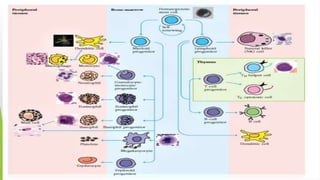
 Formation of lymphocytes take place in the bone marrow. And lymphocyte broadly subdivided
into three subpopulation-
(A) B-lymphocyte or B-Cell (B) T-lymphocyte or T-Cell and
(C) Natural killer cell (NK Cell)
 T lymphocytes occur in the bone marrow and their site of maturation in the thymus.
 Like the B cell, the T cell expresses a unique antigen-binding receptor called
the T-cell receptor.
 T lymphocytes are subdivided into two major cell types—
T-helper (TH) cells and T cytotoxic (TC) cells—that can be distinguished from one another by the
presence of either CD4 or CD8 membrane glycoproteins on heir surfaces.
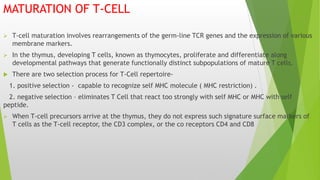
MATURATION OF T-CELL
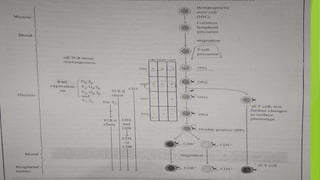
 T-cell maturation involves rearrangements of the germ-line TCR genes and the expression of various
membrane markers.
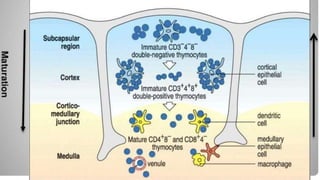
 In the thymus, developing T cells, known as thymocytes, proliferate and differentiate along
developmental pathways that generate functionally distinct subpopulations of mature T cells.
 There are two selection process for T-Cell repertoire-
1. positive selection - capable to recognize self MHC molecule ( MHC restriction) .
2. negative selection – eliminates T Cell that react too strongly with self MHC or MHC with self
peptide.
 When T-cell precursors arrive at the thymus, they do not express such signature surface markers of
T cells as the T-cell receptor, the CD3 complex, or the co receptors CD4 and CD8
Thymic selection
 Thymocytes undergo two selection process-
(1) positive selection
(2) negative selection
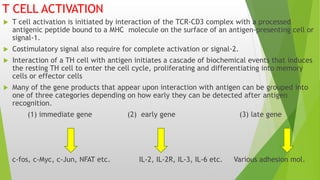
T CELL ACTIVATION
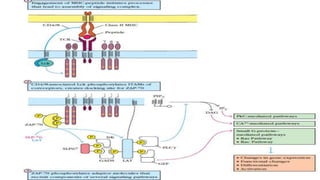
 T cell activation is initiated by interaction of the TCR-CD3 complex with a processed
antigenic peptide bound to a MHC molecule on the surface of an antigen-presenting cell or
signal-1.
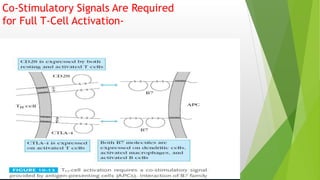
 Costimulatory signal also require for complete activation or signal-2.
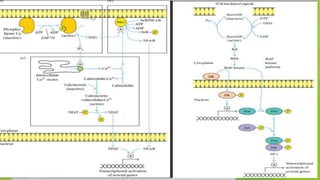
 Interaction of a TH cell with antigen initiates a cascade of biochemical events that induces
the resting TH cell to enter the cell cycle, proliferating and differentiating into memory
cells or effector cells
 Many of the gene products that appear upon interaction with antigen can be grouped into
one of three categories depending on how early they can be detected after antigen
recognition.
(1) immediate gene (2) early gene (3) late gene
c-fos, c-Myc, c-Jun, NFAT etc. IL-2, IL-2R, IL-3, IL-6 etc. Various adhesion mol.
Co-Stimulatory Signals Are Required
for Full T-Cell Activation-
T-Cell Differentiation
 CD4 and CD8 T cells leave the thymus and enter the circulation as resting cells in
the G0 stage of the cell cycle.
 T cells that have not yet encountered antigen known as naive T cells, are
characterized by condensed chromatin, very little cytoplasm, and little
transcriptional activity.
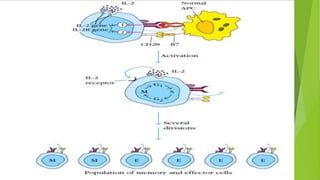
 If a naïve T cell encountered with a specific antigen it become active.
 activation depends on a signal induced by engagement of the TCR complex and a
co-stimulatory signal induced by the CD28-B7 interaction. These signals trigger entry
of the T cell into the G1 phase of the cell cycle.
 at the same time, induce transcription of the gene for IL-2 and the alpha-chain of
the high-affinity IL-2 receptor. In addition, the co-stimulatory signal increases the
half-life of the IL-2 mRNA. The increase in IL-2 transcription, together with
stabilization of the IL-2 mRNA, increases IL-2 production
CONCLUSIONS
 T Cell contributes the major protective function in the immune system and
prevent the body from infectious agent.
 T Cell show specificity for antigen and make a broad part of adaptive immune
system, which recognize specific antigen.
 The rearrangement in the TCR gene, which provide huge diversity for various
types of antigens, so there is at least one possibility to found one antibody for
various type of antigens.
 T Cell also regulate immunity or suppress the activated T Cell, that prevent
autoimmunity or autoimmune disorders (Ts)
REFERENCES
KUBY IMMUNOLOGY
Cellular and molecular immunology by abbas and lichtman
ncbi
THANKS.

Manisha t cell

  • 1.
    JIWAJI UNIVERSITY GWALIOR TOPIC:-T-CELL MATURATION, ACTIVATION, AND DIFFERENTIATION PRESENTED TO : PRESENTED BY: HEAD OF THE DEPARTMENT Manisha Singhai SOS IN M.H.G M.Sc. 2nd Semester
  • 2.
    SYNOPSIS INTRODUCTION MATURATION OF TCELL THYMIC SELECTION ACTIVATION OF T CELL DIFFERENTIATION OF T CELL CONCLUSION REFERENCES
  • 3.
    INTRODUCTION  T Lymphocytesare the principal cell players in the adaptive immune response.  They represent 20% to 40% of circulating white blood cells and 99% of cells in the lymph.  Formation of lymphocytes take place in the bone marrow. And lymphocyte broadly subdivided into three subpopulation- (A) B-lymphocyte or B-Cell (B) T-lymphocyte or T-Cell and (C) Natural killer cell (NK Cell)  T lymphocytes occur in the bone marrow and their site of maturation in the thymus.  Like the B cell, the T cell expresses a unique antigen-binding receptor called the T-cell receptor.  T lymphocytes are subdivided into two major cell types— T-helper (TH) cells and T cytotoxic (TC) cells—that can be distinguished from one another by the presence of either CD4 or CD8 membrane glycoproteins on heir surfaces.
  • 5.
    MATURATION OF T-CELL T-cell maturation involves rearrangements of the germ-line TCR genes and the expression of various membrane markers.  In the thymus, developing T cells, known as thymocytes, proliferate and differentiate along developmental pathways that generate functionally distinct subpopulations of mature T cells.  There are two selection process for T-Cell repertoire- 1. positive selection - capable to recognize self MHC molecule ( MHC restriction) . 2. negative selection – eliminates T Cell that react too strongly with self MHC or MHC with self peptide.  When T-cell precursors arrive at the thymus, they do not express such signature surface markers of T cells as the T-cell receptor, the CD3 complex, or the co receptors CD4 and CD8
  • 8.
    Thymic selection  Thymocytesundergo two selection process- (1) positive selection (2) negative selection
  • 9.
    T CELL ACTIVATION T cell activation is initiated by interaction of the TCR-CD3 complex with a processed antigenic peptide bound to a MHC molecule on the surface of an antigen-presenting cell or signal-1.  Costimulatory signal also require for complete activation or signal-2.  Interaction of a TH cell with antigen initiates a cascade of biochemical events that induces the resting TH cell to enter the cell cycle, proliferating and differentiating into memory cells or effector cells  Many of the gene products that appear upon interaction with antigen can be grouped into one of three categories depending on how early they can be detected after antigen recognition. (1) immediate gene (2) early gene (3) late gene c-fos, c-Myc, c-Jun, NFAT etc. IL-2, IL-2R, IL-3, IL-6 etc. Various adhesion mol.
  • 12.
    Co-Stimulatory Signals AreRequired for Full T-Cell Activation-
  • 13.
    T-Cell Differentiation  CD4and CD8 T cells leave the thymus and enter the circulation as resting cells in the G0 stage of the cell cycle.  T cells that have not yet encountered antigen known as naive T cells, are characterized by condensed chromatin, very little cytoplasm, and little transcriptional activity.  If a naïve T cell encountered with a specific antigen it become active.  activation depends on a signal induced by engagement of the TCR complex and a co-stimulatory signal induced by the CD28-B7 interaction. These signals trigger entry of the T cell into the G1 phase of the cell cycle.  at the same time, induce transcription of the gene for IL-2 and the alpha-chain of the high-affinity IL-2 receptor. In addition, the co-stimulatory signal increases the half-life of the IL-2 mRNA. The increase in IL-2 transcription, together with stabilization of the IL-2 mRNA, increases IL-2 production
  • 15.
    CONCLUSIONS  T Cellcontributes the major protective function in the immune system and prevent the body from infectious agent.  T Cell show specificity for antigen and make a broad part of adaptive immune system, which recognize specific antigen.  The rearrangement in the TCR gene, which provide huge diversity for various types of antigens, so there is at least one possibility to found one antibody for various type of antigens.  T Cell also regulate immunity or suppress the activated T Cell, that prevent autoimmunity or autoimmune disorders (Ts)
  • 16.
    REFERENCES KUBY IMMUNOLOGY Cellular andmolecular immunology by abbas and lichtman ncbi
  • 17.