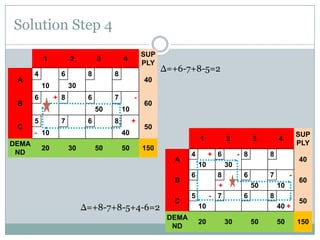
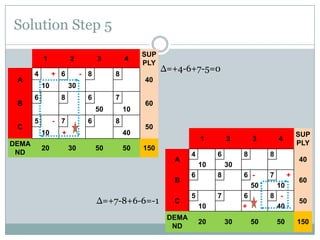
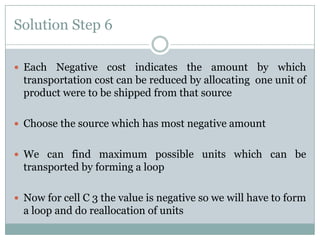
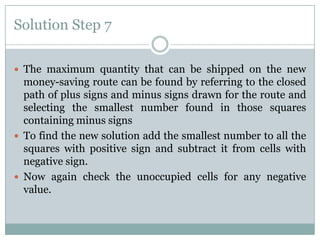

Transportation Problem:
Stepping Stone Method

MBA OIL & GAS 2013-2015
Stepping Stone Method
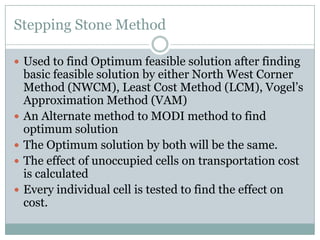
 Used to find Optimum feasible solution after finding






basic feasible solution by either North West Corner
Method (NWCM), Least Cost Method (LCM), Vogel’s
Approximation Method (VAM)
An Alternate method to MODI method to find
optimum solution
The Optimum solution by both will be the same.
The effect of unoccupied cells on transportation cost
is calculated
Every individual cell is tested to find the effect on
cost.
Steps Involved
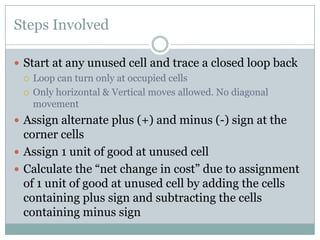
 Start at any unused cell and trace a closed loop back
 Loop can turn only at occupied cells
 Only horizontal & Vertical moves allowed. No diagonal
movement
 Assign alternate plus (+) and minus (-) sign at the

corner cells
 Assign 1 unit of good at unused cell
 Calculate the “net change in cost” due to assignment
of 1 unit of good at unused cell by adding the cells
containing plus sign and subtracting the cells
containing minus sign
Problem
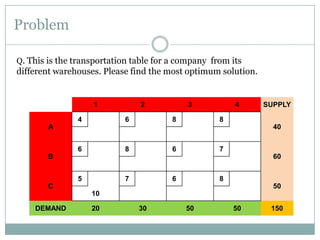
Q. This is the transportation table for a company from its

different warehouses. Please find the most optimum solution.

1
4

2
6

3
8

4

SUPPLY

8

A

40

6

8

6

7

B

60
5

7

6

8

C

50
10

DEMAND

20

30

50

50

150
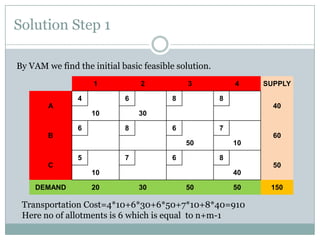
Solution Step 1
By VAM we find the initial basic feasible solution.
1
4

2
6

3
8

4
8

A

40
10
6

30
8

6

7

B

60

50
5

7

6

10
8

C

50
10

DEMAND

SUPPLY

20

40
30

50

50

Transportation Cost=4*10+6*30+6*50+7*10+8*40=910
Here no of allotments is 6 which is equal to n+m-1

150
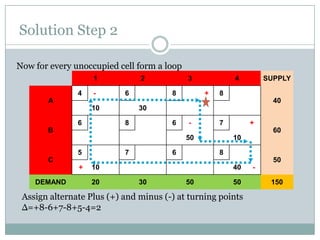
Solution Step 2
Now for every unoccupied cell form a loop
1
4

-

2
6

3
8

4
+

SUPPLY

8

A

40
10
6

30
8

6

-

7

+

B

60
50
5

7

6

10
8

C

50
+

DEMAND

10
20

40
30

50

50

Assign alternate Plus (+) and minus (-) at turning points
Δ=+8-6+7-8+5-4=2

150
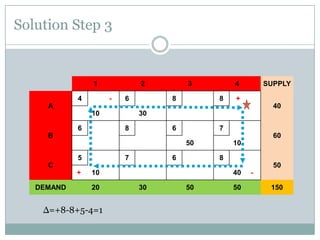
Solution Step 3

1
4

2
-

6

3
8

4
8

SUPPLY

+

A

40
10
6

30
8

6

7

B

60

50
5

7

6

10
8

C

50
+

DEMAND

10
20

Δ=+8-8+5-4=1

40
30

50

50

150
Solution Step 4
1
A

B
C
DEMA
ND

4

2
6

10
6

3
8

8

6

7
50

7

6

20

10

8

- 10

+
40

30

50

Δ=+6-7+8-5=2

40

30
+ 8

5

SUP
PLY

4

50

60
50
1
150
A
B

Δ=+8-7+8-5+4-6=2

C
DEMA
ND

4

2
+ 6

10

6

8

6

7

40

30
50
6

10

8

10

20

SUP
PLY

4

- 8

8
+
- 7

5

3

40 +

30

50

50

60
50

150
Solution Step 5
1
A

B
C
DEMA
ND

4

2
+ 6

10
6

3

4

- 8

8

6

7
50

5

- 7
10
20

6

10
8

+

40
30

50

Δ=+4-6+7-5=0

40

30
8

SUP
PLY

50

60
50
1
150
A
B

Δ=+7-8+6-6=-1

C
DEMA
ND

4

2
6

10

6

8

6 50
6
+

7

40

30

7
10

20

SUP
PLY

4

8

8

5

3

30

50

+

10
8 40

50

60
50

150
Solution Step 6
 Each

Negative cost indicates the amount by which
transportation cost can be reduced by allocating one unit of
product were to be shipped from that source

 Choose the source which has most negative amount
 We can find maximum possible units which can be

transported by forming a loop
 Now for cell C 3 the value is negative so we will have to form

a loop and do reallocation of units
Solution Step 7
 The maximum quantity that can be shipped on the new

money-saving route can be found by referring to the closed
path of plus signs and minus signs drawn for the route and
selecting the smallest number found in those squares
containing minus signs
 To find the new solution add the smallest number to all the
squares with positive sign and subtract it from cells with
negative sign.
 Now again check the unoccupied cells for any negative
value.
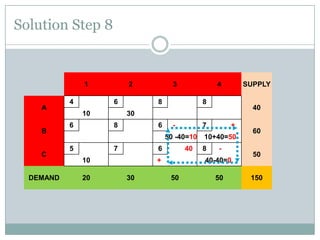
Solution Step 8

1
A
B
C
DEMAND

4

2
6

10

6

3

4

8

8

6

-

7

50 -40=10
7

6

10
20

40

30

8

5

SUPPLY

40

+
30

+

10+40=50
8

-

40-40=0
50

50

60
50
150
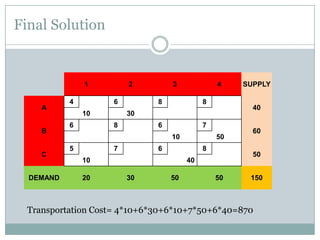
Final Solution

1
A
B
C
DEMAND

4

2
6

10

6

3

4

8

8

6

7
10

5

7

50

6

8

10
20

40

30

8

50

60
50

40
30

SUPPLY

50

150

Transportation Cost= 4*10+6*30+6*10+7*50+6*40=870
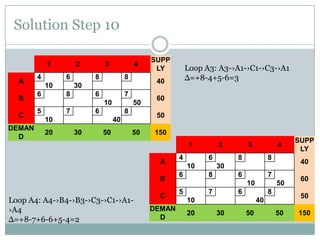
Solution Step 10
1

A
B
C
DEMAN
D

4

2
6

10
6

3

4

8

8

6

7
10

5

7

8

10

20

50

6

50

60
50

40

30

Loop A3: A3-›A1-›C1-›C3-›A1
Δ=+8-4+5-6=3

40

30
8

SUPP
LY

50

150
1
A
B

Loop A4: A4-›B4-›B3-›C3-›C1-›A1›A4
Δ=+8-7+6-6+5-4=2

C
DEMAN
D

4

2
6

10
6

3

4

8

8

6

7
10

5

7

50

6

8

10
20

40

30
8

50

60
50

40
30

SUPP
LY

50

150
Solution Step 10
1

A
B
C
DEMAN
D

4

2
6

10
6

3

4

8

8

6

7
10

5

7

8

10

20

50

6

50

60
50

40

30

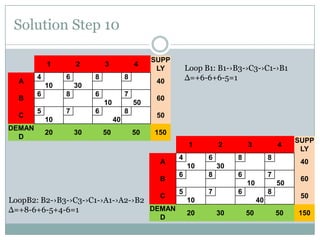
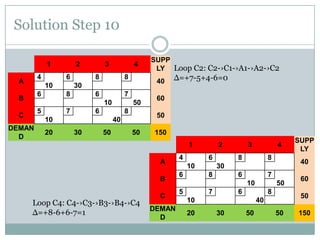
Loop B1: B1-›B3-›C3-›C1-›B1
Δ=+6-6+6-5=1

40

30
8

SUPP
LY

50

150
1
A
B
C

LoopB2: B2-›B3-›C3-›C1-›A1-›A2-›B2
DEMAN
Δ=+8-6+6-5+4-6=1
D

4

2
6

10
6

3

4

8

8

6

7
10

5

7

50

6

8

10
20

40

30
8

50

60
50

40
30

SUPP
LY

50

150
Solution Step 10
1
4

A

2
6

10
6

B

3

4

8

8

6

7
10

5

C

7

20

50

6

8

10

DEMAN
D

40

30
8

50

Δ=+7-5+4-6=0

60
50

40

30

SUPP
LY Loop C2: C2-›C1-›A1-›A2-›C2

50

150
1
A
B

Loop C4: C4-›C3-›B3-›B4-›C4
Δ=+8-6+6-7=1

C
DEMAN
D

4

2
6

10
6

3

4

8

8

6

7
10

5

7

50

6

8

10
20

40

30
8

50

60
50

40
30

SUPP
LY

50

150
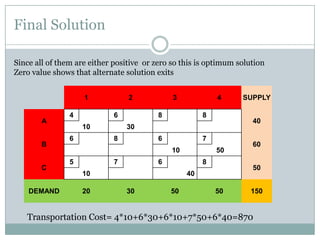
Final Solution
Since all of them are either positive or zero so this is optimum solution
Zero value shows that alternate solution exits
1
A
B
C
DEMAND

4

2
6

10
6

3

4

8

8

6

7
10

5

7

50

6

8

10
20

40

30
8

50

60
50

40
30

SUPPLY

50

150

Transportation Cost= 4*10+6*30+6*10+7*50+6*40=870
Thanks!!!

Transportation Problem- Stepping Stone Method

  • 1.
    Transportation Problem: Stepping StoneMethod MBA OIL & GAS 2013-2015
  • 2.
    Stepping Stone Method Used to find Optimum feasible solution after finding     basic feasible solution by either North West Corner Method (NWCM), Least Cost Method (LCM), Vogel’s Approximation Method (VAM) An Alternate method to MODI method to find optimum solution The Optimum solution by both will be the same. The effect of unoccupied cells on transportation cost is calculated Every individual cell is tested to find the effect on cost.
  • 3.
    Steps Involved  Startat any unused cell and trace a closed loop back  Loop can turn only at occupied cells  Only horizontal & Vertical moves allowed. No diagonal movement  Assign alternate plus (+) and minus (-) sign at the corner cells  Assign 1 unit of good at unused cell  Calculate the “net change in cost” due to assignment of 1 unit of good at unused cell by adding the cells containing plus sign and subtracting the cells containing minus sign
  • 4.
    Problem Q. This isthe transportation table for a company from its different warehouses. Please find the most optimum solution. 1 4 2 6 3 8 4 SUPPLY 8 A 40 6 8 6 7 B 60 5 7 6 8 C 50 10 DEMAND 20 30 50 50 150
  • 5.
    Solution Step 1 ByVAM we find the initial basic feasible solution. 1 4 2 6 3 8 4 8 A 40 10 6 30 8 6 7 B 60 50 5 7 6 10 8 C 50 10 DEMAND SUPPLY 20 40 30 50 50 Transportation Cost=4*10+6*30+6*50+7*10+8*40=910 Here no of allotments is 6 which is equal to n+m-1 150
  • 6.
    Solution Step 2 Nowfor every unoccupied cell form a loop 1 4 - 2 6 3 8 4 + SUPPLY 8 A 40 10 6 30 8 6 - 7 + B 60 50 5 7 6 10 8 C 50 + DEMAND 10 20 40 30 50 50 Assign alternate Plus (+) and minus (-) at turning points Δ=+8-6+7-8+5-4=2 150
  • 7.
  • 8.
    Solution Step 4 1 A B C DEMA ND 4 2 6 10 6 3 8 8 6 7 50 7 6 20 10 8 -10 + 40 30 50 Δ=+6-7+8-5=2 40 30 + 8 5 SUP PLY 4 50 60 50 1 150 A B Δ=+8-7+8-5+4-6=2 C DEMA ND 4 2 + 6 10 6 8 6 7 40 30 50 6 10 8 10 20 SUP PLY 4 - 8 8 + - 7 5 3 40 + 30 50 50 60 50 150
  • 9.
    Solution Step 5 1 A B C DEMA ND 4 2 +6 10 6 3 4 - 8 8 6 7 50 5 - 7 10 20 6 10 8 + 40 30 50 Δ=+4-6+7-5=0 40 30 8 SUP PLY 50 60 50 1 150 A B Δ=+7-8+6-6=-1 C DEMA ND 4 2 6 10 6 8 6 50 6 + 7 40 30 7 10 20 SUP PLY 4 8 8 5 3 30 50 + 10 8 40 50 60 50 150
  • 10.
    Solution Step 6 Each Negative cost indicates the amount by which transportation cost can be reduced by allocating one unit of product were to be shipped from that source  Choose the source which has most negative amount  We can find maximum possible units which can be transported by forming a loop  Now for cell C 3 the value is negative so we will have to form a loop and do reallocation of units
  • 11.
    Solution Step 7 The maximum quantity that can be shipped on the new money-saving route can be found by referring to the closed path of plus signs and minus signs drawn for the route and selecting the smallest number found in those squares containing minus signs  To find the new solution add the smallest number to all the squares with positive sign and subtract it from cells with negative sign.  Now again check the unoccupied cells for any negative value.
  • 12.
    Solution Step 8 1 A B C DEMAND 4 2 6 10 6 3 4 8 8 6 - 7 50-40=10 7 6 10 20 40 30 8 5 SUPPLY 40 + 30 + 10+40=50 8 - 40-40=0 50 50 60 50 150
  • 13.
  • 14.
    Solution Step 10 1 A B C DEMAN D 4 2 6 10 6 3 4 8 8 6 7 10 5 7 8 10 20 50 6 50 60 50 40 30 LoopA3: A3-›A1-›C1-›C3-›A1 Δ=+8-4+5-6=3 40 30 8 SUPP LY 50 150 1 A B Loop A4: A4-›B4-›B3-›C3-›C1-›A1›A4 Δ=+8-7+6-6+5-4=2 C DEMAN D 4 2 6 10 6 3 4 8 8 6 7 10 5 7 50 6 8 10 20 40 30 8 50 60 50 40 30 SUPP LY 50 150
  • 15.
    Solution Step 10 1 A B C DEMAN D 4 2 6 10 6 3 4 8 8 6 7 10 5 7 8 10 20 50 6 50 60 50 40 30 LoopB1: B1-›B3-›C3-›C1-›B1 Δ=+6-6+6-5=1 40 30 8 SUPP LY 50 150 1 A B C LoopB2: B2-›B3-›C3-›C1-›A1-›A2-›B2 DEMAN Δ=+8-6+6-5+4-6=1 D 4 2 6 10 6 3 4 8 8 6 7 10 5 7 50 6 8 10 20 40 30 8 50 60 50 40 30 SUPP LY 50 150
  • 16.
    Solution Step 10 1 4 A 2 6 10 6 B 3 4 8 8 6 7 10 5 C 7 20 50 6 8 10 DEMAN D 40 30 8 50 Δ=+7-5+4-6=0 60 50 40 30 SUPP LYLoop C2: C2-›C1-›A1-›A2-›C2 50 150 1 A B Loop C4: C4-›C3-›B3-›B4-›C4 Δ=+8-6+6-7=1 C DEMAN D 4 2 6 10 6 3 4 8 8 6 7 10 5 7 50 6 8 10 20 40 30 8 50 60 50 40 30 SUPP LY 50 150
  • 17.
    Final Solution Since allof them are either positive or zero so this is optimum solution Zero value shows that alternate solution exits 1 A B C DEMAND 4 2 6 10 6 3 4 8 8 6 7 10 5 7 50 6 8 10 20 40 30 8 50 60 50 40 30 SUPPLY 50 150 Transportation Cost= 4*10+6*30+6*10+7*50+6*40=870
  • 18.