Page 1
Page 2
TransporTaTion
problem
“North West Corner
Method”
Page 3
Group Members:
Muhammad Daniyal Ashfaq (051)
Muhammad Waleed Aslam (014)
Javeria Khalid Hassan (047)
Shahrukh Hussain (032)
Course Instructor:
Ms. Faiza Shahid
Page 4
AgendaAgenda
Topics
 Introduction
 Concept of TP
 History of TP
 Application of TP
 Process of TP
 Methods/Techniques
 NWCM
 Types of TP
 Steps
 Problem Statement
 Balanced Problem
 Unbalanced Problem
 Program
 References
Page 5
Transportation Problem (TP)Transportation Problem (TP)
It deals with sources where a
supply of some commodity is
available and destinations where
the commodity is demanded. The
classic statement of the TP uses a
matrix with the rows representing
sources and columns representing
destinations.
IntroductionIntroduction
Page 6
Concept of TPConcept of TP
Transportation is a O.R technique intended to establish
the “least cost route” of transportation of goods from
the company’s factories to its warehouses at different
places.
It’s a special type of linear programming problem (LLP)
that involves transportation of goods from supply
points (factories) to the demand points (warehouses).
The problem involves determination of optimum routes
to minimize shipping route from supply to destinations.
Page 7
History of TPHistory of TP
“The Distribution of a Product from Several Sources of
Numerous Localities”
Study by: F.L. Hitchcock (1941)
“Optimum Utilization of the Transportation System”
Study by: T.C Koopmans (1947)
These two contribution are mainly responsible for the
development of Transportation Model.
Page 8
Application of TPApplication of TP
Minimize shipping costs
Determine low cost location
Find minimum cost production schedule
Military distribution system
Page 9
Process of TPProcess of TP
Standardization of problem
Check the nature of the problem
Check prohibited cell
Check balancing problem
Page 10
Methods/TechniquesMethods/Techniques
North West
Corner Method
(NWCM)
Least Cost
Method
(LCM)
Vogel’s
Approximation
Method (VAM)
Methods AvailableMethods Available
Page 11
North West CornerNorth West Corner
“Most systematic and easiest method for
obtaining initial feasible basic solution”
Page 12
Types of TPTypes of TP
Balanced Transportation Problem (TP)
where the Total Supply = Total Demand
 Unbalanced Transportation Problem (TP)
where the Total Supply ≠ Total Demand
Page 13
Steps to FollowSteps to Follow
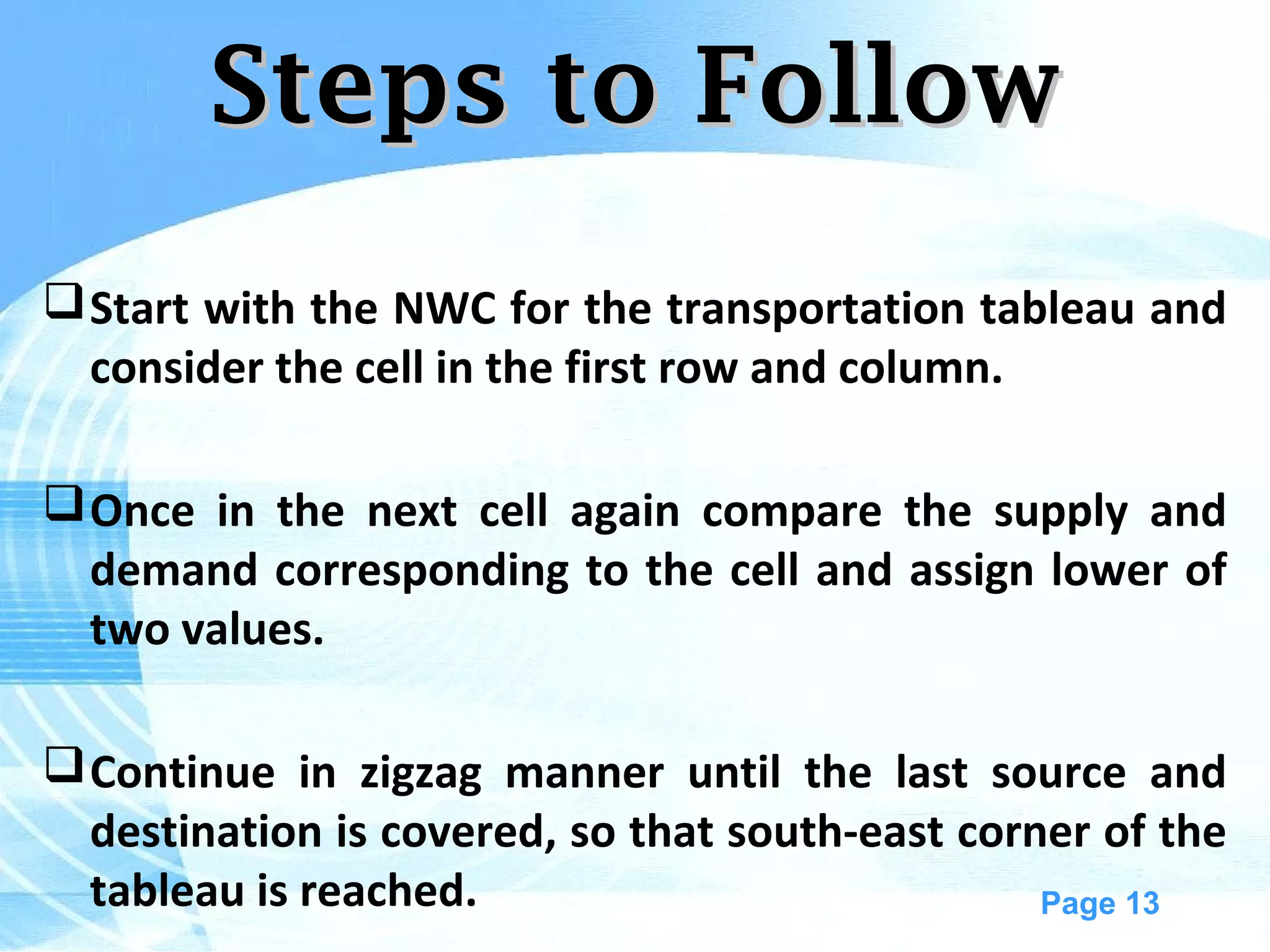
Start with the NWC for the transportation tableau and
consider the cell in the first row and column.
Once in the next cell again compare the supply and
demand corresponding to the cell and assign lower of
two values.
Continue in zigzag manner until the last source and
destination is covered, so that south-east corner of the
tableau is reached.
Page 14
Problem StatementProblem Statement
A Medical Supply company produces catheters in packs
at three production facilities. The company ships the
packs from the production facilities to four warehouses.
The packs are distributed directly to hospitals from the
warehouses.
The table on the next slide shows the costs per pack to
ship to the four warehouses.
Medical SupplyMedical Supply
Page 15
Problem StatementProblem Statement
Page 16
Balanced ProblemBalanced Problem
Page 17
Balanced ProblemBalanced Problem
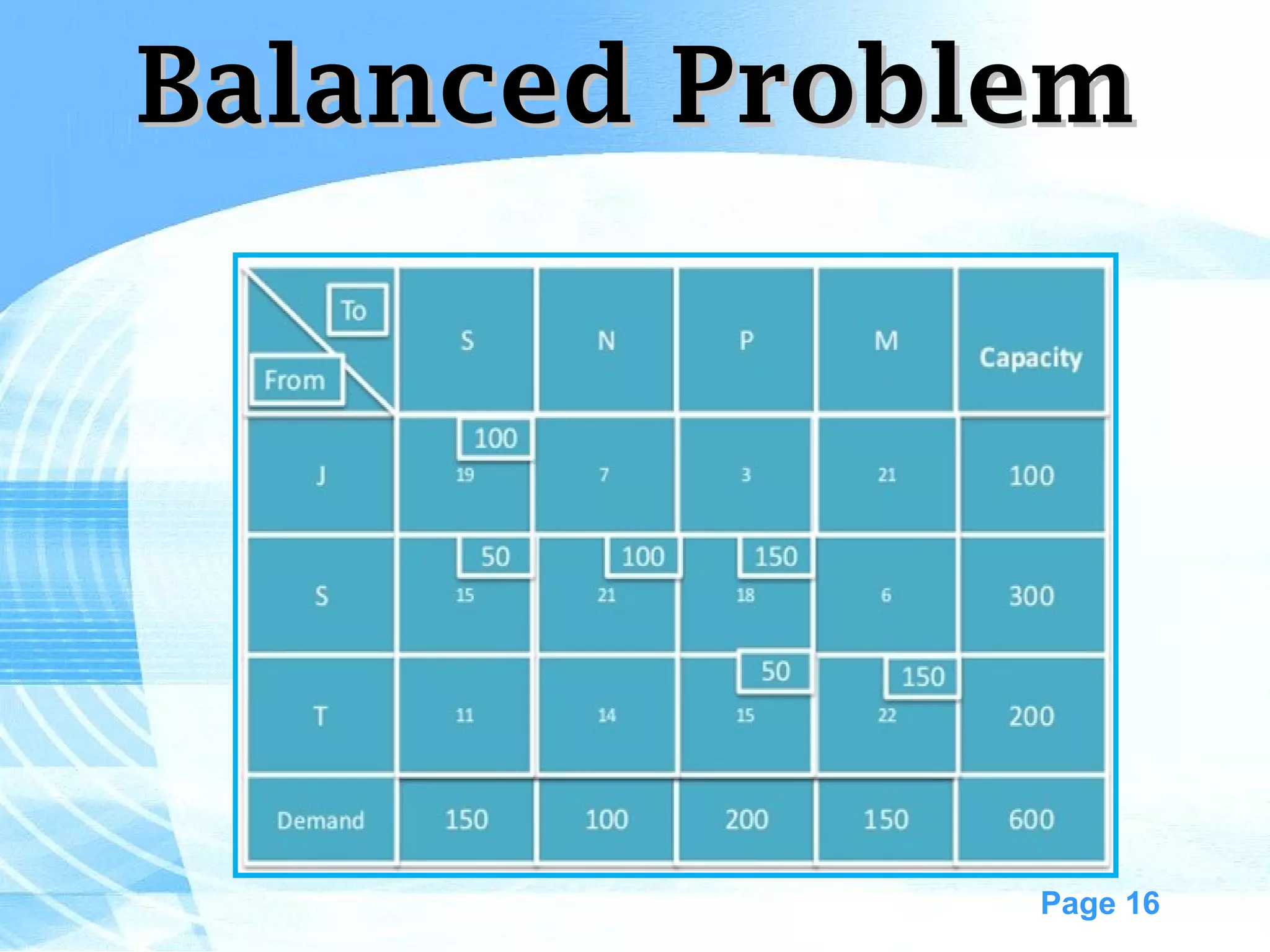
= 19 (100) + 15 (50) + 21(100) + 18 (150) + 15(50) +
22(150)
= 1900 + 750 + 2100 + 750 + 3300
= 11,500
Cost/Feasible Solution:Cost/Feasible Solution:
Page 18
Unbalanced ProblemUnbalanced Problem
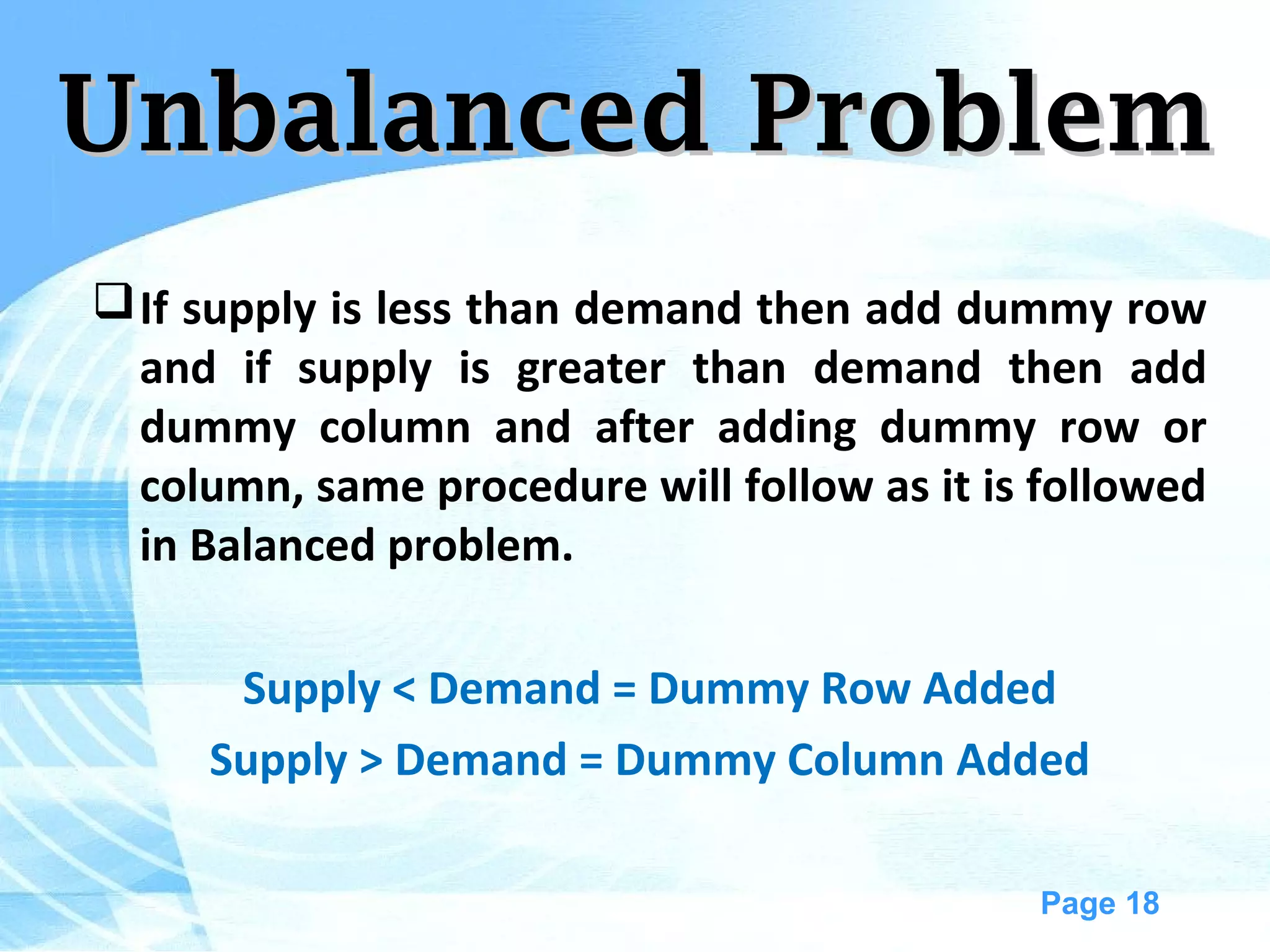
If supply is less than demand then add dummy row
and if supply is greater than demand then add
dummy column and after adding dummy row or
column, same procedure will follow as it is followed
in Balanced problem.
Supply < Demand = Dummy Row Added
Supply > Demand = Dummy Column Added
Page 19
ProgramProgram
Page 20
Page 21
Page 22
ReferencesReferences
Page 23
Page 24

North West Corner Method

  • 1.
  • 2.
  • 3.
    Page 3 Group Members: MuhammadDaniyal Ashfaq (051) Muhammad Waleed Aslam (014) Javeria Khalid Hassan (047) Shahrukh Hussain (032) Course Instructor: Ms. Faiza Shahid
  • 4.
    Page 4 AgendaAgenda Topics  Introduction Concept of TP  History of TP  Application of TP  Process of TP  Methods/Techniques  NWCM  Types of TP  Steps  Problem Statement  Balanced Problem  Unbalanced Problem  Program  References
  • 5.
    Page 5 Transportation Problem(TP)Transportation Problem (TP) It deals with sources where a supply of some commodity is available and destinations where the commodity is demanded. The classic statement of the TP uses a matrix with the rows representing sources and columns representing destinations. IntroductionIntroduction
  • 6.
    Page 6 Concept ofTPConcept of TP Transportation is a O.R technique intended to establish the “least cost route” of transportation of goods from the company’s factories to its warehouses at different places. It’s a special type of linear programming problem (LLP) that involves transportation of goods from supply points (factories) to the demand points (warehouses). The problem involves determination of optimum routes to minimize shipping route from supply to destinations.
  • 7.
    Page 7 History ofTPHistory of TP “The Distribution of a Product from Several Sources of Numerous Localities” Study by: F.L. Hitchcock (1941) “Optimum Utilization of the Transportation System” Study by: T.C Koopmans (1947) These two contribution are mainly responsible for the development of Transportation Model.
  • 8.
    Page 8 Application ofTPApplication of TP Minimize shipping costs Determine low cost location Find minimum cost production schedule Military distribution system
  • 9.
    Page 9 Process ofTPProcess of TP Standardization of problem Check the nature of the problem Check prohibited cell Check balancing problem
  • 10.
    Page 10 Methods/TechniquesMethods/Techniques North West CornerMethod (NWCM) Least Cost Method (LCM) Vogel’s Approximation Method (VAM) Methods AvailableMethods Available
  • 11.
    Page 11 North WestCornerNorth West Corner “Most systematic and easiest method for obtaining initial feasible basic solution”
  • 12.
    Page 12 Types ofTPTypes of TP Balanced Transportation Problem (TP) where the Total Supply = Total Demand  Unbalanced Transportation Problem (TP) where the Total Supply ≠ Total Demand
  • 13.
    Page 13 Steps toFollowSteps to Follow Start with the NWC for the transportation tableau and consider the cell in the first row and column. Once in the next cell again compare the supply and demand corresponding to the cell and assign lower of two values. Continue in zigzag manner until the last source and destination is covered, so that south-east corner of the tableau is reached.
  • 14.
    Page 14 Problem StatementProblemStatement A Medical Supply company produces catheters in packs at three production facilities. The company ships the packs from the production facilities to four warehouses. The packs are distributed directly to hospitals from the warehouses. The table on the next slide shows the costs per pack to ship to the four warehouses. Medical SupplyMedical Supply
  • 15.
  • 16.
  • 17.
    Page 17 Balanced ProblemBalancedProblem = 19 (100) + 15 (50) + 21(100) + 18 (150) + 15(50) + 22(150) = 1900 + 750 + 2100 + 750 + 3300 = 11,500 Cost/Feasible Solution:Cost/Feasible Solution:
  • 18.
    Page 18 Unbalanced ProblemUnbalancedProblem If supply is less than demand then add dummy row and if supply is greater than demand then add dummy column and after adding dummy row or column, same procedure will follow as it is followed in Balanced problem. Supply < Demand = Dummy Row Added Supply > Demand = Dummy Column Added
  • 19.
  • 20.
  • 21.
  • 22.
  • 23.
  • 24.