The Barcode
Presented by:
Youssef Ismail
Aslam Eltashanni
Ceren Turan
Sara Hussein
Fohn Asobah
Presentation date: Monday 14th December 2015
1
Outline
 Punch cards & bull’s eye barcode
 UPC barcode
 Barcode scanners
 QR codes
2
Introduction
 Problems solved by the barcode
 Development of the invention
 First standardised system
 Scanning the barcodes
 Where the barcode is today
3
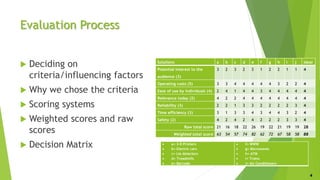
Evaluation Process
 Deciding on
criteria/influencing factors
 Why we chose the criteria
 Scoring systems
 Weighted scores and raw
scores
 Decision Matrix
Solutions a b c d e f g h i j Ideal
Potential interest to the
audience (3)
3 2 3 2 3 1 2 2 1 1 4
Operating costs (5) 3 3 4 4 4 4 4 3 2 2 4
Ease of use by individuals (4) 2 4 1 4 4 3 4 4 4 4 4
Relevance today (2) 4 2 2 4 4 4 4 4 4 4 4
Reliability (3) 2 2 1 3 3 2 2 2 2 3 4
Time efficiency (3) 3 1 3 3 4 3 4 4 3 2 4
Safety (2) 4 2 4 2 4 2 2 2 3 3 4
Raw total score 21 16 18 22 26 19 22 21 19 19 28
Weighted total score 63 54 57 74 82 62 72 67 58 58 88
 a= 3-D Printers
 b= Electric cars
 c= Lie detectors
 d= Treadmills
 e= Barcode
 f= WWW
 g= Microwaves
 h= ATM
 i= Trains
 j= Air Conditioners
4
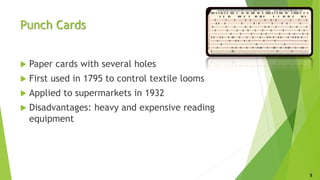
Punch Cards
 Paper cards with several holes
 First used in 1795 to control textile looms
 Applied to supermarkets in 1932
 Disadvantages: heavy and expensive reading
equipment
5
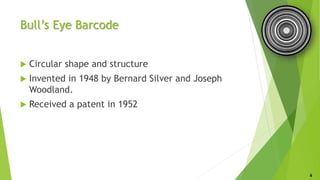
Bull’s Eye Barcode
 Circular shape and structure
 Invented in 1948 by Bernard Silver and Joseph
Woodland.
 Received a patent in 1952
6
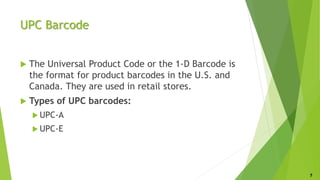
UPC Barcode
 The Universal Product Code or the 1-D Barcode is
the format for product barcodes in the U.S. and
Canada. They are used in retail stores.
 Types of UPC barcodes:
 UPC-A
 UPC-E
7
UPC Barcode
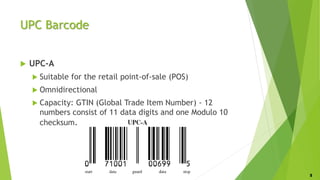
 UPC-A
 Suitable for the retail point-of-sale (POS)
 Omnidirectional
 Capacity: GTIN (Global Trade Item Number) - 12
numbers consist of 11 data digits and one Modulo 10
checksum.
8
UPC Barcode
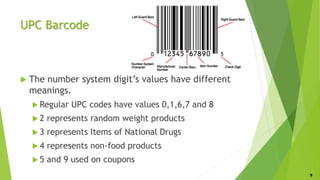
 The number system digit’s values have different
meanings.
 Regular UPC codes have values 0,1,6,7 and 8
 2 represents random weight products
 3 represents Items of National Drugs
 4 represents non-food products
 5 and 9 used on coupons
9
UPC Barcode
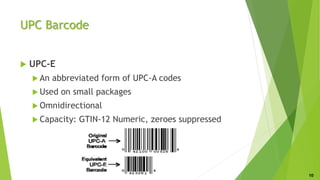
 UPC-E
 An abbreviated form of UPC-A codes
 Used on small packages
 Omnidirectional
 Capacity: GTIN-12 Numeric, zeroes suppressed
10
Barcode Scanners
Who invented
the first
scanner?
Where it was
installed
What was the
first item to
be scanned?
The first scanner was invented by George Laurer.
At Marsh’s supermarket.
A packet of Wrigley's Gum
11
Barcode Scanners
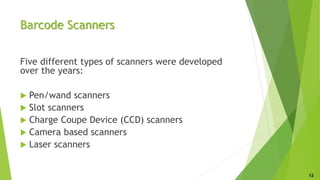
Five different types of scanners were developed
over the years:
 Pen/wand scanners
 Slot scanners
 Charge Coupe Device (CCD) scanners
 Camera based scanners
 Laser scanners
12
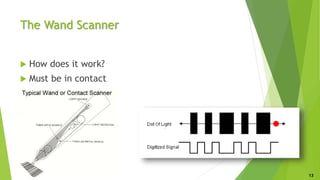
The Wand Scanner
 How does it work?
 Must be in contact
13
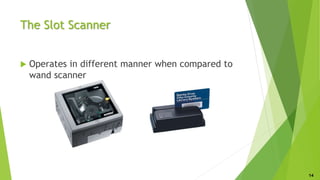
The Slot Scanner
 Operates in different manner when compared to
wand scanner
14
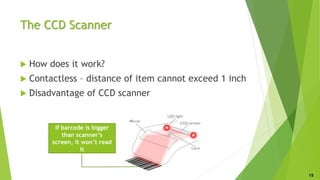
The CCD Scanner
 How does it work?
 Contactless – distance of item cannot exceed 1 inch
 Disadvantage of CCD scanner
If barcode is bigger
than scanner’s
screen, it won’t read
it
15
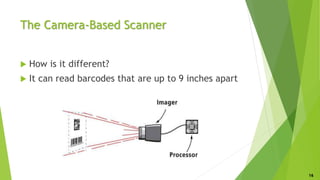
The Camera-Based Scanner
 How is it different?
 It can read barcodes that are up to 9 inches apart
16
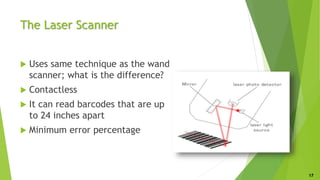
The Laser Scanner
 Uses same technique as the wand
scanner; what is the difference?
 Contactless
 It can read barcodes that are up
to 24 inches apart
 Minimum error percentage
17
Future of the Barcode
 Quick Response (QR) Codes
 A two dimensional barcode read using
smartphones or QR reading devices
 Invented by Denso-Wave in 1994
 Scanning is done using phone’s camera
 Ideal placement location
18
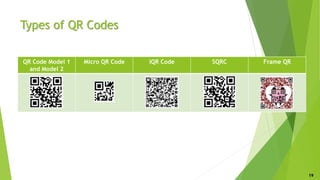
Types of QR Codes
QR Code Model 1
and Model 2
Micro QR Code IQR Code SQRC Frame QR
19
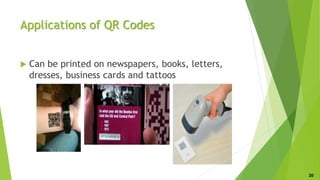
Applications of QR Codes
 Can be printed on newspapers, books, letters,
dresses, business cards and tattoos
20
Conclusion
 Allowed businesses to save time and money
 Has made shopping a lot quicker and reduced
queueing times
 Standardisation to the UPC barcode
 QR Codes: How barcodes are moving with new
technologies
21
Thank you for listening
22
Questions?
23
References
 http://www.physics. Rutgers.edu/~pchandra/physiss397/Handout10. pdf.
 http://www.barcodingfonts.com/pdf/UPC.pdf
 http://www.computalabel.com/aboutupc.htm
 http://www.barcodeisland.com/upce.phtml
 http://inventors.about.com/od/bstartinventions/a/Bar-Codes.htm
 http://whatis.techtarget.com/definition/barcode-reader-POS-scanner-bar-code-reader-
price-scanner
 http://www.taltech.com/barcodesoftware/articles/how_barcode_reader_works
 Content Marketing Institute, seven Creative and Effective QR Code Examples From Around the
World, http://contentmarketinginstitute.com/2012/06/effective-qr-code-examples-from-
around-the-world/ (accessed 29th November, 2015)
 Scanova Blog, How to Scan QR codes, http://scanova.io/blog/blog/2015/05/14/how-to-scan-
qr-codes/. (accessed 29th November, 2015)
24

"The Barcode" Presentation

  • 1.
    The Barcode Presented by: YoussefIsmail Aslam Eltashanni Ceren Turan Sara Hussein Fohn Asobah Presentation date: Monday 14th December 2015 1
  • 2.
    Outline  Punch cards& bull’s eye barcode  UPC barcode  Barcode scanners  QR codes 2
  • 3.
    Introduction  Problems solvedby the barcode  Development of the invention  First standardised system  Scanning the barcodes  Where the barcode is today 3
  • 4.
    Evaluation Process  Decidingon criteria/influencing factors  Why we chose the criteria  Scoring systems  Weighted scores and raw scores  Decision Matrix Solutions a b c d e f g h i j Ideal Potential interest to the audience (3) 3 2 3 2 3 1 2 2 1 1 4 Operating costs (5) 3 3 4 4 4 4 4 3 2 2 4 Ease of use by individuals (4) 2 4 1 4 4 3 4 4 4 4 4 Relevance today (2) 4 2 2 4 4 4 4 4 4 4 4 Reliability (3) 2 2 1 3 3 2 2 2 2 3 4 Time efficiency (3) 3 1 3 3 4 3 4 4 3 2 4 Safety (2) 4 2 4 2 4 2 2 2 3 3 4 Raw total score 21 16 18 22 26 19 22 21 19 19 28 Weighted total score 63 54 57 74 82 62 72 67 58 58 88  a= 3-D Printers  b= Electric cars  c= Lie detectors  d= Treadmills  e= Barcode  f= WWW  g= Microwaves  h= ATM  i= Trains  j= Air Conditioners 4
  • 5.
    Punch Cards  Papercards with several holes  First used in 1795 to control textile looms  Applied to supermarkets in 1932  Disadvantages: heavy and expensive reading equipment 5
  • 6.
    Bull’s Eye Barcode Circular shape and structure  Invented in 1948 by Bernard Silver and Joseph Woodland.  Received a patent in 1952 6
  • 7.
    UPC Barcode  TheUniversal Product Code or the 1-D Barcode is the format for product barcodes in the U.S. and Canada. They are used in retail stores.  Types of UPC barcodes:  UPC-A  UPC-E 7
  • 8.
    UPC Barcode  UPC-A Suitable for the retail point-of-sale (POS)  Omnidirectional  Capacity: GTIN (Global Trade Item Number) - 12 numbers consist of 11 data digits and one Modulo 10 checksum. 8
  • 9.
    UPC Barcode  Thenumber system digit’s values have different meanings.  Regular UPC codes have values 0,1,6,7 and 8  2 represents random weight products  3 represents Items of National Drugs  4 represents non-food products  5 and 9 used on coupons 9
  • 10.
    UPC Barcode  UPC-E An abbreviated form of UPC-A codes  Used on small packages  Omnidirectional  Capacity: GTIN-12 Numeric, zeroes suppressed 10
  • 11.
    Barcode Scanners Who invented thefirst scanner? Where it was installed What was the first item to be scanned? The first scanner was invented by George Laurer. At Marsh’s supermarket. A packet of Wrigley's Gum 11
  • 12.
    Barcode Scanners Five differenttypes of scanners were developed over the years:  Pen/wand scanners  Slot scanners  Charge Coupe Device (CCD) scanners  Camera based scanners  Laser scanners 12
  • 13.
    The Wand Scanner How does it work?  Must be in contact 13
  • 14.
    The Slot Scanner Operates in different manner when compared to wand scanner 14
  • 15.
    The CCD Scanner How does it work?  Contactless – distance of item cannot exceed 1 inch  Disadvantage of CCD scanner If barcode is bigger than scanner’s screen, it won’t read it 15
  • 16.
    The Camera-Based Scanner How is it different?  It can read barcodes that are up to 9 inches apart 16
  • 17.
    The Laser Scanner Uses same technique as the wand scanner; what is the difference?  Contactless  It can read barcodes that are up to 24 inches apart  Minimum error percentage 17
  • 18.
    Future of theBarcode  Quick Response (QR) Codes  A two dimensional barcode read using smartphones or QR reading devices  Invented by Denso-Wave in 1994  Scanning is done using phone’s camera  Ideal placement location 18
  • 19.
    Types of QRCodes QR Code Model 1 and Model 2 Micro QR Code IQR Code SQRC Frame QR 19
  • 20.
    Applications of QRCodes  Can be printed on newspapers, books, letters, dresses, business cards and tattoos 20
  • 21.
    Conclusion  Allowed businessesto save time and money  Has made shopping a lot quicker and reduced queueing times  Standardisation to the UPC barcode  QR Codes: How barcodes are moving with new technologies 21
  • 22.
    Thank you forlistening 22
  • 23.
  • 24.
    References  http://www.physics. Rutgers.edu/~pchandra/physiss397/Handout10.pdf.  http://www.barcodingfonts.com/pdf/UPC.pdf  http://www.computalabel.com/aboutupc.htm  http://www.barcodeisland.com/upce.phtml  http://inventors.about.com/od/bstartinventions/a/Bar-Codes.htm  http://whatis.techtarget.com/definition/barcode-reader-POS-scanner-bar-code-reader- price-scanner  http://www.taltech.com/barcodesoftware/articles/how_barcode_reader_works  Content Marketing Institute, seven Creative and Effective QR Code Examples From Around the World, http://contentmarketinginstitute.com/2012/06/effective-qr-code-examples-from- around-the-world/ (accessed 29th November, 2015)  Scanova Blog, How to Scan QR codes, http://scanova.io/blog/blog/2015/05/14/how-to-scan- qr-codes/. (accessed 29th November, 2015) 24