DKTE’s Textile & Engineering Institute
Electronics Department
Seminar on
BARCODE TECHNOLOGY
Presented by:
Neeta Bhimrao Chavare
Key Points :
• What is barcode?
• Why use barcodes?
• Barcode types
• Working of barcode
• Advantages
• Application
• What is QR code
• Inside QR code
• Advantages
• Application
• References
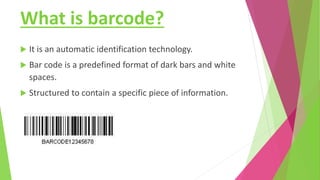
What is barcode?
 It is an automatic identification technology.
 Bar code is a predefined format of dark bars and white
spaces.
 Structured to contain a specific piece of information.
Why use barcodes?
 As far back as the 1960s, barcodes were used in
industrial work environments.
 In the early 1970s, common barcodes started appearing
on grocery shelves.
 Today, barcodes are just about everywhere and are
used for identification in almost all types of business.
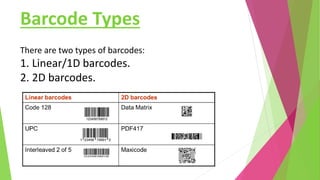
Barcode Types
There are two types of barcodes:
1. Linear/1D barcodes.
2. 2D barcodes.
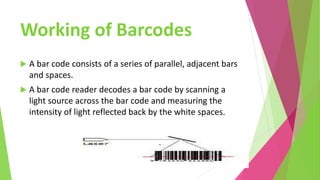
Working of Barcodes
 A bar code consists of a series of parallel, adjacent bars
and spaces.
 A bar code reader decodes a bar code by scanning a
light source across the bar code and measuring the
intensity of light reflected back by the white spaces.
Advantages
 Represent unique identity
of a product.
 Accuracy of data input.
(error free)
 Labor savings by avoiding
manual system.
 More accurate dispatch.
 Cost efficient.
 Real time data collection.
 Measurement of work in
progress throughout the
factory.
 Rapid access to total
production costs.
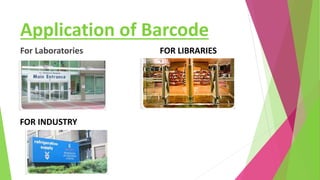
Application of Barcode
For Laboratories FOR LIBRARIES
FOR INDUSTRY
QR Code
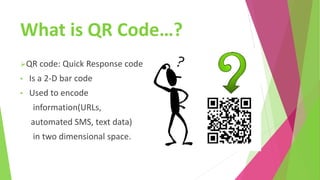
What is QR Code…?
QR code: Quick Response code
• Is a 2-D bar code
• Used to encode
information(URLs,
automated SMS, text data)
in two dimensional space.
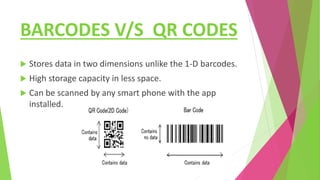
BARCODES V/S QR CODES
 Stores data in two dimensions unlike the 1-D barcodes.
 High storage capacity in less space.
 Can be scanned by any smart phone with the app
installed.
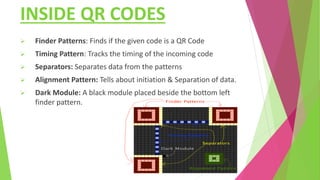
INSIDE QR CODES
 Finder Patterns: Finds if the given code is a QR Code
 Timing Pattern: Tracks the timing of the incoming code
 Separators: Separates data from the patterns
 Alignment Pattern: Tells about initiation & Separation of data.
 Dark Module: A black module placed beside the bottom left
finder pattern.
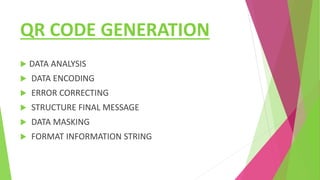
QR CODE GENERATION
 DATA ANALYSIS
 DATA ENCODING
 ERROR CORRECTING
 STRUCTURE FINAL MESSAGE
 DATA MASKING
 FORMAT INFORMATION STRING
Advantages
 QR codes are not time limited in anyway and don’t
expire.
 You can generate as many as you need.
 There are no limits on the number of times they can be
scanned.
Application
 Human tracking robot using QR codes.
 Most commonly used barcode as of recent especially
with mobile phones.
Reference
International Journal of Emerging Trends & Technology in
Computer Science (IJETTCS) Web Site: www.ijettcs.org Email:
editor@ijettcs.org, editorijettcs@gmail.com ISSN 2278-6856
H. Aoki, S. Matsushita: “Balloon Tag: (In)visible Marker Which
Tells Who’s Who,” Proc.of the 4th IEEE International Symposium
on Wearable Computers, pp. 181-182 (2000-2010)
Thank You!

Barcode technology ppt

  • 1.
    DKTE’s Textile &Engineering Institute Electronics Department Seminar on BARCODE TECHNOLOGY Presented by: Neeta Bhimrao Chavare
  • 2.
    Key Points : •What is barcode? • Why use barcodes? • Barcode types • Working of barcode • Advantages • Application • What is QR code • Inside QR code • Advantages • Application • References
  • 3.
    What is barcode? It is an automatic identification technology.  Bar code is a predefined format of dark bars and white spaces.  Structured to contain a specific piece of information.
  • 4.
    Why use barcodes? As far back as the 1960s, barcodes were used in industrial work environments.  In the early 1970s, common barcodes started appearing on grocery shelves.  Today, barcodes are just about everywhere and are used for identification in almost all types of business.
  • 5.
    Barcode Types There aretwo types of barcodes: 1. Linear/1D barcodes. 2. 2D barcodes.
  • 6.
    Working of Barcodes A bar code consists of a series of parallel, adjacent bars and spaces.  A bar code reader decodes a bar code by scanning a light source across the bar code and measuring the intensity of light reflected back by the white spaces.
  • 7.
    Advantages  Represent uniqueidentity of a product.  Accuracy of data input. (error free)  Labor savings by avoiding manual system.  More accurate dispatch.  Cost efficient.  Real time data collection.  Measurement of work in progress throughout the factory.  Rapid access to total production costs.
  • 8.
    Application of Barcode ForLaboratories FOR LIBRARIES FOR INDUSTRY
  • 9.
  • 10.
    What is QRCode…? QR code: Quick Response code • Is a 2-D bar code • Used to encode information(URLs, automated SMS, text data) in two dimensional space.
  • 11.
    BARCODES V/S QRCODES  Stores data in two dimensions unlike the 1-D barcodes.  High storage capacity in less space.  Can be scanned by any smart phone with the app installed.
  • 12.
    INSIDE QR CODES Finder Patterns: Finds if the given code is a QR Code  Timing Pattern: Tracks the timing of the incoming code  Separators: Separates data from the patterns  Alignment Pattern: Tells about initiation & Separation of data.  Dark Module: A black module placed beside the bottom left finder pattern.
  • 13.
    QR CODE GENERATION DATA ANALYSIS  DATA ENCODING  ERROR CORRECTING  STRUCTURE FINAL MESSAGE  DATA MASKING  FORMAT INFORMATION STRING
  • 14.
    Advantages  QR codesare not time limited in anyway and don’t expire.  You can generate as many as you need.  There are no limits on the number of times they can be scanned.
  • 15.
    Application  Human trackingrobot using QR codes.  Most commonly used barcode as of recent especially with mobile phones.
  • 16.
    Reference International Journal ofEmerging Trends & Technology in Computer Science (IJETTCS) Web Site: www.ijettcs.org Email: editor@ijettcs.org, editorijettcs@gmail.com ISSN 2278-6856 H. Aoki, S. Matsushita: “Balloon Tag: (In)visible Marker Which Tells Who’s Who,” Proc.of the 4th IEEE International Symposium on Wearable Computers, pp. 181-182 (2000-2010)
  • 17.